


Overview
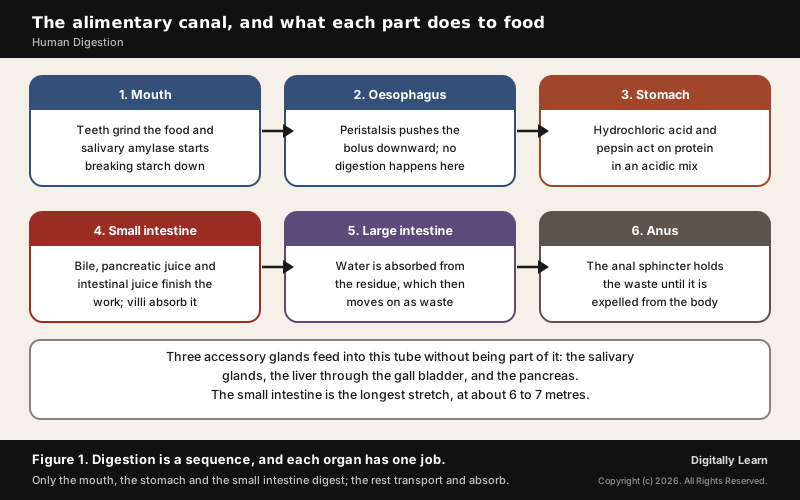
The human digestive system breaks food into molecules small enough to be absorbed across a cell membrane. It is built around the alimentary canal, a continuous tube from mouth to anus in which only three regions digest anything: the mouth begins on starch, the stomach works on protein, and the small intestine completes all three classes of food with the help of bile from the liver and enzymes from the pancreas.
Food, Nutrients and What a Balanced Diet Means
Nutrients, Energy and What the Body Takes From Food
Nutrition is the process by which an organism takes in food and uses it to build tissue, to repair what is worn out and to release energy. The body does not absorb a meal as it is eaten: it first breaks the food into molecules small enough to cross a cell membrane, and absorbs those.
A nutrient is any component of food that performs one of those functions. Nutrients fall into two groups by the quantity needed. Macronutrients, meaning carbohydrates, proteins and fats, are needed in grams a day and supply nearly all the energy.
Micronutrients, meaning vitamins and minerals, are needed in milligrams or micrograms and supply no energy at all. A shortage of any one still produces a specific deficiency disease, which is why they are taken up separately in the article on vitamins, minerals and nutrition programmes.
Three properties separate the macronutrients from one another and decide how each is handled:
- (i) Energy density. Carbohydrates and proteins each yield about four kilocalories per gram, while fats yield about nine. That difference is why fat is capped as a share of energy and carbohydrate is not.
- (ii) Substitutability. The body can make glucose from other sources and can store fat, but it cannot synthesise the essential amino acids or the essential fatty acids, which must arrive ready-made.
- (iii) Site of digestion. Starch begins to break down in the mouth, protein in the stomach, and fat only in the small intestine. No single organ digests all three.
Balanced Diet: Shares of Energy, Not a List of Foods
A balanced diet supplies every nutrient in the amount the body needs, from foods that are actually available and affordable. India's dietary guidelines, issued by the ICMR-National Institute of Nutrition, define it as a set of proportions of a day's energy rather than a list of permitted foods.
The Dietary Guidelines issued in 2024 set out seventeen guidelines and sort foods into ten groups. The institute's My Plate for the Day asks that a day's food draw on at least ten of those groups, with vegetables, fruits, green leafy vegetables, roots and tubers together occupying essentially half the plate.
Within that plate the guidelines set explicit ceilings. Cereals and millets, which dominate most diets here, are limited to about 45 per cent of total energy. Total fat is not to exceed 30 per cent, protein contributes about 15 per cent, and added sugar is to stay under 5 per cent.
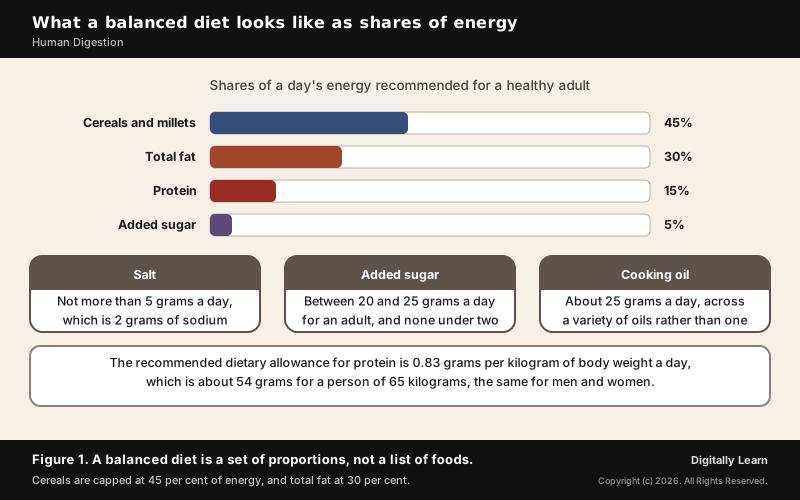
Three daily limits sit alongside those shares. Salt is to be held to not more than 5 grams a day, which is 2 grams of sodium. Added sugar is to be held between 20 and 25 grams a day for an adult, and children under two are to be given none.
Cooking oil is to be held to about 25 grams a day, and the guidelines ask for that quantity to be spread across a variety of oils rather than drawn from a single one, because no one oil supplies a good balance of the three kinds of fatty acid.
Recommended Dietary Allowance and the Protein Requirement
A recommended dietary allowance is the daily intake judged sufficient for almost every healthy person in a group. It sits deliberately above the estimated average requirement, which would meet the needs of only half that group, so that the allowance covers variation between individuals rather than the average person alone.
For protein the guidelines put the allowance at 0.83 grams per kilogram of body weight a day. For a person weighing 65 kilograms that is an estimated average requirement of about 43 grams and a recommended allowance of about 54 grams a day, the same figure regardless of physical activity or gender.
Two consequences follow. The allowance is expressed per kilogram of body weight, so it scales with the person and cannot be quoted as one national number. The guidelines also advise meeting it from cereals, millets and pulses rather than from protein supplements, because a mixed plate supplies a range of amino acids that one source does not.
Parts of the Human Digestive System, Organ by Organ
The Alimentary Canal and the Process of Digestion
The alimentary canal is a single continuous tube from the mouth to the anus, along which different regions have become specialised for different tasks. Food moves one way, pushed by peristalsis, the rhythmic contraction of the muscle in the wall, and held at each boundary by a ring of muscle called a sphincter.
The human digestive system works by a division of labour along the canal. Only three regions digest anything. The mouth begins the breakdown of starch, the stomach works on protein, and the small intestine completes all three classes of food. Every other region transports, absorbs water, or stores.
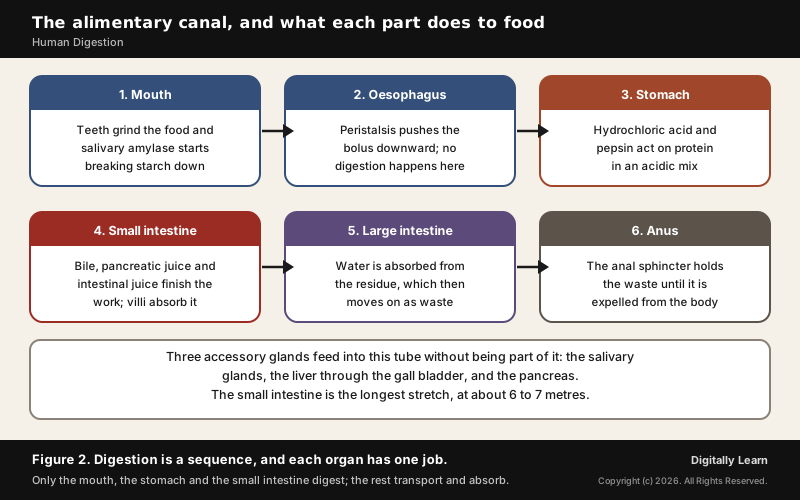
Digestion begins in the mouth. The teeth reduce food mechanically while the salivary glands release saliva carrying salivary amylase, which starts converting starch into sugar. The tongue mixes food with saliva into a bolus, which the oesophagus then carries downward, digesting nothing on the way.
Three accessory glands feed into the canal without forming part of the tube. The salivary glands open into the mouth, the liver delivers bile through the gall bladder, and the pancreas delivers pancreatic juice. Each is essential to digestion while lying outside the passage that food itself takes.
The whole process of digestion in human beings can be followed in six steps:
- Mouth: Teeth break the food down and salivary amylase begins turning starch into sugar; the tongue shapes the food into a bolus.
- Oesophagus: Peristalsis carries the bolus down to the stomach; nothing is digested here.
- Stomach: Hydrochloric acid, pepsin and mucus are released, and protein digestion begins in an acid medium.
- Small intestine: Bile and pancreatic juice enter the duodenum, and trypsin, amylase and lipase complete the digestion of protein, starch and fat.
- Intestinal lining: The digested molecules pass into the blood and are carried first to the liver by the hepatic portal vein.
- Large intestine: Water is absorbed from the residue, and the waste is held until the anal sphincter releases it.
The Stomach: Hydrochloric Acid, Pepsin and the Mucus Lining
The stomach is a muscular bag in which food is churned and protein digestion begins. The gastric glands in its wall release three secretions at once, and each depends on the others:
- Hydrochloric acid creates the strongly acidic medium that the stomach’s own enzyme requires. At a pH between one and three it also plays a protective role against pathogens arriving with the food.
- Pepsin, the protein-digesting enzyme of the stomach, works only in acid, which is why the acid has to be present before it can act at all.
- Mucus coats the inner lining and protects the stomach wall from being digested by its own acid and its own enzyme.
The third secretion keeps the stomach from digesting itself: mucus protects the inner lining from the acid under normal conditions. Those last words matter, because the protection can fail.
Where that protection fails the result is a peptic ulcer. The causes most commonly named are infection with Helicobacter pylori and heavy use of non-steroidal anti-inflammatory drugs, so the defect is usually in the protective layer rather than in the acid.
Food leaves the stomach through a sphincter that releases it into the small intestine in small quantities rather than all at once. That controlled release is what allows the next stage, where the medium must be alkaline rather than acidic, to work at all.
The Small Intestine: Duodenum, Jejunum and Ileum
The small intestine is the longest part of the canal, about six to seven metres in an adult, and it is where all three classes of food are finally broken down. It divides into three structural parts, and their order along the canal is the reverse of the order of their lengths.
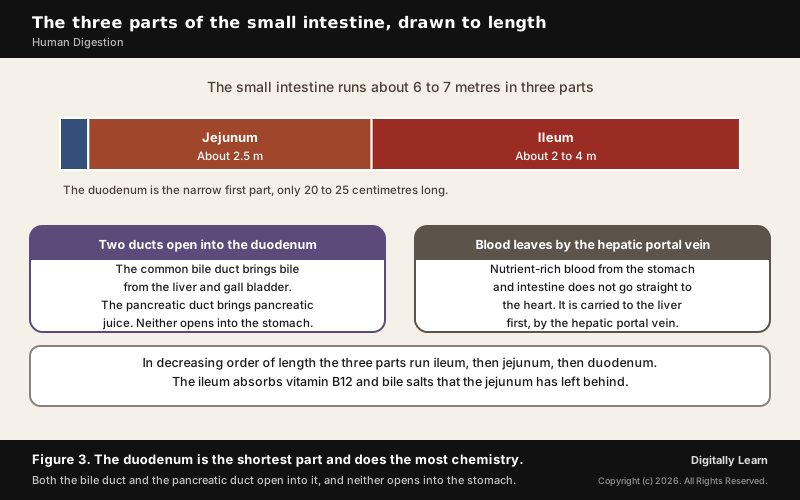
The duodenum is the first and much the shortest part, only about 20 to 25 centimetres long, shaped like the letter C around the head of the pancreas. The jejunum follows at about 2.5 metres.
The ileum is the final part, about 2 to 4 metres long, and it absorbs vitamin B12 and the bile salts that the jejunum has left behind. In decreasing order of length the three therefore run ileum, then jejunum, then duodenum, which inverts their anatomical order.
Two ducts open into the duodenum and into no other part of the canal. The common bile duct brings bile from the liver and the gall bladder, and the pancreatic duct brings pancreatic juice. Neither opens into the stomach.
Villi, Absorption and the Hepatic Portal Vein
Digested food still has to reach the blood, and that passage is absorption, a separate event from digestion for which the wall of the small intestine is built. The lining is thrown into finger-like projections called villi, which multiply the surface available for absorption enormously. Each villus carries a network of blood vessels into which the digested molecules cross.
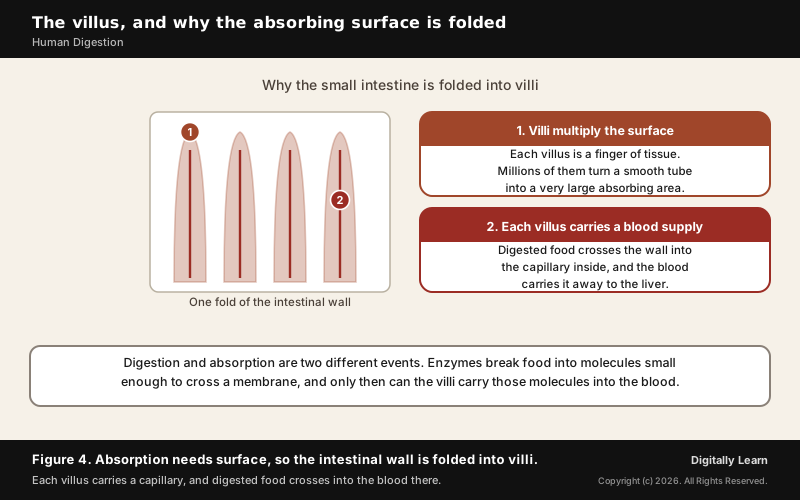
The order of the two events cannot be reversed. Enzymes must first reduce food to molecules small enough to cross a membrane, and only then can the villi carry those molecules away. A large molecule meeting a villus is simply not absorbed, however much absorbing surface is available.
Where that blood goes next is unusual. Nutrient-rich blood leaving the stomach and the intestine does not travel straight to the heart. It is carried first to the liver by the hepatic portal vein, so the liver can process what has been absorbed before it reaches the rest of the body.
The Large Intestine and the Completion of the Process
The large intestine receives what the small intestine has not absorbed, and it digests nothing. Its work is to absorb water from the residue, which turns a fluid mass into a solid one, and to hold that waste until it is expelled under the control of the anal sphincter.
The two intestines differ because their tasks differ. The small intestine is long, folded into villi and richly supplied with enzymes, because its task is chemical and needs surface. The large intestine is short and smooth, because its task is the recovery of water and nothing more.
Digestive Enzymes and Where Each One Acts
What an Enzyme Is, and Why Each Acts on One Substrate
An enzyme is a protein that speeds up a specific chemical reaction without being consumed by it. It works by lowering the energy barrier the reaction would otherwise cross, which lets a change that would take days at body temperature happen in seconds.
The property that matters for digestion is specificity. Each enzyme carries a region called the active site whose shape fits one substrate and not another, so an enzyme that digests starch cannot digest protein however much protein is present.
Two consequences follow. Every enzyme has an optimum temperature and acidity at which its shape is correct, which is why pepsin works in the stomach's acid and trypsin does not. Every enzyme is also a protein, so calling a hormone an enzyme is a category error.
Four kinds of biological molecule are easily confused, and each has a standard example:
| Category | What it does | Standard example |
|---|---|---|
| Enzyme | Catalyses one reaction where it is released; always a protein | Pepsin, which digests protein in the stomach |
| Hormone | Carries a message through the blood to an organ elsewhere | Progesterone, a steroid hormone; and oxytocin, which stimulates contraction of the uterine muscle |
| Vitamin | Needed in small amounts and supplies no energy | Carotene, the plant precursor of vitamin A |
| Structural protein | Builds tissue rather than acting on it | Keratin, the fibrous protein of hair and nails |
Three of those four are proteins, so being a protein does not make a substance an enzyme. What makes an enzyme is that it catalyses a reaction, and what makes a hormone is that it carries a signal to somewhere it was not made.
Digestive Enzymes of the Mouth, Stomach and Small Intestine
The digestive enzymes can be set out by the site at which each acts, the substrate it acts on and the product it yields. The small intestine rows outnumber the rest, because most digestion happens there. Salivary amylase also has an older name, ptyalin.
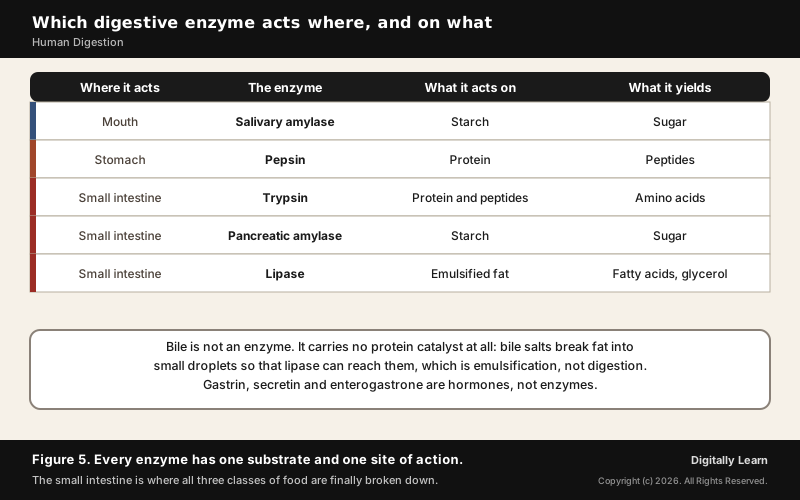
| Site and secretion | Enzyme | Acts on, and yields |
|---|---|---|
| Mouth (saliva) | Salivary amylase | Starch, giving sugar |
| Stomach (gastric juice) | Pepsin | Protein, giving peptides |
| Small intestine (pancreatic juice) | Trypsin | Protein and peptides, giving amino acids |
| Small intestine (pancreatic juice) | Pancreatic amylase | Starch, giving sugar |
| Small intestine (pancreatic juice) | Lipase | Emulsified fat, giving fatty acids and glycerol |
| Small intestine (intestinal juice) | Intestinal enzymes | Remaining nutrients, giving absorbable molecules |
Two features of the table stand out. The small intestine is the only site where all three classes of food are acted on, which is what makes it the organ where digestion is completed. No enzyme appears in the oesophagus or the large intestine at all, because neither digests.
The final breakdown yields molecules small enough to be absorbed. Carbohydrates become simple sugars, proteins become amino acids, and fats become fatty acids and glycerol. Absorption at the villi begins only once that reduction is complete.
Bile, Emulsification and the Role of the Liver
Bile is secreted by the liver, stored in the gall bladder and released into the duodenum. It performs two functions in digestion, and neither of them is enzymatic:
- It makes the medium alkaline. Food arriving from the stomach is acidic, and the pancreatic enzymes that must act on it work only in an alkaline medium, so the acid has to be neutralised first.
- It emulsifies fat. Bile salts break large globules of fat into small droplets, which greatly increases the surface area that lipase can act on.
Emulsification is not digestion. Bile carries no enzyme of any kind, and it changes the physical state of fat rather than its chemical composition; the chemical breakdown is done afterwards by lipase. The liver therefore has an important role in fat digestion while producing no fat-digesting enzyme at all.
The liver's involvement does not end there. Because the hepatic portal vein delivers absorbed nutrients to it first, the liver also regulates what enters general circulation, storing excess glucose as glycogen and processing substances absorbed along with the food.
Gut Hormones: Gastrin, Secretin and Enterogastrone
Digestion is coordinated by hormones as well as by enzymes, and the two are easily confused. An enzyme catalyses a reaction where it is released; a hormone is a chemical messenger that travels in the blood and regulates an organ somewhere else.
- Gastrin is a hormone produced in the stomach. It stimulates the secretion of gastric acid and assists gastric movement, and it digests nothing itself, so it is not a digestive enzyme.
- Secretin is a hormone produced by cells in the lining of the duodenum in response to acid arriving from the stomach. It regulates the secretions of the stomach, the pancreas and the liver, and so prepares the duodenum to receive acidic food.
- Enterogastrone is the name for any hormone secreted by the duodenal lining in response to dietary fat, which then slows the stomach down. By inhibiting gastric secretion and movement it holds a fatty meal longer, so the small intestine is not overwhelmed.
One further name belongs here because it is so often confused. Renin is an enzyme secreted by the kidneys that acts on angiotensinogen in the blood, and it has nothing to do with digestion. Rennin, spelt with a double letter, is the milk-clotting enzyme.
Carbohydrates, Proteins and Fats in the Diet
Starch, Sugars and the Value of Indigestible Fibre
The body's principal source of energy is carbohydrate, which yields about four kilocalories per gram. It is classified by the size of the molecule, and the three classes behave differently in the gut:
- Simple sugars, such as glucose and fructose, need no digestion at all and are absorbed as they are.
- Disaccharides, such as the sucrose of table sugar and the lactose of milk, are split into simple sugars by enzymes of the small intestine.
- Polysaccharides, such as starch and dietary fibre, are long chains. Starch is digested to sugar; fibre is not digested at all.
Starch is the form in which cereals, millets, pulses and tubers store carbohydrate, and it is the single largest source of energy in most diets here. Digestion of starch begins in the mouth with salivary amylase and is completed in the small intestine by pancreatic amylase.
The one carbohydrate that human enzymes cannot digest at all is dietary fibre, and its value lies precisely in that. Because it passes through undigested it adds bulk, slows the release of sugar into the blood and assists movement of the residue. Cellulose in whole grains, and gums and pectin in fruits, are its common forms.
The distinction between an added sugar and the carbohydrate of a whole grain is central to the dietary guidance. Cereals and millets are to supply about 45 per cent of a day's energy while added sugar stays under 5 per cent, and the guidelines ask that at least half the cereal eaten be whole grain rather than refined.
Aspartame, an artificial sweetener, is built from amino acids and yields calories as any amino acid would. It serves as a low-calorie sweetener because it is many times sweeter than table sugar, so the quantity needed is small enough to make its calories negligible.
Essential Amino Acids and What Decides Protein Quality
The body's structural and functional material is built from proteins, which are polymers of amino acids joined by peptide bonds. They form muscle, enzymes, many hormones and the antibodies of the immune system, and they yield about four kilocalories per gram when used for energy.
Amino acids divide into two classes by whether the body can make them. A non-essential amino acid can be synthesised in the body from other material. An essential amino acid cannot, and must be supplied ready-made in the diet, and it is this second group alone that a diet is obliged to contain.
Similar-sounding names fall on opposite sides of this divide. Serine and tyrosine are amino acids the body makes for itself, and glycerine is not an amino acid at all but a component of fat, so a claim that a diet must compulsorily contain those three is false.
The practical consequence of that division is protein quality. A source supplying all the essential amino acids in useful proportion ranks higher than one short of some. Diets built on a single cereal tend to be short of particular amino acids, which the guidelines address by pairing cereals and millets with pulses and beans.
Saturated, Unsaturated and the Legal Trans Fat Limit
Fats, or lipids, yield about nine kilocalories per gram, more than twice what carbohydrate or protein yields, and this is why they are limited as a share of energy rather than by appetite. They also carry the fat-soluble vitamins and supply the essential fatty acids the body cannot make.
Fats are classified by the structure of their fatty acids, and all fats in food supply a mixture of the three kinds. That mixture is why the guidelines ask for a variety of cooking oils rather than a single one, and why a ceiling of 30 per cent of energy is set on total fat rather than a ban on any one source.
- Saturated fatty acids carry no double bond and predominate in ghee, butter, full-cream dairy and red meat.
- Monounsaturated fatty acids carry one double bond and are prominent in groundnut and mustard oils.
- Polyunsaturated fatty acids carry more than one and are prominent in most seed oils, nuts, oilseeds and fatty fish.
Trans fatty acids are the category carrying a legal limit. Industrial trans fats form when liquid vegetable oil is partially hydrogenated to make it solid, and they raise the risk of heart disease and stroke, which is what moved them from dietary advice into enforceable regulation.
The Food Safety and Standards Authority caps industrial trans fatty acids at 2 per cent by mass of the total oils and fats in a product. The limit was reached in two steps, from a 3 per cent ceiling in January 2021 to the 2 per cent ceiling from January 2022.
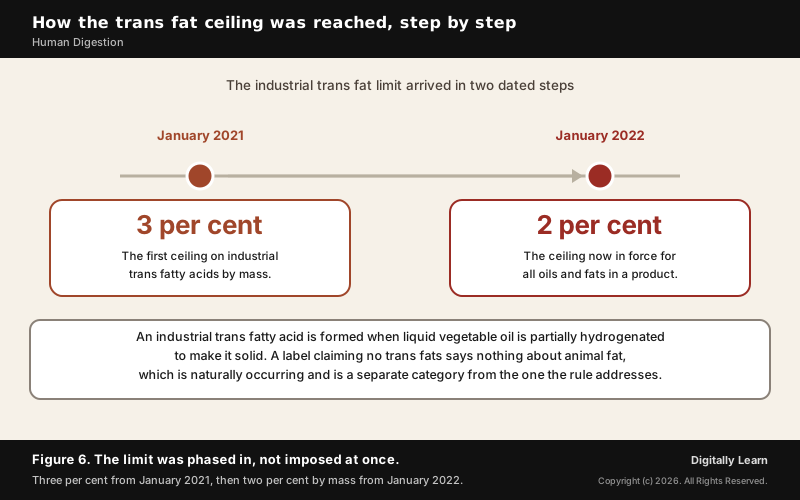
A label claim about trans fats therefore signifies two things and not three. It tells the customer the product is not made from partially hydrogenated oil, and it indicates a product less likely to damage cardiovascular health. It says nothing about animal fat, which is naturally occurring and forms a separate category.
That limit also shows how a nutrition finding becomes an enforceable standard. A fatty acid identified as harmful is defined in a regulation, given a numerical ceiling and phased in on a published timetable. The same route from evidence to legal standard runs through the fortification rules and the programmes taken up in the article on vitamins, minerals and malnutrition.
Millets as Nutricereals: Calcium, Iron and Dietary Fibre
Millets are a group of small-grained cereals grown largely on dryland, including sorghum, pearl millet, finger millet, foxtail millet, kodo millet and barnyard millet. The dietary guidelines treat them as nutricereals rather than a lesser substitute for rice and wheat, and the nutrient profile is the reason.
| Millet | Protein (g) | Fibre (g) |
|---|---|---|
| Foxtail millet | 12.3 | 8.0 |
| Barnyard millet | 11.2 | 10.1 |
| Pearl millet | 10.6 | 1.3 |
| Sorghum | 10.0 | 4.0 |
| Kodo millet | 8.3 | 9.0 |
| Finger millet | 7.3 | 3.6 |
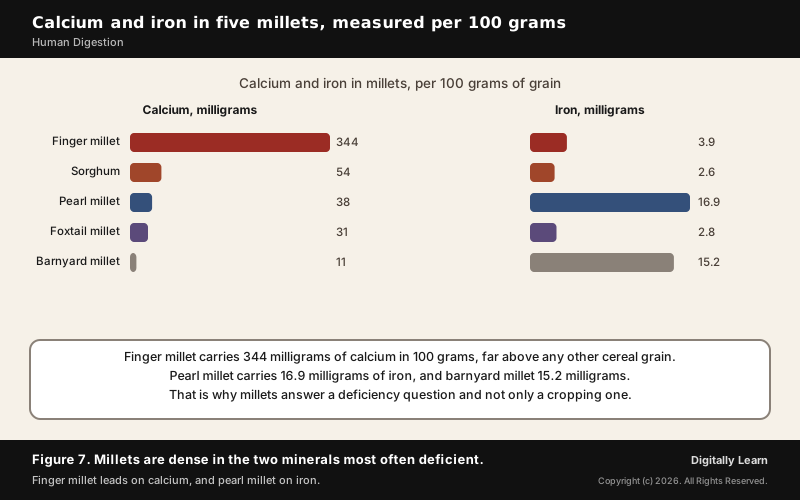
The figure above carries the two minerals that matter most. Finger millet supplies 344 milligrams of calcium in 100 grams, far above any other cereal grain, and pearl millet supplies 16.9 milligrams of iron with barnyard millet at 15.2 milligrams, against a background of widespread anaemia.
The table sets out the other two. Several millets carry high dietary fibre, barnyard millet at 10.1 grams and kodo millet at 9 grams per 100 grams, which slows the release of sugar into the blood. Their protein content, between 7 and 12 grams, is comparable with the major cereals rather than better than them.
The contribution to nutritional security rests on a second set of properties, belonging to how millets are grown rather than what they contain. They need far less water than rice, tolerate poor soils and higher temperatures, and are grown by smallholders in regions where the cereal alternatives are least secure. The cropping side is set out in the article on millets and pulses in agriculture.
The two arguments meet in policy. The guidelines ask that at least half the cereal in a day's food be whole grain such as millet, and public nutrition programmes have been asked to build millets into what they serve, so that nutrient density reaches the groups whose diets are least diverse. Those programmes are the subject of the article on vitamins, minerals and malnutrition.
Previous Year UPSC-CSE Questions
Previous Year UPSC-CSE Questions By the end you will be able to draft model answers for the following UPSC questions. Each question carries a collapsible framework showing how to approach it in the exam.
- UPSC Prelims 2010 Prelims-GSWhich one of the following processes in the bodies of living organisms is a digestive process ?
How to approach this Prelims question
Approach: Ask of each option whether it breaks a large food molecule into a smaller absorbable one, or does something else with a molecule already absorbed.
Trap to watch: Breaking glucose into carbon dioxide and water is respiration, not digestion. It releases energy from a molecule the body has already absorbed.
Key facts to recall:
- (a) Breakdown of proteins into amino acids: right. Digestion breaks large food molecules into absorbable ones; pepsin and trypsin reduce protein to amino acids.
- (b) Breakdown of glucose into CO₂ and H₂O: wrong. That is respiration, which releases energy inside cells.
- (c) Conversion of glucose into glycogen: wrong. That is storage, done in the liver and muscles.
- (d) Conversion of amino acids into proteins: wrong. That is synthesis, the reverse of digestion.
Answer signal: Only the breakdown of proteins into amino acids is digestion, so option (a) is the answer.
- UPSC Prelims 2007 Prelims-GSWhich of the following is not a digestive enzyme in the human system?
How to approach this Prelims question
Approach: Identify the substrate each named substance acts on. Three of the four have one; the remaining name is a messenger rather than a catalyst.
Trap to watch: Gastrin sounds like an enzyme of the stomach and is often assumed to be one. It regulates the release of acid rather than acting on food.
Key facts to recall:
- (a) Trypsin: an enzyme, so not the answer. It digests protein in the small intestine.
- (b) Gastrin: right. Gastrin is a hormone that stimulates gastric acid secretion, not a digestive enzyme.
- (c) Ptyalin: an enzyme, so not the answer. It is salivary amylase and digests starch in the mouth.
- (d) Pepsin: an enzyme, so not the answer. It digests protein in the stomach.
Answer signal: Gastrin is the hormone among four names, so option (b) is the answer.
- UPSC Prelims 2007 Prelims-GSWhich on the following is the correct sequence in order of decreasing length of the three structural parts given below of small intestine in the human body?
How to approach this Prelims question
Approach: Fix the two extremes first. The duodenum is the shortest by a wide margin, so any option that does not end with it is wrong.
Trap to watch: The duodenum is named first in the anatomical order, from the stomach onward, which tempts a reader into placing it first here. The question asks for length, not sequence.
Key facts to recall:
- (a) Jejunum, duodenum, ileum: wrong. The duodenum is the shortest part, so it cannot be second, and the ileum is the longest.
- (b) Ileum, duodenum, jejunum: wrong. The jejunum, about 2.5 metres, is longer than the duodenum.
- (c) Jejunum, ileum, duodenum: wrong. The ileum, about 2 to 4 metres, is the longest, so it comes first.
- (d) Ileum, jejunum, duodenum: right. Ileum about 2 to 4 metres, jejunum about 2.5 metres, duodenum about 20 to 25 centimetres.
Answer signal: Ileum, then jejunum, then duodenum, so option (d) is the answer.
- UPSC Prelims 2006 Prelims-GSWhat is the name of the vessel that delivers the nutrient-rich blood from the stomach and small intestine to the liver?
How to approach this Prelims question
Approach: Separate the vessels that bring blood to the liver from the one that takes it away, then separate artery from vein.
Trap to watch: The hepatic vein carries blood away from the liver, not towards it. The similarity of the names is the whole difficulty of the question.
Key facts to recall:
- (a) Left hepatic artery: wrong. The hepatic arteries bring oxygenated blood to the liver, not blood from the gut.
- (b) Hepatic vein: wrong. The hepatic vein drains blood out of the liver.
- (c) Right hepatic artery: wrong. It too supplies oxygenated blood to the liver.
- (d) Hepatic portal vein: right. It carries nutrient-rich blood from the stomach and intestine to the liver.
Answer signal: The hepatic portal vein, so option (d) is the answer.
- UPSC Prelims 2006 Prelims-GSConsider the following statements with reference to the human body:
- The common bile duct releases its contents into the stomach.
- The pancreatic duct releases its contents into the duodenum.
Which of the statements given above is/are correct?
How to approach this Prelims question
Approach: Take each duct separately and name the single part of the canal it opens into.
Trap to watch: Bile acts on food that has just left the stomach, which makes the stomach feel like the natural destination. The duct opens one stage further along, into the duodenum.
Key facts to recall:
- (a) 1 only: wrong. The common bile duct opens into the duodenum, not the stomach.
- (b) 2 only: right. The pancreatic duct opens into the duodenum, and statement 1 is false.
- (c) Both 1 and 2: wrong. Statement 1 is false.
- (d) Neither 1 nor 2: wrong. Statement 2 is correct.
Answer signal: Only the second statement is correct, so option (b) is the answer.
- UPSC Prelims 2008 Prelims-GSConsider the following assertion and reason, and select the correct answer from the codes given below:
- Assertion (A): In human body, liver has an important role in fat digestion.
- Reason (R): Liver produces two important fat-digesting enzymes.
Which one of the four codes given below is correct?
How to approach this Prelims question
Approach: Judge the two statements independently before considering whether one explains the other.
Trap to watch: The liver's genuine importance to fat digestion makes the reason look plausible. Bile is an emulsifier, not an enzyme, and emulsification is a physical change rather than a chemical one.
Key facts to recall:
- (a) A and R true, R explains A: wrong. R is false; the liver makes no fat-digesting enzyme.
- (b) A and R true, R does not explain A: wrong. R is false.
- (c) A true, R false: right. The liver's bile emulsifies fat, but bile contains no enzyme; lipase comes from the pancreas.
- (d) A false, R true: wrong. The liver does matter for fat digestion, through bile.
Answer signal: The assertion is true and the reason is false, so option (c) is the answer.
- UPSC Prelims 2005 Prelims-GSConsider the following assertion and reason, and select the correct answer from the codes given below:
- Assertion (A): All the proteins in our food are digested in small intestine only.
- Reason (R): The protein-digesting enzymes from pancreas are released into small intestine.
Which one of the four codes given below is correct?
How to approach this Prelims question
Approach: Test the assertion against the stomach. If any protein is digested there, the word 'only' defeats the statement whatever the reason says.
Trap to watch: The reason is true and relevant, which makes it tempting to accept the assertion with it. Pepsin digests protein in the stomach, so the small intestine is not the only site.
Key facts to recall:
- (a) A and R true, R explains A: wrong. A is false; protein digestion begins in the stomach.
- (b) A and R true, R does not explain A: wrong. A is false.
- (c) A true, R false: wrong. A is false, and pancreatic trypsin does reach the small intestine.
- (d) A false, R true: right. Pepsin starts protein digestion in the stomach, and pancreatic enzymes finish it in the small intestine.
Answer signal: The assertion is false and the reason is true, so option (d) is the answer.
- UPSC Prelims 2003 Prelims-GSWith reference to normal human beings, consider the following statements:
- In response to the presence of HCl, secretin is produced from the duodenum
- Enterogastrone is produced in the small intestine in response to the presence of fatty acids
Which of these statements is/are correct?
How to approach this Prelims question
Approach: For each hormone, fix the site of production and the stimulus separately, then check both against the statement.
Trap to watch: Both hormones come from the duodenum rather than from the stomach that sends the stimulus, which is the inversion a hurried reader makes.
Key facts to recall:
- (a) Only 1: wrong. Statement 2 is also correct; fatty acids trigger enterogastrone.
- (b) Only 2: wrong. Statement 1 is also correct; acid triggers secretin from the duodenum.
- (c) Both 1 and 2: right. Secretin answers acid and enterogastrone answers fat, both from the duodenal lining.
- (d) Neither 1 nor 2: wrong. Both statements describe these gut hormones correctly.
Answer signal: Both statements are correct, so option (c) is the answer.
- UPSC Prelims 2001 Prelims-GSMatch List I (Substance) with List II (Physiological role), where List II reads A) Converts angiotensinogen in blood into angiotensin, B) Digests starch, C) Digests proteins, D) Hydrolyses fats, E) Induces contraction of smooth muscles:
- I. Ptyalin
- II. Pepsin
- III. Renin
- IV. Oxytocin
Select the correct answer using the codes given below the Lists:
How to approach this Prelims question
Approach: Place the two digestive names first, then use the remaining two to separate the kidney enzyme from the hormone.
Trap to watch: Renin and rennin differ by one letter and by an entire organ system. The list is testing whether the reader treats renin as a digestive substance because of the company it keeps.
Key facts to recall:
- (a) I-B, II-C, III-A, IV-E: right. Ptyalin digests starch, pepsin digests protein, renin acts on angiotensinogen and oxytocin contracts smooth muscle.
- (b) I-C, II-D, III-B, IV-E: wrong. Ptyalin digests starch, not protein, and pepsin does not hydrolyse fats.
- (c) I-B, II-C, III-E, IV-A: wrong. It swaps renin and oxytocin.
- (d) I-C, II-A, III-B, IV-D: wrong. All four pairs are mismatched.
Answer signal: Ptyalin with B, pepsin with C, renin with A and oxytocin with E, so option (a) is the answer.
- UPSC Prelims 1996 Prelims-GSMatch List I with List II, where List II reads A. Pepsin, B. Carotene, C. Keratin, D. Progesterone:
- I. Vitamin
- II. Enzyme
- III. Hormone
- IV. Protein
Select the correct answer using the codes given below the lists:
How to approach this Prelims question
Approach: Anchor on the one certainty, pepsin as the enzyme, then separate the hormone from the structural protein.
Trap to watch: Keratin and progesterone are the pair most often swapped. Keratin is a structural protein of hair and nails; progesterone is a hormone.
Key facts to recall:
- (a) I-A, II-B, III-C, IV-D: wrong. Pepsin is an enzyme, not a vitamin, and keratin is not a hormone.
- (b) I-B, II-A, III-D, IV-C: right. Carotene is a vitamin precursor, pepsin an enzyme, progesterone a hormone and keratin a protein.
- (c) I-B, II-A, III-C, IV-D: wrong. It swaps the hormone (progesterone) and the protein (keratin).
- (d) I-A, II-B, III-D, IV-C: wrong. It swaps the vitamin (carotene) and the enzyme (pepsin).
Answer signal: Vitamin with carotene, enzyme with pepsin, hormone with progesterone and protein with keratin, so option (b) is the answer.
- UPSC Prelims 2002 Prelims-GSConsider the following assertion and reason, and select the correct answer from the codes given below:
- Assertion (A): Human diet should compulsorily contain Glycerine, Serine and Tyrosine.
- Reason (R): Essential amino acids cannot be synthesised in the human body.
Which one of the four codes given below is correct?
How to approach this Prelims question
Approach: Check the three names in the assertion one by one against the definition in the reason before judging the pair.
Trap to watch: The reason states a correct principle, which makes the assertion look like an application of it. None of the three named substances is an essential amino acid.
Key facts to recall:
- (a) A and R true, R explains A: wrong. A is false.
- (b) A and R true, R does not explain A: wrong. A is false.
- (c) A true, R false: wrong. A is false, and R is true.
- (d) A false, R true: right. Serine and tyrosine are non-essential and glycerine is not an amino acid, while essential amino acids cannot be made in the body.
Answer signal: The assertion is false and the reason is true, so option (d) is the answer.
- UPSC Prelims 2011 Prelims-GSA company marketing food products advertises that its items do not contain trans-fats. What does this campaign signify to the customers?
- The food products are not made out of hydrogenated oils.
- The food products are not made out of animal fats/oils.
- The oils used are not likely to damage the cardiovascular health of the consumers.
Which of the statements given above is/are correct?
How to approach this Prelims question
Approach: Trace each statement back to the definition of an industrial trans fat, and reject any statement that the definition does not support.
Trap to watch: The second statement is the one to reject. A trans fat claim concerns hydrogenation, not the animal or plant origin of the fat.
Key facts to recall:
- (a) 1 only: wrong. Statement 3 also holds; trans fats raise the risk of heart disease.
- (b) 2 and 3 only: wrong. Statement 2 is not what the label means; animal fats are a separate category.
- (c) 1 and 3 only: right. No partially hydrogenated oil, and so less risk to cardiovascular health.
- (d) 1, 2 and 3: wrong. A trans-fat-free label says nothing about animal fats.
Answer signal: The first and third statements follow and the second does not, so option (c) is the answer.
- UPSC Prelims 2011 Prelims-GSAspartame is an artificial sweetener sold in the market. It consists of amino acids and provides calories like other amino acids. Yet, it is used as a low-calorie sweetening agent in food items. What is the basis of this use?
How to approach this Prelims question
Approach: Notice that the stem has already conceded that aspartame yields calories. The answer must therefore turn on quantity rather than on calorie content.
Trap to watch: Three options try to explain away the calories, which the stem has already stated exist. The explanation has to lie in how little of the substance is needed.
Key facts to recall:
- (a) as sweet as sugar, not oxidised: wrong. Aspartame is made of amino acids and is digested like them; it is far sweeter than sugar.
- (b) sweet taste stays but resists oxidation: wrong. It still yields calories; it is not made calorie-free by processing.
- (c) converted into metabolites that yield no calories: wrong. It yields about four kilocalories per gram, like protein.
- (d) several times sweeter, so less is used: right. So little is needed to sweeten food that it adds few calories.
Answer signal: The sweetness per gram is what allows the small quantity, so option (d) is the answer.
- UPSC Mains 2024 GS-IIIExplain the role of millets for ensuring health and nutritional security in India.
Answer outline: how to structure the answer
What the question asks, the main arguments, relevant examples and the direction of the conclusion. This is not a full model answer.
Introduction: Define millets as the small-grained dryland cereals that the dietary guidelines classify as nutricereals, name the principal ones, and separate the two demands of the question before answering either.
Body (sub-themes to develop):
- Nutrient density: finger millet at 344 milligrams of calcium per 100 grams, far above any other cereal grain, against a low background intake.
- Iron and anaemia: pearl millet at 16.9 milligrams and barnyard millet at 15.2 milligrams of iron per 100 grams.
- Dietary fibre: barnyard millet at 10.1 grams and kodo millet at 9 grams per 100 grams, which slows the release of sugar into the blood.
- Protein in combination: 7 to 12 grams per 100 grams, comparable with the major cereals, and complemented by pulses for amino acid balance.
- Security of supply: low water requirement, tolerance of poor soils and heat, and smallholder dryland cultivation where the cereal alternatives are least secure.
- Delivery: the guideline that at least half the cereal eaten be whole grain, and the inclusion of millets in public nutrition programmes.
Conclusion: Close on the meeting point of the two demands, that nutrient density counts only when it reaches the diets that are least diverse, which is why millets appear in the dietary guidance and in the nutrition programmes alike.
Sources and Further Reading
- NCERT: Science, Class 10, Chapter 5, Life Processes
- NCERT: Biology, Class 11, Chapter 9, Biomolecules
- ICMR-National Institute of Nutrition: Dietary Guidelines for Indians, 2024
- ICMR-National Institute of Nutrition: My Plate for the Day
- Food Safety and Standards Authority: Prohibition and Restrictions on Sales Regulations, consolidated
- Food Safety and Standards Authority: press release on the industrial trans fat limit
- ICAR-Indian Institute of Millets Research: nutritional benefits of millets
- World Health Organization: Healthy diet, fact sheet
- Wikipedia: Small intestine
- Wikipedia: Hepatic portal vein
- Wikipedia: Secretin
- Wikipedia: Enterogastrone
- Wikipedia: Gastric acid
- Wikipedia: Peptic ulcer disease
Editorial Disclaimer
This article is for UPSC preparation and explains how human digestion works and what a balanced diet contains. Dietary figures follow the official guidelines cited and are not medical advice for any individual.


