


Overview
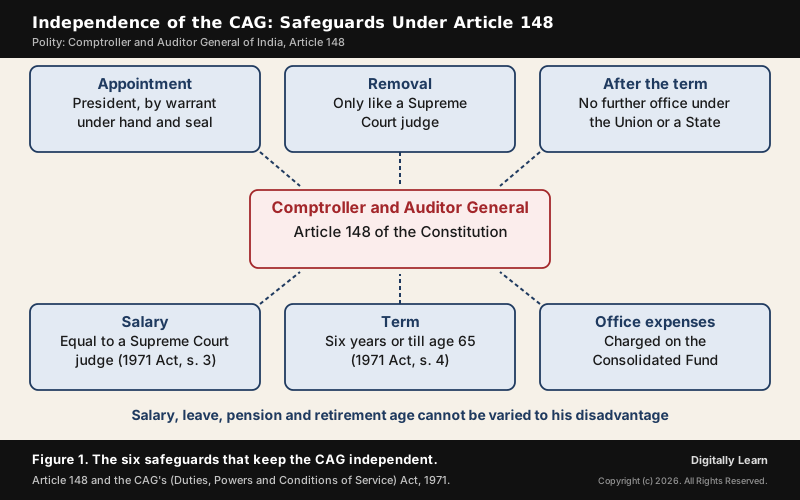
The Comptroller and Auditor General of India is the constitutional officer under Article 148 who audits the accounts of the Union and the States and reports to Parliament and the State Legislatures. The office checks whether public money was spent legally, properly and to good effect.
Comptroller and Auditor General of India Under Article 148
Article 148: Appointment, Oath, Term and Removal of the CAG
The Comptroller and Auditor General of India (CAG) is the head of the Indian Audit and Accounts Department and the supreme audit institution of the country. Article 148 provides for the office, and Article 149 lets Parliament prescribe its duties and powers over the accounts of the Union, the States and any other authority or body. One officer therefore audits public money at both levels of government.
The President appoints the CAG by warrant under hand and seal. Before taking office, the CAG makes and subscribes an oath before the President in the form set out in the Third Schedule, which includes a promise to perform the duties of the office without fear or favour, affection or ill-will. Under section 4 of the CAG's (Duties, Powers and Conditions of Service) Act, 1971, the term is six years, ending earlier if the CAG reaches the age of 65, and the CAG may resign at any time by writing to the President.
The CAG can be removed only in the manner and on the grounds that apply to a Supreme Court judge. Both Houses of Parliament must pass a resolution by special majority on the ground of proved misbehaviour or incapacity, after which the President removes him. Because the CAG upholds the Constitution and the laws of Parliament in financial administration, B. R. Ambedkar called the CAG the most important officer under the Constitution.
List of Comptroller and Auditor General of India Since 1950
Fifteen people have held the office since the Constitution came into force. V. Narahari Rao, who had been Auditor General of India before 1950, became the first Comptroller and Auditor General and served until 1954. K. Sanjay Murthy, the present CAG, made and subscribed the oath of office before the President at Rashtrapati Bhavan on 21 November 2024.
| No. | Comptroller and Auditor General | Tenure |
|---|---|---|
| 1 | V. Narahari Rao | 1950 to 1954 |
| 2 | A. K. Chanda | 1954 to 1960 |
| 3 | A. K. Roy | 1960 to 1966 |
| 4 | S. Ranganathan | 1966 to 1972 |
| 5 | A. Baksi | 1972 to 1978 |
| 6 | Gian Prakash | 1978 to 1984 |
| 7 | T. N. Chaturvedi | 1984 to 1990 |
| 8 | C. G. Somiah | 1990 to 1996 |
| 9 | V. K. Shunglu | 1996 to 2002 |
| 10 | V. N. Kaul | 2002 to 2008 |
| 11 | Vinod Rai | 2008 to 2013 |
| 12 | Shashi Kant Sharma | 2013 to 2017 |
| 13 | Rajiv Mehrishi | 2017 to 2020 |
| 14 | Girish Chandra Murmu | 2020 to 2024 |
| 15 | K. Sanjay Murthy | Since 2024 |
Independence of CAG of India: Constitutional Safeguards
Safeguards in Article 148 and the 1971 Act
Because the CAG audits the government that appoints him, the Constitution surrounds the office with safeguards. Article 148 and the 1971 Act together provide the following:
- Security of tenure: Removal only in the manner of a Supreme Court judge, so the CAG does not hold office at the President’s pleasure.
- No office afterwards: Under Article 148(4), the CAG is not eligible for any further office under the Government of India or of any State after leaving the post.
- Protected service conditions: Parliament fixes the salary by law, and neither the salary nor the rights to leave, pension or retirement age can be varied to the CAG’s disadvantage after appointment; section 3 of the 1971 Act sets the salary equal to that of a Supreme Court judge.
- Control of the department: The conditions of service of the Indian Audit and Accounts Department and the CAG’s administrative powers are prescribed by the President only after consulting the CAG.
- Expenses not voted: The administrative expenses of the office, including salaries and pensions, are charged on the Consolidated Fund of India, so Parliament does not vote on them.
One more rule protects the office: no minister represents the CAG in Parliament, and no minister answers for the CAG's actions. The CAG speaks to the legislature through audit reports alone.
Duties and Powers of CAG: Articles 149 to 151 and the 1971 Act
Article 149 and the CAG (Duties, Powers and Conditions of Service) Act, 1971
Article 149 leaves the CAG's duties and powers to Parliament, and Parliament set them out in the CAG's (Duties, Powers and Conditions of Service) Act, 1971. The Act was amended in 1976 to separate accounts from audit in the Union government, so the CAG no longer compiles the Union's accounts, though the office still compiles the accounts of the States.
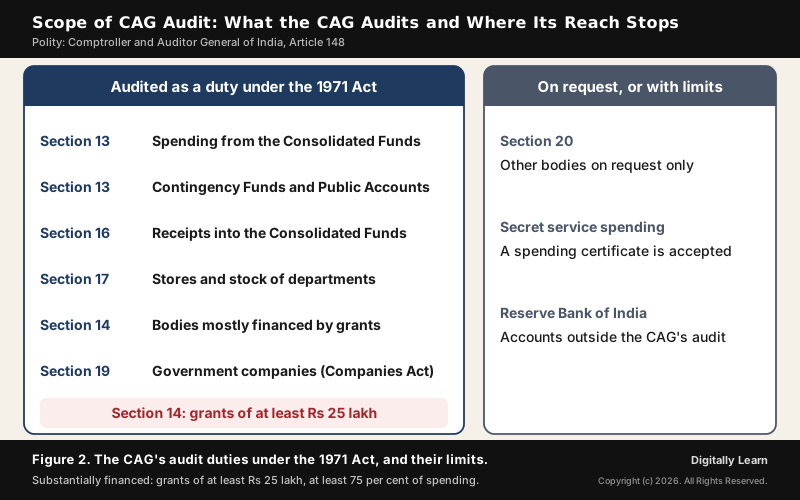
- Section 13: Audit all expenditure from the Consolidated Fund of India, of each State and of each Union Territory with a Legislative Assembly, and all transactions relating to the Contingency Funds and Public Accounts.
- Section 14: Audit bodies substantially financed by government grants or loans, that is, grants or loans of at least Rs 25 lakh in a year that make up at least 75 per cent of the body’s spending.
- Section 16: Audit all receipts paid into the Consolidated Funds and check that the rules secure an effective check on the assessment, collection and allocation of revenue.
- Section 17: Audit the accounts of stores and stock kept in any office or department.
- Section 18: Inspect any office of accounts, including treasuries, and call for any books and documents relevant to the audit.
- Sections 19 and 20: Audit government companies under the Companies Act and corporations under their own laws, and audit any other body when the President or a Governor requests it.
| Article | What it provides |
|---|---|
| 148 | The office of the CAG: appointment, oath, removal, service conditions, no further office, expenses charged on the Consolidated Fund |
| 149 | Duties and powers in relation to the accounts of the Union, the States and other bodies, as Parliament prescribes by law |
| 150 | The accounts of the Union and the States are kept in the form the President prescribes on the advice of the CAG |
| 151 | Audit reports on the Union's accounts go to the President, and on a State's accounts to the Governor, to be laid before the legislature |
| 279 | The CAG ascertains and certifies the net proceeds of a tax or duty, and the certificate is final |
Article 279 gives the CAG a role in Centre-State finance too. The net proceeds of a tax, meaning its proceeds less the cost of collection, are certified by the CAG, and that certificate decides how much is available for sharing. The Finance Commission and Centre-State financial relations explain how those proceeds are divided.
Comptroller or Only Auditor? Limits on the CAG's Role
The title says comptroller, but in India the CAG works only as an auditor. The office has no control over the issue of money from the Consolidated Fund: departments draw money without the CAG's prior approval, and the CAG comes in only at the audit stage, after the money has been spent. In Britain, by contrast, the executive can draw money from the public exchequer only with the Comptroller and Auditor General's approval.
The audit has other limits as well. For secret service expenditure, the CAG cannot call for the details and accepts a certificate from the competent authority that the money was spent under its authority. Some corporations are audited by private auditors whom the government appoints in consultation with the CAG, and the CAG can then carry out a supplementary audit. The accounts of the Reserve Bank of India do not fall within the CAG's audit at all.
Types of CAG Audit: Legality, Propriety and Performance
Legal and Regulatory Audit and Propriety Audit
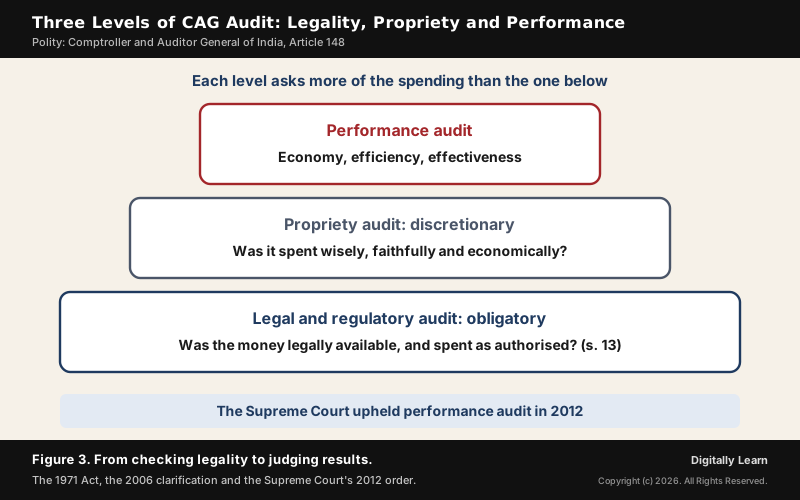
The basic test is legality. Section 13 asks the CAG to ascertain whether the money shown as spent was legally available for the purpose, and whether the spending conforms to the authority that governs it. This legal and regulatory audit is obligatory.
Beyond legality lies propriety audit, which asks whether spending showed wisdom, faithfulness and economy, and lets the CAG comment on waste and extravagance. It is discretionary rather than obligatory. The Supreme Court, in Subramaniam Balaji v. Government of Tamil Nadu (2013), described the CAG as examining the propriety, legality and validity of all expenses incurred by the government, and noted that the CAG's duty arises only after the money has been spent.
Performance Audit: Economy, Efficiency and Effectiveness
Performance audit asks what public money achieved: the economy, efficiency and effectiveness with which the government used its resources. The CAG conducts it alongside financial audits and compliance audits. On 13 June 2006 the Finance Ministry clarified that performance audit lies within the scope of the CAG's audit under the 1971 Act, and the CAG's Regulations on Audit and Accounts, 2007 provided for it.
The power was challenged in the Supreme Court in Arvind Gupta v. Union of India, where the petitioner argued that the CAG had no power to give performance audit reports. On 1 October 2012 the Court held that examining economy, efficiency and effectiveness is in-built in the 1971 Act, found nothing unconstitutional in the Regulations, and noted that the reports are in any case subject to scrutiny by the legislature under Article 151.
A recent State example shows what such an audit examines. In September 2026 a CAG performance audit of the District Mineral Foundations in Odisha found funds meant for people affected by mining spent without following the rules: in Keonjhar, the share spent on indirectly affected areas rose to 45.68 per cent against a limit of 40 per cent.
CAG Reports and Parliamentary Accountability
CAG Reports and the Public Accounts Committee
Under Article 151, the CAG's reports on the Union's accounts are submitted to the President, who has them laid before each House of Parliament; reports on a State's accounts go to the Governor and are laid before the State Legislature. The CAG audits for the legislature: the accountability of the executive to Parliament in financial matters is secured through these reports.
Once laid, the reports go to the Public Accounts Committee (PAC). The committee has not more than 22 members, 15 elected by the Lok Sabha and not more than 7 by the Rajya Sabha, chosen every year by proportional representation. Since 1967 its chairperson has come from the opposition. The CAG acts as the committee's guide, friend and philosopher, and the committee examines the reports and reports its findings to Parliament. On the basis of the CAG's reports and the committee's findings, the Lok Sabha can enquire into cases of misuse of funds.
A CAG report is not the last word. In Arun Kumar Agarwal v. Union of India (2013), the Supreme Court held that a report is always subject to scrutiny by Parliament, that the ministry concerned may offer its view, and that the Public Accounts Committee may accept or reject the CAG's findings. Coming from a constitutional authority, a report commands respect, but a court will not grant relief on the report alone.
CAG Reports That Shaped Public Debate
Some CAG reports have reached far beyond Parliament. A report on the Bihar animal husbandry department alleged fraudulent withdrawal of Rs 950 crore against supplies that did not exist; on the orders of the Patna High Court, the CBI investigated and registered 63 cases. Information from audit reports can thus become the starting point for investigating agencies, although the CAG itself only audits and reports.
The report on 2G spectrum licences estimated a presumptive loss of Rs 1,76,600 crore. The CBI's chargesheet of 2 April 2011 put the loss at Rs 31,000 crore, and on 21 December 2017 a special court acquitted all the accused. The episode shows both the reach of a CAG report and its limits: an estimate of loss in an audit is not proof of a crime, and the courts decide guilt on evidence.
Criticism of the CAG and Proposed Reforms
The office has had sharp critics. Paul H. Appleby, in his reports on Indian administration, called the CAG's function largely an inheritance from colonial rule and blamed audit for a widespread and paralysing unwillingness to decide and to act; he went as far as suggesting that the CAG be relieved of audit altogether.
The opposite pressure has been to widen the audit. In November 2009 the then CAG asked the government to amend the 1971 Act to bring public-private partnerships, Panchayati Raj Institutions and societies receiving government funds within the CAG's audit, and to strengthen its access to documents. The Supreme Court later ruled that the CAG could audit private firms in revenue-sharing deals with the government. To handle technical audits of specialised enterprises, an Audit Board of a chairman and two members was set up in the CAG's office in 1968 on the recommendation of the Administrative Reforms Commission.
The CAG also audits beyond India. It is a regular member of the United Nations Panel of External Auditors, was elected in 2011 to chair the UN Board of Auditors, and serves as the external auditor of the Food and Agriculture Organization and the World Health Organization.
Previous Year UPSC-CSE Questions
Previous Year UPSC-CSE Questions By the end you will be able to draft model answers for the following UPSC questions. Each question carries a collapsible framework showing how to approach it in the exam.
- UPSC Prelims 2012 Prelims-GSIn India, other than ensuring that public funds are used efficiently and for intended purpose, what is the importance of the office of the Comptroller and Auditor General (CAG)?
- CAG exercises exchequer control on behalf of the Parliament when the President of India declares national emergency/financial emergency.
- CAG reports on the execution of projects or programmes by the ministries are discussed by the Public Accounts Committee.
- Information from CAG reports can be used by investigating agencies to press charges against those who have violated the law while managing public finances.
- While dealing with the audit and accounting of government companies, CAG has certain judicial powers for prosecuting those who violate the law.
Which of the statements given above is/are correct?
How to approach this Prelims question
Approach: Step 1: statement 1 fails. The CAG has no control over the issue of money from the Consolidated Fund at any time; an emergency does not give it one. Step 2: statement 2 holds. The CAG's reports are examined by the Public Accounts Committee. Step 3: statement 3 holds. Findings in audit reports have been the starting point for investigations, as in the Bihar animal husbandry case, where the CBI registered 63 cases. Step 4: statement 4 fails. The CAG audits and reports; it has no judicial power to prosecute anyone.
Trap to watch: Statement 1 sounds plausible because the title says comptroller; in India the office never had exchequer control.
Key facts to recall:
- (a) 1, 3 and 4 only: wrong. Statements 1 and 4 give the CAG powers it does not have.
- (b) 2 only: wrong. It leaves out statement 3, which is also correct.
- (c) 2 and 3 only: right. The PAC discusses the reports, and investigating agencies can use their information.
- (d) 1, 2, 3 and 4: wrong. The CAG has neither exchequer control nor judicial powers.
Answer signal: 2 and 3 only: option (c), the official answer, because the CAG only audits and reports.
- UPSC Prelims 2001 Prelims-GSWhich one of the following duties is NOT performed by the Comptroller and Auditor General of India?
How to approach this Prelims question
Approach: Step 1: options (a), (b) and (c) restate section 13 of the 1971 Act: audit of the Consolidated Fund, of the Contingency Funds and Public Accounts, and of trading, manufacturing and profit and loss accounts. Step 2: option (d) describes a comptroller's control over the receipt and issue of public money, which the Indian CAG does not exercise. Step 3: the answer is the one duty the office lacks.
Trap to watch: The word comptroller in the title tempts you to accept option (d); in India the office is an auditor only.
Key facts to recall:
- (a) Audit of expenditure from the Consolidated Fund of India: performed under section 13, so not the answer.
- (b) Audit of the Contingency Funds and Public Accounts: performed under section 13, so not the answer.
- (c) Audit of trading, manufacturing and profit and loss accounts: performed under section 13, so not the answer.
- (d) Control of the receipt and issue of public money: not performed, so this is the answer.
Answer signal: Option (d), the official answer, because the CAG has no control over the issue of public money.
- UPSC Mains 2024 GS-II“The duty of the Comptroller and Auditor General is not merely to ensure the legality of expenditure but also its propriety.” Comment.
Answer outline: how to structure the answer
What the question asks, the main arguments, relevant examples and the direction of the conclusion. This is not a full model answer.
Introduction: Introduce the CAG under Article 148 as the auditor of public spending for the legislature.
Body (sub-themes to develop):
- Legality: section 13 of the 1971 Act asks whether money was legally available and spent as authorised; this is obligatory.
- Propriety: wisdom, faithfulness and economy; comment on waste and extravagance; the Supreme Court in Subramaniam Balaji (2013) said the CAG examines propriety, legality and validity.
- Beyond propriety: performance audit of economy, efficiency and effectiveness, upheld in Arvind Gupta (2012).
- Limits: propriety audit is discretionary, comes only after the spending, and its findings are weighed by the PAC and Parliament.
Conclusion: Conclude that propriety is what turns audit from book-keeping into accountability, while the final judgement stays with Parliament.
- UPSC Mains 2018 GS-II“The Comptroller and Auditor General (CAG) has a very vital role to play.” Explain how this is reflected in the method and terms of his appointment as well as the range of powers he can exercise.
Answer outline: how to structure the answer
What the question asks, the main arguments, relevant examples and the direction of the conclusion. This is not a full model answer.
Introduction: Introduce the CAG as the head of the Indian Audit and Accounts Department, whom Ambedkar called the most important officer under the Constitution.
Body (sub-themes to develop):
- Method and terms: appointment by the President by warrant; six years or age 65; removal only like a Supreme Court judge; no further office; salary equal to a Supreme Court judge and not varied to disadvantage; expenses charged on the Consolidated Fund.
- Powers: audit of the Consolidated Funds, Contingency Funds and Public Accounts, receipts, stores, substantially financed bodies and government companies (sections 13 to 19); certifying net proceeds under Article 279.
- Reach of audit: legality, propriety and performance audit.
- Link to Parliament: reports under Article 151 examined by the Public Accounts Committee.
Conclusion: Conclude that independent tenure and wide audit powers together let the CAG check the executive on Parliament's behalf.
- UPSC Mains 2016 GS-IIExercise of CAG’s powers in relation to the accounts of the Union and the States is derived from Article 149 of the Indian Constitution. Discuss whether audit of the Government’s policy implementation could amount to overstepping its own (CAG) jurisdiction.
Answer outline: how to structure the answer
What the question asks, the main arguments, relevant examples and the direction of the conclusion. This is not a full model answer.
Introduction: Open with Article 149, which leaves the CAG's duties and powers to Parliament, and the 1971 Act that sets them out.
Body (sub-themes to develop):
- Within jurisdiction: performance audit of economy, efficiency and effectiveness is in-built in the 1971 Act, as the Supreme Court held in Arvind Gupta (2012); the Finance Ministry's 2006 clarification agreed.
- The line: auditing implementation and results is audit; choosing between policies is the executive's and Parliament's task.
- Concerns: an audit's estimate of loss, such as the 2G presumptive loss, can be contested; the courts later decided the criminal case on evidence.
- Safeguard: every report goes to the legislature under Article 151, where the PAC and the ministry can contest it (Arun Kumar Agarwal, 2013).
Conclusion: Conclude that auditing implementation is within the CAG's mandate, while judgement on policy itself rests with Parliament.
- UPSC Mains 2017 GS-IIDiscuss the role of Public Accounts Committee in establishing accountability of the government to the people.
Answer outline: how to structure the answer
What the question asks, the main arguments, relevant examples and the direction of the conclusion. This is not a full model answer.
Introduction: Introduce the PAC as the parliamentary committee that examines the CAG's audit reports.
Body (sub-themes to develop):
- Composition: not more than 22 members, 15 from the Lok Sabha and up to 7 from the Rajya Sabha, elected every year by proportional representation; an opposition chair since 1967.
- Accountability: it examines the CAG's reports with the CAG's help and reports its findings to Parliament, so ministries must explain their spending.
- Example: the September 2026 examination of the CAG's report on railway station amenities.
- Limits: the PAC examines spending after the event, and a report remains open to the ministry's response and Parliament's judgement.
Conclusion: Conclude that the PAC carries the CAG's findings to Parliament, completing the chain of accountability to the people.
Sources and Further Reading
- Legislative Department, Ministry of Law and Justice: The Constitution of India
- Comptroller and Auditor General of India: The CAG's (Duties, Powers and Conditions of Service) Act, 1971, with judgments and the Finance Ministry's 2006 clarification
- President of India: Press communique, K. Sanjay Murthy sworn in as Comptroller and Auditor General, 21 November 2024
- Akashvani News: K Sanjay Murthy sworn in as CAG of India, 21 November 2024
- NCERT: Indian Constitution at Work, Class 11, Chapter 5, Legislature
- The Hindu (Delhi): PAC pulls up Railways over gaps in amenities despite promises, 18 September 2026
- The Hindu (Delhi): CAG report flags irregularities in use of DMF funds in Odisha, 29 September 2026
- Wikipedia: Comptroller and Auditor General of India
- Wikipedia: Public Accounts Committee (India)
Editorial Disclaimer
This article explains the CAG from the Constitution's text, the CAG's governing Act, the Supreme Court's judgments and the other sources listed.


