


Overview
The Election Commission of India is the permanent constitutional body that conducts elections to Parliament, the State Legislatures and the offices of President and Vice-President. Article 324 vests in it the superintendence, direction and control of these elections, from the electoral rolls to the result.
Election Commission of India Under Article 324: Mandate and Scope
Article 324: Superintendence, Direction and Control of Elections
The Election Commission of India is a permanent constitutional body, set up on 25 January 1950, that conducts free and fair elections. Article 324(1) vests in it the superintendence, direction and control of the preparation of the electoral rolls for, and the conduct of, all elections to Parliament and to the Legislature of every State, and of elections to the offices of President and Vice-President. One Commission therefore serves both the Union and the States.
In practice this covers four kinds of election: to the Lok Sabha and the Rajya Sabha, to the State Legislative Assemblies and Legislative Councils, to the office of President, chosen by an electoral college of the elected members of both Houses of Parliament and of the State Assemblies, and to the office of Vice-President, chosen by the members of both Houses of Parliament.
The three words in Article 324, superintendence, direction and control, give the Commission a decisive role in almost everything to do with an election, and the Supreme Court has accepted that wide reading. The Commission decides when polls are held, supervises the officers who run them and can postpone or cancel a poll where a free and fair election is not possible. The date of its founding, 25 January, is now marked every year as National Voters' Day.
Panchayat and municipal elections lie outside its mandate. Articles 243K and 243ZA vest those elections in a State Election Commission, headed by a State Election Commissioner whom the Governor appoints and who can be removed only in the manner of a High Court judge. Each State Election Commission works on its own, separate from the Election Commission of India.
Articles 324 to 329: The Constitution's Part on Elections
Part XV of the Constitution, Articles 324 to 329, sets the framework within which the Commission works. Article 324 creates the Commission; the next five Articles fix who may vote, who makes election law and how far the courts can step in.
| Article | What it provides |
|---|---|
| 324 | The Election Commission: superintendence, direction and control of elections, its composition and the safeguards on removal |
| 325 | One general electoral roll for every territorial constituency; no one is left out only on grounds of religion, race, caste or sex |
| 326 | Adult suffrage: every citizen aged 18 or more who is not otherwise disqualified is entitled to be registered as a voter |
| 327 | Parliament may make law on all matters relating to elections to Parliament and the State Legislatures, including rolls and delimitation |
| 328 | A State Legislature may make such law for its own elections where Parliament has not done so |
| 329 | Laws on delimitation cannot be questioned in any court, and an election can be questioned only by an election petition |
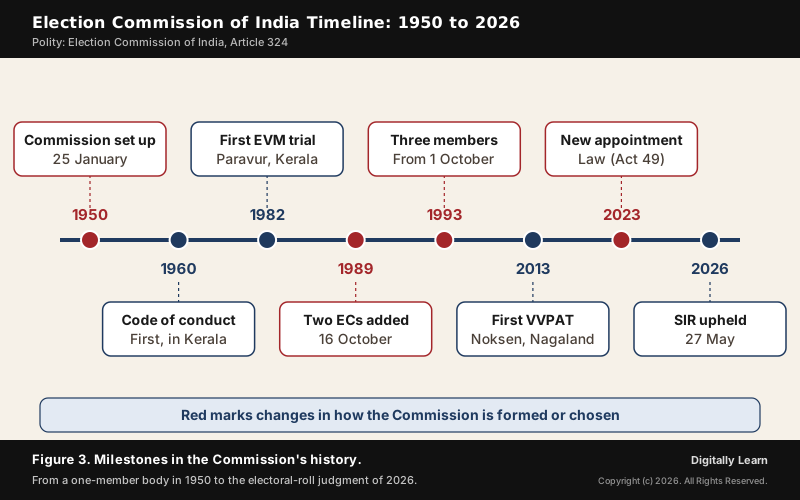
Article 326 first fixed the voting age at 21. The 61st Amendment lowered it to 18 with effect from 28 March 1989, and the much larger electorate was one reason the Commission gained two more members later that year.
The Commission works within the laws Parliament has made under Article 327. Political parties, for example, register with it under section 29A of the Representation of the People Act, 1951, while section 21 of the Representation of the People Act, 1950 governs the revision of electoral rolls.
Composition, Appointment and Independence of the Election Commission
From a Single-Member to a Three-Member Commission (1950 to 1993)
Article 324(2) says the Commission shall consist of the Chief Election Commissioner and such number of other Election Commissioners, if any, as the President may fix from time to time. When other Commissioners are appointed, the Chief Election Commissioner acts as the chairman. Before a general election the President may also appoint Regional Commissioners, after consulting the Commission, to assist it.
For almost four decades the Commission had one member. Sukumar Sen, the first Chief Election Commissioner, held the office from 1950 to 1958. On 16 October 1989 two Election Commissioners were appointed for the first time, but the posts were abolished on 1 January 1990 and the Commission went back to one member. The three-member structure was restored on 1 October 1993 and has continued since.
The change of 1993 led to a dispute. T. N. Seshan, Chief Election Commissioner from 12 December 1990 to 11 December 1996, challenged the new structure in the Supreme Court, and the matter was settled in favour of three equal members. The Chief Election Commissioner presides but has no more power than the other two; when they differ, the majority decides. A multi-member Commission is now widely accepted as the better design, because power is shared and each member is more accountable.
Appointment of Chief Election Commissioner and Election Commissioners Under the 2023 Act
Article 324(2) leaves the method of appointment to Parliament: the President appoints, subject to any law Parliament makes. For more than seven decades Parliament made no such law, so the President appointed the Commissioners on the advice of the Council of Ministers. Critics feared that the party in power could then choose a referee for its own contest.
In March 2023, in Anoop Baranwal v. Union of India, the Supreme Court ruled that until Parliament made a law, appointments would be made on the advice of a committee of the Prime Minister, the Chief Justice of India and the Leader of Opposition. Parliament then passed the Chief Election Commissioner and other Election Commissioners (Appointment, Conditions of Service and Term of Office) Act, 2023, which received assent on 28 December 2023 and replaced the Act of 1991.
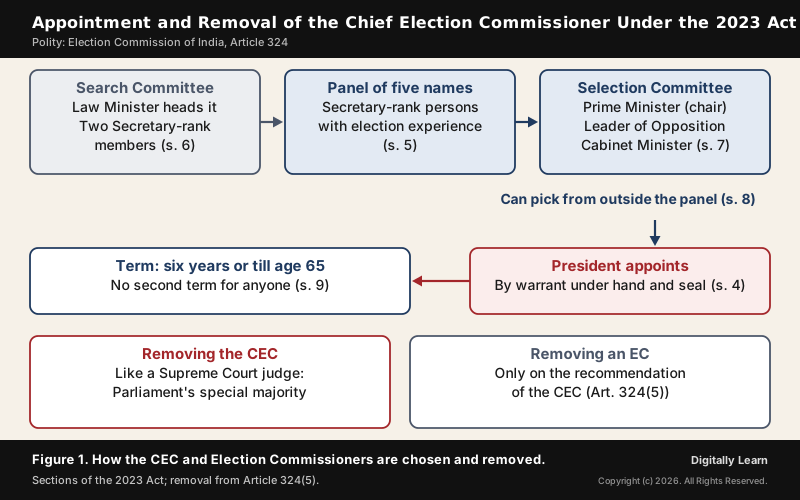
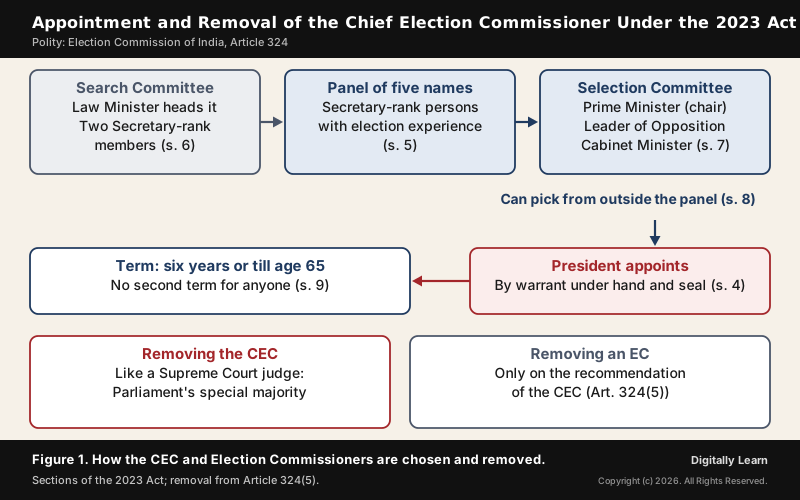
- Who can be appointed (section 5): Persons who hold or have held a post equal in rank to Secretary to the Government of India, of integrity and with knowledge and experience of conducting elections.
- Search Committee (section 6): Headed by the Minister of Law and Justice, with two members not below the rank of Secretary, it prepares a panel of five names.
- Selection Committee (section 7): The Prime Minister as chairperson, the Leader of Opposition in the Lok Sabha and a Union Cabinet Minister nominated by the Prime Minister. Where no Leader of Opposition is recognised, the leader of the largest opposition party takes the seat.
- Wider choice (section 8): The Selection Committee may consider a person outside the panel.
- Appointment (section 4): The President appoints by warrant under hand and seal, on the Selection Committee’s recommendation.
The Act replaced the Chief Justice of India, who sat on the Court's interim committee, with a Cabinet Minister chosen by the Prime Minister. Because two of the three members now come from the government, critics argue that the Act gives the ruling side a majority in choosing the referee. Gyanesh Kumar became the 26th Chief Election Commissioner on 19 February 2025; Sukhbir Singh Sandhu and Vivek Joshi are the other two Election Commissioners.
Term, Salary and Removal of Chief Election Commissioner and Election Commissioners
The 2023 Act fixes the service conditions that the Constitution left to the President. The table sets the Chief Election Commissioner beside the other Election Commissioners.
| Feature | Chief Election Commissioner | Election Commissioner |
|---|---|---|
| Appointed by | President, on the Selection Committee's recommendation | President, on the Selection Committee's recommendation |
| Term | Six years or till age 65, whichever is earlier | Six years or till age 65; if later made CEC, six years in all |
| Second term | Not eligible for re-appointment | Not eligible for re-appointment |
| Salary | Equal to a Supreme Court judge | Equal to a Supreme Court judge |
| Removal | Only like a Supreme Court judge, through Parliament | Only on the recommendation of the CEC |
| Constitutional shield | Conditions of service cannot be varied to his disadvantage | No such clause in Article 324 |
Removing a Chief Election Commissioner follows the procedure for a Supreme Court judge. Both Houses of Parliament must pass a resolution by a special majority, that is, a majority of the total membership and two-thirds of those present and voting, on the ground of proved misbehaviour or incapacity. The President then removes him. He therefore holds office securely, not at the pleasure of the President who appointed him.
Inside the Commission, all three members have equal powers. Section 18 of the Act asks them to work unanimously as far as possible and settles any difference by majority. Section 16 protects present and former Commissioners from civil or criminal proceedings for anything done or said in the course of official duty.
Independence of the Election Commission: Safeguards and Gaps
The Constitution protects the Commission's independence mainly through the Chief Election Commissioner's office. These are the safeguards that keep the Commission free of the government of the day:
- Security of tenure: The Chief Election Commissioner can be removed only like a Supreme Court judge.
- Fixed service conditions: His conditions of service cannot be varied to his disadvantage after appointment.
- Protection for colleagues: Another Election Commissioner or a Regional Commissioner can be removed only on the Chief Election Commissioner’s recommendation.
- Staff on request: Under Article 324(6), the President or a Governor must make staff available when the Commission asks.
The gaps lie in what the Constitution leaves out. It prescribes no qualifications for the members, fixes no term, and does not bar retiring Commissioners from later government posts. The 2023 Act now prescribes the qualifications and the term and rules out a second term, but it adds no bar on posts after retirement. The protection for the other two Commissioners has a second side as well: because they can be removed on the Chief Election Commissioner's recommendation, a member who disagrees with him may feel exposed.
Powers and Functions of Election Commission of India
Administrative Functions: Electoral Rolls, Election Schedule, Parties and Symbols
The Commission's powers and functions are usually grouped as administrative, advisory and quasi-judicial. The administrative ones keep the machinery of an election running, from the roll to the result.
- Electoral rolls: Preparing and regularly revising the rolls, registering every eligible voter and issuing elector identity cards.
- Election schedule: Fixing the timing of elections and the schedule, from the notification and the last dates for nominations, scrutiny and withdrawal to the poll, the count and the result.
- Candidates: Scrutinising nomination papers and monitoring election expenditure.
- Parties and symbols: Registering political parties, recognising them as national or State parties on the strength of their poll performance, and allotting symbols. The same symbol cannot go to two registered parties.
- Conduct during the campaign: Enforcing the Model Code of Conduct and preparing the roster for parties’ broadcasts on radio and television.
The Commission, not any ministry, decides when general elections and bye-elections are held. It also acts like a court in disputes over the recognition of parties and the allotment of symbols, including disputes between rival groups that arise when a recognised party splits.
Advisory and Quasi-Judicial Functions of the Commission
The Commission's advice binds the President and the Governors on one matter. When a question arises whether a Member of Parliament has become disqualified, Article 103(2) requires the President to obtain the opinion of the Election Commission and to act according to that opinion. Article 192(2) lays the same duty on the Governor for members of a State Legislature. The Commission also advises the President whether elections can be held in a State under President's Rule, which matters when the period of an emergency is to be extended beyond one year.
Its quasi-judicial powers come into play during the poll itself. The Commission can cancel a poll in the event of rigging, booth capturing or violence, order a re-poll in a constituency and order a recount where the count has not been fair.
Election Machinery: Chief Electoral Officers to Returning Officers
The Commission has only a small staff of its own and conducts elections through the administration of the Union and the States. In every State and Union Territory a Chief Electoral Officer supervises elections under the Commission's direction. At the district and constituency levels the work is done by the District Election Officer, the Electoral Registration Officer, who prepares the roll, and the Returning Officer, who conducts the poll and the count.
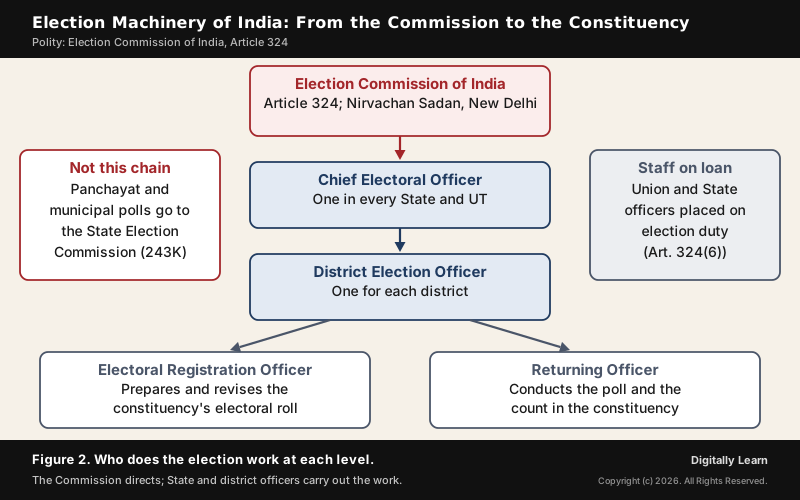
Once the election process begins, officers on election duty work under the Commission's control. The Commission can transfer them or stop their transfers, and it can act against an officer who fails to work in a non-partisan way. This borrowed but controlled machinery is how a Commission of three members runs elections across the whole country.
Model Code of Conduct, EVMs and the Electoral Roll
Model Code of Conduct: Meaning, Origin and Seven Parts
The Model Code of Conduct is a set of guidelines that the Election Commission issues for political parties and candidates during elections. It comes into force as soon as the election schedule is announced and stays in force until the electoral process ends. The code evolved with the consensus of the political parties.
The code began in Kerala, where the State administration drafted a code of conduct for the Assembly elections of 1960. The Commission circulated it to all recognised parties and State governments for the Lok Sabha elections of 1962, and from 1991 it began to enforce the code far more strictly after repeated violations. T. N. Seshan, Chief Election Commissioner in those years, is best known for such reforms, among them the enforcement of the code of conduct and voter identity cards for all.
Its seven parts deal with general conduct, meetings, processions, polling day, polling booths, the party in power and election manifestos. In practice they ask the following of parties and candidates:
- General conduct: No appeal based on religion, no attack on a rival’s private life, no bribery, intimidation or impersonation.
- Meetings and processions: Held only with permission from the police, on the approved route and time.
- Polling day and polling booths: Parties co-operate with officials; no symbols, propaganda or liquor near the booths; complaints go to the Commission’s observer.
- Party in power: No use of official machinery or public money for the campaign, no new schemes or grants announced by ministers, and no transfers made to gain an advantage.
- Election manifestos: No promise that goes against the law or the Constitution.
The section on the party in power is the code's sharpest edge, because it limits what a sitting government may do once the schedule is announced. How the Commission applies it can itself be contested: in 2019 Election Commissioner Ashok Lavasa stopped attending meetings on code violations because his dissenting views were not being recorded.
EVM and VVPAT: Voting Machines and the Paper Trail
India votes on Electronic Voting Machines built for the Commission by two public sector firms, Electronics Corporation of India and Bharat Electronics. A working model was shown to political parties in August 1980, and the machines were first tried in May 1982 in the by-election to the Paravur Assembly constituency in Kerala. In the 2004 general election they were used in all 543 Lok Sabha constituencies for the first time, and every Assembly and Lok Sabha election since has used them.
Each machine has a ballot unit, on which the voter presses the button against a candidate's name and symbol, and a control unit, which stores the count. Parties that lost elections have at times alleged that the machines were faulty. On 8 October 2013 the Supreme Court directed the Commission to add a paper trail, the Voter Verifiable Paper Audit Trail (VVPAT), which prints a paper record of each vote that the voter can check.
VVPAT was first used in September 2013 in the Noksen Assembly constituency in Nagaland and in 8 Lok Sabha constituencies in 2014. By the 2019 general election it covered all 543 constituencies, and the Supreme Court has since required the slips from a small share of machines to be counted and matched with the electronic result before results are declared.
Electoral Rolls and the Special Intensive Revision of 2025 and 2026
An election is only as fair as its electoral roll, the list of people entitled to vote. Besides its routine updates, the Commission periodically conducts an intensive revision, a door-to-door enumeration that prepares the roll afresh. Before 2025 the most recent intensive revisions were carried out between 2002 and 2004.
On 24 June 2025 the Commission ordered a Special Intensive Revision (SIR) of the roll in Bihar, four months before the State's Assembly election. The roll held 7.89 crore electors when the SIR was notified; the final roll published on 30 September 2025 held 7.42 crore. A second phase, announced on 27 October 2025, covered 51 crore voters in 12 States and Union Territories, including West Bengal, Tamil Nadu and Kerala.
On 27 May 2026 a Bench of Chief Justice Surya Kant and Justice Joymalya Bagchi upheld the SIR as an exercise the Commission carried out in furtherance of its constitutional obligation to conduct free and fair elections. The Court found cogent reasons for it: more than two decades since the last intensive revision, large additions and deletions in that period, rapid urbanisation and migration. The SIR did not replace the Representation of the People Act or the Registration of Electors Rules of 1960; it gave effect to the mandate of Article 324.
On citizenship, the Court held that citizenship is a condition precedent for enrolment, so the Commission is empowered to examine questions bearing on citizenship to the limited extent of deciding inclusion in or exclusion from the roll. It directed the Commission to refer to the Union government, within four weeks, the names of electors who were on the 2003 roll but were removed in the Bihar SIR as non-citizens, so that a competent authority could decide their cases under the Citizenship Act.
Is the Right to Vote a Fundamental Right? Article 326 and the Courts
The right to vote is not among the Fundamental Rights in Part III. It flows from Article 326, which entitles every citizen aged 18 or more to be registered as a voter unless disqualified on grounds of non-residence, unsoundness of mind, crime, or a corrupt or illegal practice. The Supreme Court's view of its nature has changed over the years.
- N. P. Ponnuswami (1952): The right to vote or to stand for election is a creature of statute, subject to the limits the statute imposes.
- Jyoti Basu v. Debi Ghosal (1982): The right to elect is neither a fundamental right nor a common law right, but a statutory right.
- People’s Union for Civil Liberties v. Union of India (2013): The right to vote may not be a fundamental right, but it is a constitutional right.
- Rajbala v. State of Haryana and Anoop Baranwal (2023): The right under Article 326 is a constitutional right, not merely a statutory one.
In its 2024 judgment on Section 6A of the Citizenship Act, the Supreme Court summed up this journey: through judicial construction, the right to vote has been upgraded from a mere statutory right to a constitutional right. It is therefore protected by the Constitution itself, even though it cannot be enforced through Article 32 in the way a Fundamental Right can.
Previous Year UPSC-CSE Questions
Previous Year UPSC-CSE Questions By the end you will be able to draft model answers for the following UPSC questions. Each question carries a collapsible framework showing how to approach it in the exam.
- UPSC Prelims 2017 Prelims-GSConsider the following statements:
- The Election Commission of India is a five-member body.
- Union Ministry of Home Affairs decides the election schedule for the conduct of both general elections and bye-elections.
- Election Commission resolves the disputes relating to splits/mergers of recognised political parties.
Which of the statements given above is/are correct?
How to approach this Prelims question
Approach: Step 1: count the members. Since 1 October 1993 the Commission has had three: the Chief Election Commissioner and two Election Commissioners. Step 2: ask who fixes the poll dates. The Commission decides the timing and schedule of general elections and bye-elections; no ministry does. Step 3: disputes over the recognition of parties and the allotment of symbols, including those after a split, are decided by the Commission acting like a court.
Trap to watch: Statement 2 sounds plausible because the Home Ministry handles security for elections, but security is not the schedule.
Key facts to recall:
- (a) 1 and 2 only: wrong. The Commission has three members, not five, and it fixes the schedule itself.
- (b) 2 only: wrong. The Home Ministry does not decide the election schedule.
- (c) 2 and 3 only: wrong. Statement 2 is false for the same reason.
- (d) 3 only: right. Only statement 3 holds: the Commission resolves disputes over the recognition and symbols of parties, including after splits.
Answer signal: 3 only: option (d), the official answer, because the Commission has three members and fixes election dates itself.
- UPSC Prelims 2004 Prelims-GSConsider the following tasks:
- Superintendence, direction and conduct of free and fair elections
- Preparation of electoral rolls for all elections to the Parliament, State Legislatures and the Office of the President and the Vice-President
- Giving recognition to political parties and individuals contesting the election
- Proclamation of final verdict in the case of election disputes
Which of the above are the functions of the Election Commission of India?
How to approach this Prelims question
Approach: Step 1: tasks 1 and 2 restate Article 324(1): superintendence, direction and control of elections and the preparation of electoral rolls. Step 2: recognising parties and scrutinising candidates is part of the Commission's administrative work. Step 3: a final verdict on an election dispute comes only through an election petition under Article 329(b), heard by the High Court since the 19th Amendment of 1966.
Trap to watch: Task 4 tempts because the Commission settles disputes over party symbols; that is not the same as deciding an election petition.
Key facts to recall:
- (a) 1, 2 and 3: right. These are functions of the Commission under Article 324 and the election laws.
- (b) 2, 3 and 4: wrong. It drops task 1 and adds task 4, which belongs to the courts.
- (c) 1 and 3: wrong. It leaves out the preparation of electoral rolls, a core function under Article 324(1).
- (d) 1, 2 and 4: wrong. Election disputes are decided through election petitions, not by the Commission.
Answer signal: 1, 2 and 3: option (a), the official answer, because election disputes go to the courts under Article 329(b).
- UPSC Prelims 2002 Prelims-GSConsider the following statements with reference to India:
- The Chief Election Commissioner and other Election Commissioners enjoy equal powers but receive unequal salaries.
- The Chief Election Commissioner is entitled to the same salary as is provided to a judge of the Supreme Court.
- The Chief Election Commissioner shall not be removed from his office except in like manner and on like grounds as a judge of the Supreme Court.
- The term of office of an Election Commissioner is five years from the date he assumes office or till he attains the age of 62 years, whichever is earlier.
Which of these statements are correct?
How to approach this Prelims question
Approach: Step 1: the three members have equal powers and receive equal salaries, so statement 1 fails on its second half. Step 2: the salary is equal to that of a Supreme Court judge, true under the 1991 Act and under section 10 of the 2023 Act. Step 3: Article 324(5) allows removal of the Chief Election Commissioner only like a Supreme Court judge. Step 4: the term is six years or till age 65, not five years or 62.
Trap to watch: Statement 4 changes both numbers of the term; check each number, not just the shape of the rule.
Key facts to recall:
- (a) 1 and 2: wrong. Salaries are equal, so statement 1 is false.
- (b) 2 and 3: right. The salary matches a Supreme Court judge, and removal follows the procedure for a judge.
- (c) 1 and 4: wrong. Both statements are false: equal salaries, and a term of six years or till age 65.
- (d) 2 and 4: wrong. Statement 4 gives the wrong term.
Answer signal: 2 and 3: option (b), the official answer, because salaries are equal and the term is six years or till age 65.
- UPSC Mains 2026 GS-IIIs the right to vote a fundamental right? Discuss the position of the Election Commission of India while undertaking the revision of electoral rolls. Can it also examine the question of citizenship of voters?
Answer outline: how to structure the answer
What the question asks, the main arguments, relevant examples and the direction of the conclusion. This is not a full model answer.
Introduction: Open with Article 326: every citizen aged 18 or more is entitled to be registered as a voter, unless disqualified by law.
Body (sub-themes to develop):
- Nature of the right: not in Part III; held statutory in Ponnuswami (1952) and Jyoti Basu (1982); a constitutional right in PUCL (2013), Rajbala and Anoop Baranwal (2023), as the 2024 Section 6A judgment records.
- The Commission's position: Article 324 gives it superintendence, direction and control over the preparation of rolls; the 2026 judgment upheld the SIR as part of its constitutional duty to conduct free and fair elections.
- Citizenship: citizenship is a condition precedent for enrolment, so the Commission may examine it only to decide inclusion or exclusion; the final decision on citizenship lies with the competent authority under the Citizenship Act, to which the Court asked the Commission to refer the Bihar cases.
- Remedy: electors deleted for absence, death, duplication or shifting can challenge the decision in the courts.
Conclusion: Conclude that the right to vote is a constitutional, not a fundamental, right, and that the Commission's role on citizenship is limited to the roll.
- UPSC Mains 2022 GS-IIDiscuss the role of the Election Commission of India in the light of the evolution of the Model Code of Conduct.
Answer outline: how to structure the answer
What the question asks, the main arguments, relevant examples and the direction of the conclusion. This is not a full model answer.
Introduction: Define the Model Code of Conduct as guidelines the Commission issues for parties and candidates, in force from the announcement of the schedule till the end of the process.
Body (sub-themes to develop):
- Evolution: a Kerala code of 1960, circulated nationally in 1962, enforced strictly from 1991.
- The Commission's role: enforcing a consensus code under its Article 324 powers; the party-in-power section limiting schemes, grants, transfers and the use of official machinery.
- Its tools: observers on the ground, the power to act against officers on election duty and to postpone or cancel a poll.
- Criticism: the 2019 episode in which an Election Commissioner's dissent on code violations went unrecorded raised questions about how evenly the code is applied.
Conclusion: Conclude that the code's authority rests on the Commission's credibility, so the Commission's independence is what keeps the code effective.
- UPSC Mains 2018 GS-IIIn the light of recent controversy regarding the use of Electronic Voting Machines (EVM), what are the challenges before the Election Commission of India to ensure the trustworthiness of elections in India?
Answer outline: how to structure the answer
What the question asks, the main arguments, relevant examples and the direction of the conclusion. This is not a full model answer.
Introduction: Introduce EVMs, used in all 543 Lok Sabha constituencies since 2004, and the doubts raised about tampering.
Body (sub-themes to develop):
- Technical trust: the voter cannot see the electronic count; VVPAT, directed by the Supreme Court on 8 October 2013, gives a slip the voter can check.
- Verification: matching VVPAT slips with the electronic count in a sample of machines before results are declared.
- Institutional trust: the method of appointing Commissioners and the recording of dissent within the Commission.
- Communication: explaining the safeguards clearly to voters and parties.
Conclusion: Conclude that trust in elections depends as much on the Commission's independence as on the machine.
Sources and Further Reading
- Legislative Department, Ministry of Law and Justice: The Constitution of India
- Gazette of India: The Chief Election Commissioner and other Election Commissioners (Appointment, Conditions of Service and Term of Office) Act, 2023 (Act 49 of 2023)
- Supreme Court of India: In re Section 6A of the Citizenship Act, 1955, judgment of 17 October 2024
- NCERT: Indian Constitution at Work, Class 11, Chapter 3, Election and Representation
- The Hindu (Delhi): SC upholds SIR, says it is EC's constitutional duty, 28 May 2026
- Wikipedia: Election Commission of India
- Wikipedia: Chief Election Commissioner of India
- Wikipedia: Chief Election Commissioner and Other Election Commissioners (Appointment, Conditions of Service and Term of Office) Act, 2023
- Wikipedia: Model Code of Conduct
- Wikipedia: T. N. Seshan
- Wikipedia: Gyanesh Kumar
- Wikipedia: Electronic voting in India
- Wikipedia: Voter-verified paper audit trail
- Wikipedia: Special Intensive Revision
Editorial Disclaimer
This article explains the Election Commission from the Constitution's text, the law on the appointment of Commissioners, the Supreme Court's judgments and the other sources listed.


