


Overview
Terrorism in India is the use or threat of violence against civilians or symbolic targets, meant to spread fear far beyond the immediate victims and to force a government or a society to change course. It reaches the country through groups based across the border, home-grown modules, regional insurgencies and organised crime. The attack on Parliament in 2001, the Mumbai attacks of 2008, Pulwama in 2019 and Pahalgam in 2025 were each followed by a new law, a new agency or a change of policy, while the Bombay bombings of 1993 showed how organised crime could serve terrorism.
Terrorism in India: Meaning and the Problem of Definition
Terrorism Defined: Violence as a Message to a Wider Audience
Purpose separates terrorism from ordinary crime. A criminal seeks private gain, whereas a terrorist uses violence as a message: The victims are often chosen at random or for what they symbolise, and the fear is meant to reach the public and the government far beyond the scene of the attack. This is why attacks fall on crowded places and on symbols of the State such as Parliament.
Violence of this kind has persisted for decades in Jammu and Kashmir, in the north-eastern States and in the forest belt of central and eastern India, and it has struck the large cities repeatedly. Government data released in July 2016 put the toll of terror attacks since 2005 at 707 lives lost and more than 3,200 people injured.
No definition of terrorism commands universal agreement, because a group that one country calls terrorist another may call a liberation movement. Indian statutes therefore define the offence by the act and the intent behind it, and India has pressed for a global treaty that would settle the definition for all states.
Terrorist Act Under UAPA Section 15 and BNS Section 113
The Unlawful Activities (Prevention) Act, 1967 (UAPA), is the principal anti-terror statute. It defines a terrorist act in Section 15 and prescribes its punishment in Section 16. The present definition was substituted by the amendment of 2008, enacted after the Mumbai attacks.
The Bharatiya Nyaya Sanhita, 2023 (BNS), which replaced the Indian Penal Code and came into force on 1 July 2024, defines a terrorist act in Section 113, the first such definition in the general criminal law. The definition has two parts.
- Intent: An act done with intent to threaten, or likely to threaten, the unity, integrity, sovereignty, security or economic security of India, or with intent to strike terror in the people or any section of the people in India or abroad.
- Means and consequence: The use of bombs, explosives, firearms, poisonous gases, chemical, biological, radioactive or nuclear substances, or any other means, to cause death or injury, destruction of property, disruption of essential supplies or services, damage to monetary stability through counterfeit Indian currency, or damage to property used for defence.
Two further clauses cover overawing a public functionary by criminal force or causing the death of one, and kidnapping or detaining a person and threatening to kill or injure that person in order to compel a government or an international organisation to do or abstain from doing an act.
The punishment is graded. A terrorist act that causes death is punishable with death or imprisonment for life, and fine. Any other terrorist act is punishable with imprisonment of not less than five years, which may extend to life, and fine. Conspiracy, advocacy, recruitment, running training camps, membership of an organisation involved in a terrorist act, harbouring a terrorist (the spouse of the offender is exempted) and knowingly holding property derived from a terrorist act are separate offences.
An Explanation to Section 113 provides that an officer not below the rank of Superintendent of Police decides whether a case is registered under that section or under the UAPA. In practice the UAPA, with its stricter bail provision and longer period of investigation, remains the main instrument in terror cases.
Comprehensive Convention on International Terrorism: India's Proposal
The Comprehensive Convention on International Terrorism (CCIT) is a proposed treaty that would criminalise all forms of international terrorism and deny terrorists, their financiers and their supporters access to funds, arms and safe havens. India proposed it in 1996. The Ad Hoc Committee set up by UN General Assembly Resolution 51/210 of 17 December 1996 has negotiated it since 1997, together with the Sixth Committee of the General Assembly.
As of November 2026 the negotiations remain deadlocked over the definition itself, in particular over what separates a terrorist organisation from a liberation movement and whether the activities of national armed forces should be excluded. The same Ad Hoc Committee has nevertheless produced three other conventions.
- The International Convention for the Suppression of Terrorist Bombings, adopted on 15 December 1997.
- The International Convention for the Suppression of the Financing of Terrorism, adopted on 9 December 1999.
- The International Convention for the Suppression of Acts of Nuclear Terrorism, adopted on 13 April 2005.
India keeps the CCIT on the agenda; at the General Assembly's session of 2024 it suggested that the definition of terrorism in Security Council Resolution 1566 (2004) could serve as a basis for further discussion. Without an agreed definition, the international designation of terrorists rests on lists kept by committees of the UN Security Council, such as the 1267 regime, rather than on a treaty.
Types of Terrorism Faced by India
Six Types Compared: Aims, Examples and Responses
The types of terrorism in India differ in their aims, in where their support comes from and in the laws used against them.
| Type | Main aim | Indian example | Response |
|---|---|---|---|
| Cross-border and state-sponsored | Harm India through groups based and backed abroad | Lashkar-e-Taiba and Jaish-e-Mohammed attacks: 2001, 2008, 2016, 2019, 2025 | UAPA, National Investigation Agency (NIA), military strikes across the Line of Control and the border, diplomacy |
| Ethno-nationalist | A separate State or the dominance of one ethnic group | Khalistan militancy in Punjab, the United Liberation Front of Asom in Assam, the killing of Rajiv Gandhi by the Liberation Tigers of Tamil Eelam | Accords, special forces, banning under the UAPA |
| Religious extremist | Violence in the name of faith | Indian Mujahideen serial bombings of 2005 to 2013 | UAPA, NIA trials |
| Left-wing | Overthrow of the State through a "people's war" | Communist Party of India (Maoist) and its armed wing | Security operations, development schemes, surrender policy |
| Narco-terrorism | Violence funded by, or merged with, the drug trade | Dawood Ibrahim designated a global terrorist in 2003 | Organised-crime and UAPA provisions |
| Cyber terrorism | Attacks on networks, and propaganda and recruitment online | Cyber terrorism added to the NIA's scheduled offences in 2019 | NIA Act, Cyber Multi-Agency Centre (2025) |
Ethno-nationalist and left-wing violence has been largely confined to particular regions, whereas cross-border and religious extremist groups have struck the large cities. Narco-terrorism and cyber terrorism are less often movements of their own than channels that sustain the other four, through drug money on the one hand and online propaganda and recruitment on the other.
Cross-Border and State-Sponsored Terrorism
Cross-border terrorism is violence carried out by groups that are trained, armed and sheltered outside India and that usually infiltrate across the Line of Control or the international border. Where a state provides that support, it is state-sponsored terrorism. India's official position is that Pakistan's Inter-Services Intelligence provides training, arms and money to Lashkar-e-Taiba, Jaish-e-Mohammed and Hizbul Mujahideen; Pakistan denies the charge.
The insurgency in Jammu and Kashmir, which began in 1989, shows the pattern. A disputed State election in 1987 drove some legislators into armed groups, and jihadists who had fought in Afghanistan crossed the Line of Control after the Soviet-Afghan War. In 2015, Pakistan's former President Pervez Musharraf admitted that the Pakistani state had supported and trained insurgent groups in Kashmir in the 1990s.
The character of the groups changed over time. Hizbul Mujahideen, founded in September 1989, had a Kashmir-centred aim of merging the region with Pakistan. Lashkar-e-Taiba, founded by Hafiz Saeed, and Jaish-e-Mohammed, led by Masood Azhar, often used fidayeen (suicide-squad) attacks on symbolic targets, both far beyond Kashmir (the Red Fort in December 2000, Parliament in 2001, Mumbai in 2008 and the Pathankot airbase in 2016) and on army bases within it, such as Uri in 2016.
Ethno-Nationalist, Left-Wing and Religious Extremist Terrorism
These three types arise mainly within the country, although each has had links abroad. Ethno-nationalist terrorism seeks either a separate State or the dominance of one ethnic group over another. In Punjab, the Khalistan militancy reached its height in the 1980s after Operation Blue Star in June 1984, and Prime Minister Indira Gandhi was assassinated on 31 October 1984. The assassination of Rajiv Gandhi in 1991 by a suicide bomber of the Liberation Tigers of Tamil Eelam (LTTE) belongs to the same category.
In the north-east, the United Liberation Front of Asom (ULFA), formed in 1979 to seek the independence of Assam, was later banned by the Union Government. Violence in the region has since fallen sharply and was 80 per cent lower in 2022 than in 2014, although Manipur has seen renewed insurgent activity since the ethnic violence that began on 3 May 2023.
Left-wing terrorism traces its origin to the Naxalbari uprising of 1967. Its armed wing, the People's Liberation Guerrilla Army, is a banned terrorist organisation under the UAPA. The "Red Corridor", which covered nearly 180 districts at its peak in the late 2000s, had shrunk to three districts by early 2026. On 1 April 2026, the day after the deadline the Government had set for ending the insurgency, the Union Home Minister described a Naxal-free India as one of the Government's biggest successes.
Religious extremist terrorism is violence justified in the name of a faith. The Indian Mujahideen, an offshoot of the Students Islamic Movement of India (SIMI), carried out serial bombings in Indian cities between 2005 and 2013.
Narco-Terrorism and Cyber Terrorism
Narco-terrorism is terrorism financed by, or merged with, the drug trade. The term was coined in 1983 by Peru's President Fernando Belaunde Terry to describe attacks on his country's anti-narcotics police. India's clearest case is Dawood Ibrahim, leader of the Mumbai crime syndicate D-Company, which coordinated the 1993 bombings; in 2003 he became the first drug lord to be formally classified as a global terrorist.
Cyber terrorism is the use of the internet to carry out violent acts, or to threaten loss of life or serious bodily harm, for political or ideological ends. It takes two forms. One is an attack on networks and infrastructure; the other is the use of the internet for propaganda, recruitment and fund-raising. The National Investigation Agency (Amendment) Act, 2019, added cyber terrorism to the offences the NIA can investigate, and on 22 January 2025 the Ministry of Home Affairs set up the Cyber Multi-Agency Centre to share information on cyber threats in real time.
Drugs, arms, counterfeit currency and hawala, an informal system that moves value outside the banks, form the nexus between crime and terrorism, because they give terrorist groups both money and mobility.
Causes and Drivers of Terrorism
Grievances, Ideology, Foreign Support and Triggers
The causes of terrorism in India cannot be reduced to a single factor. They are better understood as a set of conditions that armed groups exploit.
- Disputed territory and political alienation: The Kashmir insurgency grew out of a political grievance over autonomy and the 1987 election, and was then taken over and shaped by backers abroad. The movements in Punjab and the north-east likewise began with demands concerning identity, territory and migration; the Assam agitation against illegal immigration, for instance, ended with the Assam Accord of 15 August 1985.
- Ideology and religious radicalisation: Armed groups give violence a religious or revolutionary justification. Online propaganda now allows the Islamic State and similar groups to reach young people and encourages self-radicalised, low-intensity attacks on civilian places.
- Socio-economic neglect: The Naxalite movement began in 1967 with a seizure of land by peasants. In 2010 the Union Home Secretary acknowledged legitimate grievances over access to forest land and produce and over the distribution of benefits from mining and hydropower projects, and in 2011 Prime Minister Manmohan Singh called development "the master remedy".
- State support from abroad: Without safe havens, training camps and money from outside, many of these movements would have remained local.
- Illegal arms networks: Arms trafficking across the border and the illegal possession of weapons supply terrorist and insurgent groups, which is why the Arms (Amendment) Act, 2019, increased the punishments for these offences.
- Historical triggers: Operation Blue Star in 1984 was followed by the assassination of Prime Minister Indira Gandhi, and the Bombay bombings of 1993 came after the riots that followed the demolition of the Babri Masjid.
In each case three kinds of factor can be told apart. The root cause is a grievance, an ideology or a sponsor; the enabler is money, weapons, networks or technology; and the trigger is the event that sets off a particular attack.
Terrorism as a Competitive Industry: Funding, Branding and Recruitment
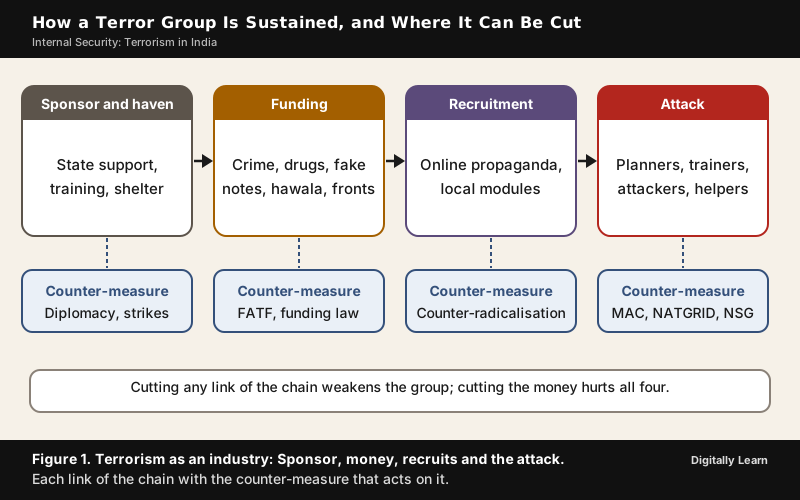
Terrorism has been called "a competitive industry", and the description fits, because terrorist groups behave like organisations competing for money, recruits and attention.
- Funding: Terrorist groups draw on several sources at once, including support from a hostile state, organised crime and the drug trade (as in the case of D-Company), counterfeit currency, hawala transfers, and charities or front organisations. Jamaat-ud‑Dawa is the "charity wing" of Lashkar-e-Taiba, and the Milli Muslim League its political front. The Financial Action Task Force (FATF), set up in 1989 and given a mandate over terrorist financing in 2001, became the main source of international pressure. After it threatened to blacklist Pakistan, Lashkar leaders, including Hafiz Saeed and Zakiur Rehman Lakhvi, were convicted of terror financing in 2021 and 2022.
- Branding and rivalry: Groups adopt new names and fronts that allow a sponsor to deny involvement. The Resistance Front (TRF), formed from Lashkar-e-Taiba and Hizbul Mujahideen cadres after 2019, was banned by India under the UAPA in January 2023, and the United States designated it a Foreign Terrorist Organization on 17 July 2025 as a front and proxy of Lashkar-e-Taiba. Global brands also compete. Al-Qaeda announced its subcontinent branch in 2014 partly to counter the expansion of the Islamic State, while the Kashmir-based groups (Lashkar, Jaish and Hizbul) have rejected the propaganda of both and presented the Kashmir cause as indigenous.
- Recruitment: Groups compete for recruits as they compete for money, through propaganda, local networks and, increasingly, social media, which lets a group reach young people far from any training camp.
- Professional division of labour: Planners, financiers, trainers, suicide attackers and local helpers, often called over-ground workers, perform separate roles. The Mumbai plot of 2008 involved Lashkar trainers; David Headley, a Pakistani-American who had completed Lashkar courses in 2002 and 2003; and ten attackers.
Major Terror Attacks in India and Their Lessons
Mumbai 1993, Parliament 2001 and Mumbai 26/11
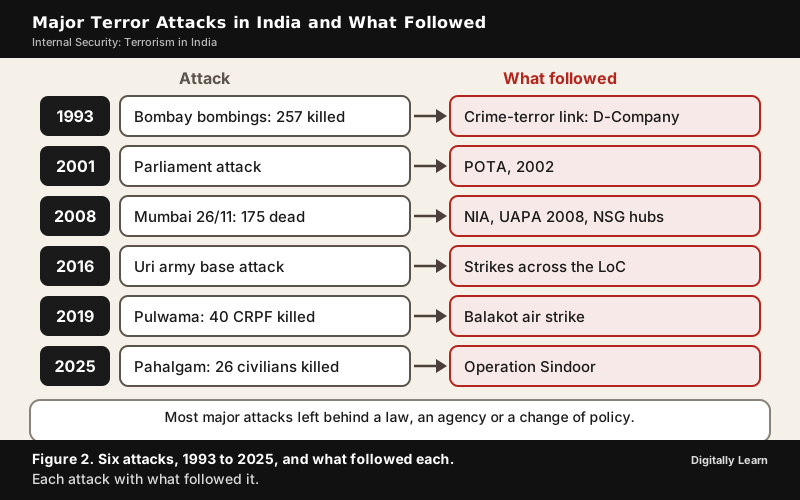
Measured by the number killed, the Bombay bombings of 1993 remain the biggest terror attack on an Indian city. They killed 257 people, more than the Mumbai train bombings of 2006 (209) or the Mumbai attacks of 2008 (175). The attacks of 2001 and 2008 changed the law and the institutions of the State, while the bombings of 1993 showed how organised crime could serve terrorism.
- Bombay bombings, 12 March 1993: Twelve bombs exploded across the city in a single day, killing 257 people and injuring 1,400. The attack was organised by Dawood Ibrahim of D-Company and showed how organised crime and terrorism can merge. Yakub Memon, whose death sentence the Supreme Court upheld on 21 March 2013, was executed on 30 July 2015; Dawood Ibrahim and Tiger Memon have never been tried.
- Parliament attack, 13 December 2001: Five militants of Jaish-e-Mohammed entered the Parliament complex in a car and were all killed; six Delhi Police personnel, two Parliament Security Service personnel and a gardener died. India held Lashkar-e-Taiba and Jaish-e-Mohammed responsible, and the military stand-off with Pakistan that followed lasted into 2002. The Prevention of Terrorism Act, 2002, replaced the ordinance of 2001 in the months after the attack.
- Mumbai 26/11, 26 to 29 November 2008: Ten attackers of Lashkar-e-Taiba, who reached Mumbai by sea, struck a railway terminus, two luxury hotels, a café, a hospital and Nariman House; 175 people died, nine of the attackers among them. Commandos of the National Security Guard (NSG) ended the siege on 29 November in Operation Black Tornado. Ajmal Kasab, the only attacker captured alive, was executed in 2012. The attack led to the creation of the National Investigation Agency, the UAPA amendment of 2008, regional hubs of the NSG and a stronger intelligence network.
Pathankot, Uri, Pulwama and Pahalgam
From 2016 onwards, attacks by Pakistan-based groups on security forces and civilians drew a new pattern of military response.
- Pathankot, 2 January 2016: Four militants in army fatigues attacked the Indian Air Force base, and the fighting and combing operations lasted several days. The United Jihad Council claimed responsibility, but the attackers were suspected to belong to Jaish-e-Mohammed.
- Uri, 18 September 2016: Four militants of Jaish-e-Mohammed attacked an army brigade headquarters and killed 19 soldiers. On 29 September 2016, Para (Special Forces) units of the Indian Army crossed the Line of Control and struck what the Government described as terrorist launch pads; it was the first time India publicly acknowledged that its forces had crossed the line. Pakistan rejected India's account, and independent analysts questioned the scale of the casualties claimed.
- Pulwama, 14 February 2019: A suicide bomber, a local Kashmiri youth, drove an explosives-laden vehicle into a convoy on the Jammu-Srinagar highway and killed 40 personnel of the Central Reserve Police Force; Jaish-e-Mohammed claimed responsibility. On 26 February 2019 the Indian Air Force struck what India described as a Jaish training camp at Balakot in Pakistan. Pakistan said the bombs fell on an uninhabited hillside, and independent satellite analysis reported that no significant targets were hit.
- Pahalgam, 22 April 2025: Three armed militants killed 26 civilians, 25 of them tourists, in the Baisaran valley after asking the victims their religion. It was the deadliest attack on civilians in India since 2008. The Resistance Front claimed responsibility and later withdrew the claim. India held the Indus Waters Treaty in abeyance and, on 7 May 2025, launched Operation Sindoor, missile strikes on nine sites in Pakistan and Pakistan-occupied Jammu and Kashmir linked to Lashkar-e-Taiba, Jaish-e-Mohammed and Hizbul Mujahideen. A ceasefire was announced on 10 May 2025.
In his address to the nation on 12 May 2025, the Prime Minister set out three principles. India would respond to a terrorist attack on its own terms, would not tolerate nuclear blackmail, and would make no distinction between terrorists and the governments that sponsor them; terror and talks, he added, cannot go together.
Urban Bombings and Home-Grown Modules
Between 2005 and 2013, bombs struck crowded places in Indian cities again and again, and many of the attacks were claimed by the Indian Mujahideen or by Lashkar-e-Taiba and its fronts.
- Delhi, 29 October 2005: Three explosions in two markets and a bus, two days before Diwali, killed 62 people.
- Mumbai suburban trains, 11 July 2006: Seven bombs exploded within about 11 minutes and killed 209 people.
- Jaipur, 13 May 2008: Nine blasts killed 63 people.
- Ahmedabad, 26 July 2008: Twenty-one blasts killed 56 people; in 2022 a special court sentenced 38 of the accused to death.
- Delhi, 13 September 2008: Five blasts killed at least 20 people.
- Mumbai, 13 July 2011: Three blasts killed 26 people.
- Hyderabad, 21 February 2013: Two blasts in Dilsukhnagar killed 18 people; Yasin Bhatkal, a co-founder of the Indian Mujahideen, was sentenced to death in December 2016.
These attacks followed a common pattern. Low-cost bombs were placed in markets and on public transport by a home-grown module of local men, often drawn from the banned SIMI, while the planning came from handlers in Pakistan or Bangladesh. Investigators linked the Indian Mujahideen to Lashkar-e-Taiba and to Harkat-ul‑Jihad-al‑Islami Bangladesh.
The outcomes in court were uneven. In March 2023 the Rajasthan High Court acquitted the four men sentenced to death for the Jaipur blasts. In July 2025 the Bombay High Court acquitted all 12 accused in the train bombings of 2006; on 24 July 2025 the Supreme Court stayed that order, while ruling that the released men would not return to jail. In the attack on the Akshardham temple in Gandhinagar on 24 September 2002, which killed 33 people and was ended by the NSG the next day, the Supreme Court acquitted the six accused in 2014.
According to the Government, the decade after the Hyderabad blasts of 2013 saw a near-complete absence of major urban attacks, while the NIA and State agencies foiled several plots inspired by the Islamic State. A car explosion near the Red Fort in Delhi on 10 November 2025, which killed at least 15 people and which the Government called a terrorist act, ended that long lull.
Global Terror Networks and India
Al-Qaeda in the Indian Subcontinent and ISIS Wilayah Hind
Besides the Pakistan-based groups, India faces two global terrorist organisations.
Al-Qaeda in the Indian Subcontinent (AQIS) was announced by Ayman al‑Zawahiri on 3 September 2014. Its stated aim was to fight the governments of India, Myanmar, Bangladesh and Pakistan, and it is listed as a terrorist organisation by the United Nations, India and other countries.
The Islamic State (ISIS or ISIL) proclaimed a worldwide caliphate in 2014, held large territories in Syria and Iraq, and had lost them by 2019. Its declared mission is a caliphate with religious and political authority over all Muslims, imposed by violence. India banned ISIL in mid-December 2014. The group's Khorasan branch declared a "Hind Province" (Wilayah Hind) in May 2019 after claiming attacks in Kashmir; an earlier local group, the Islamic State in Jammu and Kashmir, had never been recognised by the Islamic State itself.
The Islamic State threatens internal security differently from the Pakistan-based groups. It spreads through online propaganda, so recruitment can take place without a training camp. It encourages self-radicalised individuals and small cells to attack civilian places by low-cost methods, which are hard to detect in advance, and it appeals across borders; Indian nationals have been among its foreign fighters. The State's response relies on counter-radicalisation, cyber monitoring, coordination of intelligence and NIA investigations of plots inspired by the group.
UN Security Council 1267 Sanctions and India's Listing Efforts
The 1267 sanctions regime was created by UN Security Council Resolution 1267, adopted unanimously on 15 October 1999, which designated Osama bin Laden and his associates as terrorists. The resolution set up a committee and a list of individuals and entities associated with Al-Qaeda and the Taliban, who became subject to sanctions such as an asset freeze and a travel ban. The regime has since been reaffirmed and modified by later resolutions, and a right to seek delisting was added in December 2006.
The regime matters to India because Pakistan-based groups have been listed under it.
- Lashkar-e-Taiba was placed on the list on 2 May 2008, and Jamaat-ud‑Dawa was sanctioned by the Security Council on 11 December 2008, after 26/11.
- Masood Azhar, the founder of Jaish-e-Mohammed, was listed on 1 May 2019. He was one of the three militants India released in December 1999 in exchange for the hostages of Indian Airlines Flight IC 814, which had been hijacked on 24 December 1999. China had blocked earlier attempts to list him, including in February 2017 and on 13 March 2019, before lifting its hold in May 2019.
- After the Pahalgam attack, an Indian delegation met the Monitoring Team of the 1267 Committee and presented evidence of the links between The Resistance Front and Lashkar-e-Taiba, seeking the front's listing.
Because one permanent member of the Security Council can hold up a listing, as China did with Masood Azhar, India has also used its own power under the UAPA, available since 2019, to designate individuals as terrorists. By June 2026 the Government had designated more than 57 individuals, including Masood Azhar, Hafiz Saeed and Zakiur Rehman Lakhvi.
Countering Terrorism: India's Overall Approach
Laws Against Terrorism: TADA, POTA, UAPA and the BNS
India's anti-terror laws developed in four stages, each in response to a particular threat.
- TADA (1985 to 1995): The Terrorist and Disruptive Activities (Prevention) Act came into force on 24 May 1985, during the Punjab insurgency. Confessions made to police officers were admissible as evidence. It was renewed several times and allowed to lapse in 1995 after widespread complaints of abuse.
- POTA (2002 to 2004): The Prevention of Terrorism Act, 2002, followed the attack on Parliament and replaced an ordinance of 2001. After the Rajya Sabha rejected the Bill by 113 votes to 98, a joint sitting of the two Houses passed it by 425 votes to 296, only the third time a Bill had been passed in this way. POTA also made confessions to police officers admissible and allowed detention for up to 180 days before a chargesheet. It was repealed in 2004.
- UAPA (1967, strengthened in 2004, 2008, 2012 and 2019): The Act of 1967 was first directed at unlawful associations, under the authority of the Sixteenth Amendment of 1963, which allowed restrictions on speech, assembly and association in the interests of sovereignty and integrity. In 2004 most of POTA's provisions were incorporated into it, and the amendment of 2008 followed the Mumbai attacks. The amendment of 2019, which received assent on 8 August 2019, empowers the Central Government to designate individuals as terrorists, allows NIA officers of the rank of Inspector to investigate, and permits the Director General of the NIA to approve the seizure of property.
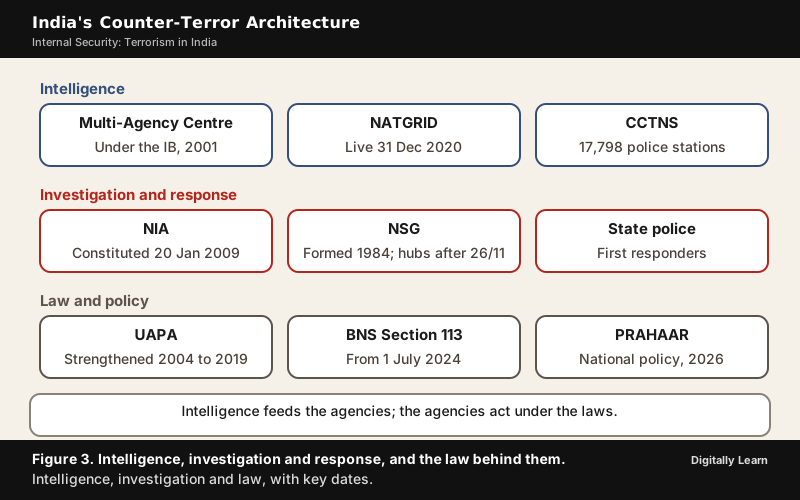
- BNS (from 1 July 2024): Terrorism and organised crime are now defined in the general criminal law.
Preventive detention is a separate instrument. Under Article 22(3)(b) of the Constitution, the safeguards of clauses (1) and (2), including the right to consult a legal practitioner and to be produced before a magistrate within 24 hours, do not apply to a person arrested or detained under a law providing for preventive detention.
Article 355 makes it the duty of the Union to protect every State against external aggression and internal disturbance and to ensure that its government is carried on in accordance with the Constitution. It is the constitutional basis for central assistance to States facing terrorism.
Agencies, Doctrine and International Cooperation
The National Investigation Agency (NIA) was created by the NIA Act, 2008, which received assent on 31 December 2008, and was constituted on 20 January 2009 as the first statutory counter-terror investigating agency with nationwide jurisdiction. The amendment of 2019, passed on 17 July 2019, added offences such as cyber terrorism and human trafficking to its remit and allowed it to investigate offences against Indian interests abroad. Its cases are tried by special NIA courts.
Intelligence fusion, the pooling of intelligence from many agencies, has three main elements. The Multi-Agency Centre (MAC), set up under the Intelligence Bureau in 2001 after Kargil and strengthened after 26/11, links 28 central and State agencies and has subsidiary centres in the States. The National Intelligence Grid (NATGRID) connects databases on immigration, banking, telecommunications and travel for authorised agencies, and went live on 31 December 2020. The Crime and Criminal Tracking Network and Systems (CCTNS) connects police stations, and CCTNS 2.0 links all 17,798 of them.
Response forces, doctrine and diplomacy complete the system.
- Response forces: The National Security Guard, formed on 16 October 1984 after Operation Blue Star and placed on a statutory footing by the NSG Act, 1986, is the national counter-terror force. After 26/11 it set up regional hubs, including at Mumbai, Chennai, Hyderabad and Kolkata, so that it no longer has to fly in from its base at Manesar.
- Doctrine: The Government's stated policy is zero tolerance of terrorism. The shift from restraint to imposing costs runs from the strikes of 2016 through Balakot in 2019 to Operation Sindoor in 2025. PRAHAAR, India's National Counter-Terrorism Policy and Strategy, unveiled on 23 February 2026, brings together prevention, swift response, a whole-of-government approach, processes based on human rights and international cooperation.
- International cooperation: India joined the FATF in 2010 and has used it to press for action against terror financing. It has Joint Working Groups on counter-terrorism with 27 countries and five multilateral groupings, namely the Shanghai Cooperation Organisation, BIMSTEC (the Bay of Bengal Initiative for Multi-Sectoral Technical and Economic Cooperation), BRICS, the European Union and the Quad. It hosted the third "No Money for Terror" conference in New Delhi on 18 and 19 November 2022, and Tahawwur Hussain Rana, an accused in the 26/11 case, was extradited from the United States in April 2025.
Gaps: Prosecution, Coordination and Police Capacity
Three gaps remain in India's response to terrorism.
- Prosecution: Critics of the UAPA point to its low rate of conviction. Government data for 2016 to 2020 show 5,027 cases registered against 24,134 persons, with 212 convicted and 386 acquitted. The NIA's conviction rate in its own cases stood at 92.70 per cent in June 2026. The two figures measure different things: The first covers all UAPA cases across the States, the second only the cases of one central agency. Bail under the UAPA is difficult to obtain and trials are long. In 2020 United Nations special rapporteurs stated that the 2019 amendment contravenes human rights standards, and in June 2021 the Delhi High Court observed that the scope of "terrorist activity" had been broadened to include ordinary penal offences. The acquittals in the Akshardham and Jaipur cases, and the High Court acquittal in the train bombings of 2006, also raise questions about the collection of evidence and delays in trials.
- Coordination: After 26/11 the Union Home Minister proposed a National Counter Terrorism Centre to collect and analyse all intelligence in one place, but it remained a proposal. Intelligence sharing between the Centre and the States still depends on the MAC and its subsidiary centres, and the CCTNS, NATGRID and the planned Organized Crime Network Database are intended to fill the gap.
- Police capacity: The Pradhan Inquiry Commission, set up after 26/11, found that the "war-like" attack was beyond the capacity of any police force. Over ₹6,300 crore was committed to modernising the police and security forces between 2021 and 2026, including ₹4,846 crore allocated to State and Union Territory police. Local police remain the first responders and the main source of ground intelligence, so their training and equipment determine how early a plot is detected.
Previous Year UPSC‑CSE Questions
Each Prelims question is explained option by option, and each Mains question comes with an answer outline.
- UPSC Prelims 2003Which one of the following Articles of the Indian Constitution provides that 'It shall be the duty of the Union to protect every State against external aggression and internal disturbance'?
How to approach this Prelims question
Approach: The quoted duty belongs to the emergency provisions in Part XVIII of the Constitution, so the test is which of the four Articles sits in that Part and carries this duty. Articles 215, 275 and 325 deal with the High Courts, grants to States and the electoral roll.
Why each option is right or wrong:
- (a) Article 215: Wrong. It makes every High Court a court of record.
- (b) Article 275: Wrong. It provides for grants-in-aid from the Union to certain States.
- (c) Article 325: Wrong. It provides for one general electoral roll for every territorial constituency, from which no one may be excluded on grounds only of religion, race, caste or sex.
- (d) Article 355: Correct. It places on the Union the duty to protect every State against external aggression and internal disturbance and to ensure that every State government is carried on in accordance with the Constitution.
Answer: (d) Article 355. The emergency provisions of Part XVIII lay on the Union the duty to protect every State against external aggression and internal disturbance.
- UPSC Mains 2025 GS‑IIITerrorism is a global scourge. How has it manifested in India? Elaborate with contemporary examples. What are the counter measures adopted by the State? Explain.
Answer outline
The outline sets out what the question asks, the main arguments, relevant examples and the direction of the conclusion; it is not a full model answer.
Introduction: Terrorism is a global scourge that has reached India through cross-border groups, home-grown modules and insurgencies, from the Bombay bombings of 1993 to Pahalgam in 2025.
Body (sub-themes to develop):
- Manifestations: Cross-border attacks (Pulwama 2019, Pahalgam 2025), urban bombings by home-grown modules, ethno-nationalist and left-wing violence, online radicalisation.
- Contemporary examples: Pahalgam and Operation Sindoor in 2025, and the Red Fort explosion of November 2025, in which the NIA has charged 13 accused.
- Counter-measures: The UAPA and Section 113 of the BNS, the NIA, the Multi-Agency Centre and NATGRID, NSG hubs, FATF pressure and diplomacy, strikes in 2016, 2019 and 2025, and PRAHAAR.
Conclusion: The State has moved from restraint to imposing costs on sponsors, while prosecution and police capacity remain the weak links.
- UPSC Mains 2021 GS‑IIIAnalyse the complexity and intensity of terrorism, its causes, linkages and obnoxious nexus. Also suggest measures required to be taken to eradicate the menace of terrorism.
Answer outline
Introduction: Terrorism is violence or its threat used to strike fear into the public and coerce a government; Section 113 of the BNS defines it by intent and means, and it reaches India through cross-border groups, home-grown modules, insurgencies and organised crime.
Body (sub-themes to develop):
- Complexity: Cross-border, ethno-nationalist, religious extremist and left-wing terrorism, with narco-terrorism and cyber terrorism, each with an example.
- Intensity: 707 lives lost in terror strikes from 2005 to July 2016, and the major attacks from 1993 to Pahalgam in 2025.
- Causes: Political grievances, ideology and online radicalisation, socio-economic neglect, state support from abroad and illegal arms.
- Linkages and nexus: D-Company and the 1993 bombings, drugs, counterfeit currency, hawala and fronts such as Jamaat-ud‑Dawa.
- Measures: The UAPA and the BNS, the NIA, the Multi-Agency Centre and NATGRID, NSG hubs, FATF pressure and 1267 listings, cross-border deterrence, development, counter-radicalisation and police capacity.
Conclusion: Responses matched to each cause, from deterrence of sponsors to accords, development and counter-radicalisation, work better than a single policy for every kind of terrorism.
- UPSC Mains 2017 GS‑IIIThe scourge of terrorism is a grave challenge to national security. What solutions do you suggest to curb this growing menace? What are the major sources of terrorist funding?
Answer outline
Introduction: Terrorism is a grave challenge to national security, as the attacks from the Bombay bombings of 1993 to Pahalgam in 2025 show, and it survives on steady funding.
Body (sub-themes to develop):
- Sources of funding: State sponsorship, organised crime and drugs, counterfeit currency, hawala, charities and front organisations.
- Legal solutions: The UAPA and the BNS, with funding offences.
- Financial solutions: FATF compliance and pressure on sponsors.
- Intelligence and response: The Multi-Agency Centre, NATGRID, CCTNS and NSG hubs.
- Prevention: Counter-radicalisation, police capacity, international cooperation and the push for the CCIT.
Conclusion: Cutting off the money is the one solution common to every form of terrorism, from cross-border groups to insurgencies.
- UPSC Mains 2016 GS‑III"Terrorism is emerging as a competitive industry over the last few decades." Analyze the above statement.
Answer outline
Introduction: Terrorist groups behave like firms in a market, competing for money, recruits and attention, which is why terrorism is described as a competitive industry.
Body (sub-themes to develop):
- Funding: State support, organised crime and drugs, counterfeit currency, hawala, charities and fronts.
- Branding and rivalry: Fronts such as The Resistance Front and Jamaat-ud‑Dawa; Al-Qaeda's subcontinent branch of 2014 against the Islamic State.
- Recruitment: Online propaganda and self-radicalised cells.
- Division of labour: Planners, financiers, trainers, attackers and local helpers, as in the 2008 Mumbai plot.
Conclusion: The industry view holds for funding, branding and recruitment, and it shows why cutting off money and recruits matters as much as stopping attacks.
- UPSC Mains 2015 GS‑IIIReligious indoctrination via digital media has resulted in Indian youth joining the ISIS. What is ISIS and its mission? How can ISIS be dangerous for the internal security of our country?
Answer outline
Introduction: The Islamic State is a jihadist group that proclaimed a worldwide caliphate in 2014 and lost its territory in Syria and Iraq by 2019.
Body (sub-themes to develop):
- Mission: A caliphate with religious and political authority over all Muslims, imposed by violence.
- Danger to India: Online radicalisation, self-radicalised individuals and small cells, low-cost attacks on civilian places, and the "Hind Province" claim of May 2019.
- Response: The ban of December 2014, NIA investigations, counter-radicalisation and cyber monitoring.
Conclusion: The threat to India lies in recruitment through digital media more than in any base on Indian soil.
Sources
- Gazette of India: Bharatiya Nyaya Sanhita, 2023, Sections 111 and 113
- National Investigation Agency (MHA): Unlawful Activities (Prevention) Act, 1967
- Constitution of India (Legislative Department): Articles 22 and 355
- NCERT: Contemporary World Politics (Class XII, revised edition 2022, reprint 2026‑27), Chapter 5, Security in the Contemporary World
- PIB: Prime Minister's address to the nation (12 May 2025)
- PIB: 12 Years of India's Zero Tolerance Against Terror (19 June 2026)
- PIB: Operation Sindoor, India's Strategic Clarity and Calculated Force
- PIB: Union Home Minister on a Naxal-free India (1 April 2026)
- Wikipedia: Terrorism in India
- Wikipedia: 1993 Bombay bombings
- Wikipedia: 2001 Indian Parliament attack
- Wikipedia: 2008 Mumbai attacks
- Wikipedia: 2016 Pathankot attack
- Wikipedia: 2016 Uri attack
- Wikipedia: 2019 Pulwama attack
- Wikipedia: 2019 Balakot airstrike
- Wikipedia: 2025 Pahalgam attack
- Wikipedia: 2006 Mumbai train bombings
- Wikipedia: 2008 Ahmedabad bombings
- Wikipedia: Akshardham Temple attack
- Wikipedia: Comprehensive Convention on International Terrorism
- Wikipedia: United Nations Security Council Resolution 1267
- Wikipedia: Al-Qaeda in the Indian subcontinent
- Wikipedia: Islamic State
- Wikipedia: Islamic State – Khorasan Province
- Wikipedia: Insurgency in Jammu and Kashmir
- Wikipedia: Insurgency in Northeast India
- Wikipedia: Naxalite–Maoist insurgency
- Wikipedia: Khalistan movement
- Wikipedia: Narcoterrorism
- Wikipedia: Cyberterrorism
- Wikipedia: Lashkar-e-Taiba
- Wikipedia: Jaish-e-Mohammed
- Wikipedia: Indian Mujahideen
- Wikipedia: National Investigation Agency
- Wikipedia: NATGRID
- Wikipedia: Multi Agency Centre
- Wikipedia: National Security Guard
- Wikipedia: Financial Action Task Force
- Wikipedia: 2005 Delhi bombings
- Wikipedia: Jaipur bombings
- Wikipedia: 13 September 2008 Delhi bombings
- Wikipedia: 2011 Mumbai bombings
- Wikipedia: 2013 Hyderabad blasts
- Wikipedia: 2025 Delhi Red Fort blast
- Wikipedia: The Resistance Front
- Wikipedia: List of terrorist incidents in India
- UPSC: Civil Services Examination question papers
Editorial Disclaimer
This article draws on the text of the laws, official statements and the sources listed at its end. Cases still in the courts or under investigation are described as they stood when the article was last revised.
See more of our UPSC articles in Google Search
Add to Preferred Sources

