


Overview
Operation Sindoor was the codename for the cross-border missile strikes India launched on the night of 6-7 May 2025 against nine sites in Pakistan and Pakistan-occupied Kashmir linked to militant groups Jaish-e-Mohammed and Lashkar-e-Taiba. The strikes followed the 22 April 2025 Pahalgam attack, in which gunmen killed 26 tourists at a meadow in Anantnag district. A three-day military confrontation followed, with a ceasefire taking effect on 10 May 2025. One year on, the operation is being read as the maturation of a controlled-force approach under the shadow of nuclear weapons.
Why this is in the news on 7 May 2026
The anniversary and the reckoning across three tracks
On 7 May 2026, India marked the one-year anniversary of Operation Sindoor. The reckoning is unfolding across three tracks that an aspirant should read together: the civilian cost on the Line of Control, the military strategy the operation revealed, and the defence-procurement reset that has followed.
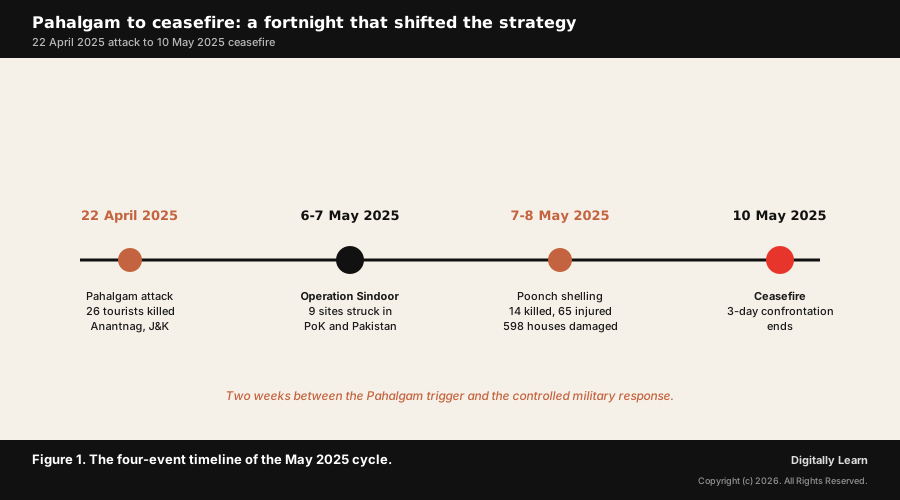
Operation Sindoor was India's cross-border missile-strike response to the 22 April 2025 Pahalgam attack. Two weeks after the Pahalgam attack, in which gunmen killed 26 tourists at a meadow in Anantnag district, India struck nine sites in Pakistan and Pakistan-occupied Kashmir linked to Jaish-e-Mohammed and Lashkar-e-Taiba. Strikes ran from the night of 6-7 May 2025 through three days of confrontation, with a ceasefire on 10 May 2025.
The anniversary frame matters for UPSC because three reports converged on it in the first week of May 2026:
- (i) Ground reporting from Poonch on the civilian cost of cross-border shelling, including the 14 killed and 598 houses damaged in the 7-8 May 2025 shelling cycle.
- (ii) Strategic picture describing Sindoor as the maturation of controlled force under the shadow of nuclear weapons, with multi-domain jointness as the operational signature.
- (iii) Defence-procurement update from the Defence Secretary on roughly 30,000 crore of emergency contracts signed after Sindoor, plus the Army’s reorganisation into five new formation types.
Why the civilian and strategic dimensions matter for UPSC
Poonch shelling, ex-gratia framework, and bunker proposal
Why it matters: The civilian costs of cross-border conflict are not collateral footnote material in UPSC Mains; they are central to Internal Security and Disaster Management syllabus heads. The Poonch figures put numbers on a frequently abstract topic.
On 7-8 May 2025, cross-border shelling hit Poonch district. According to government data carried in the anniversary reporting, 14 people were killed and 65 injured, and 598 houses were damaged. The Poonch town bazaar, residential lanes, and at least one madrasa were hit. The ground reporting documents one family that lost 11-year-old twins on the same day, and a confectionery-shop owner killed when an artillery shell struck the road outside his shop.
The Central and Jammu and Kashmir governments responded with an ex-gratia framework: 16 lakh per deceased family, 1 lakh for the seriously injured, and an additional 5 lakh for those who suffered permanent disabilities. Reconstruction outlays of 7.39 crore for pucca houses and 2.25 crore for kuccha houses were sanctioned, and the construction of 200-300 prefabricated three-room structures was proposed for families unable to rebuild despite the relief.
The most institutional response is a proposal for 5,693 new underground bunkers in Poonch district, a vast majority of them community shelters rather than private ones. The proposal is awaiting approval. Bunker infrastructure of this scale moves the question from incident response to permanent civil-defence architecture along the Line of Control.
Significance for India's military strategy
Controlled force under the shadow of nuclear weapons
What is the significance of this operation for India's strategic thinking: Sindoor is being read as the maturation of a controlled-force approach in three converging senses: discipline of application, mastery of escalation control, and validation of the stability-instability paradox in South Asia.
- (i) Discipline of application. The most striking feature was not the scale of force employed but the discipline with which it was applied. India chose precise, time-bound, politically directed strikes over a wider conventional conflict. Credible retribution against the perpetrators, rather than territorial ambition, defined the operation.
- (ii) Mastery of escalation control. India maintained a posture of readiness that was understood without being articulated. The operation reaffirmed that limited conflict remains possible, even effective, within a nuclearised environment, provided political intent, military capability, and communication are aligned.
- (iii) Stability-instability paradox revisited. The long-debated South Asian paradox, that nuclear parity stabilises strategic deterrence while permitting sub-conventional turbulence, found a contemporary expression in Sindoor. Pakistan’s military response lacked coherence, and its repeated invocation of the nuclear threat appeared formulaic; nuclear signalling, once a potent deterrent, risks losing salience when overused without corresponding credibility.
The Pahalgam objective has failed: The Pahalgam attack that preceded Sindoor was intended to reinsert Pakistan into the Kashmiri consciousness and to project its continuing relevance. The trigger sought to disrupt a narrative of normalcy built around economic revival, tourism, and declining local recruitment. A year later, that objective appears to have failed: local recruitment into militancy remains limited, and the economic momentum in the Valley continues.
Distinguishing features of the operation
Multi-domain jointness in one view
Joint-force integration: Sindoor reflected a level of jointness that went beyond coordination to integration. Five capability areas were brought into one operational picture; the table below maps each area to its role in the operation.
| Capability area | Role in Operation Sindoor | Indicative platform / unit |
|---|---|---|
| Cyber | Disruption of adversary command and communications, denial of digital infrastructure | Cyber Command and inter-services cyber assets |
| Electronic warfare | Jamming, spoofing, and signal-environment shaping over the target zones | Mobile electronic-warfare equipment procured under the emergency contracts |
| Intelligence, surveillance, reconnaissance | Target identification, battle-damage assessment, and persistent overwatch of nine sites | Drones, satellites, signals intelligence |
| Precision strike | Standoff strikes on nine sites in PoK and Pakistan from beyond visual range | Scalp cruise missile, Hammer smart weapon, BrahMos, guided bomb kits |
| Air defence | Sky shield against incoming aerial threats during the three-day confrontation | S-400 surface-to-air missile system (longest-ever surface-to-air kill from 300 km) |
Distinguishing features: Three architectural moves separate Sindoor from earlier Indian cross-border actions:
- (i) Compressed decision-making timelines. Cyber, electronic warfare, ISR, and precision strike were synchronised in a manner that reduced the gap between target identification and engagement.
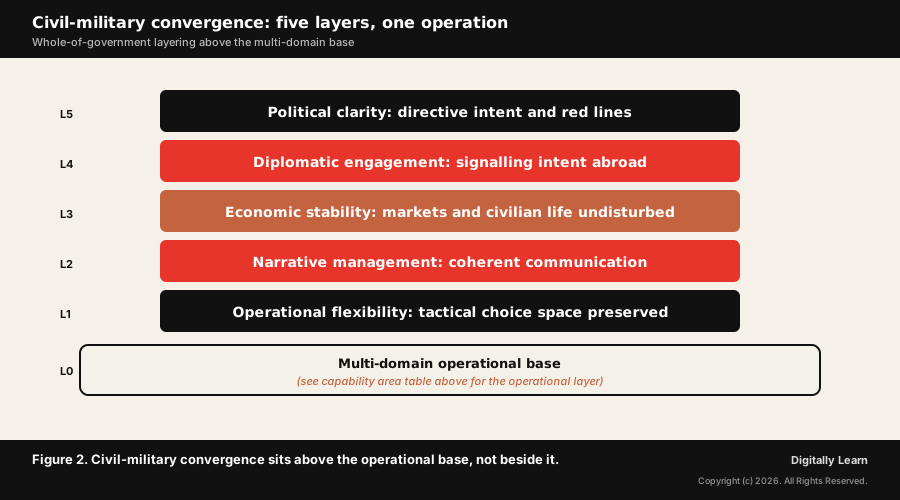
- (ii) Whole-of-government convergence. Political clarity enabled operational flexibility; diplomatic engagement ensured international understanding; economic stability was maintained with minimal disruption to markets and civilian life.
- (iii) Civil-military communication framework. Narrative management, while not flawless, was significantly more coherent than in earlier crises. The operation revealed a need for faster institutionalised communication frameworks that do not rely on individual personalities.
Observable outcomes the operation is producing
Three trackable outcomes of the post-Sindoor reset
The post-Sindoor reset is producing three trackable institutional outcomes that an aspirant should keep in working memory.
- (a) 30,000 crore emergency procurement. The Defence Secretary has indicated that the majority of emergency-procurement contracts signed after Sindoor (about 30,000 crore in value) were intended to acquire drones, counter-drone systems, loitering munitions, various radars, and electronic-warfare equipment. India is also acquiring the R-37 long-range air-to-air missile from Russia, inducting the homegrown Astra beyond-visual-range air-to-air missile and variants, and buying 216 Excalibur precision-guided 155 mm artillery projectiles from the United States.
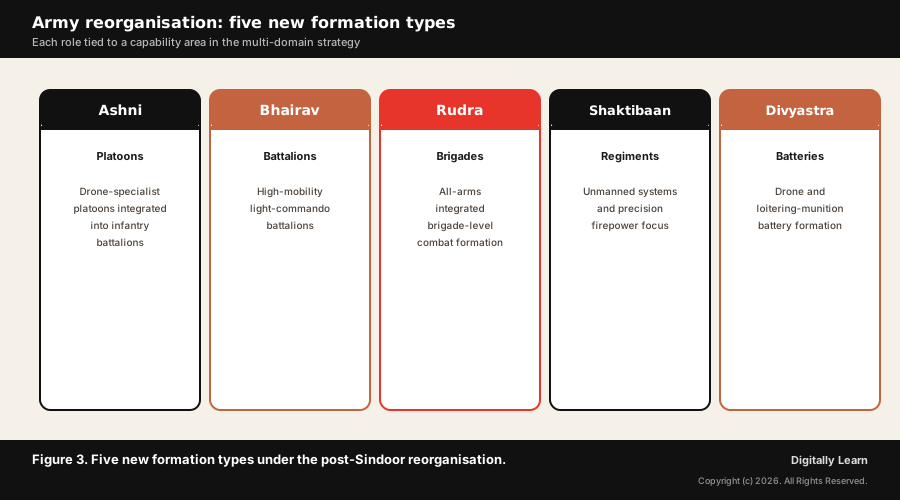
- (b) Army reorganisation into five new formation types. The Army is raising Ashni platoons (specialised drone platoons integrated into infantry battalions), Bhairav battalions (high-mobility light-commando battalions), Rudra brigades (all-arms integrated brigade-level combat formations), Shaktibaan regiments (focused on unmanned systems and precision firepower), and Divyastra batteries (primarily drone and loitering-munition batteries). Integrated battle groups are also being established.
- (c) Conventional missile force on the horizon. In the wake of the West Asia war, India is looking to raise a conventional missile force. Earlier the idea was to use it for strategic purposes only; with that approach shifting now, India is adjusting accordingly. A senior official described the change as letting fewer forces dominate large areas, releasing reserves for offensive and other tasks.
Operation Sindoor and the wider security picture
How Sindoor links to evolving threats
Contemporary linkages: The Sindoor anniversary lands inside three other strategic conversations that an aspirant should connect.
- (i) Evolving terror-financing threat. Terror financing, though under greater scrutiny, is adapting. The shift from traditional channels to hybrid models, including digital and crypto-based mechanisms, poses new challenges. Sustained monitoring through agencies such as the National Investigation Agency is part of the policy response.
- (ii) Lessons from the West Asia war and the Russia-Ukraine war. Operation Sindoor, the Russia-Ukraine war, and the West Asia war have together provided insights into the shape of future conflict: shorter, sharper, fought across domains that blur the line between war and peace. Urban centres, digital infrastructure, and societal cohesion may become as significant as traditional battlefields.
- (iii) PL-15E and the air-to-air missile race. During the hostilities, Pakistan deployed the China-supplied PL-15E beyond-visual-range air-to-air missile, providing India insights into its capabilities. India is responding by acquiring the R-37 long-range air-to-air missile from Russia and accelerating induction of the homegrown Astra and its variants. The post-Sindoor procurement file is, in that sense, also a response to Chinese platforms transferred to Pakistan.
UPSC relevance and exam focus
Where this fits in the UPSC-CSE syllabus
This topic sits primarily under General Studies Paper III: Internal Security (linkages of organised crime with terrorism; role of external state and non-state actors in internal-security challenges; security challenges and their management in border areas; cross-border movement of insurgents). It also draws on General Studies Paper II: International Relations for the India-Pakistan bilateral and the nuclear-strategy debate, and on General Studies Paper III: Science and Technology in Defence for the drone, loitering-munition, and standoff-weapon discussion.
For Prelims, the high-yield facts are: trigger date (22 April 2025 Pahalgam, 26 tourists killed at an Anantnag meadow); Sindoor launch (night of 6-7 May 2025); nine sites struck in PoK and Pakistan; named militant groups (Jaish-e-Mohammed, Lashkar-e-Taiba); ceasefire on 10 May 2025; the five new Army formation types (Ashni, Bhairav, Rudra, Shaktibaan, Divyastra); the S-400 longest-ever surface-to-air kill from 300 km; and the 30,000 crore emergency-procurement headline.
For Mains, two framings recur. First, the stability-instability paradox in South Asia and how Sindoor expressed it: nuclear parity stabilises strategic deterrence while permitting sub-conventional turbulence, and India demonstrated that limited conflict remains feasible under the shadow of nuclear weapons when political intent, military capability, and communication are aligned. Second, the institutional and procurement reset triggered by Sindoor: drones and loitering munitions, counter-UAS systems, standoff weapons, mobile air defence and artillery, and Army reorganisation into five new formation types.
- Common Prelims trap. Sindoor was a set of missile strikes on infrastructure, not a ground incursion; the targets were sites linked to Jaish-e-Mohammed and Lashkar-e-Taiba, not generic ‘terror camps’. Students often misstate the operation as a ground action.
- Common Mains trap. Treating Sindoor as a stand-alone tactical action misses the doctrinal argument. The recommended framing is precision, restraint, escalation control, multi-domain jointness, civil-military convergence, and the institutional reset that has followed.
- Cross-cutting trap. The S-400 is an air-defence platform that intercepts incoming threats; it is not a standoff-strike weapon. The Excalibur 155 mm precision-guided round is procured from the United States; the R-37 long-range air-to-air missile is from Russia. Mixing these source-countries is a frequent error.
Previous Year UPSC-CSE Questions By the end you will be able to draft model answers for the following UPSC questions. Each question carries a collapsible framework showing how to approach it in the exam.
- UPSC Prelims 2023: With reference to Home Guards, consider the following statements:
- Home Guards are raised under the Home Guards Act and Rules of the Central Government.
- The role of the Home Guards is to serve as an auxiliary force to the police in maintenance of internal security.
- To prevent infiltration on the international border/coastal areas, the Border Wing Home Guards Battalions have been raised in some States.
How many of the above statements are correct?
How to approach this Prelims question
Approach: Verify each statement separately against the actual legal basis and the actual deployment pattern.
Trap to watch: Statement 1 is the trap: Home Guards are raised under state Home Guards Acts modelled on a central framework, not directly under a 'Home Guards Act of the Central Government'. Statements 2 and 3 are correct.
Key facts to recall:
- Home Guards are a voluntary auxiliary force raised under state Home Guards Acts modelled on a central framework.
- Their primary role is to serve as an auxiliary force to the police in internal-security maintenance.
- Border Wing Home Guards Battalions have been raised in states with international borders or coastal stretches to prevent infiltration.
Answer signal: Two statements are correct; option (b) is the answer.
- UPSC Mains 2023 GS-III: The use of unmanned aerial vehicles (UAVs) by our adversaries across the borders to ferry arms/ ammunitions, drugs, etc., is a serious threat to the internal security. Comment on the measures being taken to tackle this threat.
How to structure the answer in the exam
Introduction: One-line definition of the UAV-borne cross-border threat, with a topical anchor in the May 2025 Operation Sindoor cycle.
Body (sub-themes to develop):
- Capability area measures: counter-UAS systems, mobile radars, electronic warfare, jamming and spoofing infrastructure on the Line of Control.
- Institutional measures: the five new Army formation types (Ashni drone platoons, Divyastra loitering-munition batteries) and emergency-procurement track (about 30,000 crore in contracts).
- Cross-cutting measures: National Investigation Agency's terror-finance monitoring, including hybrid digital and crypto channels; civil-defence bunker architecture along Poonch and other LoC districts.
Conclusion: Two-line synthesis arguing that the UAV threat is best read as one layer in a multi-domain conflict picture, with measures correspondingly layered across capability, institution, and strategy.
Sources and Further Reading
- Indian Express: Operation Sindoor, a year later – Twins dead, father says 'I often wonder why we moved to Poonch…' (6 May 2026 ground reporting)
- Indian Express Opinion: Operation Sindoor's key lesson – Future conflicts will not resemble the past (7 May 2026)
- Indian Express: A year after Operation Sindoor, drones to standoff weapons – Armed forces take fast route to shopping (8 May 2026)
- Frontline: Operation Sindoor – A special package (curated reporting and expert analysis)
- Ministry of External Affairs: India-Pakistan bilateral and statements on cross-border terrorism
- Press Information Bureau: Defence procurement and Defence Secretary statements (search portal)
- Wikipedia: Operation Sindoor (bilateral context and incident timeline)
- Ministry of Home Affairs: cross-border security and counter-terrorism remit
- Wikipedia: National Investigation Agency (institutional overview for terror-finance remit)
Editorial Disclaimer
This article is compiled from the reference materials listed in the Sources section. It is an explainer for UPSC preparation and is not a substitute for primary documents (NCERTs, GoI ministry releases, IMD bulletins, RBI / CEA / MoEFCC publications, and Standing-Committee reports).


