


Overview
State and non-state actors are the two kinds of outside force that the GS Paper III syllabus identifies as threats to India's internal security. State actors are governments and the agencies that act for them, such as armed forces and intelligence services. A non-state actor is an individual or organisation with significant political influence that does not belong to any state, although a state may back it in secret; its violent forms include insurgent groups, terrorist organisations and armed militias. The two meet in a proxy war, in which a state uses an armed group to harm a rival while concealing its own role. In the Lok Sabha on 28 July 2025, India's Defence Minister described Operation Sindoor as punishment for a state "fighting a proxy war in the form of terrorism".
State and Non-State Actors: Meaning in the Syllabus
Hostile States, Proxies and Transnational Networks
The word "external" in the syllabus matters because the Constitution places the duty to meet outside threats and the duty to meet internal disorder on the same Union.
Four kinds of external actor are usually distinguished.
- Hostile states: Governments that give money, training, weapons, safe havens or diplomatic cover to armed groups, or that apply coercion themselves.
- Proxy groups: Organisations such as Lashkar-e-Taiba and Jaish-e-Mohammed, which operate from foreign soil against India.
- Transnational criminal networks: Networks that smuggle narcotics, arms and counterfeit currency and also finance terrorism.
- Diaspora and online networks: Organisations abroad that raise funds, campaign for separatism or spread propaganda through social media.
Security studies distinguish two kinds of threat. In the traditional conception of security, the greatest danger to a country is from military threats, and the source of the danger is another country. Non-traditional conceptions look at new sources of threat, among them terrorism, which refers to political violence that targets civilians deliberately and indiscriminately. International terrorism involves the citizens or territory of more than one country. When a state sponsors terrorism, the two kinds of threat combine, because a state stands behind a non-traditional threat.
These actors rarely work alone. A hostile state may combine a proxy group, a criminal network and an information campaign in a single effort, and that combination is what the term hybrid warfare describes.
Exploitation of Internal Fault Lines by External Actors
External actors seldom create grievances. They find existing ones and supply what a local movement lacks, usually weapons, money, training and a place to hide. India's north-east shows the pattern most clearly.
The Mizo National Front, which began its armed rebellion in 1966, believed that it could not continue the struggle without help from a foreign power, and because Pakistan and China were rivals of India, it approached both. As early as 1963 a delegation led by Laldenga had crossed into what was then East Pakistan, and after meetings with Pakistan's intelligence agency the group received weapons, military training and support camps there.
The Naga groups also drew support from outside. The Indian government has alleged that China and Pakistan provide financial support and weapons to the National Socialist Council of Nagaland (NSCN). After his arrest, Anthony Shimray, a leader of the NSCN's Isak-Muivah faction, alleged that Chinese intelligence agencies had tasked him with gathering intelligence on Indian troop deployments in the north-east.
Safe havens in neighbouring countries are the second part of the pattern. Assamese separatist groups moved their camps into Bhutan after the army's Operations Bajrang and Rhino. India then put diplomatic pressure on Bhutan, and on 15 December 2003 the Royal Bhutan Army launched Operation All Clear, dislodging militants from all 30 camps. The forests along the Myanmar border served the same purpose for groups in the north-east, which is why that border was the setting of the cross-border operation of June 2015. In February 2024 the Government decided to fence the entire 1,643 km border with Myanmar and to scrap the Free Movement Regime between the two countries, citing internal security.
Pakistan: Proxy War and Cross-Border Terror
ISI, Terror Groups and Infiltration
India's central external security problem is terrorism that originates in, or is supported from, Pakistan. Pakistan's Inter-Services Intelligence (ISI) was established in 1948 and has often been accused of a role in major terrorist attacks across India. Pakistan denies state involvement in such attacks; after the Pahalgam attack, for example, it alleged that the incident was a "false flag operation" orchestrated by India.
The groups most often named in India's official statements are Lashkar-e-Taiba (LeT) and Jaish-e-Mohammed (JeM), both banned in India as terrorist organisations under the Unlawful Activities (Prevention) Act (UAPA). Their record over two decades shows a consistent pattern.
- 13 December 2001: Militants of JeM and LeT attacked the Indian Parliament.
- 26 November 2008: A team of 10 LeT members began 12 coordinated attacks in Mumbai that lasted until 29 November; 175 people died, nine of the attackers among them.
- 2 January 2016: Militants attacked the Pathankot airbase, an attack India attributed to JeM.
- 18 September 2016: An attack on an army base at Uri killed 19 soldiers.
- 14 February 2019: A suicide bomber killed 40 personnel of the Central Reserve Police Force (CRPF) at Pulwama, and JeM claimed responsibility.
- 22 April 2025: Terrorists killed 26 people near Pahalgam, 25 Indians and one Nepali citizen.
Infiltration across the LoC is the usual method. On 29 September 2016 the Director General of Military Operations (DGMO) stated that almost 20 attempts at infiltration had been foiled at or near the LoC that year, that items recovered from attackers, including GPS devices, pointed to an origin in Pakistan, and that captured terrorists had confessed to being trained and armed in Pakistan or in territory under its control. India relies on a multi-tiered counter-infiltration grid of soldiers deployed along the LoC, and it reminds Pakistan of its commitment of January 2004 not to allow its soil, or territory under its control, to be used for terrorism against India.
Narcotics, Fake Currency and Drones on the Western Front
Along the western border, criminal networks and terrorist financing overlap. Drones and counterfeit currency are the two main channels, and fencing closes the land routes.
Narcotics and arms now cross the India-Pakistan border in Punjab by drone as well as by land. In the three years to 28 February 2023, 28 recoveries of drones used to smuggle arms or narcotics were made in Punjab, and the drones carried 125.174 kg of heroin along with pistols, magazines and ammunition. By 30 June 2023 the number of such incidents over three years had risen to 53. The counts have since run into hundreds a year. In 2025, 791 drone intrusions were recorded along the international border, 782 of them along the stretch in Punjab and Rajasthan, and 237 drones were brought down, 72 of them carrying narcotics and five carrying war-like stores. The response has several layers.
- Technology: Anti-drone systems have been deployed in the border areas of Punjab, and spoofers and jammers are used along the western front.
- Procedure: Field units follow an anti-rogue drone standard operating procedure, and depth nakas (checkpoints set back from the border) are laid in suspected dropping zones.
- Community: Residents of border villages are made aware of the threat.
- Certification: An Anti Rogue Drone Technology Committee under the Director General of the Border Security Force (BSF) evaluates and certifies counter-drone technology.
During the fighting of May 2025, India's Integrated Counter UAS Grid, a network against unmanned aircraft systems, and its air defence systems neutralised Pakistani drones and missiles aimed at military targets across northern and western India.
Fake Indian Currency Notes (FICN) are the second channel and one of the routes by which terrorism in India is financed. The UAPA now treats the production, smuggling or circulation of high-quality counterfeit Indian currency as a terrorist act. The National Investigation Agency (NIA) has a Terror Funding and Fake Currency cell, and the Ministry of Home Affairs runs the FICN Coordination Group to share intelligence between the Centre and the States. Counterfeit notes also come in across the eastern border, and India and Bangladesh have signed a memorandum of understanding against their smuggling.
Fencing closes the land routes, though it cannot stop drones. By August 2021, 2,041 km of the India-Pakistan border had been fenced, and stretches that could not be fenced because of riverine and marshy land were being covered through technological solutions.
China and the Security Challenge on the Northern Front
Pressure on the Line of Actual Control: Doklam, Galwan and Disengagement
China's role in India's security differs from Pakistan's, since it has not been linked to mass-casualty terrorist attacks. It appears in two other ways. India alleges that China supported insurgents in the north-east, as the Naga case shows, and China keeps up military pressure on the boundary.
The Line of Actual Control is generally divided into three sectors.
- Western sector: It runs through Ladakh, between the part of Ladakh that India administers and Aksai Chin, part of Ladakh held by China since 1962.
- Middle sector: It separates Himachal Pradesh and Uttarakhand from Tibet.
- Eastern sector: It separates Arunachal Pradesh from Tibet and generally follows the McMahon Line.
The term originally referred only to the western sector after the war of 1962 and came to mean the whole de facto border during the 1990s. Because no alignment has been agreed, the limits of patrolling overlap, and any road, post or patrol can become the cause of a confrontation.
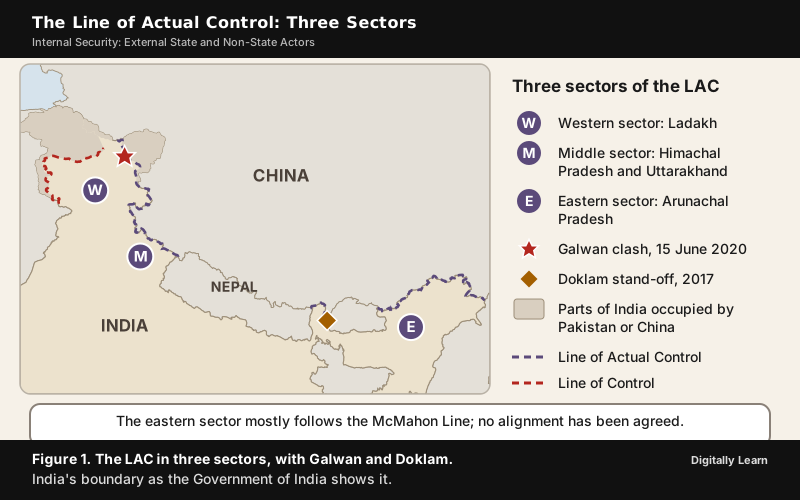
Two episodes define the recent pressure. At Doklam, a territory claimed both by China and by Bhutan, an ally of India, Chinese troops began extending a road on 16 June 2017; about 270 Indian troops crossed the Sikkim border on 18 June to stop them, and both sides announced their withdrawal on 28 August 2017.
At Galwan in eastern Ladakh, fighting on 15 June 2020 killed 20 Indian soldiers, including the commanding officer of 16 Bihar, a battalion of the Bihar Regiment. India followed the clash with economic measures, among them the blocking of 59 mobile apps on 29 June 2020 as prejudicial to the sovereignty and integrity of India, a list that was later extended.
An agreement on patrolling arrangements along the LAC, reached in October 2024, led to disengagement from all the friction points of 2020, and the completion of disengagement in eastern Ladakh was announced in the Lok Sabha on 3 December 2024. The Special Representatives' talks on the boundary question, a mechanism set up in 2003, held their 23rd round in Beijing on 18 December 2024 and their 24th in New Delhi on 19 August 2025.
China-Pakistan Economic Corridor Through Pakistan-Occupied Kashmir
The China-Pakistan Economic Corridor (CPEC) is a Chinese infrastructure network of about 3,000 km under construction in Pakistan. It is a flagship project of China's Belt and Road Initiative (BRI), the global infrastructure strategy that Xi Jinping announced in 2013. On 20 April 2015 Pakistan and China signed an agreement to begin work on a project then valued at 46 billion US dollars, and by 2020 the value of CPEC projects was put at 62 billion US dollars.
The corridor links Kashgar in Xinjiang to the port of Gwadar on the Arabian Sea in Balochistan. Highways, railways and power plants lie along the route, and the upgraded Karakoram Highway is crucial for the link between Gwadar and China. The upgrade works on the highway take place in Gilgit-Baltistan, part of the Union Territory of Ladakh under Pakistan's illegal occupation. China also holds operational control of Gwadar through the China Overseas Port Holding Company.
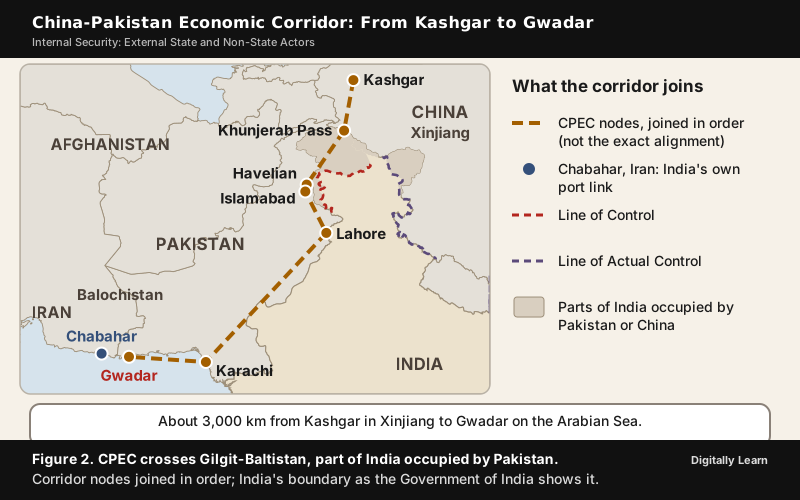
CPEC matters to China because it offers a route that avoids the Strait of Malacca, which could be blockaded in a war; the distance for oil imports from the Middle East would fall from about 12,000 km to 2,395 km. India's concerns fall under four heads.
- Sovereignty: India objects mainly because CPEC passes through Pakistan-occupied Kashmir, part of India, and so ignores India's sovereignty and territorial integrity. India has also protested against the 1,100 MW Kohala hydropower project in Pakistan-occupied Kashmir, which CPEC funds support.
- Strategic presence: Chinese control of Gwadar and a permanent Chinese stake on Pakistan's western flank give China a position in the Arabian Sea and strengthen the military relationship between China and Pakistan.
- Security of the corridor: Pakistan assigned about 10,000 troops to protect Chinese investments, rising to about 15,000 by 2016, so CPEC deepens the role of the Pakistani army.
- Economic leverage: Chinese capital under CPEC props up Pakistan's economy, and with it the state that India holds responsible for cross-border terrorism.
China and Pakistan see the corridor differently from India. China presents CPEC as development that revives the Silk Road, and Pakistan expects gains in infrastructure and energy supply. India's practical response has been to develop its own connectivity; in May 2016 it signed agreements with Iran to refurbish and reconstruct berths at Chabahar port.
Hybrid Warfare and Grey Zone Tactics
Cyber Attacks, Disinformation and Economic Coercion
Hybrid warfare, as Frank Hoffman defined it in 2007, is the simultaneous use of several kinds of warfare by flexible adversaries. It blends conventional and irregular warfare and cyberwarfare with other means of influence, such as fake news, diplomacy and lawfare. The related idea of the grey zone covers actions such as propaganda, economic pressure and the use of non-state entities that stay below the threshold of formal aggression by a state. The aim is to cause damage while denying that a state is responsible, so that the victim cannot easily justify a military response.
Indian defence planners use the phrase "two-and-a-half front war" for a worst case in which India faces pressure from China and Pakistan at the same time while also handling a significant internal security challenge; the half front is internal conflict such as insurgency and terrorism. Hybrid methods link these fronts.
Cyber intrusion is the first hybrid method. During the conflict of May 2025, Indian authorities recorded over 1.5 million attempted cyber intrusions aimed at government websites and critical digital infrastructure. India's legal instrument against hostile digital content is Section 69A of the Information Technology Act, 2000. The app ban that followed Galwan was issued under it, after complaints that some of the apps were stealing users' data and sending it to servers outside India, and in May 2025 the Government also blocked thousands of social media accounts and several Pakistani YouTube channels.
Disinformation is the second. In the same conflict both countries faced misinformation campaigns, particularly on the platform X, and India described some of Pakistan's claims about damage to Indian bases as a malicious misinformation campaign. Because a false report spreads faster than a correction, verified official briefings form part of India's defence.
Economic pressure is the third, and it has run in both directions. After the Pahalgam attack, India held the Indus Waters Treaty in abeyance on 23 April 2025, citing national security, as a measure against the state it holds responsible for cross-border terrorism, and Pakistan responded by closing its airspace to Indian carriers and suspending trade. India said in June 2026 that the treaty would remain in abeyance until Pakistan completely stops cross-border terrorism, and on 31 August 2026 it rejected the rulings of the Court of Arbitration, whose very establishment it regards as a grave violation of the treaty. Water, trade and airspace have thus become instruments of pressure on both sides.
Diaspora-Based Separatism: The Khalistan Case
The Khalistan case shows how a movement rooted in one Indian State is sustained from abroad. Khalistan is a separatist demand for a sovereign Sikh state, and India regards support for secession as a threat to its sovereignty and territorial integrity. The armed militancy of the 1980s lost its support in Punjab, and the movement has little popular backing today, either in India or among the diaspora; the demand is now kept alive by small groups abroad.
India's legal response targets named organisations and individuals.
- Unlawful association: Sikhs for Justice (SFJ) was banned in India in 2019 as an unlawful association. SFJ ran an unofficial and non-binding referendum campaign, whose first phase began in London on 31 October 2021.
- Terrorist organisation: On 17 February 2023 the Central Government declared the Khalistan Tiger Force a terrorist organisation under the UAPA, describing it as a militant outfit that aims to revive terrorism in Punjab, which brought the number of terrorist organisations in the First Schedule of the Act to 44. On the same day Harwinder Singh Sandhu, associated with Babbar Khalsa International and described as based in Lahore under the patronage of cross-border agencies, was declared a terrorist.
- Individual designation: The UAPA amendment of August 2019 allowed the Central Government to designate individuals as terrorists. In July 2020 nine people were so designated, including Gurpatwant Singh Pannun, described as a key member of SFJ, and Hardeep Singh Nijjar, described as chief of the Khalistan Tiger Force.
The diaspora dimension also produced a diplomatic dispute with Canada. Nijjar, a Canadian citizen, was shot dead on 18 June 2023. On 18 September 2023 the Canadian Prime Minister told Parliament that Canadian agencies were pursuing credible allegations of a potential link between agents of the Government of India and the killing. India's Ministry of External Affairs rejected the claim as absurd and motivated and said that Khalistani terrorists and extremists had been given shelter in Canada. Both countries expelled diplomats, and the dispute widened in October 2024.
Relations began to recover after the two Prime Ministers met at the G7 summit in Kananaskis on 17 June 2025 and agreed to restore stability, beginning with the return of High Commissioners to both capitals, which was completed in September 2025. The Canadian Prime Minister paid an official visit to India from 27 February to 2 March 2026. The allegation of a link between Indian agents and the killing has not been tested in any court.
Cross-Border Responses: Hot Pursuit and Surgical Strikes
Surgical Strike and Hot Pursuit: Meaning and Legal Basis
A surgical strike is a military attack intended to damage only a legitimate military target, with no or minimal collateral damage. It can be carried out by an air strike, by special forces dropped by air or by a swift ground operation, and because it is limited, it can also prevent escalation into a full-scale war. A bombing campaign that destroys wide areas is its opposite.
India has carried out four publicly known operations of this kind since 2015, each after a major attack.
- June 2015: Special forces raided insurgent camps along the Myanmar border after the ambush in Chandel.
- September 2016: The Army struck terrorist launch pads across the LoC after the Uri attack.
- February 2019: Indian warplanes struck a training camp at Balakot after the Pulwama attack.
- May 2025: Missile and drone strikes under Operation Sindoor hit terrorist infrastructure across the border after the Pahalgam attack.
Hot pursuit is the urgent and direct pursuit of a suspect by law enforcement officers, or by armed forces under international rules of engagement, and it gives the pursuers powers they would not otherwise have. In international law it is codified for ships. Article 111 of the United Nations Convention on the Law of the Sea allows a coastal state to pursue and arrest a ship escaping to the high seas, provided the pursuit begins in the state's own waters and is continuous; the right ends when the ship enters the territorial sea of another state. A comparable right to pursue criminals across land borders has been proposed, but it is not a settled principle of international law.
For armed action across a border, the usual legal argument is self-defence. Article 51 of the Charter of the United Nations preserves the inherent right of individual or collective self-defence if an armed attack occurs against a Member, and requires the measures taken to be reported immediately to the Security Council. Whether the right extends to attacks by non-state actors is debated. India has described its own strikes as pre-emptive action against terrorist infrastructure, not as war against a state.
The two terms differ in practice. Hot pursuit follows a particular group that has just attacked and fled across the border, whereas a surgical strike hits fixed targets, such as camps or launch pads, that are selected in advance on the basis of intelligence.
Myanmar Operation 2015 and the Uri Surgical Strikes 2016
On 4 June 2015 militants ambushed an Army convoy of the 6 Dogra Regiment in Chandel district of Manipur and killed 18 soldiers, the biggest attack on the Army since the Kargil war of 1999.
On 9 June 2015, 21 Para (Special Forces) carried out a cross-border operation along the India-Myanmar border, facing Nagaland and Manipur, that lasted about 40 minutes and destroyed two transit camps of the NSCN (Khaplang) and the Kanglei Yawol Kanna Lup (KYKL). The operation was code-named Operation Hot Pursuit. The Indian Army said that it had been in communication with Myanmar and that the two militaries had a history of close cooperation. Myanmar's presidential office, however, insisted that the operation had taken place on the Indian side, and the Khaplang faction disputed India's claims; the casualty figures differ widely between reports and have not been confirmed.
Cooperation continued. In February and March 2019, India and the Tatmadaw, Myanmar's armed forces, conducted coordinated operations, known as Operation Sunrise, against insurgent camps along their border, reportedly without the Indian Army crossing the border.
The operation of 2016 differed in scale and purpose. After the Uri attack of 18 September 2016, the Cabinet Committee on Security met on 24 September. On 29 September the DGMO announced that, acting on specific and credible inputs about terrorist teams at launch pads along the LoC, the Army had "conducted surgical strikes at several of these launch pads to pre-empt infiltration". Indian accounts say that teams of the Para Special Forces crossed the LoC at night and returned the same night. The DGMO said that the operations had ended and that he had informed his Pakistani counterpart. The strikes were then read in three ways.
- India: The announcement of 29 September 2016 was the first time that India publicly acknowledged that its forces had crossed the LoC, and a Ministry of Defence statement later described the action as "heralding a change of stand on the rules of engagement on the disputed Line of Control".
- Pakistan: Pakistan denied that any strike had taken place and spoke only of firing across the LoC.
- Analysts: Some analysts argue that a raid about a kilometre across the line is better described as a cross-border raid than as a surgical strike, because surgical strikes usually involve air power and deeper targets.
Balakot 2019 and Operation Sindoor 2025: Strategic Impact
The two later operations raised the level of force further. After the Pulwama attack of 14 February 2019, India's Foreign Secretary announced on 26 February that India had struck the biggest training camp of JeM at Balakot in an "intelligence led operation", which he described as a "non-military preemptive action". It was the first time since the war of 1971 that Indian warplanes had crossed the line dividing Kashmir, known since 1972 as the LoC. Pakistan responded on 27 February; an Indian warplane was shot down, and its pilot, Abhinandan Varthaman, was captured and returned on 1 March.
Independent satellite assessments questioned how much damage had been done, while India maintained that a large number of terrorists had been killed, and the two accounts have not been reconciled. On 1 May 2019, shortly after the crisis, the United Nations Security Council listed Masood Azhar, the leader of JeM, as an international terrorist.
Operation Sindoor followed the Pahalgam attack. Late on 6 May and in the early hours of 7 May 2025, the armed forces struck nine sites in Pakistan and Pakistan-occupied Kashmir, among them the headquarters complexes of JeM at Bahawalpur and of LeT at Muridke and two sites in Muzaffarabad. India said that the targets were terrorist infrastructure, that its action was focused, measured and non-escalatory, and that no Pakistani military facilities had been targeted. Pakistan said that civilians had been killed and that mosques and residential areas had been hit.
The fighting then developed in three steps.
- On the night of 7 and 8 May, Pakistan attempted to strike military targets in northern and western India with drones and missiles, which the Integrated Counter UAS Grid and air defence systems neutralised.
- On 8 May India struck air defence radars and systems in Pakistan.
- The conflict, often described as the first drone battle between two nuclear-armed states, ended with a ceasefire from 5 pm Indian Standard Time on 10 May 2025, after contact between the two Directors General of Military Operations.
The Defence Minister told the Lok Sabha that more than 100 terrorists were estimated to have been killed and that the operation had only been paused, not ended. Pakistan said that 40 civilians and 13 military personnel had been killed, and both sides claimed success.
On 12 May 2025 the Prime Minister set out India's approach in three parts.
- A terrorist attack on India will receive a befitting response on India's own terms.
- India will not tolerate nuclear blackmail and will strike terrorist hideouts that grow under its cover.
- India will make no distinction between a government that sponsors terrorism and the masterminds of terrorism.
The strategic impact of these operations can be assessed under five heads.
- Deterrence by punishment: The aim is to raise the cost of sponsoring terrorism so that the sponsor stops.
- Lower threshold: Each operation went further across the border, from a raid near the LoC in 2016 to air strikes at Balakot and then to missile and drone strikes on nine sites in 2025.
- Risk of escalation: In 2019 and 2025 retaliation followed within a day or two, so the risk of unintended escalation between nuclear-armed states is real.
- Contested claims: Pakistan and independent analysts dispute Indian accounts of the damage, and a government's credibility depends on how far it can publish verifiable evidence.
- Diplomatic cost: In 2025 a dispute arose over the role of outside mediators in the ceasefire, which India says was worked out directly between the two countries.
Countering External Actors
Diplomacy, FATF Pressure and UN Listings
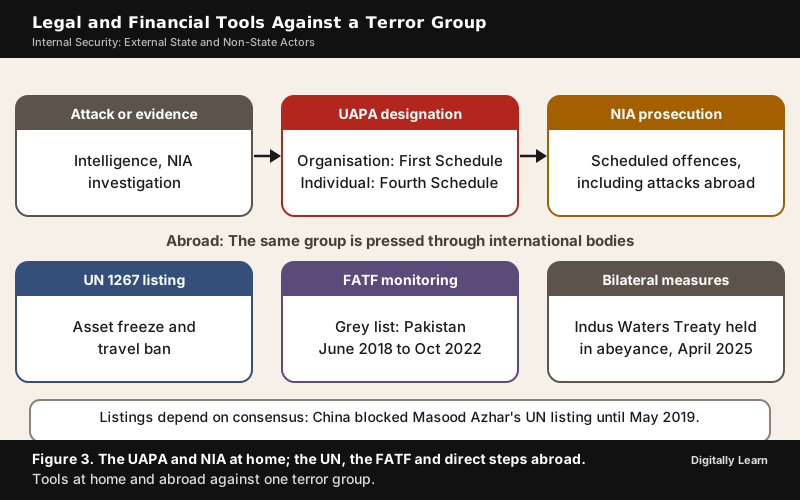
Three instruments beyond India's borders support the military and domestic response. They are listings under United Nations (UN) sanctions, monitoring by the Financial Action Task Force (FATF), and direct diplomatic or economic measures.
The United Nations sanctions regime against Al-Qaeda and the Taliban began with Security Council Resolution 1267, adopted on 15 October 1999. It set up a committee and a consolidated list of individuals and entities associated with Al-Qaeda and the Taliban, and member states must implement the sanctions through their own laws. India uses this list to press for action against leaders based in Pakistan. The listing of Masood Azhar on 1 May 2019 came after earlier attempts that China had blocked, including in October 2016 and February 2017, until China withdrew its objection in May 2019.
The FATF is an intergovernmental body founded in 1989 on the initiative of the G7 and hosted at the Organisation for Economic Co-operation and Development in Paris; in 2001 its mandate was extended to terrorist financing. It publishes a blacklist, formally a "call for action", and a grey list of jurisdictions under increased monitoring. Pakistan was placed on the grey list in June 2018 for strategic deficiencies in countering money laundering and terrorist financing, and was removed in October 2022 after implementing 34 action items. The UAPA amendment of 2019 was itself linked to the FATF; its statement of objects says it was intended to meet commitments made at the FATF.
Direct measures go beyond listings. After Pahalgam, India also withdrew the visa privileges that Pakistani nationals had held under the South Asian Association for Regional Cooperation (SAARC), and its stated policy is that terror and talks cannot go together.
Border Security, Intelligence and Deterrence
At home, the border forces, the NIA and the UAPA provide the day-to-day defence. The Border Security Force was formed after the war of 1965, when the attack on Sardar Post, Char Bet and Beria Bet in Kutch exposed the inadequacy of State Armed Police against armed aggression. It has grown from 25 battalions in 1965 to 193 and, as the first line of defence, guards the borders with Pakistan and Bangladesh. Along the LoC, the Army's counter-infiltration grid serves the same purpose, and fencing, supported by technological solutions where the border cannot be fenced, completes the layered defence.
The National Investigation Agency was created by the National Investigation Agency Act, 2008, enacted after the Mumbai attacks; the Act received assent on 31 December 2008, and the Agency was constituted on 20 January 2009. The amendment of 2019 extended its remit to terror attacks on Indians and Indian interests abroad, among other new scheduled offences.
The UAPA is the legal foundation for banning groups and, since its amendment of 2019, for designating individuals; by June 2026 the Government had designated more than 57 individuals under that power, among them Masood Azhar and Hafiz Saeed. Critics, including United Nations special rapporteurs, argue that the 2019 amendment conflicts with human rights standards, and bail is harder to obtain for those charged under the Act. In 2021 the Supreme Court held that bail could be granted where the right to a speedy trial had been violated.
Deterrence completes the picture. The strikes of 2016 and 2019 and Operation Sindoor in 2025 changed India's signal to its adversaries from restraint to a promise of response. The Union discharges its duty under Article 355 through the intelligence agencies, the paramilitary forces, the Army and the courts acting together.
| External actor | Main tools | India's principal response |
|---|---|---|
| Pakistan-based terror groups and the ISI | Infiltration across the LoC, fidayeen (suicide squad) attacks, financing | Counter-infiltration grid, UAPA bans, cross-border strikes in 2016, 2019 and 2025 |
| Pakistan-based smuggling networks | Narcotics, arms and fake currency, increasingly by drone | Fencing, anti-drone systems, the NIA terror-funding cell, FICN Coordination Group |
| China on the northern front | Pressure on the LAC, alleged support to insurgents in the north-east, CPEC through Pakistan-occupied Kashmir | Disengagement talks, Special Representatives' talks, app bans, Chabahar and other connectivity |
| Hybrid actors | Cyber intrusion, disinformation, economic pressure | Section 69A blocking orders, account blocking, official briefings |
| Diaspora separatist networks | Fund-raising, referendum campaigns, propaganda | UAPA bans and designations, diplomatic representations |
| Neighbours hosting insurgent camps | Safe havens in Bhutan and Myanmar | Diplomatic pressure leading to Bhutan's Operation All Clear, Operation Sunrise with Myanmar, fencing of the Myanmar border |
Previous Year UPSC‑CSE Questions
Each Prelims question is explained option by option, and each Mains question comes with an answer outline.
- UPSC Prelims 2016'Belt and Road Initiative' is sometimes mentioned in the news in the context of the affairs of
How to approach this Prelims question
Approach: The question is settled by identifying who launched the initiative it names. The Belt and Road Initiative is a global infrastructure and economic development strategy pursued by the government of China since 2013; Xi Jinping announced it during visits to Kazakhstan and Indonesia that year. Only one option names that state.
Why each option is right or wrong:
- (a) African Union: Wrong. It is a regional organisation; China works with African countries on Belt and Road projects through the Forum on China-Africa Cooperation, but the strategy is not the Union's.
- (b) Brazil: Wrong. Brazil did not launch the initiative; the strategy is pursued by China.
- (c) European Union: Wrong. The Union did not launch the strategy, which is Chinese.
- (d) China: Correct. The government of China has pursued the strategy since 2013, and CPEC is one of its flagship projects.
Answer: (d) China. The Belt and Road Initiative has been China's strategy since 2013, and the China-Pakistan Economic Corridor is one of its flagship projects.
- UPSC Prelims 2003Which one of the following Articles of the Indian Constitution provides that 'It shall be the duty of the Union to protect every State against external aggression and internal disturbance'?
How to approach this Prelims question
Approach: The quoted words open one article of Part XVIII on Emergency Provisions, the article that places on the Union the duty to protect every State against external aggression and internal disturbance. Match the subject of each option against that duty.
Why each option is right or wrong:
- (a) Article 215: Wrong. It makes High Courts courts of record.
- (b) Article 275: Wrong. It deals with grants from the Union to certain States.
- (c) Article 325: Wrong. It provides for one general electoral roll for every territorial constituency and bars any person from being excluded from it, or from claiming inclusion in a special roll, on grounds only of religion, race, caste or sex.
- (d) Article 355: Correct. It places the duty on the Union to protect every State against external aggression and internal disturbance and to ensure that every State government is carried on in accordance with the Constitution.
Answer: (d) Article 355. It places on the Union the duty to protect every State against external aggression and internal disturbance.
- UPSC Mains 2023 GS‑IIIThe use of unmanned aerial vehicles (UAVs) by our adversaries across the borders to ferry arms/ammunitions, drugs, etc., is a serious threat to the internal security. Comment on the measures being taken to tackle this threat.
Answer outline
The outline sets out what the question asks, the main arguments, relevant examples and the direction of the conclusion; it is not a full model answer.
Introduction: Drones ferry arms, ammunition and narcotics across the western border; 791 drone intrusions were recorded along the international border in 2025.
Body (sub-themes to develop):
- The threat: Drone recoveries in Punjab, 28 incidents to February 2023 and 53 to June 2023, and 237 drones brought down along the international border in 2025.
- Technology: Anti-drone systems, spoofers and jammers, and the Anti Rogue Drone Technology Committee under the Director General of the BSF.
- Procedure: The anti-rogue drone standard operating procedure and depth checkpoints in suspected dropping zones.
- Community: Sensitising the border population.
- Military layer: The Integrated Counter UAS Grid used in May 2025.
Conclusion: Technology works only when it is combined with procedure, local awareness and coordination between forces.
- UPSC Mains 2021 GS‑IIIAnalyse the multidimensional challenges posed by external state and non-state actors, to the internal security of India. Also discuss measures required to be taken to combat these threats.
Answer outline
Introduction: India's internal security is threatened from outside by hostile states and by the non-state actors through which they often work as proxies.
Body (sub-themes to develop):
- Actors: States and their agencies, and the proxy groups, criminal networks and diaspora networks they work with or through.
- Pakistan: Cross-border terrorism and infiltration, with the Parliament, Mumbai, Uri, Pulwama and Pahalgam attacks as examples.
- Smuggling: Narcotics, arms and fake currency, now by drone, and terror financing.
- China: Alleged aid to north-eastern insurgents, pressure on the LAC, and CPEC through Pakistan-occupied Kashmir.
- Hybrid threats: Cyber intrusion, disinformation and economic coercion; the Khalistan case for diaspora networks.
- Measures: Diplomacy, UN listings and FATF pressure; border fencing and counter-drone systems; UAPA and the NIA; deterrence through cross-border strikes; balance with civil liberties.
Conclusion: The response has to be layered, combining diplomacy, financial pressure, border management, law and deterrence, while protecting civil liberties.
- UPSC Mains 2018 GS‑IIIThe China-Pakistan Economic Corridor (CPEC) is viewed as a cardinal subset of China's larger 'One Belt One Road' initiative. Give a brief description of CPEC and enumerate the reasons why India has distanced itself from the same.
Answer outline
Introduction: CPEC links Kashgar in Xinjiang to the port of Gwadar in Balochistan through Pakistan-occupied Kashmir.
Body (sub-themes to develop):
- Description: A corridor of about 3,000 km, initially valued at 46 billion US dollars, with roads, rail, energy projects and a port, begun under an agreement of 20 April 2015.
- Belt and Road link: CPEC is a flagship project of the Belt and Road Initiative announced in 2013.
- Sovereignty: It passes through Pakistan-occupied Kashmir and so ignores India's sovereignty and territorial integrity.
- Protested projects: The Kohala hydropower project in Pakistan-occupied Kashmir.
- Strategic presence: Chinese control of Gwadar and a deeper China-Pakistan military relationship.
Conclusion: India's answer to CPEC is connectivity of its own, such as the agreements of May 2016 to develop berths at Chabahar in Iran.
- UPSC Mains 2016 GS‑IIIThe terms 'Hot Pursuit' and 'Surgical Strikes' are often used in connection with armed action against terrorist attacks. Discuss the strategic impact of such actions.
Answer outline
Introduction: Hot pursuit is the immediate chase of attackers who have fled across a border, and a surgical strike is a limited attack on military targets selected in advance.
Body (sub-themes to develop):
- Legal basis: Self-defence under Article 51 of the UN Charter, and the debate over whether it covers attacks by non-state actors.
- Examples: Myanmar 2015, the LoC in 2016, Balakot in 2019 and Operation Sindoor in 2025.
- Impact: Deterrence, signalling resolve, lower threshold for cross-border force.
- Risks: Escalation between nuclear-armed states, contested claims of damage, legal ambiguity over non-state actors.
- Diplomatic effect: Cooperation with neighbours such as Myanmar in Operation Sunrise, and the dispute of 2025 over outside mediation in the ceasefire.
Conclusion: Such strikes raise the cost of sponsoring terrorism but carry a risk of escalation between nuclear-armed states.
- UPSC Mains 2014 GS‑IIIChina and Pakistan have entered into an agreement for development of an economic corridor. What threat does this pose for India's security? Critically examine.
Answer outline
Introduction: The corridor that China and Pakistan agreed to develop runs through Pakistan-occupied Kashmir, part of India, and ends at Gwadar on the Arabian Sea.
Body (sub-themes to develop):
- Description: About 3,000 km from Kashgar to Gwadar, a flagship project of the Belt and Road Initiative.
- Sovereignty: It passes through Pakistan-occupied Kashmir, part of India under Pakistan's illegal occupation.
- Strategic: Chinese control of Gwadar, a position on the Arabian Sea, and a deeper China-Pakistan military relationship.
- Corridor security: Pakistan's troops assigned to protect Chinese investment.
- Economic leverage: Capital for the economy of India's main security rival.
- Critical view: China and Pakistan present it as development; India's responses include Chabahar and the diplomatic protest.
Conclusion: India's objection on sovereignty is firm, while the size of the military threat depends on how China uses its position at Gwadar.
Sources
- NCERT: Contemporary World Politics (Class XII, revised edition 2022, reprint 2026‑27), Chapter 5, Security in the Contemporary World
- Constitution of India (Legislative Department): Article 355
- United Nations: Repertory of Practice, Article 51 of the Charter
- PIB: Foreign Secretary's statement on the Balakot strike (26 February 2019)
- PIB: DGMO statement on the surgical strikes (29 September 2016)
- PIB: Terror financing and fake Indian currency notes
- Ministry of External Affairs: India-Canada Bilateral Brief (April 2026)
- Ministry of External Affairs: India-China Bilateral Brief (July 2026)
- Ministry of External Affairs: 25th Round of the Special Representatives Talks on the India-China Boundary Question (25 August 2026)
- PIB: Defence Minister on Operation Sindoor in the Lok Sabha (28 July 2025)
- PIB: Operation Sindoor, statement of 7 May 2025
- PIB: Operation Sindoor, statement of 8 May 2025
- PIB: Prime Minister's address to the nation (12 May 2025)
- PIB: Drone recoveries along the Punjab border (2023)
- PIB: Lok Sabha reply on drones (August 2023)
- PIB: Border fencing (August 2021)
- PIB: Government blocks 59 mobile apps (29 June 2020)
- PIB: Khalistan Tiger Force declared a terrorist organisation (17 February 2023)
- PIB: Nine individuals designated as terrorists (July 2020)
- PIB: Surgical strike anniversary statement (2018)
- PIB: Ministry of Defence, Year End Review 2025
- PIB: MHA decides to scrap the Free Movement Regime between India and Myanmar (8 February 2024)
- PIB: Fence along the entire India-Myanmar border (6 February 2024)
- Wikipedia: Non-state actor
- Wikipedia: Hybrid warfare
- Wikipedia: Two-and-a-half front war
- Wikipedia: Surgical strike
- Wikipedia: Hot pursuit
- Wikipedia: Inter-Services Intelligence
- Wikipedia: Lashkar-e-Taiba
- Wikipedia: Jaish-e-Mohammed
- Wikipedia: 2008 Mumbai attacks
- Wikipedia: 2016 Uri attack
- Wikipedia: 2019 Pulwama attack
- Wikipedia: 2025 Pahalgam attack
- Wikipedia: Mizo National Front
- Wikipedia: National Socialist Council of Nagaland
- Wikipedia: Insurgency in Northeast India
- Wikipedia: Line of Actual Control
- Wikipedia: Doklam standoff
- Wikipedia: China–Pakistan Economic Corridor
- Wikipedia: Belt and Road Initiative
- Wikipedia: Gwadar Port
- Wikipedia: Operation Sindoor
- Wikipedia: Indus Waters Treaty
- Wikipedia: Khalistan movement
- Wikipedia: Sikhs for Justice
- Wikipedia: Hardeep Singh Nijjar
- Wikipedia: 2015 Indian counter-insurgency operation in Myanmar
- Wikipedia: Operation Sunrise (2019)
- Wikipedia: 2016 Indian Line of Control strike
- Wikipedia: 2019 Balakot airstrike
- Wikipedia: Line of Control
- Wikipedia: Masood Azhar
- Wikipedia: United Nations Security Council Resolution 1267
- Wikipedia: Financial Action Task Force on Money Laundering
- Wikipedia: Unlawful Activities (Prevention) Act, 1967
- Wikipedia: National Investigation Agency
- Wikipedia: Border Security Force
- UPSC: Civil Services Examination question papers
Editorial Disclaimer
This article draws on official statements, the Constitution and the other sources listed in the Sources section. Casualty figures and damage claims in cross-border strikes are disputed; both sides' claims are stated as claims.
See more of our UPSC articles in Google Search
Add to Preferred Sources

