


Overview
Mob lynching, communal violence and radicalisation are three distinct threats to internal security that reinforce one another. Lynching is an extrajudicial killing by a group; in recent Indian cases it has followed a rumour, a suspicion of cow slaughter or a fear of child abduction. Communal violence is violence by members of one religious group against members and institutions of another, often in the form of rioting. Radicalisation differs from both, because it is a change of belief that may or may not end in violence. All three depend on persuading people that another group is a threat and that they must act on their own, and rumours spread online speed up each of them. The response of the State therefore combines police action, criminal law, regulation of online platforms and work with communities.
Responsibility for Internal Security: Union and States
Article 355 and the State List Entries on Public Order and Police
Article 355 places on the Union a duty to protect every State against external aggression and internal disturbance, and to ensure that the government of every State is carried on in accordance with the Constitution. Day-to-day responsibility nevertheless lies with the States, because public order and police are Entries 1 and 2 of the State List. The States and Union Territories are therefore primarily responsible for preventing, detecting, investigating and prosecuting crime, cybercrime included, through their own police.
The Union supports the States without replacing them. It issues advisories, deploys central armed police forces, shares intelligence through the Multi-Agency Centre and investigates terror cases through the National Investigation Agency (NIA). Riots and lynchings are handled first by district police and administration, while radicalisation that crosses State or national borders draws in the central agencies.
Radicalisation: Meaning and Pathways
Ideology, Grievance and Group Belonging
Radicalisation is the adoption by an individual or a group of increasingly radical views opposed to the political, social or religious status quo, and it can result in violent or non-violent action. No definition is accepted everywhere, and the meaning shifts with context and political perspective. Radicalisation becomes a security concern when it ends in violent extremism, but the process begins much earlier.
Several separate pathways lead to radicalisation; each can act alone, but they usually reinforce one another.
- Personal grievance: A desire for revenge for a real or perceived harm sharpens the sense of "us" and "them" and lowers inhibitions against violence.
- Group grievance: A sense that harm has been done to a group one belongs to or sympathises with drives much political and ethnic violence carried out on the group's behalf.
- Slippery slope: A person's social circle and outlook narrow gradually, one small step after another.
- Love and friendship: Close groups of friends, relatives or partners often form the core of an extremist network.
- Risk and status: High-risk acts bring standing within a group, which attracts young men who see few other routes to respect.
- Unfreezing: The loss of family or social ties, as in prison, leaves a person open to a new identity.
Poverty and mental illness, often blamed for radicalisation, are not its root causes. There is no statistical association between poverty and militant radicalisation, and many terrorists come from middle-class families and have a university education. In India, global terrorist groups and some foreign agencies hostile to the country have tried to radicalise people, but the Ministry of Home Affairs (MHA) assessed in July 2022 that "inclination towards radical ideologies is minuscule as compared to the population of the country".
Online Radicalisation Through Social Media and Encrypted Apps
Online radicalisation is the use of websites, social media and messaging services to spread a violent ideology and draw people into a group. Cyber technology is now the main tool for propagating radical ideology, and it targets gullible, depressed or alienated young people. Jihadist groups follow a tried and tested method. They contact vulnerable people through messaging services or social media platforms and then move quickly to draw them into violent action.
The internet does not radicalise people by itself. Social media is a facilitating environment rather than a driving force for violent radicalisation, and the evidence on whether recommendation algorithms and filter bubbles cause radicalisation is mixed, although they can reinforce what a person already believes.
Encrypted messaging makes investigation harder. Radical elements use secure applications such as Signal, Telegram and Viber, the dark web and WhatsApp with its end-to-end encryption to reach like-minded people, and this has proved a major challenge for security agencies. In response to counter-radicalisation efforts, supporters of the Islamic State moved their activity from public social media to Telegram, which is not publicly viewable. Indian policy therefore combines monitoring and blocking, tracing of the first originator of a message, and notices to platforms.
Radicalisation in India's Neighbourhood and at Home
ISIS and Global Jihadist Propaganda: Influence on Indian Youth
The Islamic State (also called ISIS or ISIL) is a transnational Salafi jihadist militant organisation. In 2014 it proclaimed itself a worldwide caliphate with authority over all Muslims, a claim that the vast majority of Muslims reject, and the United Nations has designated it a terrorist organisation. Its magazine Dabiq set out its aim of continuing to seize land until it had taken over the entire Earth. By March 2019 it had lost the last of its territory in West Asia.
For India the threat has been mainly ideological and online. The first prominent case was the arrest in Bengaluru on 13 December 2014 of a young man who circulated ISIS material through a Twitter account; he was charged under the Unlawful Activities (Prevention) Act (UAPA), Section 66F of the Information Technology Act (IT Act) and Section 125 of the Indian Penal Code (IPC).
Indian affiliates followed. Shafi Armar, a former member of the Indian Mujahideen, and his brother Sultan Armar founded Ansar-ut Tawhid fi Bilad al‑Hind and Janood-ul‑Khalifa-e-Hind; the two brothers were killed fighting in the Syrian civil war in 2015, although their deaths were confirmed only in 2019. An Islamic State faction in Jammu and Kashmir, never recognised by the group itself, began in February 2016, and on 11 May 2019 the group's Khorasan branch announced a Hind Province (Wilayah Hind).
The danger to internal security takes four forms, namely recruitment through cyberspace, plots by individuals acting for the group, links between older home-grown groups and the new organisation, and propaganda that spreads communal hatred. Arrests continued into 2024; on 9 August 2024 the NIA arrested an alleged ISIS operative who was planning an attack in New Delhi. As of December 2024, besides the cases with State police, the NIA was investigating 67 cases of online radicalisation, in which 325 accused had been arrested, 336 chargesheeted and 63 convicted.
Religious and Ethnic Radicalism in a Plural Society
India's diversity does not protect it from radicalism, but it shapes the forms that radicalism takes. The Indian Mujahideen, an offshoot of the Students Islamic Movement of India (SIMI), was linked with Lashkar-e-Taiba, and Harkat-ul‑Jihad-al‑Islami Bangladesh helped to found it. India declared it a terrorist organisation and banned it on 4 June 2010. The case shows how groups based in the neighbourhood can sustain a local network.
Radicalism in India is not confined to one religion or one ideology. The violent ethnic and separatist movements in the north-east, Punjab and Jammu and Kashmir, and the Left-Wing Extremist movement, belong to the same picture. Elsewhere in the world, violent extremism has also arisen among right-wing and left-wing groups, so radicalism cannot be tied to any one faith.
A strategy against radicalisation works at several levels at once.
- Welfare and inclusion: Universal coverage of welfare schemes without discrimination, special schemes for underserved communities and areas, constitutional safeguards for minorities and their fair representation are the Government's stated measures against radicalisation.
- Institutions: The MHA has a Counter Terrorism and Counter Radicalisation Division, which coordinates the security and law enforcement agencies.
- Composite culture: The State promotes composite culture and coexistence among communities, and Article 51A(e) makes it a fundamental duty to promote harmony and the spirit of common brotherhood amongst all the people of India transcending religious, linguistic and regional or sectional diversities.
Communal Violence in India: Causes, Data and Prevention
Causes: Politics of Identity, Rumour and Local Triggers
In its worst form, communalism takes the shape of communal violence, riots and massacres; India and Pakistan suffered some of the worst communal riots at the time of Partition.
A communal riot needs a spark, but the spark takes hold only where an area has already been communalised. The immediate causes are usually local and specific, such as a minor religious dispute, the teasing of a girl, or a violent quarrel between two people of different faiths. Politicians who exploit communal feeling add fuel, and criminal gangs may use a riot to settle scores with their rivals. Laxity, and at times partisanship, on the part of the police allows a small clash to grow.
Rumour now travels by phone and through messaging groups, and the law reaches it there. Section 353 of the Bharatiya Nyaya Sanhita (BNS) punishes making or circulating a statement, false information or rumour, including by electronic means, with intent to incite one class or community to commit an offence against another. A person who reasonably believes a statement to be true and circulates it in good faith is exempt.
Prevention: Police Neutrality, Early Warning and Law
Prevention rests on four elements.
- Police neutrality: Prompt and impartial police action is essential, because communal movements cannot prevail without the support, or at least the neutrality and passivity, of state power.
- Early warning: District officers watch rumours, processions and disputes in places with a record of tension.
- Even-handed enforcement: Cases of rioting and incitement are registered and prosecuted whatever the religion of the accused.
- Equal protection: The State must protect every citizen alike, since Article 15(1) forbids it to discriminate against any citizen on grounds only of religion, race, caste, sex or place of birth.
The criminal law against rioting and incitement is now in the BNS.
- Unlawful assembly and rioting: An assembly of five or more persons with an unlawful common object is an unlawful assembly under Section 189 of the BNS. Under Section 191, every member is guilty of rioting when force or violence is used; the punishment is up to two years, or up to five years if the offender is armed with a deadly weapon.
- Promoting enmity: Section 196 punishes the promotion of disharmony or hatred between religious, racial, language or regional groups, by words, signs or electronic communication, with up to three years of imprisonment, rising to five years if the offence is committed in a place of worship.
- Insulting religion: Section 299 punishes deliberate and malicious acts intended to outrage the religious feelings of a class by insulting its religion, with up to three years of imprisonment.
- National integration: Section 197 covers imputations and assertions that a class of persons cannot be loyal to the Constitution or should be denied the rights of citizens.
A separate law on communal violence has been proposed more than once. The National Advisory Council drafted the Prevention of Communal and Targeted Violence (Access to Justice and Reparations) Bill, 2011, which critics said would exacerbate communalism and damage the federal structure. In December 2013 the Prime Minister described the purpose of a communal violence bill as making the officials responsible for law and order act effectively and ensuring adequate compensation for victims where riots could not be prevented. When the Home Minister moved for leave to introduce the Prevention of Communal Violence (Access to Justice and Reparations) Bill, 2014, in the Rajya Sabha, the opposition objected, and the motion was deferred on 5 February 2014.
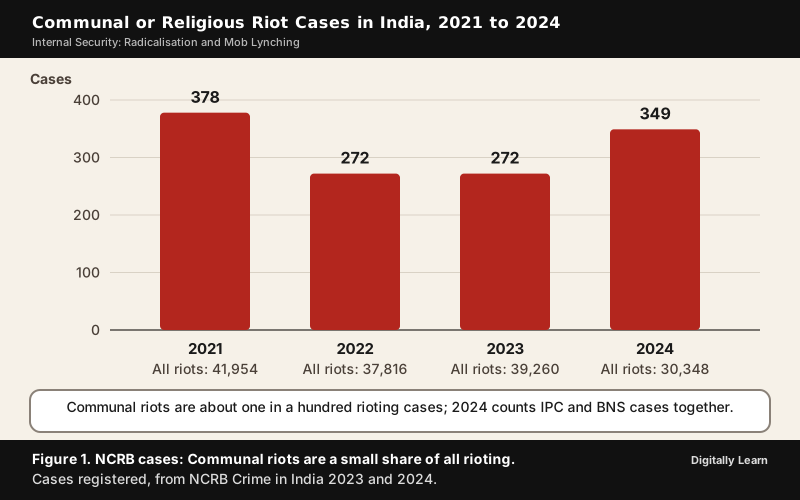
The National Crime Records Bureau (NCRB) records communal or religious riots as a separate head, and they form a small share of all rioting. In 2023, 272 of the 39,260 rioting cases registered were communal or religious riots. Crime in India 2024, the latest edition as of November 2026, records 349 such riots among 30,348 rioting cases, and 44,349 offences against public tranquillity in all, against 58,247 in 2023. The 2024 counts are not directly comparable with those of earlier years, because the BNS replaced the IPC on 1 July 2024, so they combine cases under both codes, and the 2024 tables add a new head for clashes between ethnic or community groups (30 cases).
Mob Lynching and Mob Violence in India
Causes and Consequences of Mob Violence
Mob violence is punishment inflicted by a crowd, without trial, on a person it believes guilty. The Supreme Court has held that no individual, alone or as part of a group that quickly takes on the character of a mob, can take the law into his own hands, and it described lynching as a sweeping phenomenon. Indian cases since 2015 point to four causes.
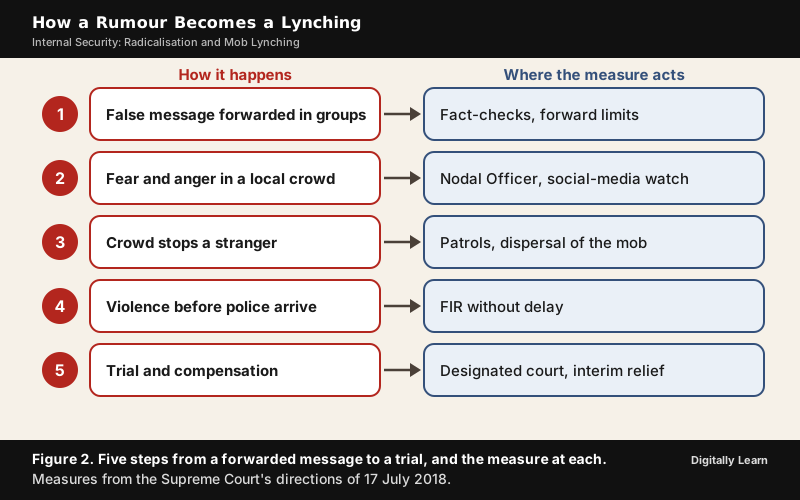
- Rumour and false information: In 2017 and 2018 a wave of killings followed WhatsApp messages about child abduction. In almost all the places where lynchings occurred, no child abduction had been recorded in the previous three months. The mobs included men, women and children. The first of these killings, of seven men, took place in Jharkhand in May 2017. In Karbi Anglong, Assam, in 2018, two men who stopped to ask villagers for directions were taken for child abductors and killed. In Palghar, Maharashtra, on 16 April 2020, a crowd killed two sadhus and their driver after rumours about thieves during the lockdown.
- Vigilantism and suspicion of cow slaughter: At Bisahda village near Dadri, Uttar Pradesh, a mob attacked the home of Mohammad Akhlaq on 28 September 2015 on the suspicion that he had stolen and slaughtered a calf, and killed him.
- Hate speech and fake news: Provocative statements and fake news prepare a crowd to act, which is why the Supreme Court ordered special task forces to gather intelligence on the people who spread them.
- Weak enforcement and impunity: Police inaction lets a crowd gather and strike, and the Court therefore treated an officer's failure to prevent or investigate a lynching as deliberate negligence.
The consequences are severe. A life is lost without trial, and the victim's family may face harassment afterwards. Targeted communities live in fear and in a hostile environment, and the Court directed Nodal Officers to work to remove that hostility. The rule of law is weakened, and the Court warned that such violence must not be allowed to become the new normal.
Crime in India publishes no all-India series on lynching, and the Government has stated that the Supreme Court has given it no direction to have the NCRB collect data on hate crimes. The true scale of the problem is therefore hard to measure.
Tehseen Poonawalla Guidelines 2018 and Section 103(2) of the BNS
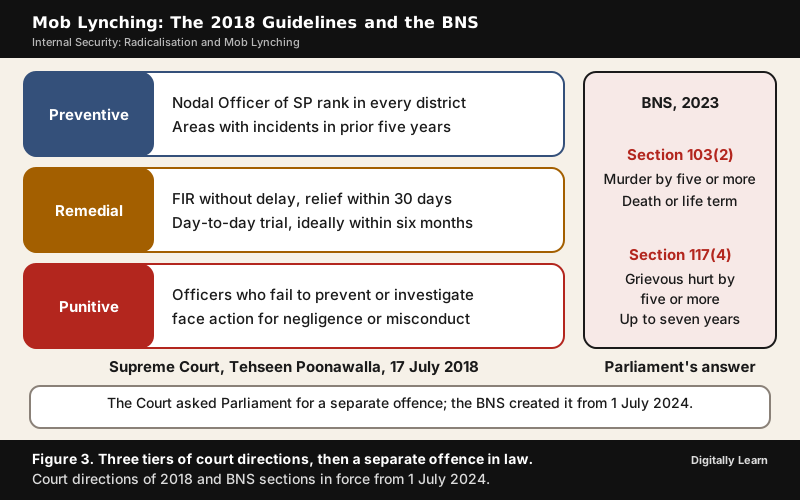
In Tehseen S. Poonawalla v. Union of India (Writ Petition (Civil) No. 754 of 2016), decided on 17 July 2018 by a bench of Chief Justice Dipak Misra, Justice A.M. Khanwilkar and Justice D.Y. Chandrachud, the Supreme Court held that the State must prevent lynching and issued guidelines in three groups. Where preventive measures fail, remedial and punitive measures must follow.
The preventive directions place the first duty on the district police.
- Nodal Officer: Each State is to appoint a senior police officer, not below the rank of Superintendent of Police, as the Nodal Officer in every district, assisted by a Deputy Superintendent of Police and a special task force that gathers intelligence on people likely to commit such crimes or to spread hate speech and fake news.
- Vulnerable areas: The States are to identify the districts, sub-divisions and villages where lynching or mob violence had been reported in the five years before the judgment.
- Regular review: The Nodal Officer is to meet the local intelligence units and Station House Officers at least once a month, and the Director General of Police is to review the situation at least once a quarter.
- Duties of the police: Every police officer is bound to disperse a mob that may turn violent; the Union and the States are to curb irresponsible and explosive messages on social media; and the police are to register a First Information Report (FIR) against those who disseminate them.
The remedial directions protect the victim. An FIR is to be lodged without delay, and the Nodal Officer is to monitor the investigation personally. The States are to prepare a scheme of compensation for victims, with interim relief within 30 days, and trials are to be held in designated courts on a day-to-day basis and preferably concluded within six months. Victims are to receive free legal aid, and courts may protect witnesses.
The punitive directions apply to officials. An officer who fails to prevent or investigate a lynching, or to assist in the trial, is guilty of deliberate negligence or misconduct and faces departmental action, which should preferably be completed within six months.
The guidelines bind every authority in the country under Article 141, but their enforcement rests with the States and the courts below. On 11 February 2025, deciding a petition by the National Federation of Indian Women that sought compliance with the guidelines and a uniform minimum compensation for victims, the Supreme Court held that it could not monitor incidents in different States from Delhi. A person aggrieved by non-compliance can approach the competent courts, and no uniform compensation can be ordered, because what is adequate differs from case to case.
The Court had also recommended that Parliament create a separate offence of lynching with adequate punishment, and the BNS, in force since 1 July 2024, has done so. Section 103(2) provides that when a group of five or more persons acting in concert commits murder on the ground of race, caste or community, sex, place of birth, language, personal belief or any other similar ground, each member shall be punished with death or with imprisonment for life, and shall also be liable to fine.
Section 117(4) punishes grievous hurt caused by such a group on the same grounds with imprisonment of up to seven years and fine. The MHA has stated that this is the first time mob lynching has been made a separate offence.
The Central Government's advisories add to the Court's directions. The MHA issued an advisory on 4 July 2018 on fake news and rumours that could incite violence, and further advisories on 23 July 2018 and 25 September 2018 asking the States to curb mob lynching.
Deradicalisation and Counter-Radicalisation
Community Engagement and Government Programmes
Deradicalisation is a process in which a person with extreme views moves towards more moderate positions. It differs from disengagement, in which a person stops violent behaviour without necessarily giving up the beliefs. Counter-radicalisation acts earlier, on people who have not yet joined a group, through education, welfare and the building of trust in communities.
Indian policy treats the two together. The MHA's Counter Terrorism and Counter Radicalisation Division leads the work, and by March 2025 the Multi-Agency Centre had been extended to cyber security, narco-terrorism, gun running, organised crime and emerging extremist hotspots.
Programmes abroad show what makes such work succeed. Human contact and a supportive community count for more than lectures, and a relationship with a mentor or friend who affirms peaceful behaviour helps a person turn away from extremism. Programmes can also fail. France's first deradicalisation centre, at Pontourny, had no residents less than a year after it opened, and Spain suspended its prison programme in 2022 when only four inmates had signed up. Some scholars doubt that beliefs can be removed at all and prefer to strengthen a person's intellectual defences.
Inclusion is also part of prevention. Article 25(1) guarantees freedom of religion, subject to public order, morality and health, and a separate Ministry of Minority Affairs runs schemes for minority communities.
Online Counter-Narratives and Platform Responsibility
Measures online rest on four instruments.
- Blocking: Section 69A of the IT Act allows the Government, after due process under the blocking rules of 2009, to block information in the interest of the sovereignty and integrity of India, the defence of India, the security of the State, friendly relations with foreign States or public order, or to prevent incitement to a cognisable offence relating to these. The Ministry of Electronics and Information Technology (MeitY) issued directions to block 9,845 URLs between January and October 2024, radical content among them.
- Take-down notices: The Indian Cyber Crime Coordination Centre (I4C) in the MHA is designated under Section 79(3)(b) of the IT Act to issue take-down notices to intermediaries.
- Platform duties: The Information Technology (Intermediary Guidelines and Digital Media Ethics Code) Rules, 2021, require significant social media intermediaries, those with 50 lakh or more registered users in India, to appoint a Chief Compliance Officer, a nodal contact person and a Resident Grievance Officer, and Rule 4(2) provides for the identification of the first originator of information within India. Amendments of 10 February 2026 require clear labelling and traceable metadata for permissible AI-generated content such as deepfakes, and cut the time for removing unlawful information after a court order or a reasoned notice from the Government from 36 hours to three hours. A user whose complaint a platform does not resolve can appeal to a Grievance Appellate Committee.
- Measures by platforms: After more than 30 killings linked to rumours on WhatsApp, the platform limited the number of people to whom a message can be forwarded, labelled forwarded messages, started a tip-line and ran a course on digital literacy.
The Constitution sets the limits of these measures. In Shreya Singhal v. Union of India (2015), the Supreme Court struck down Section 66A of the IT Act, upheld Section 69A, and read down Section 79 so that intermediaries need act only on an order from a court or a government authority. Article 19(2) permits reasonable restrictions on free speech only in the interests of the sovereignty and integrity of India, the security of the State, friendly relations with foreign States, public order, decency or morality, or in relation to contempt of court, defamation or incitement to an offence, so every restriction must rest on one of these grounds.
Counter-narratives are the softer instrument. The Redirect Method, developed by Google's Jigsaw, uses search advertising and YouTube videos to reach people searching for extremist content and dissuade them from joining groups such as ISIS. In India, the Supreme Court's judgment of 2018 directed the Union and the States to broadcast on radio, television and official websites that lynching and mob violence will invite serious consequences. Because online radicalisation crosses borders, India also works through INTERPOL, with the Central Bureau of Investigation (CBI) acting as India's National Central Bureau.
Legal Framework Against Radicalisation, Communal Violence and Mob Lynching
UAPA, NIA Act and the BNS Provisions on Incitement
Three laws form the framework against radicalisation that turns violent. The UAPA of 1967, as amended in 2019, empowers the Central Government to designate organisations and, since that amendment, individuals as terrorists; the amendment received assent on 8 August 2019. By March 2025, 57 individuals had been declared terrorists and 23 associations designated as unlawful. Amendments to the NIA Act in August 2019 extended the agency's jurisdiction to new offences and allowed it to investigate offences committed outside India.
United Nations special rapporteurs have said that the 2019 provisions contravene international human rights instruments, and people charged under the UAPA find bail harder to obtain. The Government holds that the changes give a strong legal foundation to its policy of zero tolerance of terrorism.
The BNS adds offences of speech that bear on radicalisation as well as on communal and mob violence. Besides Section 196 on promoting enmity and Section 353 on rumours, Section 197(1)(d) punishes making or publishing false or misleading information that jeopardises the sovereignty, unity, integrity or security of India.
Three Threats Compared: Drivers, Setting, Law and Prevention
The three threats differ in their drivers, in the places where they arise, in the law that applies and in the agency that leads the response. Each can still feed the others, as when online propaganda supplies the rumour that starts a riot or a lynching, so prevention in one field helps in the other two.
| Feature | Radicalisation | Communal violence | Mob lynching |
|---|---|---|---|
| What it is | Process of adopting extreme views that may lead to violence | Violence between religious communities, often rioting | Killing of a person by a crowd without trial |
| Main drivers | Grievance, ideology, group belonging, online propaganda | Political opportunism, local triggers, rumour, weak policing | Rumour, vigilantism, hate speech, impunity |
| Typical setting | Online networks, prisons, peer groups | Districts and towns with a record of tension | Villages and towns, often after a message spreads online |
| Main criminal law | UAPA, NIA Act, IT Act | BNS Sections 189 to 197, 299 and 353 | BNS Sections 103(2) and 117(4), with the general offences |
| Lead agency | Intelligence agencies, NIA, State police | District police and administration | District police with a Nodal Officer |
| Prevention | Counter-narratives, blocking, outreach, welfare | Neutral policing, early warning, laws against incitement | The 2018 guidelines, fact-checking, designated courts |
Previous Year UPSC‑CSE Questions
Each Prelims question is explained option by option, and each Mains question comes with an answer outline.
- UPSC Prelims 2003Which one of the following Articles of the Indian Constitution provides that 'It shall be the duty of the Union to protect every State against external aggression and internal disturbance'?
How to approach this Prelims question
Approach: The quoted words open one article of Part XVIII on Emergency Provisions, the article that places on the Union the duty to protect every State against external aggression and internal disturbance. Match the subject of each option against that duty.
Why each option is right or wrong:
- (a) Article 215: Wrong. It makes High Courts courts of record.
- (b) Article 275: Wrong. It deals with grants from the Union to certain States.
- (c) Article 325: Wrong. It provides for one general electoral roll for every territorial constituency and bars any person from being excluded from it, or from claiming inclusion in a special roll, on grounds only of religion, race, caste or sex.
- (d) Article 355: Correct. It places the duty on the Union to protect every State against external aggression and internal disturbance and to ensure that every State government is carried on in accordance with the Constitution.
Answer: (d) Article 355. It places on the Union the duty to protect every State against external aggression and internal disturbance.
- UPSC Mains 2024 GS‑IIISocial media and encrypting messaging services pose a serious security challenge. What measures have been adopted at various levels to address the security implications of social media? Also suggest any other remedies to address the problem.
Answer outline
The outline sets out what the question asks, the main arguments, relevant examples and the direction of the conclusion; it is not a full model answer.
Introduction: Social media and encrypted messaging spread rumour and propaganda faster and more privately than cyber patrols can easily follow.
Body (sub-themes to develop):
- Challenge: Encrypted applications hide content from cyber patrols, and rumour and propaganda spread fast.
- Government level: Blocking under Section 69A (9,845 URLs between January and October 2024); I4C take-down notices; the MHA advisories of July 2018; NIA cases.
- Legal level: Tracing of the first originator under Rule 4(2); due diligence officers; labelling of AI-generated content and three-hour removal under the 2026 amendments; BNS Sections 196, 197 and 353.
- Platform level: Forward limits, labels on forwarded messages, tip-lines and digital literacy.
- Other remedies: Grievance Appellate Committees, fact-checking, international cooperation through INTERPOL, and the Shreya Singhal safeguards.
Conclusion: Blocking and tracing need to be matched by digital literacy, transparent grievance redress and the safeguards of the Shreya Singhal judgment.
- UPSC Mains 2017 GS‑IIIMob violence is emerging as a serious law and order problem in India. By giving suitable examples, analyze the causes and consequences of such violence.
Answer outline
Introduction: Mob violence is the killing or injuring of a person by a crowd that takes the law into its own hands, and the Supreme Court called lynching a sweeping phenomenon in 2018.
Body (sub-themes to develop):
- Causes: Rumour and false information; vigilantism and suspicion of cow slaughter; hate speech and fake news; weak enforcement and impunity.
- Examples: Dadri in 2015; the Jharkhand killings of May 2017; Karbi Anglong in 2018; Palghar in 2020.
- Consequences: Loss of life without trial; harassment of the victim's family; fear and a hostile environment for targeted communities; a weaker rule of law.
- Response: The 2018 guidelines (preventive, remedial and punitive); BNS Sections 103(2) and 117(4); the MHA advisories of 2018.
Conclusion: The 2018 guidelines and Section 103(2) of the BNS give the law its tools, but they work only where district police enforce them.
- UPSC Mains 2016 GS‑IIIUse of Internet and social media by non-state actors for subversive activities is a major security concern. How have these been misused in the recent past? Suggest effective guidelines to curb the above threat.
Answer outline
Introduction: Non-state actors use the internet and social media for propaganda, recruitment and rumour, because these channels are cheap, fast and hard to trace.
Body (sub-themes to develop):
- Misuse: ISIS propaganda and recruitment; WhatsApp rumours that led to lynchings from 2017; communal and anti-India propaganda found by cyber patrols.
- Guidelines: Cyber patrolling; blocking under Section 69A; take-down notices by I4C under Section 79(3)(b); due diligence by intermediaries and tracing of the first originator; forward limits; BNS Sections 196, 197 and 353.
- Safeguards: Article 19(2) and the Shreya Singhal judgment on Sections 66A, 69A and 79.
- Cooperation: Work through INTERPOL, with the CBI as India's National Central Bureau, and digital literacy for users.
Conclusion: Guidelines work when they are precise and lawful, resting on the grounds in Article 19(2) and the Shreya Singhal judgment.
- UPSC Mains 2015 GS‑IIIReligious indoctrination via digital media has resulted in Indian youth joining the ISIS. What is ISIS and its mission? How can ISIS be dangerous for the internal security of our country?
Answer outline
Introduction: The Islamic State is a transnational jihadist group that proclaimed a worldwide caliphate in 2014 and has drawn Indian youth mainly through digital propaganda.
Body (sub-themes to develop):
- What ISIS is: A transnational Salafi jihadist group that proclaimed a worldwide caliphate in 2014 and is designated a terrorist organisation by the United Nations.
- Mission: Seizing land until it had taken over the entire Earth, as set out in its magazine Dabiq.
- Indian links: The Bengaluru Twitter case of 2014; Ansar-ut Tawhid fi Bilad al‑Hind and Janood-ul‑Khalifa-e-Hind; the Jammu and Kashmir faction of 2016; the Hind Province of 2019.
- Danger: Recruitment through cyberspace, plots by individuals, links with older groups such as the Indian Mujahideen, and propaganda that spreads communal hatred.
- Response: The NIA's 67 online radicalisation cases with 63 convictions as of December 2024; cyber patrolling; the UAPA.
Conclusion: For India the threat is mainly online recruitment and plots by individuals, which cyber patrolling, intelligence and prosecution under the UAPA are designed to stop.
- UPSC Mains 2014 GS‑III"The diverse nature of India as a multi-religious and multi-ethnic society is not immune to the impact of radicalism which is seen in her neighbourhood." Discuss along with strategies to be adopted to counter this environment.
Answer outline
Introduction: India's many religions and ethnic groups have not made it immune to radicalism, although the MHA assessed in 2022 that "inclination towards radical ideologies is minuscule as compared to the population of the country", and outside groups keep trying to radicalise people.
Body (sub-themes to develop):
- Neighbourhood influence: The Indian Mujahideen, linked with Lashkar-e-Taiba and founded with the help of Harkat-ul‑Jihad-al‑Islami Bangladesh; the Hind Province announced by the Islamic State's Khorasan branch in 2019.
- Domestic vulnerability: Personal and group grievance, group belonging and online propaganda, rather than poverty alone.
- Strategy: The UAPA as amended in 2019 and the NIA; cyber patrolling and blocking under Section 69A; the Counter Terrorism and Counter Radicalisation Division; welfare without discrimination and safeguards for minorities; composite culture and Article 51A(e).
- Safeguards: Article 19(2) and the Shreya Singhal judgment keep the response within the Constitution.
Conclusion: Security action against networks succeeds only when it is matched by inclusion, welfare and the promotion of composite culture.
Sources
- NCERT: Democratic Politics II (Class X, reprint 2026‑27), Chapter 3, Gender, Religion and Caste
- Supreme Court of India: Tehseen S. Poonawalla v. Union of India, judgment of 17 July 2018
- India Code: Bharatiya Nyaya Sanhita, 2023
- Legislative Department: Constitution of India, Articles 15, 19, 25, 51A and 355 and the Seventh Schedule
- NCRB: Crime in India 2023
- NCRB: Crime in India 2024, Volume I
- PIB: Mob lynching and other provisions in the new criminal laws (4 December 2024)
- PIB: Hate crimes and lynching (28 July 2021)
- PIB: Curbing the threat of online radicalisation (11 December 2024)
- PIB: Spreading of religious radicalisation (19 July 2022)
- PIB: Home Minister on the working of the Ministry of Home Affairs, Rajya Sabha (21 March 2025)
- PIB: Arrest of a youth running a Twitter handle for ISIS (15 December 2014)
- Supreme Court of India: National Federation of Indian Women v. Union of India, order of 11 February 2025
- PIB: Government strengthens regulatory framework to address AI-generated deepfakes (6 August 2026)
- PIB: Prime Minister on the Prevention of Communal Violence Bill (6 December 2013)
- Rajya Sabha Secretariat: The Law Making Process
- Penguin Books: India Since Independence, by Bipan Chandra, Mridula Mukherjee and Aditya Mukherjee
- Wikipedia: Radicalization
- Wikipedia: Deradicalization
- Wikipedia: Islamic State
- Wikipedia: Islamic State in India
- Wikipedia: Indian Mujahideen
- Wikipedia: Indian WhatsApp lynchings
- Wikipedia: 2015 Dadri lynching
- Wikipedia: Fake news in India
- Wikipedia: Information Technology Rules, 2021
- Wikipedia: Shreya Singhal v. Union of India
- Wikipedia: Unlawful Activities (Prevention) Act, 1967
- Wikipedia: Lynching in India
- Wikipedia: Bharatiya Nyaya Sanhita
- Wikipedia: National Advisory Council (India)
- Wikipedia: Communal violence
- Wikipedia: Communal violence in India
- UPSC: Civil Services Examination question papers
Editorial Disclaimer
This article draws on judgments and orders of the Supreme Court, the text of the BNS, NCRB data and official statements to Parliament. Crime figures change with each edition of Crime in India.
See more of our UPSC articles in Google Search
Add to Preferred Sources

