


Overview
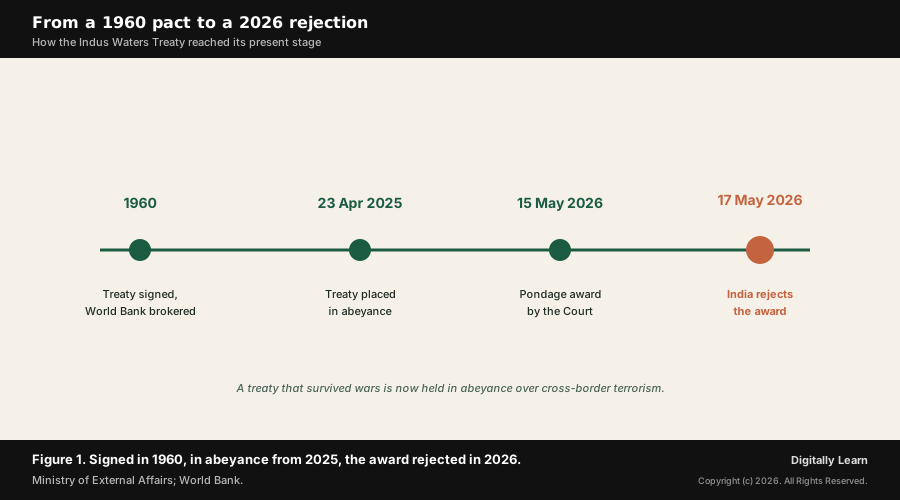
The Indus Waters Treaty (IWT) is a 1960 water-sharing agreement between India and Pakistan, brokered by the World Bank, that allocates the three eastern rivers to India and the three western rivers to Pakistan. On 15 May 2026, the Court of Arbitration issued an award on maximum pondage at Indian hydroelectric projects; on 17 May 2026, India rejected it as null and void, calling the Court illegally constituted. India also reaffirmed that the treaty remains in abeyance following the April 2025 Pahalgam terror attack.
Why the Indus Waters Treaty is back in focus
India rejects the pondage award
On 17 May 2026, India rejected an award issued by the Court of Arbitration at The Hague on 15 May 2026. The award concerned maximum pondage at Indian hydroelectric projects on the western rivers of the Indus system.
The Indus Waters Treaty is a 1960 agreement between India and Pakistan, brokered by the World Bank, that divides the six rivers of the Indus basin. It is one of the most durable water-sharing treaties in the world.
India called the Court illegally constituted and the award null and void, stating it has never recognised the Court's establishment. India also reaffirmed that the treaty stays in abeyance, a stance adopted after the April 2025 Pahalgam terror attack.
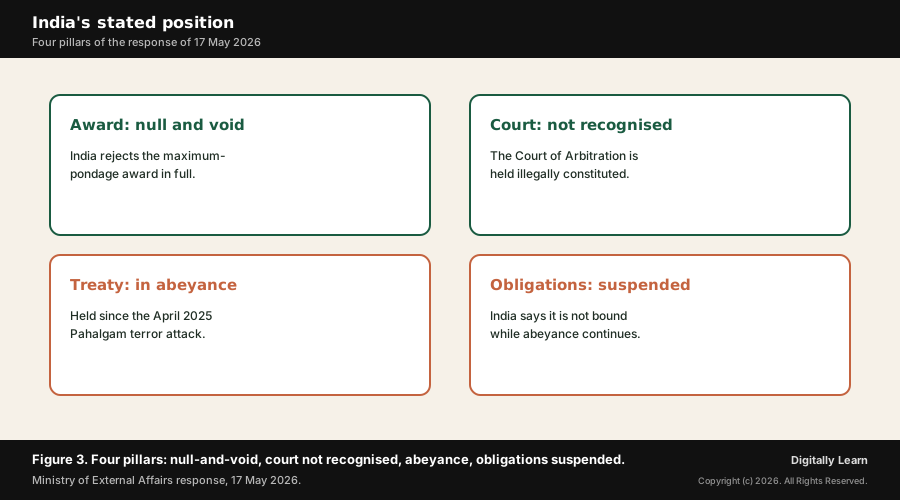
The core elements of India's position are:
- Award rejected: the maximum-pondage award is treated as null and void.
- Court not recognised: India holds the Court of Arbitration to be illegally constituted.
- Treaty in abeyance: held in abeyance since the April 2025 Pahalgam attack.
- Obligations suspended: India says it is not bound by treaty obligations while abeyance continues.
Why the dispute matters
Water, security and a sixty-year-old treaty
The Indus basin is the lifeline of agriculture in both countries. Any change in how its waters are shared or how disputes are settled carries large consequences for food security, energy and bilateral relations.
The treaty had survived wars and long freezes in relations, so its abeyance is a significant shift. By linking water to cross-border terrorism, India has placed a previously insulated pact inside the wider security relationship.
The rejection of the award also raises questions about the dispute-settlement machinery itself. India argues that parallel proceedings before a Court of Arbitration and a Neutral Expert on the same issue are not permitted by the treaty.
What the rejection signifies
Sovereignty, dispute-settlement and leverage
Three threads carry the weight: India's assertion of sovereign rights, the contest over the treaty's dispute-settlement design, and the use of water as strategic leverage.
First, sovereignty. India frames abeyance as a sovereign act under international law, holding that it need not perform treaty obligations while a partner supports cross-border terrorism.
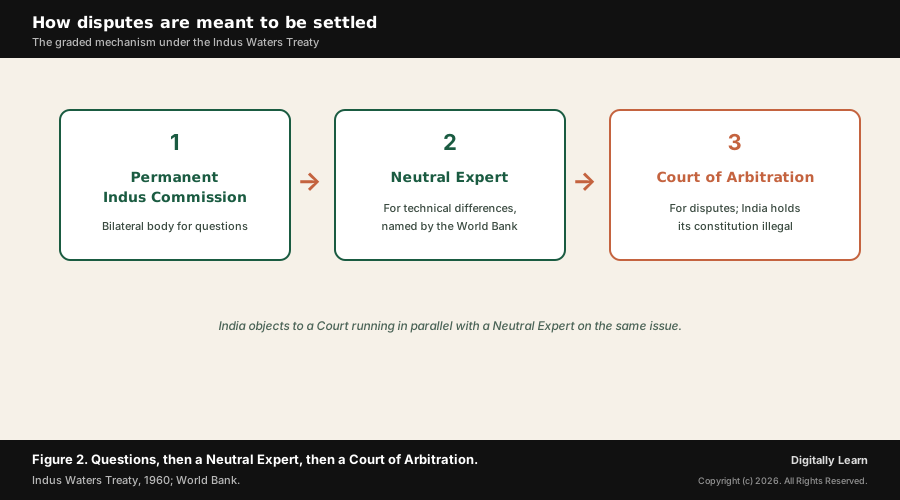
Second, the dispute-settlement contest. The treaty provides a graded mechanism, and India objects to a Court of Arbitration running in parallel with a Neutral Expert on the same questions, calling that constitution illegal.
Third, strategic leverage. Control over the timing of data-sharing, project design and flows on the western rivers gives India calibrated influence, short of stopping water, within the basin's hydrology.
Distinguishing features of the treaty and the dispute
How the treaty divides the rivers
The table sets out how the six rivers of the Indus basin are allocated, so the structure of the 1960 settlement is visible at a glance.
| River group | Rivers | Primary allocation |
|---|---|---|
| Eastern rivers | Ravi, Beas, Sutlej | India, for unrestricted use |
| Western rivers | Indus, Chenab, Jhelum | Pakistan, with India allowed non-consumptive use |
| India's use on western rivers | Run-of-the-river projects | Power, limited irrigation, navigation |
Three features that define the framework
Three elements set the treaty and the current dispute apart:
- (i) River division. Three eastern rivers go to India and three western rivers to Pakistan, with India permitted non-consumptive use of the western rivers.
- (ii) Graded dispute-settlement. Differences move from the Permanent Indus Commission to a Neutral Expert, and disputes to a Court of Arbitration.
- (iii) Pondage disputes. Pakistan objects to the storage and design of projects such as Kishanganga and Ratle, which is what the rejected award addressed.
Observable outcomes
Three trackable outcomes
The rejection and the abeyance translate into three visible consequences.
- (a) Suspended cooperation. Routine data-sharing and meetings of the Permanent Indus Commission stand paused while the treaty is in abeyance.
- (b) Project latitude. India gains room to revisit the design, storage and flushing of run-of-the-river projects on the western rivers.
- (c) Diplomatic friction. Pakistan continues to invoke the treaty and the Court, while India treats those proceedings as without legal effect.
Abeyance is not the same as withdrawal. The treaty has no unilateral exit clause, so India's position is that obligations are suspended, not that the treaty has ended.
Water diplomacy and the wider relationship
Terrorism, transboundary rivers and international law
The episode sits inside the larger India-Pakistan relationship, where India has tied normal cooperation to a verifiable end to cross-border terrorism. Water is now part of that calculus.
It connects to the law of transboundary rivers, where upper and lower riparian rights, non-consumptive use, and the duty to share data are contested across many basins, not only the Indus.
The dispute also tests the credibility of international arbitration. When one party refuses to recognise a tribunal, the practical force of an award depends on enforcement that such bodies rarely command.
UPSC relevance and exam focus
Where this fits in the UPSC-CSE syllabus
This topic maps to General Studies Paper II: India and its neighbourhood, and bilateral agreements involving India, and links to General Studies Paper I and III: drainage systems, water resources and security.
For Prelims, hold the high-yield facts: the 1960 signing, the World Bank's role, the eastern and western river groups, the three-tier dispute mechanism, and the Kishanganga and Ratle projects.
For Mains, two framings recur: how India balances treaty commitments with national security, and the challenges of transboundary water governance between upper and lower riparian states.
Recurring linked concepts an aspirant should keep in working memory:
- Eastern rivers: Ravi, Beas and Sutlej, allocated to India.
- Western rivers: Indus, Chenab and Jhelum, allocated to Pakistan with India’s non-consumptive use.
- Dispute tiers: Permanent Indus Commission, Neutral Expert, and Court of Arbitration.
- Run-of-the-river: projects that use flow without large live storage, permitted to India.
The eastern rivers are allocated to India and the western rivers to Pakistan. Reversing the two groups, or forgetting India's permitted non-consumptive use on the western rivers, is a frequent error.
Do not equate abeyance with withdrawal. The treaty has no exit clause, so the precise claim is that India's obligations are suspended, not that the treaty has been terminated.
Previous Year UPSC-CSE Questions By the end you will be able to draft model answers for the following UPSC questions. Each question carries a collapsible framework showing how to approach it in the exam.
- UPSC Prelims 2009Consider the following statements about the Baglihar Power Project:
- The Baglihar Power Project had been constructed within the parameters of the Indus Waters Treaty.
- The project was completely built by the Union Government with loans from Japan and the World Bank.
Which of the statements given above is/are correct?
How to approach this Prelims question
Approach: Check each statement against the design and financing of the Baglihar project.
Trap to watch: Statement 2 is the trap: the financing claim is incorrect, so only statement 1 stands.
Key facts to recall:
- Baglihar is on the Chenab, a western river where India has non-consumptive rights.
- The Baglihar design dispute went to a World Bank Neutral Expert.
- The Neutral Expert broadly upheld the project within the treaty's parameters.
Answer signal: Statement 1 is correct; statement 2 is not. Correct answer: 1 only.
- UPSC Mains 2016 GS-II“Increasing cross-border terrorist attacks in India and growing interference in the internal affairs of several member-states by Pakistan are not conducive for the future of SAARC (South Asian Association for Regional Cooperation).” Explain with suitable examples.
How to structure the answer in the exam
Introduction: Open with the principle that sustained cross-border terrorism erodes the trust on which cooperation rests.
Body (sub-themes to develop):
- Cross-border terrorism as the central irritant in India-Pakistan relations.
- Stalling of SAARC summits and cooperation due to the security environment.
- Linkage of previously insulated issues, such as the Indus Waters Treaty, to terrorism.
- India's pivot towards sub-regional groupings like BIMSTEC as an alternative.
- The cost to connectivity, trade and people-to-people ties in the region.
Conclusion: Conclude that durable regional cooperation requires a verifiable end to cross-border terrorism.
Sources and Further Reading
- Ministry of External Affairs: response on the so-called Court of Arbitration
- Press Information Bureau: Indus Waters Treaty 1960, present status of development in India
- World Bank: fact sheet on the Indus Waters Treaty 1960 and the role of the World Bank
- Department of Water Resources, RD and GR (Jal Shakti)
- National Portal of India: Constitution and governance
- Wikipedia: Indus Waters Treaty
Editorial Disclaimer
This article is compiled from the reference materials listed in the Sources section. It is an explainer for UPSC preparation and is not a substitute for primary documents (NCERTs, GoI ministry releases, IMD bulletins, RBI / CEA / MoEFCC publications, and Standing-Committee reports).


