


Overview
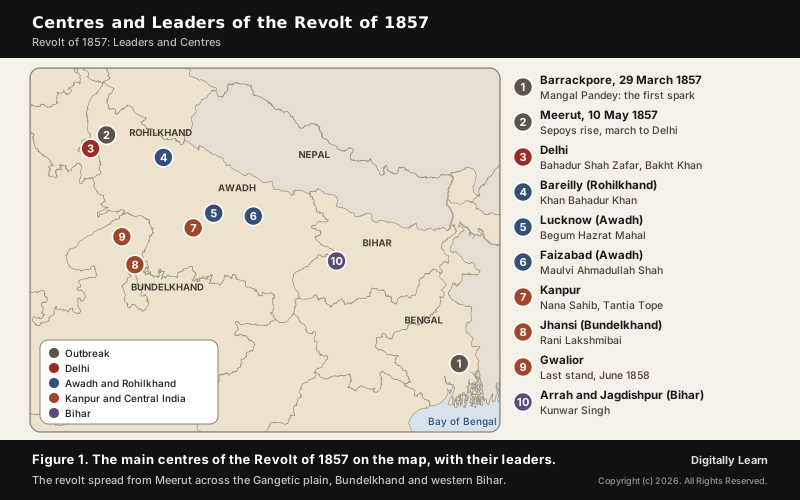
The leaders of the Revolt of 1857 were the men and women who took charge of the uprising in each of its centres after the sepoys of Meerut rose on 10 May 1857. At Delhi the rebels proclaimed the Mughal emperor Bahadur Shah Zafar their leader, while Bakht Khan commanded the troops. Nana Sahib and Tantia Tope led at Kanpur, Begum Hazrat Mahal at Lucknow, Rani Lakshmibai at Jhansi and Kunwar Singh in Bihar. Most were old rulers whom the sepoys and the people pressed into leadership.
Leaders of the Revolt of 1857 and Their Centres at a Glance
Who Led the Revolt of 1857 in Each Centre
The leaders of the Revolt of 1857 are best learnt centre by centre, because the revolt never had a single commander. It broke out among the sepoys at Meerut on 10 May 1857, and in each town where it took hold the rebels turned to a leader of their own, usually a ruler or noble who had lost power to the East India Company. The table sets out who led where and what became of each leader.
| Centre | Leader | Who the leader was | What became of the leader |
|---|---|---|---|
| Delhi | Bahadur Shah Zafar | The last Mughal emperor, accepted as leader on 11 May 1857 | Captured on 20 September 1857; exiled to Rangoon, where he died in 1862 |
| Delhi | Bakht Khan | A subedar who brought the Bareilly sepoys to Delhi | Left Delhi when it fell; died of wounds in the Terai of Nepal in 1859 |
| Kanpur | Nana Sahib | Adopted son of the last Peshwa, Baji Rao II | Escaped to Nepal at the end of 1858; his fate is unknown |
| Kanpur | Tantia Tope | Nana Sahib's general | Handed over to the British and executed on 18 April 1859 |
| Lucknow | Begum Hazrat Mahal | Wife of the exiled Nawab Wajid Ali Shah; regent for her son Birjis Qadr | Found refuge in Nepal; died in Kathmandu in 1879 |
| Jhansi | Rani Lakshmibai | Widow of Raja Gangadhar Rao, whose adopted heir the Company refused to accept | Killed in battle near Gwalior on 18 June 1858 |
| Arrah and Jagdishpur, Bihar | Kunwar Singh | Zamindar of Jagdishpur, then nearly eighty | Died at Jagdishpur on 26 April 1858, after a last victory |
| Bareilly | Khan Bahadur Khan | Grandson of the Rohilla regent Hafiz Rahmat Khan | Handed over by Nepal; hanged on 24 February 1860 |
| Faizabad | Maulvi Ahmadullah Shah | A preacher known as Danka Shah | Killed on 5 June 1858 by the Raja of Powayan |
Put simply, the leader of the revolt in Delhi was Bahadur Shah Zafar, with Bakht Khan as his commander; in Kanpur it was Nana Sahib, whose general was Tantia Tope; in Lucknow, Begum Hazrat Mahal; in Jhansi, Rani Lakshmibai; and in Bihar, Kunwar Singh.
Main Centres of the Revolt of 1857 on the Map
On a map of India the centres of the revolt form a belt across the north. It runs from Meerut and Delhi in the west, down the Ganga plain through Bareilly, Lucknow, Faizabad and Kanpur, south to Jhansi and Gwalior in Bundelkhand and Central India, and east to Arrah in Bihar. Barrackpore, near Calcutta, stands apart: the first spark came there, but Bengal stayed largely calm.
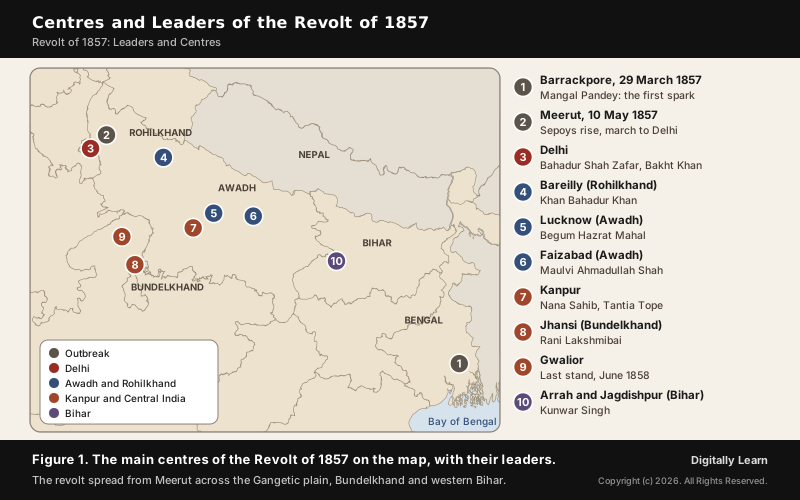
To mark the centres on an outline map, follow the order in which the revolt spread: Meerut and Delhi first, then Rohilkhand (Bareilly) and Awadh (Lucknow and Faizabad), then Kanpur, Jhansi and Gwalior, and finally Arrah and Jagdishpur in Bihar. The five colours on the map group the centres into theatres of the war.
Large parts of India stayed out of the revolt:
- The presidencies: Bengal, Bombay and Madras remained largely calm.
- The Punjab: The Sikh princes helped the British with soldiers and supplies.
- The big princely states: Hyderabad, Mysore, Travancore and Kashmir, like the smaller states of Rajputana, did not join. The Governor-General, Lord Canning, called them breakwaters in a storm.
How the Revolt of 1857 Broke Out: Barrackpore, Meerut and Delhi
From Barrackpore to Meerut: Mangal Pandey and the Outbreak of 10 May 1857
The first open act of defiance came six weeks before the main outbreak. On 29 March 1857, at Barrackpore near Calcutta, Mangal Pandey, a sepoy of the 34th Bengal Native Infantry, attacked his British officers in protest against the new greased cartridges and called on his comrades to rise. They did not join him, and he was overpowered.
He was hanged on 8 April 1857, and on 6 May seven companies of his regiment were disbanded in disgrace. Barrackpore itself did not rise, but Mangal Pandey's name became the lasting symbol of the sepoys' refusal to accept the cartridges.
At Meerut the trigger was a punishment. On 9 May 1857, 85 troopers of the 3rd Bengal Light Cavalry who had refused the new cartridges were court-martialled. The whole garrison was paraded to watch them stripped of their uniforms and put in shackles, and most were sentenced to ten years in prison with hard labour.
Late in the afternoon of 10 May the sepoys broke into mutiny, and the rising unfolded in four stages:
- It began in the lines of the native infantry and spread quickly to the cavalry and then to the city, where people from the town and nearby villages joined the soldiers.
- The sepoys seized the bell of arms, the store where weapons and ammunition were kept, and freed their imprisoned comrades.
- They attacked the British and burned their bungalows, and destroyed the record office, jail, court, post office and treasury.
- They cut the telegraph line to Delhi, and as night fell a group of them rode off towards the city.
The March to Delhi and Bahadur Shah Zafar as Leader
The Meerut sepoys reached the gates of the Red Fort early on 11 May 1857. It was the month of Ramzan, and the old emperor, Bahadur Shah Zafar, had just finished his prayers. The sepoys told him they had killed the Englishmen at Meerut because they had been asked to bite cartridges coated with the fat of cows and pigs, which would corrupt the faith of Hindus and Muslims alike.
Zafar's first reaction was horror. He had no army and little power beyond the fort. Another group of sepoys had entered Delhi, the people of the city joined them, and by the end of the day the city was out of British control. Only when sepoys rode into the fort itself, ignoring court etiquette, did Zafar, seeing few options, agree to become the nominal leader of the rebellion.
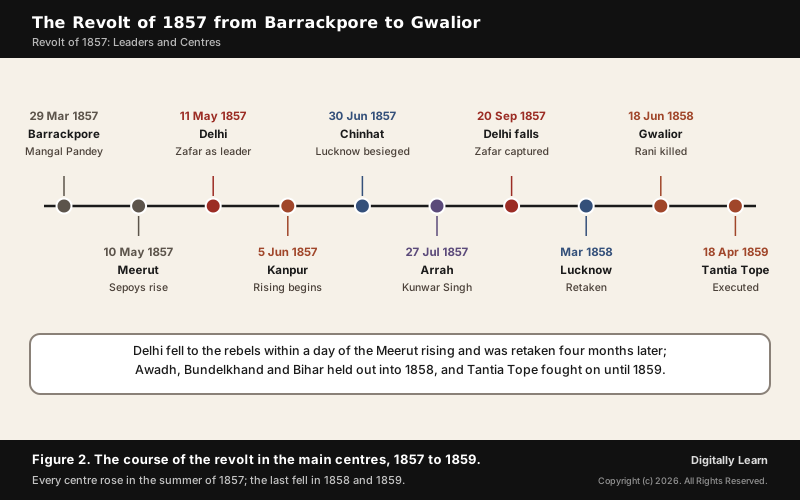
For two days North India stayed quiet. Then, once word spread that Delhi had fallen and the emperor had blessed the rising, cantonment after cantonment in the Ganga valley rose in mutiny. The timeline shows when the revolt reached each centre and when each fell.
How the Sepoy Mutiny of 1857 Became a Popular Revolt
The Common Pattern of Mutiny in Every Cantonment
The risings followed the same sequence almost everywhere, which is why historians speak of a pattern of rebellion:
- The signal: The firing of the evening gun or the sound of a bugle.
- Arms and money: The sepoys seized the bell of arms and plundered the treasury.
- Symbols of Company rule: They attacked the jail, telegraph office, record room and British bungalows, and burned the records.
- Proclamations: Notices in Hindi, Urdu and Persian called on Hindus and Muslims alike to unite and drive out the firangis, the foreigners.
- The people join: As townspeople and peasants joined, the targets widened. In Lucknow, Kanpur and Bareilly, moneylenders and the rich were attacked too, since peasants saw them as oppressors and as allies of the British.
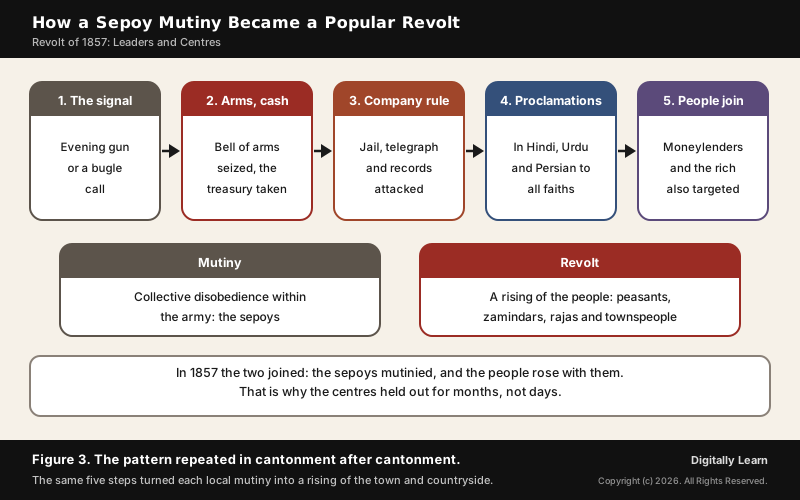
The two joined in 1857, and that is what gave the revolt its strength. Wherever the sepoys rose, their kinsmen in the villages and the people of the towns joined them with grievances of their own, over revenue, lost land and lost thrones. In May and June the British had no answer; British rule, in one officer's words, collapsed like a house made of cards.
Planning and Coordination: Emissaries, Panchayats and Rumours
The pattern was so uniform that the British believed the revolt had been planned. There was certainly communication between cantonments. After the 7th Awadh Irregular Cavalry refused the new cartridges in early May, they wrote to the 48th Native Infantry that they had acted for the faith and awaited the 48th's orders, and sepoys or their emissaries moved from one station to another.
Decisions were often taken together. Charles Ball, one of the earliest historians of the revolt, recorded that panchayats of native officers met nightly in the Kanpur sepoy lines. The sepoys lived in the same lines, shared a way of life and often came from the same castes, so they could sit together and decide their future. In that sense the sepoys were the makers of their own rebellion.
Rumours and prophecies moved people to act:
- The cartridges: They were said to be greased with the fat of cows and pigs, a rumour that spread like wildfire across the sepoy lines of North India.
- The flour: The British were said to have mixed the bone dust of cows and pigs into the atta sold in the market, and many refused to touch it.
- The prophecy: British rule would end on the centenary of the Battle of Plassey, on 23 June 1857.
- The chapatis: They were passed from village to village by night, each watchman asked to make five more for the next village. Their purpose is not clear even today, but people read them as an omen of upheaval.
The Main Centres of the Revolt of 1857 and Their Leaders
Delhi: Bahadur Shah Zafar and General Bakht Khan
Delhi was the symbolic capital of the revolt. Rebels from across North India marched there to defend the emperor, but Zafar was old and no soldier, so real command passed to the rebel troops and their officers.
The ablest of these was Bakht Khan, a subedar of the Company's army from Bijnor in Rohilkhand. He reached Delhi from Bareilly on 1 July 1857 with a large force of Rohilla sepoys. The emperor soon gave him real authority and the title Saheb-e-Alam Bahadur, and he became the virtual commander of the rebel army. The fall of Delhi came in three steps:
- 8 June 1857: British forces began the siege from the Ridge to the north of the city, and were reinforced from the Punjab in August.
- 14 September: They broke in at the Kashmiri Gate, and a week of street fighting followed.
- 20 September: Zafar, who had taken refuge at Humayun’s Tomb, surrendered to Major William Hodson against Bakht Khan’s pleas. The next day Hodson had the emperor’s sons shot.
Zafar was tried for treason and exiled to Rangoon, where he died on 7 November 1862, the last of the Mughal emperors. Bakht Khan left Delhi and fought on, and died of his wounds in the Terai of Nepal in 1859.
Kanpur: Nana Sahib and Tantia Tope
At Kanpur the sepoys and the people of the town gave Nana Sahib no choice but to lead them. He was the adopted son of Baji Rao II, the last Peshwa, and the Company had refused to continue the Peshwa's pension to him. He proclaimed himself Peshwa and declared that he was a governor under Emperor Bahadur Shah Zafar. Events at Kanpur moved fast:
- 5 June 1857: The sepoys rose, and on 6 June Nana Sahib’s forces attacked the entrenchment where General Hugh Wheeler’s garrison had taken shelter.
- 27 June: After three weeks under fire the garrison surrendered in return for safe passage by boat to Allahabad, but at the Satichaura Ghat the departing British were attacked and most were killed or captured.
- Mid-July: The women and children held in the Bibighar were killed. General Havelock retook Kanpur on 16 July, and savage British reprisals followed.
Nana Sahib's general, Tantia Tope, became the most resourceful rebel commander of the war. He tried to retake Kanpur in November 1857, went to the aid of the Rani of Jhansi, and with her seized Gwalior in 1858. After Gwalior fell he fought a guerrilla war through Central India and Rajputana. In 1859 Man Singh, the Raja of Narwar, whom Tantia had befriended in the jungles of Paron, handed him over to the British, and he was executed at Sipri on 18 April 1859. Nana Sahib escaped to Nepal at the end of 1858, and the story of his escape added to his legend.
Lucknow and Awadh: Begum Hazrat Mahal and Birjis Qadr
Nowhere was the revolt more popular than in Awadh. The Company had annexed the kingdom only in 1856 and sent the popular Nawab Wajid Ali Shah into exile in Calcutta, and the memory was fresh. When Lucknow rose on 30 May 1857, the people hailed the Nawab's young son, Birjis Qadr, as their ruler. His mother, Begum Hazrat Mahal, became regent and the real leader of the resistance. The struggle for Lucknow went on for ten months:
- 30 June 1857: The rebels defeated the British under Sir Henry Lawrence at the Battle of Chinhat, and the siege of the British Residency began.
- 4 July: Lawrence died of a shell wound.
- 25 September: A relief force under Henry Havelock and James Outram fought its way in, but was itself shut in.
- November 1857: Sir Colin Campbell relieved the garrison and evacuated it from the city.
- March 1858: Campbell returned with a large army and retook Lucknow.
Awadh resisted longer than any other region. A British official, Forsyth, estimated that three-fourths of the adult male population of Awadh was in rebellion, and the area was brought under control only in March 1858 after protracted fighting. After Lucknow fell, Begum Hazrat Mahal found refuge in Nepal, where she died in 1879.
Jhansi and Gwalior: Rani Lakshmibai
Born Manikarnika, Rani Lakshmibai married Raja Gangadhar Rao of Jhansi in 1842. Before he died in November 1853, the Raja adopted a five-year-old relative, Damodar Rao, as his heir. The Company refused to recognise the adoption and annexed Jhansi under the Doctrine of Lapse, ignoring the Rani's protests to the Governor-General, Lord Dalhousie.
When the revolt reached Jhansi in June 1857, popular pressure pushed the Rani to its head, and the British soon treated her as an enemy:
- March and April 1858: Sir Hugh Rose besieged and took Jhansi. The Rani escaped on horseback with her adopted son and joined the other rebel leaders at Kalpi.
- 22 May 1858: Rose defeated the rebels at Kalpi.
- After Kalpi: The Rani and Tantia Tope marched on Gwalior and seized its fortress; the Maharaja of Gwalior stood by the British.
- 18 June 1858: She was killed fighting near Gwalior, between Kotah-ki-Serai and the city.
Hugh Rose himself called her the best and bravest of the rebels. The last rebels at Gwalior were defeated two days after her death, but her courage made her the most lasting symbol of 1857.
Arrah and Jagdishpur: Kunwar Singh in Bihar
In Bihar the revolt was led by Kunwar Singh, the zamindar of Jagdishpur in the old Shahabad district, today's Bhojpur. Born in 1777, he was nearly eighty and in failing health when he was called on to take up arms, and his brother Amar Singh fought beside him. His campaign ran for nine months:
- 25 to 27 July 1857: Sepoys who had mutinied at Danapur joined Kunwar Singh and occupied Arrah, the district headquarters, besieging a small party of Europeans and loyal sepoys in a fortified house.
- 3 August: Major Vincent Eyre relieved Arrah, defeated Kunwar Singh’s force and destroyed Jagdishpur.
- December 1857 to March 1858: Kunwar Singh carried the war into Awadh, meeting the rebel leaders at Lucknow and then occupying Azamgarh.
- 23 April 1858: He returned home and won a last victory near Jagdishpur over a British force under Captain Le Grande.
- 26 April 1858: He died at Jagdishpur, undefeated in his own country, and Amar Singh carried on the struggle.
Rohilkhand, Haryana, Assam and Other Centres of the Revolt
Beyond the five main centres, the revolt threw up leaders across the Ganga plain and beyond:
- Bareilly (Rohilkhand): Khan Bahadur Khan, grandson of the Rohilla regent Hafiz Rahmat Khan, led the rising. He later fled to Nepal, whose army captured him and handed him to the British, and he was hanged on 24 February 1860.
- Faizabad (Awadh): Maulvi Ahmadullah Shah raised a large following and fought at Chinhat; his story is told with the religious leaders below.
- Rewari (Haryana): Rao Tula Ram occupied Rewari on 17 May 1857 and raised a force of about 5,000; he was defeated at Narnaul (Nasibpur) on 16 November 1857.
- Upper Assam: Maniram Dewan, a noble and one of the first to set up tea gardens in Assam, was hanged by the British in February 1858 for conspiring against them.
- Barout, near Meerut: Shah Mal raised the villages of the area.
- Singhbhum (Chotanagpur): Gonoo, a tribal cultivator, led the Kol tribals.
Across this belt, the revolt was not the work of a few famous names alone. It was carried by many local leaders who turned their own followers against Company rule.
Three Kinds of Leaders in the Revolt of 1857
Old Rulers and Soldier-Commanders
Most of the famous leaders of 1857 did not seek the role. The rebels needed leadership and organisation, and they turned to those who had been leaders before the British conquest. Bahadur Shah Zafar agreed only after sepoys had entered his court. At Kanpur the sepoys and townspeople left Nana Sahib no choice; at Jhansi popular pressure forced the Rani to lead, as it did Kunwar Singh at Arrah; and at Lucknow the crowds hailed Birjis Qadr.
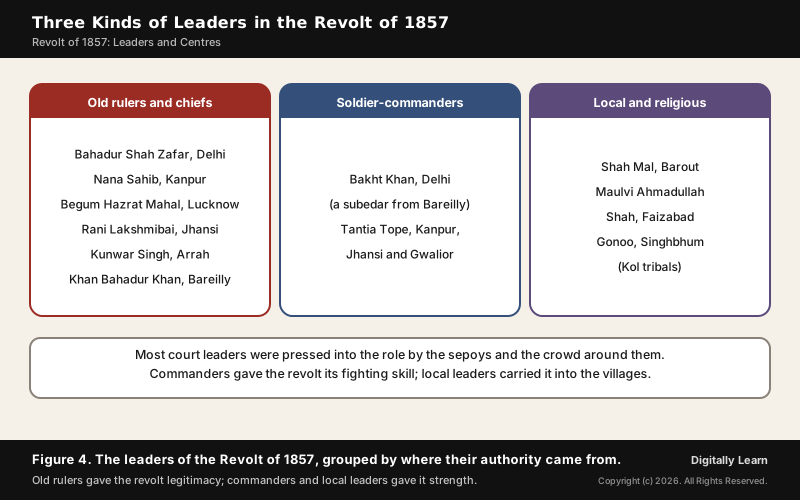
Each of these figures had a grievance that the Company's own policies had created:
- A lost kingdom: Awadh was annexed in 1856 and its Nawab sent into exile.
- A refused pension: Nana Sahib was denied the pension of his adoptive father, the last Peshwa.
- An heir not recognised: Jhansi was annexed after the Company refused to accept the Rani’s adopted son.
This shows what many rebels wanted: the return of the world they had lost to annexation, under rulers they knew. A second kind of leader gave the revolt its fighting skill. Bakht Khan, a veteran subedar, was the nearest the rebels came to a commander-in-chief at Delhi, and Tantia Tope kept up the longest resistance of the war, for almost a year after the Rani's death. Neither had a claim to rule; their authority came from the troops who followed them.
Local and Religious Leaders: Shah Mal, Ahmadullah Shah and Gonoo
Not every leader came from a court. The message of rebellion was also carried by ordinary men and women and by religious figures, and local leaders urged peasants, zamindars and tribals to rise.
In a large village of pargana Barout, in today's Uttar Pradesh, lived Shah Mal. He belonged to a clan of Jat cultivators whose kinship ties spread over eighty-four villages. The land was fertile, but a high and inflexible revenue demand was making cultivators lose their land to traders and moneylenders. Shah Mal went from village to village at night urging people to rebel, and his men:
- Destroyed the bridge over the river and dug up metalled roads, both to keep government troops out and because roads and bridges stood for British rule.
- Sent supplies to the sepoys in Delhi and stopped official communication between the British headquarters and Meerut.
- Turned an English officer’s bungalow into a hall of justice, where Shah Mal, acknowledged locally as Raja, settled disputes. He was killed in battle in July 1857.
Educated in Hyderabad, Maulvi Ahmadullah Shah toured the villages from 1856 preaching war against the British. He travelled in a palanquin with drummers in front, so people called him Danka Shah, the maulvi with the drum. Jailed at Faizabad in 1857, he was freed and chosen as leader by the mutinous 22nd Native Infantry, and he fought at Chinhat, where the British under Henry Lawrence were defeated. Many believed he could not be killed. He fought on from Shahjahanpur after Lucknow fell, until the Raja of Powayan killed him on 5 June 1858 for the reward the British had offered.
In Chotanagpur, Gonoo, a tribal cultivator of Singhbhum, became a rebel leader of the Kol tribals. Leaders like these show that 1857 was a revolt of peasants and tribals as well as of princes and sepoys.
Hindu-Muslim Unity and Rebel Government in 1857
Hindu-Muslim Unity in the Rebel Proclamations
The rebel proclamations were addressed to all sections of the population, whatever their caste or creed. Many were issued by Muslim princes or in their names, but even these took care to respect the feelings of Hindus, and they looked back to the coexistence of communities under the Mughal Empire. The proclamation issued in the name of Bahadur Shah called on people to fight under the standards of both Muhammad and Mahavir.
The fullest statement of what the rebels wanted is the Azamgarh Proclamation of 25 August 1857. It called on Hindus and Muslims alike, and especially on those with ties to the old royal families, to stake their lives and property against the English. Religious divisions were hardly visible during the uprising. At Bareilly in December 1857 the British spent Rs 50,000 trying to turn Hindus against Muslims, and the attempt failed.
Rebel Administration and Why the Centres Mattered
Where British rule collapsed, the rebels at Delhi, Lucknow and Kanpur tried to set up a government of their own. Its features were practical:
- Appointments were made to various posts.
- Arrangements were made to collect land revenue and pay the troops.
- Orders were issued to stop loot and plunder, and chains of command were laid down in the army.
In all this the rebels looked back to the eighteenth-century Mughal world as their model. These structures were built for war and most could not survive the British counter-attack, but in Awadh, where resistance lasted longest, the Lucknow court was still drawing up plans of counter-attack late in 1857 and early in 1858.
Revolt of 1857 Leaders and Centres in UPSC Previous Year Questions
What UPSC Has Asked About the Leaders and Centres of 1857
The objective questions UPSC has set on the centres of 1857 test precise pairs: which leader belonged where, which places rose and what became of each leader. The leader-by-centre table and the map above answer all three.
| Year | What the question asked | The point being tested |
|---|---|---|
| 2005 | Which of Jhansi, Chittor, Jagdishpur and Lucknow was not affected by the revolt | Chittor, in Rajputana, was not a centre |
| 2005 | Which state Kunwar Singh belonged to | Bihar: Jagdishpur, near Arrah |
| 2006 | Which leader was betrayed by a friend, captured and put to death | Tantia Tope, handed over by Man Singh of Narwar in 1859 |
The 2016 GS Paper I question on 1857 as a watershed in British policy uses this material as its starting point: the revolt's reach across Delhi, Kanpur, Lucknow, Jhansi and Bihar, and its popular character, explain why the British ended Company rule and remade their policy towards India.
Previous Year UPSC-CSE Questions
Previous Year UPSC-CSE Questions By the end you will be able to draft model answers for the following UPSC questions. Each question carries a collapsible framework showing how to approach it in the exam.
- UPSC Mains 2016 GS-IExplain how the uprising of 1857 constitutes an important watershed in the evolution of British policies towards colonial India.
Answer outline: how to structure the answer
What the question asks, the main arguments, relevant examples and the direction of the conclusion. This is not a full model answer.
Introduction: Open with 1857 as the great divide between Company rule and Crown rule.
Body (sub-themes to develop):
- Scale: the revolt held Delhi, Kanpur, Lucknow, Jhansi and Bihar for months.
- Popular character: sepoys joined by peasants, talukdars and townspeople; Hindu-Muslim unity.
- Shock to the British: the realisation that this was an uprising, not a mere mutiny.
- Watershed in policy: end of the Company, Crown rule under the Act of 1858, army reorganisation and conciliation of the princes.
Conclusion: Conclude that the scale and popular reach of 1857 compelled the British to remake the very structure of their rule in India.
- UPSC Prelims 2005 Prelims-GSWhich one of the following territories was not affected by the Revolt of 1857?
How to approach this Prelims question
Approach: Check each place against the map of the centres.
Trap to watch: Jagdishpur is less famous than Jhansi or Lucknow, but it was Kunwar Singh's base.
Key facts to recall:
- (a) Jhansi: wrong. Jhansi was a centre, led by Rani Lakshmibai.
- (b) Chittor: right. Chittor lay in Rajputana, whose states did not join the revolt.
- (c) Jagdishpur: wrong. Jagdishpur was Kunwar Singh's base in Bihar.
- (d) Lucknow: wrong. Lucknow was a centre, led by Begum Hazrat Mahal.
Answer signal: Answer (b), Chittor: the Rajputana states stayed out of the revolt.
- UPSC Prelims 2005 Prelims-GSWhich one of the following places did Kunwar Singh, a prominent leader of the Revolt of 1857, belong to?
How to approach this Prelims question
Approach: Place Kunwar Singh at his home base, not where he later fought.
Trap to watch: He fought in Awadh and at Azamgarh in 1858, which tempts the answer Uttar Pradesh.
Key facts to recall:
- (a) Bihar: right. Kunwar Singh's home and base were Jagdishpur, near Arrah, in today's Bhojpur district.
- (b) Madhya Pradesh: wrong. His home and base were in Bihar, not in Central India.
- (c) Rajasthan: wrong. The Rajputana states did not join the revolt.
- (d) Uttar Pradesh: wrong. He fought there in 1858, but his home was in Bihar.
Answer signal: Answer (a), Bihar: Jagdishpur near Arrah was his base.
- UPSC Prelims 2006 Prelims-GSWith reference to the revolt of the year 1857, who of the following was betrayed by a friend; captured and put to death by the British?
How to approach this Prelims question
Approach: Recall how each leader's story ended.
Trap to watch: Khan Bahadur Khan was captured and hanged too, but he was handed over by the Nepalese army, not betrayed by a friend.
Key facts to recall:
- (a) Nana Sahib: wrong. He escaped to Nepal and was never captured.
- (b) Kunwar Singh: wrong. He died at home in Jagdishpur.
- (c) Khan Bahadur Khan: wrong. He was captured by the Nepalese army and handed over, not betrayed by a friend.
- (d) Tantia Tope: right. Man Singh of Narwar betrayed him; he was captured and executed.
Answer signal: Answer (d), Tantia Tope: betrayed by Man Singh of Narwar.
Sources
- NCERT: Themes in Indian History Part III (Class XII), Rebels and the Raj
- NCERT: Our Pasts III (Class VIII), When People Rebel
- District Meerut (Government of Uttar Pradesh): History
- District Jhansi (Government of Uttar Pradesh): History
- District Lucknow (Government of Uttar Pradesh): History
- District Bhojpur (Government of Bihar): History
- Wikipedia: Indian Rebellion of 1857
- Wikipedia: Siege of Delhi
- Wikipedia: Siege of Cawnpore
- Wikipedia: Siege of Lucknow
- Wikipedia: Rani of Jhansi
- Wikipedia: Kunwar Singh
- Wikipedia: Bahadur Shah Zafar
- Wikipedia: Tatya Tope
- Wikipedia: Begum Hazrat Mahal
- Wikipedia: Nana Sahib
- Wikipedia: Bakht Khan
- Wikipedia: Mangal Pandey
- Wikipedia: Khan Bahadur Khan Rohilla
- Wikipedia: Ahmadullah Shah
- Wikipedia: Battle of Chinhat
- Wikipedia: Siege of Arrah
- Wikipedia: Rao Tula Ram
- Wikipedia: Maniram Dewan
- Wikipedia: Narwar
- UPSC: Civil Services Examination question papers
Editorial Disclaimer
This article is for UPSC preparation. Verify dates and interpretations against NCERT and standard reference histories before relying on them.