


Overview
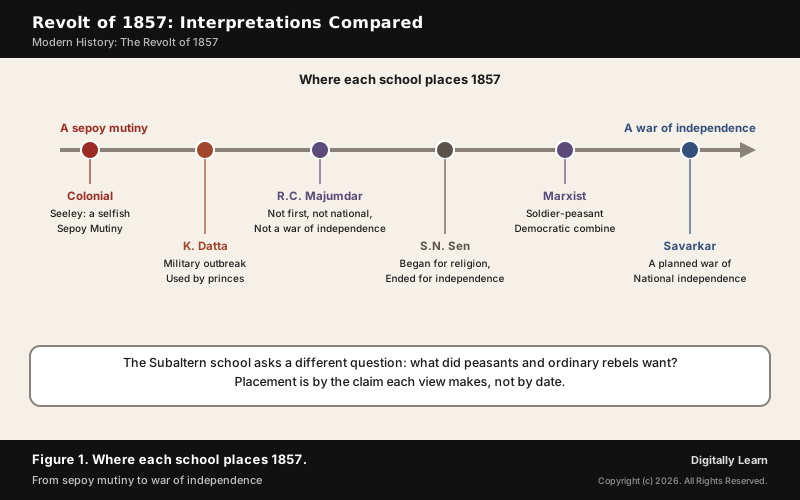
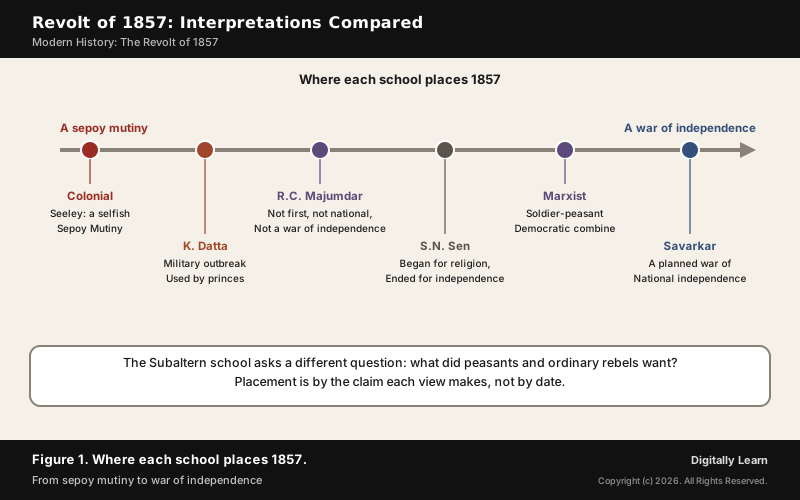
Historians have never agreed on what to call the events of 1857. British writers called them the Sepoy Mutiny; Indian nationalists, led by V.D. Savarkar, called them the First War of Independence. Between these poles stand R.C. Majumdar's 'neither first, nor national, nor a war of independence', S.N. Sen's fight for religion that became a war of independence, the Marxist soldier-peasant revolt and the subaltern focus on ordinary rebels.
Historiography of the Revolt of 1857: Sepoy Mutiny or War of Independence
Names for 1857 and What Each One Implies
There is no universally agreed name for the events of 1857. In India and Pakistan they are called the First War of Indian Independence or the Revolt of 1857; in Britain they are commonly called the Indian Mutiny, and terms such as Sepoy Mutiny, Sepoy Rebellion and Great Mutiny are also used. Each name carries a judgement about what happened.
- Mutiny: When soldiers as a group disobey their officers in the army. The label limits 1857 to a revolt of sepoys.
- Revolt or rebellion: A wider rising in which civilians also took part, without a claim about its aims.
- War of independence: A conscious, shared struggle to end foreign rule over India as a whole.
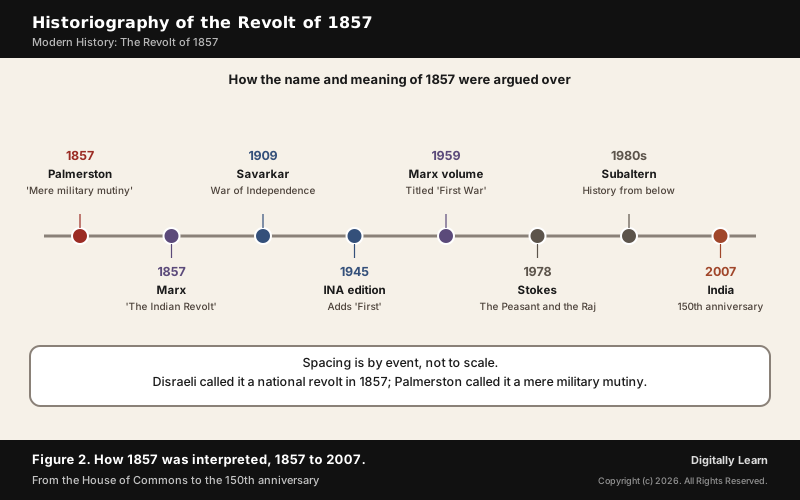
The argument began at once. Speaking in the House of Commons in July 1857, Disraeli called it a 'national revolt', while the Prime Minister, Palmerston, played it down as a 'mere military mutiny'. Some Indian politicians regard 'Indian Mutiny' as belittling and imperialist, and others dispute that reading.
Sources for 1857: Colonial Records, Rebel Proclamations and Images
Every view of 1857 depends on its sources, and those sources are lopsided. The British, as victors, recorded their own trials and heroism and dismissed the rebels as ungrateful and barbaric. Few rebels could record their version; most were sepoys and ordinary people who could not read or write. What survives from their side is mainly a few proclamations and ishtahars (notifications).
- Colonial records: They reveal the minds of officials but tell us very little about what the rebels wanted.
- Rebel proclamations: The Azamgarh Proclamation of 25 August 1857 is one of the main sources for the rebels’ aims.
- British images: Paintings such as ‘Relief of Lucknow’ (1859) and ‘In Memoriam’ (1859), and Punch cartoons, celebrated British heroes and fed demands for revenge.
- Nationalist images: The twentieth-century national movement drew inspiration from 1857 and celebrated it as the First War of Independence.
Colonial Interpretation: The Revolt as a Sepoy Mutiny
British Views: Seeley, Rees and Holmes
To many British historians 1857 was a mere mutiny. Sir John Seeley called it 'a wholly unpatriotic and selfish Sepoy Mutiny with no native leadership and no popular support'. Others went further: L.E.R. Rees saw a war of fanatic religionists against Christians, and T.R. Holmes a conflict between civilisation and barbarism.
British images reinforced this reading. 'In Memoriam' showed English women and children waiting helplessly for dishonour and death, representing the rebels as violent and brutish although they never appear in the picture. Such images created a mood in which violent repression and vengeance seemed both necessary and just.
Not every British writer was consistent. Charles Ball, an early historian of the rebellion, used the word mutiny in his title but called it a 'struggle for liberty and independence as a people' in his text.
Why the Mutiny Label Does Not Fit the Evidence
The mutiny label is not a complete picture, because the revolt involved many sections of the civilian population and not just the sepoys. When soldiers rose, they were joined very swiftly by their brethren in the villages; peasants poured into towns and joined in collective acts of rebellion.
- Awadh: A chain of grievances linked prince, taluqdar, peasant and sepoy, who came to identify firangi raj with the end of their world.
- Scale: Of about 135,000 sipahis of the Bengal Army, only about 8,000 remained loyal, so over 120,000 professional soldiers took the field.
- Unity: Religious divisions between Hindus and Muslims were hardly noticeable; a British attempt to set them against each other in Bareilly in December 1857, at a cost of Rs 50,000, failed.
- Wider regions: There was a widespread popular revolt in Awadh, Bundelkhand and Rohilkhand.
The words of a taluqdar show why this was more than a soldiers' affair. Hanwant Singh, the Raja of Kalakankar, saved a British officer during the revolt and then told him: 'At one blow you took from me lands which from time immemorial had been in my family … now I march at the head of my retainers to Lucknow to try and drive you from the country.'
Nationalist Interpretation: The First War of Indian Independence
Savarkar's The Indian War of Independence (1909)
At the start of the twentieth century 1857 came to be read as a planned war of national independence. V.D. Savarkar wrote The Indian War of Independence in Marathi at India House in London, finishing it in 1907 in response to British celebrations of the revolt's fiftieth anniversary, and an English translation appeared in 1909.
- Banned: The book was seen as highly inflammatory; the Marathi edition was banned in British India even before it was published.
- The word ‘First’: The original edition did not use it. ‘First’ appears in a 1945 edition published in Kuala Lumpur by the Indian National Army, titled The Volcano, or The First War of Indian Independence.
- Marx: Karl Marx wrote ‘The Indian Revolt’ in the New-York Tribune in 1857 but never called it a war of independence; a 1959 Moscow volume of his articles carried that title.
Nationalist art and literature kept 1857 alive. Rani Lakshmi Bai of Jhansi was shown in battle armour, sword in hand, a symbol of resistance to alien rule, and children learnt Subhadra Kumari Chauhan's line 'Khoob lari mardani woh to Jhansi wali rani thi'.
Arguments for Calling 1857 a War of Independence
Those who defend the name point to what the rebels did and said. Most rebel sepoys made their way to Delhi to revive the Mughal Empire, which stood for unity even for the Hindus among them, and they vowed to drive the British out of India as they knew it.
- A common cause: Sepoys ignored local princes and proclaimed ‘Khalq Khuda Ki, Mulk Badshah Ka, Hukm Subahdar Sipahi Bahadur Ka’: the people belong to God, the country to the Emperor, authority to the sepoy.
- Unity of Hindus and Muslims: The proclamation in Bahadur Shah’s name appealed to people to fight under the standards of both Muhammad and Mahavir.
- Patriotic language: The Delhi Urdu Akhbar addressed its readers as ‘fellow countrymen’ and called the sepoys the fauj Hindustani, the Indian Army.
- A wider vision: The Awadh court’s reply to Queen Victoria’s proclamation appealed to ‘the Army and people of India’.
Official India has taken this view. The Government of India marked 2007 as the 150th anniversary of India's First War of Independence, with a national youth rally from Meerut to Delhi on 7 May 2007, and on 10 May 2022 the Prime Minister described the day in 1857 as the beginning of the historic First War of Independence.
Sceptical and Balanced Views: Majumdar, Sen and Datta
R.C. Majumdar: Neither First, Nor National, Nor a War of Independence
R.C. Majumdar gave the sharpest dissent: the so-called First National War of Independence of 1857 was 'neither First, nor National, nor War of Independence'. Large parts of the country remained unaffected, and many sections of the people took no part. Majumdar left the government committee writing a history of the freedom struggle after a clash with Education Minister Maulana Azad over 1857, and published his own book, The Sepoy Mutiny and the Revolt of 1857.
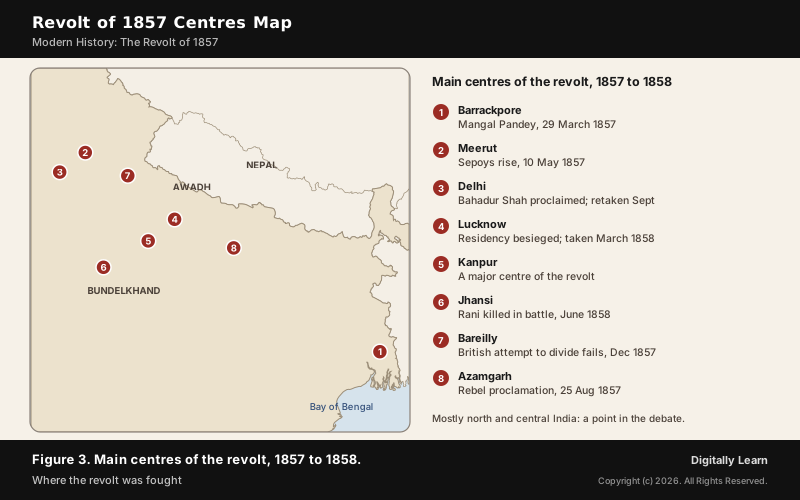
- Limited area: The revolt was largely confined to north and central India; risings elsewhere had little impact.
- Indians on the British side: Soldiers of the Madras Army, the Bombay Army and Sikh regiments helped suppress it, and about 80 per cent of the Company’s forces were Indian.
- No united India: A united India did not yet exist politically, culturally or ethnically, and many rulers fought among themselves.
- Weak centre: The King of Delhi had no real control over the mutineers.
S.N. Sen and K. Datta: From Religious Fight to War of Independence
S.N. Sen, in Eighteen Fifty-Seven, held that the revolt began as a fight for religion but ended as a war of independence. In his account the mutiny became a revolt and took on a political character when the mutineers of Meerut placed themselves under the King of Delhi and a section of the landed aristocracy and civil population declared for him.
K. Datta was more cautious. He saw 1857 as 'in the main a military outbreak', taken advantage of by discontented princes and landlords whose interests had been hurt by the new political order. It was 'never all-Indian in character, but was localised, restricted and poorly organised', and lacked cohesion and unity of purpose among the rebels.
What the rebels built once British rule collapsed supports a middle view. In Delhi, Lucknow and Kanpur they set up structures of authority, made appointments, collected land revenue and paid troops, but the leadership wanted to restore the pre-British world of the eighteenth century. In Delhi the sipahis even formed a Court of Administration of elected representatives of the different contingents.
Marxist, Peasant and Subaltern Interpretations of 1857
Marxist Reading: A Soldier-Peasant Democratic Combine
Marxist historians described 1857 as 'the struggle of the soldier-peasant democratic combine against foreign as well as feudal bondage'. They trace it to what colonialism did to the economy: in the Mahalwari areas of Upper India, the heart of the revolt, taxation rose by 70 per cent in real terms between 1819 and 1856, and spinners and weavers were thrown out of work by duty-free British goods.
The objection is that many leaders of the revolt came from a feudal background. Jawaharlal Nehru, in The Discovery of India, called it basically a feudal uprising, while Irfan Habib argues that when taluqdars, zamindars and princes rose against the greatest colonial power of the world on the support of sepoys, peasants and artisans, their own ideas changed.
Eric Stokes and the Subaltern School: Peasants as Makers of the Revolt
Eric Stokes, in The Peasant and the Raj (1978), undermined the idea that whole classes rose for general causes. He argued that those who suffered the greatest relative deprivation rebelled, and that a revolt broke out where there were prosperous magnates who supported British rule.
The Subaltern Studies group, which arose in the 1980s under the influence of Stokes and Ranajit Guha, wrote history from below, focused on the masses rather than the elite. For 1857 this means looking at what rebels did as well as what leaders proclaimed. In the villages they burnt account books and ransacked moneylenders' houses, an attempt to overturn old hierarchies that hints at a more egalitarian vision.
Contemporary officials saw the same thing. Thornhill, a District Magistrate of Mathura, wrote in late 1858 that the peasants were the most hostile to British rule, and that the British should now support the landowners and repress the peasants.
A Balanced Verdict on the Nature of the Revolt of 1857
1857 as the Culmination of a Century of Rebellions
The revolt did not come out of nowhere. For a hundred years before 1857, peasants, tribals and deposed rulers had risen against Company rule, region by region, and 1857 gathered many of the same grievances into one great rising.
| Rising | Years | Main grievance |
|---|---|---|
| Sanyasi revolt, Bengal | After the famine of 1770 | Restrictions on pilgrimage; raids on Company factories |
| Chuar uprising, Midnapore | 1766 to 1772; 1795 to 1816 | Famine and higher land revenue |
| Poligars' revolt, Madras Presidency | From 1801 | The oppressive land revenue system |
| Vellore mutiny | 1806 | A sepoy revolt |
| Kol uprising, Chhotanagpur | 1831 | Transfer of land to outsiders |
| Santhal rebellion | 1855 to 1856 | Zamindars and moneylenders; later anti-British |
These revolts were local and were suppressed one by one. What set 1857 apart was its scale and the joining of sepoys with peasants, artisans and dispossessed rulers across north India. It established local traditions of resistance to British rule that paved the way for the modern national movement.
What 1857 Was and Was Not: Weighing the Schools
The revolt of 1857 is not easy to categorise. It was far more than a mutiny, but one cannot quite call it a war of independence in the modern sense. It had seeds of nationalism and anti-imperialism, yet the concept of common nationality and nationhood was not inherent in it.
- More than a mutiny: Civilians, peasants and artisans joined the sepoys, and whole regions rose.
- Less than a nation: The south and much of the country stayed out, and Indians fought on both sides.
- A lasting legacy: It was the first great struggle of Indians to throw off British rule, and it inspired the national movement of the twentieth century.
Recent work keeps the debate open. William Dalrymple, in The Last Mughal, stressed the role of religion and the divisions among the rebels, and found little proto-nationalism. Kim Wagner argues that Indian historiography has yet to move beyond responding to the prejudice of colonial accounts.
Previous Year UPSC-CSE Questions
Previous Year UPSC-CSE Questions By the end you will be able to draft model answers for the following UPSC questions. Each question carries a collapsible framework showing how to approach it in the exam.
- UPSC Mains 2019 GS-IThe 1857 Uprising was the culmination of the recurrent big and small local rebellions that had occurred in the preceding hundred years of British rule. Elucidate.
Answer outline: how to structure the answer
What the question asks, the main arguments, relevant examples and the direction of the conclusion. This is not a full model answer.
Introduction: For a century before 1857, local risings had challenged Company rule region by region.
Body (sub-themes to develop):
- Earlier risings: Sanyasi, Chuar, Poligar, Vellore 1806, Kol 1831, Santhal 1855 to 1856.
- Shared grievances: land revenue, dispossession, outsiders, interference in custom.
- What 1857 added: scale, the Bengal Army, civilian participation, Hindu-Muslim unity.
- Limits: largely north and central India.
Conclusion: Conclude that 1857 gathered a century of grievances into the first great struggle to throw off British rule.
- UPSC Prelims 1999 Prelims-GSMatch List I with List II and select the correct answer using the codes given below the Lists: List I (Books)
- I. The First Indian War of Independence
- II. Anand Math
- III. Life Divine
- IV. Sadhana List II (Authors) A) Rabindranath Tagore B) Sri Aurobindo C) Bankim Chandra Chatterji D) Vinayak Damodar Savarkar
How to approach this Prelims question
Approach: Fix Savarkar's book first, then the three literary works.
Trap to watch: Anand Math is Bankim's, not Aurobindo's.
Key facts to recall:
- (a) I-D, II-C, III-B, IV-A: right. Savarkar, Bankim Chandra Chatterji, Sri Aurobindo and Tagore, in that order.
- (b) I-C, II-D, III-A, IV-B: wrong. It gives Savarkar's book to Bankim and Anand Math to Savarkar.
- (c) I-D, II-A, III-C, IV-B: wrong. Anand Math is Bankim's, not Tagore's.
- (d) I-C, II-B, III-A, IV-D: wrong. The First Indian War of Independence is Savarkar's, not Bankim's.
Answer signal: I-D, II-C, III-B, IV-A: option (a).
- UPSC Prelims 1999 Prelims-GSConsider the following events:
- I. Indigo Revolt
- II. Santhal Rebellion
- III. Deccan Riot
- IV. Mutiny of the Sepoys The correct chronological sequence of these events is:
How to approach this Prelims question
Approach: Date each event and order them.
Trap to watch: The Santhal rebellion came just before 1857, not after it.
Key facts to recall:
- (a) IV, II, I, III: wrong. The Santhal rebellion (1855 to 1856) came before the Mutiny of 1857.
- (b) IV, II, III, I: wrong. It starts with 1857 and puts the Deccan riots (1874) before the Indigo Revolt (1859).
- (c) II, IV, III, I: wrong. The Indigo Revolt (1859 to 1860) came before the Deccan riots (from 1874).
- (d) II, IV, I, III: right. Santhal 1855, Mutiny 1857, Indigo 1859, Deccan riots 1874.
Answer signal: II, IV, I, III: option (d).
- UPSC Prelims 2005 Prelims-GSWhich one of the following territories was not affected by the Revolt of 1857?
How to approach this Prelims question
Approach: Pick the place outside the revolt's area.
Trap to watch: Jagdishpur, in Bihar, was Kunwar Singh's base.
Key facts to recall:
- (a) Jhansi: wrong. Jhansi was a centre of the rising.
- (b) Chittor: right. The revolt was largely confined to north and central India, and Chittor was not among its centres.
- (c) Jagdishpur: wrong. It was the home of Kunwar Singh and a centre.
- (d) Lucknow: wrong. Lucknow was a centre of the rising.
Answer signal: Chittor: option (b).
Sources and Further Reading
- NCERT: Themes in Indian History Part III (Class XII), Rebels and the Raj
- NCERT: Our Pasts III (Class VIII), When People Rebel
- Lok Sabha, Bureau of Parliamentary Studies: Perspectives on the 1857 Uprising, lecture by Irfan Habib, 9 May 2007
- PIB (Ministry of Defence): India celebrates 150th year of its First War of Independence, 2007
- PIB (PMO): PM pays homage to those who were part of the events of 1857, 10 May 2022
- Meerut District Administration: History of Meerut
- Wikipedia: Indian Rebellion of 1857
- Wikipedia: The Indian War of Independence (book)
- Wikipedia: Ramesh Chandra Majumdar
- Wikipedia: Subaltern Studies
- Wikipedia: John Robert Seeley
- UPSC: Previous year question papers
Editorial Disclaimer
This article explains the debate over the nature of the Revolt of 1857 for UPSC preparation. Dates, figures and attributions reflect the cited sources.