


Overview
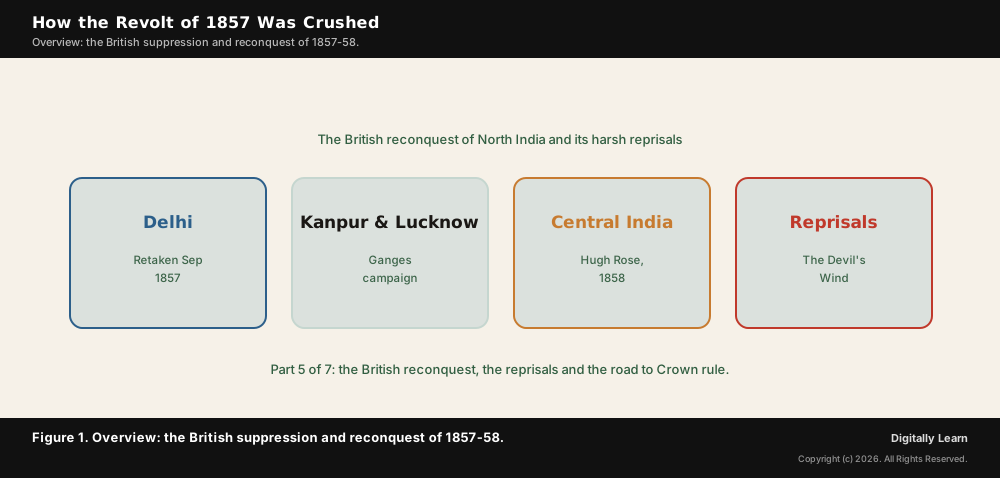
The suppression of the Revolt of 1857 was the long and brutal campaign by which the British reconquered North India between 1857 and 1859. Armed with special martial-law powers, they mounted three converging campaigns, the recapture of Delhi in September 1857, the Ganges campaign that retook Kanpur and Lucknow, and Sir Hugh Rose's Central India campaign that took Jhansi and Gwalior. The reconquest was accompanied by harsh and often indiscriminate reprisals, remembered as the Devil's Wind, and its enormous cost led directly to the abolition of the East India Company and the start of direct Crown rule.
The British Strategy of Reconquest
Martial Law and the Special Acts of May to June 1857
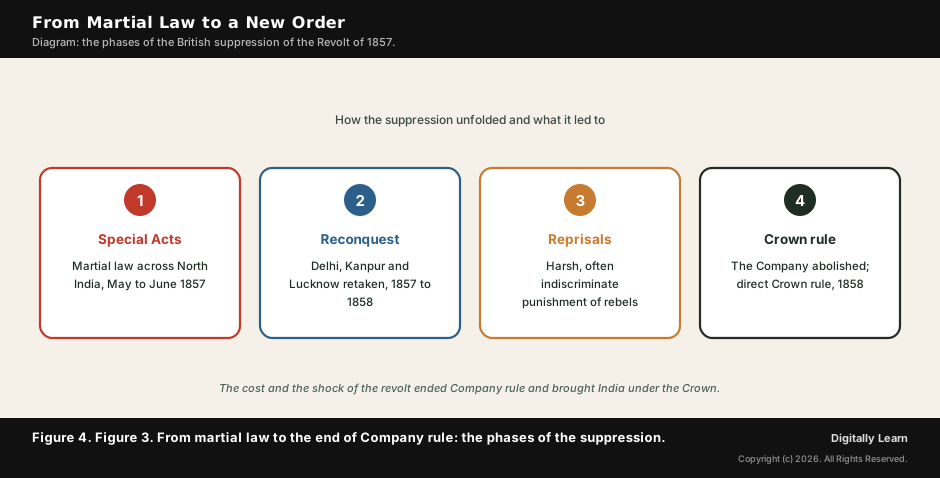
The British did not find the revolt easy to put down. Before sending troops to reconquer the north, the government of Governor-General Lord Canning passed a series of special Acts in May and June 1857 that placed the whole of North India under martial law. The ordinary processes of law were suspended, and military officers and even ordinary Britons were given the power to try and punish anyone suspected of rebellion.
Under these laws the punishment for rebellion was, in effect, death. This legal framework, examined here alongside the reprisals it licensed, shaped the whole character of the reconquest. It explains why the suppression of a revolt whose causes and failure are traced in Part 4 was so severe, and why its memory endured so long.
The Two-Pronged Plan: Punjab and Calcutta Converge on Delhi
The British recognised, as the rebels did, the symbolic value of Delhi, and made its recapture their first priority. They mounted a two-pronged advance: one force moved up from Calcutta into the Gangetic plain, while another came down from the Punjab, which had stayed loyal and supplied fresh troops.
The reconquest was therefore organised as three great campaigns, one against Delhi, one up the Ganges to Kanpur and Lucknow, and one through Central India. The figure below sets out these three British columns, their commanders and their outcomes, and the rest of this article follows each in turn.
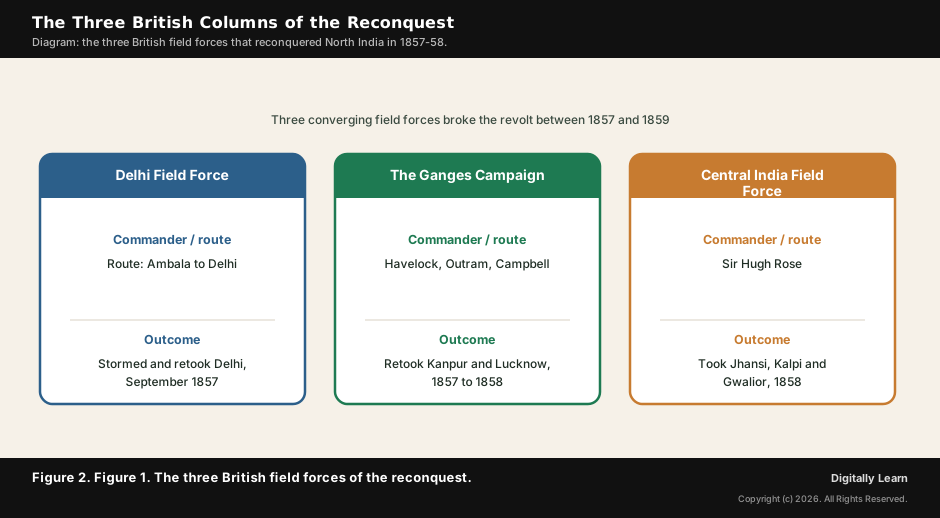
| Campaign | Commander(s) | Route | Key outcome |
|---|---|---|---|
| Delhi Field Force | Advanced from the loyal Punjab | Ambala to Delhi | Delhi stormed and retaken, September 1857 |
| The Ganges Campaign | Havelock, Outram, Campbell | Calcutta and Allahabad to Lucknow | Kanpur and Lucknow retaken, 1857 to 1858 |
| Central India Field Force | Sir Hugh Rose | Mhow to Gwalior | Jhansi, Kalpi and Gwalior taken, 1858 |
The Recapture of Delhi (September 1857)
The Siege of Delhi and the Assault from the Ridge
The struggle for Delhi was the hardest of the war, because rebels from all over North India had gathered to defend the Mughal capital. British forces took up position on the Ridge outside the city in June 1857, but for months they were too few to assault it, and suffered heavily from the rebels and from disease.
Only after a siege train and reinforcements arrived from the Punjab in September could the British storm the walls. The assault began on 14 September 1857 and the fighting inside the city was desperate and street by street, with heavy losses on both sides, before the British gained control.
The main storming column was led by Brigadier-General John Nicholson, who was mortally wounded in the assault and died days later. So heavy were the British casualties in the first days that the attack nearly faltered, and only the arrival of the siege train and the steadiness of the assault columns carried the city. The cost of taking Delhi was a measure of how fiercely the rebels fought for their capital.
The Fall of the Capital and the Capture of Bahadur Shah Zafar
By 20 September 1857 the city was in British hands, and the symbolic heart of the revolt, the seizure of which is described in Part 3, had been retaken. The aged emperor Bahadur Shah Zafar had taken refuge at Humayun's Tomb, where he was captured by Major Hodson.
Hodson shot the emperor's sons in cold blood, and Bahadur Shah was later tried and exiled to Rangoon, bringing the Mughal dynasty to its end. The fall of Delhi was the decisive blow of the war: with the capital gone and the emperor a prisoner, the revolt lost its centre and its symbol, even though hard fighting continued elsewhere for months.
The Campaigns up the Ganges: Kanpur and Lucknow
A Map of the British Reconquest
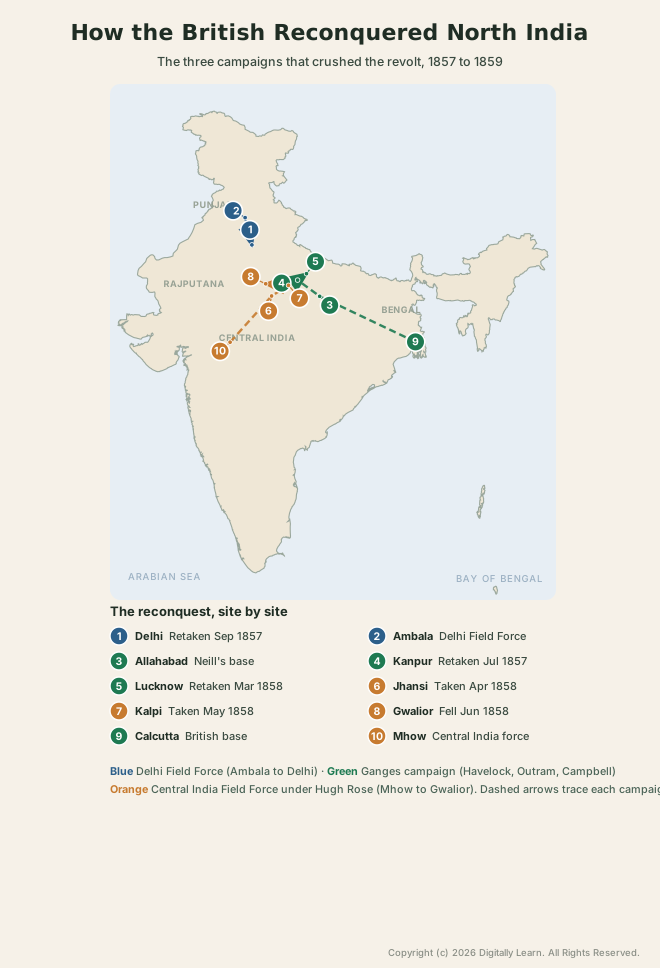
While Delhi was being besieged, a second British effort pushed up the Ganges valley from Calcutta. This was the hardest country to reconquer, because the villages and the people were almost wholly hostile, and the British had to fight their way forward, by contemporary accounts, almost village by village.
The map below traces the three campaigns on real geography, the Delhi Field Force from the Punjab, the Ganges campaign through Allahabad to Kanpur and Lucknow, and Hugh Rose's Central India column. It shows how the loyal Punjab and the river route became the two great axes along which British power was restored.
Havelock and Neill: The Recapture of Kanpur
Before Havelock could arrive, the British garrison at Kanpur under General Wheeler had been besieged in a weak entrenchment. After a negotiated surrender at the Satichaura Ghat, the survivors were killed, and the women and children were later put to death at a house known as the Bibighar. The episode became a byword for the horrors of the war.
General Henry Havelock, supported by the troops of General James Neill from a base at Allahabad, fought a rapid series of actions and retook Kanpur on 17 July 1857. He came too late to save the captives, and the discovery of the killings, above all at the Bibighar, hardened British feeling and shaped the brutality of the reprisals that followed.
The recapture of Kanpur opened the road towards Lucknow, where a British garrison was besieged in the Residency. But Havelock's force, worn down by heat, disease and battle, was too small to hold Kanpur and relieve Lucknow at once, and the campaign in Awadh would prove long and costly, dragging on well into 1858.
The Reliefs and Final Recapture of Lucknow
The siege of the Lucknow Residency became the most famous episode of the war. A first relief by Havelock and Outram in September 1857 cut through to the garrison but was itself then besieged. A second relief by the new commander-in-chief, Sir Colin Campbell, in November 1857 evacuated the defenders but did not yet hold the city.
The first relief reached the Residency on 25 September 1857, and Campbell's column lifted the siege and evacuated the garrison in November 1857. Through it all the defenders had held out under repeated assault since the early summer, after their commander, Sir Henry Lawrence, was killed in the first days of the siege.
The final recapture of Lucknow came only in March 1858, when Campbell returned with a large army, aided by the Gurkha forces of Jang Bahadur of Nepal. The taking of Lucknow broke the back of the revolt in its strongest centre, though resistance in the Awadh countryside continued for months more.
The Reconquest of Awadh (March 1858)
Awadh was the hardest province of all to subdue, for there the revolt had been most popular and most determined. Even after Lucknow fell, the talukdars and their peasants fought on from their forts and villages, and a British official estimated that three-fourths of the adult men of Awadh were in rebellion.
The British broke this resistance by a mixture of force and political guile, hunting the rebels through the countryside while promising loyal landholders the return of their estates. By the time Awadh was finally pacified, around March 1858, the cost in lives and bitterness had been enormous, and the province had been all but reconquered village by village.
The Central India Campaign: Hugh Rose, Jhansi and Gwalior
Hugh Rose's March through Bundelkhand
The third campaign fell to Sir Hugh Rose, who led the Central India Field Force north from Mhow early in 1858. Marching through Bundelkhand in the heat of an Indian summer, he fought a brilliant and rapid campaign against the rebels of the region, winning a series of actions on his way to Jhansi.
Rose's campaign showed how far the tide had turned. With Delhi fallen and the Ganges valley being cleared, the rebels of Central India faced a disciplined and well-supplied force that could move faster than they could concentrate, and their last great effort would end at the fortress of Gwalior.
Jhansi, Kalpi and the Fall of Gwalior (June 1858)
Hugh Rose besieged Jhansi and, after beating off a large relief force under Tantia Tope at the Battle of the Betwa on 1 April 1858, stormed the city on 3 April. Rani Lakshmibai escaped to join the rebels at Kalpi, which fell in May, and in a last bold stroke the rebels seized the great fortress of Gwalior from the loyal Sindhia.
Rose moved at once on Gwalior, and in the fighting there in June 1858 Rani Lakshmibai was killed in battle. The fall of Gwalior is usually taken as the effective end of the revolt as an organised force, though scattered resistance and the pursuit of its last leaders went on into 1859.
The Hunting-Down of Tantia Tope and the End of Resistance (1859)
After Gwalior, Tantia Tope carried on a remarkable guerrilla campaign across Central India for nearly a year, evading the British columns sent against him and keeping the embers of the revolt alive long after its main armies had been destroyed.
His resistance ended only when he was betrayed by a friend, captured and executed in 1859. With his death the last organised resistance was gone, and the British could declare the revolt finally suppressed, nearly two years after the first mutiny at Meerut.
The Reprisals: The Devil's Wind and British Vengeance
Indiscriminate Reprisals: Neill at Allahabad and Kanpur
The reconquest was marked by reprisals of great severity. Inflamed by reports of the killing of British women and children, and licensed by the martial-law Acts, British officers punished not only captured rebels but whole communities suspected of sympathy with the revolt. General Neill became notorious for his harsh measures at Allahabad and Kanpur.
Villages along the line of march were burned, and suspected rebels were hanged in large numbers, often after the most summary of trials. The violence was frequently indiscriminate, falling on the innocent as well as the guilty, and it left a deep and lasting bitterness in the countryside of North India.
Blowing from the Guns and the Theatre of Punishment
The most dreaded punishment was blowing from guns, in which condemned rebels were tied across the mouths of cannon and blown apart. The British used such executions deliberately as a public spectacle, meant to terrify the population into submission and to make an example of those who had defied them.
This theatre of punishment, and the scale of the hangings and burnings, is why the suppression came to be remembered, in a phrase of the time, as the Devil's Wind. The brutality of the reprisals was widely noted even by some Britons, and it shaped Indian memory of 1857 for generations.
The Reaction in Britain: The Cry for Revenge
In Britain, news of the revolt and especially of the killing of women and children at Kanpur produced a wave of public fury. Newspapers printed lurid accounts of the violence, and there were widespread demands for revenge and retribution against the rebels.
This public mood encouraged and excused the severity of the reprisals in India, and it hardened British attitudes towards Indians for a generation. The popular image of 1857 in Britain, of innocent victims and heroic rescuers, would long obscure the Indian experience of the revolt and its suppression.
From Suppression to a New Order
The Cost of Reconquest and the Shift to Crown Rule
The suppression of the revolt was a costly and brutal victory. It had taken nearly two years, vast sums of money and many lives to reconquer a single belt of North India, and it had revealed how fragile the rule of the East India Company really was.
That revelation had a decisive consequence. The British government concluded that India could no longer be governed by a trading company, and in 1858 it abolished the East India Company and took India under direct Crown rule. The Government of India Act of 1858 and the wider consequences of the revolt are the subject of Part 6.
Previous Year UPSC-CSE Questions
Previous Year UPSC-CSE Questions By the end you will be able to draft model answers for the following UPSC questions. Each question carries a collapsible framework showing how to approach it in the exam.
- UPSC Mains 2016 GS-IExplain how the uprising of 1857 constitutes an important watershed in the evolution of British policies towards colonial India.
How to structure the answer in the exam
Introduction: Open with 1857 as the divide between Company rule and Crown rule.
Body (sub-themes to develop):
- The scale of the revolt and the difficulty of its suppression (nearly two years, three campaigns).
- The brutality of the reprisals and the bitterness they left.
- The lesson drawn: a trading company could not safely govern India.
- Watershed in policy: abolition of the Company and direct Crown rule under the Act of 1858 (Part 6).
Conclusion: Conclude that the cost and shock of suppressing 1857 compelled the British to remake the very form of their rule in India.
- UPSC Prelims 2006 GS Paper IWho was the Governor-General of India during the Sepoy Mutiny?
How to approach this Prelims question
Approach: Recall the Governor-General who directed the suppression of 1857, distinct from his predecessor Dalhousie.
Trap to watch: Dalhousie's annexations helped cause the revolt but he left office in 1856; his successor Canning directed the suppression.
Key facts to recall:
- Lord Canning was Governor-General during the Revolt of 1857 and its suppression.
- He later became the first Viceroy under Crown rule.
Answer signal: The Governor-General during the revolt was Lord Canning, option (a).
- UPSC Prelims 2006 GS Paper IWith reference to the revolt of the year 1857, who of the following was betrayed by a friend; captured and put to death by the British?
How to approach this Prelims question
Approach: Recall the fate of each leader during the suppression and pick the one betrayed, captured and executed.
Trap to watch: Nana Sahib escaped to Nepal and Kunwar Singh died of his wounds; only Tantia Tope was betrayed, captured and put to death.
Key facts to recall:
- Tantia Tope: led a long guerrilla resistance across Central India after Gwalior.
- Betrayed by a friend, captured and executed in 1859.
Answer signal: The leader betrayed, captured and put to death was Tantia Tope, option (d).
Sources and Further Reading
- NCERT, Themes in Indian History Part III (Theme 11: Rebels and the Raj)
- Wikipedia: Indian Rebellion of 1857
- Wikipedia: Siege of Delhi (1857)
- Wikipedia: Siege of Lucknow
- Wikipedia: Hugh Rose, 1st Baron Strathnairn
- Wikipedia: Central Indian campaign of 1858
- Wikipedia: Henry Havelock
- Wikipedia: Tatya Tope
Editorial Disclaimer
This article is for UPSC preparation. Verify dates and interpretations against NCERT and standard reference histories before relying on them.