


Overview
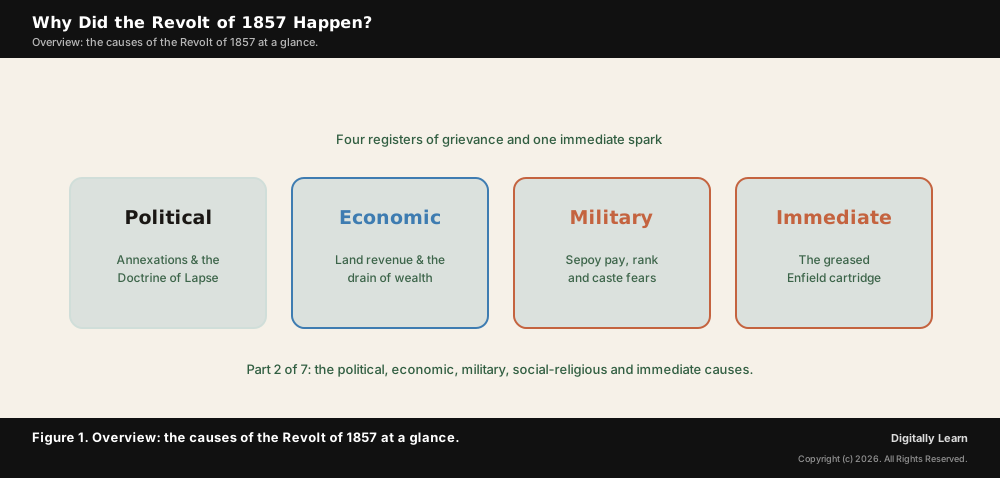
The causes of the Revolt of 1857 were the long-building grievances against East India Company rule that finally erupted into open rebellion. They are usually grouped into four registers, political grievances over annexation and the loss of Indian states, economic grievances over land revenue and the ruin of crafts, military grievances of the sepoys, and social and religious fears of conversion and reform, which together created a deep reservoir of discontent. The immediate cause was the introduction of the new Enfield rifle cartridge, rumoured to be greased with cow and pig fat, which offended Hindu and Muslim sepoys alike and turned accumulated grievance into mutiny.
The Roots of the Revolt: How Company Expansion Bred Discontent
A Reservoir of Grievance Across Indian Society
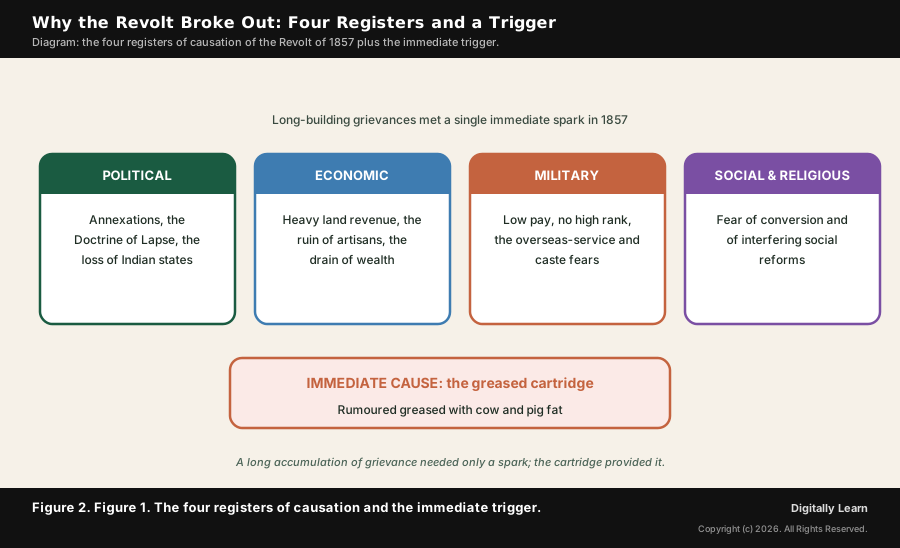
By the middle of the nineteenth century, almost a century of East India Company expansion had touched every section of Indian society, and almost everywhere that touch had bred resentment. Rulers had lost their thrones, landholders their estates, artisans their livelihoods, peasants their savings and soldiers their sense of honour. No single grievance caused the revolt; rather, a deep reservoir of discontent had filled, waiting for a spark.
Historians group these grievances into four broad registers, political, economic, military and social-religious, and add to them the immediate trigger of the greased cartridge. The figure below sets out this structure, which organises the rest of this article. It is worth remembering that these registers overlapped: an annexation was at once a political insult, an economic blow and a wound to local pride.
Political Causes: Annexation, the Doctrine of Lapse and the Subsidiary Alliance
The Subsidiary Alliance and the Eclipse of Indian States
The political undermining of Indian states began in earnest with the Subsidiary Alliance system of Lord Wellesley from 1798. Under it, an Indian ruler had to keep a British force in his territory at his own expense, accept a British Resident at his court, surrender control of his foreign relations, and employ no other Europeans without British consent, receiving British protection in return.
The effect was to reduce one princely state after another to nominal sovereignty under British control. Hyderabad signed first in 1798, followed by Mysore in 1799, the Carnatic and Tanjore, and the Marathas after the defeat of the Peshwa, so that by the early nineteenth century the great Indian powers had been hollowed out from within. A weakened, resentful princely order was one result.
| Policy | Instrument | Examples of states absorbed |
|---|---|---|
| Subsidiary Alliance | British troops at the prince's cost; a Resident; no foreign policy | Hyderabad (1798), Mysore (1799), Carnatic, Awadh's ceded districts |
| Doctrine of Lapse | No recognition of an adopted heir; the state lapses to the Company | Satara (1848), Sambalpur (1849), Jhansi (1853), Nagpur (1854) |
| Annexation on misrule | Charge of maladministration | Awadh (1856), under Nawab Wajid Ali Shah |
The Doctrine of Lapse and the Annexations of Satara, Jhansi and Nagpur
The most resented political instrument was the Doctrine of Lapse, applied vigorously by Lord Dalhousie between 1848 and 1856. Dalhousie was in some ways a great moderniser, who gave India its first railways, the telegraph, a cheap postal system and a Public Works Department, but it was his aggressive annexations that earned him lasting resentment.
Under the doctrine, a dependent state whose ruler died without a natural male heir lapsed to the Company, and an adopted heir, long sanctioned by Hindu law and custom, was not recognised.
By this device the Company annexed Satara in 1848, Jaitpur and Sambalpur in 1849, Udaipur in 1852, Jhansi in 1853 and Nagpur in 1854, adding some four million pounds to its annual revenue. The dispossessed rulers, among them the Rani of Jhansi, whose adopted son was refused the throne, became natural leaders of the revolt when it came. The policy struck not only at princes but at the wider Hindu sense of legitimate succession.
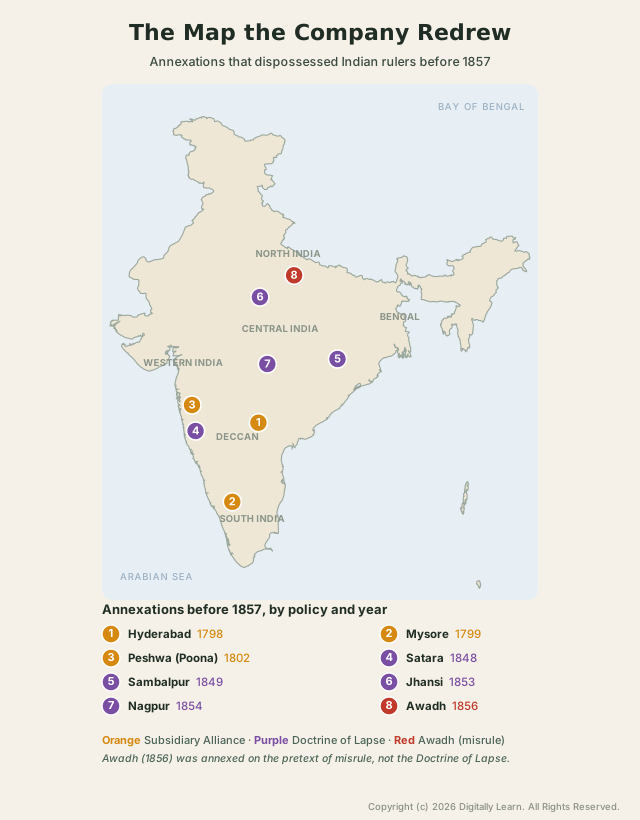
The map below sets out the sweep of these annexations across India, distinguishing the states taken under the Subsidiary Alliance, those that fell to the Doctrine of Lapse, and Awadh, taken separately on the charge of misrule. Together they show how comprehensively the political landscape had been redrawn in the Company's favour by 1856.
The Annexation of Awadh (1856) and the Talukdar Grievance
The annexation of Awadh in 1856 was the most damaging of all, and it is important to note that Awadh was taken not under the Doctrine of Lapse but on the pretext of misrule, for it had heirs. Dalhousie deposed the popular Nawab Wajid Ali Shah and exiled him to Calcutta, an act widely felt as a betrayal, since Awadh had been a loyal ally of the Company for decades.
Annexation was followed by the Summary Settlement of 1856, a land-revenue arrangement that dispossessed the talukdars, the great landholders of Awadh, of many of their estates and over-assessed the land. Because a very large part of the Bengal Army was recruited from Awadh, the resentment of the dispossessed countryside passed directly into the barracks, which is why Awadh became the most rebellious region of all in 1857.
The Humiliation of the Mughal Dynasty
The Company also struck at the symbolic centre of Indian sovereignty, the Mughal dynasty. Though shorn of real power, the Mughal emperor in Delhi still commanded a deep legitimacy across Hindu and Muslim India. Dalhousie ruled that after the death of Bahadur Shah, his successors would lose the imperial title and quit the Red Fort.
This planned extinction of the Mughal name offended a wide public and removed any future focus of loyalty, even as it left the old emperor available, in 1857, as a symbol around which the rebels could rally. The political grievances thus reached from the greatest princely houses down to the idea of legitimate kingship itself.
Economic Causes: Land Revenue, Deindustrialisation and the Drain of Wealth
Exploitative Land-Revenue Settlements and Peasant Distress
Beneath the political grievances lay a deeper economic distress. The Company's overriding aim was to maximise land revenue, and its revenue settlements, whether the Permanent Settlement in Bengal or the ryotwari and mahalwari systems elsewhere, fixed demands so high and so rigidly that peasants who failed to pay lost their land to moneylenders and the state.
Heavy and inflexible land taxes, collected even in years of poor harvest, drove peasants into debt and dispossession across northern India. The countryside that fed the Bengal Army was therefore already in distress before 1857, and the soldiers carried its grievances with them.
The Ruin of Artisans and Traditional Industries
Company policy also ruined India's traditional industries. The flooding of the Indian market with cheap machine-made British textiles, combined with discriminatory tariffs that favoured British goods, destroyed the demand for the handloom cloth that had made India famous, a process later called deindustrialisation.
Skilled artisans and weavers, especially in centres such as Bengal and the Gangetic towns, lost their livelihoods and were pushed back onto an already overcrowded land. The decline of the old courts, which had patronised craftsmen, deepened their ruin, adding a large body of impoverished townsfolk to the reservoir of discontent.
The Drain of Wealth and the Burden on the Countryside
Underlying both was the drain of wealth, the continuous transfer of India's resources to Britain through revenue, the costs of Company administration and the export of profits, without a corresponding return. India's wealth funded the very rule that impoverished it.
The cumulative effect of heavy revenue, ruined crafts and this outward drain was a society under deep economic strain, in which large numbers of people, peasants, artisans and dispossessed gentry alike, had little to lose and a clear sense of who was responsible for their plight.
Military Causes: Grievances of the Bengal Army Sepoy
Pay, Promotion and Racial Discrimination in the Company Army
The Indian sepoy made up the great majority of the Company's army, yet he was treated as an inferior. He was paid less than a British soldier of the same rank, and however able or long-serving, he could rise no higher than the rank of subedar, with all senior commands reserved for Europeans.
This racial discrimination in pay, promotion and respect bred a deep sense of injustice among soldiers who knew that the Company's power rested on their own loyalty. The sepoy was a peasant in uniform, and he carried both the army's grievances and the countryside's into a single explosive combination.
The General Service Enlistment Act (1856) and the Overseas-Service Fear
Specific measures sharpened this discontent. The General Service Enlistment Act of 1856 required new recruits to serve wherever they were sent, including overseas, if ordered. For high-caste Hindu sepoys, crossing the sea meant the loss of caste, so the Act was felt as a direct threat to religion and status.
Earlier, as the Company annexed new provinces, the sepoys had also lost the foreign-service allowance, the extra batta paid for service beyond the Company's older territory, since those lands were now in-territory. Lower real pay, the overseas-service fear and the steady erosion of old privileges combined to make the Bengal Army deeply uneasy by 1857.
The Erosion of the Sepoy's Traditional Privileges
The sepoy's sense of grievance was also bound up with caste and custom. High-caste recruits had long enjoyed certain customary privileges and exemptions, and they read each new regulation, on dress, on service, on the cartridge, as an attack on the religious identity they prized.
Because so many sepoys came from the very regions, especially Awadh and Bihar, where annexation and revenue policy had caused the most distress, the army was uniquely placed to turn the grievances of an entire society into organised armed revolt.
Social and Religious Causes: Fear of Conversion and Reform
Missionary Activity and the Fear of Forced Conversion
A powerful current of fear ran through Indian society that the Company intended to convert the population to Christianity. The growing activity of Christian missionaries, sometimes with official sympathy, and their open criticism of Hindu and Muslim practice, gave this fear a sharp edge.
Measures such as the Religious Disabilities Act of 1850, which allowed a convert to Christianity to keep his rights of inheritance, were read as evidence that the state was tilting the law in favour of conversion. To many Indians, British rule seemed to threaten not only their land and livelihood but their religion and identity.
Social Reform, Sati Abolition and Suspicion of British Intent
The Company's social reforms, however well-intentioned, deepened this suspicion. The abolition of sati in 1829 and the legalisation of widow remarriage in 1856, whatever their merits, were seen by conservative opinion as an unwelcome interference in religion and custom by a foreign power.
Together with the spread of Western education and English law, these reforms convinced many that the British meant to remake Indian society in their own image. The greased cartridge, when it came, fell upon a society already primed to believe the worst about British intentions towards its faith.
The Immediate Cause: The Enfield Rifle and the Greased Cartridge
The Greased-Cartridge Controversy and Religious Sentiment
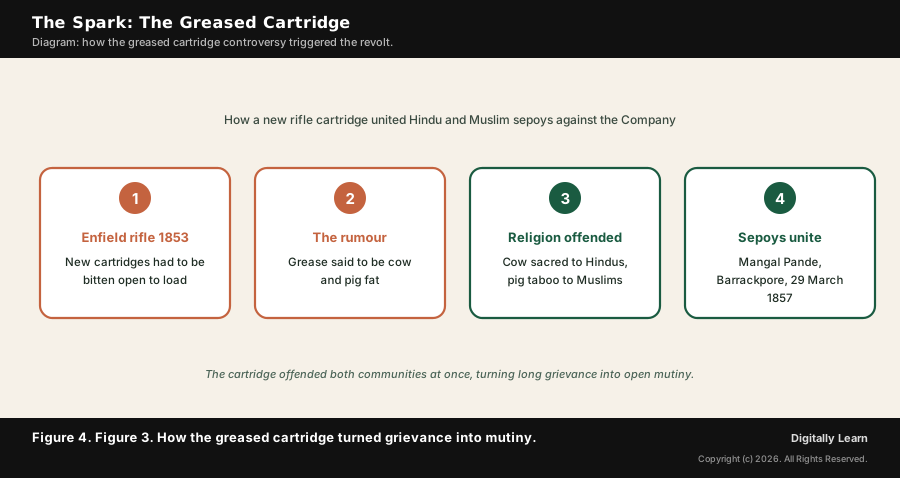
The spark that set this combustible mixture alight was the new Enfield rifle, introduced in 1853. Its cartridge had to be bitten open before loading, and a rumour spread through the sepoy lines that the cartridge was greased with the fat of cows and pigs.
The choice could not have been more provocative: the cow is sacred to Hindus and the pig taboo to Muslims, so the same grease offended both communities at once. What might have been a narrow military complaint thus became a shared religious outrage that united Hindu and Muslim sepoys against the Company, as the figure below sets out.
Mangal Pande and the Barrackpore Incident (March 1857)
The first open act came at Barrackpore near Calcutta. On 29 March 1857, a sepoy of the 34th Bengal Native Infantry, Mangal Pande, attacked his European officers in protest against the cartridges. He was overpowered, and was executed on 8 April 1857; his regiment was disbanded.
Mangal Pande's defiance, though quickly crushed, signalled how explosive the mood had become, and within weeks the sepoys at Meerut would break into open mutiny on 10 May 1857. The long accumulation of political, economic, military and religious grievance had finally found its trigger; the outbreak and its spread are the subject of Part 3.
Previous Year UPSC-CSE Questions
Previous Year UPSC-CSE Questions By the end you will be able to draft model answers for the following UPSC questions. Each question carries a collapsible framework showing how to approach it in the exam.
- UPSC Mains 2013 GS-I“In many ways, Lord Dalhousie was the founder of modern India.” Elaborate.
How to structure the answer in the exam
Introduction: Open with Dalhousie as both a great moderniser and an aggressive annexationist.
Body (sub-themes to develop):
- Modern India: railways, telegraph, postal system, Public Works Department.
- Annexation: the Doctrine of Lapse (Satara, Jhansi, Nagpur) and Awadh on misrule.
- Discontent: dispossessed princes and talukdars, a cause of 1857.
- Assessment: a founder of modern administration whose policies also sowed revolt.
Conclusion: Conclude that Dalhousie shaped modern India both by building it and by provoking the revolt that transformed its rule.
- UPSC Prelims 2018 GS Paper IWhich one of the following statements does not apply to the system of Subsidiary Alliance introduced by Lord Wellesley?
How to approach this Prelims question
Approach: Recall the aims and features of the Subsidiary Alliance and pick the one that does not fit.
Trap to watch: It is a negative question; the Alliance did keep an army at the ally's expense, counter Napoleonic danger and build paramountcy, but it did not secure a 'fixed income'.
Key facts to recall:
- Subsidiary Alliance: British troops at the prince's cost; a Resident; no independent foreign policy.
- Its aims: paramountcy and security, not a fixed Company income.
Answer signal: The statement that does NOT apply is 'to secure a fixed income for the Company', option (c).
Sources and Further Reading
- NCERT, Themes in Indian History Part III (Theme 11: Rebels and the Raj)
- Wikipedia: Causes of the Indian Rebellion of 1857
- Wikipedia: Doctrine of lapse
- Wikipedia: Subsidiary alliance
- Wikipedia: James Broun-Ramsay, 1st Marquess of Dalhousie
- Wikipedia: Wajid Ali Shah
- Wikipedia: Mangal Pandey
- Wikipedia: Pattern 1853 Enfield
Editorial Disclaimer
This article is for UPSC preparation. Verify dates and interpretations against NCERT and standard reference histories before relying on them.