


Overview
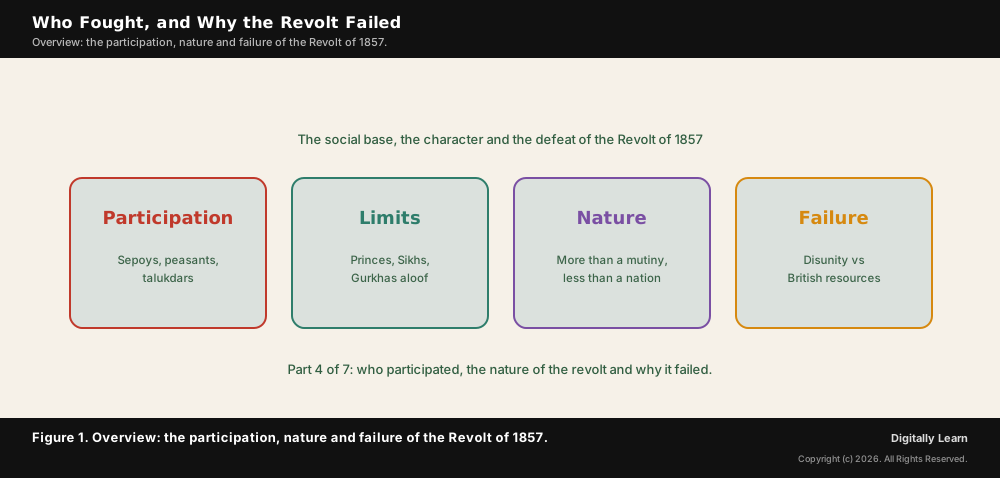
The Revolt of 1857 drew in a remarkably wide cross-section of Indian society, the sepoys of the Bengal Army, the peasants and talukdars of the countryside, ruined artisans and many local and religious leaders, which is why it was far more than a mere mutiny. Yet its participation had clear limits: most princely states, the Sikhs and the Gurkhas, the educated middle class and the big merchants stayed loyal or aloof, and the revolt never spread beyond a belt of North and Central India. This mixture of broad popular support and serious disunity shaped both the nature of the revolt and the causes of its failure.
Who Participated in the Revolt: The Social Base of the Uprising
More Than a Mutiny: The Breadth of Participation
The single most important fact about 1857 is the breadth of its participation. The mutiny of the sepoys, whose outbreak and centres are traced in Part 3, was quickly joined by wide sections of the civilian population, so that in many districts a military rising became a general rebellion against British rule and its local agents.
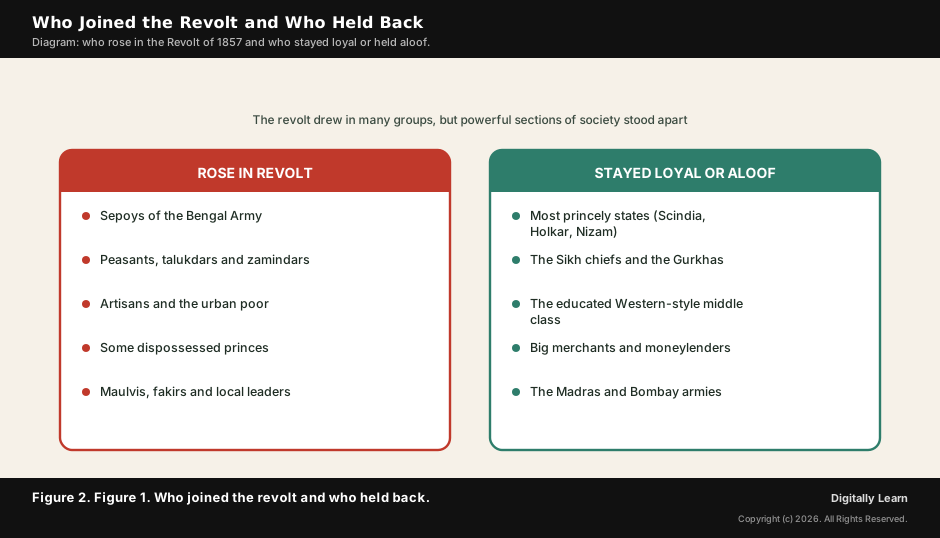
This popular character is what distinguishes 1857 from an ordinary army mutiny. Wherever the sepoys rose, their kinsmen in the villages and the ordinary people of the towns rose with them, drawn by grievances of their own. The figure below sets out who joined the revolt and who, by contrast, held back, a division that runs through the whole of this analysis.
The Sepoys and the Bengal Army at the Core
At the heart of the revolt stood the sepoys of the Bengal Army, drawn very largely from the villages of Awadh and eastern North India. Awadh was so important a recruiting ground that it was called the nursery of the Bengal Army, and the grievances of its countryside passed directly into the barracks.
The sepoys supplied the revolt with trained soldiers, arms and organisation that no purely civilian rising could have matched. Their causes of complaint, examined in the causes covered in Part 2, ran from pay and promotion to the greased cartridge, but their importance in 1857 was that they turned scattered discontent into an armed force capable of seizing cities.
Peasants, Talukdars and Zamindars in Revolt
The deepest popular base of the revolt lay in the countryside, above all in Awadh. There the recent annexation and the Summary Settlement of 1856 had dispossessed the talukdars, the great landholders, and over-assessed the peasants, so that both had reason to resent British rule.
When the revolt came, many talukdars led their armed retainers against the British and rallied to leaders like Begum Hazrat Mahal, while the peasants followed them or rose on their own account. A British officer, Forsyth, estimated that three-fourths of the adult men of Awadh were in rebellion, a measure of how completely the countryside had joined the soldiers.
Artisans, Religious Leaders and the Urban Poor
The revolt also drew in the towns. Artisans and weavers ruined by the flood of British machine-made goods, and the urban poor who had lost the patronage of the old courts, joined the attack on the symbols of Company rule. In the cities the rebels often turned on moneylenders and the rich, burning their account books and ransacking their houses.
Religious leaders of both faiths gave the revolt much of its emotional force. Maulvis such as Ahmadullah Shah of Faizabad, wandering fakirs and Hindu sadhus preached resistance and were widely believed to possess special powers. Their presence shows that 1857 was felt by many as a defence of religion as much as a political revolt.
Who Stayed Away: The Limits of Participation
The Loyal Princes and Chiefs Who Aided the British
Against this broad participation must be set an equally important fact: most of princely India stayed loyal to the British, and several rulers actively helped to crush the revolt. Sindhia of Gwalior, Holkar of Indore, the Nizam of Hyderabad, the Raja of Jodhpur and many others held their territories for the Company, even when their own troops wished to join the rebels.
Two groups were especially decisive. The Sikh chiefs of the Punjab, recently conquered and resentful of the old Mughal and Bengal-army order, gave the British men and money, and the Gurkhas of Nepal, under Jang Bahadur, sent an army that helped retake Lucknow. Without these loyal allies the British task would have been immeasurably harder. The table below sets out the principal loyal powers.
The Principal Loyal Powers of 1857
The pattern of loyalty was not accidental. Rulers who had been confirmed in their thrones, chiefs with grievances against the old order, and groups the British had cultivated all had reasons to stand aside or to help. The table summarises who stayed loyal and why their support mattered to the outcome.
It is worth noting that loyalty often ran against the wishes of the troops. At Gwalior the Sindhia stayed loyal even as his own contingent went over to the rebels and seized the fort, and similar tensions ran through other states. The princes' calculation was that their thrones were safer with the British than with a revolt that looked back to a Mughal or Maratha overlordship.
| Loyal power | Region | Why their loyalty mattered |
|---|---|---|
| Sindhia of Gwalior | Central India | Held a key state in the revolt belt; his troops were kept in check |
| Holkar of Indore | Central India | Kept the Malwa region from joining the rising |
| Nizam of Hyderabad | The Deccan | Kept the whole South largely quiet |
| The Sikh chiefs | Punjab | Supplied troops and money; the Punjab became a base |
| The Gurkhas (Jang Bahadur) | Nepal | Sent an army that helped reconquer Awadh |
| The Rajput princes | Rajputana | Held the west and north-west for the British |
The Regions That Remained Quiet: Punjab, Bengal and the South
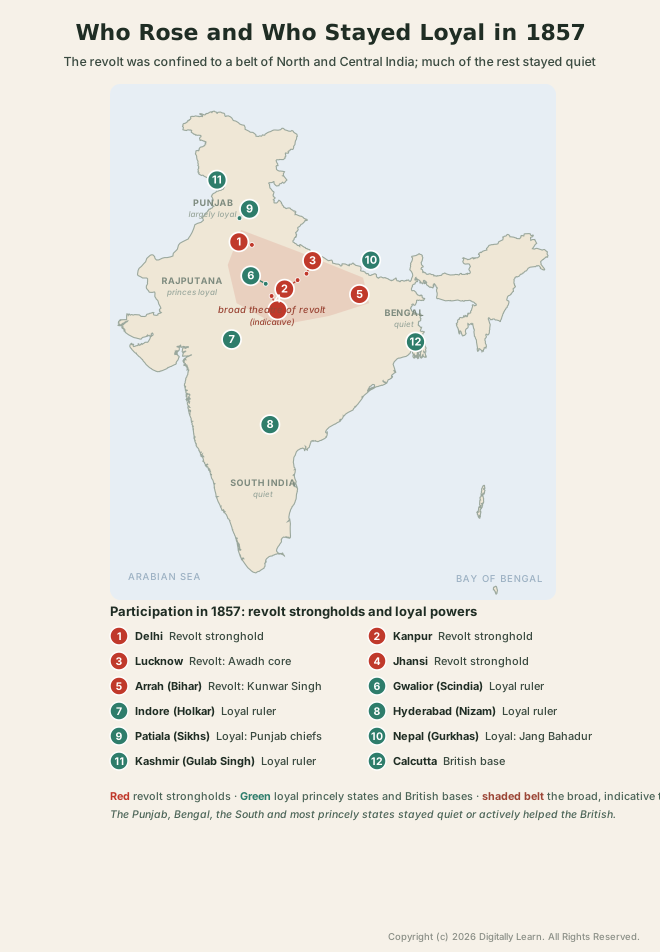
The revolt was also geographically limited. The recently annexed Punjab stayed firmly in British hands and became the base from which Delhi was retaken. Bengal, the oldest British possession, and the whole of South India remained almost untouched, as did most of western and eastern India.
This silence of so much of the country was a grave weakness for the rebels. The British could draw troops, revenue and supplies from the loyal provinces and concentrate them against the narrow belt in revolt. A rising confined to the Ganga valley and central India could be encircled and crushed in a way that an all-India revolt could not.
The Educated Middle Class and the Merchant-Moneylender Classes
Two influential social groups held aloof. The small but growing Western-educated middle class, the product of the new English schools and colleges, saw little to gain from a revolt that looked back to the old order, and many of them still hoped that British rule would bring modern reform.
The big merchants and moneylenders were, if anything, hostile to the revolt. They had prospered under Company rule, their wealth was tied to it, and they were often the very people the rebels attacked as local oppressors. Their support for the British, in money and intelligence, was an important and often overlooked reason for the revolt's defeat.
The Geography of Participation: Storm Centres and Silent Zones
A Map of Who Rose and Who Stayed Loyal
The contrast between participation and loyalty is best seen on a map. The revolt formed a broad belt across North and Central India, from Delhi and the Doab through Awadh and Bundelkhand to western Bihar, while a loyal periphery of princely states and pacified provinces hemmed it in on every side.
The map below marks the revolt strongholds in red against the loyal princes and British bases in green, with the broad theatre of revolt shaded as an indicative belt. It shows at a glance why the rising, for all its popular depth, could be contained: it never broke out of its core region into the loyal lands around it.
The Nature of the Revolt: How Should 1857 Be Understood?
More Than a Sepoy Mutiny: The Popular Character
The first question about the nature of 1857 is whether it was a mere sepoy mutiny or something larger. The breadth of participation settles it: the rising of the soldiers was everywhere joined by peasants, talukdars, artisans and townsfolk, so that in Awadh and the Doab it became a genuine popular revolt against British rule. It was marked, too, by a striking Hindu-Muslim unity, as both communities fought side by side under the shared banner of the Mughal emperor.
To call 1857 only a mutiny is therefore to miss most of what happened. The civil rebellion was in many places wider and more stubborn than the military mutiny that sparked it, and it is the popular character, drawn out in the centres of Part 3, that gives the revolt its real weight in Indian history.
The Limits of Its National Character
Yet the revolt was not a national movement in the modern sense. It had no all-India scope, no common political programme and no idea of a single Indian nation; the loyalty of the Sikhs, the Gurkhas and most princes shows that older identities of region, dynasty and community still counted for more than any shared nationhood.
Its leaders fought for particular causes, a lost throne, a dispossessed estate, a threatened religion, rather than for a common India. For this reason most historians see 1857 as a great popular revolt with strong anti-British feeling, but not yet the first war of national independence that later nationalists claimed, a debate examined fully in Part 7.
A Backward-Looking Restoration, Not a Forward Programme
The nature of the revolt is revealed too by what the rebels wanted. Where British rule collapsed, they tried not to build something new but to restore the old order, the Mughal emperor at Delhi, the Peshwa at Kanpur, the Nawab's house at Lucknow, looking back to the eighteenth-century world that annexation had destroyed.
This backward-looking character was a source of both strength and weakness. It gave the revolt legitimacy and emotional power, but it offered no modern programme of reform or unity that could hold its many groups together. The revolt could destroy British authority in a district, but it could not yet imagine a new India to put in its place.
Why the Revolt of 1857 Failed: The Causes of Defeat
A Widespread Revolt That Still Failed
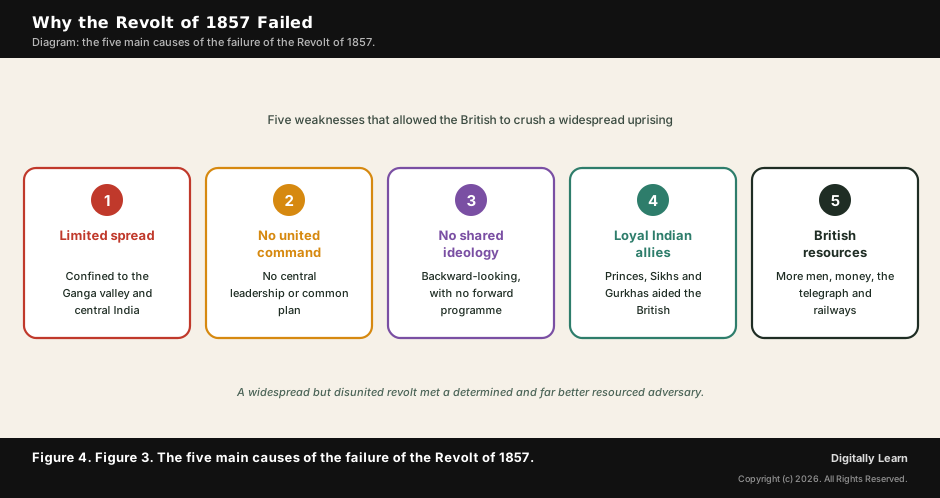
Despite its breadth and ferocity, the revolt was completely defeated within about eighteen months. Its failure was not the result of any single cause but of several weaknesses that together gave the British a decisive advantage. The figure below sets out the five principal reasons, which the sub-sections then examine.
It is worth stressing that the British, under the Governor-General Lord Canning, won not only by force of arms but by exploiting the rebels' divisions. They broke the unity of the countryside by promising loyal landholders their estates, and they drew on the loyal provinces for the men and money that the rebels could not match.
Limited Territorial and Social Spread
The first cause of failure was the revolt's limited spread. It was confined to a belt of North and Central India, while the Punjab, Bengal, the South and most of the west stayed quiet. This allowed the British to concentrate their forces against a single region instead of facing a rising everywhere at once.
The social limits mattered as much as the geographic ones. Because the educated middle class and the merchant classes held back, the revolt lacked modern leadership, finance and a wider organising idea. It remained a revolt of the sepoy, the peasant and the dispossessed prince, powerful but narrow.
The Absence of Unified Leadership and a Common Plan
The revolt had no central leadership and no common plan. Bahadur Shah at Delhi was a nominal figurehead, and the real leaders, Nana Sahib, Begum Hazrat Mahal, Rani Lakshmibai, Kunwar Singh, fought their own campaigns in their own regions with little coordination between them.
Each centre therefore rose and fell more or less alone, allowing the British to defeat them one by one. There was no single commander, no shared strategy and no agreed political aim, so that the very localism that gave the revolt its popular roots also denied it the unity needed to win.
The Lack of a Shared Ideology and Forward Vision
Bound up with this was the absence of a shared ideology. The rebels were united by what they opposed, the firangi and his rule, but not by any common vision of what should replace it. Their aim was to restore a vanished past, and the backward-looking programme could not bind Marathas, Mughals, Rohillas and Awadh talukdars into a lasting common cause.
Without a forward-looking idea of nation or reform, the revolt could not generate the sustained unity that a long war demanded. This is the deepest difference between 1857 and the later national movement, which would be held together precisely by a shared idea of India.
Loyal Indian Allies and the Superiority of British Resources
Finally, the British enjoyed a decisive superiority of resources and allies. The loyal princes, the Sikhs and the Gurkhas supplied troops and secure bases, while the loyal provinces yielded the revenue and supplies that fed the reconquest. The rebels, by contrast, were short of money, arms and trained officers.
British technology and organisation sharpened the advantage. The telegraph carried orders faster than the rebels could march, the new railways and steamers moved troops quickly, and fresh forces were brought in from Britain and elsewhere. Against this concentrated power a disunited and localised revolt could not, in the end, prevail. The suppression itself is the subject of Part 5, and the consequences of the defeat the subject of Part 6.
Previous Year UPSC-CSE Questions
Previous Year UPSC-CSE Questions By the end you will be able to draft model answers for the following UPSC questions. Each question carries a collapsible framework showing how to approach it in the exam.
- UPSC Mains 2016 GS-IExplain how the uprising of 1857 constitutes an important watershed in the evolution of British policies towards colonial India.
How to structure the answer in the exam
Introduction: Open with 1857 as the divide between Company rule and Crown rule.
Body (sub-themes to develop):
- Scale and popular base: sepoys joined by peasants, talukdars and townspeople.
- Limits: loyal princes, Sikhs, Gurkhas and quiet provinces; no national idea.
- Why it shook the British: a popular revolt, not a mere mutiny, that nearly broke their power.
- Watershed in policy: end of the Company, Crown rule under the Act of 1858, army reorganisation and conciliation of princes (Part 6).
Conclusion: Conclude that the revolt's popular scale and its ultimate failure together compelled the British to remake the structure of their rule.
- UPSC Prelims 2005 GS Paper IWhich one of the following territories was not affected by the Revolt of 1857?
How to approach this Prelims question
Approach: Recall the storm centres of the revolt and pick the place that lay outside the revolt belt.
Trap to watch: Jhansi, Jagdishpur (Kunwar Singh) and Lucknow were all major revolt centres; Chittor, in loyal Rajputana, was not affected.
Key facts to recall:
- Revolt belt: Delhi, Awadh, Bundelkhand (Jhansi), Bihar (Jagdishpur).
- Rajputana and its princes stayed loyal; Chittor was unaffected.
Answer signal: The territory not affected was Chittor, option (b).
- UPSC Prelims 2006 GS Paper IWho was the Governor-General of India during the Sepoy Mutiny?
How to approach this Prelims question
Approach: Recall the Governor-General in office in 1857, distinct from his predecessor Dalhousie.
Trap to watch: Dalhousie, whose annexations helped cause the revolt, had left office in 1856; his successor Canning was Governor-General during 1857.
Key facts to recall:
- Lord Canning was Governor-General during the Revolt of 1857.
- He later became the first Viceroy under Crown rule.
Answer signal: The Governor-General during the revolt was Lord Canning, option (a).
Sources and Further Reading
- NCERT, Themes in Indian History Part III (Theme 11: Rebels and the Raj)
- Wikipedia: Indian Rebellion of 1857
- Wikipedia: Causes of the Indian Rebellion of 1857
- Wikipedia: Jung Bahadur Rana
- Wikipedia: Charles Canning, 1st Earl Canning
- Wikipedia: Jayajirao Scindia
- Wikipedia: Begum Hazrat Mahal
- Wikipedia: Bengal Army
Editorial Disclaimer
This article is for UPSC preparation. Verify dates and interpretations against NCERT and standard reference histories before relying on them.