


Overview
The airfare cap, viability gap funding and the successive rounds
UDAN, Ude Desh ka Aam Naagrik, is the Regional Connectivity Scheme of the Ministry of Civil Aviation, a market-based plan under the National Civil Aviation Policy of 2016 to make regional air travel affordable and to revive unserved and under-served airports.
UDAN, short for Ude Desh ka Aam Naagrik and formally the Regional Connectivity Scheme (RCS), is a flagship plan of the Ministry of Civil Aviation to make air travel affordable for ordinary citizens and to connect the country's unserved and under-served airports. It is a key component of the National Civil Aviation Policy released in 2016. UDAN works through a market-based model: airlines bid for regional routes, a share of the seats is sold under an airfare cap, and the government bridges the shortfall with Viability Gap Funding drawn from a Regional Connectivity Fund. Over successive rounds it has reached new airports, helipads and water aerodromes, and it now has dedicated tracks such as international UDAN and Krishi UDAN.
What UDAN Is: The Regional Connectivity Scheme for Affordable Air Travel
A market-based scheme to make regional flying affordable
UDAN, short for Ude Desh ka Aam Naagrik, let the common citizen fly, is the brand name of the Regional Connectivity Scheme, or RCS, of the Ministry of Civil Aviation. Its purpose is twofold: to make air travel affordable for ordinary people in smaller towns, and to revive airports that carry few flights or none at all. The scheme captures a simple idea, that a citizen in slippers should be able to board a plane.
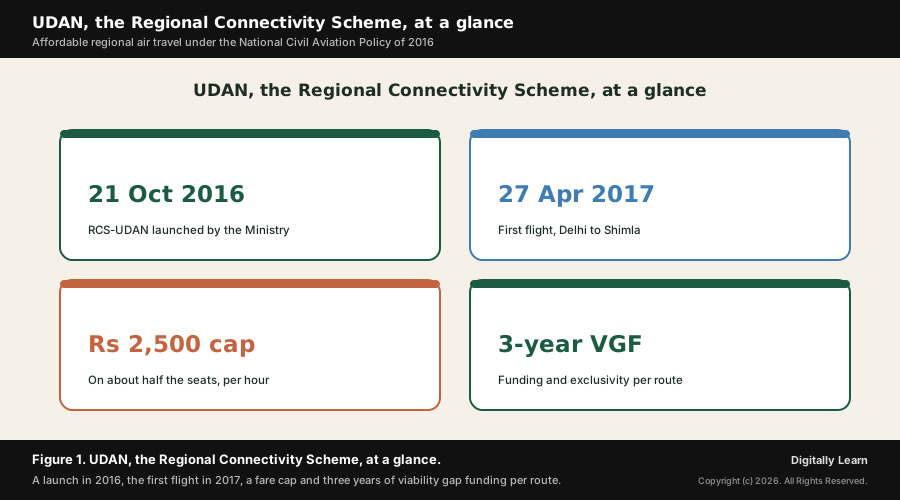
UDAN is a key part of the National Civil Aviation Policy released on 15 June 2016, the first integrated civil-aviation policy of independent India. The scheme document itself was launched on 21 October 2016, and the first UDAN flight was flagged off on 27 April 2017 on the Delhi to Shimla route. From that single hill route the network has grown across the country, which is why the scheme has stayed a live subject for the examination.
What makes UDAN distinctive is that it is market-based rather than a simple subsidy. The government does not run the flights itself; instead airlines compete for routes, agree to sell part of the seats under a price cap, and receive a time-limited payment to cover the shortfall on routes that would otherwise lose money. The figure below sets out the headline facts before the rest of the article unpacks how the model works.
Why UDAN Is in the News: A Modified Scheme and Nine Years of Operation
The Modified UDAN approval and the nine-year record
Why it matters now is that the government has moved to deepen the scheme as it completes its first phase. The Union Cabinet approved a Regional Connectivity Scheme, Modified UDAN, with a total outlay of about Rs 28,840 crore over ten years, aiming to add 120 new destinations and to carry about 4 crore passengers, with 100 unserved airstrips and 200 helipads in hilly, remote, island and aspirational districts.
The renewal lands on a substantial base. According to a Press Information Bureau account, 663 routes had been operationalised across 95 airports, heliports and water aerodromes as on 28 February 2026, carrying about 1.62 crore passengers. These figures move with each new award and each route that opens or closes, so they are read here as an attributed, dated record, and the gap between routes awarded and routes still flying is part of the debate examined below.
Understanding the Significance of UDAN for Access, Airports and the Economy
Affordable access, revived airports and regional growth
What is the significance of UDAN lies first in affordable access. By capping the fare on a share of the seats, the scheme puts flying within reach of middle-income travellers in towns that the big airlines had ignored, turning air travel from a metro luxury into a more widely available service and saving long hours on road and rail.
Its second significance is the revival of idle airports. India had many airports, airstrips and helipads built over the decades that carried no scheduled flights. UDAN gives airlines a reason to fly to them and the states a reason to upgrade them, so dormant infrastructure is brought back into use and the wider airport network is strengthened, complementing the broader expansion of aviation capacity.
Its third significance is regional growth. A new air link can open a remote district to tourism, trade, investment and faster medical access, and it knits far-flung places into the national economy. By spreading connectivity beyond the metros, UDAN supports more balanced regional development and gives smaller centres a stake in the country's growth.
How the UDAN Model Works: Fare Cap, Viability Gap Funding, Fund and Bidding
The airfare cap and Viability Gap Funding, explained mechanically
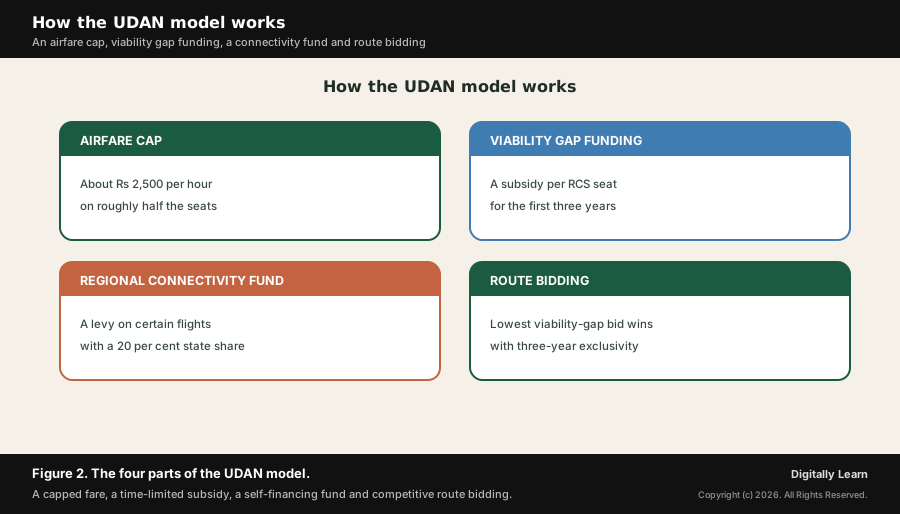
The first pillar of the model is the airfare cap. On each route, roughly half the seats are reserved as RCS seats sold under a price ceiling, set at about Rs 2,500 per hour of flight for a fixed-wing aircraft, graded by distance. The remaining seats sell at market price. A fixed-wing flight carries a minimum of nine and a maximum of forty such capped seats, so the cap covers a defined block, not the whole aircraft.
The second pillar is Viability Gap Funding (VGF), the device that makes a capped-fare route worth flying. Because the capped seats and thin demand would otherwise leave the route loss-making, the government pays the operator a subsidy per RCS seat to bridge the gap between costs and the capped revenue. This VGF is paid for the first three years, on the expectation that demand will have built up enough by then for the route to stand on its own.
Together the two pillars share the risk of a new route. The traveller gets a predictable, capped fare; the airline is protected from early losses by the subsidy; and the support is deliberately temporary, so that public money seeds a route rather than funding it forever. The figure below sets out the four moving parts of the model before the next sub-section explains where the money comes from.
The Regional Connectivity Fund, concessions and competitive bidding
Where does the subsidy come from? The central share of VGF is met from a Regional Connectivity Fund (RCF), a pool created by a small levy on certain flights. The levy falls on departures of larger aircraft on busy trunk routes between major cities, while North-East, hilly-state and island departures are exempt. The design is self-financing: the busiest part of the sector cross-subsidises thin regional routes, drawing on the industry rather than on general taxation alone.
The states and airport operators add further concessions. State governments contribute a 20 per cent share of the VGF for routes within their territory, a lighter 10 per cent for the North-Eastern states and the Union Territories, and they provide land, security and utilities at the airport. Airport operators waive landing and parking charges and levy navigation charges at a discounted rate. These concessions lower the operator's costs and stretch the public money further.
The fourth pillar is competitive bidding. Routes are not handed out; airlines bid for them in rounds, and the operator that asks for the lowest Viability Gap Funding, ideally zero, wins the route. The winner is then granted the route on an exclusive basis for three years, so that it can build the market without a rival undercutting it. This reverse-auction design keeps the subsidy bill down and rewards airlines that can fly a route most efficiently.
Reviving Airports: Unserved and Under-Served, Helipads and Water Aerodromes
Unserved versus under-served airports and the revival effort
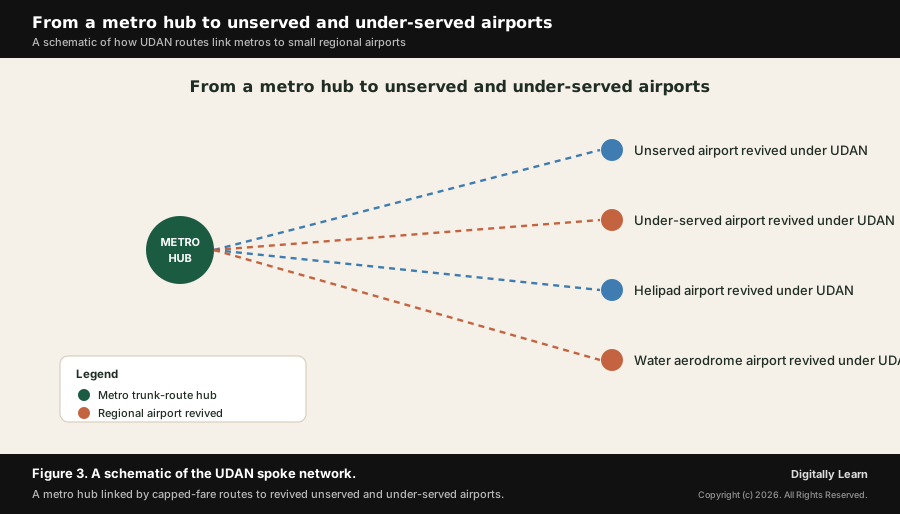
UDAN draws a careful distinction between two kinds of neglected airport. An unserved airport is one with no scheduled flights at all, often an airstrip or a small terminal that had fallen out of use. An under-served airport is one with very few scheduled flights, well below what its catchment could support. The scheme is built to bring both back into the network by giving airlines a reason to fly there.
To do this UDAN works alongside the upgrading of infrastructure. Many small airports needed runways, terminals, lighting and navigation aids before they could safely take scheduled flights, so the scheme is paired with airport development by the implementing agency and the states. As routes are awarded, dormant airstrips are revived, and the scheme has reached beyond conventional airports to helipads for hilly and remote areas and to water aerodromes for seaplane operations.
The revival is therefore as much about the airport network as about the flights themselves. By turning idle assets into working airports, UDAN widens the map of places that can be reached by air, and it feeds the larger national effort to expand the number of operational airports across the country. The schematic below shows how a metro hub links out to these revived regional airports.
The Rounds and Variants: From UDAN 1.0 to International and Krishi UDAN
UDAN 1.0 to 5.0 and what each round added
UDAN has been rolled out in successive rounds, each widening the scheme. UDAN 1.0 in 2017 awarded the first batch of fixed-wing routes to unserved and under-served airports. UDAN 2.0, later in 2017, added helipads for the first time and announced many more unserved airports, extending the scheme to hard-to-reach terrain.
UDAN 3.0 in 2019 broadened the design further, adding tourism routes in coordination with the tourism ministry, seaplane operations to connect water aerodromes, and a focus on the North-East. UDAN 4.0 in 2020 prioritised remote, hilly and island regions, including new links to the islands of Lakshadweep, and encouraged the use of Indian-made aircraft and helicopters on these routes.
UDAN 5.0 in 2023 shifted the focus to larger aircraft, opening the scheme to Category-2 and Category-3 planes and easing the earlier limit on how far a single UDAN sector could run, so that longer regional routes became eligible. Read together the rounds show a steady widening, from a handful of fixed-wing routes to a network spanning helipads, water aerodromes, islands and bigger aircraft. The figure below sets out the sequence.
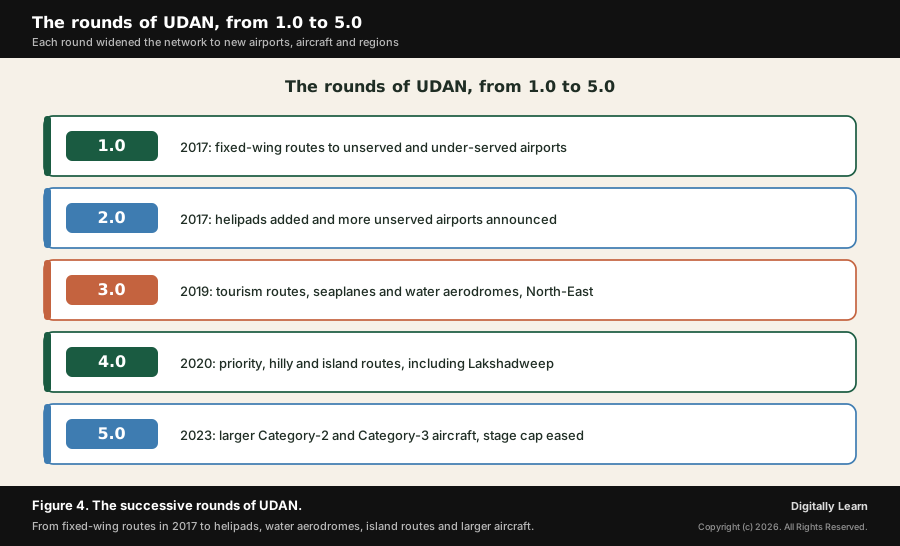
| Round | Year | What it added |
|---|---|---|
| UDAN 1.0 | 2017 | First fixed-wing routes to unserved and under-served airports |
| UDAN 2.0 | 2017 | Helipads added and many more unserved airports announced |
| UDAN 3.0 | 2019 | Tourism routes, seaplanes and water aerodromes, North-East focus |
| UDAN 4.0 | 2020 | Priority, hilly and island routes, including Lakshadweep |
| UDAN 5.0 | 2023 | Larger Category-2 and Category-3 aircraft, stage-length cap eased |
Reading the rows together shows the direction of travel: each round did not merely add routes but extended the kinds of place and aircraft the scheme could reach, turning a single-product scheme into a flexible family of connectivity efforts.
International UDAN and Krishi UDAN for cross-border routes and farm produce
Beyond the numbered rounds, UDAN has grown dedicated variants. International UDAN extends the connectivity idea to selected cross-border routes, with states such as those in the North-East and the south sponsoring international links from their airports, so that regional airports gain a direct line to nearby foreign destinations rather than only to domestic metros.
The other major variant is Krishi UDAN, which uses air transport to move farm produce. Launched first in 2020 and renewed as Krishi UDAN 2.0, announced on 27 October 2021, it carries perishable agricultural goods, horticulture, fishery and dairy, from hilly areas, the North-Eastern states and tribal districts to markets, with the implementing agency waiving landing, parking and navigation charges for qualifying cargo flights. It runs as a convergence effort across several ministries.
These variants show how the core UDAN idea, a capped, supported, bid-out route, has been adapted to new purposes: international links for border regions and an air-cargo channel for farmers. They keep the scheme relevant to the wider goals of tourism, exports and farm incomes, and they are a frequent source of examination questions on how a single scheme can serve many ends.
The Institutional Architecture: Ministry, Implementing Agency, Regulator and States
Who runs UDAN and under what authority
UDAN is run not by one body but by a chain of institutions. At the top is the Ministry of Civil Aviation, the nodal ministry that frames the scheme, sets each round and decides the policy parameters such as the fare cap and the funding rules. The scheme sits inside the broader National Civil Aviation Policy, so the ministry aligns it with the wider goals for the sector.
The day-to-day work is done by the Airports Authority of India (AAI), which acts as the implementing agency. The AAI runs the bidding rounds, issues the letters of award to the winning airlines, administers the Viability Gap Funding and the Regional Connectivity Fund, and coordinates the airport upgrades that a new route needs. It is the operational engine that turns the policy into flights on the ground.
Two further sets of actors complete the architecture. The Directorate General of Civil Aviation (DGCA) is the aviation regulator: it licences the operators and aircraft, clears the routes and airports for scheduled service, and oversees safety and standards, so no UDAN flight runs outside the regulatory framework. The state governments are partners that provide land, security and utilities and share the funding. The figure below sets out who does what.
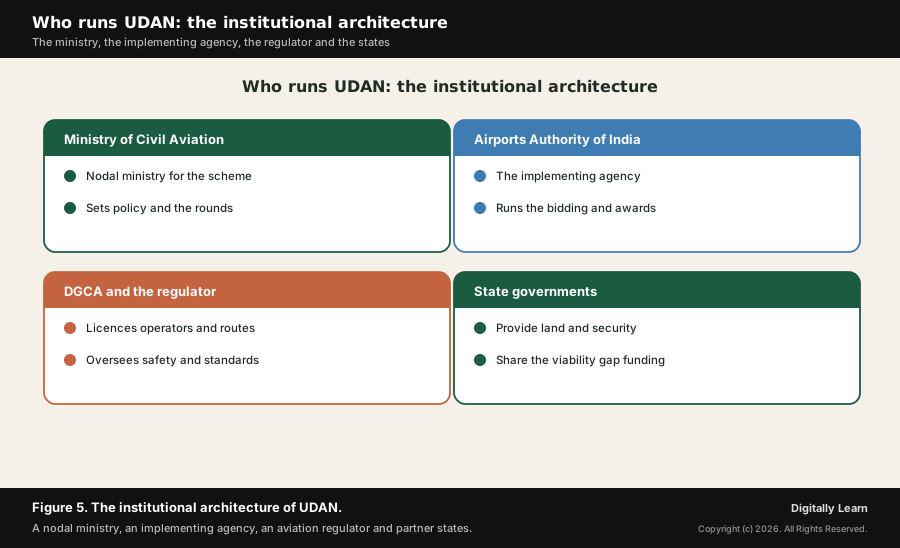
Challenges and Debates: Route Sustainability, Viability and Demand
Discontinued routes, airline viability and the awarded-versus-operational gap
A balanced reading must weigh the challenges the scheme has met. The most discussed is route sustainability after the three-year Viability Gap Funding period ends. Some routes that opened with support have not built up enough demand to survive on their own and have been discontinued once the funding lapsed, which raises the question of whether three years is long enough for a thin market to mature. This is set out here as a documented concern, neither dismissed nor overstated.
A related challenge is airline viability. Several smaller carriers that won UDAN routes have struggled financially or stopped operating, and small regional aircraft are costly to run on thin routes, so the supply of willing and stable operators is itself a constraint. There is also a recurring gap between routes awarded in the bidding and routes actually flying, because not every award translates into a lasting service once costs, aircraft and demand are tested in practice.
Further difficulties lie in infrastructure and demand. Upgrading and maintaining small airports, terminals and navigation aids takes time and money, and some revived airports see low passenger numbers that make even a supported route hard to sustain. None of this denies the scheme's gains; rather it frames the central policy question of how to convert seeded routes into self-sustaining ones, which the way forward must address.
The Way Forward: From Seeded Routes to a Self-Sustaining Network
Demand-building, viable aircraft and durable airport infrastructure
The first task ahead is to turn supported routes into self-sustaining ones. That means stimulating demand on a new route during its funded years, through better scheduling, links to tourism and local promotion, so that enough traffic builds up to keep the route flying once the Viability Gap Funding ends. The renewed Modified UDAN, with its larger outlay and longer horizon, is itself a step toward giving routes more time to mature.
A second task is the supply of viable operators and aircraft. A healthier base of regional airlines and a steady supply of suitable small aircraft, including Indian-made types, would reduce the risk of routes collapsing when a single carrier fails. Stable financing and predictable rules help airlines plan, which in turn narrows the gap between routes awarded and routes that actually fly.
The third task is durable airport infrastructure and integration. Sustained investment in small-airport terminals, runways and navigation aids, and tighter coordination with the wider expansion of the airport network, would let revived airports handle growing traffic. Taken together these steps point the way from a scheme that seeds routes toward a regional network that can stand largely on its own, which is the test by which UDAN will ultimately be judged.
UPSC Relevance and Exam Focus
Where UDAN fits in the UPSC-CSE syllabus
This topic maps most directly to General Studies Paper III: infrastructure, including civil aviation, and the related parts of the economy, and it also serves General Studies Paper II as a government welfare and connectivity scheme. It connects to themes of inclusive growth, regional development and public-private models in infrastructure that recur across the syllabus.
For Prelims, hold the high-yield facts: UDAN is the Regional Connectivity Scheme under the National Civil Aviation Policy of 2016; the nodal ministry is Civil Aviation and the implementing agency is the Airports Authority of India; the fare cap is about Rs 2,500 per hour on a share of seats; Viability Gap Funding runs for three years from a Regional Connectivity Fund levied on certain flights; and the variants include international UDAN and Krishi UDAN.
For Mains, the recurring framing is to explain the need to expand regional air connectivity, to describe the UDAN model and to assess its achievements and limits. A strong answer treats UDAN as a market-based connectivity scheme: it explains the fare cap, the funding and the bidding mechanically, weighs the real gains in access and airport revival against the debates over route sustainability and viability, and links the scheme to balanced regional development.
Recurring linked concepts an aspirant should keep in working memory:
- National Civil Aviation Policy 2016: The parent policy of which UDAN is a key component, India’s first integrated civil-aviation policy.
- Viability Gap Funding: The time-limited subsidy that makes a capped-fare regional route worth flying, met from the Regional Connectivity Fund.
- Krishi UDAN: The air-cargo variant for moving perishable farm produce from hilly, North-Eastern and tribal areas.
- Airports Authority of India: The implementing agency that runs the bidding, the awards and the funding under the Ministry of Civil Aviation.
A common Prelims trap is to confuse the nodal ministry with the implementing agency, or to misstate the funding source; hold that the Ministry of Civil Aviation frames the scheme, the Airports Authority of India implements it, and the central subsidy comes from the Regional Connectivity Fund.
A common Mains trap is to present UDAN only as a success story. Its exam value lies in a balanced judgment: the genuine gains in affordable access and airport revival set beside the documented challenges of route discontinuation after the funding period, airline viability, the awarded-versus-operational gap and thin demand at small airports.
Previous Year UPSC-CSE Questions By the end you will be able to draft model answers for the following UPSC questions. Each question carries a collapsible framework showing how to approach it in the exam.
- UPSC Mains 2024 GS-IIIExplain why regional air connectivity needs to be expanded in India, discuss the UDAN Scheme and assess its achievements.
How to structure the answer in the exam
Body (sub-themes to develop):
- The need to expand regional air connectivity: air travel had been confined to metros and to higher-income travellers, many airports and airstrips lay idle, and remote regions were cut off from tourism, trade, investment and faster medical access, so wider air access serves inclusive and balanced regional development.
- The UDAN model: the airfare cap on a share of the seats, Viability Gap Funding for the first three years, the Regional Connectivity Fund met by a levy on certain flights, the state and airport concessions, and competitive reverse-bidding with three-year route exclusivity.
- The reach of the scheme: the successive rounds from UDAN 1.0 to 5.0 adding helipads, water aerodromes, island and longer routes, and the variants of international UDAN and Krishi UDAN, implemented by the Airports Authority of India under the ministry and the DGCA with the states as partners.
- The achievements: the attributed, dated record of routes, airports, heliports and water aerodromes operationalised and passengers carried, the revival of idle airports, the spread of affordable access and the renewed Modified UDAN, presented as progress that still moves with each award.
- A balanced assessment of the limits: route discontinuation after the three-year funding period, airline and small-aircraft viability, the gap between routes awarded and routes actually flying, and thin demand and infrastructure gaps at small airports, which the way forward must address.
Sources and Further Reading
- Press Information Bureau: UDAN Scheme (Ministry of Civil Aviation)
- Press Information Bureau: Cabinet approves Regional Connectivity Scheme, Modified UDAN, with a total outlay of Rs 28,840 crore
- Press Information Bureau: Regional Connectivity Fund created for the UDAN Scheme
- Press Information Bureau: Krishi UDAN 2.0
- Ministry of Civil Aviation: Regional Connectivity Scheme (RCS) document
- Ministry of Civil Aviation: Regional Connectivity Scheme publications
- NITI Aayog: New Approaches to PPP focusing on the Airport Sector
- Union Budget: Boost to the shipping and aviation sector, 2025-26
- Directorate General of Civil Aviation: the civil-aviation safety regulator
- National Portal of India: aviation and the UDAN scheme
- Wikipedia: UDAN
- Wikipedia: National Civil Aviation Policy
Editorial Disclaimer
This briefing is for UPSC preparation. Operational figures such as routes and airports change with each new award; verify the latest numbers against the official Ministry of Civil Aviation and PIB sources before relying on them.


