


Overview
India's unified electronic market for farm produce
Launched on 14 April 2016 by the Ministry of Agriculture and Farmers Welfare and run by the Small Farmers Agribusiness Consortium, e-NAM is India's pan-India electronic market that links APMC mandis into one online platform for transparent auctions, quality assaying and direct online payment, building one nation, one market for farm produce.
The National Agriculture Market, or e-NAM, is India's pan-India electronic trading portal for agricultural produce, launched on 14 April 2016 by the Ministry of Agriculture and Farmers Welfare and run by the Small Farmers Agribusiness Consortium. It networks the wholesale mandis of the Agricultural Produce Market Committees onto one online platform, offering a unified trading licence, a single point levy of market fee, transparent electronic auctions, scientific quality assaying and direct online payment, in pursuit of one nation, one market for farm produce.
What e-NAM Is: The 2016 Launch, the One-Nation-One-Market Idea and the SFAC Mandate
The 14 April 2016 launch by the Ministry of Agriculture and Farmers Welfare, the Small Farmers Agribusiness Consortium as lead agency, and the objectives of price discovery, wider reach and direct payment
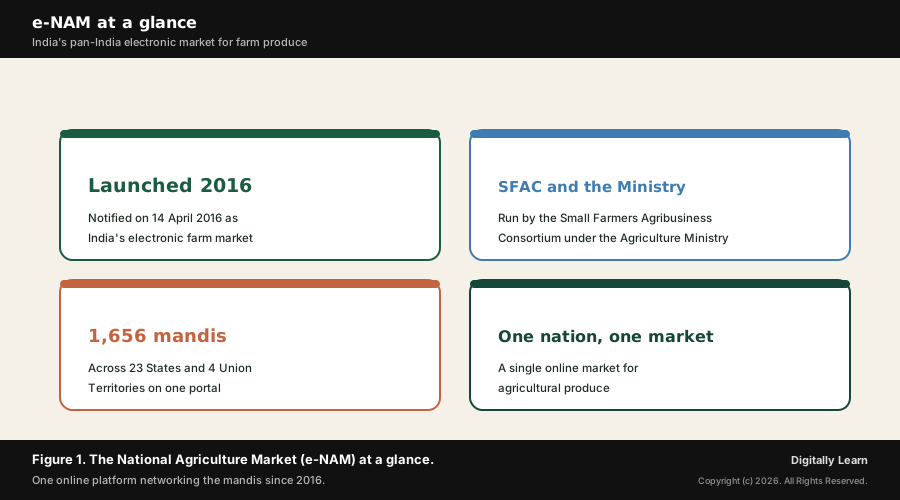
The National Agriculture Market, branded e-NAM, is India's pan-India electronic trading portal for farm produce. It was launched on 14 April 2016 by the Ministry of Agriculture and Farmers Welfare and is run by the Small Farmers Agribusiness Consortium. Rather than build new markets, e-NAM links the existing wholesale mandis run by Agricultural Produce Market Committees onto one online platform, so that a farmer can offer produce to buyers far beyond the local yard and discover a fairer price.
The guiding idea is one nation, one market for agriculture. e-NAM seeks to replace many fragmented, isolated markets with a single networked market in which price information, buyers and trade flow freely across mandis and across state lines. Its core objectives are to improve price discovery through transparent online auctions, to widen the farmer's reach to more buyers, to standardise quality through scientific assaying, and to make payment to the farmer direct, quick and accountable.
Why it matters is that agricultural marketing, not production alone, decides what a farmer finally earns. A good harvest sold in a thin, manipulated local market can still leave the grower poor, while the same crop sold transparently to many bidders fetches a better price. By placing the Small Farmers Agribusiness Consortium under the Department of Agriculture and Farmers Welfare in charge, the scheme treats market reform as central to raising farm incomes. The figure below sets out e-NAM at a glance.
The Problem e-NAM Attacks: Fragmented APMC Mandis, Multiple Fees and Poor Price Discovery
Fragmented state market yards and separate licences, multiple market fees and commission agents, trader cartelisation and the long intermediary chain that depressed farm prices and fed food inflation
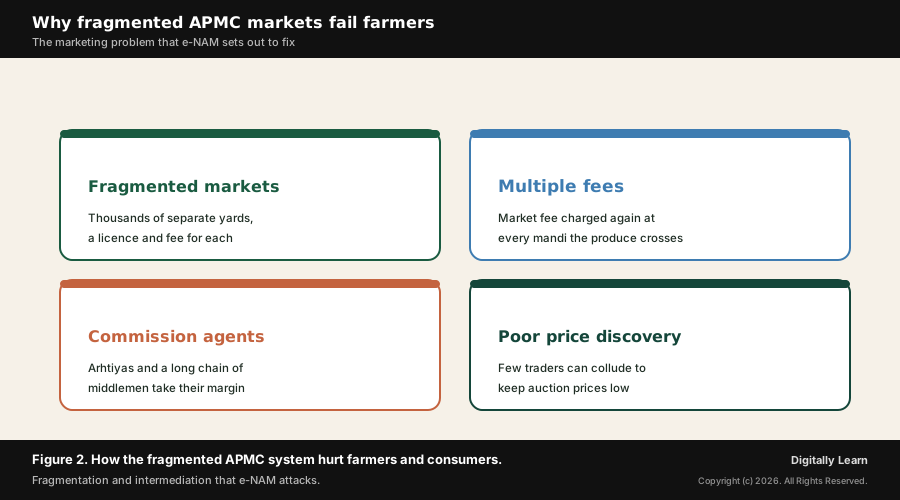
Indian agricultural marketing has long been organised around the Agricultural Produce Market Committee, or APMC, set up under each state's law. A farmer was generally required to sell notified produce only in a designated market yard, and the country was divided into thousands of such fragmented markets. A trader needed a separate licence for each market, and produce moving from one mandi to another was taxed again, so a single national market for a crop simply did not exist and competition between buyers stayed weak.
Within this closed system, power shifted to intermediaries. Licensed commission agents, the arhtiyas, stood between the farmer and the buyer and charged a commission on every sale, while traders, few in number in any one yard, could quietly collude to keep auction prices low. Produce often passed through a long chain of middlemen before reaching the consumer, and each link added a margin. The farmer received a small share of the final price, and the gap between farm-gate and retail price stayed wide.
What is the significance of this design is that it hurt both ends of the market. Poor price discovery and high charges depressed what the farmer earned, weakening the incentive to invest and so holding back the development of agriculture. At the same time, multiple market fees, commissions and the cost of a long intermediary chain were passed on to consumers, which fed into food inflation. This twin failure is exactly the charge that the 2014 examination question puts to the APMC system.
How e-NAM Works: Unified Licence, Single Point Levy, Transparent e-Auction and Online Payment
The unified single trading licence valid across the state, the single point levy of market fee, the transparent online e-auction with quality assaying and direct online payment, and inter-mandi and inter-state trade
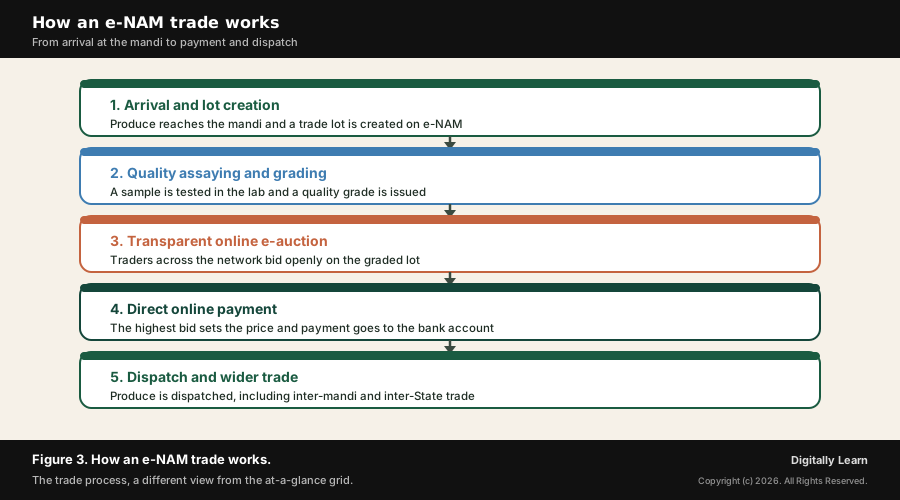
e-NAM answers these faults by changing the rules of trade rather than the location of the mandi. The first reform is a unified single trading licence valid across all the e-NAM markets of a state, so a trader no longer needs a fresh licence for every yard and can bid in many mandis at once. The second is a single point levy of market fee, charged only once in the state rather than again at every market the produce passes through, which directly lowers the cost of trade.
The heart of the platform is the transparent online auction. Once produce arrives, a sample is graded at a quality assaying lab and the lot, with its quality report, is opened to electronic bidding in which traders across the network compete openly. The highest bid sets the price, visible to the farmer in real time, which sharpens price discovery. Payment is then made online, directly into the farmer's bank account, cutting the delay and the leakage that came with cash settlement through middlemen.
What is the significance of this unified market is that it attacks the APMC problems point by point. The single licence and single levy break the fragmentation and the repeated fees; the open e-auction and assaying replace cartelised, opaque pricing with competition on stated quality; and online payment shortens the intermediary chain. Where states allow it, e-NAM also supports inter-mandi and inter-state trade, so a buyer in one market can purchase from another. The table below contrasts the old mandi with the e-NAM market.
| Aspect | Traditional APMC mandi | e-NAM unified market |
|---|---|---|
| Market access | Sell mainly in the local notified yard | Offer to buyers across many mandis on one portal |
| Trading licence | A separate licence for each market | One unified licence valid across the state |
| Market fee | Levied again at each market the produce crosses | Single point levy charged once in the state |
| Price discovery | Often opaque, with few traders and cartelisation | Open online e-auction visible to the farmer |
| Quality | Eye estimate, with scope for dispute | Scientific assaying with a graded quality report |
| Payment | Often in cash through commission agents | Direct online payment into the farmer's account |
Coverage and Scale of e-NAM: Mandis, States, Farmers, Traders, FPOs and Trade Value
The 1,656 mandis across 23 States and 4 Union Territories, the per-mandi grant, the registered farmers, traders and Farmer Producer Organisations, the commodities and the cumulative trade value
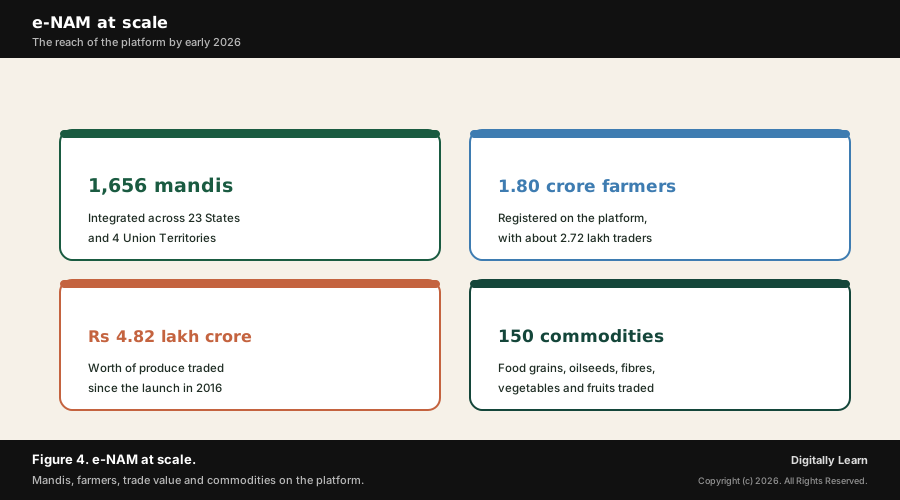
e-NAM has grown steadily since its launch. Since 2016 about 1,656 mandis across 23 States and 4 Union Territories have been integrated with the portal, joining markets that were earlier islands into one electronic network. The central government supports this integration with a grant of up to Rs 75 lakh per mandi for the hardware, internet, assaying equipment and software each yard needs to trade online, while the states notify the mandis and adapt their market rules to the platform.
The reach in numbers is large. By early 2026 more than 1.80 crore farmers and about 2.72 lakh traders had registered on e-NAM, along with roughly 4,724 Farmer Producer Organisations that aggregate the produce of small growers. About 150 commodities, spanning food grains, oilseeds, fibres, vegetables and fruits, are traded on the platform, each with its own quality parameters, so that the basket reaches the staples and the perishables on which most farm incomes depend.
The value flowing through the platform shows its scale. Since inception up to early 2026, produce worth about Rs 4.82 lakh crore, amounting to roughly 13.22 crore metric tonnes, has been traded on e-NAM. These figures mark real progress in linking farmers to a wider market, though, as later sections show, the share of trade that actually crosses mandi and state borders remains modest against the vision of a single national market. The figure below sets out e-NAM at scale.
Key Features and Modules of e-NAM: Assaying, FPO Trading, Logistics and Warehouse-Based e-NWR Trading
The quality assaying labs, the FPO trading module and equity grant, the logistics module, the warehouse-based trading using an electronic Negotiable Warehouse Receipt, the mobile app and BHIM and UPI payment
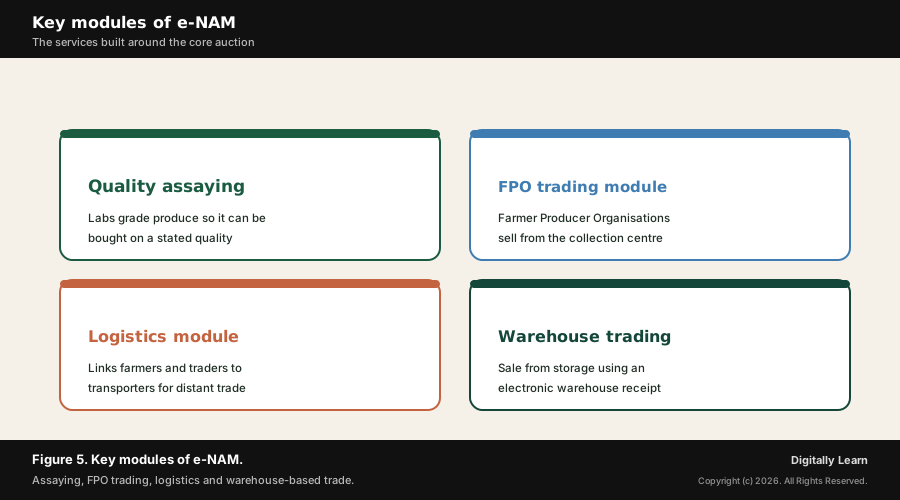
Beyond the core auction, e-NAM has added modules that deepen the market. Quality assaying labs at the mandis test moisture, foreign matter and other parameters and issue a grade, so that produce can be bought on a stated quality rather than on sight, which is what makes remote bidding possible. A dedicated FPO trading module lets Farmer Producer Organisations upload and sell their members' produce from the collection centre itself, and at the launch of the wider platform over Rs 37 crore in equity grant was released to 1,018 Farmer Producer Organisations to strengthen them.
Two further modules tackle the practical hurdles of distance and storage. A logistics module connects farmers and traders to transporters, so that produce bought from a distant mandi can actually be moved, an essential support for inter-state trade. A warehouse-based trading module lets a farmer deposit produce in an accredited warehouse and sell it using an electronic Negotiable Warehouse Receipt, so the crop can be sold from storage without first being carried to a mandi, and the farmer can wait for a better price.
e-NAM also reaches the farmer through a mobile application, which shows live prices, arrivals and bids and lets a farmer track a sale from a phone rather than travelling to the yard. Payments on the platform are made through online banking and BHIM and UPI, so settlement is digital and traceable. Together these modules turn e-NAM from a simple auction screen into a fuller marketplace that carries trade, quality testing, finance and logistics on one window.
The Platform of Platforms and the e-NAM Mobile Ecosystem
The Platform of Platforms launched in 2022, the service providers across trading, assaying, warehousing, fintech, logistics and market information, and the shift to an open marketplace of services around the farmer
To widen the market still further, the government launched the Platform of Platforms, or PoP, under e-NAM on 14 July 2022. The idea is to open e-NAM to many independent digital service providers, so that a farmer or trader on e-NAM can reach not just the auction but a whole ecosystem of services through a single login. It marks a shift from one government platform to a network of platforms working together around the farmer.
Under the Platform of Platforms about 41 service providers have been brought on board, offering services across trading, quality assaying, warehousing, fintech, logistics and market information. A farmer can compare and choose among competing providers for each service, much as a shopper chooses among sellers, which keeps the providers competitive and the farmer in control. By turning a single portal into an open marketplace of services, the PoP tries to make e-NAM more useful and more widely used.
The Institutional and Legal Architecture: SFAC, the States and Agricultural Marketing as a State Subject
The Small Farmers Agribusiness Consortium and the Strategic Partner, the Department of Agriculture and Farmers Welfare and the states, and the state-subject limit that makes APMC amendment or the model APLM Act necessary
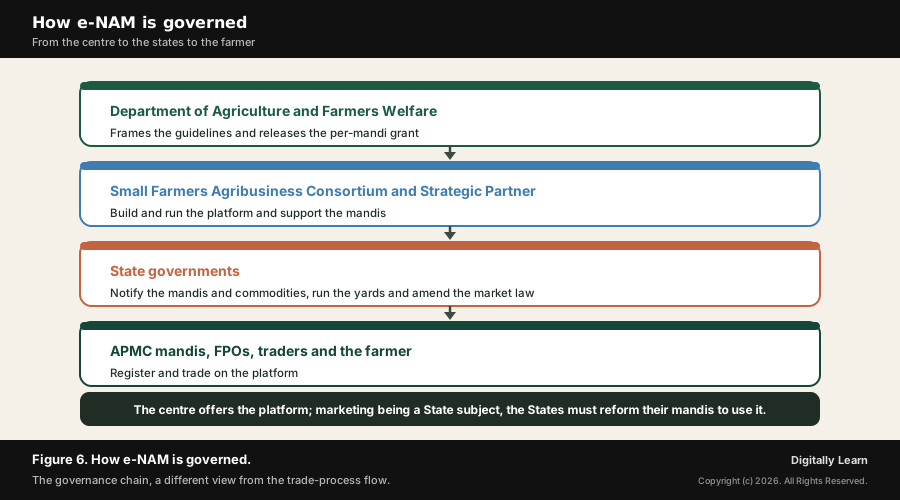
e-NAM is delivered through a clear chain. The Small Farmers Agribusiness Consortium, a body under the Department of Agriculture and Farmers Welfare, is the lead implementing agency, and it works with a Strategic Partner that builds and runs the software and supports the mandis. The central department frames the guidelines and releases the per-mandi grant, while the state governments notify which mandis and commodities join e-NAM, run the yards and adapt their market rules to online trade.
The architecture also explains the scheme's deepest limit. Under the Constitution, agricultural marketing is a State subject, and wholesale trade is governed by each state's APMC Act, which runs a network of about 6,946 regulated markets. The centre can build and offer e-NAM, but it cannot compel a state to reform its mandis. To unlock a single licence, a single levy and inter-state trade, a state must amend its APMC Act or adopt the model APLM Act of 2017, which the centre framed for this purpose.
Why it matters is that the success of e-NAM rests on the states, not on the centre alone. Where a state has amended its law and joined wholeheartedly, e-NAM works closer to its promise; where a state has been slow, or has stayed outside, the platform reaches fewer farmers and trade stays local. The reform is therefore real but partial, advancing only as fast as the states are willing to change their own market laws. The figure below sets out how e-NAM is governed.
Performance and Challenges: Progress, Low Inter-State Trade and the Gaps That Remain
The large network against the unfinished single-market goal, the low inter-mandi and inter-state trade, the assaying, logistics and digital-divide gaps, and the state-amendment hurdle with trader resistance
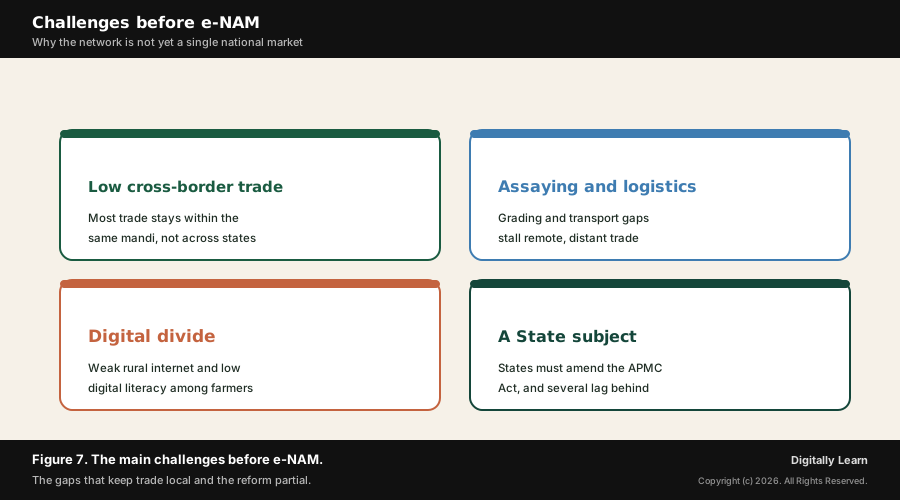
Judged honestly, e-NAM has built a large network but has not yet created a single national market. Most trade on the platform is still intra-mandi, settled within the same yard, and the share that crosses into another mandi or another state, the truest test of a unified market, remains low. Differences in state laws, in assaying standards and in trust between distant buyers and sellers mean that, in practice, a buyer in one state rarely bids for a lot in another.
Several practical gaps slow the platform. Quality assaying is not yet available for every commodity at every mandi, and without a trusted grade a distant buyer will not bid, so remote trade stalls. Logistics for moving produce across long distances are still thin. On the farmer's side, weak rural internet connectivity and limited digital literacy keep many growers dependent on the physical auction, so the online market does not always reach those it was built to help.
The hardest constraint is institutional. Because marketing is a state subject, progress depends on each state amending its APMC Act, and several states have joined late, partially or not at all. Commission agents and established traders, whose role and income the reform threatens, often resist the shift to open electronic trade. These are not reasons to abandon e-NAM but a map of the work that remains if the platform is to become the national market it was meant to be.
The Way Forward: Deepening India's Unified Agricultural Market
Deepening inter-state trade, expanding assaying and logistics, onboarding more Farmer Producer Organisations, building farmer digital capacity and harmonising state market laws
The path ahead is to convert a wide network into a genuinely unified market. That means deepening the trade that crosses mandi and state borders, closing the gaps in assaying and logistics that hold remote trade back, and bringing more states fully into the reform. The measures below set out a balanced way to strengthen India's national agricultural market.
- Deepen inter-mandi and inter-State trade by harmonising assaying standards and building trust between distant buyers and sellers, so that the network becomes a single market in practice.
- Expand scientific quality assaying to more commodities and more mandis, since a trusted grade is what allows a buyer to bid for produce sight unseen.
- Integrate logistics and warehousing fully with the platform, so that produce bought from a distant mandi or sold from a warehouse can actually be moved and stored.
- Onboard more Farmer Producer Organisations and strengthen them, so that small and marginal farmers can aggregate produce and bargain on the platform as larger sellers.
- Build rural digital infrastructure and farmer digital literacy, so that weak connectivity and unfamiliarity no longer keep growers tied to the physical auction.
- Encourage more States to amend their APMC Acts or adopt the model APLM Act, since agricultural marketing is a State subject and the reform advances only as fast as the States act.
- Ensure timely online payment and effective grievance redress, so that farmers trust the platform and return to it season after season.
UPSC Relevance: Prelims Pointers, the Mains Framing and the APMC Reform Debate
The GS-III economy and agriculture fit, the Prelims facts, the APMC-critique-and-e-NAM-response Mains framing of the 2014 PYQ, and the linked reforms (FPOs, e-NWR and the model APLM Act) to connect
For the examination, e-NAM sits in GS-III, under the economy, agriculture and inclusive growth. The facts worth fixing for Prelims are the launch on 14 April 2016 under the Ministry of Agriculture and Farmers Welfare, the lead role of the Small Farmers Agribusiness Consortium, the unified licence and single point levy, the transparent e-auction with quality assaying and online payment, and the Platform of Platforms of 2022. Candidates should not confuse e-NAM, a market, with the minimum support price or procurement.
For Mains, e-NAM is the standard example for any answer on agricultural marketing reform. It lets a student first set out the charge against the APMC system, that its fragmented markets, multiple fees, commission agents and weak price discovery impeded agriculture and added to food inflation, and then show how e-NAM responds through a unified licence, a single levy, open auctions and online payment. The 2014 question on the APMC Acts maps directly onto this need-and-response structure.
Contemporary linkages place e-NAM within a wider push to lift farm incomes. It works alongside the Farmer Producer Organisations, the e-NWR warehouse system and the model APLM Act, and it speaks to debates on doubling farmers' income, on the limits of a state subject and on the unfinished agenda of market reform after the repeal of the 2020 farm laws. Read this way, e-NAM is the central instrument of India's attempt to build one market for its farmers.
Previous Year UPSC-CSE Questions By the end you will be able to draft model answers for the following UPSC questions. Each question carries a collapsible framework showing how to approach it in the exam.
- UPSC Mains 2014 GS-IIIThere is also a point of view that Agricultural Produce Market Committees [APMCs) set up under the State Acts have not only impeded the development of agriculture but also have been the cause of food inflation in India. Critically examine.
How to structure the answer in the exam
Body (sub-themes to develop):
- The case against the APMCs: fragmented market yards each needing a separate trader licence, market fees levied again at every mandi, licensed commission agents (arhtiyas) and a long chain of middlemen, and the cartelisation of a few traders that produced opaque, low price discovery for the farmer.
- How this impeded agriculture and fed food inflation: poor price realisation weakened the farmer's incentive to invest and modernise, while multiple fees, commissions and the cost of a long intermediary chain were passed on to consumers, widening the gap between farm-gate and retail prices.
- The balancing view: APMCs did create regulated marketplaces, weighment, dispute settlement and some infrastructure, so the fair conclusion is that the model needs reform rather than abolition; the problem lies in fragmentation, monopoly and excess intermediation, not in regulation as such.
- The e-NAM response: a unified single trading licence valid across the state, a single point levy of market fee, a transparent online e-auction with scientific assaying, direct online payment, and support for inter-mandi and inter-state trade, attacking each APMC fault point by point.
- The extent and limit of the fix: because agricultural marketing is a State subject, e-NAM works only where a state amends its APMC Act or adopts the model APLM Act of 2017; inter-state and inter-mandi trade remains low and assaying and logistics gaps persist, so the reform is real but partial.
Relevance to this topic. The body first explains the APMC problem the question raises, fragmented mandis, multiple licences and fees, arhtiya cartels and poor price discovery that depress farm prices and inflate consumer prices, then sets out the e-NAM response and its limit as a state subject, so the question can be examined fully.
Sources and Further Reading
- National Agriculture Market (e-NAM): official portal and revised operational guidelines on the unified licence, single point levy and assaying
- Department of Agriculture and Farmers Welfare: agricultural marketing, the model APLM Act 2017 and the State APMC framework
- Press Information Bureau: e-NAM integrates 1,656 mandis, benefits over 1.80 crore farmers with Rs 4.82 lakh crore trade since inception
- Press Information Bureau: Union Agriculture Minister launches the Platform of Platforms (PoP) under e-NAM
- NITI Aayog: report of the expert committee on integration of commodity spot and derivatives markets
- World Bank: India agricultural wholesale markets and the case for efficient price discovery
- FAO: market integration and price transmission in food and cash crop markets of developing countries
- Wikipedia: National Agriculture Market (e-NAM)
Editorial Disclaimer
This briefing is for UPSC preparation. Verify the coverage and trade figures against the official e-NAM portal, the Department of Agriculture and Farmers Welfare and Press Information Bureau sources before relying on them.


