


Overview
NITI Aayog's model for transforming the most under-developed districts
The Aspirational Districts Programme, launched in 2018 and led by NITI Aayog, aims to rapidly transform India's most under-developed districts through convergence, collaboration and competition.
The Aspirational Districts Programme (ADP) is a governance programme launched by the Government of India in January 2018 and led by NITI Aayog to rapidly and effectively transform India's most under-developed districts. It selected 112 districts, identified on a composite index of backwardness, and works to lift them on measurable outcomes rather than on inputs or spending alone. Its method is captured in the three Cs: the convergence of central and state schemes, the collaboration of central, state and district officials with citizens, and competition among districts through real-time ranking. Districts are scored on 49 key performance indicators across five socio-economic themes and ranked on the Champions of Change dashboard, an approach the programme later extended to the block level through the Aspirational Blocks Programme in 2023.
What the Aspirational Districts Programme Is and Why It Is in Focus
A NITI Aayog governance programme for the most under-developed districts
The Aspirational Districts Programme, often shortened to ADP, is a governance programme launched by the Government of India in January 2018 and steered by NITI Aayog. Its aim is to quickly transform some of the country's most under-developed districts, so that districts long lagging on health, education and income can catch up with the national average. It is a leading example of how India tries to close the gap between fast growth and uneven development.
What makes the programme distinctive is its focus on outcomes rather than spending. Instead of judging a district by how much money it receives, the programme measures it by how far its development indicators actually improve, and it publishes those measurements openly. The district, rather than the state or the village, is treated as the practical unit of transformation, because the district administration is where most welfare schemes are actually delivered.
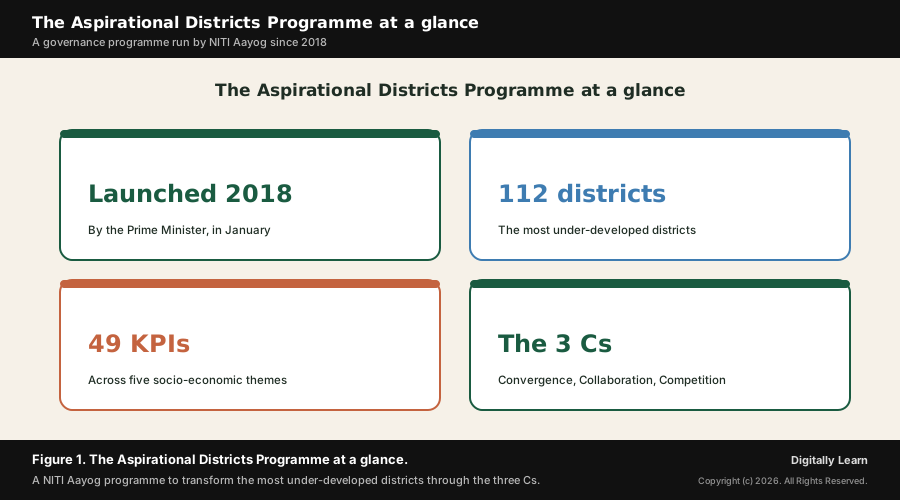
The programme rests on a simple idea expressed as the three Cs: the convergence of central and state schemes, the collaboration of officials and citizens, and competition among districts. These are carried forward through real-time monitoring and a public ranking, so that progress is visible and laggard districts face pressure to improve. The figure below sets out the headline facts of the programme.
Why the programme remains a live subject for the exam
Why it matters now is that the model has matured and been independently assessed, and it has been widened. An independent appraisal by the United Nations Development Programme (UNDP) in India, released in June 2021, examined the programme and judged it a successful model of local-area development, a verdict that put the approach in the spotlight as a possible template for other regions and countries.
At the same time the government has extended the model downward. In 2023 it launched the Aspirational Blocks Programme, applying the same convergence-collaboration-competition method to under-developed blocks within districts. Because the programme combines cooperative and competitive federalism, data-driven governance and regional development in one design, it remains a recurring subject across the governance and inclusive-growth parts of the syllabus.
The Rationale: Regional Backwardness and the District as the Unit of Change
Why regional disparity made a district-level programme necessary
The programme grows out of a long-recognised problem: India's development is highly uneven across space. National averages on health, education and income hide wide gaps, and a relatively small set of districts has historically pulled down the country's overall human-development indicators. A student of governance must hold this regional disparity at the centre of the rationale, because it is the disparity, not slow national growth, that the programme is built to address.
Earlier approaches often worked through broad, scheme-by-scheme spending that was not always concentrated where backwardness was deepest. The programme instead targets the districts furthest behind and concentrates attention and convergence there. This is a deliberate shift from spreading resources thinly to focusing them where the development deficit is greatest, so that the worst-off districts are not left to drift.
The choice of the district as the unit of change is the second part of the rationale. The district is the level at which the bulk of welfare delivery actually happens, where the district magistrate coordinates departments, and where data can be gathered and acted on quickly. By making the district the focus, the programme places accountability close to the point of delivery, which is what gives the model its practical bite.
The Selection of Districts: A Composite Index of Backwardness
How 117 districts were identified and why 112 are active
Districts were not chosen by discretion but on a composite index of deprivation. NITI Aayog built the index from a range of socio-economic indicators, covering health and nutrition, education, and basic services and infrastructure, so that the districts furthest behind on these measures would surface objectively. The aim was to make the selection defensible and data-driven rather than political.
On this basis, 117 districts were initially identified across the country as the most under-developed. One state, West Bengal, chose not to take part, so the programme has in practice operated in 112 districts. Holding both numbers precisely matters for the exam: 117 were selected, while 112 are the districts actually covered. The shortlist deliberately spread across many states, since backwardness is not confined to one region.
The selection also tied into the broader idea that backwardness is multi-dimensional. A district can lag on health while doing better on roads, or trail on education while it has reasonable financial access, so a single income figure would not capture its position. By using a basket of indicators, the index picked districts on a rounded reading of deprivation, which then set the baseline against which later progress would be measured.
The Strategy: The Three Cs of Convergence, Collaboration and Competition
How aligning schemes, joining officials and ranking districts work together
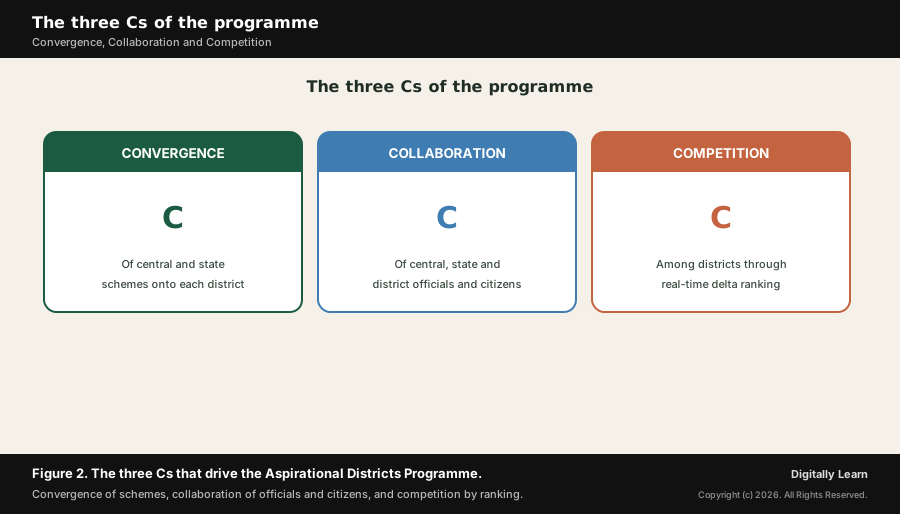
The first C is convergence. Many central and state schemes already operate in every district, but they often run in parallel without joining up. Convergence means aligning these central and state schemes so that they pull in the same direction in a given district, pooling their effort on the same families and the same gaps rather than working in isolation. It is an attempt to make existing money and machinery work harder through coordination.
The second C is collaboration. The programme deliberately links the levels of government and brings in citizens. It connects central, state and district officials, including the central officers assigned to each district and the district administration, and it draws in citizens and partners so that the effort is shared. The idea is that transformation needs the centre, the state and the district working together, not any one level acting alone, which is the cooperative-federalism strand of the design.
The third C is competition. Districts are ranked against one another on their progress, and the rankings are published, so that each district is pushed to improve and to learn from the front-runners. This competition, run through a real-time public dashboard and a monthly ranking, gives the programme its energy: it turns development into a visible race in which catching up is rewarded. The figure below sets out the three Cs together.
The Five Themes and the Forty-Nine Indicators
What the programme measures across five socio-economic themes
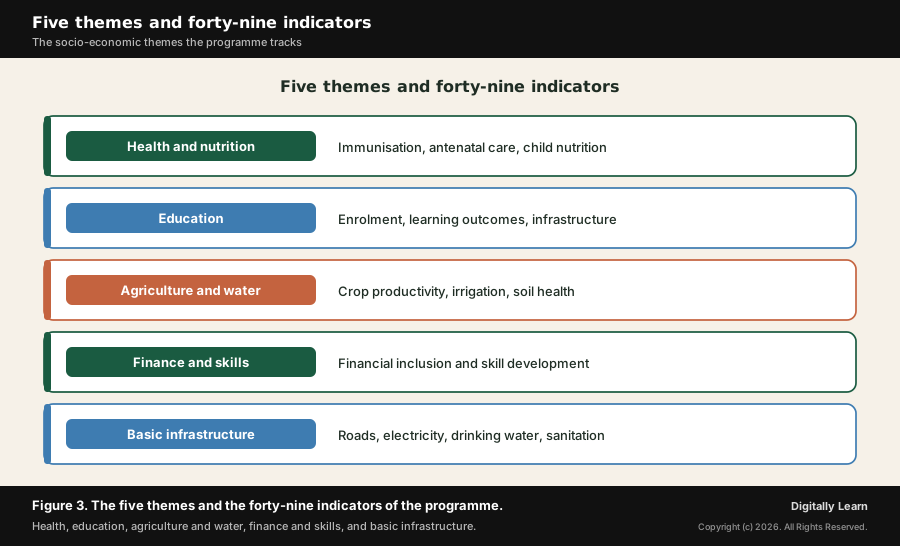
Progress is measured on 49 key performance indicators, grouped under five broad socio-economic themes. The five themes are health and nutrition; education; agriculture and water resources; financial inclusion and skill development; and basic infrastructure. Each theme breaks down into specific, measurable indicators, so that a district's standing is read across the whole sweep of development rather than on any single number.
Within these themes, health and nutrition and education carry the greatest weight in the overall index, reflecting a judgment that human-development outcomes matter most for lifting a backward district. The remaining themes, agriculture and water resources, financial inclusion and skill development, and basic infrastructure, capture livelihoods, finance and skills, and physical services. The precise weight of each theme is set in the programme's methodology, but health and education together account for the largest share.
Because the indicators are concrete, they track things a citizen can feel, such as immunisation and antenatal care, school enrolment and learning, crop productivity and irrigation, access to bank accounts and skilling, and roads, electricity, drinking water and sanitation. This grounding in real-world outcomes is what lets the programme claim to measure development as people actually experience it. The figure below sets out the five themes and the kinds of indicators within each.
The Delta-Ranking Method and the Champions of Change Dashboard
How real-time data and incremental ranking drive competition
The heart of the competition is the delta-ranking method. Rather than ranking districts only on where they stand, which would always favour the less-backward, the programme ranks them on the incremental progress they make from their own baseline over a period. This delta, the change a district achieves, is what is scored, so that a very poor district that improves fast can top the ranking and the most backward districts are given a fair chance to shine.
This ranking runs on the Champions of Change dashboard, a real-time public platform on which district-level data is entered and progress is scored across the indicators. Because the dashboard is updated continuously and is open, it makes performance transparent to officials, citizens and the press alike. Publishing the rankings monthly turns the data into pressure, since no district administration wants to be seen sliding down a public league table.
To keep the rankings credible, the programme relies on validated data. Alongside the data districts enter, it draws on independent household surveys carried out by knowledge partners, including Tata Trusts and the Bill and Melinda Gates Foundation, covering more than a hundred thousand households, to check key indicators. This third-party validation is meant to guard against districts simply reporting flattering numbers, and it is central to whether the dashboard can be trusted, a point the debates section returns to.
The Institutional Architecture: Who Runs the Programme
NITI Aayog, central Prabhari officers, states and district magistrates
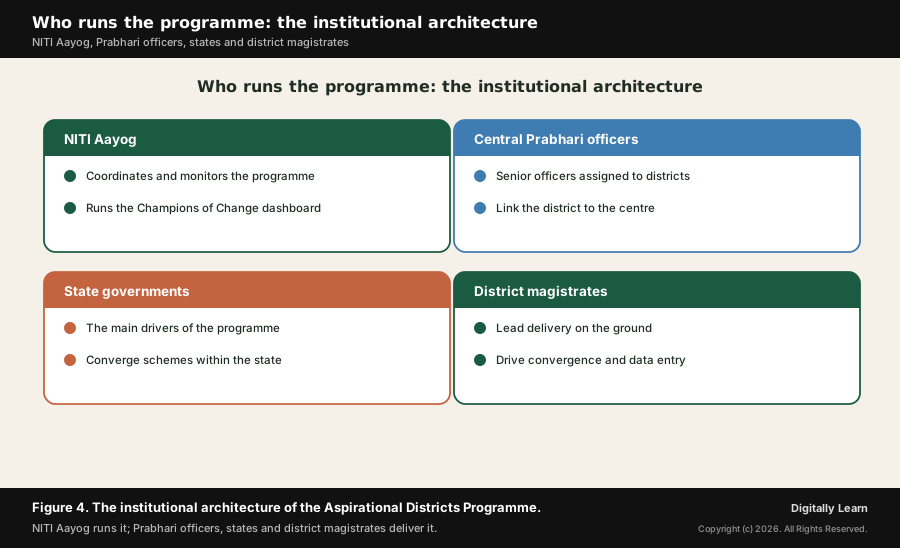
At the apex sits NITI Aayog, which runs the programme, frames the indicators, operates the Champions of Change dashboard and publishes the rankings. NITI Aayog does not deliver schemes itself; its role is to coordinate, to set the measurement framework and to keep the spotlight on results, making it the convening and monitoring brain of the programme rather than its implementing arm.
Each district is assigned a central Prabhari officer, a senior official of the central government who acts as a bridge between the district and the centre. These officers visit and track their assigned districts, help unblock problems and carry district-level realities back up to the government. They are a distinctive feature of the design, embedding central attention in each district without displacing the local administration.
The states are the main drivers of delivery, since most of the relevant schemes and staff are theirs, and within each district the district magistrate or collector leads on the ground. The district magistrate convenes departments, drives the convergence of schemes, oversees data entry and is accountable for the district's progress. Citizens, district fellows and development partners support this effort, so responsibility runs from NITI Aayog down to the district administration. The figure below sets out who does what.
The Aspirational Blocks Programme: Extending the Model in 2023
Taking convergence, collaboration and competition down to the block level
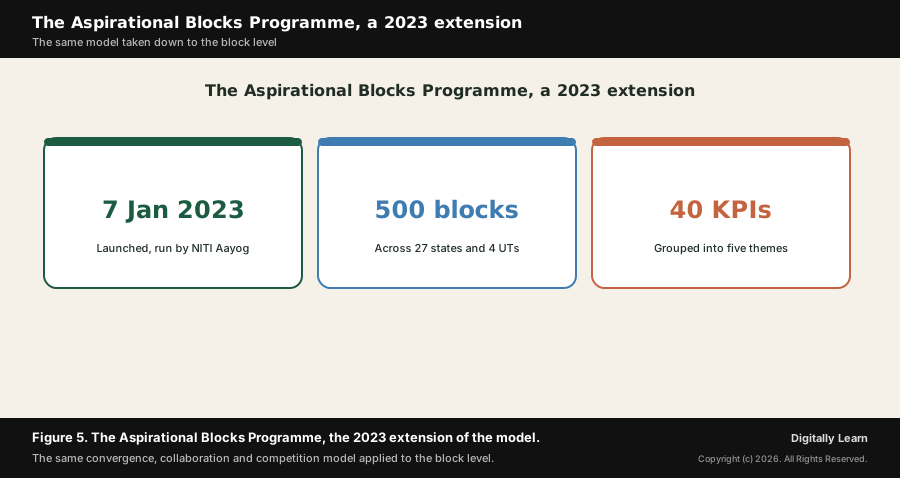
In January 2023 the government extended the model downward by launching the Aspirational Blocks Programme (ABP), again coordinated by NITI Aayog. The reasoning was that even within better-performing districts, some blocks remain badly under-developed, so a finer unit was needed to reach the pockets of backwardness that a district average can hide. The block, a sub-district administrative level, became the new focus.
The Aspirational Blocks Programme covers 500 blocks across 27 states and 4 Union Territories, carrying over the same approach of converging schemes, collaborating across levels and competing on outcomes. It tracks blocks on a set of 40 indicators grouped under five themes, mirroring the districts model while adding a social-development focus appropriate to the block level. In this way the programme's logic was scaled from roughly a hundred districts to several hundred blocks.
The block-level extension matters because it shows the model being treated as a repeatable template rather than a one-off. By showing that convergence, collaboration and competition can work at the block level too, the government widened the programme's reach to the most local pockets of deprivation. The table below compares the two programmes side by side.
| Feature | Aspirational Districts Programme | Aspirational Blocks Programme |
|---|---|---|
| Launched | January 2018 | 7 January 2023 |
| Nodal body | NITI Aayog | NITI Aayog |
| Unit of focus | 112 under-developed districts | 500 under-developed blocks |
| Coverage | Across many states | 27 states and 4 Union Territories |
| Indicators | 49 KPIs across five themes | 40 KPIs across five themes |
| Method | The three Cs and delta ranking | The same three Cs at the block level |
Reading the rows together shows the continuity: the blocks programme keeps the same nodal body, the same three-Cs method and the same five-theme design, while shifting the unit from the district to the block to reach finer pockets of backwardness. The figure below sets out the headline facts of the blocks programme.
Outcomes and Evidence: What Independent Assessments Have Found
The UNDP appraisal and the pattern of measured progress
The most cited independent assessment is the UNDP appraisal of June 2021. Examining the programme across its five themes, UNDP India described it as a successful model of local-area development and suggested it could serve as a best practice for other regions and countries facing persistent regional disparities. This external, attributed verdict is the strongest evidence in the programme's favour and is worth citing carefully in an answer.
On the substance, the appraisal found that health and nutrition, education, and to some extent agriculture and water resources had registered the clearest improvements in the aspirational districts, while several other indicators, though they had advanced, still left room for further strengthening. The honest reading, which the assessment itself offers, is therefore uneven: real and measurable gains in the human-development themes, alongside areas where progress has been slower.
It is important to state outcomes in measured terms. Where this article reports results it relies on the independent appraisal and keeps the framing qualitative rather than asserting precise figures that are not firmly established. The fair conclusion is that the programme has produced documented progress in its core themes, while the depth and durability of that progress remain matters of continuing study, which leads into the debates.
Challenges and Debates Around the Programme, Presented Neutrally
Data quality, the index method, sustainability and ranking pitfalls
A balanced reading must weigh the debates around the programme, and the first concerns data quality. Because districts rank competitively on data they themselves help enter, there is a recognised risk that numbers may be reported optimistically, which is precisely why the programme builds in independent household surveys and third-party validation. How fully that validation can keep pace with the demand for fresh data is a genuine, openly discussed question rather than a settled one.
A second debate concerns the index method itself. Any composite index involves choices about which indicators to include and how to weight them, and reasonable observers can differ on those choices, on how comparable districts in very different conditions really are, and on whether the chosen indicators capture every dimension of backwardness. Presented neutrally, this is a debate about method, not a charge of bad faith; it is the ordinary contestability of any ranking-based design.
Two further concerns are sustainability and the pitfalls of ranking-driven competition. On sustainability, observers ask whether gains made under intense focus will hold once attention moves on, and whether improvements reach the hardest, most marginal groups. On the ranking itself, the worry is that competition can tempt districts toward quick wins and away from the deepest, slowest problems. These are open questions, with defenders pointing to the delta method and validation, and critics treating them as unfinished business.
Understanding the Significance: A Model of Federalism and Outcome-Based Governance
Competitive and cooperative federalism and data-driven governance
What is the significance of the Aspirational Districts Programme lies first in its blend of competitive and cooperative federalism. By making the centre, states and districts work together on convergence while ranking districts against one another, it joins cooperation and competition in a single design. This is held up as a working illustration of how federal energy can be harnessed for development, with the centre setting the frame and states and districts driving delivery.
Its second significance is the move toward outcome-based governance. The programme shifts the test of success from how much is spent to how far indicators actually improve, and it makes that improvement public and measurable. This emphasis on transparency and accountability, achieved through an open real-time dashboard, is widely seen as the model's most transferable idea, applicable well beyond these particular districts.
Its third significance is for inclusive and regional development. By concentrating effort on the most backward districts, the programme directly targets the regional disparity that makes India's growth uneven, and it tries to ensure that the places left furthest behind are pulled toward the national average. In this sense it speaks to the core inclusive-growth concern of the syllabus: making development reach the regions and people that headline growth tends to bypass.
The Way Forward for the Programme
Strengthening data, deepening reach and sustaining gains
The natural way forward begins with the data foundation. Strengthening independent validation, widening the use of household surveys and improving the timeliness and reliability of district reporting would directly answer the data-quality debate and make the rankings more credible. Because the whole model rests on trustworthy data, investment here protects everything built on top of it.
A second priority is to deepen reach and durability. Extending the design to the block level through the Aspirational Blocks Programme already pushes attention into finer pockets of backwardness, and the further task is to ensure that gains are sustained after the initial intensity, that the hardest-to-reach groups are not skipped in the chase for quick wins, and that the slow, structural problems get the patient effort they need.
A third direction is to keep refining the method. Revisiting the choice and weighting of indicators, learning from the independent appraisals, and balancing the spur of competition against the danger of teaching to the metric would keep the programme honest. Pursued together, these steps would let the model do what it was designed to do, lift the most backward districts on outcomes that citizens can feel, while addressing the fair criticisms made of it.
The Programme in Context: India's Wider Development and Governance Effort
How the programme sits among India's governance and development ideas
Contemporary linkages place the Aspirational Districts Programme within a wider family of governance and development ideas. It sits beside the broader push for cooperative and competitive federalism that NITI Aayog champions, beside the move toward data-driven, dashboard-based governance across many schemes, and beside India's long effort to make growth inclusive and regionally balanced. The following ideas are worth holding together:
- Cooperative and competitive federalism: The principle that the centre, states and districts both cooperate and compete on development, of which this programme is a leading example.
- Outcome-based governance: The shift from judging schemes by spending to judging them by measured results, made visible through open dashboards.
- Regional and inclusive development: The concern with closing the gaps between regions and reaching the people that headline growth bypasses.
- The Aspirational Blocks Programme: The 2023 extension of the same model to the block level, showing the design treated as a repeatable template.
Taken together, these linkages show that the programme is not a stand-alone scheme but a node in India's evolving approach to development administration, joining its federal philosophy, its embrace of data and transparency, and its commitment to reaching the regions left furthest behind.
UPSC Relevance and Exam Focus
Where the programme fits in the UPSC-CSE syllabus
This topic maps most directly to General Studies Paper II: government policies and interventions for development in various sectors, and to transparency and accountability in governance, since the open dashboard is a clear instance of both. It also speaks to cooperative and competitive federalism, and it connects to General Studies Paper III on inclusive growth and regional development, making it a genuinely cross-cutting subject.
For Prelims, hold the high-yield facts: the programme was launched in 2018 and is run by NITI Aayog; it covers 112 districts (with 117 selected initially); its strategy is the three Cs; it ranks districts on 49 indicators across five themes using delta ranking on the Champions of Change dashboard; and the Aspirational Blocks Programme was launched in 2023 over 500 blocks.
For Mains, the recurring framing is to assess the programme as a model of governance and federalism: explain the three Cs and the outcome-based, data-driven design, evaluate the evidence of progress in measured terms, and weigh the debates on data quality, index method, sustainability and ranking pitfalls. A strong answer treats it as an instance of competitive cooperative federalism and transparency-driven governance, balanced honestly against its limits.
Recurring linked concepts an aspirant should keep in working memory:
- NITI Aayog and cooperative federalism: The nodal body that runs the programme and the federal philosophy it embodies.
- Delta ranking and dashboards: The method of ranking on incremental progress and the open, real-time platforms that make it transparent.
- Regional disparity and inclusive growth: The development problem the programme is built to address.
- The Aspirational Blocks Programme: The 2023 block-level extension that mirrors the districts model.
A common Prelims trap is to misstate the numbers; hold that 117 districts were selected initially while 112 are covered, that there are 49 indicators across five themes for the districts programme and 40 indicators for the blocks programme, and that the programme is run by NITI Aayog, not a line ministry.
A common Mains trap is to write a one-sided celebration. The exam value lies in a balanced judgment: the genuine, independently noted gains in health and education, the model's federalism and transparency strengths, set honestly against the real debates over data, method, sustainability and the risk that ranking crowds out the hardest problems.
Previous Year UPSC-CSE Questions By the end you will be able to draft model answers for the following UPSC questions. Each question carries a collapsible framework showing how to approach it in the exam.
- UPSC Mains 2019 GS-IIExamine why, despite high growth, India still shows low human-development indicators and what makes balanced and inclusive development elusive.
How to structure the answer in the exam
Body (sub-themes to develop):
- The growth-versus-human-development gap: high headline growth coexisting with weak outcomes on health, education and income, because national averages hide the districts and groups left furthest behind.
- Regional disparity as a core issue: backwardness concentrated in particular districts and multi-dimensional across health and nutrition, education, agriculture and water, finance and skills, and basic infrastructure.
- Delivery and convergence failures: schemes running in parallel without joining up, and resources spread thinly rather than concentrated where deprivation is deepest, which a district-level, convergence-based approach seeks to fix.
- Targeted, outcome-based governance as a response: the Aspirational Districts Programme's three Cs, 49-indicator measurement and delta ranking, and the independently noted gains in health and education, as a way to make development more inclusive.
- The remaining issues: data quality, the sustainability of gains, reaching the hardest and most marginal groups, and the risk that ranking-driven competition chases quick wins, which keep balanced development a work in progress.
Sources and Further Reading
- NITI Aayog: Aspirational Districts Programme and Aspirational Blocks Programme
- NITI Aayog: An Aspirational Story of Transformation
- Press Information Bureau: The Rise of India's Aspirational Districts
- Press Information Bureau: NITI Aayog releases Baseline Ranking of Aspirational Districts
- Press Information Bureau: UNDP Report Lauds Aspirational Districts Programme
- Press Information Bureau: NITI Aayog releases the first Delta Ranking of the Aspirational Blocks Programme
- NITI Aayog: Aspirational Districts Programme, An Appraisal (the UNDP assessment)
- Development Monitoring and Evaluation Office (NITI Aayog): Monitoring in Aspirational Districts
- Ministry of Education: NITI Aayog identified 117 districts as Aspirational Districts
- Ministry of Health and Family Welfare: National Family Health Survey (NFHS-5)
- Wikipedia: Aspirational Districts Programme
Editorial Disclaimer
This briefing is for UPSC preparation. Verify the facts and figures against the official NITI Aayog and PIB sources before relying on them.


