


Overview

There are 18 railway zones in India, each run by a General Manager from a fixed headquarters and divided into divisions under Divisional Railway Managers. The newest, South Coast Railway at Visakhapatnam, began operating on 1 June 2026, which made all 18 zones operational. Lists that show 19 zones add the Konkan Railway, which is run by a separate corporation, and older textbooks show 16 or 17 because they were written before the newer zones were created.
Railway Zones in India: How Many Zones and Why
How Many Railway Zones Are There in India?
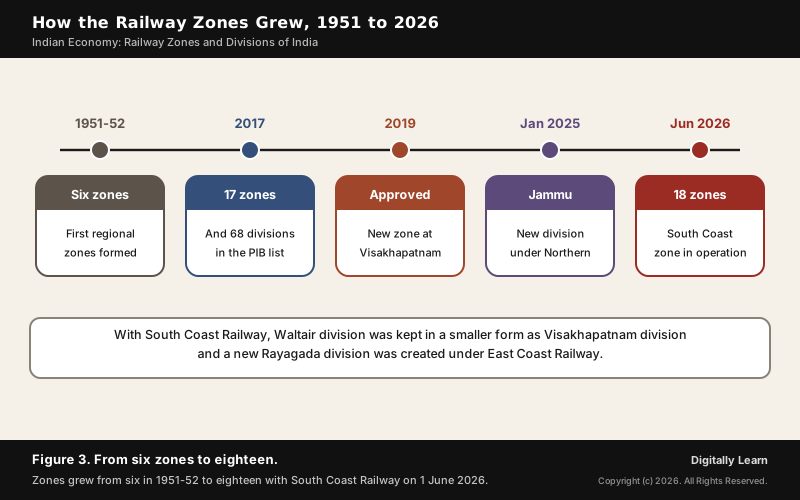
India has 18 railway zones. A government list of July 2017 named 17 zones, counting the Kolkata Metro as one, and 68 divisions. The 18th, South Coast Railway, was approved by the Cabinet in February 2019, notified in the Gazette on 4 May 2026 and began operating on 1 June 2026.
Older books give smaller numbers because the network kept growing. NCERT's Class 12 text, written earlier, says the system has been divided into sixteen zones. Always count from the latest government notification, not from a textbook table.
History of Indian Railways and the Formation of Zones
The first passenger train in India ran in 1853 over 34 km from Bombay to Thane, carrying about 400 people in 14 carriages. A century later, in 1951, Indian Railways was formed by amalgamating 42 railway companies spanning about 55,000 km, and the network was reorganised into six regional zones in 1951-52, with the Southern, Central and Western Railways the first to be created.
| Period | Zones created | What changed |
|---|---|---|
| 1951-52 | Southern, Central, Western, Northern, North Eastern, Eastern | The six original regional zones |
| 1955 to 1966 | South Eastern (1955), Northeast Frontier (1958), South Central (1966) | Large zones split for the east, north-east and south |
| 2002-03 | North Western, East Central, South Western, West Central, North Central, South East Central, East Coast | Seven new zones in two years |
| 2010 | Metro Railway, Kolkata | A metro system made a zone |
| 2026 | South Coast Railway | The 18th zone |
Why Indian Railways Is Divided into Zones and Divisions
A network of this size cannot be run from one office. NCERT notes that the railways' very large size puts pressure on a centralised management system, which is why it is divided into zones. The railway network was reorganised into six regional zones in 1951-52, and the number grew over the decades as traffic and regions demanded.
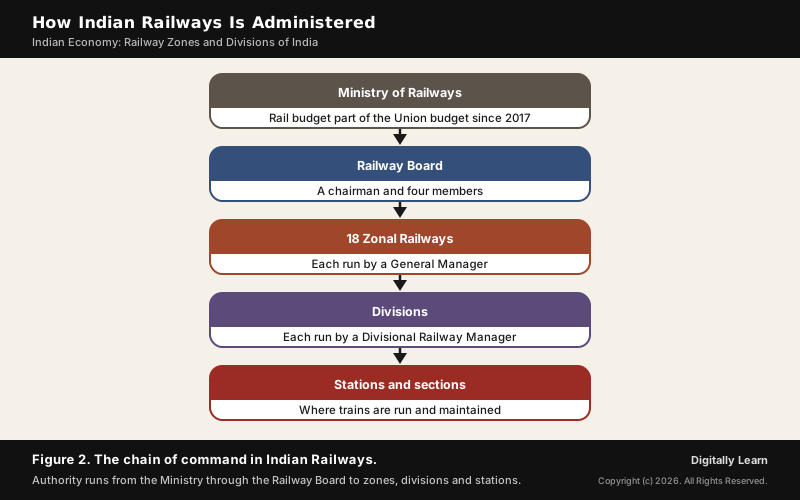
- Railway Board: A chairman and four members head the organisation under the Ministry of Railways; the separate rail budget was merged with the general budget from 2017.
- Zone: Headed by a General Manager, who reports to the Board.
- Division: Headed by a Divisional Railway Manager; divisional staff operate and maintain the assets.
- Boundaries: Zonal and divisional boundaries follow operational and administrative needs, not state boundaries, so some states have lines under more than one zone.
List of Railway Zones in India with Headquarters and Divisions
List of 18 Railway Zones and Their Headquarters
Railway zones and headquarters go together: each zone is named after the region it serves and is run from a fixed headquarters. Eighteen zones are run from fifteen cities: Kolkata hosts the Eastern, South Eastern and Metro Railway zones, and Mumbai hosts the Central and Western zones.
The zones differ greatly in size. Northern Railway has the longest route length, about 7,363 km with 1,013 stations, while Western Railway, at about 6,157 km, has the most stations, 1,046. The smallest is the Metro Railway, Kolkata, with about 73 km of route.

Railway Divisions in India: Zone-Wise List
Below the zones sit the divisions, the level at which trains are actually run and tracks maintained. The table lists the Indian railway zones and divisions, each zone with its code and headquarters. Northern, Southern and Western Railways have the most, six each, while the Kolkata Metro has none.
| Zone (code), headquarters | Divisions (number) |
|---|---|
| Northern Railway (NR), New Delhi | Ambala, Delhi, Firozpur, Lucknow, Moradabad, Jammu (6) |
| North Eastern Railway (NER), Gorakhpur | Izzatnagar, Lucknow, Varanasi (3) |
| Northeast Frontier Railway (NFR), Guwahati | Alipurduar, Katihar, Lumding, Rangiya, Tinsukia (5) |
| Eastern Railway (ER), Kolkata | Asansol, Howrah, Malda, Sealdah (4) |
| South Eastern Railway (SER), Kolkata | Adra, Chakradharpur, Kharagpur, Ranchi (4) |
| South Central Railway (SCR), Secunderabad | Secunderabad, Hyderabad, Nanded (3) |
| Southern Railway (SR), Chennai | Chennai, Madurai, Palakkad, Salem, Thiruvananthapuram, Tiruchirappalli (6) |
| Central Railway (CR), Mumbai (CSMT) | Bhusawal, Mumbai, Nagpur, Pune, Solapur (5) |
| Western Railway (WR), Mumbai (Churchgate) | Ahmedabad, Bhavnagar, Mumbai Central, Rajkot, Ratlam, Vadodara (6) |
| North Western Railway (NWR), Jaipur | Ajmer, Bikaner, Jaipur, Jodhpur (4) |
| South Western Railway (SWR), Hubballi | Bengaluru, Hubballi, Mysuru (3) |
| West Central Railway (WCR), Jabalpur | Bhopal, Jabalpur, Kota (3) |
| North Central Railway (NCR), Prayagraj | Agra, Jhansi, Prayagraj (3) |
| South East Central Railway (SECR), Bilaspur | Bilaspur, Nagpur, Raipur (3) |
| East Coast Railway (ECoR), Bhubaneswar | Khurda Road, Sambalpur, Rayagada (3) |
| East Central Railway (ECR), Hajipur | Danapur, Dhanbad, Pt. Deen Dayal Upadhyaya, Samastipur, Sonpur (5) |
| South Coast Railway (SCoR), Visakhapatnam | Guntakal, Guntur, Vijayawada, Visakhapatnam (4) |
| Metro Railway, Kolkata (KMRC), Kolkata | No divisions |
New and Special Zones: South Coast, Kolkata Metro and Konkan
South Coast Railway: India's Newest Railway Zone
India's newest zone took seven years from approval to operation. On 28 February 2019 the Cabinet approved a railway zone at Visakhapatnam and a new division with its headquarters at Rayagada, created by reorganising South Central Railway and East Coast Railway.
- Divisions of the new zone: Guntakal, Guntur and Vijayawada, taken from South Central Railway, plus Visakhapatnam.
- Waltair retained: In February 2025 the Cabinet kept Waltair division in truncated form, about 410 km, and renamed it Visakhapatnam division because Waltair is a colonial name.
- Rayagada division: The other part of Waltair, about 680 km, became a new division under East Coast Railway.
- Start: The Gazette notification was issued on 4 May 2026 and the zone began operating on 1 June 2026.
- Why it was created: The Cabinet cited the optimal size and scale of railway operations and the long-standing demand of the region; Andhra Pradesh’s railway allocation now stands at a record Rs 10,134 crore, against Rs 886 crore earlier for Andhra Pradesh and Telangana together.
Kolkata Metro and the Konkan Railway: Zone or Not?
The Kolkata Metro is counted as a zone in its own right; the 2017 government list shows it with no divisions. The Konkan Railway is different: its line from Roha to Thokur is operated and maintained by Konkan Railway Corporation Limited, which is why the official count of zones leaves it out.
- Length and states: The line is 756.25 km long and connects Maharashtra, Goa and Karnataka; it does not enter Kerala.
- Opening: The first train on the completed track ran on 26 January 1998.
- Engineering: With over 2,116 bridges and 92 tunnels, it was the largest railway project of the century in Asia, and land had to be acquired from about 43,000 landowners.
- Kolkata Metro: Opened in 1984, it was the first rapid transit system in South Asia.
- Ownership: The Government of India holds 51 per cent; Maharashtra 22, Karnataka 15, Kerala 6 and Goa 6 per cent, which is why Kerala shares in its benefits although the line ends before it.
Production Units and Other Railway Organisations
The zones run the trains, but the railways also build their own rolling stock. The first locomotive factory, Chittaranjan Locomotive Works, was commissioned in 1950, and the first coach factory was the Integral Coach Factory at Madras, now Chennai.
- Locomotives: Chittaranjan Locomotive Works and Banaras Locomotive Works, among others.
- Coaches: Factories at Kapurthala, Raebareli, Sonipat and Latur, besides the Integral Coach Factory.
- Wheels: Rail wheel factories at Bangalore, Bela and Raebareli.
- Electrification: The Central Organisation for Railway Electrification, founded in 1979, is headquartered at Prayagraj.
- Training: The National Academy of Indian Railways at Vadodara was formerly the Railway Staff College.
Indian Railways in the Economy: Freight, Safety and Stations
Economic Role of Indian Railways
Indian Railways is today the fourth largest national railway system by size, with a route length of 69,181 km. In 2023-24 it ran 13,198 passenger trains a day on average and carried 6.905 billion passengers, and moved 1,588.06 million tonnes of freight.
- Broad gauge and electrification: 66,820 km of the route is 1,676 mm broad gauge, and about 99.1 per cent of the broad-gauge network was electrified by October 2025.
- Employer: With more than 1.2 million employees, the railways are the second largest employer in India.
- Investment: The gross budgetary allocation rose from Rs 32,300 crore in 2014-15 to Rs 2,52,200 crore in 2025-26.
NCERT classifies track by gauge, the distance between the rails: broad gauge of 1.676 metre, metre gauge of one metre, and narrow gauge of 0.762 or 0.610 metre, mostly in the hills. The railways have run a long programme to convert metre and narrow gauge to broad gauge. Coal is the largest single item in NCERT's freight table, at 251.75 million tonnes out of 557.39 million tonnes in 2004-05.
National Rail Plan 2030 and the Dedicated Freight Corridors
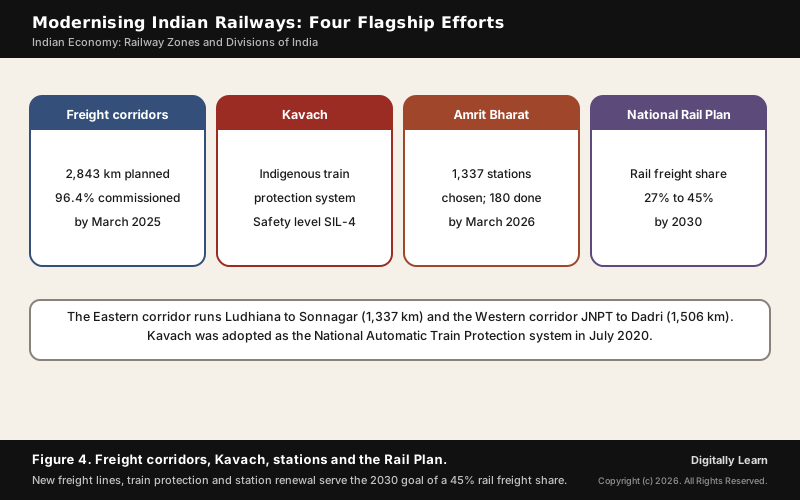
The National Rail Plan aims to create a future-ready railway system by 2030. Its central target is to raise the railways' share of freight traffic from 27 per cent to 45 per cent by 2030, building capacity ahead of demand to serve growth up to 2050. It also aims to raise the average speed of freight trains to 50 km/h, and says all financial models, including public-private partnership, are being considered.
- Eastern corridor: Ludhiana to Sonnagar, 1,337 km.
- Western corridor: Jawaharlal Nehru Port Terminal to Dadri, 1,506 km; of the 2,843 km in all, 2,741 km (96.4 per cent) was commissioned by March 2025.
- Why corridors help: Separate freight lines allow heavy-haul trains with loads of 13,000 tonnes, lower energy use and shorter transit times, which make rail tariffs more competitive.
- Next corridors: Detailed project reports are being prepared for an East-Coast corridor (Kharagpur to Vijayawada), an East-West corridor and a North-South sub-corridor (Vijayawada, Nagpur, Itarsi).
Kavach and Amrit Bharat Station Scheme: Safety and Stations
Kavach is an indigenously developed Automatic Train Protection system, certified to Safety Integrity Level 4. It brakes a train automatically if the loco pilot fails to keep within the speed limit, and it was adopted as the National Automatic Train Protection system in July 2020; version 4.0 was approved by the RDSO on 16 July 2024. Its parts include station units, RFID tags throughout the track length, telecom towers and a Kavach unit on every locomotive. Field trials began in February 2016, version 3.2 ran on 1,465 route km of South Central Railway, and a project to fit Kavach to 10,000 locomotives has been finalised.
The Amrit Bharat Station Scheme redevelops stations through long-term master plans: better access and circulating areas, waiting halls, lifts and escalators, and integration of the station with both sides of the city. It is funded mainly from the budget, but 15 stations have been identified to be explored under public-private partnership.
Previous Year UPSC-CSE Questions
Previous Year UPSC-CSE Questions By the end you will be able to draft model answers for the following UPSC questions. Each question carries a collapsible framework showing how to approach it in the exam.
- UPSC Mains 2022 GS-IIIWhy is Public Private Partnership (PPP) required in infrastructural projects? Examine the role of PPP model in the redevelopment of Railway Stations in India.
How to structure the answer in the exam
Introduction: Infrastructure needs large, long-term capital and management skills that budgets alone struggle to supply.
Body (sub-themes to develop):
- Why PPP: private capital and efficiency, risk sharing, faster execution, commercial use of land.
- Station redevelopment: Amrit Bharat covers 1,337 stations with master plans; 180 done by March 2026.
- Funding reality: mainly budgetary support; 15 stations identified to be explored under PPP.
- Challenges: returns only where stations can earn from commercial space; risk allocation.
Conclusion: Conclude that PPP suits high-footfall stations, while the budget carries the rest.
- UPSC Prelims 2006 Prelims-GSWhich one of the following pairs is not correctly matched? Railway Zone – Headquarters
How to approach this Prelims question
Approach: Check each zone against its headquarters in the zone table. North Eastern Railway is at Gorakhpur, Eastern Railway at Kolkata and South East Central Railway at Bilaspur. Bhubaneswar is the headquarters of the East Coast Railway; the South Eastern Railway is headquartered in Kolkata. So pair (b) is the wrong match.
Trap to watch: Bhubaneswar is the East Coast Railway, not the South Eastern Railway.
Key facts to recall:
- (a) North Eastern Railway – Gorakhpur: correctly matched, so not the answer.
- (b) South Eastern Railway – Bhubaneswar: not correctly matched, so this is the answer. Bhubaneswar is the East Coast Railway; the South Eastern Railway is at Kolkata.
- (c) Eastern Railway – Kolkata: correctly matched.
- (d) South East Central Railway – Bilaspur: correctly matched.
Answer signal: South Eastern Railway does not sit at Bhubaneswar, so option (b) is the answer.
- UPSC Prelims 2004 Prelims-GSWhich one of the following pairs is NOT correctly matched? Unit of Indian Railway – Location
How to approach this Prelims question
Approach: Check each railway unit against its location. The Railway Staff College at Vadodara is now the National Academy of Indian Railways; the Central Organisation for Railway Electrification, founded in 1979, is headquartered at Prayagraj; rail wheels are made at Bangalore, among other places; and Kapurthala has a coach factory. Varanasi has the Banaras Locomotive Works, not the electrification organisation.
Trap to watch: Varanasi has a locomotive works; railway electrification is run from Prayagraj.
Key facts to recall:
- (a) Railway Staff College – Vadodara: correctly matched; it is now the National Academy of Indian Railways.
- (b) Central Organization for Railway Electrification – Varanasi: not correctly matched, so this is the answer. CORE is at Prayagraj.
- (c) Wheel and Axle Plant – Bangalore: correctly matched; Bangalore has a rail wheel factory.
- (d) Rail Coach Factory – Kapurthala: correctly matched.
Answer signal: CORE is at Prayagraj, not Varanasi, so option (b) is the answer.
- UPSC Prelims 1998 Prelims-GSWhich one of the following sets of states stands to benefit the most from the Konkan Railway?
How to approach this Prelims question
Approach: The Konkan Railway line connects Maharashtra, Goa and Karnataka, and Kerala holds a 6 per cent share in the company that built it. Pick the set that has these four states and no state without a stake.
Trap to watch: Tamil Nadu, Madhya Pradesh and Gujarat have no stake in the line.
Key facts to recall:
- (a) Goa, Karnataka, Maharashtra, Kerala: right. The line runs through the first three, and Kerala is a shareholder.
- (b) Madhya Pradesh, Maharashtra, Tamil Nadu, Kerala: wrong. Madhya Pradesh and Tamil Nadu have no stake in the line.
- (c) Tamil Nadu, Kerala, Goa, Maharashtra: wrong. It drops Karnataka, through which the line runs, and adds Tamil Nadu.
- (d) Gujarat, Maharashtra, Goa, Tamil Nadu: wrong. Gujarat and Tamil Nadu have no stake, and Karnataka is missing.
Answer signal: Goa, Karnataka, Maharashtra and Kerala, so option (a) is the answer.
- UPSC Prelims 1999 Prelims-GSWhich one of the following statements is not true of the Konkan Railway?
How to approach this Prelims question
Approach: The question asks for the statement that is NOT true. Check the states first: the 756.25 km line connects Maharashtra, Goa and Karnataka and does not enter Kerala, although Kerala holds shares in the company. That makes statement (b) the untrue one, as UPSC's key confirms.
Trap to watch: Kerala holds shares in the company, but the line itself does not enter Kerala.
Key facts to recall:
- (a) Total length about 760 km: true, so not the answer. The line is 756.25 km long.
- (b) Runs through Karnataka, Goa, Maharashtra and Kerala: not true, so this is the answer. The line does not enter Kerala.
- (c) Only rail route that cuts across the Western Ghats: not the answer; UPSC's key marks (b) as the untrue statement.
- (d) Konkan Railway Construction Company raised money through public issues: not the answer; the key again points to (b).
Answer signal: The line does not run through Kerala, so option (b) is the answer.
- UPSC Prelims 2025 Prelims-GSConsider the following statements:
- Indian Railways have prepared a National Rail Plan (NRP) to create a 'future ready' railway system by 2028.
- 'Kavach' is an Automatic Train Protection system developed in collaboration with Germany.
- 'Kavach' system consists of RFID tags fitted on track in station section.
Which of the statements given above are not correct?
How to approach this Prelims question
Approach: The question asks which statements are NOT correct. Statement I: the National Rail Plan aims at a future-ready railway by 2030, not 2028, so it is not correct. Statement II: Kavach is an indigenously developed Automatic Train Protection system, not one made with Germany, so it is not correct. Statement III: Kavach's parts include RFID tags throughout the track length, so it is correct. The incorrect ones are I and II.
Trap to watch: Statement III is true: RFID tags are fitted along the track. The plan's year is 2030, not 2028.
Key facts to recall:
- (a) I and II only: right. The plan's year is 2030 and Kavach is indigenous, so both statements are wrong.
- (b) II and III only: wrong. Statement III is correct: RFID tags are fitted along the track.
- (c) I and III only: wrong. It includes the correct statement III and leaves out the wrong statement II.
- (d) I, II and III: wrong. Only I and II are incorrect.
Answer signal: Statements I and II are not correct, so option (a) is the answer, as UPSC's official key confirms.
Sources and Further Reading
- PIB: Railway Zones and Divisions in the Country, 2017
- PIB: Cabinet approves setting up of a Railway Zone at Visakhapatnam, 2019
- PIB: Revision of divisional jurisdiction under South Coast Railway, 2025
- PIB: Gazette notification for South Coast Railway, 2026
- South Coast Railway: official website (History page)
- Railway Board: List of Zones and Divisions (November 2023)
- PIB: National Rail Plan for India, 2030
- PIB: National Rail Plan freight share 27 to 45 per cent
- PIB: Dedicated Freight Corridors and modernisation, 2025
- PIB: Kavach, the shield of safety, 2024
- PIB: Kavach version 4.0, 2025
- PIB: Amrit Bharat Station Scheme, 1,337 stations, 2025
- PIB: Amrit Bharat Station Scheme, 180 stations completed, 2026
- NCERT: India People and Economy (Class XII), Transport and Communication
- Wikipedia: Indian Railways
- Wikipedia: Indian Railways organisational structure
- Wikipedia: South Coast Railway zone
- Wikipedia: Konkan Railway
- Wikipedia: Kolkata Metro
- Wikipedia: Jammu railway division
- Wikipedia: Ministry of Railways (India)
- Wikipedia: Central Organisation for Railway Electrification
- Wikipedia: National Academy of Indian Railways
- UPSC: Official answer key, Civil Services (Preliminary) Examination 2025
Editorial Disclaimer
This article explains the zones of Indian Railways for UPSC preparation, drawing on official and standard references. The structure and figures reflect the cited authorities.


