


Overview
The seven engines, the six pillars and the National Logistics Policy
PM Gati Shakti is the National Master Plan for multi-modal connectivity, a GIS-based digital platform that brings the infrastructure ministries onto one map to plan together, build seamless connectivity and cut the cost of logistics.
PM Gati Shakti, the National Master Plan for multi-modal connectivity, is a Geographic Information System (GIS) based digital platform that integrates the infrastructure ministries of the Union and the states so that they plan and build together rather than separately. Launched on 13 October 2021, it is built on a platform developed by BiSAG-N that layers data on roads, railways, ports, land use, economic zones and utilities onto a single national map. Its purpose is to deliver seamless multimodal connectivity, fill missing links, speed up project clearances and cut the cost of moving goods. It rests on six pillars, drives seven sectoral engines, and works alongside the National Logistics Policy of 2022 to lift India's logistics performance.
What PM Gati Shakti Is: A GIS-Based National Master Plan for Multimodal Connectivity
A digital platform that puts the infrastructure ministries on one map
PM Gati Shakti, formally the National Master Plan for multi-modal connectivity, is a digital platform that brings the many ministries that build infrastructure onto a single shared map. For decades, departments planned roads, railways, ports, power lines and pipelines in isolation from one another, which led to duplicated work, missing links and costly delays. PM Gati Shakti was designed to replace that fragmented way of working with one integrated picture of the country's infrastructure.
At its heart is a Geographic Information System, a GIS platform built by BiSAG-N, the Bhaskaracharya National Institute for Space Applications and Geoinformatics. The platform layers data, on roads, railways, ports, land records, forests, economic zones and utilities, onto one national map. This gives planners a bird's-eye view, so a new highway can be aligned to a port and a pipeline routed to avoid a forest on one screen.
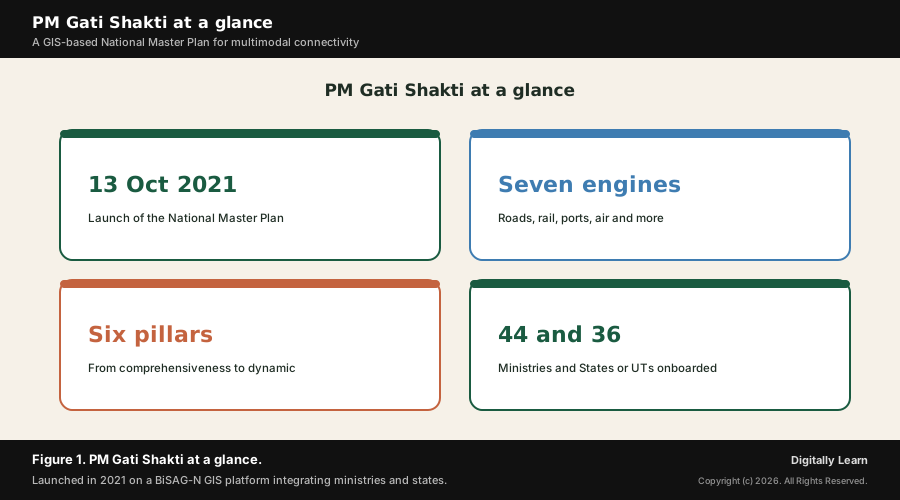
PM Gati Shakti was launched by the Prime Minister on 13 October 2021. Its purpose is to deliver seamless multimodal connectivity for the movement of people, goods and services, to fill the gaps between different modes of transport, and to cut the time and cost of building and using infrastructure. The figure below sets out the headline facts before the rest of the article unpacks how the plan is built and run.
Why PM Gati Shakti Is in Focus: Three Years On and a Maturing Logistics Reform
The third anniversary, the data layers and the projects planned on the platform
Why it matters now is that PM Gati Shakti has moved from launch to working maturity, and its results are beginning to show. The platform has onboarded 44 Central Ministries and 36 States and Union Territories, and more than 1,600 data layers have been integrated onto the GIS map, making it a genuine national planning tool rather than a pilot. All states and union territories have built their own State Master Plan portals aligned to the national platform.
The plan is also being used to design real projects. Ministries have used the National Master Plan to plan thousands of kilometres of new roads and railway lines, to align a long inter-state green-energy transmission corridor, and to cut pipeline route surveys from months to a single day using an electronic survey. These early signs that integrated, map-based planning can speed delivery and reduce waste are why the reform stays on the exam radar.
Understanding the Significance of PM Gati Shakti for Growth and Competitiveness
Lower logistics cost, integrated planning and a boost to manufacturing
What is the significance of PM Gati Shakti lies first in the cost of logistics. Moving goods in India has long been costly relative to the global benchmark, and high logistics costs make Indian products less competitive at home and abroad. By planning transport modes together and filling missing links, the master plan aims to move goods faster and more cheaply, which directly supports trade, exports and the wider economy.
Its second significance is integrated planning itself. By replacing siloed, department-by-department planning with a single shared map, PM Gati Shakti reduces duplication, prevents one agency from digging up what another has just built, and lets scarce public money go further. This is a reform of governance as much as of concrete and steel, changing how the government plans rather than only what it builds.
Its third significance is the push to manufacturing and investment. Reliable, well-connected infrastructure with strong last-mile links lowers the cost of doing business and makes India a more attractive place to build factories and create jobs. By mapping economic zones such as industrial corridors and textile and fishing clusters and connecting them to ports and markets, the plan ties infrastructure directly to economic growth and competitiveness.
How the Plan Is Built: The Seven Engines and the Six Pillars
The seven engines of growth that the master plan drives
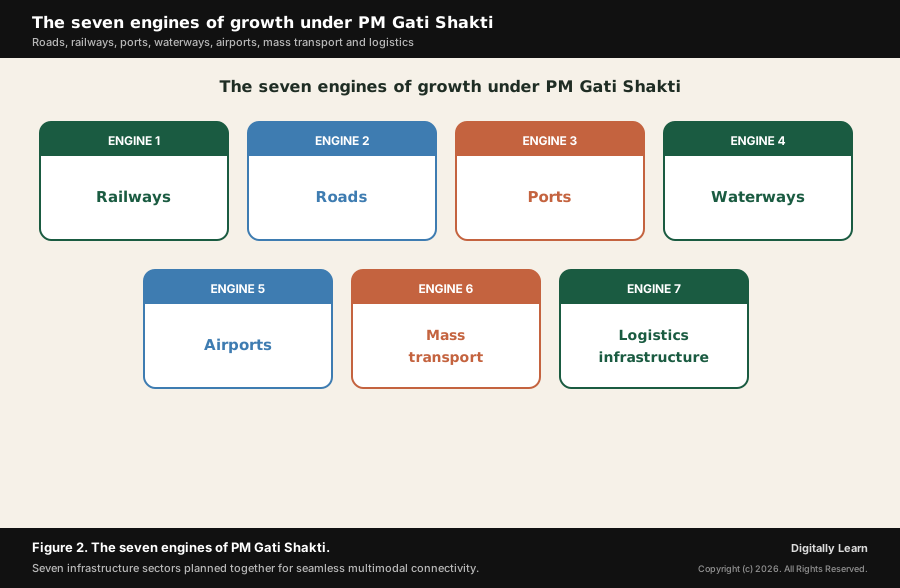
The Union Budget for 2022-23 placed PM Gati Shakti at the centre of the government's growth agenda and set out its seven engines. These are the seven infrastructure sectors that the master plan plans together: railways, roads, ports, waterways, airports, mass transport and logistics infrastructure. The idea is that these engines pull the economy forward in unison rather than each running on its own track.
Treating the seven as engines captures the core insight of the reform. A port is of limited use without the road, rail and waterway links that carry cargo, and an airport needs metro or bus connections for passengers. By planning all seven sectors on one map, the master plan knits them into a single network, the meaning of seamless multimodal connectivity. The figure below names each engine.
The six pillars on which the National Master Plan rests
The master plan rests on six pillars that describe how it works. The first is comprehensiveness: every department's existing and planned activities sit on one platform, so each can see the whole picture. The second is prioritisation, which lets ministries arrange projects through cross-sectoral interaction so the most important links come first. The third is optimisation, which helps choose the most efficient route or location and fill critical gaps between modes.
The remaining three pillars keep the plan coordinated and current. Synchronisation aligns the timing and design of projects across ministries and between the Centre and the states. The analytical pillar provides the whole picture through a GIS platform with spatial tools, including planning that draws on satellite imagery. The dynamic pillar keeps the data live, letting agencies monitor progress and update the map as projects move forward. Together the pillars make the platform a continuously updated tool.
The table below sets out the six pillars side by side, with the function each performs in turning siloed planning into one shared, continuously updated map of the country's infrastructure.
| Pillar | What it does |
|---|---|
| Comprehensiveness | Brings every department's existing and planned activities onto one platform |
| Prioritisation | Lets ministries sequence projects so the most important links come first |
| Optimisation | Helps choose the most efficient route or location and fill gaps between modes |
| Synchronisation | Aligns timing and design across ministries and between the Centre and the states |
| Analytical | Provides the whole picture through GIS and spatial tools, including satellite imagery |
| Dynamic | Keeps the data live so progress can be monitored and the map updated |
How the Plan Is Run: The EGoS, the Network Planning Group and States
The three-tier institutional structure that steers the master plan
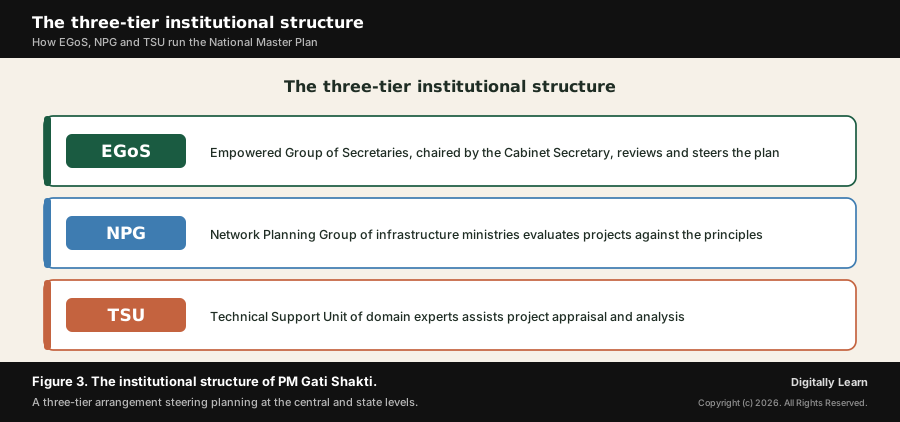
PM Gati Shakti is run through a three-tier institutional structure, set up at the central and state levels, so planning is coordinated rather than left to each ministry alone. At the top sits the Empowered Group of Secretaries (EGoS), a twenty-member body chaired by the Cabinet Secretary with the secretaries of the major infrastructure ministries as members. It reviews and monitors how the plan is carried out and gives directions to meet its objectives.
Below it works the Network Planning Group (NPG), made up of the network-planning heads of the infrastructure ministries, with NITI Aayog taking part. The NPG meets regularly to evaluate proposed projects against the principles of the plan, integrated multimodal infrastructure, last-mile connectivity to economic and social nodes, and a whole-of-government approach, before putting them up to the EGoS. A Technical Support Unit (TSU) of domain experts supports the NPG with technical appraisal.
This structure is reinforced by the role of the states. Every state and union territory has set up its own State Master Plan portal aligned to the national platform, along with its own state-level group of secretaries and planning group, so that state and central infrastructure can be synchronised. The figure below sets out how the three central tiers fit together.
The BiSAG-N technology backbone and the role of the states
The technology backbone of the whole reform is BiSAG-N, the Bhaskaracharya National Institute for Space Applications and Geoinformatics, an institute under the government that built and maintains the GIS platform. It is BiSAG-N that turns scattered departmental records into shared data layers on a single map, and that trains officials across ministries and states to use the platform. Without this common technical foundation, the promise of integrated planning would remain only an idea.
The states are equal partners in the design, not mere recipients. Because most last-mile roads, water supply, urban transport and land records sit with the states, their State Master Plans are essential to making the national picture complete. By bringing state and central data onto one platform, the reform synchronises projects that cross the Union-state boundary, such as a national highway feeding a state industrial park, so connectivity does not break at the last mile.
The National Logistics Policy: ULIP, the Action Plan and the Cost Targets
The National Logistics Policy of 2022 and the Unified Logistics Interface Platform
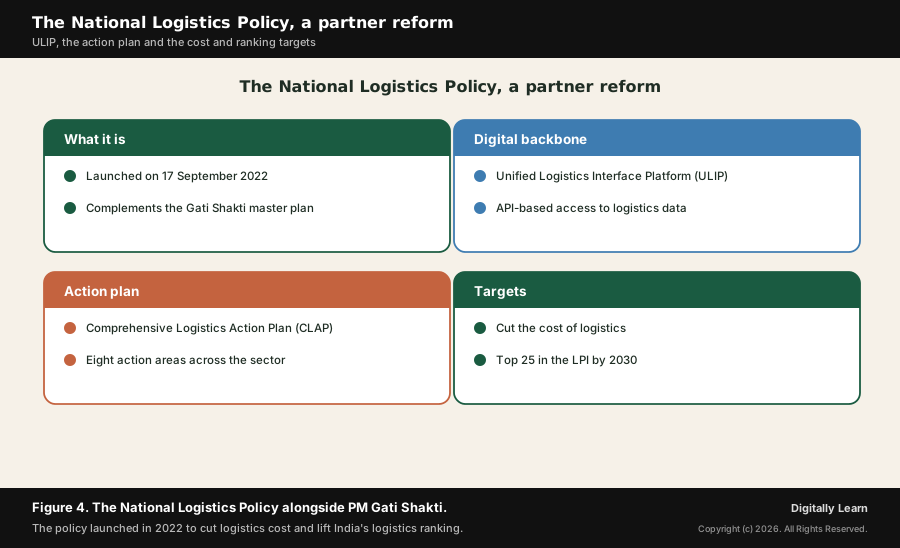
PM Gati Shakti is paired with the National Logistics Policy, launched on 17 September 2022, which carries the same goals into the soft side of logistics, the processes, digital systems, skills and standards that govern how goods move. If the master plan builds and connects the physical network, the logistics policy works on the rules and the data that run on top of it, so the two reforms are designed to reinforce each other.
Its digital centrepiece is the Unified Logistics Interface Platform (ULIP), which connects the digital systems of many logistics ministries through application programming interfaces, giving industry secure, single-window access to data such as vehicle and consignment details. The policy is carried forward through a Comprehensive Logistics Action Plan (CLAP) with eight action areas, covering digital systems, standardisation, skills, state engagement, export and import logistics, services, sectoral plans and logistics parks. The figure below summarises the policy alongside the master plan.
Cutting the cost of logistics, the LPI target and the LEADS exercise
The headline aim of the policy is to cut the cost of logistics. For years it was commonly said that logistics in India cost about 13 to 14 per cent of GDP, far above the global benchmark, though those figures came from external or partial studies. A recent assessment by the National Council of Applied Economic Research for the government put the cost at about 7.97 per cent of GDP, and the policy aims to lower it toward global levels.
The policy also sets a clear ranking target. It aims for India to be among the world's top 25 countries in the World Bank's Logistics Performance Index (LPI) by 2030; in the 2023 index India ranked 38, up six places from 2018. To drive reform in the states, the government runs the LEADS exercise, the Logistics Ease Across Different States survey, which ranks states each year and guides their reforms.
Challenges and the Road Ahead for PM Gati Shakti
Inter-ministerial coordination, data quality, state capacity and clearances
A balanced reading must weigh the challenges the reform still faces. The first is coordination across many ministries and between the Centre and the states. Bringing dozens of departments, each with its own priorities, budgets and ways of working, onto one platform and getting them to plan jointly is a continuing administrative task, and the success of the plan depends on sustained cooperation rather than on the technology alone.
A second challenge is data quality and capacity. The master plan is only as good as the data layers fed into it, so out-of-date, incomplete or inconsistent records can weaken the shared map. Many states and smaller departments also need trained staff and stronger systems to map and update their assets, which is why capacity building by BiSAG-N and the technical units is central to the effort. Uneven capacity across the states risks an uneven rollout.
A third set of challenges lies in delivery on the ground. Land acquisition, environmental and forest clearances, and the gap between projects planned on the platform and projects actually completed remain real constraints, and the private sector has to be brought in through clear, well-coordinated arrangements. The way ahead is to keep improving data, deepen state and private participation, and convert integrated plans into finished projects, so the map-based promise becomes real gains in connectivity and cost.
PM Gati Shakti in Context: Infrastructure, Logistics and the Wider Reform Agenda
How the master plan links to other infrastructure and economy initiatives
Contemporary linkages place PM Gati Shakti within a wider push to modernise India's infrastructure and economy. It works hand in hand with the National Logistics Policy and its ULIP platform on the soft side of logistics, and it draws on capital-spending programmes through which the Union and the states fund the projects that the platform helps plan. The reform is best understood not as a stand-alone scheme but as the planning layer of a broader infrastructure and competitiveness agenda.
It also connects to the goals of manufacturing and trade. Better multimodal connectivity and lower logistics cost support the drive to make India a manufacturing hub and to raise exports, and the mapping of economic zones ties infrastructure directly to industrial policy. In this sense the master plan sits at the meeting point of infrastructure planning, logistics reform and industrial strategy. The following initiatives are worth holding together in working memory:
- National Logistics Policy and ULIP: The 2022 policy and its data platform that work on the processes, standards and digital systems of logistics, complementing the physical network.
- National Infrastructure Pipeline: The medium-term pipeline of infrastructure projects that the master plan helps plan and sequence across sectors.
- Multimodal logistics parks: Hubs that bring road, rail and warehousing together, a physical expression of the multimodal connectivity the plan seeks.
- Make in India and the export push: The manufacturing and trade goals that lower logistics cost and reliable connectivity are meant to support.
Taken together, these linkages show that PM Gati Shakti is a node in India's evolving infrastructure architecture, joining its planning platform, its logistics reform and its manufacturing ambitions into one connected effort.
UPSC Relevance and Exam Focus
Where PM Gati Shakti fits in the UPSC-CSE syllabus
This topic maps most directly to General Studies Paper III: infrastructure, including energy, ports, roads, airports and railways, and investment models and the mobilisation of resources. It also touches the growth and development part of the economy syllabus and the governance theme of how the government plans and coordinates across departments, so it can be drawn into several kinds of answers.
For Prelims, hold the high-yield facts: PM Gati Shakti is the National Master Plan for multi-modal connectivity, launched on 13 October 2021 on a GIS platform built by BiSAG-N; it has seven engines (railways, roads, ports, waterways, airports, mass transport and logistics infrastructure) and six pillars; it is run through the EGoS, the Network Planning Group and a Technical Support Unit; and the National Logistics Policy was launched in 2022 with ULIP.
For Mains, the recurring framing is to assess how PM Gati Shakti and the logistics policy can cut the cost of logistics and improve connectivity, and to weigh the coordination, data and delivery challenges that decide whether they succeed. A strong answer treats the reform as a change in governance and planning, links it to manufacturing and growth, and stresses that joint planning by the Centre, the states and the private sector is the condition for connectivity.
Recurring linked concepts an aspirant should keep in working memory:
- Multimodal connectivity and last-mile links: Planning road, rail, port, waterway and air links together so goods and people move seamlessly across modes.
- Logistics cost and the LPI: The cost of moving goods as a share of the economy and India’s standing in the World Bank’s Logistics Performance Index.
- Cooperative federalism: The need for the Centre and the states to plan and synchronise infrastructure together through aligned master plans.
- Public-private partnership: The role of private investment and capacity in delivering the infrastructure the master plan helps plan.
A common Prelims trap is to confuse the seven engines with the six pillars or to add or drop one of them; hold the seven sectoral engines and the six pillars separately and precisely, and remember the 2021 launch year and the BiSAG-N platform.
A common Mains trap is to describe PM Gati Shakti only as a list of projects. Its exam value lies in treating it as a planning and governance reform: integrated, map-based planning across ministries and states, paired with the logistics policy, weighed honestly against the coordination, data and delivery challenges that will decide whether the promised gains in connectivity and cost are realised.
Previous Year UPSC-CSE Questions By the end you will be able to draft model answers for the following UPSC questions. Each question carries a collapsible framework showing how to approach it in the exam.
- UPSC Mains 2022 GS-IIDiscuss why PM Gati Shakti needs careful coordination between the government and the private sector to achieve its goal of connectivity.
How to structure the answer in the exam
Body (sub-themes to develop):
- The goal of connectivity: the seven engines and the aim of seamless multimodal connectivity and last-mile links, which require many sectors and agencies to plan as one network.
- Coordination within government: the three-tier structure of the Empowered Group of Secretaries, the Network Planning Group and the Technical Support Unit, and the synchronisation of central and state master plans through cooperative federalism.
- Coordination with the private sector: the dependence of delivery on private investment and capacity, and the need for clear, well-coordinated public-private partnership arrangements to build and operate connectivity infrastructure.
- Why coordination must be meticulous: the risks of poor data quality, uneven state capacity, land and clearance delays, and the gap between projects planned on the platform and projects actually completed.
- The balance: the genuine gains of integrated, map-based planning weighed against the administrative challenge of sustaining joint planning across dozens of actors over time.
Sources and Further Reading
- Press Information Bureau: PM launches Gati Shakti, National Master Plan for infrastructure development
- Press Information Bureau: PM Gati Shakti National Master Plan to encompass seven engines
- Press Information Bureau: GoI constitutes 20-member Empowered Group of Secretaries to monitor the PM Gati Shakti NMP
- Press Information Bureau: Network Planning Group under PM GatiShakti recommends infrastructure projects on the principles of PM GatiShakti
- Press Information Bureau: PM GatiShakti National Master Plan completes 3 years
- Press Information Bureau: PM launches the National Logistics Policy
- Department for Promotion of Industry and Internal Trade: PM Gati Shakti and related portals and initiatives
- Department for Promotion of Industry and Internal Trade: Unified Logistics Interface Platform
- NITI Aayog: Infrastructure division and integrated infrastructure planning
- Union Budget 2022-23: Budget Speech of the Minister of Finance
- World Bank: Logistics Performance Index, India scorecard
- Wikipedia: PM Gati Shakti
Editorial Disclaimer
This briefing is for UPSC preparation. Verify the facts and figures against the official PIB and DPIIT sources before relying on them.


