


Overview
The four pillars, Coastal Economic Zones and the blue economy
The Sagarmala Programme is India's flagship programme for port-led development, launched in 2015 to modernise ports, improve their connectivity, build industry along the coast and develop coastal communities.
The Sagarmala Programme is India's flagship programme for port-led development, run by the Ministry of Ports, Shipping and Waterways and approved in 2015. Its central idea is that a country with a long coastline and busy ports can grow faster if it builds its economy around those ports rather than away from them. The programme rests on four pillars: modernising ports and building new ones; improving how ports connect to the hinterland; drawing industry to the coast through Coastal Economic Zones; and developing the coastal communities that live by the sea. It harnesses India's coastline of about 7,500 km and its waterways, and it is tied to the wider blue economy and the Maritime India Vision. Because ports handle the bulk of India's trade, the programme is meant above all to cut logistics costs.
What Sagarmala Is: India's Flagship Programme for Port-Led Development
A 2015 programme to build the economy around India's ports and coast
The Sagarmala Programme is the flagship programme of the Ministry of Ports, Shipping and Waterways for port-led development, approved in 2015. Its name joins the Sanskrit words for sea and garland, and its guiding idea is simple but far-reaching: a nation with a long coastline and well-placed ports can grow faster and more cheaply if it builds its trade, its industry and its transport network around those ports rather than away from them.
India is well suited to this idea. It has a coastline of about 7,500 km, about 14,500 km of potentially navigable waterways, and a position astride some of the world's busiest shipping routes. Yet for decades much of India's cargo moved long distances overland before reaching a port, which made trade slower and more expensive than it needed to be. Sagarmala was framed to correct this by making the ports themselves the engines of growth.
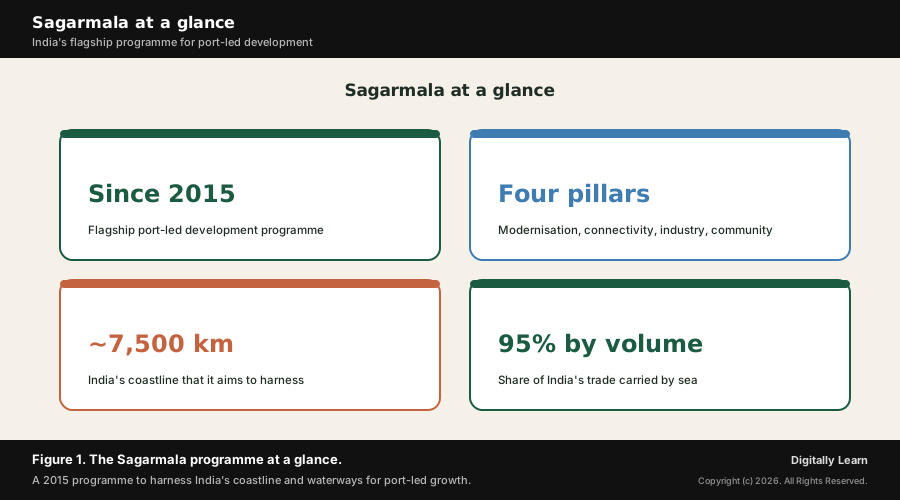
The programme is therefore best understood as a logistics and infrastructure strategy rather than a single project. It is meant to lower the cost of moving goods for both export-import (EXIM) and domestic trade, to draw manufacturing toward the coast, and to spread the gains of maritime growth to the coastal communities that live by the sea. The figure below sets out the headline facts.
Why Sagarmala Is in Focus: Maritime Vision, Logistics Costs and the Blue Economy
A renewed maritime push and the drive to cut logistics costs
Why it matters now is that India has placed its maritime sector at the centre of its growth plans. Successive vision documents, from the Maritime India Vision 2030 to the longer-term Amrit Kaal Vision 2047, have set ambitious targets for ports, shipping and waterways, and Sagarmala is the main programme that delivers much of that ambition. The programme is also being widened, with a next phase signalled to bridge remaining gaps.
The push is driven by a hard economic fact. Ports handle about 95 per cent of India's trade by volume and about 70 per cent by value, so the efficiency of ports shapes the cost of nearly all of India's external trade. High logistics costs have long been seen as a drag on competitiveness, and port-led development is a principal way to bring those costs down and make Indian goods cheaper abroad.
Understanding the Significance of Sagarmala for India's Economy and Coast
Lower logistics costs, coastal industry and inclusive coastal growth
What is the significance of Sagarmala lies first in logistics costs. By modernising ports and shortening the journey between the port and the factory, the programme seeks to make trade cheaper and faster. Lower logistics costs improve the competitiveness of Indian exports, reduce the price of imported inputs, and free up resources across the economy, which is why port-led development is treated as a core part of India's growth strategy.
Its second significance is coastal industrialisation. By drawing manufacturing toward the coast through Coastal Economic Zones, Sagarmala tries to turn ports into the hearts of industrial clusters, where raw materials can be imported, processed and the finished goods exported with minimal inland movement. This concentrates industry where it is cheapest to trade, and it links India's factories more directly to world markets.
Its third significance is inclusive coastal growth. Sagarmala is not only about cargo and steel; it also seeks to improve the lives of the coastal communities, the fishers and others, who depend on the sea. Through better fishing harbours, skill training and support for coastal tourism, the programme tries to ensure that the gains of maritime growth reach ordinary people on the coast, making the strategy broad-based rather than narrow.
The Four Pillars of Sagarmala, Explained One by One
How the port-led development model is structured
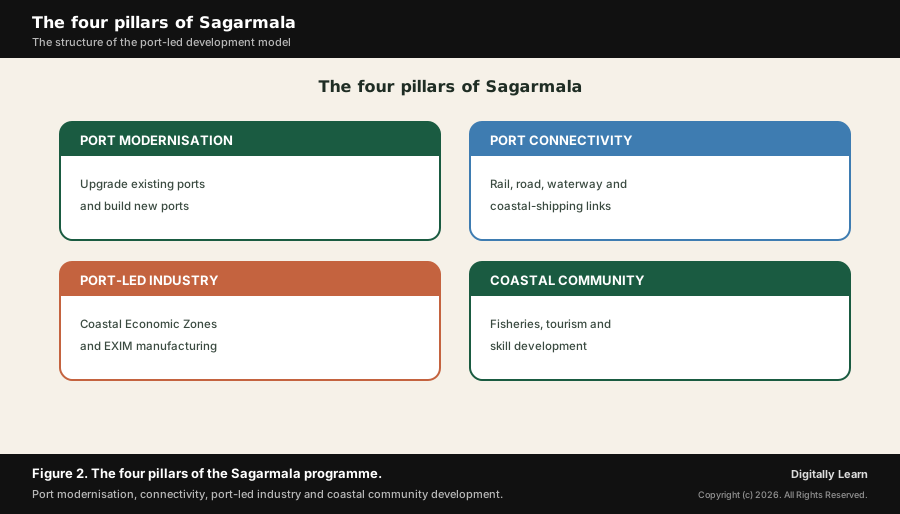
The Sagarmala model is built on four pillars, each addressing a different part of the journey from the factory to the ship and back. The first two pillars deal with the ports themselves and how goods reach them; the third draws industry to the coast; and the fourth makes sure coastal people share in the gains. Taken together the four pillars turn a scattered set of port projects into a single, coherent strategy for port-led growth.
It is worth holding the four pillars together as a framework, because they are designed to reinforce one another. A modern port is of little use without good connectivity; connectivity matters most when industry clusters near the port; and industrial growth on the coast is sustainable only when the surrounding communities benefit. The table below summarises the four pillars, and the figure and sub-sections that follow take each in depth.
| Pillar | Focus | Main aim |
|---|---|---|
| Port modernisation and new ports | Upgrading existing ports and building new ones | Faster turnaround and added capacity |
| Port connectivity | Rail, road, waterways and coastal shipping to ports | Cheaper, multi-modal cargo movement |
| Port-led industrialisation | Coastal Economic Zones around ports | Lower logistics cost for exports |
| Coastal community development | Fisheries, tourism and skill development | Inclusive growth on the coast |
Reading the rows together shows the logic of the model: the first two pillars make the port and its links efficient, the third brings industry to that efficient gateway, and the fourth ensures the surrounding communities share in the gains, so the four together form one connected strategy.
Pillar one: port modernisation and new ports
The first pillar is port modernisation and new port development. It focuses on upgrading India's existing ports, expanding their capacity, deepening their channels and bringing in modern, often digital, systems so that ships can be turned around faster and cargo handled more efficiently. Where the existing ports cannot meet demand, the pillar provides for building new ports along the coast to add capacity where it is most needed.
The aim of this pillar is to close the gap between India's port capacity and the trade that flows through it. Faster turnaround, deeper berths able to take larger ships, and mechanised handling all reduce the time and cost a cargo spends at the port. Because the port is the gateway for almost all sea-borne trade, even modest gains in efficiency ripple across the whole economy, which is why modernisation sits at the head of the programme.
Pillar two: port connectivity, including rail, road, waterways and coastal shipping
The second pillar is port connectivity enhancement. A modern port is only as good as the links that carry cargo to and from it, so this pillar builds the rail lines, roads, pipelines and inland waterways that connect ports to the hinterland. The goal is multi-modal connectivity, so that cargo can switch between modes smoothly and reach the interior of the country at the lowest cost and in the shortest time.
Two modes matter especially here. Coastal shipping moves cargo along India's own coast from one port to another, taking trucks off congested highways and cutting costs for bulk goods. Inland waterways carry cargo along rivers deep into the country; the Jal Marg Vikas Project, for instance, is developing National Waterway-1 on the Ganga over a 1,390 km stretch from Varanasi to Haldia with World Bank assistance. Both modes are cheaper and cleaner than road for heavy cargo.
Pillar three: port-led industrialisation and Coastal Economic Zones
The third pillar is port-led industrialisation, delivered mainly through Coastal Economic Zones (CEZs). A Coastal Economic Zone is a large region built around one or more ports where industry is encouraged to cluster, so that raw materials can be landed, processed and the finished goods shipped out again with very little inland movement. Fourteen CEZs covering all the maritime states and union territories have been identified under the programme's National Perspective Plan.
The logic of this pillar is that locating industry near the port cuts the logistics cost of both imported inputs and exported output, which is decisive for export-oriented manufacturing. By concentrating factories, smaller manufacturing units and shared infrastructure in coastal clusters, the CEZs aim to make Indian goods cheaper to produce and to trade, and to draw investment to the coast. This pillar is where Sagarmala connects most directly to India's wider drive to expand manufacturing and exports.
Pillar four: coastal community development
The fourth pillar is coastal community development. It recognises that the people who live along the coast, above all the fishing communities, must share in the gains of maritime growth rather than be displaced by it. The pillar funds projects such as the modernisation of fishing harbours, support for fisheries, the development of coastal tourism, and skill-training so that coastal people can take up the new jobs that port-led growth creates.
This pillar is what makes Sagarmala a broad-based development strategy and not merely an infrastructure programme. A skill-gap study of coastal districts has been carried out to plan training where it is most needed, and an integrated approach is taken to improving the quality of life on the coast, from physical infrastructure to traditional livelihoods. By tying social development to the economic pillars, the programme tries to ensure that the benefits of port-led growth are inclusive.
The Institutional Architecture: Who Runs Sagarmala and How
The apex committee, the nodal ministry, the development company and the maritime states
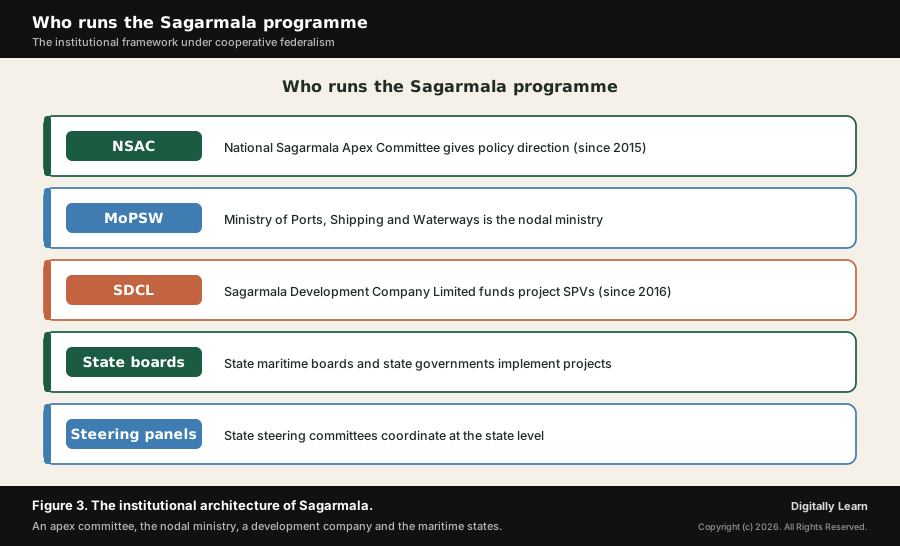
Sagarmala is run through a layered institutional framework designed around cooperative federalism, so that the centre, the states and local agencies work in step. At the top sits the National Sagarmala Apex Committee (NSAC), constituted in 2015 and chaired by the Minister for Ports, Shipping and Waterways, which gives policy direction and reviews progress. It brings together cabinet ministers of the concerned central ministries and the chief ministers and administrators of the maritime states and union territories.
The Ministry of Ports, Shipping and Waterways is the nodal ministry that steers the programme day to day. To finance and shepherd projects, the Sagarmala Development Company Limited (SDCL) was incorporated in 2016 under the Companies Act, 2013; it supports the project special purpose vehicles (SPVs) set up by central ministries, state governments, ports and state maritime boards by taking an equity stake. This lets large projects raise money and move forward without waiting on a single budget line.
Implementation on the ground rests with the maritime states. The actual projects are carried out by major ports, central ministries, state maritime boards, state governments and other agencies, while state steering committees coordinate work and identify projects. This division of labour, an apex committee for direction, a ministry and a company at the centre, and the states for delivery, holds a programme spread across a long coastline together. The figure below sets out the architecture.
Sagarmala Along the Coast: How the Pillars Fit India's Geography
Ports, communities and waterways across India's coastline
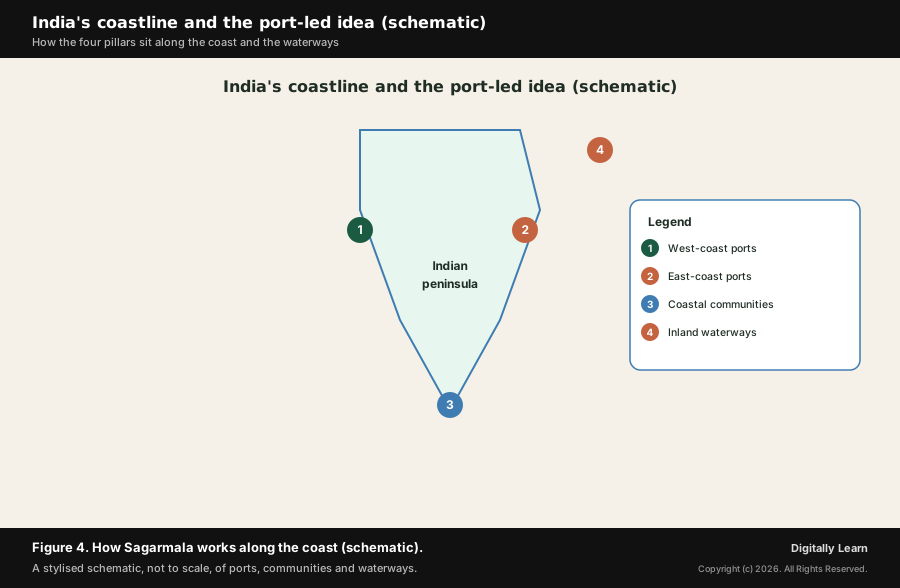
It helps to picture how the four pillars sit along India's coast. India's western and eastern coasts each carry major ports that the modernisation and connectivity pillars seek to upgrade and to link inland, while the coastal communities all along the shoreline are the focus of the fourth pillar. Inland, the navigable rivers reach deep into the hinterland, carrying cargo away from the coast and bringing it back through the connectivity pillar.
The schematic below is a stylised, not-to-scale illustration of this idea rather than a precise map. It shows, in simple terms, how port modernisation works on the coasts, how coastal communities sit along the shoreline, and how inland waterways carry trade between the coast and the interior. The point is to see the programme as a single system tying the sea to the land, not as a list of separate projects.
Sagarmala, the Blue Economy and the Maritime India Vision
How port-led development links to the blue economy and the wider vision
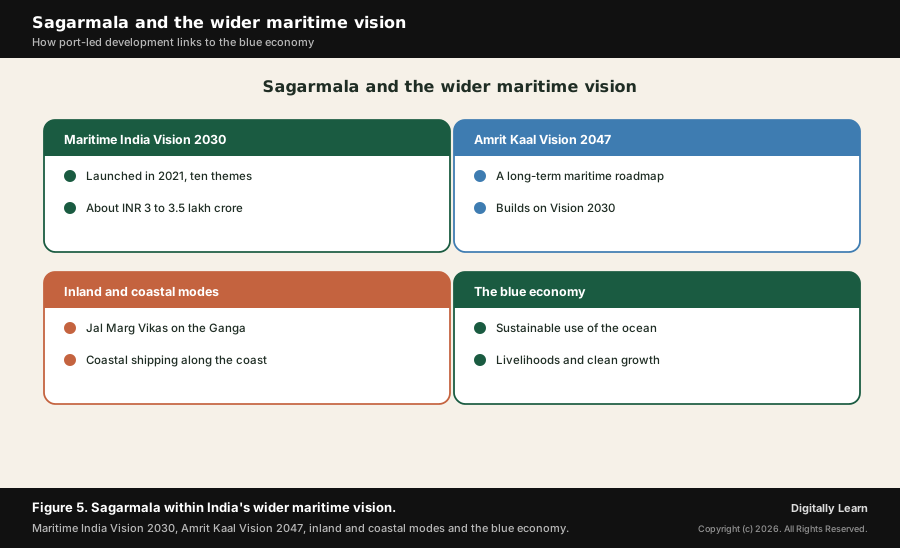
Sagarmala does not stand alone; it is part of a wider maritime strategy. The Maritime India Vision 2030, launched in 2021, set out more than 150 initiatives across ten themes covering ports, shipping and inland waterways, with an estimated investment of about three to three and a half lakh crore rupees. The longer-term Amrit Kaal Vision 2047 extends this roadmap, and Sagarmala is the principal vehicle through which the port and coastal parts of these visions are realised.
The programme also sits within the idea of the blue economy. The blue economy means using the resources of the ocean, shipping, fisheries, tourism, energy and more, for economic growth and better livelihoods while keeping the ocean ecosystem healthy. Sagarmala's pillars, from coastal industry to coastal community development, map onto this idea, which is why port-led development is increasingly framed as part of India's blue-economy agenda rather than as transport infrastructure alone.
Finally, Sagarmala connects to India's broader push on logistics and connectivity. By shifting freight toward cheaper coastal and inland-water routes and tying ports to the rail and road network, the programme supports the national effort to lower logistics costs and integrate transport modes. In this sense port-led development is one strand of a wider drive to move goods across India faster, cheaper and cleaner. The figure below places Sagarmala within this wider vision.
Challenges and the Coastal-Ecology Debate, in Measured Terms
Land, finance, coordination and the environment
A balanced reading must weigh the challenges Sagarmala faces. The first is land and finance. Building new ports, industrial zones and connectivity corridors needs large tracts of land and very large sums of money, and acquiring land along a crowded coast and mobilising private investment at scale are both difficult. Many projects are spread over years, and a gap can open between what is planned and what is actually delivered.
A second set of challenges is coordination. Because the programme runs across many central ministries, several coastal states, the major ports and a range of agencies, keeping all of them moving in step is a continuing task even under a shared institutional framework. Differences in priorities, capacity and pace between states can slow projects, and dredging deep channels and maintaining them adds further technical and recurring costs.
The most debated challenge is the environment and coastal ecology, and it must be presented fairly. Supporters argue that shifting freight to cleaner coastal and inland-water routes can lower emissions, and that growth and conservation can be pursued together. Critics and many coastal residents worry that new ports, dredging and coastal industry can damage fragile ecosystems, affect fishing livelihoods and stress the shoreline.
A measured view holds both concerns together. The development case and the ecological case are each real, and the proper task is to weigh them through careful environmental assessment rather than to treat either as already settled.
The Way Forward for Port-Led Development
Delivery, sustainability and a wider logistics network
The way forward for Sagarmala turns on delivery and balance. The first priority is to close the gap between announcement and completion, by speeding up the projects already identified, drawing in private investment, and strengthening the connectivity that makes a modern port useful. A next phase of the programme has been signalled to bridge the remaining infrastructure gaps, especially in shipbuilding, repair and port modernisation.
The second priority is sustainability. As port-led development expands, the way forward is to build it in step with the coastal environment and the communities that depend on the sea, through proper environmental assessment, cleaner technologies and genuine benefit-sharing with coastal people. Tied to the wider blue economy and the Maritime India Vision, a well-delivered and sustainable Sagarmala can lower India's logistics costs while keeping its coast healthy, which is the test by which the programme will be judged.
UPSC Relevance and Exam Focus
Where Sagarmala fits in the UPSC-CSE syllabus
This topic maps most directly to General Studies Paper III: infrastructure, that is ports, roads, airports and railways, and the Indian economy. It also touches the themes of investment and growth, manufacturing and exports, and, through its fourth pillar and the coastal-ecology debate, the environment and inclusive development, so it cuts across several parts of the GS-III syllabus.
For Prelims, hold the high-yield facts: Sagarmala was approved in 2015 under the Ministry of Ports, Shipping and Waterways; its four pillars are port modernisation, port connectivity, port-led industrialisation through Coastal Economic Zones, and coastal community development; ports handle about 95 per cent of India's trade by volume; the National Sagarmala Apex Committee gives policy direction; and the programme links to the Maritime India Vision and the blue economy.
For Mains, the recurring framing is to assess how infrastructure investment such as Sagarmala can make growth both faster and more inclusive, and to weigh the development case against the environmental and coastal-ecology concerns. A strong answer treats port-led development as a way to cut logistics costs and spread coastal prosperity, while handling the ecological dimension in measured, attributed terms rather than as advocacy for either side.
Recurring linked concepts an aspirant should keep in working memory:
- Blue economy: The sustainable use of ocean resources for growth and livelihoods while keeping the ocean healthy, the frame within which port-led development increasingly sits.
- Coastal Economic Zones: Large port-centred regions where industry clusters to cut logistics costs, the vehicle of the third pillar.
- Maritime India Vision and Amrit Kaal Vision 2047: The wider roadmaps for ports, shipping and waterways that Sagarmala helps to deliver.
- Logistics cost and connectivity: The drive to lower the cost of moving goods through coastal shipping, inland waterways and multi-modal links.
A common Prelims trap is to confuse the four pillars or to attach Sagarmala to the wrong ministry; hold the pillars precisely and remember it runs under the Ministry of Ports, Shipping and Waterways. A common Mains trap is to treat the programme as purely positive or purely harmful; its exam value lies in a balanced judgment weighing the gains in logistics cost, industry and coastal livelihoods against the challenges of land, finance, coordination and ecology.
Previous Year UPSC-CSE Questions By the end you will be able to draft model answers for the following UPSC questions. Each question carries a collapsible framework showing how to approach it in the exam.
- UPSC Mains 2021 GS-IIIDiscuss how investment in infrastructure can make economic growth both more rapid and more inclusive, drawing on India's experience.
How to structure the answer in the exam
Body (sub-themes to develop):
- How infrastructure makes growth rapid: lower logistics and transaction costs, better connectivity and higher productivity, illustrated by port-led development cutting the cost of trade where ports handle about 95 per cent of India's trade by volume.
- How infrastructure makes growth inclusive: spreading opportunity to lagging regions and communities, illustrated by Sagarmala's coastal community development pillar, fishing harbours, skill-training and coastal livelihoods.
- India's experience across sectors: port-led development and Coastal Economic Zones, inland waterways and coastal shipping, alongside the wider Maritime India Vision and the national logistics and connectivity effort.
- Why investment must be well designed: the institutional framework of cooperative federalism, financing through development companies and SPVs, and the need to close the gap between announcement and delivery.
- The costs and trade-offs: land acquisition, financing, inter-agency coordination and the environmental and coastal-ecology concerns that must be weighed so that growth is genuinely sustainable and inclusive.
Sources and Further Reading
- Ministry of Ports, Shipping and Waterways: Sagarmala, Introduction
- Ministry of Ports, Shipping and Waterways: The Four Pillars of the Sagarmala Programme
- Ministry of Ports, Shipping and Waterways: Sagarmala Institutional Framework
- Ministry of Ports, Shipping and Waterways: Coastal Economic Zone (CEZ)
- Press Information Bureau: Ports Handle 95% of India's Trade by Volume
- Press Information Bureau: Sagarmala Programme
- Ministry of Ports, Shipping and Waterways: Maritime India Vision 2030
- Press Information Bureau: Jal Marg Vikas Project
- NITI Aayog: Infrastructure division
- World Bank: What is the Blue Economy?
- Wikipedia: Sagar Mala project
Editorial Disclaimer
This briefing is for UPSC preparation. Verify the facts and figures against the official Sagarmala, Ministry of Ports, Shipping and Waterways and PIB sources before relying on them.


