


Overview
Objectives, the two components, the SPV model and the debates
The Smart Cities Mission, launched in 2015 by the Ministry of Housing and Urban Affairs, set out to upgrade a hundred Indian cities through core infrastructure, a clean environment, a decent quality of life and smart solutions.
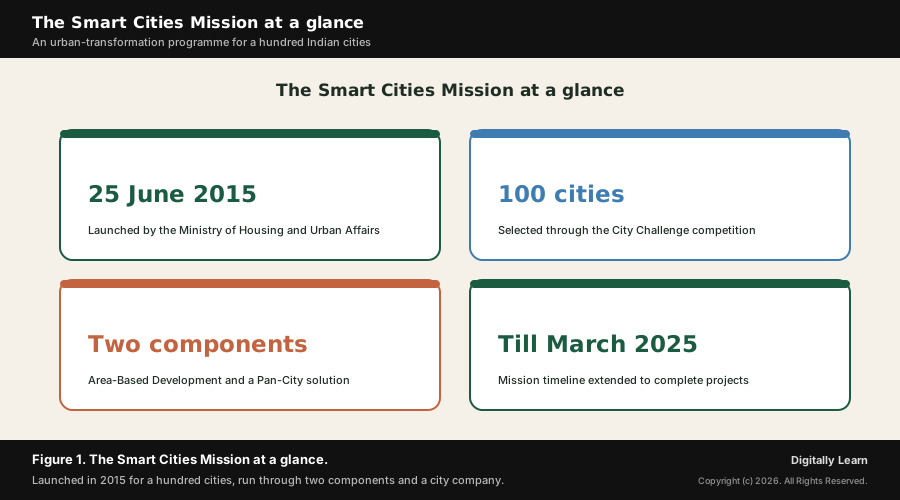
The Smart Cities Mission (SCM) is a centrally-sponsored urban-transformation programme of the Ministry of Housing and Urban Affairs, launched on 25 June 2015, to develop a hundred Indian cities selected through a competition called the City Challenge. Its stated aim is to promote cities that provide core infrastructure, a clean and sustainable environment and a decent quality of life to their citizens through the application of smart solutions. The Mission works through two components, Area-Based Development, which improves, renews or extends a chosen part of the city, and a Pan-City solution, which applies smart, largely technology-based, solutions across the whole city. Each selected city implements the Mission through a dedicated company, a Special Purpose Vehicle, and most run an Integrated Command and Control Centre to manage city services.
What the Smart Cities Mission Is and Why It Is in Focus
A centrally-sponsored urban-transformation programme for a hundred cities
The Smart Cities Mission is one of the flagship urban programmes of the Government of India, launched by the Prime Minister on 25 June 2015 alongside two sister missions, the Atal Mission for Rejuvenation and Urban Transformation and the housing mission for urban areas. It is run by the Ministry of Housing and Urban Affairs, and it set out to develop a hundred cities so that they offer their residents a markedly better standard of urban living.
The Mission's purpose is best understood through its core idea. It promotes cities that provide core infrastructure, such as assured water and power, sanitation, public transport and housing, together with a clean environment and a decent quality of life, all delivered through smart solutions. The Mission frames this work across four pillars of the city, the social, the economic, the physical and the institutional, so that the change is comprehensive.
The Mission is again in focus because its formal period has run its course and is being wound up and reviewed. After an initial timeline and later revisions, the Government extended it until 31 March 2025 to let cities complete their projects, and the Ministry has issued guidance on what the city companies and command centres do once it ends. This makes it a natural moment to assess the Mission. The figure below sets out the headline facts.
The Objectives and the Idea of a 'Smart' City
Core infrastructure, a clean environment, quality of life and smart solutions
The Mission's objectives are deliberately broad, because a city's liveability depends on many systems working together. The first is core infrastructure: an adequate and assured water supply, electricity, sanitation and solid-waste management, efficient public transport, affordable housing especially for the poor, and robust digital connectivity. These are the basic services that an aspirant should recognise as the foundation on which any further improvement rests.
The second and third objectives concern the urban environment and the resident's quality of life. The Mission seeks a clean and sustainable environment, with attention to green and open spaces, walkability and the prudent use of resources, and it seeks a decent quality of life for citizens, including the poor, with safety, health and economic opportunity. The intention is that growth in a Smart City should be both inclusive and durable rather than confined to a privileged few.
The fourth objective is the use of smart solutions, and it is worth being precise about what 'smart' means here. A Smart City is not only a city of sensors and screens; it uses technology, data and good design to deliver better services and plan more wisely. Smart solutions thus range from intelligent traffic management and smart metering to e-governance, but they serve the larger goal of liveability rather than defining the city.
The Selection of Cities: the City Challenge Competition
How a hundred cities were chosen through a competitive challenge
A distinctive feature of the Mission is that cities were not simply nominated from above; they were chosen through a competition. States and Union Territories first shortlisted potential cities against set conditions, and those cities then competed nationally in what was called the City Challenge, submitting Smart City proposals that were scored on the credibility of their plans, their finances and their citizen engagement.
Through this process a hundred cities were selected in four rounds of the challenge, running from January 2016 to June 2018. The competitive design was meant to reward cities that had done the hard work of planning and consultation, and to create replicable models that other cities could learn from. The approach also gave States and cities a strong incentive to improve their own planning to qualify.
The competitive, proposal-based selection is itself an exam point, because it marks a shift in how the Union supports cities. Rather than a uniform grant spread thinly, the Mission used a challenge-and-reward model that concentrated support on cities with strong, citizen-backed plans. This design is a recurring theme in modern urban policy and is worth holding precisely, including the figure of a hundred cities and the four-round process.
The Two Components: Area-Based Development and the Pan-City Solution
Area-Based Development through retrofitting, redevelopment and greenfield
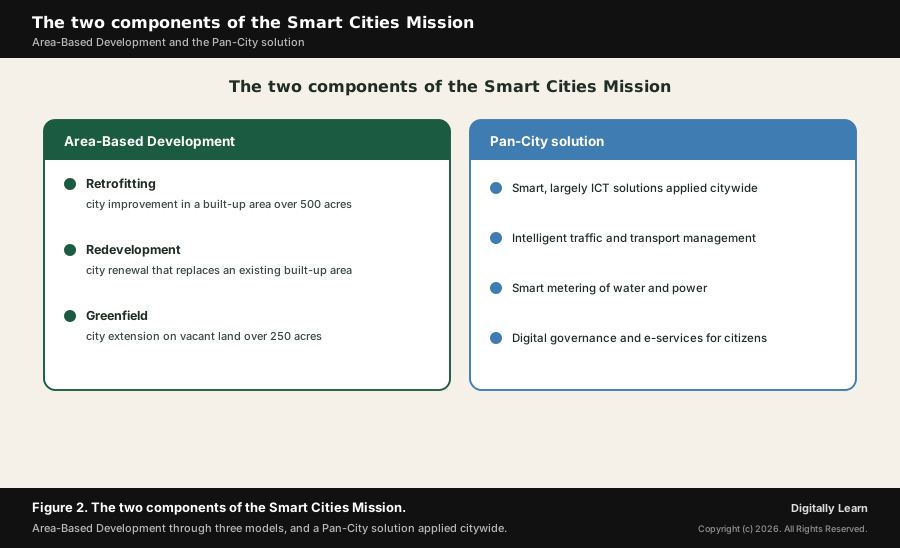
The Mission delivers its goals through two components, the first of which is Area-Based Development. Here the city takes a defined area and transforms it comprehensively, so that the area becomes a working model of what a Smart City can be. Area-Based Development comes in three forms, and it is important to keep them distinct because they apply to different kinds of land.
The first form is retrofitting, described as city improvement. Retrofitting introduces planning into an existing built-up area of more than five hundred acres to make it more efficient and liveable, while keeping the existing fabric largely in place. The second form is redevelopment, described as city renewal: here an existing built-up area is replaced with a new layout that allows enhanced infrastructure and a mixed use of land, a more thorough change than retrofitting.
The third form is greenfield development, described as city extension. Greenfield development introduces smart solutions in a previously vacant area of more than two hundred and fifty acres, using planning tools such as land pooling and land reconstitution, with a clear provision for affordable housing for the poor. Taken together, these three forms let a city improve what exists, rebuild what is failing, or build afresh. The table below summarises the components, and the figure that follows contrasts them.
| Component / form | Nature | Key feature |
|---|---|---|
| Retrofitting | City improvement | Planning added to a built-up area over 500 acres, fabric largely kept |
| Redevelopment | City renewal | An existing built-up area replaced with a new, denser layout |
| Greenfield development | City extension | Vacant land over 250 acres developed using land pooling, with affordable housing |
| Pan-City solution | Citywide | Smart, largely ICT solutions applied across the whole city |
Reading the rows together shows the logic: the first three forms transform a chosen area in different ways, while the Pan-City solution layers a citywide technology improvement on top, so that the Mission reaches both a model area and the city as a whole. The figure below contrasts the two components.
The Pan-City solution: smart, technology-based solutions applied citywide
The second component is the Pan-City solution, and it complements Area-Based Development by reaching the whole city rather than one area. Under the Pan-City component a city selects one or more smart solutions, largely based on information and communication technology, and applies them across its entire extent so that every resident, not only those in the developed area, sees some benefit.
In practice the Pan-City solutions tend to address a city's most pressing system-wide problems. Common examples include intelligent traffic and transport management to cut congestion, smart metering and improved monitoring to manage water and electricity, and digital platforms for governance and citizen services. The aim is that a layer of technology and data should make existing city-wide systems work better, which is why the command centres described later are so central to this component.
The Implementation Model: the Special Purpose Vehicle and Funding
The Special Purpose Vehicle: a city company that delivers the Mission
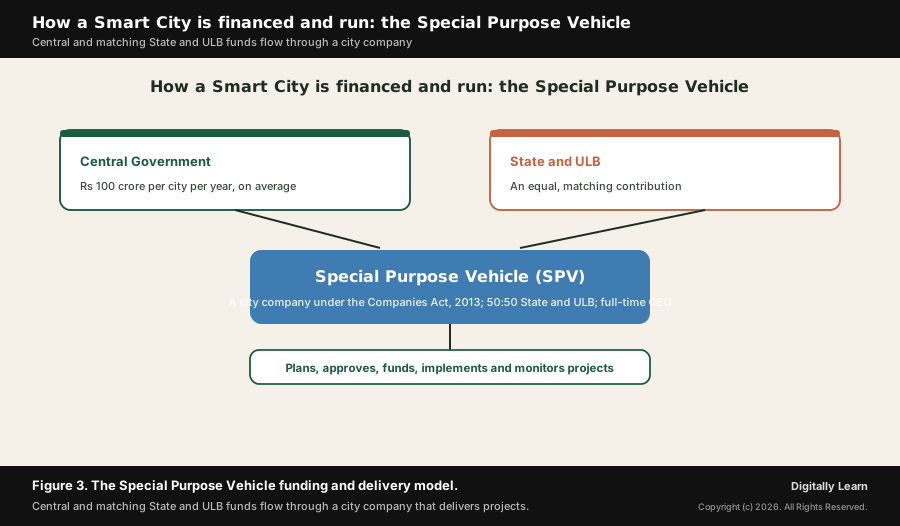
The Mission's most distinctive institutional feature is the Special Purpose Vehicle, the company through which each Smart City is delivered. In every selected city the Mission is implemented by an SPV, a limited company incorporated under the Companies Act, 2013 at the city level, with the State or Union Territory and the Urban Local Body as its promoters holding equal, fifty-fifty, equity in the company.
The SPV is built to act with a degree of autonomy and professionalism. It is headed by a full-time Chief Executive Officer and has on its board nominees of the Central Government, the State Government and the Urban Local Body. Within its mandate the SPV plans, appraises, approves, releases funds for, implements, manages, monitors and evaluates the Smart City projects, which gives the Mission a single, ring-fenced vehicle able to move faster than the ordinary municipal process.
This company-led design is the heart of the Mission's delivery model, and it is also the focus of the governance debate considered later. Concentrating planning and project powers in a dedicated company is meant to overcome the capacity and finance constraints of many city governments. Whether it does so without sidelining the elected city government is what makes the SPV both the Mission's signature and its most-discussed feature. The figure below traces the flow.
Central, State and ULB funding, convergence and private finance
The Mission's funding model matches its shared structure. The Central Government committed financial support of about forty-eight thousand crore rupees over five years, which works out, on an average, to about one hundred crore rupees per city per year. An equal amount is contributed on a matching basis by the State Government and the Urban Local Body, so that nearly one lakh crore rupees of Government and ULB funds was envisaged for Smart Cities development.
Mission grants were never expected to meet the full cost, so the model relies heavily on convergence and leverage. Cities are expected to raise further resources by converging other government schemes, by drawing on their own revenues and Finance Commission grants, by issuing municipal bonds and other innovative finance, and through Public-Private Partnerships. A large part of the planned project value was therefore expected from convergence and partnerships, not from grants alone.
The Integrated Command and Control Centre as the city's digital brain
The clearest physical expression of the 'smart' idea is the Integrated Command and Control Centre, often called the ICCC, which most Smart Cities have built and made operational. An ICCC brings the data feeds from many city systems, such as traffic, transport, water, waste, lighting and surveillance, into a single control room, so that the city can monitor its services in real time and respond quickly to problems.
These command centres draw on technologies such as artificial intelligence, the internet of things and data analytics, and during the pandemic many were repurposed as COVID war rooms. As the Mission winds up, the Ministry has advised States on how the ICCCs should continue, as city operating systems and analytical hubs serving urban governance beyond the Mission's end. This continuing role is also why the data they hold has become a subject of public discussion, considered later.
The Institutional and Federal Architecture: Who Runs the Mission
The Ministry, the States, the Urban Local Bodies and the 74th Amendment
Understanding the Mission requires holding its institutional architecture clearly, because urban development in India is shared across three levels of government. At the top, the Ministry of Housing and Urban Affairs frames the Mission's guidelines, releases the central share of funds, and monitors progress through an apex committee, while leaving the choice and design of projects to the cities.
Below the Union, the State Governments are central to the Mission, because urban local government is a State subject. States nominate and back the competing cities, contribute the matching State share, set up high-powered steering committees, and are joint promoters of every city company. The day-to-day delivery, however, runs through the city-level Special Purpose Vehicle and, alongside it, the Urban Local Body, the municipal corporation or council that is the constitutionally-recognised city government.
This is where the 74th Constitutional Amendment enters. The Constitution (74th Amendment) Act, 1992, in force on 1 June 1993, gave constitutional status to Urban Local Bodies, and its Twelfth Schedule lists eighteen functions, including urban planning, that may be devolved to municipalities, supported by Ward, District and Metropolitan Planning Committees. The Mission therefore sits on top of an existing constitutional design for elected city government, and the link between the company and that elected body drives the main debate.
Convergence with AMRUT and the Other Urban Missions
How the Smart Cities Mission sits among India's urban programmes
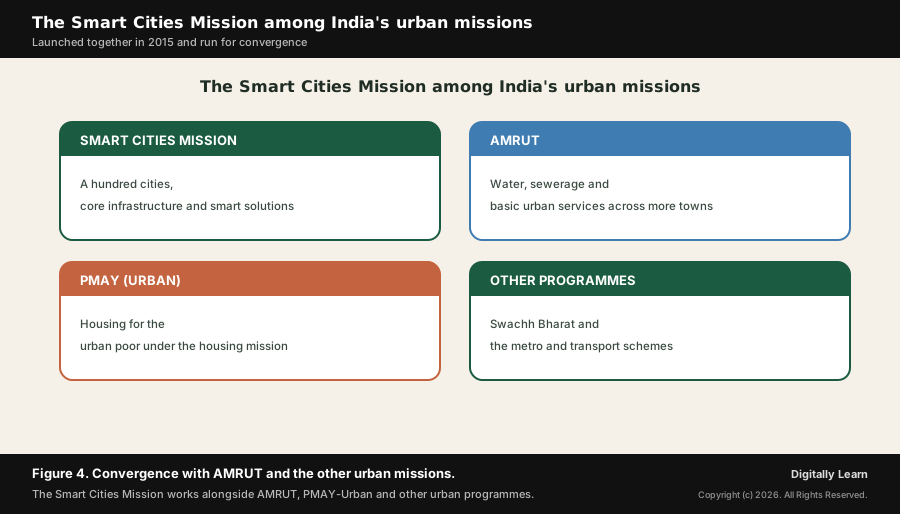
The Smart Cities Mission was never meant to work in isolation. It was launched on the same day as the Atal Mission for Rejuvenation and Urban Transformation, known as AMRUT, and the housing mission for urban areas, and the three were designed to reinforce one another. Where the Smart Cities Mission concentrates intensive, model development in a hundred chosen cities, AMRUT spreads basic urban services more widely across many more towns.
This is the logic of convergence. AMRUT focuses on universal coverage of water supply, sewerage, drainage, green spaces and urban transport across a much larger set of cities, while the housing mission for urban areas addresses affordable housing for the urban poor. A Smart City can braid these programmes together, so that Mission funds, AMRUT works and housing schemes, along with sanitation and transport programmes, add up to more than the sum of their parts in the same city.
For the exam, the value of seeing the Mission in this wider family is that it prevents a common error, treating the Smart Cities Mission as the whole of urban policy. It is one instrument among several, marked by its competitive selection, its concentrated area model and its company-led delivery, but dependent on convergence with the other missions for broad-based change. The figure below places it among the urban programmes.
Outcomes, the Extended Timeline and the Mission's Record
What the Mission delivered and why its timeline was extended
Assessing the Mission's outcomes calls for care, because the picture is mixed and the figures move as projects are completed. The Mission has driven a large body of work across the hundred cities, in public spaces, mobility, water and sanitation, and digital governance, and the building of operational command centres is among its most visible achievements. The Government presents the Mission as having improved how cities plan and manage their services.
At the same time, the Mission ran behind its original schedule. The initial completion timeline was set for the years soon after launch, but as the scale of the work became clear the deadline was revised more than once, and the Mission period was finally extended to 31 March 2025 so that cities could finish the remaining share of their projects. The need for repeated extensions is itself a fair indicator of how demanding the programme proved in practice.
A balanced reading therefore avoids both extremes. The Mission cannot be dismissed, given the volume of projects and the command-centre infrastructure now in place, nor can it be called an unqualified success, given the delays, the uneven progress between cities and the open questions about how the gains will be sustained once it ends. This measured assessment, rather than a verdict either way, is what a strong answer should offer.
The Debates: the SPV Model, Equity, the Enclave Critique and Data
The Special Purpose Vehicle and the elected city government under the 74th Amendment
The most important debate around the Mission concerns the Special Purpose Vehicle and its relationship with the elected city government. Supporters of the model argue that a dedicated, professionally-staffed company can plan and execute projects faster and more capably than many municipal bodies, which often lack the finance, staff and technical capacity to deliver complex urban infrastructure on their own. On this view the SPV is a practical answer to a real constraint.
Critics and many commentators counter that the company can sit outside the elected council. Because the SPV plans, approves and funds projects, with a CEO and government nominees on its board, important decisions about a city can be taken by a body its voters do not directly elect. This, the critics argue, sits uneasily with the spirit of the 74th Amendment, which sought to devolve planning and powers to elected Urban Local Bodies.
The functional and financial sides of this concern run together. Functionally, planning powers that the 74th Amendment envisaged for the municipality can in practice be exercised by the SPV or by State parastatal agencies, so the elected council may not lead its own city's work. Financially, the Mission's funds flow through the SPV, not the municipal budget, and many city governments depend on outside transfers with weak own revenues, deepening the gap in municipal empowerment.
The equity and 'enclave' critique of Area-Based Development
A second debate concerns equity, and it focuses on the Area-Based Development component. Because Area-Based Development concentrates intensive investment in one chosen part of the city, critics argue that it can create well-served enclaves while the rest of the city, where most residents and most of the poor live, sees comparatively little direct benefit. The worry is that a Smart City can become a smart district within an otherwise unchanged city.
Defenders of the design respond that the area model is meant to be a demonstration, a replicable example whose lessons can spread outward, and that the Pan-City component is what is meant to reach the whole city. The honest assessment is that the balance between the showcase area and city-wide benefit varies from city to city, and that improving life for the urban poor, not only for a favoured zone, remains a genuine test of the Mission's inclusiveness.
Data, surveillance and privacy questions around the command centres
A third debate concerns data and privacy, and it arises from the command centres at the Mission's technological core. Because an Integrated Command and Control Centre gathers data from across the city, including from cameras and sensors, it raises questions about surveillance, the security of citizens' data, and who may access and use it. As these centres are designed to outlast the Mission and serve wider city governance, those questions become more, not less, important over time.
A careful view treats this as a matter of safeguards rather than of rejecting the technology. The case for command centres in improving city services is real, but it strengthens the argument for clear rules on data protection, for transparency about what is collected and why, and for accountability in how the systems are used, in light of India's data-protection law. Holding both the benefit and the risk in view is the balanced position an answer should adopt.
The Significance and the Way Forward
Why the Mission matters and how its gains can be sustained
What is the significance of the Smart Cities Mission lies in how it has reshaped the practice of urban governance in India. It made cities plan and compete, it concentrated investment and professional capacity on urban delivery, and it normalised the use of data and command centres in running a city. Whatever the debates, it placed the future of India's cities, where a growing share of the population now lives, near the centre of national policy.
The way forward follows from the debates themselves. The sustained value of the Mission will depend on integrating the city companies and their command centres into the elected municipal structure rather than around it, on strengthening the finances and functions of Urban Local Bodies in the spirit of the 74th Amendment, on spreading benefits beyond the model areas to the whole city and its poor, and on putting firm data-protection safeguards around the command centres.
Seen in the round, the Smart Cities Mission is best read not as a finished verdict but as a major experiment in modern Indian urban policy, with real achievements and real unresolved questions. For an aspirant, the task is to explain its objectives, components and delivery model accurately, and then to weigh its record and debates in measured terms, which is exactly what the examination tends to reward.
UPSC Relevance and Exam Focus
Where the Smart Cities Mission fits in the UPSC-CSE syllabus
This topic maps most directly to General Studies Paper II: government policies and interventions for development in various sectors and to issues of urban governance, including the devolution of powers under the 74th Amendment. It also maps to General Studies Paper I, under urbanisation and its problems and remedies, since the Mission is a leading governmental response to the pressures of rapid urban growth.
For Prelims, hold the high-yield facts: the Mission was launched on 25 June 2015 by the Ministry of Housing and Urban Affairs; a hundred cities were chosen through the City Challenge; its objectives are core infrastructure, a clean environment, a decent quality of life and smart solutions; its two components are Area-Based Development (retrofitting, redevelopment and greenfield) and the Pan-City solution; and it is delivered by an SPV under the Companies Act, 2013 with a command centre.
For Mains, the recurring framing is to assess the Mission as a government intervention in urban development and to weigh the governance debates around it. A strong answer explains the objectives, components and the SPV-led delivery model precisely, and then evaluates the Mission against the 74th Amendment, the equity and enclave concerns, the data questions and the record of delivery, taking a measured rather than a one-sided position.
Recurring linked concepts an aspirant should keep in working memory:
- The 74th Amendment and Urban Local Bodies: The constitutional design for elected city government and the Twelfth Schedule of municipal functions, against which the SPV model is judged.
- Area-Based Development and the Pan-City solution: The two components, with retrofitting, redevelopment and greenfield as the three forms of the first.
- The Special Purpose Vehicle: The city company under the Companies Act, 2013 that plans, funds and delivers the Mission’s projects.
- Convergence with AMRUT and the housing mission: The wider family of urban programmes with which the Mission is meant to work.
A common Prelims trap is to confuse the two components or the three forms of Area-Based Development, or to misstate the SPV's legal form; hold that the SPV is a company under the Companies Act, 2013, with the State or Union Territory and the Urban Local Body as equal promoters.
A common Mains trap is to praise or condemn the Mission wholesale. Its exam value lies in a balanced judgment: the genuine gains in planning, infrastructure and command centres, set against the questions about elected city government, equity and data, with the way forward framed around integrating the gains into a strengthened municipal structure.
Previous Year UPSC-CSE Questions By the end you will be able to draft model answers for the following UPSC questions. Each question carries a collapsible framework showing how to approach it in the exam.
- UPSC Mains 2023 GS-IIComment on whether and why the states in India are reluctant to empower urban local bodies functionally and financially.
How to structure the answer in the exam
Body (sub-themes to develop):
- Functional disempowerment: the 74th Amendment envisaged planning and eighteen Twelfth Schedule functions for elected municipalities, but under the Mission these can be exercised by a separate Special Purpose Vehicle or by State parastatal agencies, leaving the elected council without effective control over its own city's projects.
- Financial disempowerment: the Mission's central and matching funds flow through the SPV rather than the municipal budget, and many Urban Local Bodies have weak own revenues and depend on State and central transfers, so they are not financially empowered to lead urban development.
- Why states may prefer this design: a professionally-run company can overcome real capacity, staffing and finance constraints in many municipalities and can deliver complex infrastructure faster, which is the practical case for the model.
- The cost in democratic terms: decisions taken by a company that voters do not directly elect sit uneasily with the spirit of the 74th Amendment's devolution to elected city governments, raising accountability concerns.
- A balanced way forward: integrate the city companies and their command centres into a strengthened elected municipal structure, and build the functions and finances of Urban Local Bodies so that delivery and democratic devolution are not in conflict.
Sources and Further Reading
- Smart Cities Mission: About the Mission
- Smart Cities Mission: About SCM (components and the City Challenge)
- Smart Cities Mission: Implementation (the Special Purpose Vehicle)
- Smart Cities Mission: Financing
- Press Information Bureau: Smart Cities Mission objectives and core infrastructure
- Press Information Bureau: Implementation of the Smart Cities Mission
- Press Information Bureau: Smart Cities Mission extended till March 2025
- Press Information Bureau: MoHUA issues Advisory for Repurposing of Smart City SPVs
- Ministry of Housing and Urban Affairs: The Constitution (74th Amendment) Act, 1992
- India Code: The Constitution (Seventy-fourth Amendment) Act, 1992
- NITI Aayog: India Smart City Mission presentation
- Wikipedia: Smart Cities Mission
- Wikipedia: Seventy-fourth Amendment of the Constitution of India
Editorial Disclaimer
This briefing is for UPSC preparation. Verify the facts and provisions against the official MoHUA and Smart Cities Mission sources before relying on them.


