


Overview
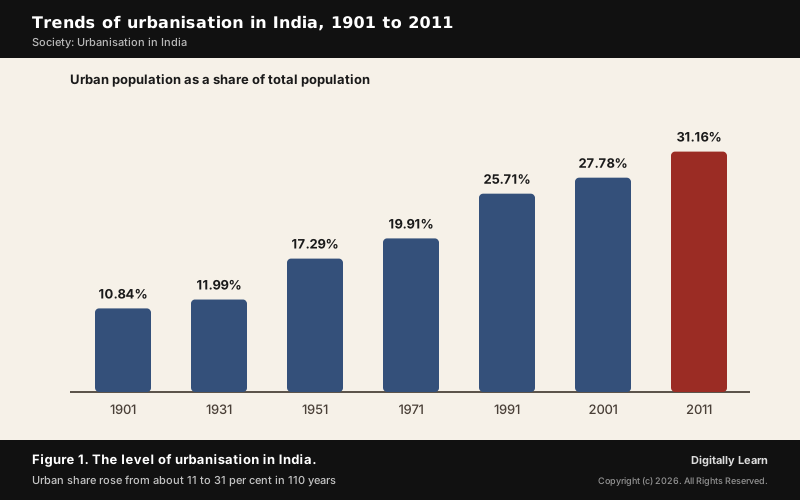
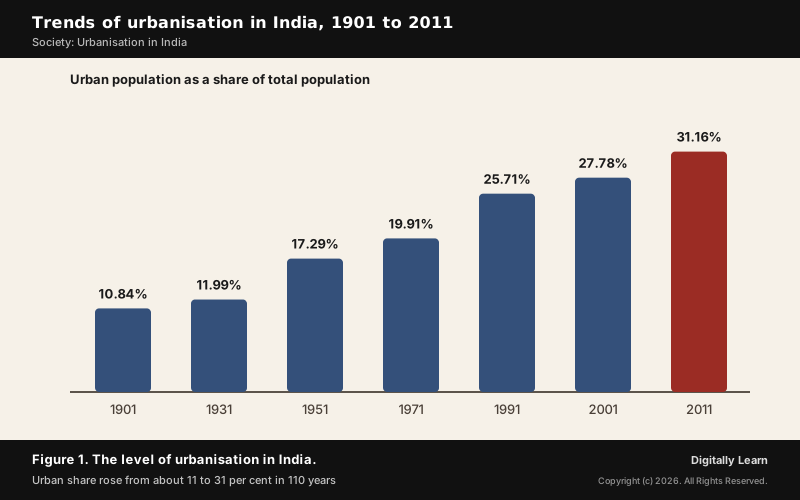
Urbanisation in India is the growth in the share of India's people who live in towns and cities. Its level is measured as the percentage of urban population in the total population, which rose from about 11 per cent in 1901 to 31.16 per cent in 2011. It is driven by migration from villages and the growth of towns, and it brings both opportunity and problems such as slums, congestion and pollution.
Urbanisation in India: Meaning, Definition and Trends
What Is Urbanisation? Meaning and the Census Definition of Urban
The level of urbanisation is measured as the percentage of urban population in the total population. Urban settlements, unlike villages, are generally compact and large, and specialise in secondary and tertiary activities: processing, manufacturing and services. Cities act as nodes of economic growth, serving the rural hinterland that sends them food and raw materials.
- Statutory towns: In India a settlement of any size is urban if it has a municipality, a corporation, a cantonment board or a notified town area committee.
- Census towns: Other places count as urban if they have at least 5,000 people, a density of at least 400 persons per square kilometre, and 75 per cent of male workers in non-agricultural work.
- City and class I town: An urban centre of more than one lakh people.
- Metropolitan and mega cities: Cities of one to five million are metropolitan; above five million they are mega cities.
- Urban agglomeration: A town or city with its adjoining urban outgrowths, such as railway colonies, university campuses or cantonments, or a contiguous spread of towns.
Trends of Urbanisation in India: 1901 to 2011
India's urban share grew slowly for half a century and faster after Independence. It stood at 10.84 per cent in 1901, 17.29 per cent in 1951 and 27.78 per cent in 2001, and reached 31.16 per cent in 2011. Urban population rose from 25.85 million in 1901 to 377.11 million in 2011, and increased eleven-fold during the twentieth century alone. The enlargement of existing towns and the emergence of new ones drove this growth, though the growth rate has slowed over the last two decades.
- Class I dominance: In 2001, more than 60 per cent of urban population lived in class I towns; of 423 cities, 35 were metropolitan and six were mega cities.
- Mega cities: More than one-fifth of urban population lived in the six mega cities in 2001, with Greater Mumbai the largest at 16.4 million, followed by Kolkata, Delhi, Chennai, Bangalore and Hyderabad.
- Still low: India’s level of urbanisation is quite low compared with developed countries; the World Bank put it at 35.69 per cent in 2025.
Evolution of Towns in India: Ancient, Medieval, Colonial and Modern
Towns have flourished in India since the Indus valley civilisation, when Harappa and Mohenjodaro existed. On the basis of when they grew, Indian towns fall into three groups:
- Ancient towns: Towns with over 2,000 years of history, mostly religious and cultural centres, such as Varanasi, Prayag, Pataliputra and Madurai.
- Medieval towns: About 100 existing towns grew as headquarters of principalities and kingdoms, often fort towns such as Delhi, Hyderabad, Jaipur, Lucknow, Agra and Nagpur.
- Colonial towns: Europeans built trading ports such as Surat, Daman, Goa and Pondicherry; the British then built Mumbai, Chennai and Kolkata; in 1690 Job Charnock leased three villages by the Hugli that grew into Kolkata.
- After Independence: New administrative towns such as Chandigarh, Bhubaneswar and Gandhinagar, industrial towns such as Durgapur, Bhilai and Barauni, and satellite towns such as Ghaziabad, Rohtak and Gurugram around Delhi.
Colonial urbanisation was governed by colonial interests: some earlier urban centres declined while new port cities grew to ship raw materials such as cotton, jute and indigo to Britain.
| Functional class | Examples |
|---|---|
| Administrative | Chandigarh, New Delhi, Bhopal, Shillong, Gandhinagar |
| Industrial | Mumbai, Salem, Coimbatore, Jamshedpur, Bhilai |
| Transport (ports and inland hubs) | Kandla, Kochi, Kozhikode, Visakhapatnam; Agra, Itarsi, Katni |
| Commercial | Kolkata, Saharanpur, Satna |
| Mining | Raniganj, Jharia, Digboi, Ankaleshwar, Singrauli |
| Garrison cantonment | Ambala, Jalandhar, Mhow, Udhampur |
| Educational | Roorkee, Varanasi, Aligarh, Pilani, Prayagraj |
| Religious and cultural | Varanasi, Mathura, Amritsar, Madurai, Puri, Ajmer, Tirupati, Haridwar, Ujjain |
| Tourist | Nainital, Mussoorie, Shimla, Pachmarhi, Jaisalmer, Ooty, Mount Abu |
Functions change as towns grow: even a specialised city, once it becomes a metropolis, turns multifunctional, with industry, business, administration and transport so intertwined that it cannot be placed in a single class.
Causes of Urbanisation in India
Causes of Urbanisation: Push and Pull Factors of Migration
Urban growth in India comes from the enlargement of existing towns, the emergence of new ones and rural-to-urban migration, which is driven by push factors that make people leave villages and pull factors that attract them to cities.
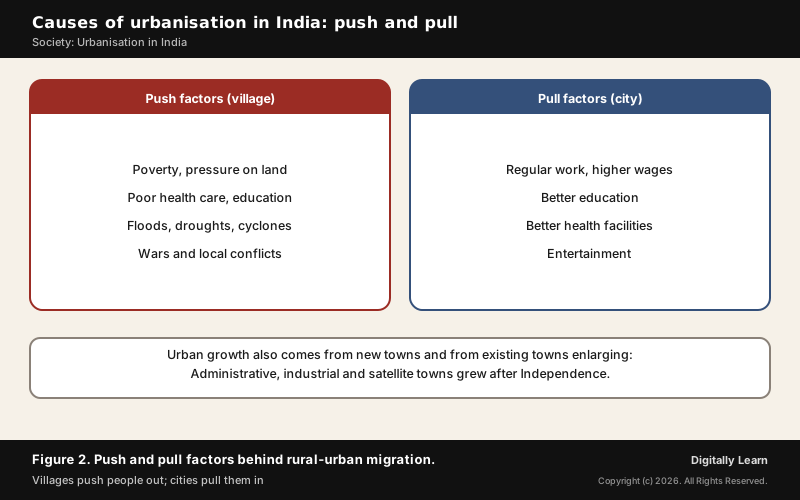
- Push factors: Poverty, high population pressure on land, and a lack of health care, education and other basic facilities; floods, droughts, cyclones, earthquakes, wars and local conflicts add a further push.
- Pull factors: The most important is better opportunity, with regular work and relatively higher wages; better education, health facilities and entertainment also attract people.
- Who migrates and why: Work and employment explain 38 per cent of male migration but only 3 per cent of female migration; about 65 per cent of women move because of marriage.
- Industrialisation: Industry creates jobs in towns, though urbanisation and industrialisation do not always go together.
Problems of Urbanisation in India
Slums, Housing and the Marginalisation of the Urban Poor
Indian cities are sharply divided. At the top are high-income localities with wide roads, street lights, water, sanitation, parks and security; at the other extreme are slums, jhuggi-jhopri clusters and shanty colonies, home to people who migrated in search of livelihood but could not afford proper housing because of high rents and land costs.
- Living conditions: Slums are residential areas of least choice, with dilapidated houses, poor hygiene and ventilation, and no drinking water, light or toilets; they are overcrowded and prone to fire.
- Work and health: Slum dwellers mostly work in low-paid, high-risk jobs in the unorganised sector, are undernourished and prone to disease, and can ill afford to educate their children.
- Exclusion: Poverty makes them vulnerable to drug abuse, alcoholism, crime and, ultimately, social exclusion.
- Scale: In most million-plus cities, one in four inhabitants lives in illegal settlements, which are growing twice as fast as the rest of the city.
Economic, Social and Environmental Problems of Urbanisation
Most cities in developing countries are unplanned, so the flow of people creates severe congestion, a shortage of housing, vertical expansion and the growth of slums. The problems fall into three groups:
- Economic problems: Fewer jobs in villages and small towns push people to cities, creating a pool of unskilled and semi-skilled labour that the urban economy is already saturated with.
- Social problems: Too little money for social infrastructure leaves educational and health facilities beyond the reach of the urban poor; lack of jobs and education aggravates crime; male-selective migration distorts the sex ratio.
- Environmental: Cities struggle to supply enough potable water; poor sewerage creates unhealthy conditions; traditional fuels pollute the air; waste is dumped untreated.
- Urban heat islands: Huge concrete structures and other changes to the land surface, with waste heat from energy use as a secondary cause, keep cities warmer than the surrounding countryside, especially at night.
Urban Governance: The 74th Amendment and Urban Local Bodies
74th Constitutional Amendment Act, 1992: Municipalities in Part IXA
Urban local government in India began under British rule: the first municipal corporation was set up at Madras in 1687-88, and corporations followed in Bombay and Calcutta in 1726. Lord Ripon's Resolution of 1882 is hailed as the Magna Carta of local self-government. A Nagarpalika Bill of 1989 lapsed after defeat in the Rajya Sabha; the 74th Constitutional Amendment Act, 1992 finally came into force on 1 June 1993.
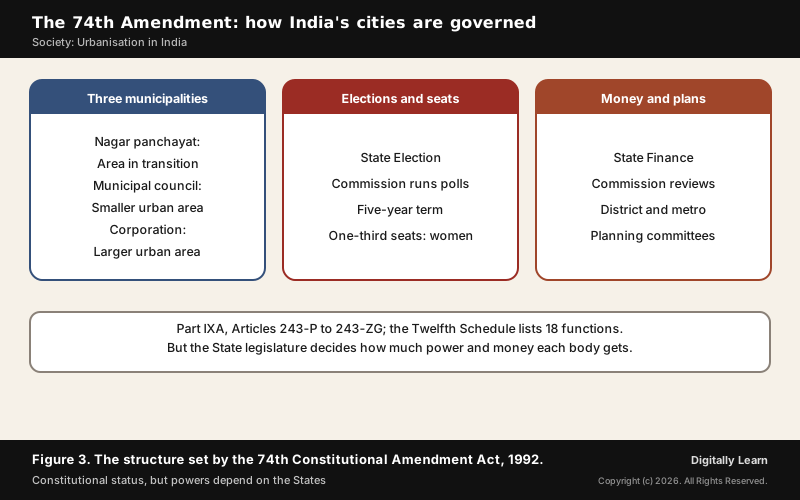
- Part IXA: Added ‘The Municipalities’, Articles 243-P to 243-ZG, and the Twelfth Schedule with 18 functional items such as urban planning, water supply, slum improvement and urban poverty alleviation; its companion, the 73rd Amendment, added Part IX on the panchayats.
- Three types (Article 243-Q): A nagar panchayat for an area in transition from rural to urban, a municipal council for a smaller urban area and a municipal corporation for a larger one.
- Representation: Members are directly elected from wards; wards committees are required where population is three lakh or more; not less than one-third of seats are reserved for women, and seats for SCs and STs in proportion to population.
- Term and elections: A five-year term, with fresh elections within six months if dissolved; elections are run by the State Election Commission.
- Finance and planning: The State Finance Commission also reviews municipal finances every five years; a district planning committee consolidates the plans of panchayats and municipalities, and every metropolitan area (ten lakh people or more) has a metropolitan planning committee.
Why Urban Local Bodies Remain Weak: Powers, Funds and Leadership
The 74th Amendment made municipalities constitutional, but it left the key decisions to the States. The State legislature may endow municipalities with powers and responsibilities, may authorise them to levy taxes, duties, tolls and fees, may assign them State taxes and may give them grants. What a city can do and spend therefore depends on how much its State chooses to devolve.
- Executive in State hands: In a municipal corporation the commissioner, appointed by the State government and generally an IAS officer, is the chief executive authority.
- A ceremonial mayor: The mayor is in most States elected for a one-year renewable term and is basically an ornamental head who presides over council meetings.
- Many types, little uniformity: India has eight types of urban local bodies, from corporations and municipalities to cantonment boards, townships, port trusts and special purpose agencies.
- Parallel bodies: Missions such as the Smart Cities Mission work through a special purpose vehicle headed by a chief executive officer, alongside the elected council.
Government Schemes for Urban Development in India
Smart Cities Mission, AMRUT, PMAY-Urban and Swachh Bharat Mission
Since 2014 the Union government has run several urban missions, most launched in 2015:
| Mission | Launched | Aim |
|---|---|---|
| Swachh Bharat Mission | 2 October 2014 | Eliminate open defecation and improve solid waste management |
| Smart Cities Mission | 25 June 2015 | Urban renewal and retrofitting of 100 cities to make them citizen-friendly and sustainable |
| AMRUT | June 2015 | Sewerage networks and water supply in 500 cities |
| PMAY-Urban | June 2015 | Affordable housing for the urban poor, including economically weaker sections |
The Smart Cities Mission aims to promote cities that provide core infrastructure, a clean and sustainable environment and a decent quality of life, by applying smart solutions to infrastructure and services. Its focus is sustainable and inclusive development: to develop compact areas and create a replicable model that acts as a lighthouse to other aspiring cities.
- Smart Cities design: Cities were selected through a countrywide competition, the Smart Cities Challenge; each developed model areas under an area development plan, expected to have a rub-off effect on the rest of the city, through a special purpose vehicle headed by a CEO. The deadline of 2019 was revised to 2023, and the mission was closed on 31 March 2025.
- Smart Cities record: A 2021 review found about 49 per cent of projects with work orders still incomplete; by 2025 only 18 of 100 cities had completed all planned projects.
- Housing target: PMAY aimed at 2 crore affordable houses by 31 March 2022, converging with schemes for toilets, electricity and LPG connections.
- Sanitation: Phase II of Swachh Bharat, launched in 2020, focuses on keeping open-defecation-free status and improving waste management (Swachh Bharat Mission).
Way Forward: Inclusive, Healthy and Sustainable Cities
Better cities need both services for all and stronger links with villages. The United Nations Development Programme's urban strategy sets out the priorities:
- Increasing shelter for the urban poor.
- Basic urban services such as education, primary health care, clean water and sanitation.
- Improving women’s access to basic services and government facilities.
- Upgrading energy use and alternative transport systems, and reducing air pollution.
The World Health Organization adds that a healthy city must have a clean and safe environment, meet the basic needs of all its inhabitants, involve the community in local government and provide easily accessible health services. Because rural population has outpaced rural jobs, the other half of the answer lies in villages: eradicating rural poverty and creating employment and education there eases the pressure on cities.
Previous Year UPSC-CSE Questions
Previous Year UPSC-CSE Questions By the end you will be able to draft model answers for the following UPSC questions. Each question carries a collapsible framework showing how to approach it in the exam.
- UPSC Mains 2013 GS-IDiscuss the various social problems which originated out of the speedy process of urbanization in India.
Answer outline: how to structure the answer
What the question asks, the main arguments, relevant examples and the direction of the conclusion. This is not a full model answer.
Introduction: India's urban share rose to 31.16 per cent in 2011, with migration feeding cities that are largely unplanned.
Body (sub-themes to develop):
- Housing: slums and illegal settlements; in most million-plus cities one in four lives in them.
- Social: Educational and health facilities beyond the reach of the poor; crime; male-selective migration distorting the sex ratio.
- Exclusion: low-paid informal work, disease and social exclusion in slums.
Conclusion: Conclude that planned, inclusive cities and rural employment reduce these problems.
- UPSC Mains 2023 GS-IDoes urbanization lead to more segregation and/or marginalization of the poor in Indian metropolises?
Answer outline: how to structure the answer
What the question asks, the main arguments, relevant examples and the direction of the conclusion. This is not a full model answer.
Introduction: Indian metropolises are divided between well-served localities and slums.
Body (sub-themes to develop):
- Segregation: wide roads, parks and security at the top; jhuggi-jhopri clusters at the other extreme.
- Why: high rents and land costs push migrants to degraded land.
- Marginalisation: low-paid, high-risk informal work, disease, poor schooling and social exclusion.
Conclusion: Conclude that urbanisation segregates the poor unless housing and services reach them.
- UPSC Mains 2016 GS-IWith a brief background of quality of urban life in India, introduce the objectives and strategy of the ‘Smart City Programme’.
Answer outline: how to structure the answer
What the question asks, the main arguments, relevant examples and the direction of the conclusion. This is not a full model answer.
Introduction: Congestion, slums and poor services mark urban life in India.
Body (sub-themes to develop):
- Background: slums, water and sewerage shortfalls, pollution, heat islands.
- Objectives: core infrastructure, a clean and sustainable environment, a decent quality of life, smart solutions.
- Strategy: selection by the Smart Cities Challenge, area development plans, a special purpose vehicle, lighthouse models.
Conclusion: Conclude that the mission's value lies in replicating its model areas across the city.
- UPSC Mains 2025 GS-IHow does smart city in India, address the issues of urban poverty and distributive justice?
Answer outline: how to structure the answer
What the question asks, the main arguments, relevant examples and the direction of the conclusion. This is not a full model answer.
Introduction: The Smart Cities Mission aims at sustainable and inclusive development.
Body (sub-themes to develop):
- Reach: core infrastructure and services; convergence with PMAY-U housing, AMRUT water and Swachh Bharat sanitation.
- Limits: area-based renewal of a chosen part of each city; slow completion.
- Justice: shelter, basic services and women's access to services, as the UNDP urban strategy sets out.
Conclusion: Conclude that smart cities reduce urban poverty only when paired with housing and services for all.
- UPSC Mains 2023 GS-II“The states in India seem reluctant to empower urban local bodies both functionally as well as financially.” Comment.
Answer outline: how to structure the answer
What the question asks, the main arguments, relevant examples and the direction of the conclusion. This is not a full model answer.
Introduction: The 74th Amendment gave municipalities constitutional status in Part IXA.
Body (sub-themes to develop):
- Guaranteed: elections, five-year term, reservation, State Election Commission, finance commission review.
- Left to States: powers, taxes and grants under Article 243-W and the finance provisions, all 'may'.
- In practice: commissioner appointed by the State; mayor elected for one year and ornamental.
Conclusion: Conclude that the reluctance is real where functions, funds and functionaries stay with the State.
- UPSC Prelims 2005 Prelims-GSConsider the following statements:
- Part IX of the Constitution of India contains provisions for Panchayats and was inserted by the Constitution (73rd Amendment) Act, 1992.
- Part IX A of the Constitution of India contains provisions for municipalities and Article 243Q envisages two types of municipalities – a Municipal Council and a Municipal Corporation – for every state.
Which of the statements given above is/are correct?
How to approach this Prelims question
Approach: Part IX on panchayats was inserted by the 73rd Amendment, 1992, so statement 1 is correct. Part IXA on municipalities came with the 74th Amendment, and Article 243Q provides for three types, a Nagar Panchayat, a Municipal Council and a Municipal Corporation, not two, so statement 2 is wrong.
Trap to watch: Article 243-Q provides three types: nagar panchayats, municipal councils and municipal corporations.
Key facts to recall:
- (a) 1 only: right. Part IX and the 73rd Amendment are correctly matched.
- (b) 2 only: wrong. Article 243Q provides for three types of municipalities.
- (c) Both 1 and 2: wrong. Statement 2 leaves out the Nagar Panchayat.
- (d) Neither 1 nor 2: wrong. Statement 1 is correct.
Answer signal: Option (a): only statement 1 is correct.
- UPSC Prelims 2009 Prelims-GSIn India, the first Municipal Corporation was set up in which one among the following ?
How to approach this Prelims question
Approach: The first Municipal Corporation in India was set up at Madras in 1687-88; Bombay and Calcutta followed in 1726.
Trap to watch: Calcutta and Bombay came later, in 1726.
Key facts to recall:
- (a) Calcutta: wrong. Its corporation came in 1726.
- (b) Madras: right. It was set up in 1687-88.
- (c) Bombay: wrong. Its corporation came in 1726.
- (d) Delhi: wrong. Delhi came much later.
Answer signal: Option (b): Madras.
Sources and Further Reading
- NCERT: India, People and Economy (Class XII), Chapter 2, Human Settlements
- NCERT: Social Change and Development in India (Class XII), Chapter 1, Structural Change
- Legislative Department: The Constitution (Seventy-fourth Amendment) Act, 1992
- PIB: Progress under Smart Cities Mission (Rajya Sabha reply, 2026)
- World Bank: Urban population (% of total population), India
- Wikipedia: Urbanisation in India
- Wikipedia: Smart Cities Mission
- Wikipedia: Atal Mission for Rejuvenation and Urban Transformation
- Wikipedia: Pradhan Mantri Awas Yojana
- Wikipedia: Swachh Bharat Mission
- Wikipedia: Urban heat island
- UPSC: Previous year question papers
Editorial Disclaimer
This article explains urbanisation in India from the NCERT geography and sociology textbooks, the constitutional provisions on municipalities and the other sources listed below. Census figures are from the latest completed census.


