


Overview
Foreign Contribution Law and the JPC
The FCRA Bill 2026, the Foreign Contribution (Regulation) Amendment Bill, amends the Foreign Contribution (Regulation) Act, 2010 to set up a Designated Authority that takes over the assets an organisation built with foreign money when its registration ends, returns them if registration is restored, and keeps them for good if it is not. On 12 August 2026 the Lok Sabha sent the Bill to a Joint Parliamentary Committee.
FCRA Bill 2026: Why It Went to a Joint Parliamentary Committee
Is the FCRA Bill Passed? Its Referral to a 31-Member JPC
The FCRA Bill has not been passed. The Foreign Contribution (Regulation) Amendment Bill, 2026 was introduced in the Lok Sabha on 25 March 2026 and listed for passage in the Monsoon Session, but on 12 August, a day before the session closed, the Lok Sabha adopted a motion referring it to a Joint Parliamentary Committee instead.
- Size: 31 members, 21 from the Lok Sabha nominated by Speaker Om Birla and 10 from the Rajya Sabha nominated by Chairman C.P. Radhakrishnan.
- Deadline: The committee reports to the Lok Sabha by the last day of the first week of the Winter Session of 2026.
- Motion: Minister of State for Home Nityanand Rai moved it in both Houses, amid Opposition demands that the Bill be withdrawn altogether.
The Monsoon Session had been stalled for weeks, and the FCRA Bill was one of the two disputes at its core, with the delimitation proposals. The referral, which followed the Home Minister's meetings with Christian groups, helped break the deadlock; the Catholic Bishops' Conference of India and the National Council of Churches in India welcomed it.
Joint Parliamentary Committee on a Bill: Procedure and Purpose
Referral to a committee is one of four choices a House has when a Bill comes up for general discussion at the second reading: take it into consideration, refer it to a select committee of the House, refer it to a joint committee of the two Houses, or circulate it to elicit public opinion. A select committee has members of the House where the Bill originated; a joint committee has members of both Houses.
- How it is set up: A motion is moved and adopted in the House where the Bill comes up, and the decision is conveyed to the other House, which nominates its own members.
- What it does: It examines the Bill clause by clause and can amend its provisions without altering the principles underlying it, then reports the Bill back to the House.
- What kind of body it is: A committee on a Bill is an ad hoc advisory committee, distinct from standing committees and from joint committees that inquire into a subject, such as those on the Bofors contract or telecom licences and spectrum.
Referral does not settle the Bill's fate. If the Lok Sabha is dissolved, a Bill pending in it lapses, as does a Bill passed by the Lok Sabha but pending in the Rajya Sabha; a Bill pending in the Rajya Sabha but not passed by the Lok Sabha does not lapse, nor does one on which the President notified a joint sitting before the dissolution.
Who Objected: Churches, States and the Opposition
The strongest objections came from Christian bodies, which run schools, colleges and hospitals built and sustained with money from churches abroad. Christian NGOs receive a little under 15% of total foreign donations. Home Minister Amit Shah met their delegations, including the Joint Action Forum on Minorities and the Mizoram Chief Minister, Lalduhoma, and said the Bill was "religion-neutral" and would not be applied retrospectively.
- State governments: The Tamil Nadu Assembly unanimously resolved on 11 August that the Centre should withdraw the Bill in its present form and consult all stakeholders, including State governments; Nagaland’s Chief Minister sought a parliamentary review.
- Streets: Hundreds of Christians marched in Aizawl under the newly formed Council of Churches in Mizoram; the Assam Christian Forum called the provisions “draconian”.
- Opposition: The Congress, the DMK, the Trinamool Congress and the Samajwadi Party demanded that the Bill be scrapped or sent to a JPC, saying it targeted NGOs and minorities.
- Abroad: After a United States Congressman criticised the Bill, the Ministry of External Affairs said legislative matters concerning India were India’s internal affairs, and that several nations, including the U.S., regulate the flow of foreign funds.
What Is FCRA: The Foreign Contribution (Regulation) Act Explained
From the 1976 Act to FCRA 2010 and Its Amendments
The Foreign Contribution (Regulation) Act governs who may receive money, articles or securities from a foreign source, how it must be received and accounted for, and which foreign-funded activities are barred because they could affect India's sovereignty, security or public order. The Ministry of Home Affairs administers it.
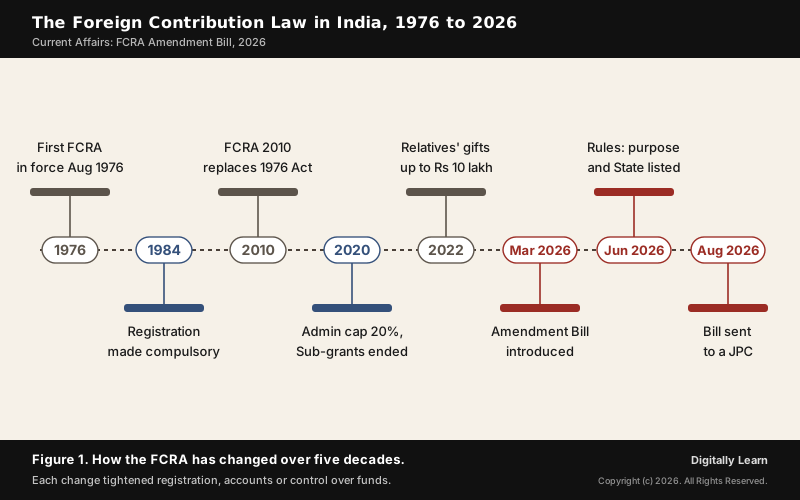
The first FCRA was enacted on 31 March 1976 and came into force on 5 August 1976. A 1984 amendment made registration with the Home Ministry compulsory for every NGO receiving foreign funds. The present law, the FCRA of 2010, received the President's assent on 26 September 2010 and came into force on 1 May 2011, replacing the 1976 Act; it was amended in 2016, 2018 and 2020.
FCRA Registration Process: SBI Account, Certificates and the 20% Cap
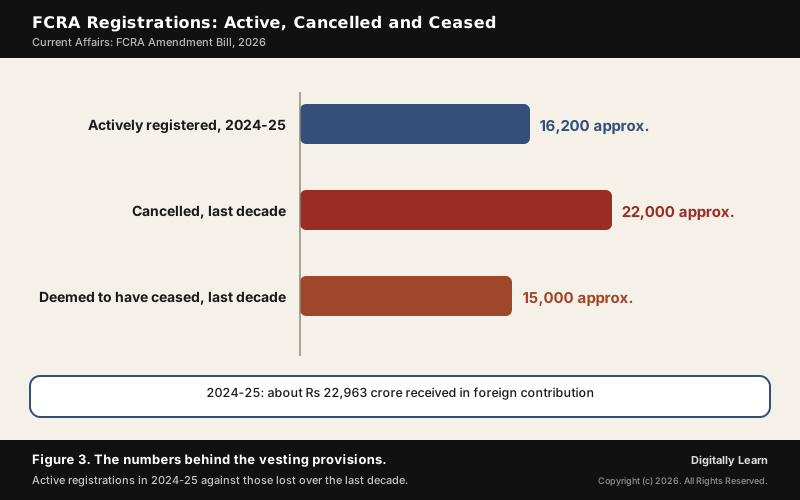
FCRA does not ban foreign donations. An organisation may receive them after obtaining registration, open to organisations working for at least three years, or prior permission for a defined project. In 2024-25 around 16,200 associations were actively registered and received about Rs 22,963 crore.
- One entry point: All foreign contributions first arrive in a single FCRA account at the State Bank of India’s New Delhi Main Branch.
- Five-year certificates: Registration is valid for five years and must be renewed, with a compliance review at renewal.
- Spending rule: No more than 20% of the annual foreign contribution may go on administration; the rest must be spent on the declared purposes.
- Annual return: Every registered organisation files Form FC-4 online, with audited receipts, the donors, the amount from each and how it was spent.
- Cancellation: Under Section 14 the Central Government may cancel a certificate after such inquiry as it deems fit, if the application made a false statement, the conditions of the certificate or the Act were violated, or cancellation is necessary in the public interest.
New FCRA Rules: The 2020 Amendment and the Rules of 2022 to 2026
- 2020 amendment: Aadhaar or passport identification for office-bearers, the single SBI New Delhi account, a ban on passing funds to another registered body (sub-granting), and an administrative-expense cap cut from 50% to 20%; public servants were added to the barred list.
- 2022 Rules: Contributions from relatives abroad allowed up to Rs 10 lakh, up from Rs 1 lakh.
- 2024-25 Rules: Unspent administrative allocations may be carried forward.
- 2026 Rules, notified on 22 June: Each certificate names the exact purposes and the States or Union Territories of work; permissible religious purposes are listed; renewal needs proof of using at least Rs 10 lakh of foreign contribution in the two prior years; annual returns name the ultimate foreign donor.
The Ministry of Home Affairs launched an FCRA 2.0 Portal on 30 June 2026 for registration, renewal and returns. Organisations registered under the Act are, by the Ministry's estimate, under 1% of all NGOs in India.
What the FCRA Amendment Bill 2026 Changes
Designated Authority: Provisional and Permanent Vesting of Assets
Vesting of assets is not new. Under Section 15 of the 2010 Act, assets created from foreign contribution vest in a prescribed authority, the State government or Union Territory administration, when registration is cancelled, and are returned if the organisation obtains fresh registration. Over the last decade nearly 22,000 registrations were cancelled and about 15,000 deemed to have ceased, but States found it hard to take over and manage such assets, which could stay in custody indefinitely without legal finality.
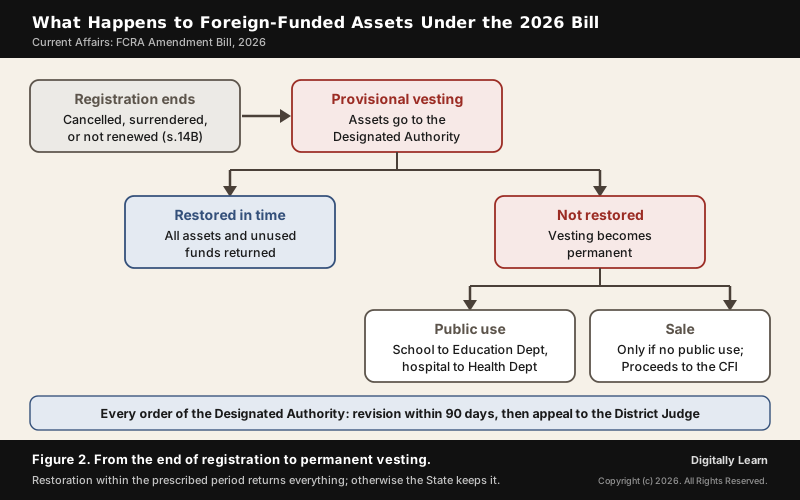
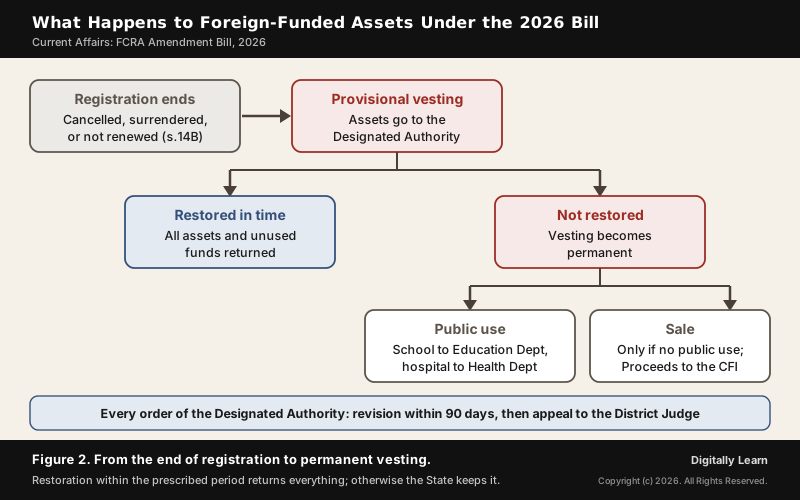
- Provisional vesting: When registration ends by cancellation, surrender or non-renewal, the assets built from foreign contribution vest provisionally in a Designated Authority with the powers of a civil court.
- Restoration: If registration is restored within the prescribed period, all assets and unused funds are returned; the period itself is left to the rules.
- Permanent vesting: Otherwise the assets vest permanently and go to public use, a school to the Education Department or a hospital to the Health Department; only assets that cannot be so used are sold, with the proceeds credited to the Consolidated Fund of India.
- Safeguards: The religious character of a place of worship must be preserved, and every order of the Designated Authority can be revised within 90 days and appealed to the District Judge.
| Feature | Section 15 of the 2010 Act | 2026 Bill |
|---|---|---|
| Who holds the assets | State government or UT administration | A Designated Authority with civil-court powers |
| When assets vest | On cancellation of registration | On cancellation, surrender or non-renewal |
| If registration returns | Returned on fresh registration | All assets and unused funds returned if restored in the prescribed period |
| If it does not | Held in custody without legal finality | Vest permanently; public use first, sale only as a last resort |
| In practice | States found the assets hard to take over and manage | A time-bound framework for vesting, restoration and disposal |
Cessation Under Section 14B, Penalties and Central Approval for Probes
- Cessation: A new Section 14B makes a registration cease automatically when it expires, is not renewed or renewal is refused.
- Penalties: The maximum imprisonment is cut from five years to one year.
- Investigations: State agencies must obtain the Central government’s approval before starting an FCRA probe; the Centre’s reason is that foreign relations and national security are Union subjects.
- Mixed assets: An asset built partly with foreign money vests in full; the organisation must then apply for return of the portion not paid for with foreign funds.
FCRA Bill Debate: Transparency Against Due Process
The Government's Case: Transparency, Accountability and Global Practice
The government presents FCRA as a registration and disclosure regime for foreign-directed activity, not a permission to exist for civil society. Its case for the Bill rests on the gaps in Section 15: assets held in custody for years with no final legal status, and no framework to manage or dispose of them.
- Global practice: The United States has run the Foreign Agents Registration Act since 1938, Australia a Foreign Influence Transparency Scheme since 2018, Canada legislated a registry in 2024, and the United Kingdom’s scheme came into force in July 2025.
- Religion-neutral: The Act applies to all organisations, faith-based welfare remains eligible for foreign funds, and the 2026 Rules list the permissible religious purposes.
- Not a finding of guilt: The end of a registration is not treated as fraud, and a refusal to renew can be challenged in court.
The Critics' Case: Hearing, Appeal and the Property of Minority Institutions
- No hearing, no appeal on renewal: The organisation is not heard before renewal is refused and cannot appeal the refusal itself; the appeal to the District Judge lies only against what the authority later does with the property.
- Automatic loss: Assets pass to the authority as soon as a certificate lapses, without a prior hearing or judicial determination, and a building put up only partly with foreign money is taken over in full.
- Retrospective reach: Despite the Home Minister’s assurance, a hospital built decades ago could be taken over today because a certificate lapsed.
- Who bears the cost: Patients in hospitals, students in schools and the elderly in care homes run with foreign funds, and minority institutions above all.
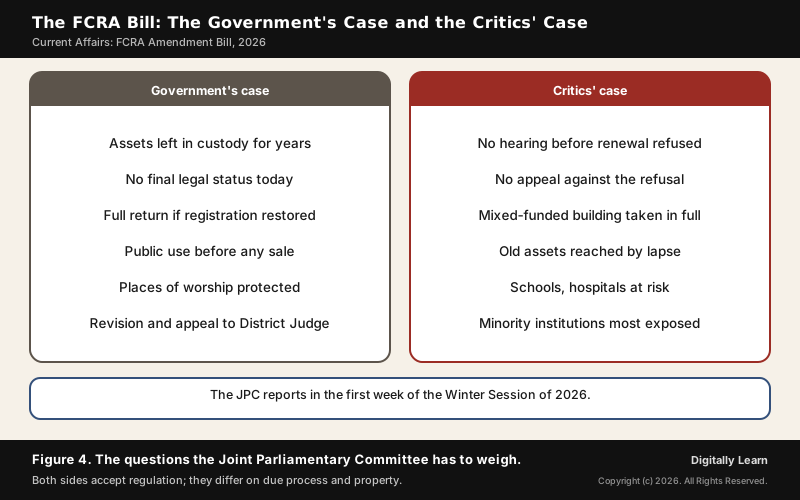
The JPC is asked to redraft the Bill so that organisations are heard before renewal is refused and can appeal such a refusal, among other changes that would make the regulation fair and transparent. The deeper question is whether regulatory power can be used without safeguards of due process.
Courts and FCRA: The Kerala High Court Ruling of August 2026
Courts already review FCRA decisions. On 11 August 2026 the Kerala High Court quashed the Centre's refusal to renew the FCRA certificates of two NGOs, Save A Family Plan and the Kerala Social Service Forum, which had been accused of using foreign donations to fund protests against the Vizhinjam seaport project. The Centre had relied on an intelligence report and argued that receiving foreign contribution is not a fundamental right.
The court held that the authority must give its reasons in every order, and that a peaceful protest against a project is not an undesirable purpose; even if some funds supported it, that would not violate the FCRA. It directed the authority to decide afresh within three months, a reminder of why critics want a hearing written into the Bill.
NGOs, Civil Society and the State: Foreign Funding in Context
Civil Society Organisations as Pressure Groups and Service Providers
Pressure groups are organisations that try to influence government policy without seeking to control or share political power themselves; they form when people with a common occupation, interest or opinion come together. Many civil society organisations play this role, and many also deliver services: foreign-funded work in India spans education, healthcare, rural development, disaster relief, the environment and faith-based welfare.
The two roles explain the friction with the State. Service delivery fills gaps the State cannot reach, while advocacy can oppose the State's own projects. An Intelligence Bureau report titled "Impact of NGOs on Development" claimed that some foreign-funded NGOs opposed development projects; the Ministry of Home Affairs has cancelled or refused renewal of licences, including that of Greenpeace India.
FCRA for UPSC: GS Paper II Links
Where Foreign Contribution Regulation Sits in the Syllabus
FCRA belongs to General Studies Paper II, under the role of NGOs, self-help groups, various groups and associations, donors, charities and other stakeholders, and under government policies and interventions. The JPC procedure links it to Parliament's functioning. State PCS papers test the same ground.
- Prelims facts: First FCRA 1976; FCRA 2010 in force from 1 May 2011; Ministry of Home Affairs administers it; single SBI New Delhi account; certificates valid five years; administrative cap 20% since 2020; 2026 Bill introduced on 25 March and sent to a 31-member JPC on 12 August.
- Mains analysis: Transparency against due process, State control of civil society, property and minority rights, and the role of Joint Parliamentary Committees in law-making.
Previous Year UPSC-CSE Questions By the end you will be able to draft model answers for the following UPSC questions. Each question carries a collapsible framework showing how to approach it in the exam.
- UPSC Mains 2015 GS-IIExamine critically the recent changes in the rules governing foreign funding of NGOs under the Foreign Contribution (Regulation) Act (FCRA), 1976.
Answer outline: how to structure the answer
What the question asks, the main arguments, relevant examples and the direction of the conclusion. This is not a full model answer.
Introduction: Introduce the FCRA as a registration and disclosure law for foreign contributions, administered by the Home Ministry, first enacted in 1976 and replaced in 2010.
Body (sub-themes to develop):
- Changes: single SBI New Delhi account, Aadhaar for office-bearers, ban on sub-granting, the administrative cap cut from 50% to 20% (2020); certificates naming purposes and States, and Rs 10 lakh utilisation for renewal (2026 Rules); provisional and permanent vesting of assets in a Designated Authority (2026 Bill).
- For: traceable money, an end to indefinite custody of assets under Section 15, full return if registration is restored, revision and appeal against the authority's orders.
- Against: no hearing or appeal on refusal of renewal, whole buildings taken over for partial foreign funding and reach back to old assets when a certificate lapses.
- Evidence: about 22,000 cancellations and 15,000 cessations in a decade; the Kerala High Court's August 2026 ruling that reasons must be given in every non-renewal order.
Conclusion: Conclude that transparency and due process can coexist: a hearing before refusal, a right of appeal and proportionate asset rules would keep the regime's purpose while protecting the schools and hospitals it funds.
- UPSC Mains 2025 GS-IICivil Society Organizations are often perceived as being anti-State actors than non-State actors. Do you agree? Justify.
Answer outline: how to structure the answer
What the question asks, the main arguments, relevant examples and the direction of the conclusion. This is not a full model answer.
Introduction: Define civil society organisations as voluntary groups that act as pressure groups and as service providers.
Body (sub-themes to develop):
- Why they look anti-State: advocacy against projects (the Vizhinjam port protests), the Intelligence Bureau report on NGOs and development, cancelled licences.
- Why they are non-State partners: schools, hospitals, disaster relief and rural development run with foreign and domestic funds; about 16,200 FCRA-registered associations in 2024-25.
- The State's response: FCRA as a transparency regime; critics' concern that asset vesting without a hearing treats lapse as guilt; the Kerala High Court's view that peaceful protest is not an undesirable purpose.
Conclusion: Conclude that dissent is not hostility: a democracy needs CSOs that both serve and criticise, governed by clear rules applied with due process.
- UPSC Prelims 2024 Prelims-GSWith reference to the Indian Parliament, consider the following statements :
- A bill pending in the Lok Sabha lapses on its dissolution.
- A bill passed by the Lok Sabha and pending in the Rajya Sabha lapses on the dissolution of the Lok Sabha.
- A bill in regard to which the President of India notified his/her intention to summon the Houses to a joint sitting lapses on the dissolution of the Lok Sabha.
Which of the statements given above is/are correct?
How to approach this Prelims question
Approach: Step 1: statement 1, a Bill pending in the Lok Sabha lapses on its dissolution: right. Step 2: statement 2, a Bill passed by the Lok Sabha but pending in the Rajya Sabha lapses: right, because the House that passed it no longer exists. Step 3: statement 3, a Bill on which the President notified a joint sitting lapses: wrong, such a Bill does not lapse if the joint sitting was notified before the dissolution. So 1 and 2.
Trap to watch: Statement 3 sounds plausible because the Lok Sabha is gone, but a notified joint sitting keeps the Bill alive.
Key facts to recall:
- (a) 1 only: wrong. Statement 2 is also correct; a Bill passed by the Lok Sabha and pending in the Rajya Sabha lapses.
- (b) 1 and 2: right. Both Lok Sabha-linked Bills lapse, and statement 3 is wrong.
- (c) 2 and 3: wrong. Statement 3 is wrong, as a Bill with a notified joint sitting does not lapse.
- (d) 3 only: wrong. Statement 3 is the one incorrect statement.
Answer signal: Statements 1 and 2 are correct: option (b), the official answer.
Sources
- The Hindu, Delhi, 13 August 2026: Troubling bill (editorial); 31-member parliamentary panel to review FCRA Bill
- The Hindu, Delhi, 7 to 12 August 2026: Shah's meetings with Christian bodies; the Opposition; Tamil Nadu resolution; Aizawl rally
- The Hindu, Delhi, 8 August 2026: India brushes off foreign criticism over draft legislation
- The Hindu, Delhi, 13 August 2026: Kerala High Court sets aside FCRA refusal for two NGOs
- The Hindu, Delhi, 11 August 2026: editorial on the stalled Monsoon Session
- PIB: Foreign Contribution (Regulation) Act, Frequently Asked Questions (22 July 2026)
- PIB: FCRA, Transparency, Sovereignty and Democratic Accountability (22 July 2026)
- Ministry of Home Affairs: Frequently Asked Questions on FCRA
- NCERT: Democratic Politics II (Class X), Popular Struggles and Movements
- Wikipedia: Foreign Contribution (Regulation) Act
- UPSC: Civil Services Examination question papers
Editorial Disclaimer
This article draws on the PIB documents on the FCRA, NCERT and the other sources listed on this page.


