


Overview
The Solid Waste Management Rules 2026 are the revised national rules governing how municipal and household solid waste is segregated, collected, processed and disposed of in India. Notified by the Ministry of Environment, Forest and Climate Change under the Environment (Protection) Act, 1986, they come into force from 1 April 2026 and replace the Solid Waste Management Rules of 2016. Their defining change is to make four-stream segregation of waste at source mandatory, while restricting landfilling and embedding the circular economy and Extended Producer Responsibility.
What the new waste rules require
A new rulebook in force from 1 April 2026
The Ministry of Environment, Forest and Climate Change has notified the Solid Waste Management Rules 2026, which come into force from 1 April 2026 and replace the Solid Waste Management Rules of 2016. The rules are issued under the Environment (Protection) Act, 1986.
Their central change is to make segregation of waste at source into four separate streams mandatory for every household and waste generator, so that recovery and recycling become the norm and landfilling becomes the exception.
India's Mounting Waste and the Case for Segregation
Why source-segregation is the heart of the reform
Why it matters is that India's towns and cities generate very large quantities of solid waste every day, and when wet, dry and hazardous items are mixed together they become far harder to treat. Mixed waste ends up in open dumps, which catch fire, leach into groundwater and occupy scarce urban land.
Separating waste at the point where it is generated keeps each stream clean enough to be processed: food waste can be composted, dry waste can be recycled, and hazardous items can be handled safely. The 2026 rules therefore treat segregation at source as the foundation on which the whole system rests.
From Waste Disposal Towards a Circular Economy
What the reform signifies for the economy and environment
What is the significance of this reform lies in its move from simply disposing of waste towards recovering value from it. By embedding the principles of the circular economy and Extended Producer Responsibility, the rules push producers, importers and brand owners to take responsibility for the waste their products become.
The rules also apply the Polluter Pays principle: those who fail to comply face environmental compensation. Taken together, these features signal that waste is to be treated as a resource and a shared responsibility, not merely as something to be carted to a dump.
Distinguishing features of the 2026 rules
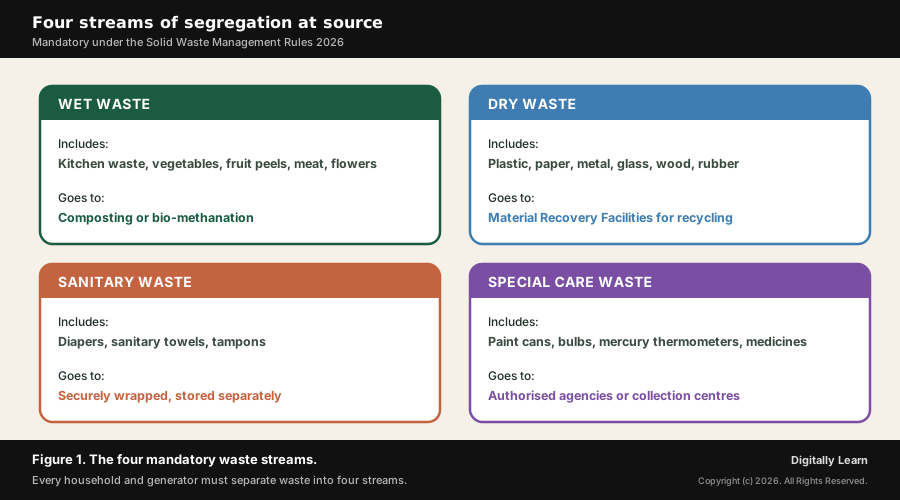
The four streams at a glance
The table sets out the four streams that every generator must separate, what each contains and where each is meant to go. The design ensures that clean, recoverable material is never lost to a mixed heap and that hazardous items are kept apart from the rest.
Read together, the rows show a system in which wet and dry waste are recovered, while sanitary and special care waste are handled safely and separately.
| Stream | What it includes | Where it goes |
|---|---|---|
| Wet waste | Kitchen waste, vegetables, fruit peels, meat, flowers | Composting or bio-methanation at the nearest facility |
| Dry waste | Plastic, paper, metal, glass, wood, rubber | Material Recovery Facilities for sorting and recycling |
| Sanitary waste | Used diapers, sanitary towels, tampons | Securely wrapped and stored separately |
| Special care waste | Paint cans, bulbs, mercury thermometers, medicines | Authorised agencies or designated collection centres |
Landfill curbs and the duties of bulk generators
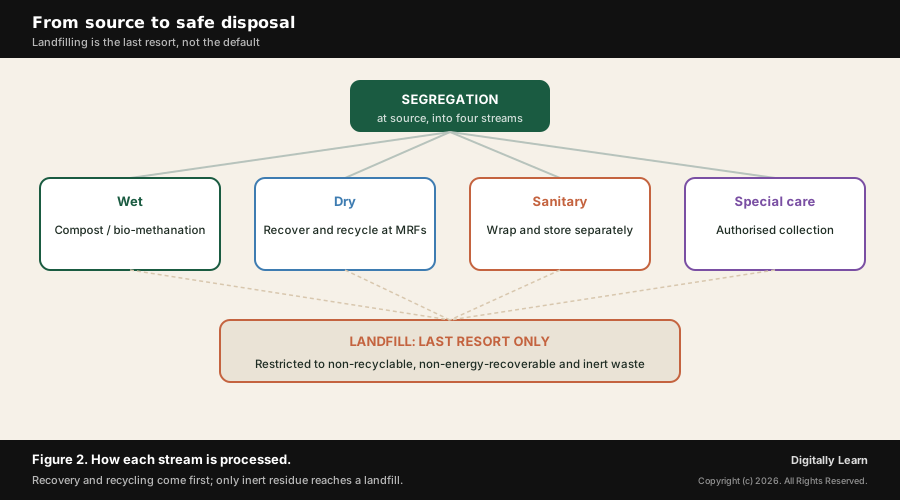
Beyond segregation, the rules sharply limit what may be sent to a landfill and widen the duties of large generators. The aim is to make landfilling expensive and rare, and to make those who generate the most waste accountable for managing it.
This matters because open dumping has been the cheap default for decades. By pricing unsegregated waste above the cost of proper handling, and by naming bulk waste generators as responsible parties, the rules change the incentives that drove waste to the nearest dump.
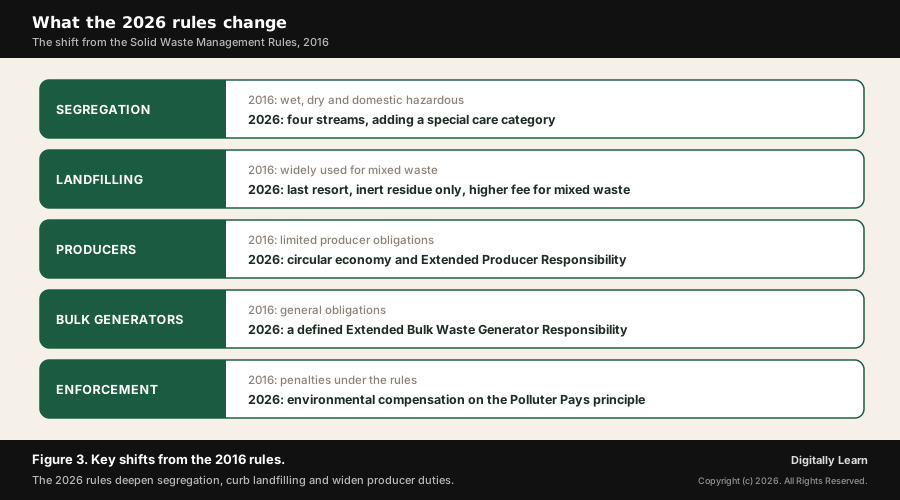
- (i) Landfilling restricted. Landfills are confined to non-recyclable, non-energy-recoverable and inert waste; legacy dumpsites are to be remediated.
- (ii) Higher fee for mixed waste. Local bodies pay a higher landfill fee for unsegregated waste than the cost of segregating, transporting and processing segregated waste.
- (iii) Bulk generator responsibility. Bulk waste generators carry a defined Extended Bulk Waste Generator Responsibility to collect, transport and process their waste soundly.
What to Watch as the Rules Take Effect
Three things to track from 2026 onwards
The rules translate into three developments worth tracking as towns and cities begin to apply them, since the gap between a notified rule and a working system is where most of the effort lies.
- (a) Local-body readiness. Whether urban and rural bodies build the composting plants, bio-methanation units and Material Recovery Facilities the streams require.
- (b) Legacy dumpsite remediation. Whether the old mountains of mixed waste are cleared and the land reclaimed.
- (c) Enforcement. Whether environmental compensation is actually levied on those who do not comply.
The real test is not the notification but the daily habit of separating waste in millions of homes and the capacity of local bodies to process what they collect.
Swachh Bharat, the Circular Economy and the Wider Waste Regime
How the rules connect to the broader framework
Contemporary linkages tie the 2026 rules to a wider effort to manage waste and build a circular economy, rather than to a single notification. They reinforce the goals of the Swachh Bharat Mission in both urban and rural areas.
They sit alongside India's other waste rules, including those for plastic waste and electronic waste, each of which uses Extended Producer Responsibility. All of these flow from the Environment (Protection) Act, 1986, the umbrella law for environmental rule-making in India.
The reform also connects to the global Sustainable Development Goals, in particular the goals on sustainable cities and on responsible consumption and production, where sound waste management is a measured target.
UPSC relevance and exam focus
Where this fits in the UPSC-CSE syllabus
This topic maps to General Studies Paper III: conservation, environmental pollution and degradation, and to governance in Paper II through the role of urban and rural local bodies in service delivery.
For Prelims, hold the high-yield facts: the four streams and what each contains, the 1 April 2026 commencement, the replacement of the 2016 rules, the parent law (the Environment (Protection) Act, 1986), and the use of Extended Producer Responsibility.
For Mains, two framings recur: the impediments to safe solid-waste disposal and the handling of toxic waste, and the shift towards a circular economy and the Polluter Pays principle.
Recurring linked concepts an aspirant should keep in working memory:
- Extended Producer Responsibility: producers bear responsibility for post-consumer waste.
- Circular economy: keeping materials in use rather than discarding them.
- Polluter Pays principle: the cost of pollution falls on the polluter.
- Swachh Bharat Mission: the national sanitation and waste programme.
A common Prelims trap is to confuse the streams: the 2016 rules used a three-way split, while the 2026 rules require four streams, adding a separate special care category for hazardous household items.
A common Mains trap is to treat a notified rule as a solved problem. The harder question is implementation: building processing capacity and changing daily behaviour, which the rules can require but not guarantee.
Previous Year UPSC-CSE Questions By the end you will be able to draft model answers for the following UPSC questions. Each question carries a collapsible framework showing how to approach it in the exam.
- UPSC Mains 2018 GS-IIIWhat are the impediments in disposing the huge quantities of discarded solid wastes which are continuously being generated? How do we remove safely the toxic wastes that have been accumulating in our habitable environment?
How to structure the answer in the exam
Introduction: Open with the scale of waste generation and the failure of mixed, unsegregated disposal.
Body (sub-themes to develop):
- Impediments: mixing of wet, dry and hazardous waste; weak segregation; reliance on open dumps; legacy dumpsites.
- Disposal reform: source-segregation, composting, recycling at Material Recovery Facilities, landfill as last resort.
- Toxic waste: a separate special care stream and authorised collection for paint, bulbs, mercury and medicines.
- Accountability: Extended Producer Responsibility and the Polluter Pays principle.
Conclusion: Conclude that safe disposal depends on segregation, recovery capacity and enforcement, not on the rule alone.
- UPSC Prelims 2019 GS Paper IAs per the Solid Waste Management Rules, 2016 in India, which one of the following statements is correct?
How to approach this Prelims question
Approach: Recall the scope and design of the Solid Waste Management Rules and test each statement against it.
Trap to watch: The 2016 rules used a three-way split, not five categories, and apply beyond only urban bodies; do not pick the inflated-number or over-narrow-scope options.
Key facts to recall:
- The rules provide criteria for siting landfills and waste-processing facilities.
- Segregation was a three-way split in 2016 and becomes four-stream from 2026.
Answer signal: Option (c) on landfill and processing-site criteria is correct.
Sources and Further Reading
- Press Information Bureau: New Solid Waste Management Rules Notified; To Come into Force from April 1, 2026
- Press Information Bureau: Solid Waste Management Rules, 2026 to come into effect from April 1
- Press Information Bureau: National review on Solid Waste Management Rules 2026 under Swachh Bharat Mission (Grameen)
- Ministry of Environment, Forest and Climate Change
- Central Pollution Control Board: Solid and Plastic Waste Management Rules
- Ministry of Housing and Urban Affairs: Swachh Bharat Mission (Urban)
- Environment (Protection) Act, 1986 (India Code)
Editorial Disclaimer
This briefing is for UPSC preparation. Verify provisions against the official notification and the Ministry of Environment, Forest and Climate Change before relying on them.


