


Overview
Samudrayaan, deep-sea resources and ocean technology
The Deep Ocean Mission is India's flagship programme, approved in 2021 and led by the Ministry of Earth Sciences, to explore the deep ocean for resources and develop deep-sea technologies through six components.
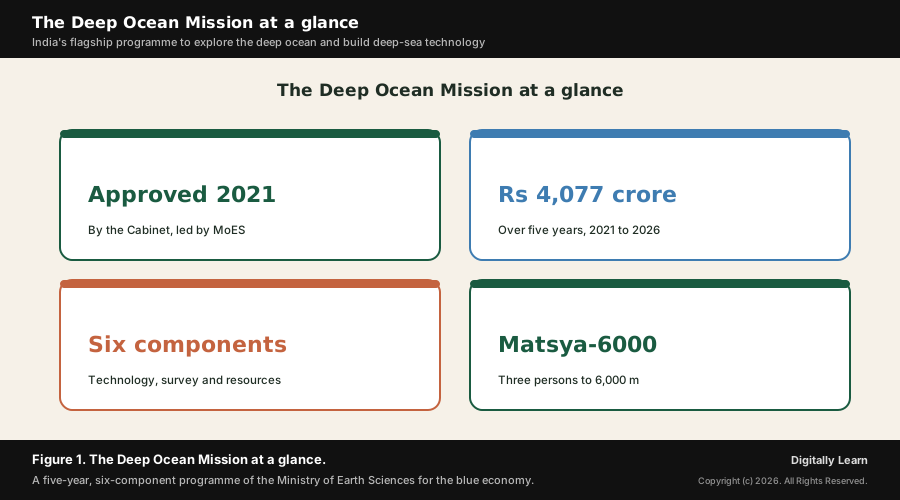
The Deep Ocean Mission (DOM) is India's flagship programme to explore the deep ocean for resources and to develop deep-sea technologies for the sustainable use of ocean resources. Approved by the Cabinet in 2021 and led by the Ministry of Earth Sciences (MoES), it has an estimated cost of about Rs 4,077 crore spread over five years, from 2021 to 2026. The Mission is built around six components, from a manned submersible and deep-sea mining technology to ocean climate services, deep-sea biodiversity, a survey of seabed minerals, ocean energy and freshwater, and a marine biology station. Its best-known element is Samudrayaan, the manned ocean mission whose submersible Matsya-6000 is designed to carry three persons to a depth of 6,000 metres. The Mission is a pillar of India's blue economy and its energy and mineral security.
What the Deep Ocean Mission Is and Why It Is in the News
A six-component mission to explore the deep ocean and build deep-sea technology
The Deep Ocean Mission (DOM) is India's flagship programme to explore the deep ocean for resources and to develop the deep-sea technologies needed to use those resources sustainably. The Cabinet approved it in 2021 on a proposal from the Ministry of Earth Sciences, which leads the Mission, at an estimated cost of about Rs 4,077 crore for five years, from 2021 to 2026. It is a national project of a scale very few countries have attempted.
The deep ocean, the part of the sea below roughly 1,000 metres, is one of the least explored places on Earth. It is dark, cold and under crushing pressure, yet it holds mineral wealth, unusual life and clues to the climate. The Mission's purpose is to give India the ships, sensors, robots and a manned submersible to reach this zone, study it and use its resources responsibly. This places India among the few nations with deep-ocean capability.
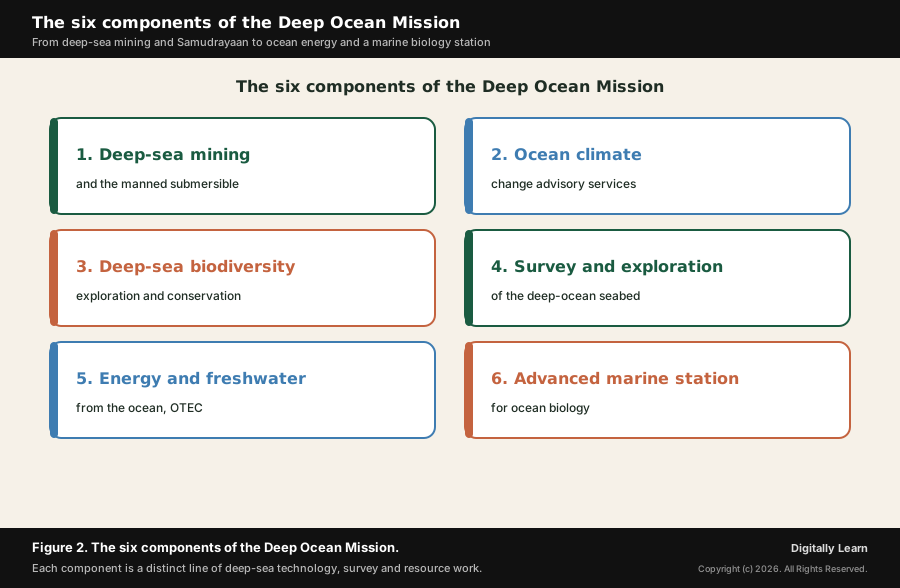
The Mission is organised into six components, each a distinct line of work. They run from deep-sea mining technology and the manned submersible, through ocean climate services and deep-sea biodiversity, to a survey of seabed minerals, ocean energy and freshwater, and a marine biology station. Holding the six components clearly in mind is the key to the whole topic, and the figure below sets them out at a glance.
Why the Deep Ocean Mission is in the news
Why it matters now is that the Mission has moved from plans into visible results. The manned submersible Matsya-6000 has completed harbour and wet trials and is being readied for shallow-water and then deep dives, a milestone for the Samudrayaan project. At the same time India has expanded its rights over the seabed, adding a new exploration contract for ocean minerals to those it already held. These steps have brought the Mission back into the headlines.
The Mission also matters because it sits at the centre of several big national themes. It is the technological backbone of India's blue economy, it touches energy and mineral security through seabed minerals and ocean energy, and it feeds the climate and disaster-warning services on which coastal India depends. For the exam, this makes the Mission a single topic that connects science and technology, the economy, the environment and strategic resources, which is exactly why it recurs.
The Six Components of the Deep Ocean Mission, Explained in Full
How the six components fit together
The Mission's design rests on six components, sometimes called its six verticals. Each tackles a different part of the deep-ocean challenge, and together they cover the technology, the survey work and the resources. The first builds the machines that reach the deep sea, the second and third study its climate and life, the fourth maps its mineral wealth, the fifth turns the ocean into energy and water, and the sixth grows the science to sustain it all.
Reading the components as a set shows the Mission's logic. India is building the capability to go to the deep sea, to understand it, and to use it, all at once, rather than chasing a single goal. The table below names the six components and their purpose, and the sub-sections that follow give each one its own treatment in depth, because each is a substantial programme in its own right.
| Component | Focus | What it does |
|---|---|---|
| 1. Deep-sea mining and submersible | Technology | Builds Matsya-6000 and underwater robotics for the deep sea |
| 2. Ocean climate advisory services | Climate | Models and forecasts ocean and climate variables |
| 3. Deep-sea biodiversity | Conservation | Explores and conserves deep-sea life and ecosystems |
| 4. Deep-ocean survey and exploration | Resources | Surveys seabed minerals such as polymetallic nodules |
| 5. Energy and freshwater from the ocean | Energy | Develops OTEC ocean energy and desalination |
| 6. Advanced marine station for ocean biology | Capacity | A station to grow ocean biology research and enterprise |
The rows together show a balanced programme: it does not chase minerals alone, but pairs resource work with the science, the climate services and the conservation needed to use the deep ocean responsibly. The figure below presents the same six components as a visual map.
Component 1: Samudrayaan and the manned submersible Matsya-6000
The first and most celebrated component develops technologies for deep-sea mining, a manned submersible and underwater robotics. Its flagship is Samudrayaan, India's manned ocean mission, launched in November 2021. At its heart is Matsya-6000, a deep-submergence vehicle designed to carry three persons to a depth of 6,000 metres so that scientists can observe and sample the deep seabed directly, rather than only through robots.
Building such a vehicle is a severe engineering test. At 6,000 metres the pressure is roughly 600 times that at the surface, so the crew sit inside a titanium personnel sphere able to hold normal pressure while the sea presses in. The vehicle is being developed by the National Institute of Ocean Technology (NIOT) in Chennai, working with the Vikram Sarabhai Space Centre of ISRO, which brings its experience of building structures that survive extreme conditions.
Matsya-6000 has completed harbour and wet trials, testing flotation, stability, control and the life-support systems that keep the crew safe, and it is being prepared for shallow-water dives before the full deep dives. Alongside it, the component develops remotely operated vehicles and mining systems to collect minerals from the seabed. Together these make India one of the few countries building the means to send people and machines into the deep ocean.
Component 2: Ocean climate change advisory services
The second component develops ocean climate change advisory services. The ocean stores most of the planet's extra heat and drives the monsoon, cyclones and sea level, so understanding it is central to climate prediction. This component builds a suite of ocean observations and computer models to understand and forecast key climate variables on time-scales from seasons to decades, sharpening the warnings that protect lives and crops.
Much of this work is delivered through the Indian National Centre for Ocean Information Services (INCOIS) in Hyderabad. INCOIS issues the Ocean State Forecast, covering waves, currents and winds, and runs early-warning services for tsunamis and storm surges for the whole Indian Ocean rim. By strengthening these models, the Mission improves the advisories on which fishers, ports, coastal communities and disaster managers across India rely every day.
Component 3: Technology for deep-sea biodiversity exploration and conservation
The third component drives technological innovations for the exploration and conservation of deep-sea biodiversity. The deep ocean hosts strange and little-known life, from the creatures around hydrothermal vents to the microbes that live on and around the mineral nodules. This life may hold molecules useful for medicine and industry, the field of bioprospecting, but it is fragile and slow to recover from disturbance.
This component develops the tools to study deep-sea organisms, to understand the ecosystems they form, and to assess how human activity such as mining might affect them. By pairing exploration with conservation from the start, the Mission tries to ensure that India learns about and protects this life even as it surveys the same seabed for minerals. It reflects the principle that the deep ocean must be used sustainably, with knowledge of its life coming first.
Component 4: Deep-ocean survey and the polymetallic-nodules mandate
The fourth component is the deep-ocean survey and exploration of seabed minerals, and it is where the Mission meets India's resource ambitions most directly. The prize is the field of polymetallic nodules, potato-sized lumps scattered across the deep seabed that are rich in manganese, nickel, copper and cobalt, metals vital for steel, batteries and clean-energy technology. The Mission surveys these deposits and develops the technology to one day collect them.
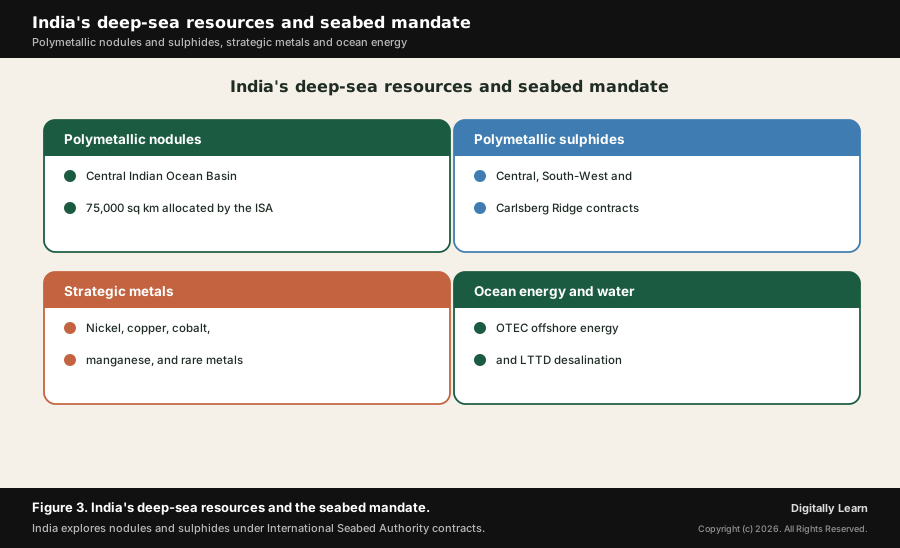
India's main nodule ground lies in the Central Indian Ocean Basin. There the International Seabed Authority (ISA), the UN body that governs the international seabed, has allotted India about 75,000 square kilometres. India first signed a 15-year nodule contract in 2002, with rights extended at the 2017 ISA session. The estimated resource potential runs to hundreds of millions of tonnes.
India has widened this seabed mandate beyond nodules. It holds a contract for polymetallic sulphides, mineral deposits formed by hot fluids at ocean ridges that carry copper, zinc and precious metals, and it has secured exploration rights over the Carlsberg Ridge in the Indian Ocean. With these, India became the first country to hold two ISA contracts for sulphides. The figure below sets out India's deep-sea resources and the seabed contracts that govern them.
Component 5: Offshore ocean energy and freshwater, including OTEC
The fifth component develops energy and freshwater from the ocean, turning the sea itself into a resource. Its centrepiece is Ocean Thermal Energy Conversion (OTEC), which uses the temperature difference between warm surface water and cold deep water to generate power. Unlike solar or wind, this gradient is steady day and night, so OTEC can supply firm, round-the-clock energy to islands and coasts far from the main grid.
The same temperature gradient yields freshwater. Through Low Temperature Thermal Desalination (LTTD), NIOT turns seawater into drinking water by evaporating warm surface water under low pressure and condensing it with cold deep-sea water, with no chemicals and little energy. India has built LTTD plants in the Lakshadweep islands, and an OTEC-powered desalination plant at Kavaratti, drawing cold water from below a kilometre, is described as the first of its kind in the world.
This component speaks directly to two pressing needs. For remote islands and coastal towns it offers clean energy and safe drinking water from a local, renewable source, easing both power and water shortages. For the country it shows how the ocean can widen India's energy mix and its water security at once, which is why this part of the Mission has drawn growing attention from policymakers.
Component 6: The Advanced Marine Station for Ocean Biology
The sixth component sets up an Advanced Marine Station for Ocean Biology. Its aim is to grow India's human capacity and enterprise in ocean biology and engineering, and to turn research into real products and industries. The station is designed to translate laboratory science into application, with on-site business-incubation facilities that help start-ups and researchers develop and commercialise ocean-based technology.
This component recognises that hardware alone is not enough. A lasting deep-ocean programme needs trained people, working laboratories and links between science and industry, so that discoveries in ocean biology, from new materials to bioactive molecules, can reach the economy. By building this base, the Mission tries to make India's deep-ocean effort self-sustaining rather than a one-off project, seeding the skills and enterprise on which the blue economy will draw for decades.
The Institutional Architecture: Who Runs the Deep Ocean Mission
MoES as the nodal ministry and its specialist institutes
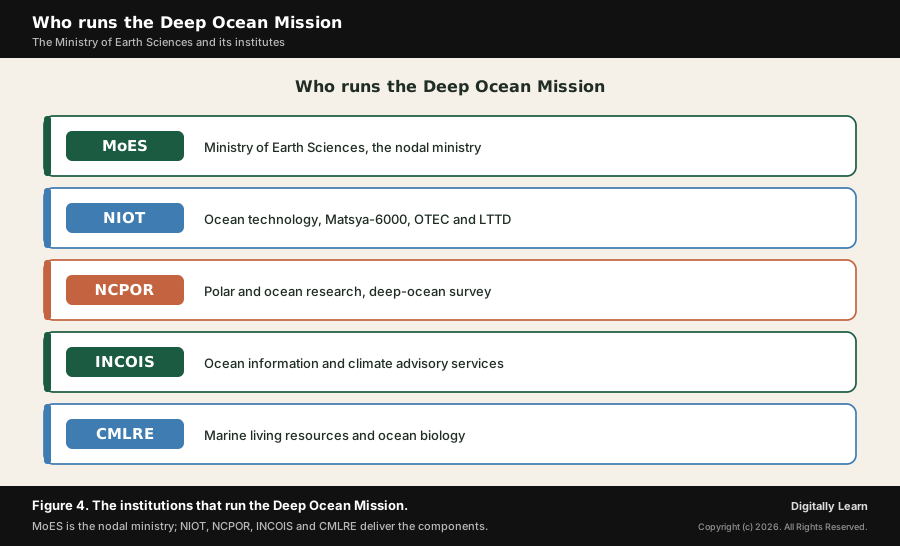
The Deep Ocean Mission is run by the Ministry of Earth Sciences (MoES), which acts as the nodal ministry and coordinates a multi-institutional effort. MoES does not work alone; it delivers the Mission through a set of specialist institutes, each of which owns the components that match its expertise. Understanding this division of labour is the key to the institutional side of the topic, which the exam often probes.
The National Institute of Ocean Technology (NIOT) in Chennai is the technology hub: it builds Matsya-6000, the underwater robotics, and the OTEC and desalination plants. The National Centre for Polar and Ocean Research (NCPOR) in Goa leads polar and deep-ocean survey work, while the Indian National Centre for Ocean Information Services (INCOIS) in Hyderabad provides the ocean-information and climate-advisory services. The figure below maps these institutions and their roles.
Two further bodies complete the picture. The Centre for Marine Living Resources and Ecology (CMLRE) in Kochi handles marine living resources and ocean biology, feeding the biodiversity and marine-station components. Internationally, India's seabed rights are governed by the International Seabed Authority, under which the survey and resource work proceeds. This spread of bodies under one ministry is what lets the Mission pursue technology, science and resources together.
Understanding the Significance of the Deep Ocean Mission for India
The blue economy, energy and mineral security, and the Amrit Kaal vision
What is the significance of the Deep Ocean Mission lies first in the blue economy. The blue economy means the sustainable use of ocean resources for growth, jobs and livelihoods while keeping the ocean healthy. The blue economy is one of the core dimensions of the Government of India's vision of a New India, and the Mission supplies the deep-sea technology and knowledge on which that ocean-based growth depends.
Its second significance is energy and mineral security. The polymetallic nodules and sulphides of the deep seabed carry nickel, cobalt, copper and rare metals that India now imports for batteries, electronics and clean energy. Securing access to these critical minerals from its own seabed area would reduce that dependence, while OTEC adds a new source of clean ocean energy. Together these strengthen India's long-term resource and energy position.
Its third significance is strategic and scientific standing. Reaching 6,000 metres with a crewed submersible places India in a select club of nations, supports its presence across the Indian Ocean, and deepens the science behind monsoon, cyclone and tsunami warnings. Framed within the Amrit Kaal vision for the run-up to the centenary of independence, the Mission ties India's ocean ambitions to its broader goal of becoming a developed, self-reliant economy.
The Deep-Sea Mining and Marine Ecology Debate, in Measured Terms
Resource potential and ecological risk, presented neutrally
No account of the Mission is complete without the debate over deep-sea mining, and it must be handled with care. On one side, the seabed's mineral wealth is real and the metals it holds are needed for the clean-energy transition, so supporters see responsible mining as a way to secure critical minerals and reduce import dependence. The Mission's own survey component is built to map these deposits and to study how they might be collected.
On the other side, many scientists and conservation bodies warn that the deep seabed is a fragile, little-understood ecosystem that recovers extremely slowly, so mining could cause lasting harm through sediment plumes, habitat loss and the disturbance of life that has barely been studied. Some states and groups have called for caution or a pause until more is known. It is fair to present this as a genuine and unresolved scientific and policy debate, with strong arguments on both sides.
India's own approach, as reflected in the Mission's design, is to pair exploration with conservation: it surveys minerals while running a dedicated biodiversity and environmental-assessment component, and it works within the rules of the International Seabed Authority, which is still finalising a global mining code. The balanced position, suitable for an answer, is that the resource case and the ecological caution must be weighed together, and that knowledge and safeguards should come before any large-scale commercial mining.
Challenges and the Road Ahead for the Deep Ocean Mission
Extreme-depth engineering, cost, ecology and technology gaps
The Mission faces formidable challenges. The first is the sheer difficulty of extreme-depth engineering. Operating at 6,000 metres means designing for crushing pressure, total darkness and corrosion, qualifying every system for human safety, and recovering vehicles from the deep sea, all of which take time and repeated testing. Schedules for such first-of-a-kind technology often slip, as the careful, staged trials of Matsya-6000 show.
A second challenge is cost and capability. Deep-ocean work is expensive, demands rare skills and specialised ships, and depends on a small pool of trained people, so building and keeping this expertise is itself a task, which is partly why the Mission includes a marine station to grow talent. A third is the ecological risk discussed above, which constrains how fast resource use can proceed and requires robust environmental safeguards before any mining.
A fourth challenge is closing technology gaps and turning exploration into use. Surveying nodules is one thing; collecting them from the seabed at scale, bringing them up and processing the metals onshore is another, and the commercial technology for this is still maturing worldwide. The honest position is that the Mission has made real strides in capability, but the path from demonstration to large-scale, safe and economic deep-sea operations remains long.
The Way Forward for India's Deep-Ocean Effort
Completing the dives, building partnerships and safeguarding the ocean
The way forward is to complete the technology the Mission has begun. Finishing the deep dives of Matsya-6000, proving the seabed-collection and OTEC systems, and scaling the LTTD and desalination plants would turn demonstrations into working capability. Steady, well-tested progress, rather than rushed timelines, is the right approach for technology where human safety and the marine environment are at stake.
Alongside the hardware, India should keep building the foundations: trained people through the marine station, strong ties between science and industry, and partnerships with other ocean nations and with the International Seabed Authority. Above all it should hold to the principle of sustainable use, advancing the survey and conservation work together so that India's deep-ocean wealth is understood and protected even as it is used, securing both the blue economy and a healthy ocean for the long term.
UPSC Relevance and Exam Focus
Where the Deep Ocean Mission fits in the UPSC-CSE syllabus
This topic maps most directly to General Studies Paper III: awareness in the fields of science and technology and developments and their applications, and to the parts of the syllabus on the blue economy, conservation and the environment. It also connects to GS-I geography of ocean resources and to GS-II international institutions through the International Seabed Authority, making it a versatile, high-value topic across papers.
For Prelims, hold the high-yield facts: the Deep Ocean Mission was approved in 2021 and is led by the Ministry of Earth Sciences at about Rs 4,077 crore over five years; it has six components; Samudrayaan's submersible Matsya-6000 carries three persons to 6,000 metres and is built by NIOT with ISRO; India explores polymetallic nodules in the Central Indian Ocean Basin under an International Seabed Authority mandate; and OTEC and LTTD provide ocean energy and freshwater.
For Mains, the recurring framing is to assess the Mission's significance for the blue economy, energy and mineral security, and India's scientific standing, and to weigh the deep-sea-mining-versus-ecology debate in balanced, attributed terms. A strong answer treats the Mission as a case study in how India develops indigenous technology for a strategic frontier, and pairs the resource opportunity with the duty to conserve a fragile ocean.
Recurring linked concepts an aspirant should keep in working memory:
- Blue economy: The sustainable use of ocean resources for growth and jobs while keeping the ocean healthy, the frame the Mission serves.
- Polymetallic nodules and the ISA: Seabed minerals in the Central Indian Ocean Basin explored under International Seabed Authority contracts.
- OTEC and LTTD: Ocean thermal energy conversion and low temperature thermal desalination, India’s ocean energy and freshwater technologies.
- Critical minerals: Nickel, cobalt and copper for batteries and clean energy, linking the deep ocean to India’s mineral security.
A common Prelims trap is to misplace the lead ministry or the submersible's depth; remember the Deep Ocean Mission sits under the Ministry of Earth Sciences, not the science or shipping ministry, and that Matsya-6000 targets 6,000 metres with three persons. A common Mains trap is to praise the resource potential without weighing the ecological risk, or the reverse; the exam rewards a balanced judgment that holds both together.
Previous Year UPSC-CSE Questions By the end you will be able to draft model answers for the following UPSC questions. Each question carries a collapsible framework showing how to approach it in the exam.
- UPSC Mains 2014 GS-ICritically evaluate the various ocean resources that can be harnessed to meet the world's resource crisis.
How to structure the answer in the exam
Body (sub-themes to develop):
- The mineral resources: polymetallic nodules in the Central Indian Ocean Basin rich in manganese, nickel, copper and cobalt, and polymetallic sulphides carrying copper, zinc and precious metals, the critical metals needed for steel, batteries and clean energy.
- The energy and freshwater resources: Ocean Thermal Energy Conversion for firm, round-the-clock power from the surface-to-deep temperature gradient, and Low Temperature Thermal Desalination for potable water, both demonstrated at Lakshadweep and Kavaratti.
- The living resources: deep-sea biodiversity and bioprospecting for molecules useful in medicine and industry, which must be explored and conserved together.
- How they can be harnessed: deep-submergence vehicles such as Matsya-6000, remotely operated vehicles and seabed-collection systems for minerals, and ocean-energy and desalination plants, with the technology still maturing worldwide.
- The critical limits: the fragile, slow-to-recover deep-sea ecosystem and the unresolved deep-sea-mining debate, the high cost and rare skills required, the gap between surveying nodules and collecting and processing them at scale, and the need to work within the International Seabed Authority's evolving rules.
Sources and Further Reading
- Press Information Bureau: Cabinet approves Deep Ocean Mission
- Ministry of Earth Sciences: Deep Ocean Mission
- Press Information Bureau: Samudrayaan and the Matsya-6000 manned submersible
- Press Information Bureau: India's exclusive rights to explore polymetallic nodules in the Central Indian Ocean Basin extended
- Press Information Bureau: India secures exclusive rights for polymetallic sulphides in the Carlsberg Ridge
- Press Information Bureau: OTEC project in Lakshadweep, first of its kind in the world
- Indian National Centre for Ocean Information Services: Ocean State Forecast and climate services
- NITI Aayog: Blue economy and ocean-based development
- World Bank: What is the Blue Economy
- Wikipedia: Deep Ocean mission
Editorial Disclaimer
This briefing is for UPSC preparation. Verify the facts and figures against the official Ministry of Earth Sciences and PIB sources before relying on them.


