


Overview
The International Big Cat Alliance, or IBCA, is an India-led, multi-country alliance for the conservation of the world's seven big cats: the tiger, the lion, the leopard, the snow leopard, the cheetah, the jaguar and the puma. It was launched by the Prime Minister on 9 April 2023, during the event marking fifty years of Project Tiger. The Union Cabinet approved its establishment on 29 February 2024, and it was set up by the Government of India through the National Tiger Conservation Authority, under the Ministry of Environment, Forest and Climate Change, by an order of 12 March 2024. Its headquarters and Secretariat are in New Delhi. The alliance has since come into force as a treaty-based inter-governmental international organisation, open to big-cat range countries and other interested partners.
What the International Big Cat Alliance Is: An India-Led Body for Seven Big Cats
An India-led alliance for the world's seven big cats
India has built a new international body for wildlife. The International Big Cat Alliance, or IBCA, is an India-led, multi-country alliance for the conservation of the world's seven big cats, bringing range countries and partners onto a single platform.
The seven big cats the alliance covers are the tiger, the lion, the leopard, the snow leopard, the cheetah, the jaguar and the puma. Four of these, the tiger, the Asiatic lion, the leopard and the snow leopard, live in India, and the cheetah has recently been reintroduced, which gives India a direct stake in the cause.
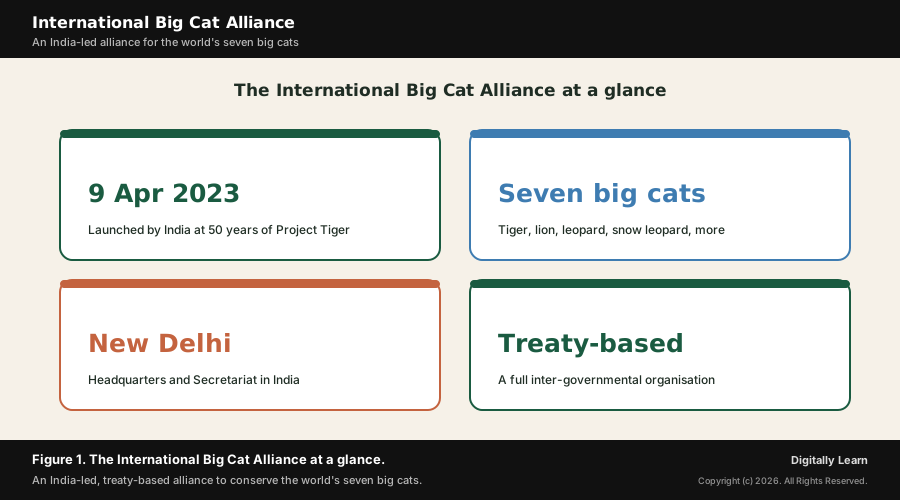
The IBCA was launched by the Prime Minister on 9 April 2023, during the event marking fifty years of Project Tiger. It was conceived as a coalition of the big-cat range countries together with other interested nations, conservation partners and scientific organisations. The figure below sets out the alliance at a glance.
Why the Alliance Is in the News: A Treaty-Based Body and Its First Assembly
The alliance becomes a treaty-based organisation
Why it matters now is that the alliance has changed in legal status. Its framework agreement secured the ratifications it needed and came into force, so the IBCA and its Secretariat have become a full-fledged treaty-based inter-governmental international organisation, with their own legal standing.
A small founding group of countries deposited their instruments of ratification to bring the treaty into force, among them India along with Nicaragua, Eswatini, Somalia and Liberia. As of this stage in 2025, that group of founding members is small but the alliance is designed to grow, with many more range countries and partners expected to join over time, so the numbers should be read as an approximate, growing figure.
The alliance has also held its First Assembly in New Delhi, attended by ministerial delegations from several countries. The Assembly ratified the agreement that hosts the headquarters in India and approved the alliance's workplan and rules, which together turned the IBCA from an idea into a working institution.
Understanding the Significance of the International Big Cat Alliance
Conservation diplomacy, soft power and umbrella species
What is the significance of the International Big Cat Alliance lies first in what it does for India's standing. It gives India a multilateral, treaty-based conservation institution of its own, headquartered on its soil, built on its long record with Project Tiger and the recovery of the Asiatic lion.
The alliance is therefore an instance of conservation diplomacy and soft power. By leading a global effort to save iconic species, India projects environmental leadership and offers South-South and range-country cooperation, sharing the methods that rebuilt its own big-cat populations.
There is a deeper ecological purpose too. Big cats are umbrella species: they need large, healthy habitats, so protecting them protects the forests, grasslands and mountains beneath them and the many other species that share those ecosystems. A single alliance for big cats thus works as an alliance for whole landscapes.
How the Alliance Came About and How It Is Structured
From the 2023 launch to a treaty-based organisation
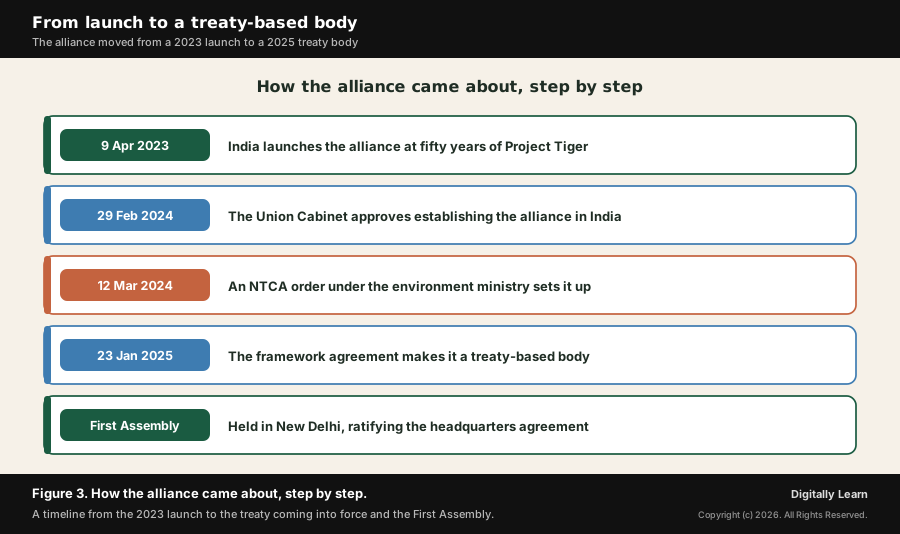
The alliance took shape in stages. After the launch on 9 April 2023, the Union Cabinet approved the establishment of the IBCA on 29 February 2024, with its headquarters in India, clearing the way for the body to be formally set up.
It was then established by the Government of India through the National Tiger Conservation Authority, the statutory body that runs Project Tiger, under the Ministry of Environment, Forest and Climate Change, by an order dated 12 March 2024. Housing the new body in the tiger authority tied it directly to India's most successful conservation programme.
The final step was legal. The framework agreement came into force in early 2025, making the IBCA a treaty-based inter-governmental organisation with its headquarters and Secretariat in New Delhi. The figure below traces these steps. An IBCA summit in New Delhi has been announced, though its date has since been rescheduled.
Headquarters, Secretariat, Assembly and membership
The alliance has a clear institutional architecture. A General Assembly of member countries is its top decision-making body; a Council of member nations guides it between assemblies; and a Secretariat, based in New Delhi, runs its day-to-day work, with the host-country agreement signed with India.
Membership is open in widening circles. The big-cat range countries are the core; non-range countries that wish to support the cause may join; and conservation partners, scientific organisations and donors are also welcome. The alliance was conceived around roughly ninety-six big-cat range countries as its potential universe, a measure of how broad the effort is meant to be.
The Seven Big Cats and India's Role in Conserving Them
Each of the seven big cats and where India fits
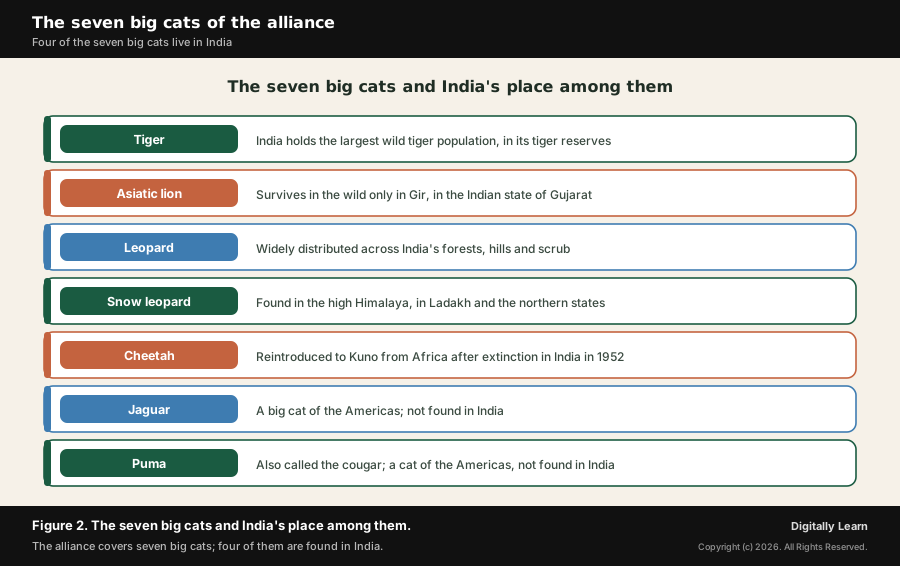
The alliance is built around seven big cats, and India is home to more of them than almost any other country, which is why it could credibly lead the effort. The tiger, the Asiatic lion, the leopard and the snow leopard are all found in India, and the cheetah has been reintroduced.
India holds the world's largest wild tiger population in its tiger reserves; the Asiatic lion survives in the wild only in the Gir landscape of Gujarat; the leopard is widely spread across the country's forests and hills; and the snow leopard roams the high Himalaya in Ladakh and the northern states. The figure below names all seven and India's place among them.
| Big cat | Where it lives | India's role |
|---|---|---|
| Tiger | Asia, with India the stronghold | The largest wild tiger population, in India's tiger reserves |
| Asiatic lion | Only the Gir landscape of Gujarat | The sole wild home of the Asiatic lion is in India |
| Leopard | Across Asia and Africa | Widely distributed across India's forests, hills and scrub |
| Snow leopard | The high mountains of Central and South Asia | Found in India's high Himalaya, in Ladakh and the north |
| Cheetah | Mainly Africa, with a few in Iran | Reintroduced to Kuno after extinction in India in 1952 |
| Jaguar | The Americas | Not found in India |
| Puma | The Americas | Not found in India |
Reading the rows together shows why the alliance suits India. With four of the seven big cats resident and the cheetah reintroduced, India has both the experience and the credibility to lead a global effort, while the jaguar and the puma bring in the conservation needs of the Americas.
The conservation status of the big cats
The big cats sit at different levels of extinction risk, which is the reason the alliance exists. The IUCN Red List, the global standard for assessing how threatened a species is, classes most of them as vulnerable or worse, reflecting habitat loss, the loss of prey, poaching and conflict with people.
The tiger is endangered and the snow leopard vulnerable; the Asiatic lion, a distinct population, is endangered and confined to a single landscape; and the cheetah is vulnerable, with its Asiatic form critically endangered. Bringing these species under one platform lets countries pool the methods and resources needed to lift them off the danger list.
The Alliance's Objectives and the Challenges It Faces
What the alliance is meant to do
The alliance was set up around a clear set of objectives. Its core purpose is to arrest the decline in big-cat populations and reverse the trend, by bringing successful conservation practices, expertise and resources onto a single shared platform.
In practice this means a few connected lines of work, each meant to help range countries do more than they could alone:
- (a) Knowledge sharing. Pooling research, data and proven conservation practices so that countries learn from one another’s successes and failures.
- (b) Capacity building. Training rangers, managers and scientists, and strengthening the institutions that protect big cats on the ground.
- (c) Finance and resources. Mobilising funding, technical support and partnerships to back conservation work in countries that lack the means.
- (d) Advocacy and awareness. Raising the global profile of big-cat conservation and pressing for action against poaching and illegal wildlife trade.
Read together, these objectives make the alliance a service platform for big-cat conservation, multiplying what individual countries can achieve rather than running projects itself.
The challenges the alliance must overcome
The alliance also faces real challenges. Sustaining funding and the commitment of members over many years is the first; a platform is only as strong as the resources and political will behind it, and donor interest can fade.
National priorities and capacities differ widely, so coordinating a body that spans rich and poor range countries is hard. There is also the risk of overlap with existing institutions such as the IUCN, CITES and the Convention on Migratory Species, which already work on these species, so the alliance must add value rather than duplicate effort.
Above all, the alliance must translate its platform into measurable gains for big-cat numbers and habitats. The cheetah, functionally extinct in India before reintroduction, is a reminder of how far a species can fall, and of how demanding it is to turn cooperation into recovery on the ground.
The Alliance in Context: Project Tiger, Global Conservation and India's Leadership
Where the alliance sits in India's conservation story
Contemporary linkages tie the alliance to India's wider conservation record. It grows directly out of Project Tiger, launched in 1973, whose fiftieth anniversary was the occasion for the launch, and out of Project Lion and Project Cheetah, the species programmes that give India its standing.
The alliance also connects to the global conservation framework. It sits alongside the IUCN, which assesses extinction risk, CITES, which regulates trade in endangered species, and the Convention on Migratory Species, complementing rather than replacing them, and adding a body focused squarely on big cats.
It speaks, too, to India's wider foreign policy. Like the International Solar Alliance and the Coalition for Disaster Resilient Infrastructure, the IBCA is an India-led, India-headquartered institution, part of a pattern in which India builds multilateral bodies to lead on global challenges and deepen its soft power.
Finally, the alliance rests on the strength of India's own protected areas. The tiger reserves, the Gir sanctuary, the Himalayan parks and the reintroduction site at Kuno are the proof of concept that lets India lead, and the variety of habitats they cover is itself a lesson in how India's wildlife is conserved.
India's Conservation Leadership and the Role of International Cooperation
The alliance is best read as a case of how India's global role has changed. For decades India projected itself as a voice for the newly independent, non-aligned and marginalised nations, championing their causes in world forums. The big cats it leads on, from the tiger of the plains to the snow leopard of the Himalaya, span habitats that reach from the high mountains to the Sundarbans mangroves, giving India the range and credibility to lead.
That older image has not vanished, but it has been overtaken by a more assertive role. In the emerging global order, India increasingly leads by building and hosting rules-based multilateral institutions of its own, rather than only joining bodies that others have created and chairing none of them.
The IBCA is a clear instance of this institution-building. It is an India-led, India-headquartered, treaty-based inter-governmental organisation, set up alongside the International Solar Alliance and the Coalition for Disaster Resilient Infrastructure, also India-led, so that India now sets agendas and hosts secretariats instead of merely lending its voice.
- From advocate to agenda-setter: India has moved from speaking for the developing world to founding and leading institutions, with the IBCA secretariat in New Delhi.
- Conservation diplomacy and soft power: By leading a global effort to save iconic big cats, India projects environmental leadership and standing in the world order.
- South-South cooperation: The new role still carries the older solidarity, sharing with poorer range states the methods that rebuilt India’s tiger, lion and cheetah populations.
- Grounded in a domestic record: This leadership rests on Project Tiger, Project Lion, Project Cheetah and India’s protected-area network, the proof of concept that lets it lead.
This new role does not break with the old so much as extend it. The solidarity that once spoke for the marginalised now flows through South-South and range-country cooperation, as India shares the conservation methods that rebuilt its own big-cat populations with states that lack the means, turning a moral stance into practical capacity-building.
The shift should be judged on results, not posture. India's standing as a conservation leader rests on a real domestic record, the recovery of the tiger and the Asiatic lion, but the alliance must still translate that leadership into measurable gains for big cats abroad. Credibility in the new global order, in short, will depend on outcomes rather than on the act of founding a body.
UPSC Relevance and Exam Focus
Where this fits in the UPSC-CSE syllabus
This topic spans two papers. It maps to General Studies Paper II as a case of India's role in international institutions and its conservation diplomacy, and to General Studies Paper III as a question of biodiversity conservation and protected areas.
For Prelims, hold the high-yield facts: the IBCA is India-led, launched on 9 April 2023 at fifty years of Project Tiger, approved by the Cabinet in February 2024, set up through the National Tiger Conservation Authority, headquartered in New Delhi, and now a treaty-based inter-governmental organisation for the seven big cats.
For Mains, the recurring framing is how India builds and leads multilateral institutions, and how flagship and umbrella species and protected areas conserve whole ecosystems. The alliance is a ready example for answers on conservation diplomacy, soft power and biodiversity governance.
Recurring linked concepts an aspirant should keep in working memory:
- Umbrella and flagship species: Well-known species whose protection shelters whole habitats and the species within them.
- Conservation diplomacy and soft power: Using leadership on global conservation to build influence and goodwill.
- India-led multilateral bodies: The International Solar Alliance and the Coalition for Disaster Resilient Infrastructure are parallel examples.
- IUCN, CITES and CMS: The global bodies that assess extinction risk, regulate trade, and protect migratory species.
A common Prelims trap is to assume all seven big cats live in India. Only four are resident, the tiger, the Asiatic lion, the leopard and the snow leopard, with the cheetah reintroduced; the jaguar and the puma are confined to the Americas.
A common Mains trap is to praise the alliance without weighing its challenges. Its exam value lies in balancing India's leadership and soft power against the hard problems of funding, coordination and avoiding overlap with bodies such as the IUCN and CITES.
Previous Year UPSC-CSE Questions By the end you will be able to draft model answers for the following UPSC questions. Each question carries a collapsible framework showing how to approach it in the exam.
- UPSC Mains 2019 GS-II“The long-sustained image of India as a leader of the oppressed and marginalised Nations has disappeared on account of its new found role in the emerging global order” Elaborate
How to structure the answer in the exam
Body (sub-themes to develop):
- The older image: India as a leader of the oppressed and marginalised nations, anchored in anti-colonial solidarity, non-alignment and advocacy for the developing world in global forums.
- The new role: India as an agenda-setter that builds and leads multilateral institutions, the International Big Cat Alliance being an India-led, India-headquartered, treaty-based inter-governmental organisation, alongside the International Solar Alliance and the Coalition for Disaster Resilient Infrastructure.
- Conservation diplomacy and soft power: by leading a global effort to save iconic big cats, India projects environmental leadership and standing, hosting a secretariat in New Delhi rather than only joining bodies others have built.
- Continuity, not a clean break: the new role still extends the older solidarity through South-South and range-country cooperation, sharing the methods that rebuilt India's own tiger, lion and cheetah populations with poorer range states.
- A critical caveat: this leadership rests on India's domestic record (Project Tiger, Project Lion, Project Cheetah and its protected-area network) and must deliver measurable results, so its credibility depends on outcomes, not posture alone.
Sources and Further Reading
- Press Information Bureau: Cabinet approves establishment of International Big Cat Alliance (IBCA)
- Press Information Bureau: IBCA comes into force as a treaty-based inter-governmental organisation
- Press Information Bureau: First Assembly of the International Big Cat Alliance, New Delhi
- National Tiger Conservation Authority
- Ministry of Environment, Forest and Climate Change: Wildlife Division
- Wikipedia: International Big Cat Alliance
- Wikipedia: International Solar Alliance
- Wikipedia: Project Tiger
- IUCN: Big cats and the IUCN Red List
- CITES: Convention on International Trade in Endangered Species
Editorial Disclaimer
This briefing is for UPSC preparation. Verify the figures and details against the official PIB and NTCA sources before relying on them.


