


Overview
India's flagship programme for digital governance
Digital India, launched in 2015 under the Ministry of Electronics and Information Technology, sets out to make India a digitally empowered society and knowledge economy through three vision areas, nine pillars of growth and the citizen platforms DigiLocker, UMANG, e-Sign, MyGov and the Common Service Centres that ride on the India Stack behind Direct Benefit Transfer.
Digital India is the Government's flagship programme to transform the country into a digitally empowered society and a knowledge economy, launched on 1 July 2015 and coordinated by the Ministry of Electronics and Information Technology, known as MeitY. Rather than a single scheme, it is an umbrella that re-orients many earlier e-governance projects under one vision built on three vision areas: digital infrastructure as a core utility to every citizen, governance and services on demand, and the digital empowerment of citizens. To carry these, it set out nine pillars of growth, from broadband highways to electronic delivery of services, and it built or unified the citizen platforms DigiLocker, UMANG, e-Sign, MyGov and the Common Service Centres, which sit on the wider India Stack of Aadhaar identity and UPI payments behind Direct Benefit Transfer.
What Digital India Is: A Flagship Programme for a Digitally Empowered Society
The 2015 umbrella programme, the digital divide and the journey from NeGP to Digital India
Digital India is the programme through which the Indian state set out to remake government and public services for a digital age and to bring the citizen into a connected, document-light system.
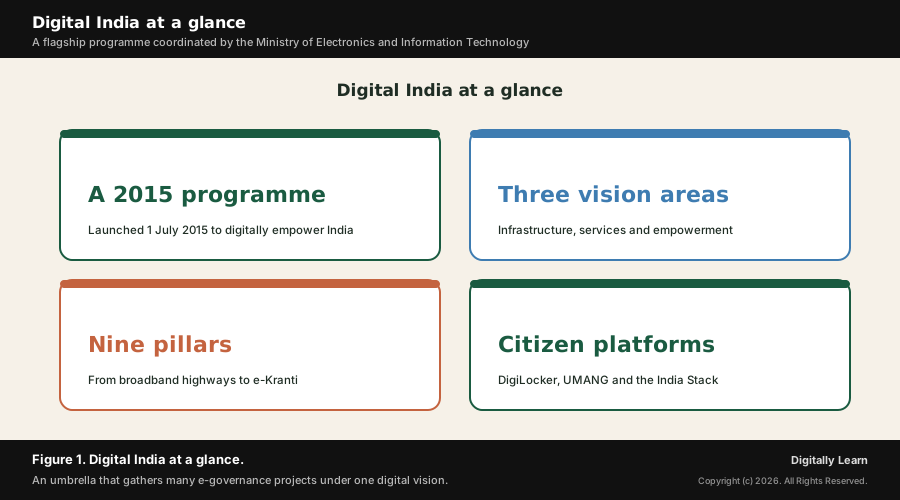
It was launched on 1 July 2015 as a flagship programme, coordinated by the Ministry of Electronics and Information Technology, with the declared aim of transforming India into a digitally empowered society and a knowledge economy. It is not one scheme but an umbrella that gathers many separate technology and governance projects under a single vision and a single name.
The problem Digital India attacks has two faces. The first is the digital divide, the gap between those with reliable connectivity, devices and the skills to use them and those without, which left much of rural and poorer India unable to reach online services at all.
The second is paper-based governance, in which a citizen had to carry physical certificates, queue at counters and depend on intermediaries to obtain a service or a benefit. Why it matters is that both faces shut ordinary people out of the modern state and the modern economy, and closing them is the purpose the programme set itself.
Digital India did not begin from nothing; it grew out of an earlier e-governance journey. The National e-Governance Plan, approved in 2006, had already set up a framework of mission-mode projects and the first Common Service Centres to deliver government services electronically, but these efforts remained fragmented and uneven.
Digital India absorbed and re-oriented this base, folding the existing projects into a coherent design and adding new platforms, so that the programme is best read as the consolidation and scaling-up of a decade of e-governance into one mission. The figure below sets out the headline shape of the programme.
The Three Vision Areas: Infrastructure as a Utility, Services on Demand and Digital Empowerment
Digital infrastructure as a core utility, governance and services on demand, and the digital empowerment of citizens
The whole programme is framed around three vision areas, each a distinct promise to the citizen. The first is digital infrastructure as a core utility to every citizen.
The idea is that connectivity, a digital identity, a mobile phone, access to a shared public cloud and a safe digital space should be available to everyone as a basic utility, in the way that power or water is, because without this base no online service can reach the ordinary person. This vision area is what the infrastructure pillars are built to deliver.
The second vision area is governance and services on demand. Here the aim is to make government services available to the citizen online, in real time, across departments, so that a person need not visit an office or carry papers to obtain a certificate, a licence or a benefit.
Services are to be seamlessly integrated across central and state governments, made available on mobile platforms, and tied to the citizen's digital identity, so that the state comes to the citizen rather than the citizen chasing the state. This is the e-governance heart of the programme.
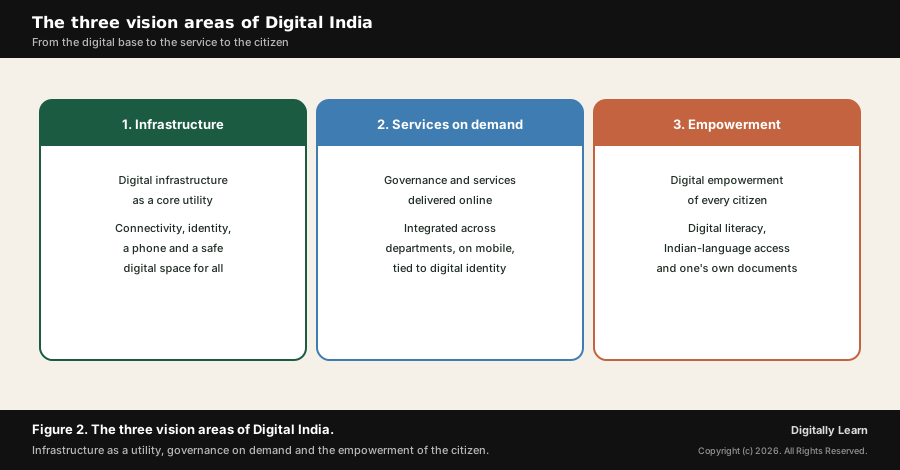
The third vision area is the digital empowerment of citizens. This goes beyond access and service to the citizen's own capacity: universal digital literacy, the availability of digital resources and services in Indian languages, and the ability to hold and share one's own documents through a cloud, so that a person is not merely a recipient but an active participant in digital life.
Read together, the three vision areas move from the base (infrastructure) to the service (governance on demand) to the citizen (empowerment), and the figure below sets them out.
The Nine Pillars of Digital India: Infrastructure, E-Governance and Job-Creation Pillars
The infrastructure pillars: broadband highways, universal mobile connectivity and public internet access
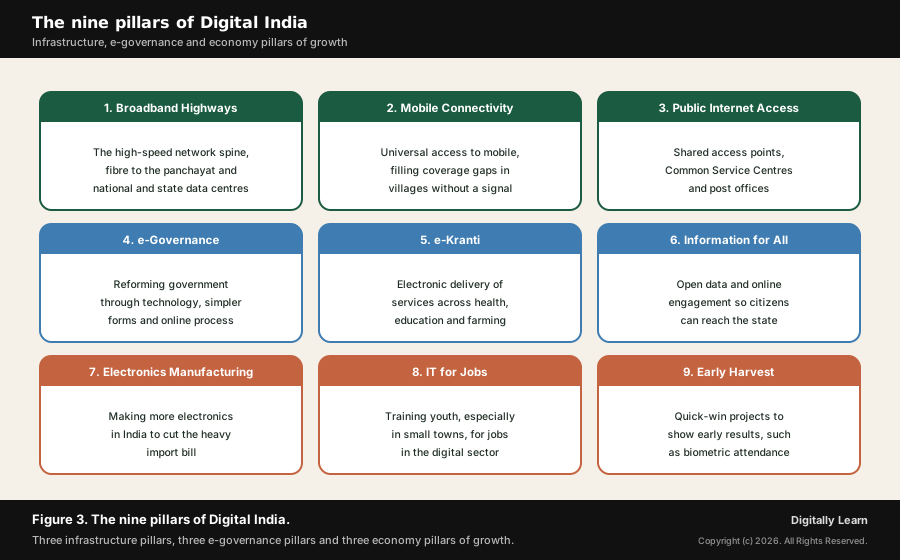
Under the three vision areas, Digital India set out nine pillars of growth, which group naturally into the digital base, the delivery of services and the wider economy. The first three build the infrastructure.
The first pillar, broadband highways, lays the high-speed network spine, including the optical-fibre reach to the village panchayat and the national and state data centres, so that data can travel to every corner of the country. It is the physical backbone on which the rest of the programme runs.
The second pillar is universal access to mobile connectivity, which fills the gaps in network coverage so that villages still without a mobile signal are brought onto the map; in a country where the phone is the main door to the internet, closing these coverage gaps is essential.
The third pillar is the public internet access programme, which turns shared outlets, above all the Common Service Centres and the post offices, into points where a citizen can get online and obtain a service even without a personal device or connection. Together these three pillars carry the first vision area, infrastructure as a utility, to the ground.
These infrastructure pillars matter because they decide whether the rest of Digital India can reach anyone. A platform like DigiLocker or a service delivered on demand is worthless to a person who cannot get online, so the broadband spine, the mobile signal and the shared access point are the precondition for inclusion rather than an afterthought.
Two of these pillars, the optical-fibre reach to the panchayat and the rural connectivity drive, are now carried forward by the separate BharatNet programme, covered in its own article, which deepens the village-level fibre network the broadband-highways pillar began.
The e-governance and economy pillars: e-Governance, e-Kranti, information for all, manufacturing, IT for jobs and early harvest
The next three pillars carry the service vision. The fourth pillar, e-Governance, is about reforming government through technology, simplifying forms, moving processes online and using a shared digital identity, so that the working of the state itself becomes digital.
The fifth pillar, e-Kranti, named for the electronic delivery of services, takes this to the citizen across health, education, farming, justice and finance, so that a service reaches a person electronically rather than over a counter. The sixth pillar, information for all, opens government data and online engagement, so that a citizen can find official information and reach the state directly.
The final three pillars carry the economy and jobs vision. The seventh pillar, electronics manufacturing, aims to make far more electronic goods within India and to cut the country's heavy import bill in this sector.
The eighth pillar, IT for jobs, trains young people, especially in smaller towns and rural areas, for work in the digital and electronics sectors. The ninth pillar, the early harvest programmes, gathers quick-win projects, such as biometric attendance, secure email and wifi in public spaces, meant to show visible results early and build confidence in the wider mission.
| Pillar | Group | What it does |
|---|---|---|
| Broadband Highways | Infrastructure | Lays the high-speed network spine and fibre reach to the panchayat |
| Universal Access to Mobile Connectivity | Infrastructure | Fills mobile-coverage gaps in villages without a signal |
| Public Internet Access Programme | Infrastructure | Makes shared outlets such as Common Service Centres and post offices into access points |
| e-Governance | Government service | Reforms government through technology, simpler forms and online process |
| e-Kranti (Electronic Delivery of Services) | Government service | Delivers services electronically across health, education, farming and finance |
| Information for All | Government service | Opens government data and online engagement for the citizen |
| Electronics Manufacturing | Economy and jobs | Makes more electronics in India to cut the import bill |
| IT for Jobs | Economy and jobs | Trains youth, especially in small towns, for digital-sector jobs |
| Early Harvest Programmes | Economy and jobs | Quick-win projects such as biometric attendance to show early results |
Two pillars now run far ahead under their own programmes. The electronics manufacturing pillar has grown into the India Semiconductor Mission and the wider electronics push, covered in its own article, while the deepening of digital public infrastructure and artificial intelligence is carried by the separate IndiaAI Mission.
Reading the nine pillars together, the design moves from the base (pillars one to three), through the service of government (pillars four to six), to the economy and jobs (pillars seven to nine), so the table below sets each pillar beside what it does.
The Citizen Platforms: DigiLocker, UMANG, e-Sign, MyGov and the Common Service Centres
DigiLocker for documents, UMANG for services, e-Sign for digital signing and MyGov for citizen engagement
The most visible face of Digital India is the set of citizen platforms it built or unified, each turning a vision area into something a person can actually use.
DigiLocker is a cloud-based platform for the issue and verification of documents: it lets a citizen hold and share official records such as identity, education, transport and driving documents in digital form, so that a verified copy is available anywhere and the need for physical papers falls away. It is the working expression of paperless governance and of the third vision area's promise that a person can carry their own documents in the cloud.
UMANG, the Unified Mobile Application for New-age Governance, is a single mobile app that aggregates a large number of citizen services from central, state and local bodies in one place, so that a person can reach many government services through one login rather than a separate app for each.
e-Sign is an online electronic signature service that lets a holder of an Aadhaar number sign a document digitally from anywhere, removing the need to print, sign and scan. MyGov is the Government's citizen-engagement platform, on which people share ideas and feedback on policies, so that participation, not just service, becomes digital.
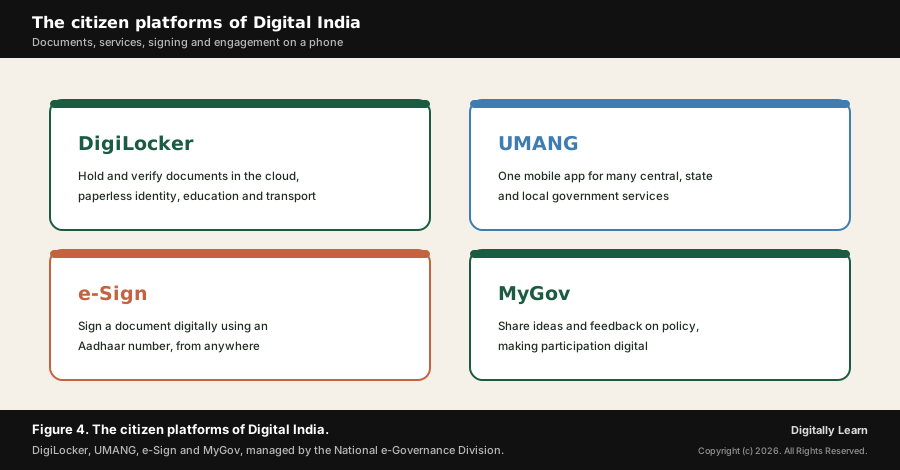
These platforms are managed by the National e-Governance Division, a body under MeitY that develops and runs the national public digital platforms; this section keeps to a qualitative account of scale, since the live user and document counts move quickly.
What unites them is a shift in the citizen's relationship with the state: instead of travelling, queuing and carrying paper, a person logs in, draws a service, signs a form or shares a document from a phone. The figure below sets out these four platforms and what each does.
The Common Service Centres: the last-mile access points run by village level entrepreneurs
Where DigiLocker and UMANG reach the citizen who already has a phone and a connection, the Common Service Centres reach the one who does not. A Common Service Centre, the CSC, is a physical access point for the delivery of government-to-citizen services, set up so that a villager can obtain a certificate, pay a bill, apply for a benefit or use a digital service through a nearby outlet rather than a distant office.
The centres are the last mile of the public internet access pillar, and they make the rest of Digital India real for those still on the wrong side of the divide.
Each centre is run by a village level entrepreneur, a local operator who works the digital terminal and helps residents complete a service for a small fee, so the model is a self-sustaining one that gives the operator a livelihood while extending the state's reach.
The network is steered by a dedicated company, CSC e-Governance Services India Limited, a special-purpose vehicle set up under MeitY to implement and manage the scheme, while the centres draw their roots from the National e-Governance Plan and were carried forward and expanded under Digital India to cover the gram panchayat level.
- Access point: A nearby outlet where a villager can obtain a certificate, pay a bill or use a digital service.
- Assisted delivery: A village level entrepreneur operates the terminal and helps residents complete a service for a small fee.
- Self-sustaining model: The fee gives the operator a livelihood while extending the reach of the state.
- Steered by a special-purpose vehicle: CSC e-Governance Services India Limited, set up under MeitY, manages the network.
The Common Service Centres matter because they are the part of the programme that confronts the access problem head-on. A platform that lives only on a smartphone leaves out the rural poor, the elderly and those without a device, so the staffed, assisted, physical centre is what carries a digital service to a person who cannot reach it alone.
This combination, the self-service platform for the connected citizen and the assisted centre for the unconnected one, is how Digital India tries to make digital governance inclusive rather than only convenient for those already online.
The India Stack and Direct Benefit Transfer: Aadhaar, UPI and How DBT Rides On Them
The India Stack of Aadhaar identity and UPI payments, and how Direct Benefit Transfer rides on it
Beneath the citizen platforms lies a deeper layer often called the India Stack, the set of shared digital building blocks on which services are built. Its foundation is Aadhaar, the digital identity number that gives each resident a unique, verifiable identity and lets a service confirm who a person is without paper, which in turn makes simple electronic know-your-customer and digital signing possible.
On this identity layer sits a payments layer, above all the Unified Payments Interface, the UPI system that lets money move instantly between bank accounts from a phone.
These shared layers are what let the citizen platforms work together. DigiLocker, e-Sign and the services on UMANG all draw on the Aadhaar identity layer to verify the user, while UPI carries any payment a service needs, so the stack acts as a common foundation rather than a set of disconnected apps.
It is widely described as a form of digital public infrastructure, a public good that the state provides and that both government and private services can build upon, much as roads or the power grid carry many users. This is the quiet engine under the visible programme.
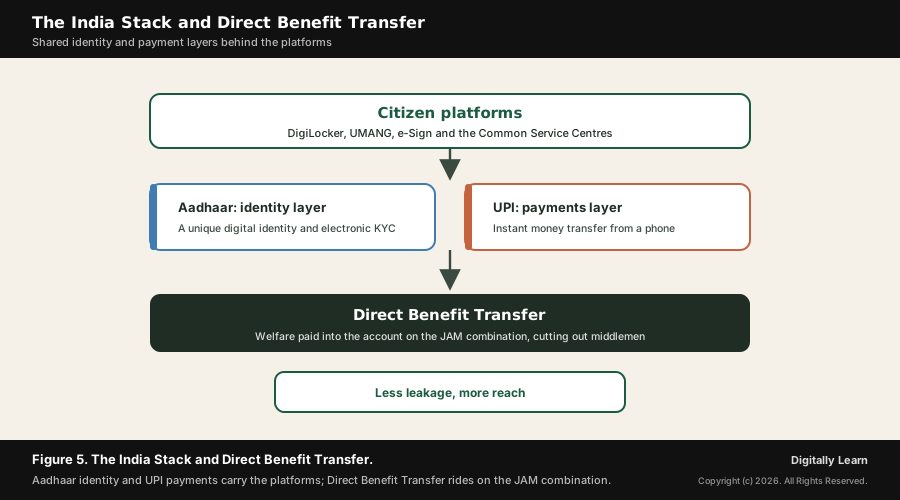
The clearest payoff of this stack is Direct Benefit Transfer, the system of paying subsidies and welfare straight into a beneficiary's bank account. DBT rides on the JAM combination, a bank account (the Jan Dhan account), Aadhaar identity and a mobile phone, so that a benefit can be routed to the right person automatically and middlemen are cut out.
The official case, set out in an Economic Survey framing, is that this design reduces leakage by identifying the right beneficiary, paying into the account and reaching the holder on the phone, though the precise savings figures move with each report and are best read as indicative. The figure below maps the stack and DBT.
The Institutional Architecture: MeitY, NeGD, NIC and the State E-Governance Bodies
The Ministry of Electronics and Information Technology, the National e-Governance Division, the National Informatics Centre and the CSC special-purpose vehicle
Digital India is delivered through a layered set of bodies rather than a single office. At the top sits the Ministry of Electronics and Information Technology, MeitY, the ministry that frames the programme, sets the policy and coordinates the many projects under the umbrella.
Because Digital India is a programme and not a law, MeitY's task is to steer departments and states towards a shared digital design, and it is the nodal point to which the platforms, the pillars and the wider mission report. It is the centre of gravity of the whole effort.
Under the ministry, the National e-Governance Division, the NeGD, is the body that develops and runs the national public digital platforms, including DigiLocker, UMANG and the others, and that provides the programme-management capacity for e-governance projects.
Alongside it, the National Informatics Centre, the NIC, is the Government's technology arm that builds and hosts much of the digital backbone, the data centres, the networks and the software, on which government applications run. Between them, the NeGD builds the citizen-facing platforms and the NIC provides the engineering base beneath them.
| Body | Role in Digital India |
|---|---|
| Ministry of Electronics and Information Technology (MeitY) | Frames the programme, sets policy and coordinates the projects under the umbrella |
| National e-Governance Division (NeGD) | Develops and runs the national public digital platforms such as DigiLocker and UMANG |
| National Informatics Centre (NIC) | Builds and hosts the data centres, networks and software backbone for government applications |
| CSC e-Governance Services India Limited | The special-purpose vehicle that manages the Common Service Centres and their village level entrepreneurs |
| State e-governance bodies | Run state service portals and machinery that plug into the national design |
The architecture reaches outward as well as downward. The Common Service Centres are delivered through a dedicated special-purpose vehicle, CSC e-Governance Services India Limited, set up under MeitY to manage the network and its village level entrepreneurs.
Because many public services are delivered by the states, each state runs its own e-governance machinery and its own service portals that plug into the national design, so that a citizen's service may be central or state but reaches them through the same digital channels. The table below sets out who does what.
The Outcomes: Paperless Documents, Online Services and the DBT Platform
Mass digital document holding, services delivered online and welfare paid through the stack
The first and most visible outcome of Digital India is the move to paperless document holding and verification. Hundreds of millions of citizens now hold official records in DigiLocker and draw services through UMANG, so that a verified document can be produced from a phone and a service obtained without a visit to an office.
The exact live counts of users and documents move quickly and are best read as indicative, but the direction is unmistakable: a great mass of routine paperwork has shifted from the counter to the cloud.
A second outcome is the spread of online service delivery across government. Services that once needed a personal visit, from certificates to benefit applications, are increasingly available through portals, apps and the Common Service Centres, and the shared identity and payment layers let these services tie together rather than stand alone.
International observers, including the World Bank, have described India's digital public infrastructure as having compressed into a few years a transformation in identity, payments and service delivery that elsewhere took far longer, treating it as a notable model.
- Paperless documents: Official records held and verified in DigiLocker, produced from a phone rather than a counter.
- Online service delivery: Certificates and benefit applications increasingly available through portals, apps and the Common Service Centres.
- The welfare platform: Direct Benefit Transfer paying subsidies across many schemes straight into accounts on the India Stack.
A third outcome is the welfare platform the stack created. By pairing the bank account with Aadhaar identity and the mobile phone, Digital India and the wider stack made Direct Benefit Transfer possible at scale, so that subsidies and welfare across a large number of schemes are now paid straight into accounts.
The Government has reported substantial savings from weeding out duplicate and ineligible claimants, though the precise figures move with each official report and are presented here as indicative rather than exact. The account that the stack reaches is the rail on which a leaner, more targeted welfare delivery now runs.
The Critiques and Debates: Digital Divide, Data Privacy and Exclusion Risks
The persisting digital divide, privacy and surveillance concerns, exclusion through mandatory digital identity and the last-mile and cyber-security questions
A balanced reading sets the gains against persistent critiques, presented here as they are argued by independent researchers, economists and civil-society bodies.
The most fundamental is the digital divide itself: critics note that a programme delivered through phones, connectivity and digital literacy can deepen inequality if the very groups it means to help, the rural poor, the elderly, women and those in remote areas, remain on the wrong side of access, so that the benefits flow first to those already connected. On this view, closing the divide, rather than building more platforms, is the binding constraint.
A second cluster of concerns is over data privacy and surveillance. As more identity, financial and service data move onto shared digital systems, critics warn of the risks of misuse, profiling and breach, and they argue that strong data-protection safeguards must keep pace with the speed of digitisation.
The Government's answer on this front is the Digital Personal Data Protection Act and the wider data-protection framework, treated in its own article, which is meant to set the rules for how personal data is collected and used; the debate is over whether such safeguards are sufficient and independently enforced.
- Digital divide: A model built on connectivity and skills can deepen inequality if the poor remain without access.
- Data privacy and surveillance: Identity, financial and service data on shared systems raise misuse and breach risks.
- Exclusion: An effectively mandatory digital step can deny a genuine beneficiary whose authentication fails.
- Last mile and cyber-security: Weak connectivity or an absent operator and rising online risk as public life moves online.
Further concerns cluster around exclusion and security. Critics caution that making a digital identity or an online step effectively mandatory for a service can shut out a genuine beneficiary whose authentication fails or who lacks the document, turning a tool of inclusion into a cause of exclusion.
They also point to last-mile gaps, where weak connectivity or an absent operator leaves a service out of reach, and to cyber-security risks as more of public life moves online. On the central question, whether Digital India has narrowed the divide or widened it, a careful answer treats the matter as open and weighs both sides.
Understanding the Significance: Digital Governance, the DBT Platform and Citizen Empowerment
A shift to digital governance, the rail for Direct Benefit Transfer and a route to citizen empowerment
What is the significance of Digital India lies first in its remaking of governance itself. By moving forms, services and documents online and tying them to a shared digital identity, the programme turns the state into a platform the citizen can reach from a phone, replacing the visit, the queue and the paper certificate with a login.
This is more than convenience: it is a change in how the state is organised to deliver, studied as one of the largest such shifts attempted anywhere, and it is the working answer to the older fragmentation that the National e-Governance Plan had left unresolved.
Its second significance is as the platform for Direct Benefit Transfer and for a wider digital economy. The shared India Stack of identity and payments is what lets welfare reach the poor directly, lets a small merchant accept a digital payment and lets a private service verify a customer cheaply, so the public infrastructure becomes a base on which both the state and the market build.
By creating this base, Digital India reshaped not only government but the rails of the economy, which is why it is read as a piece of structural reform rather than a single scheme.
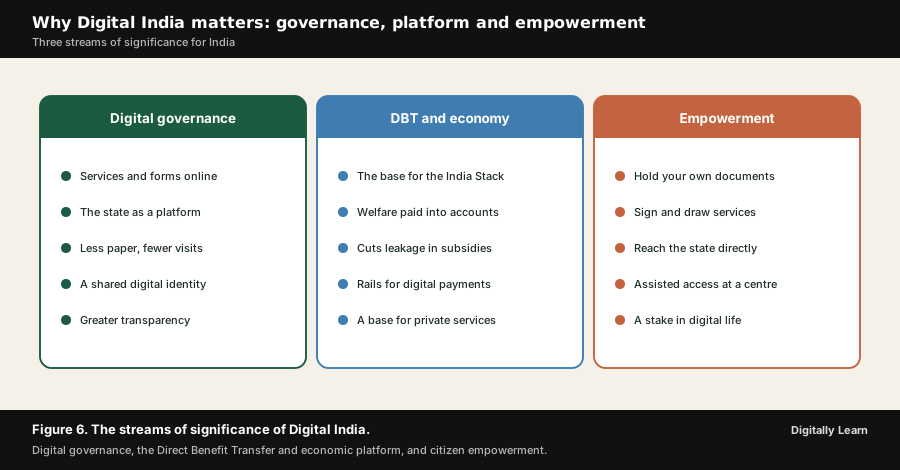
Its third significance is for citizen empowerment. When a person can hold their own documents, sign a form, draw a service and receive a benefit without an intermediary, the relationship between the citizen and the state shifts towards the citizen, and the assisted Common Service Centre extends that shift even to those without a device.
Read together, digital governance, the DBT and economic platform, and citizen empowerment are why Digital India is treated as a landmark in India's development policy. The figure below maps these strands.
The Way Forward: Closing the Divide, Strengthening Data Protection and Deepening Inclusion
Narrowing the access gap, hardening privacy and security, and turning platforms into deep, inclusive usage
The way forward follows directly from the critiques. The first priority is to close the divide: to push connectivity, affordable devices and, above all, digital literacy to the groups still left out, the rural poor, the elderly and women, and to keep the assisted Common Service Centre strong, so that the access gap narrows rather than hardens into a new inequality. Without this, every new platform risks serving mainly those already online.
The second priority is to harden the safeguards. Implementing the data-protection framework with genuine independence, investing in cyber-security as more of public life moves online, and ensuring that no service is so mandatorily digital that an authentication failure can deny a genuine beneficiary their due, would address the privacy and exclusion concerns that the critics press. A reliable manual or assisted fallback for every digital step is part of making the system fair as well as efficient.
The third priority is to turn platforms into deep, inclusive usage rather than rest on the count of users or documents. Improving the reliability of the digital plumbing, integrating services so a citizen meets one window rather than many, and continuing to extend reach to the unconnected, would move the programme from a drive that built platforms into one that genuinely changed how every citizen deals with the state.
Pursued together, these measures would move Digital India closer to its founding promise: not merely digital tools, but real, inclusive empowerment for all.
UPSC Relevance and Exam Focus
Where Digital India fits in the UPSC-CSE syllabus
This topic maps most directly to General Studies Paper II: e-governance, the applications, models, successes, limitations and potential; and government policies and interventions for development in various sectors, since Digital India is the flagship e-governance programme whose design, delivery and limits are routinely examined.
It also links strongly to General Studies Paper III, the role of technology in development and the digitisation of the economy, where digital public infrastructure, the India Stack and Direct Benefit Transfer are core themes, and it supplies rich material on transparency, inclusion and the digital divide.
For Prelims, hold the high-yield facts about the programme, its bodies and its platforms. The list below sets out the points most often tested, from the coordinating ministry and the three vision areas to the names of the nine pillars and the citizen platforms, so an aspirant can revise them at a glance before moving to the Mains framing.
- A 2015 programme coordinated by MeitY, to make India a digitally empowered society and knowledge economy.
- Three vision areas: Digital infrastructure as a utility, governance and services on demand, and digital empowerment of citizens.
- Nine pillars: From broadband highways through e-Governance and e-Kranti to early harvest programmes.
- Citizen platforms: DigiLocker stores and verifies documents, UMANG is a single app for many services, and e-Sign uses Aadhaar to sign documents.
- Common Service Centres: Last-mile access points run by village level entrepreneurs, with the platforms managed by the National e-Governance Division.
For Mains, the recurring framing is to assess whether Digital India has made government genuinely digital and inclusive: how the vision areas and pillars set the design, how the citizen platforms and the India Stack carry services and Direct Benefit Transfer, and how far the digital divide, privacy concerns and exclusion risks have limited its reach.
A strong answer treats Digital India as a case study in e-governance and digital public infrastructure, weighing its real gains in service delivery and the DBT platform against the unresolved questions of access, data protection and exclusion. The points below name the concepts that recur across both papers.
- E-governance: The use of technology to deliver government services and reform how the state works, of which Digital India is India’s flagship instrument.
- India Stack: The shared digital public infrastructure of Aadhaar identity and UPI payments on which the citizen platforms and Direct Benefit Transfer are built.
- Common Service Centres: The last-mile access points, run by village level entrepreneurs, that deliver government-to-citizen services where there is no device or connection.
- Digital divide: The gap in access, connectivity and digital skills that decides whether a digital programme includes or excludes the poor.
A common Prelims trap is to confuse the bodies and the platforms; hold that Digital India is coordinated by MeitY, that the platforms are run by the National e-Governance Division, that the Common Service Centres are managed by a special-purpose vehicle, and that DigiLocker, UMANG and e-Sign are platforms under Digital India while BharatNet, ABDM and the semiconductor mission are separate components rather than the umbrella itself.
A common Mains trap is to list the platforms and stop there. The exam value lies in a balanced judgment: the real achievements in digital service delivery, the India Stack and the DBT platform, set honestly against the open problems of the digital divide, data privacy and the risk of exclusion through mandatory digital steps.
Previous Year UPSC-CSE Questions By the end you will be able to draft model answers for the following UPSC questions. Each question carries a collapsible framework showing how to approach it in the exam.
- UPSC Mains 2020 GS-IIDiscuss how the Fourth Industrial Revolution, the digital revolution, has made e-Governance an integral part of how the government works, with reference to how technology has been built into the delivery of public services.
How to structure the answer in the exam
Body (sub-themes to develop):
- How the digital revolution drove e-Governance: Digital India consolidated the earlier National e-Governance Plan into one mission, with governance and services on demand as a core vision area.
- How e-Governance became integral: the e-Governance and e-Kranti pillars moved government process and service delivery online, and the platforms DigiLocker, UMANG, e-Sign and MyGov made digital dealing with the state routine.
- The shared digital base: the India Stack of Aadhaar identity and UPI payments, the institutional architecture of MeitY, the National e-Governance Division, the National Informatics Centre and the state bodies that embed e-governance across government.
- The real outcomes: paperless documents, online services, and Direct Benefit Transfer as the welfare platform that the stack made possible.
- Honest qualifications: the persisting digital divide, data-privacy and surveillance concerns, and the risk of exclusion through effectively mandatory digital identity temper the claim.
Relevance to this topic. Digital India is the flagship programme through which the digital revolution has been built into Indian governance, so the question's claim that the Fourth Industrial Revolution has made e-Governance an integral part of government is, in the Indian context, a claim about Digital India itself, its vision areas, its e-Governance and e-Kranti pillars and its citizen platforms.
Sources and Further Reading
- Digital India, MeitY: Our Pillars, the nine pillars of growth
- Digital India, MeitY: About Us, the vision and three vision areas
- Press Information Bureau: Digital India, a programme to transform India into a digitally empowered society and knowledge economy
- Digital India, MeitY: e-Kranti, Electronic Delivery of Services
- Digital India, MeitY: DigiLocker initiative
- Ministry of Electronics and Information Technology: e-Sign (e-Hastakshar)
- Digital India, MeitY: Common Services Centres
- Common Services Centres: CSC e-Governance Services India Limited and the Common Service Centres 2.0 scheme
- Ministry of Finance, Economic Survey: Spreading JAM across India's economy
- World Bank: India's digital transformation could be a game-changer for economic development
- Wikipedia: Digital India
Editorial Disclaimer
This briefing is for UPSC preparation. Verify the facts and figures against the official MeitY, Digital India and PIB sources before relying on them.


