


Overview
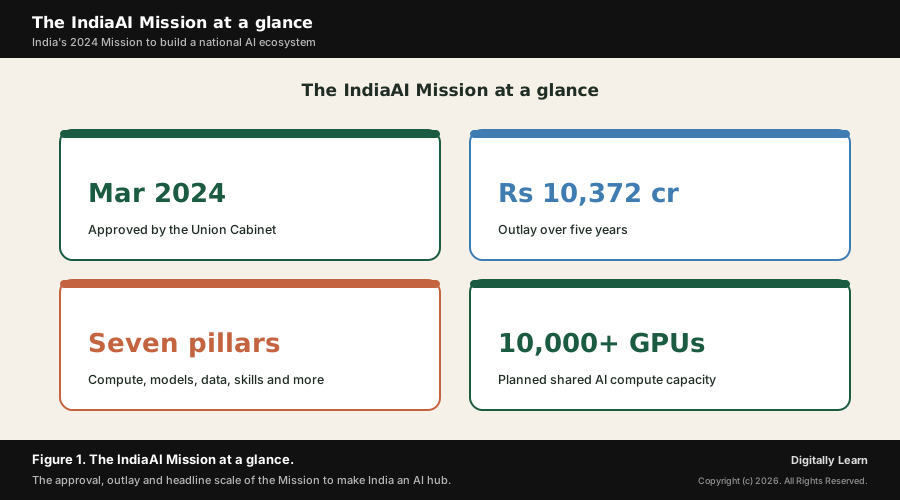
The IndiaAI Mission is India's flagship programme to build a national artificial-intelligence ecosystem, approved by the Union Cabinet in March 2024 with an outlay of about Rs 10,372 crore over five years. It is implemented by the IndiaAI Independent Business Division under the Digital India Corporation, within the Ministry of Electronics and Information Technology. Its aim is to make India a hub for the development and application of AI, by supplying the country with its own AI compute, data, models and skilled talent. The Mission is organised around seven pillars, from a shared computing backbone of over 10,000 graphics processing units to indigenous foundation models, an open datasets platform, AI in critical sectors, skilling, startup funding and safe, trusted AI.
What the IndiaAI Mission Is: A National Push to Build an AI Ecosystem
A Rs 10,372 crore Mission to make India a hub for AI
The IndiaAI Mission is India's central plan to build a whole ecosystem around artificial intelligence. It was approved by the Union Cabinet in March 2024, with an outlay of about Rs 10,372 crore spread over five years. The Mission is run by the Ministry of Electronics and Information Technology, the MeitY, which is the nodal ministry for the effort.
Implementation is handled by a dedicated body. The Mission is delivered by the IndiaAI Independent Business Division, set up under the Digital India Corporation, a not-for-profit company of MeitY. Housing the Mission in a focused division, rather than a regular department, is meant to give it the speed and flexibility that a fast-moving technology demands.
The reason this matters is that AI now shapes the economy and strategic power, yet the compute, data and models behind it have been concentrated in a few firms and countries. By backing all of these at home, the Mission ties together several national goals: a stronger digital economy, technological self-reliance and a place in the global AI race. The figure below sets out the Mission at a glance.
Why the IndiaAI Mission Is in the News: Compute Crosses a Milestone
From approval to a shared compute backbone and indigenous models
Why it matters now is that the Mission has moved from approval on paper to working infrastructure. Its most visible achievement is the shared AI compute backbone, the pool of graphics processing units that startups, researchers and institutions can rent rather than having to buy costly hardware of their own.
The figures here are best read as approximate and as-of the government's reporting, because the compute pool keeps growing as more providers are added. As of the Government's reporting, the common compute capacity made available has crossed about 34,000 GPUs, well past the Mission's initial floor of over 10,000, and is offered to startups and researchers at a low, subsidised hourly rate to bring down the cost of building AI.
Alongside the compute push, the Mission has begun work on its other pillars: an open datasets platform, support for indigenous foundation models suited to Indian languages and problems, and projects on safe and trusted AI. Each new step, a fresh tranche of GPUs, a new model or a new dataset, keeps the Mission in the news and lets the country track its progress.
Understanding the Significance of the IndiaAI Mission for India
Democratised compute, indigenous models and digital self-reliance
What is the significance of the IndiaAI Mission lies first in democratising compute. The specialised chips that train AI are scarce and expensive, which has kept serious AI work to a few large firms. By pooling GPUs and renting them cheaply, the Mission lets a small startup or a university lab build AI it could never have afforded alone, widening who can take part.
Its second significance is indigenous capability. India has long depended on foreign AI models and platforms. By funding home-grown foundation models trained on Indian languages and data, the Mission seeks models that understand the country's context and reduce reliance on systems built and controlled abroad, a form of technological self-reliance in a strategic field.
Its third significance is the data, talent and trust the ecosystem needs. The Mission builds an open datasets platform so AI has quality data to learn from, expands skilling so India has the people to build AI, and funds work on safe and trusted AI. Together these make the Mission a central piece of India's digital economy and of its bid to compete in the global AI race.
What AI Is: Foundation Models, GPUs and the Compute-Data-Talent Triad
Artificial intelligence, foundation models and the chips that power them
To follow the Mission, it helps to be clear on what artificial intelligence is. AI is software that performs tasks once thought to need human intelligence, such as understanding language, recognising images or making predictions. Modern AI mostly learns from data: instead of being programmed with fixed rules, it is trained on large quantities of examples until it can generalise to new cases.
A turning point has been the foundation model. A foundation model is a single large model trained on a vast body of data, which can then be adapted to many different tasks. Large language models, which generate and understand text, and large multimodal models, which also handle images, audio and more, are the best-known examples. The IndiaAI Innovation Centre is meant to build such models for Indian needs.
Training these models takes enormous computing power, which is where graphics processing units, or GPUs, come in. A GPU is a chip with thousands of small cores that perform many calculations at once, exactly the kind of parallel work that AI training demands. This is why GPUs are scarce and costly, and why the Mission's compute pillar is built around making them widely available.
Compute, data and talent: the three inputs the Mission targets
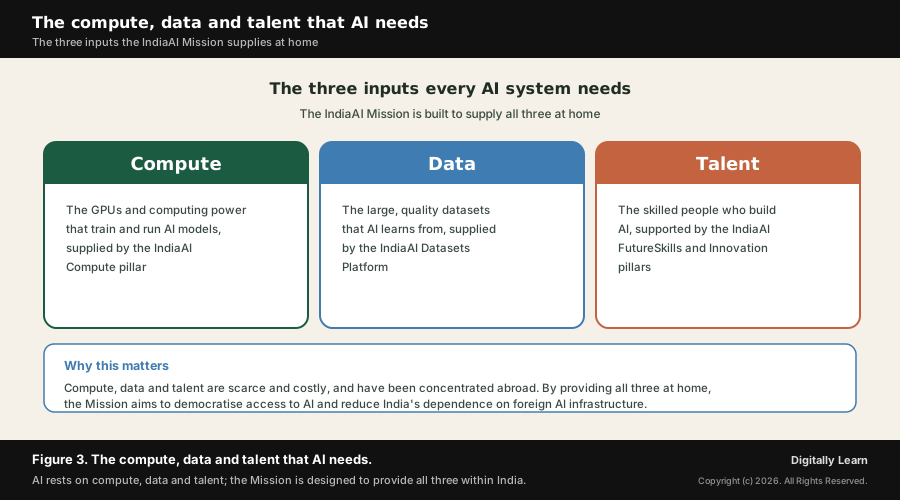
Behind any AI system sit three inputs, and the Mission is deliberately built to supply all three within India. The first is compute, the GPUs and computing power that train and run models, addressed by the IndiaAI Compute Capacity pillar. Without affordable compute, building competitive AI is simply out of reach for most.
The second input is data. AI learns from examples, so it needs large, good-quality datasets, which the IndiaAI Datasets Platform is meant to provide through a one-stop store of non-personal data. The third is talent, the skilled people who design, train and deploy AI, supported by the FutureSkills and Innovation pillars. The figure below sets out this triad.
Seen this way, the Mission is not a single scheme but a coordinated effort to remove each bottleneck at once. Supplying cheap compute is of little use without data to train on or people to build the models; the Mission's design reflects the fact that all three inputs must advance together for an AI ecosystem to take root.
The Seven Pillars of the IndiaAI Mission, Explained
Compute, the Innovation Centre and the datasets platform
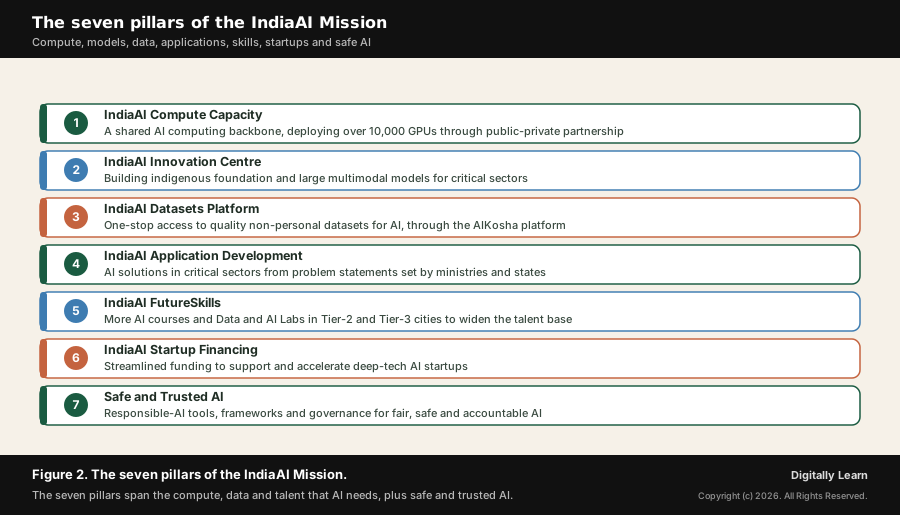
The Mission is organised into seven pillars, each tackling one part of the ecosystem. The first, IndiaAI Compute Capacity, builds a scalable AI computing backbone, deploying over 10,000 GPUs through public-private partnership, so that affordable, high-end compute is available to all who need it.
The second pillar, the IndiaAI Innovation Centre, leads the development of indigenous foundation models and large multimodal models, including domain-specific models for critical sectors, so that India has AI built for its own languages and problems. The third, the IndiaAI Datasets Platform, gives startups and researchers one-stop access to quality non-personal datasets through a unified data platform, so that good data is no longer a barrier.
These three pillars map directly onto the compute-data-talent triad: the compute pillar supplies the chips, the datasets platform supplies the data, and the Innovation Centre, together with skilling, supplies the models and the people. They are the technical heart of the Mission, the parts that build the raw capability to make AI in India.
Applications, skills, startup funding and safe, trusted AI
The fourth pillar, the IndiaAI Application Development Initiative, promotes AI applications in critical sectors, drawn from problem statements set by central ministries, state departments and other institutions, in areas such as healthcare, agriculture and disaster management. It is the pillar that turns capability into real solutions for governance and development.
The fifth pillar, IndiaAI FutureSkills, widens the talent base by expanding AI courses across degree programmes and by setting up Data and AI Labs in Tier-2 and Tier-3 cities, so that AI skilling reaches beyond the metros. The sixth, IndiaAI Startup Financing, gives deep-tech AI startups streamlined access to funding, so that promising young companies can scale.
The seventh pillar, Safe and Trusted AI, runs across the others. It funds responsible-AI tools, frameworks and governance, including work on bias, privacy and explainability, so that AI built under the Mission is fair, safe and accountable. The figure below names all seven pillars.
| Pillar | What it builds | Which input it serves |
|---|---|---|
| IndiaAI Compute Capacity | A shared backbone of over 10,000 GPUs | Compute |
| IndiaAI Innovation Centre | Indigenous foundation and multimodal models | Talent and capability |
| IndiaAI Datasets Platform | One-stop access to non-personal datasets | Data |
| Application Development Initiative | AI solutions for ministry problem statements | Use in critical sectors |
| IndiaAI FutureSkills | AI courses and Data and AI Labs | Talent |
| IndiaAI Startup Financing | Funding for deep-tech AI startups | Ecosystem and economy |
| Safe and Trusted AI | Responsible-AI tools and governance | Trust and safety |
Progress, Benefits and the Real Challenges of the Mission
Early progress: compute, indigenous models and AI in healthcare
The Mission's early progress is clearest in compute. As-of the Government's reporting, and treated as approximate because the pool keeps growing, the shared compute capacity has crossed about 34,000 GPUs, offered to startups and researchers at a subsidised rate. This is the foundation on which the other pillars build.
Work has also begun on indigenous foundation models tailored to Indian languages and use-cases, and on AI applications in critical sectors. Under the Application Development Initiative, problem statements from ministries are turned into AI solutions, and healthcare is a priority area: AI is being applied to clinical tasks such as helping read medical images and scans, supporting diagnosis, screening and triage, so that scarce specialist expertise reaches more patients. AI here assists the clinician rather than replacing professional judgement.
These healthcare applications show how AI can help clinical diagnosis: trained on large sets of labelled medical data, a model can flag likely abnormalities in an X-ray, scan or pathology slide and prioritise urgent cases. Used well, this extends the reach of good diagnosis into rural and under-served areas, which is exactly the kind of high socio-economic impact the Mission's application pillar seeks.
Data, privacy and the case for safe and trusted AI
Powerful applications bring real risks, and the Mission treats these head-on through its Safe and Trusted AI pillar. In sensitive fields such as healthcare, AI is trained on personal and medical data, which raises a genuine threat to privacy: records can be exposed, re-identified or misused, and patients may not know how their data is being used.
There are further data risks. An AI model trained on biased or unrepresentative data can give unfair or wrong outputs, for example missing a disease pattern in a group under-represented in the training set. To guard against this, the Mission's datasets platform is built around non-personal data, and the Safe and Trusted AI pillar funds tools for bias mitigation, privacy protection and explainability, so that an AI system can be audited and trusted.
This is why responsible AI is not an afterthought but a pillar in its own right. The case for AI in a field such as healthcare is strong, but it holds only if privacy is protected, data is governed and the systems are fair and accountable. The Mission's design accepts that genuine benefit and genuine risk travel together, and that the trust layer is what makes the rest usable.
The challenges: the compute and chip gap, data, talent and global competition
A balanced view must weigh the challenges, the more so because UPSC questions reward this balance. The first is the global compute and chip gap: the most advanced GPUs are made by a handful of foreign firms, so even a large compute pool depends on imported hardware, and the supply, cost and energy needs of that hardware are real constraints.
The second set of challenges is data and talent. Quality datasets in Indian languages are still limited, and poorly governed data carries privacy and bias risks; meanwhile the deepest AI research talent is scarce and globally mobile. Building enough good data and retaining enough skilled people are slow tasks that funding alone cannot rush.
Further challenges are competition and governance. India competes with global AI leaders that spend far more and move fast, so closing the gap is hard. And as AI spreads, the risks of misuse, deepfakes and unsafe systems grow, which is why clear regulation and the safe-AI pillar matter. None of these is fatal, but each must be managed for the Mission to deliver.
The IndiaAI Mission in Context: Digital Public Infrastructure, AI Governance and the Global Race
How the Mission sits within India's digital strategy and the world AI race
Contemporary linkages place the Mission within India's wider digital strategy. India has built world-leading digital public infrastructure, from digital identity to instant payments, and the IndiaAI Mission extends that logic to AI: shared compute, open datasets and common tools as public goods that the whole ecosystem can build on, rather than capabilities locked inside a few firms.
The Mission also belongs to a longer policy arc. Bodies such as NITI Aayog, through its National Strategy for Artificial Intelligence and its #AIforAll vision, mapped early how AI could serve sectors such as healthcare and agriculture and why responsible AI matters, and India has since moved toward AI governance guidelines. The Mission turns much of that strategy into funded, working programmes.
Globally, the Mission is India's bid in a fast-moving AI race. Institutions such as the World Bank note that AI compute and data centres are heavily concentrated in high-income countries, leaving a real divide, even as AI promises large gains in productivity and services for developing economies. India's combination of scale, data and a public-infrastructure model is its strategy to compete and to spread the benefits widely.
- Digital public infrastructure: The Mission treats AI compute, data and tools as shared public goods, extending India’s digital-public-infrastructure model.
- Technological self-reliance: Indigenous foundation models and home compute reduce dependence on foreign AI in a strategic technology.
- Responsible and safe AI: A dedicated pillar and the wider governance push address bias, privacy and the safety of AI systems.
- The global AI race: The World Bank flags a compute divide; the Mission is India’s bid to compete and to widen access.
Finally, the Mission sits within India's evolving technology architecture, alongside the semiconductor push, the data-protection framework and the skilling drive. It does not stand alone; it is one funded piece of a much larger effort to make India a producer, and not only a consumer, of frontier technology.
UPSC Relevance and Exam Focus
Where this fits in the UPSC-CSE syllabus
This topic maps most directly to General Studies Paper III: science and technology, developments and their applications, and indigenisation of technology, and to the awareness in the field of IT. It also reaches into the economy, since AI is a growth and jobs story, and into the ethics and governance themes that AI raises across the papers.
For Prelims, hold the high-yield facts: the IndiaAI Mission was approved in March 2024 with an outlay of about Rs 10,372 crore over five years, is run by MeitY through the IndiaAI division under the Digital India Corporation, and is organised around seven pillars, including IndiaAI Compute Capacity, the Innovation Centre, the Datasets Platform and Safe and Trusted AI.
For Mains, the recurring framing is to introduce what AI is, explain how it helps an applied field such as healthcare and clinical diagnosis, weigh its benefits against the privacy, data and safety risks, and link it to self-reliance and the global AI race. The IndiaAI Mission is a ready example that ties all of these together.
Recurring linked concepts an aspirant should keep in working memory:
- Foundation model: A single large AI model trained on vast data that can be adapted to many tasks, such as a large language model.
- Graphics processing unit (GPU): A chip with many cores for parallel computation, the workhorse of AI training, scarce and costly.
- Responsible AI: The design of AI that is fair, transparent, privacy-respecting and accountable, addressing bias and misuse.
- Digital public infrastructure: Shared digital building blocks, such as identity, payments and now AI compute and data, open to the whole ecosystem.
A common Prelims trap is to confuse the IndiaAI Mission with a single product or a private platform. It is a government Mission of MeitY, delivered through the IndiaAI division under the Digital India Corporation, and built around seven distinct pillars, not one app or model.
A common Mains trap is to praise AI without weighing its risks. Its exam value lies in a balanced judgment: the genuine gains in healthcare, agriculture and the economy, set honestly against the threats to privacy, the bias in poorly governed data, the compute and talent gaps, and the need for responsible, safe AI.
Previous Year UPSC-CSE Questions By the end you will be able to draft model answers for the following UPSC questions. Each question carries a collapsible framework showing how to approach it in the exam.
- UPSC Mains 2023 GS-IIIIntroduce the concept of Artificial Intelligence (AI). How does AI help clinical diagnosis? Do you perceive any threat to privacy of the individual in the use of AI in healthcare?
How to structure the answer in the exam
Body (sub-themes to develop):
- Introducing AI: software that learns from data to perform perception, language and prediction tasks; foundation models and the GPUs that train them; India's IndiaAI Mission building compute, data, models and talent.
- AI in clinical diagnosis: models trained on labelled medical data read X-rays, scans and pathology slides, flag abnormalities, support screening, triage and early detection, and extend specialist reach to under-served areas, assisting rather than replacing clinicians.
- The privacy threat: AI in healthcare relies on sensitive personal and medical data, raising risks of data exposure, re-identification, unconsented use and surveillance, alongside the risk of bias from unrepresentative data.
- Safeguards and responsible AI: non-personal datasets, data-protection law, anonymisation, consent, bias-mitigation, explainability and the IndiaAI Mission's Safe and Trusted AI pillar to keep AI fair, private and accountable.
- Balanced judgment: the clinical gains are real but conditional on strong privacy protection, data governance and trustworthy, auditable systems.
Sources and Further Reading
- PIB: Cabinet Approves Ambitious IndiaAI Mission
- PIB: Cabinet Approves Over Rs 10,300 Crore for IndiaAI Mission
- PIB: India's Common Compute Capacity Crosses 34,000 GPUs
- IndiaAI: The seven pillars of the IndiaAI Mission
- MeitY: IndiaAI Division, Digital India Corporation
- NITI Aayog: National Strategy for Artificial Intelligence
- World Bank: Digital Progress and Trends Report 2025, Strengthening AI Foundations
- Wikipedia: Foundation model
- Wikipedia: Graphics processing unit
Editorial Disclaimer
This briefing is for UPSC preparation. Verify the figures and Mission details against the official MeitY, PIB and IndiaAI sources before relying on them.


