


Overview
Article 3 at Work
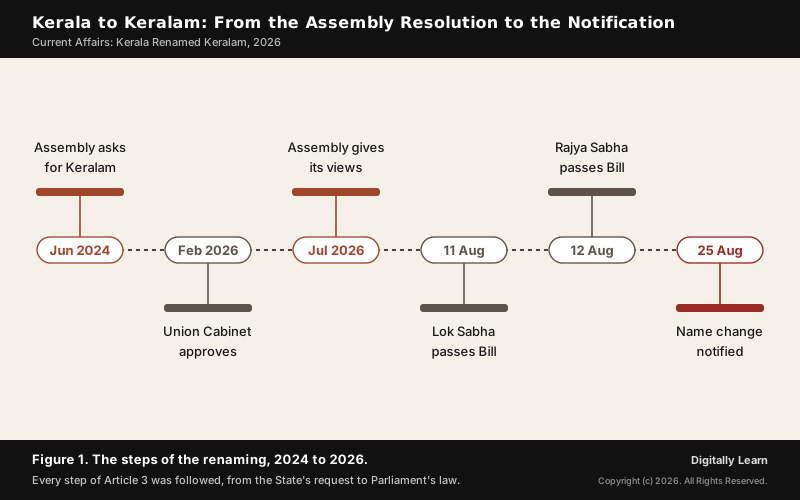
The Kerala name change to Keralam was made by the Kerala (Alteration of Name) Act, 2026, which Parliament passed under Article 3 of the Constitution on 11 and 12 August 2026, at the request of the Kerala Legislative Assembly. It replaces Kerala with Keralam, the State's name in Malayalam, in the First Schedule, and the new name took effect on 25 August 2026.
Kerala Name Change to Keralam: What Changed in August 2026
Is Kerala Now Keralam? The Kerala (Alteration of Name) Act, 2026
Yes. Kerala is now officially Keralam. The change took two years and passed through every step that Article 3 lays down, beginning with a request from the State itself; the First Schedule of the Constitution, which lists the States and their territories, now carries the new name.
- 24 June 2024: The Kerala Legislative Assembly unanimously resolved to ask the Centre to change the State’s name to Keralam.
- 24 February 2026: The Union Cabinet approved the proposal, and the President was to refer the Bill to the State Assembly for its views under the proviso to Article 3.
- 2 July 2026: The Kerala Assembly gave its views on the Bill, again by a unanimous resolution.
- 11 and 12 August 2026: The Lok Sabha passed the Bill without discussion, moved by Minister of State for Home Nityanand Rai, and the Rajya Sabha passed it the next day.
- Assent and notification: President Droupadi Murmu gave her assent, and the Ministry of Home Affairs notified the change on 25 August 2026.
Why Kerala Name Changed to Keralam: Language and Identity
Keralam is the State's name in Malayalam, and the Assembly's resolution rested on that fact. It recalled that States were formed on the basis of language on 1 November 1956, that Kerala Piravi Day, the State's formation day, also falls on 1 November, and that a demand for a united Kerala for Malayalam speakers had run since the freedom struggle. Yet the First Schedule recorded the name as Kerala.
In the Rajya Sabha, the Minister presented the Bill as a continuation of the Assembly's 2024 resolution, and spoke of the government's commitment to removing what he called symbols of slavery and establishing those that represent the pride of India's heritage. In the Lok Sabha, Congress member K.C. Venugopal wanted to speak on the Bill about his home State but could not, amid the uproar.
Article 3 of the Indian Constitution: How Parliament Renames a State
Article 3 Powers: New States, Boundaries and Names
Article 3 lets Parliament redraw the internal map of the Union. It may form a new State by separating territory from a State or by uniting States or parts of States, increase or diminish the area of a State, alter its boundaries, and alter its name. Article 2 is different: it covers the admission or establishment of new States that are not part of the Union of India, while Article 3 deals with changes in the existing States.
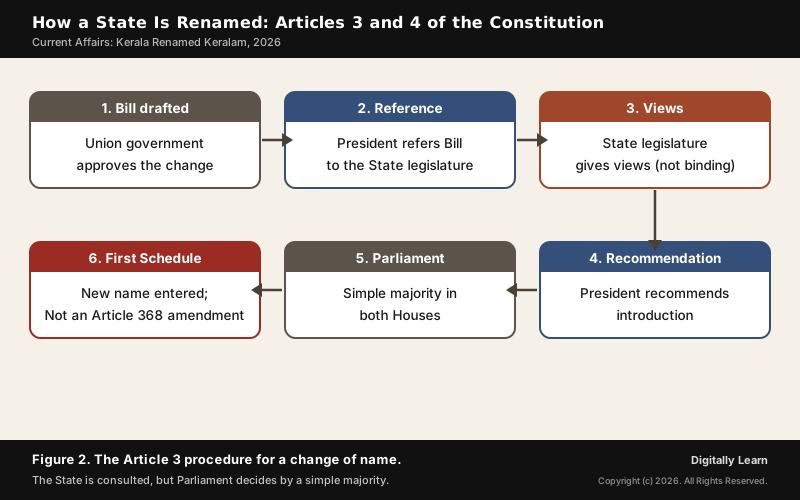
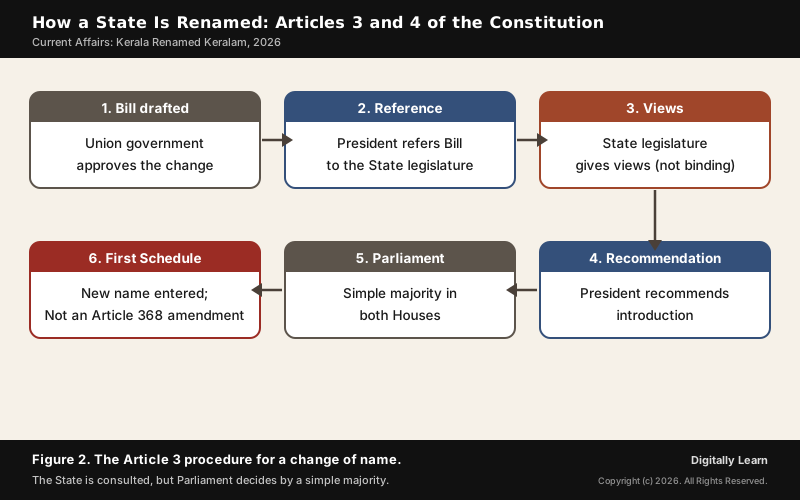
- Presidential recommendation: A Bill for any of these changes can be introduced in Parliament only on the President’s prior recommendation.
- Reference to the State: Before recommending it, the President must refer the Bill to the State legislature concerned for its views within a specified period.
- Views not binding: The President, or Parliament, may accept or reject those views, even if they arrive in time, and a fresh reference is not needed every time an amendment to the Bill is accepted.
- Union territories: No reference is needed; Parliament can act on its own.
Keralam followed this path exactly: the Cabinet's approval, the President's reference, the Assembly's views, the President's recommendation for introduction, and passage by both Houses.
Article 4 and the First Schedule: Renaming Without a Constitutional Amendment
Changing a State's name alters the First Schedule, yet it does not need the special procedure of Article 368. Article 4 declares that laws made under Articles 2 and 3, for admitting or forming States and altering their areas, boundaries or names, are not amendments of the Constitution for the purposes of Article 368. They pass by a simple majority, through the ordinary legislative process.
This is why India is called an indestructible union of destructible States: Parliament can form new States or change the areas, boundaries or names of existing ones without their consent. The United States is the contrast, an indestructible union of indestructible states, where the federal government cannot alter a state's borders without its consent.
Renamed States in India: From the United Provinces to Keralam
State Name Changes in India Since 1950
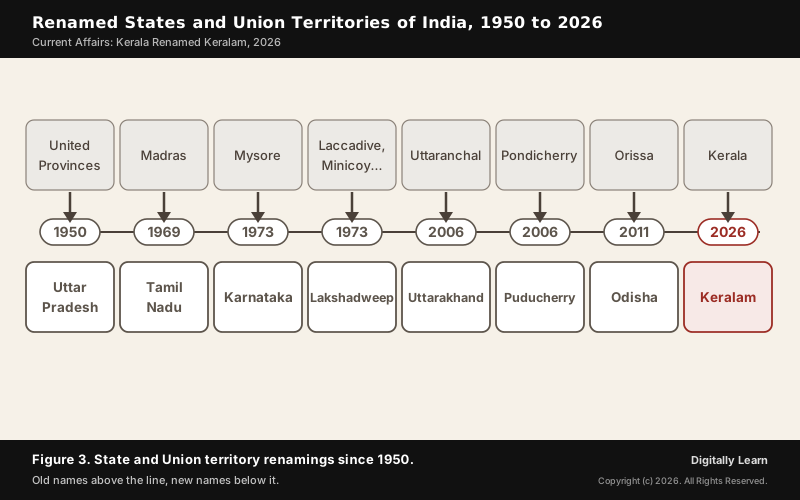
Since independence, State boundaries have been redrawn many times, and in some cases names were changed to match the wishes of the people of those States. Keralam is the latest in that line.
| Year | Old name | New name | How |
|---|---|---|---|
| 1950 | United Provinces | Uttar Pradesh | The first State to get a new name |
| 1969 | Madras | Tamil Nadu | Madras State (Alteration of Name) Act, 1968, in force 14 January 1969 |
| 1973 | Mysore | Karnataka | Mysore State (Alteration of Name) Act, 1973 |
| 1973 | Laccadive, Minicoy and Amindivi Islands | Lakshadweep | Union territory renamed by an Alteration of Name Act, 1973 |
| 2006 | Uttaranchal | Uttarakhand | Uttaranchal (Alteration of Name) Act, 2006 |
| 2006 | Pondicherry | Puducherry | Pondicherry (Alteration of Name) Act, 2006 |
| 2011 | Orissa | Odisha | Orissa (Alteration of Name) Act, 2011 |
| 2026 | Kerala | Keralam | Kerala (Alteration of Name) Act, 2026 |
Renamings have touched both States and Union territories: Mysore became Karnataka and Orissa became Odisha, while the Laccadive, Minicoy and Amindivi Islands became Lakshadweep and Pondicherry became Puducherry. The later changes were made by Alteration of Name Acts, the same kind of law that renamed Kerala, passed under Article 3 by a simple majority.
How Kerala Was Formed in 1956: Travancore-Cochin, Malabar and Kasaragod
Kerala was created on 1 November 1956 under the States Reorganisation Act, which brought the Malayalam-speaking regions into one State. Travancore and Cochin, two princely States that acceded to India, had been merged in 1949 as Travancore-Cochin.
- Added: The Malabar district of Madras State and the Kasaragod taluk of South Canara district were joined to Travancore-Cochin.
- Removed: The southern taluks of Kanyakumari district and parts of Shenkottai taluk went to Madras State.
- First government: The first elections to the new Assembly, in 1957, brought a Communist-led government under E.M.S. Namboodiripad to power.
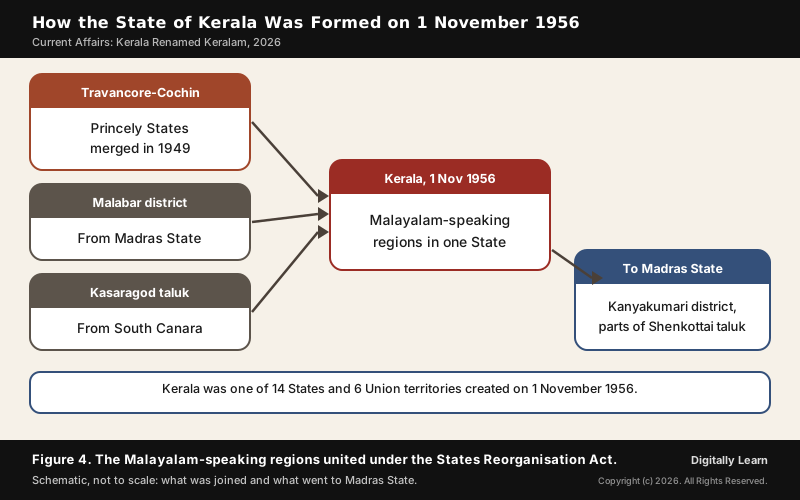
Kerala was one of 14 States and 6 Union territories created on 1 November 1956, when the States Reorganisation Act and the 7th Constitutional Amendment Act abolished the old classification of States into Parts A, B, C and D. The full story is in our article on the linguistic reorganisation of States.
Linguistic Reorganisation of States: Pressure From Below
From the Dhar Commission to the States Reorganisation Commission
The leaders of independent India were at first wary of drawing States by language. In June 1948 the Government appointed the Linguistic Provinces Commission under S.K. Dhar, which recommended administrative convenience rather than language as the basis; the Congress's JVP Committee of Nehru, Patel and Pattabhi Sitaramayya formally rejected language as the basis in April 1949.
- Andhra, 1953: After a prolonged agitation and the death of Potti Sriramulu following a 56-day hunger strike, the Centre created Andhra, the first linguistic State, from the Telugu-speaking areas of Madras State in October 1953.
- Fazl Ali Commission: Appointed in December 1953 with K.M. Panikkar and H.N. Kunzru, it reported in September 1955, broadly accepted language as the basis but rejected the theory of one language, one State.
- Its four factors: The unity and security of the country, linguistic and cultural homogeneity, financial, economic and administrative considerations, and the welfare of the people.
New States After 1956: Nagaland, Haryana, Sikkim and Arunachal Pradesh
The political map kept changing after 1956 under the pressure of popular agitations. The reorganisation of 1956 began the creation of linguistic States, and the process is still continuing.
- 1960: The bilingual State of Bombay was divided into Maharashtra and Gujarat.
- 1963: Nagaland was formed from the Naga Hills and Tuensang area of Assam, the 16th State.
- 1966: Punjab was bifurcated to create Haryana, the 17th State, and the Union territory of Chandigarh; Himachal Pradesh became a State in 1971.
- 1972: Manipur, Tripura and Meghalaya became States.
- 1975: Sikkim became the 22nd State through the 36th Amendment Act.
- 1987: Mizoram, Arunachal Pradesh and Goa became the 23rd, 24th and 25th States.
- 2000: Chhattisgarh, Uttarakhand and Jharkhand were carved out of Madhya Pradesh, Uttar Pradesh and Bihar.
Keralam for UPSC: Polity and Indian Society Links
Where the Renaming of States Sits in the Syllabus
The renaming belongs to General Studies Paper II, under the Indian Constitution, its significant provisions and the federal structure, and to Paper I, under the post-independence consolidation and reorganisation of the country and regionalism. State PCS papers test the same ground.
- Prelims facts: Article 3 (new States, areas, boundaries, names); Article 4 (not an amendment under Article 368, simple majority); the First Schedule lists the States and Union territories, while the Second covers emoluments, the Third oaths and the Fifth Scheduled Areas; Kerala formed on 1 November 1956; Keralam notified on 25 August 2026; renamings of 1950, 1969, 1973, 2006 and 2011.
- Mains analysis: Language and regional identity; Parliament’s power over State boundaries and the States’ consultative role; the linguistic reorganisation and national unity.
Previous Year UPSC-CSE Questions By the end you will be able to draft model answers for the following UPSC questions. Each question carries a collapsible framework showing how to approach it in the exam.
- UPSC Mains 2026 GS-ILinguistic reorganization of Indian States was driven by popular pressure from below. Comment.
Answer outline: how to structure the answer
What the question asks, the main arguments, relevant examples and the direction of the conclusion. This is not a full model answer.
Introduction: Introduce the reorganisation as the redrawing of State boundaries on linguistic lines after 1953, which the national leadership had first resisted.
Body (sub-themes to develop):
- Resistance from above: the Dhar Commission (1948) preferred administrative convenience; the JVP Committee (1949) formally rejected language as the basis.
- Pressure from below: a prolonged agitation and Potti Sriramulu's death after a 56-day fast forced the creation of Andhra in October 1953; demands from other regions followed.
- The response: the Fazl Ali Commission (1953 to 1955) broadly accepted language but rejected one language, one State, putting unity and security first; 14 States and 6 Union territories in 1956.
- The continuing process: Bombay divided in 1960, Punjab in 1966, Nagaland in 1963, the North-East in 1972, three States in 2000; and renamings at the States' request, from Madras to Tamil Nadu to Kerala's 2024 resolution for Keralam.
- The qualification: Parliament keeps the final word under Articles 3 and 4, and the State's views are not binding.
Conclusion: Conclude that the reorganisation began from below but was shaped from above, and that accommodating linguistic identity within a strong Union has strengthened Indian unity.
- UPSC Prelims 2001 Prelims-GSIf a new State of the Indian Union is to be created, which one of the following Schedules of the Constitution must be amended?
How to approach this Prelims question
Approach: Step 1: a new State changes the list of States and their territories. Step 2: that list is the First Schedule. Step 3: check the other Schedules: the Second covers emoluments, the Third oaths and affirmations, the Fifth Scheduled Areas and Scheduled Tribes; none lists the States.
Trap to watch: A new State also changes Rajya Sabha seats in the Fourth Schedule, but the option given is not the Fourth; the Schedule that must change in every case is the First.
Key facts to recall:
- (a) First: right. It lists the States and Union territories and their territories.
- (b) Second: wrong. It covers the emoluments of the President, Governors, judges and others.
- (c) Third: wrong. It holds the forms of oaths and affirmations.
- (d) Fifth: wrong. It deals with the administration of Scheduled Areas and Scheduled Tribes.
Answer signal: First: option (a), the official answer.
- UPSC Prelims 2007 Prelims-GSWhich one of the following is the correct chronological order of the formation of the following as full States of the Indian Union?
How to approach this Prelims question
Approach: Step 1: Nagaland became a State in 1963. Step 2: Haryana was carved out of Punjab in 1966. Step 3: Sikkim became the 22nd State in 1975. Step 4: Arunachal Pradesh became a State in 1987. So Nagaland, Haryana, Sikkim, Arunachal Pradesh.
Trap to watch: Arunachal Pradesh was a Union territory from 1972; full statehood came only in 1987.
Key facts to recall:
- (a) Sikkim, Arunachal Pradesh, Nagaland, Haryana: wrong. Nagaland (1963) and Haryana (1966) came first.
- (b) Nagaland, Haryana, Sikkim, Arunachal Pradesh: right. 1963, 1966, 1975, 1987.
- (c) Sikkim, Haryana, Nagaland, Arunachal Pradesh: wrong. Sikkim (1975) came after Nagaland and Haryana.
- (d) Nagaland, Arunachal Pradesh, Sikkim, Haryana: wrong. Haryana (1966) came before Sikkim and Arunachal Pradesh.
Answer signal: Nagaland, Haryana, Sikkim, Arunachal Pradesh: option (b), the official answer.
Sources
- The Hindu, Delhi, 12 and 13 August 2026: Lok Sabha and Rajya Sabha pass the Kerala (Alteration of Name) Bill
- The Hindu, Delhi, 18 August 2026: Murmu gives assent to Bill to rename Kerala as Keralam
- PIB: Cabinet approves alteration of the name of the State of Kerala to Keralam (24 February 2026)
- PIB: Cabinet briefing, 24 February 2026 (change of name from Kerala to Keralam)
- NCERT: Indian Constitution at Work (Class XI), Chapter 7, Federalism
- Wikipedia: Part I of the Constitution of India (Articles 1 to 4)
- Wikipedia: Kerala
- UPSC: Civil Services Examination question papers
Editorial Disclaimer
This article draws on the PIB release, NCERT and the other sources listed on this page.


