


Overview
The 25th Special Representatives Talks
The India-China border dispute is the unsettled question of where the Himalayan frontier between the two countries lies, from Aksai Chin in Ladakh to the McMahon Line in Arunachal Pradesh. On 25 August 2026 the Special Representatives of India and China, Ajit Doval and Wang Yi, met for the 25th time and agreed to advance an "early and substantial harvest" of boundary delimitation.
25th Special Representatives Talks 2026: What Was Agreed in Beijing
Doval and Wang Yi in Beijing, 25 August 2026
The Special Representatives are the main channel through which India and China negotiate the boundary itself. India's representative is the National Security Adviser; China's is Wang Yi, a member of the Political Bureau of the Communist Party of China and Director of the Office of the Central Commission for Foreign Affairs. The mechanism was set up in 2003 to explore the framework of a boundary settlement. The 23rd round met in Beijing on 18 December 2024 and the 24th in New Delhi on 19 August 2025, when Mr. Wang visited India.
The timing mattered. The talks came a few weeks before India hosted the BRICS Summit on 12 September 2026, which President Xi Jinping attended on his first visit to India in seven years. Mr. Doval said relations had been "steadily returning to normalcy" and that the leaders of the two countries had given them "a clear and positive direction". Mr. Wang said the two sides should "draw lessons from history" and "place the boundary question appropriately in bilateral relations".
Eight-Point Outcome Document: Delimitation, Hotlines and Rivers
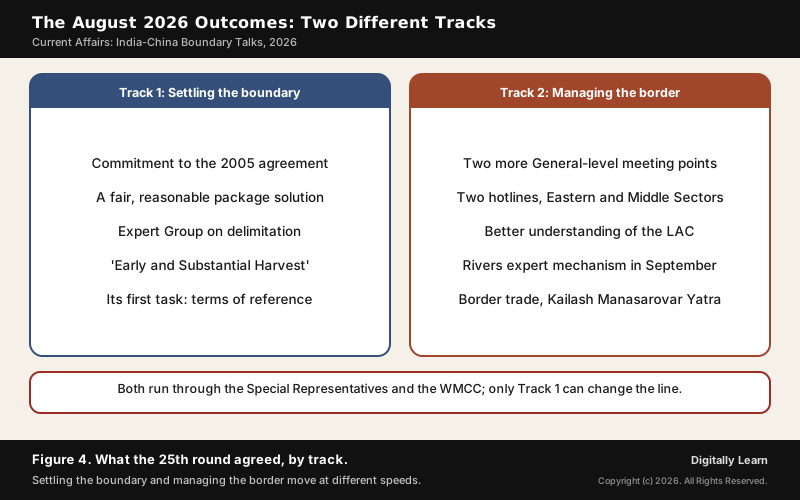
The outcome document, released on 26 August, carries the substance. Its points fall into two groups: those about settling the boundary and those about keeping the peace along it while talks go on.
- Delimitation: The Expert Group on Boundary Delimitation and a Working Group on Border Management, both under the Working Mechanism for Consultation and Coordination (WMCC), will “advance discussions on an Early and Substantial Harvest of boundary delimitation and Border Management”. Their first task is to agree on their own terms of reference.
- The 2005 agreement: Both sides reaffirmed the 2005 Political Parameters and Guiding Principles and will use the Special Representatives’ mechanism to pursue “a fair, reasonable and mutually-acceptable package solution”.
- Ground situations: Any situation on the ground will be addressed promptly through diplomatic and military channels, including the WMCC and local commander-level meetings, “to avoid misunderstanding and miscalculation along the LAC”. The two sides also “discussed ways to improve understanding of LAC in appropriate areas”.
- Military contact: Two more meeting points for General-level or Senior Highest Military Commander meetings, and two more border military hotlines, in the Eastern and Middle Sectors.
- Trans-border rivers: The Expert-Level Mechanism on trans-border rivers, set up in 2006 to discuss flood-season hydrological data and emergency management, will meet in September, as India has pushed for; its 16th meeting was in New Delhi in April 2025.
- People and trade: Both noted the reopening of three border trading points and more batches for the Kailash Manasarovar Yatra, and agreed to deepen cooperation in border trade and pilgrimage.
The location of the two new meeting points was not announced. One will be in the Eastern Sector, under the Indian Army's 3 Corps, and the other in the Central, or Middle, Sector; Joshimath is not one of them. Local commanders have already met at least twice over the past year at Kepang La in Arunachal Pradesh's Upper Siang district, a place of religious significance for people on both sides, which the Chinese People's Liberation Army had proposed as a meeting point.
India-China Border Dispute: Sectors, Claims and the Line of Actual Control
Origins of the Dispute: Tibet, Panchsheel and the 1962 War
Free India began its relationship with China on a friendly note: it was among the first countries to recognise the communist government after the revolution of 1949, and on 29 April 1954 Jawaharlal Nehru and Zhou Enlai jointly set out Panchsheel, the Five Principles of Peaceful Coexistence. Tibet was the strain. China took control of Tibet in 1950, and through the 1954 agreement's clause on respecting each other's territorial integrity and sovereignty, India conceded China's claim over it. When the Dalai Lama crossed into India in 1959 and was granted asylum, China protested strongly.
Border disputes with China erupted in 1960. In 1962 the two countries fought a border war over competing territorial claims, principally in Arunachal Pradesh and in the Aksai Chin region of Ladakh. India suffered military reverses, and diplomatic relations stayed downgraded until 1976. China's policy grew more pragmatic after the mid-1970s, and talks to resolve the border issue began in 1981.
Four Sectors of the Boundary: From Aksai Chin to the McMahon Line
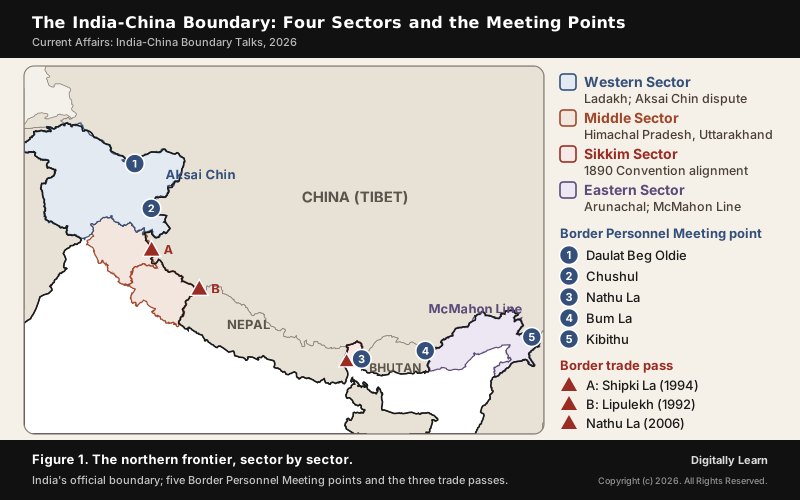
The boundary is discussed in sectors because each has a different history. The colonial-era legacy is the root: the McMahon Line in the east was drawn in 1914 at the Simla Convention between British India and Tibet, and China has never accepted it.
| Sector | Indian area | What is disputed |
|---|---|---|
| Western | Ladakh | Aksai Chin, historically linked to Jammu and Kashmir, claimed by India and administered by China since the 1962 war; India's line follows the Johnson Line along the Kunlun Mountains |
| Middle | Himachal Pradesh, Uttarakhand | Smaller pockets south of the watershed, such as Barahoti, Nilang-Jadhang and Lapthal, together about 2,450 sq km claimed by China |
| Sikkim | Sikkim | The alignment rests on the Anglo-Chinese Convention of 1890; the trijunction with Bhutan is disputed (Batang La for India and Bhutan, Gipmochi for China) |
| Eastern | Arunachal Pradesh | China rejects the McMahon Line and claims the area south of it; it has called Tawang indispensable to any settlement |
China once offered a "package": in 1960, and again in 1980 to 1985, it said it would accept an alignment in the east broadly following the McMahon Line if India conceded Aksai Chin in the west. In 1985 it changed the offer, seeking "significant and meaningful concessions" from India in the east in return for undefined concessions in the west.
Line of Actual Control: Why Differing Perceptions Cause Tension
Both sides see differing perceptions of the LAC as a key cause of tension in the Western and Eastern Sectors. The 1996 agreement on confidence-building measures noted the need for "arriving at a common understanding of the alignment of the LAC". On his first visit to China as Prime Minister in 2015, Narendra Modi publicly asked for the process of clarifying the LAC to resume. It did not: Chinese officials said clarifying the alignment would further complicate the attempts to resolve the boundary dispute.
The standoff in eastern Ladakh from April 2020 showed what this costs. This year's outcome document avoids the word "clarification" but gives a political endorsement to improving "understanding of LAC in appropriate areas", which leaves room for each side to learn the other's perception without reopening the old process.
How the Boundary Is Negotiated: Special Representatives, WMCC and Military Channels
Border Talks and Agreements from 1981 to 2013
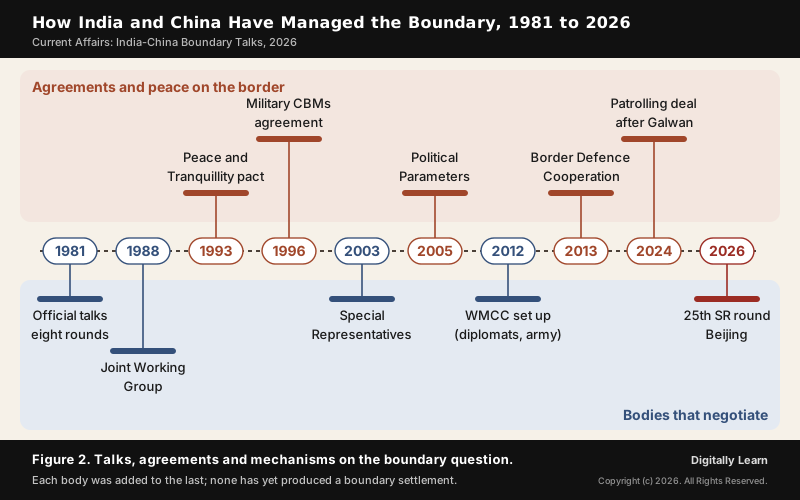
Official border talks began in December 1981 and ran for eight rounds until 1987. In 1988 a joint press communique turned them into the India-China Joint Working Group on the Boundary Question, which met 15 times, the last in 2005. Alongside the talks, a set of agreements kept the peace on a border that had no agreed line.
- Peace agreements of 1993 and 1996: The Border Peace and Tranquillity Agreement and the Agreement on Military Confidence Building Measures were concluded pending the final settlement.
- 2003 Declaration on Principles for Relations and Comprehensive Cooperation: It set up the Special Representatives mechanism; the first round met on 26 October 2003.
- 2005 Agreement on the Political Parameters and Guiding Principles: The basis of the present talks, taken up in the next section.
- 2012 WMCC agreement: It created a standing working body of diplomats and military officers, followed by the 2013 Border Defence Cooperation Agreement.
WMCC: The Working Mechanism for Consultation and Coordination
The WMCC (Working Mechanism for Consultation and Coordination on India-China Border Affairs) was set up through an agreement of January 2012, after Chinese Premier Wen Jiabao proposed it in 2010; it was finalised at the 15th round of Special Representatives talks. A Joint Secretary of the Ministry of External Affairs and a Director General of China's Ministry of Foreign Affairs lead it, with diplomatic and military officials on both sides.
By its founding agreement the WMCC does not discuss the resolution of the boundary question or affect the Special Representatives. Its work is managing the border: it reviews the situation along the LAC and prepares the ground. Its 36th meeting, on 6 August 2026, held "detailed exchanges" on delimitation, border management, mechanism-building and trans-border cooperation, and the two new groups on delimitation and border management now sit under it. The SR talks and the WMCC together form the dual track that has kept the border generally stable since 2024.
Border Personnel Meetings, Hotlines and Corps Commander Talks
On the ground, contact runs through military channels with a set path of escalation. There are five Border Personnel Meeting (BPM) points: Daulat Beg Oldie and Chushul in Ladakh, Nathu La in Sikkim, and Kibithu and Bum La in Arunachal Pradesh. Talks move from colonels to brigadiers and then to major generals. The Defence Ministry has described the BPM mechanism as an interface where local issues are discussed and resolved.
- Hotlines: A hotline between the Directors General of Military Operations was set up in 2014; by 31 July 2021 there were six hotlines between commanders, two each in Ladakh, Sikkim and Arunachal Pradesh. The 2026 outcome adds two in the Eastern and Middle Sectors.
- General-level mechanisms: In 2025 the two sides agreed to create General Level Mechanisms in the Eastern and Middle Sectors, in addition to the one in the Western Sector.
- Corps Commander meetings: During the 2020 to 2022 standoff these talks, lasting nine to more than 12 hours, kept communication open; officers of the Indo-Tibetan Border Police and the Ministry of External Affairs attended too.
Early Harvest and the 2005 Agreement: The Debate on Boundary Delimitation
The 2005 Agreement's Three Stages to a Settlement
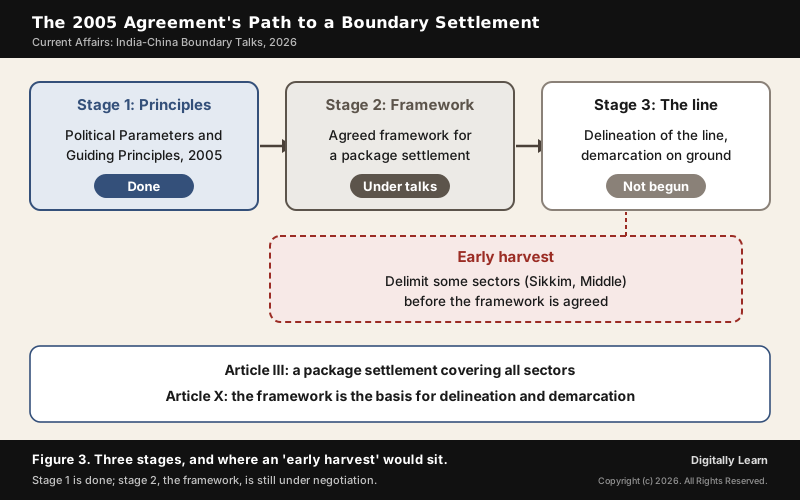
The 2005 Agreement on the Political Parameters and Guiding Principles completed the first of three stages agreed for settling the dispute. The second stage is an agreed framework for the settlement, which the Special Representatives have been negotiating since. The third is delimiting and demarcating the boundary on maps and on the ground.
- Article III: A package settlement covering all sectors of the boundary, because the sectors are linked and need give and take across them.
- Article X: The Special Representatives are to arrive at an agreed framework, which will provide the basis for delineation and demarcation.
What an Early and Substantial Harvest Would Cover
An early harvest means settling the boundary in some sectors before the full framework is agreed. In August 2025 the 24th round set up an Expert Group under the WMCC "to explore Early Harvest in boundary delimitation". The 2026 document's phrase, "Early and Substantial Harvest", is India's own coinage: China first proposed settling the Sikkim Sector alone, and around 2019 India answered with a counter-proposal covering Sikkim together with the entire Middle Sector, with the boundary along the watershed.
China rejected that offer and later reportedly agreed only to include Sikkim and some undisputed areas of the Middle Sector, which India did not accept. Accepting India's terms would mean China giving up its claim to about 2,450 sq km in the Middle Sector. Officials expect the expert group to focus on sectors where the two alignments differ little.
Concerns: Transparency, the Package Clause and the Bhutan Trijunction
- Piecemeal against package: A partial delimitation may sit badly with Article III. A settlement confined to stretches where claims already coincide would leave the Western and Eastern Sectors, where China holds a hard line, untouched.
- No framework yet: Under Article X delineation follows an agreed framework, and the 2005 agreement does not use the word “delimitation” at all.
- Sikkim is not simple: Article I of the 1890 Convention makes the watershed the boundary but names Mount Gipmochi as the starting point. A Sikkim deal on the 1890 text could be read as conceding a trijunction further south, towards the Jampheri Ridge, from which the Siliguri Corridor, India’s only overland link to its northeastern States, could be watched.
- Transparency: Neither side has said which parts of the border it plans to delimit. Agreements made without public visibility may invite suspicion, so both governments need to bring their publics along.
India-China Relations from Galwan to 2026: The Road to Normalisation
Galwan 2020 and the Patrolling Agreement of 2024
The standoff that began in eastern Ladakh in April 2020 turned deadly at Galwan in June 2020, when the fighting killed 20 Indian soldiers, among them Colonel Santosh Babu of the 16th Bihar Regiment; both sides suffered casualties. Four years of military and diplomatic talks followed. In October 2024 India announced an agreement on patrolling arrangements along the LAC, which led to disengagement from all the friction points of 2020.
On 23 October 2024 Prime Minister Modi and President Xi held their first full delegation-level talks in nearly five years, on the sidelines of the BRICS summit at Kazan, Russia, the meeting both sides see as the start of a gradual normalisation. They met again on 31 August 2025 in China, at the time of the Shanghai Cooperation Organisation summit at Tianjin, and agreed that the two countries were "development partners and not rivals" and that their differences should not turn into disputes. Exchanges followed: the Kailash Manasarovar Yatra resumed in 2025 through Lipulekh and Nathu La after a gap of nearly five years, and direct flights returned in October 2025.
Xi Jinping's Visit for the BRICS Summit, September 2026
Mr. Xi and Mr. Modi held talks on the sidelines of the BRICS Summit in New Delhi on 12 September 2026, the third year in a row that the two leaders had met. Mr. Modi said peace and tranquillity in the border areas remain an essential basis for the relationship, and asked both sides to observe existing agreements. Mr. Xi said both should seek "parallel, mutually reinforcing progress" on bilateral relations and on the boundary question.
The two positions differ in emphasis. India treats peace on the border as the condition for resuming exchanges; China asks India to put the boundary question "in an appropriate position" and not let it define the whole relationship. Mr. Wang later said the two countries should advance ties "without stagnation or backsliding".
Border Management on the China Frontier: Challenges and Strategies
Challenges: Terrain, an Undefined LAC and the Infrastructure Gap
- Terrain: The frontier runs across the high Himalaya; the passes used for trade lie at 4,310 m (Nathu La) and 5,110 m (Lipulekh).
- An undefined line: Without an agreed LAC, routine patrolling can turn into face-offs, as in eastern Ladakh in 2020 and in Arunachal Pradesh as recently as August 2026.
- Hostile relations: Distrust since 1962, the Tibet question and the 2020 clashes make every local incident a diplomatic one.
- Infrastructure gap: Roads, railways and airfields on the two sides of the border have long been unequal, and the gap persists.
- Depopulation and rivers: Out-migration from remote villages weakens the border, and rivers rising in Tibet carry flood risk downstream.
Strategies: BIM, Vibrant Villages and Confidence-Building
India's response combines diplomacy, military confidence-building and development of the border areas themselves.
- Border Infrastructure and Management (BIM): A Central Sector umbrella scheme of the Ministry of Home Affairs, continued for 2021-22 to 2025-26 at Rs 13,020 crore, for border fences, floodlights, technological solutions, border roads and Border Outposts on all six land borders, the Indo-China border among them.
- Vibrant Villages Programme: Approved in February 2023 at Rs 4,800 crore for 2022-23 to 2025-26, for villages in 46 border blocks of 19 districts along the northern land border, 663 in the first phase, to reverse out-migration; Rs 2,500 crore of it for roads. Its second phase, approved in April 2025 at Rs 6,839 crore, extends it to the other land borders. More in our Vibrant Villages Programme article.
- Border Area Development Programme (BADP): Begun in the 1980s on the western border with Pakistan and extended to the Indo-China border in 1998, it funds roads, schools, health and other works within 10 km of the border; the Vibrant Villages Programme is designed not to overlap with it.
- Confidence-building: The Special Representatives and WMCC, BPM points and hotlines, the reopened trade passes and the Kailash Manasarovar Yatra give both sides a stake in calm.
Border trade is the oldest of these links. Lipulekh in Uttarakhand was the first Indian border post opened for trade with China, in 1992, followed by Shipki La in Himachal Pradesh in 1994 and Nathu La in Sikkim, officially opened on 6 July 2006 after being sealed for decades. Chang La, by contrast, is a pass inside Ladakh on the road from Leh to Pangong Lake, not a trade route to China.
India-China Border Dispute for UPSC: GS Paper II and III Links
Where the Boundary Question Sits in the Syllabus
The talks belong to General Studies Paper II, under India and its neighbourhood and bilateral agreements affecting India's interests, and the border-management side belongs to Paper III, under security challenges and their management in border areas. State PCS papers test the same ground.
- Prelims facts: SR mechanism set up in 2003; 25th round on 25 August 2026 in Beijing; WMCC set up in 2012, led by a Joint Secretary of the MEA; five BPM points (Daulat Beg Oldie, Chushul, Nathu La, Kibithu, Bum La); trade passes Lipulekh (1992), Shipki La (1994), Nathu La (2006); McMahon Line drawn at the Simla Convention of 1914.
- Mains analysis: Package settlement against early harvest, the dual track of the SR talks and the WMCC, border management on a disputed frontier, and the link between border peace and the wider relationship.
Previous Year UPSC-CSE Questions By the end you will be able to draft model answers for the following UPSC questions. Each question carries a collapsible framework showing how to approach it in the exam.
- UPSC Mains 2016 GS-IIIBorder management is a complex task due to difficult terrain and hostile relations with some countries. Elucidate the challenges and strategies for effective border management.
Answer outline: how to structure the answer
What the question asks, the main arguments, relevant examples and the direction of the conclusion. This is not a full model answer.
Introduction: Open with the reason border management is hard: India's land borders run through some of the high Himalaya, and the frontier with China has no agreed line.
Body (sub-themes to develop):
- Terrain: high Himalayan passes (Nathu La 4,310 m, Lipulekh 5,110 m), isolated villages, out-migration that the Vibrant Villages Programme was set up to reverse.
- Hostile relations: an undefined LAC with differing perceptions, the 1962 war, Galwan in June 2020 with 20 Indian soldiers killed, face-offs in Arunachal Pradesh in August 2026.
- Diplomatic and military strategy: the Special Representatives since 2003, the WMCC since 2012, five BPM points, hotlines (six by 2021, two more agreed in 2026), the 2024 patrolling agreement.
- Development strategy: BIM (Rs 13,020 crore, 2021-26) for fences, roads and Border Outposts; the Vibrant Villages Programme (663 villages in its first phase; a second phase at Rs 6,839 crore); the BADP within 10 km of the border; trade through Lipulekh, Shipki La and Nathu La.
Conclusion: Conclude that border management on a disputed frontier needs both tracks: a political settlement, which the 2026 early-harvest talks attempt, and a populated, connected border that does not depend on it.
- UPSC Prelims 2007 Prelims-GSWhich one of the following Himalayan passes was reopened in the middle of the year 2006 to facilitate trade between India and China?
How to approach this Prelims question
Approach: Step 1: only three passes have been opened for India-China border trade: Lipulekh in 1992, Shipki La in 1994 and Nathu La in 2006. Step 2: the question asks for the one reopened in the middle of 2006; Nathu La was officially opened on 6 July 2006 after being sealed for decades. Step 3: Shipki La was already open from 1994, and the other two are not trade passes.
Trap to watch: Shipki La is a real India-China trade pass, so it looks right; its year, 1994, rules it out.
Key facts to recall:
- (a) Chang La: wrong. It is a pass inside Ladakh on the road from Leh to Pangong Lake, not a trade route to China.
- (b) Jara La: wrong. It is not one of the three passes opened for India-China border trade (Lipulekh, Shipki La, Nathu La).
- (c) Nathu La: right. The Sikkim pass was officially opened for trade on 6 July 2006 after being sealed for decades.
- (d) Shipki La: wrong. This Himachal Pradesh pass is a trade route, but it was opened in 1994, not in 2006.
Answer signal: Nathu La reopened for trade on 6 July 2006, so the answer is option (c).
Sources
- The Hindu, Delhi, 24 to 26 August 2026: reports on the 25th Special Representatives talks in Beijing
- The Hindu, Delhi, 27 August 2026: Drawing lines (editorial); the eight-point outcome document
- The Hindu, Delhi, 28 and 30 August 2026: perceptions of the LAC; new Border Personnel Meeting points
- The Hindu, Delhi, 3 September 2026: An uncertain Early Harvest (lead article)
- The Hindu, Delhi, 7, 12 and 16 September 2026: meeting points; Xi Jinping's visit and the Modi-Xi talks
- Ministry of External Affairs: India-China Bilateral Brief (July 2026)
- PIB: Cabinet approves the Vibrant Villages Programme (15 February 2023)
- PIB: Cabinet approves the Vibrant Villages Programme-II (4 April 2025)
- PIB: Border Infrastructure and Management scheme continued for 2021-22 to 2025-26 (21 February 2022)
- NCERT: Politics in India since Independence (Class XII), Chapter 4, India's External Relations
- NCERT: Contemporary World Politics (Class XII), Chapter 4, Alternative Centres of Power
- Wikipedia: Sino-Indian border dispute
- Wikipedia: Working Mechanism for Consultation and Coordination on India-China Border Affairs
- Wikipedia: 2020-2022 China-India skirmishes
- Wikipedia: Nathu La; Lipulekh Pass; Chang La; India-China border infrastructure
- UPSC: Civil Services Examination question papers
Editorial Disclaimer
This article draws on the PIB releases, NCERT and the other sources listed on this page.


