


Overview
Developing the border villages, the first villages of India
The Vibrant Villages Programme is a Government of India scheme run by the Ministry of Home Affairs to develop villages along the land borders, arrest out-migration and integrate the frontier.
The Vibrant Villages Programme (VVP) is a Government of India scheme, run by the Ministry of Home Affairs, for the comprehensive development of villages along India's land borders. Its first phase, VVP-I, was approved by the Union Cabinet on 15 February 2023 as a centrally sponsored scheme with an allocation of Rs 4,800 crore for the years 2022-23 to 2025-26, and it covers select villages in 46 blocks of 19 districts along the northern border in Arunachal Pradesh, Himachal Pradesh, Sikkim and Uttarakhand and the Union Territory of Ladakh. The aim is to improve infrastructure, livelihoods and connectivity in remote border villages, to arrest out-migration, and to reframe these settlements as the first villages of India. A second phase, VVP-II, extends the effort to the other land borders. The programme is both a development scheme and an instrument of border security.
What the Vibrant Villages Programme Is, and Why It Is in the News
A Ministry of Home Affairs scheme for comprehensive border-village development
The Vibrant Villages Programme is a Government of India scheme for the comprehensive development of villages along the country's land borders. It is run by the Ministry of Home Affairs, the ministry responsible for internal security and border management rather than a rural-development ministry. That choice of nodal ministry is itself revealing: the scheme treats the development of border villages and the security of the border as two sides of one task.
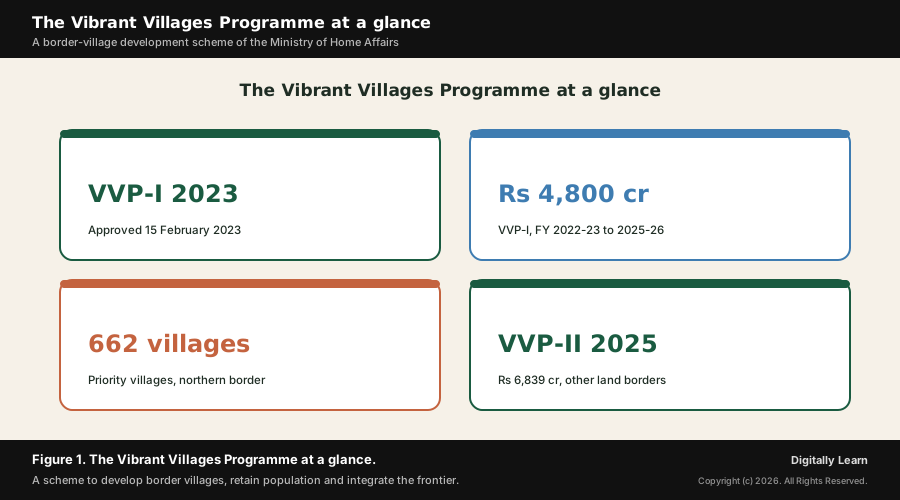
Its first phase, VVP-I, was approved by the Union Cabinet on 15 February 2023 as a centrally sponsored scheme, with a financial allocation of Rs 4,800 crore for the financial years 2022-23 to 2025-26. It covers select villages in 46 blocks of 19 districts abutting the northern border in the States of Arunachal Pradesh, Himachal Pradesh, Sikkim and Uttarakhand and the Union Territory of Ladakh. These are settlements marked by sparse population, difficult terrain, limited connectivity and thin infrastructure.
The programme matters now because it marks a deliberate shift in how the Indian state treats its border villages. For decades many of these settlements were the last villages on the map, neglected and steadily emptying as families left for towns and the plains. The programme is the attempt to reverse that drift and to recast them as the first villages of India. The figure below sets out the headline facts.
Why the programme is current: the launch, the second phase and the saturation push
Why it matters now is that the programme has moved from approval into active rollout. The Union Home Minister formally launched the Vibrant Villages Programme at Kibithoo, a remote border village in Arunachal Pradesh, on 10 April 2023, and used the occasion to set out the change in mindset: border villages should be seen not as the last villages but as the first villages of India. That reframing has become the slogan of the whole effort.
The programme is also current because it has since been extended. Building on the northern-border phase, the Union Cabinet approved a second phase, VVP-II, to carry the same model to villages along the other land borders. With both phases now in motion, the Vibrant Villages Programme has become one of the central instruments through which the government links border development to border security, which is exactly why it is a live subject for the examination.
The Strategic Rationale: Out-Migration, Security and the First-Village Idea
Arresting out-migration and the development asymmetry across the border
The first strand of the rationale is out-migration. Across the high Himalayan belts, many border villages have lost people for years, as the young leave for towns and the plains in search of jobs, education and a connected life. As villages empty, the frontier is left thinly held by civilians. The programme is built on the premise that the surest way to hold the border is to make people want to stay on it.
The second strand is the development asymmetry across the line. On the far side of stretches of India's land border, neighbouring states have in places built roads, settlements and model villages right up to the frontier. Where one side is connected and the other empty and cut off, the gap is felt keenly and carries a strategic cost. By investing in roads, power and connectivity, the programme seeks to narrow that gap.
The third strand is the first-village idea itself. Reframing the border village as the first village of India, rather than the last, is not merely rhetorical; it reorders priorities. It places these settlements at the front of the queue for connectivity, services and tourism, and asks the country to see the frontier as the face the nation presents to its neighbours, a populated and confident border rather than a neglected one.
The border population as the eyes and ears of the frontier
The security logic follows directly from the population question. A border village that is lived in is a border that is watched. Residents who farm, graze and move along the frontier notice the unfamiliar: a new track, an intrusion, an unusual movement. In this sense the settled population becomes the eyes and ears of the border, supplementing the forces who guard it with a civilian network of awareness that no patrol can fully replace.
A populated border also has strategic value beyond surveillance. Roads built for villagers serve the forces too, easing the movement of troops and supplies in difficult terrain. A living frontier strengthens India's control over remote areas and denies an adversary an empty, undefended stretch of border. Development and security here reinforce one another, which is why the scheme sits with the Ministry of Home Affairs.
It is important, though, to keep this rationale measured. The programme is presented as a development scheme whose security benefits flow from prosperity and population, not as a militarisation of village life. Its instruments are roads, schools, clinics, power and livelihoods. The security dividend is real but indirect: it comes from a frontier that is connected, populated and content, rather than from turning villagers into an arm of the security forces.
Phase I (VVP-I): Period, States, Districts and Priority Villages
The northern-border focus, the blocks and the 662 priority villages
VVP-I is focused squarely on the northern border. It runs for the financial years 2022-23 to 2025-26 with an allocation of Rs 4,800 crore, and it covers select villages in 46 blocks of 19 districts in four States, Arunachal Pradesh, Himachal Pradesh, Sikkim and Uttarakhand, and the Union Territory of Ladakh. These are the settlements along the long Himalayan frontier with China, the very belt where sparse population and weak connectivity had left the border thinly held.
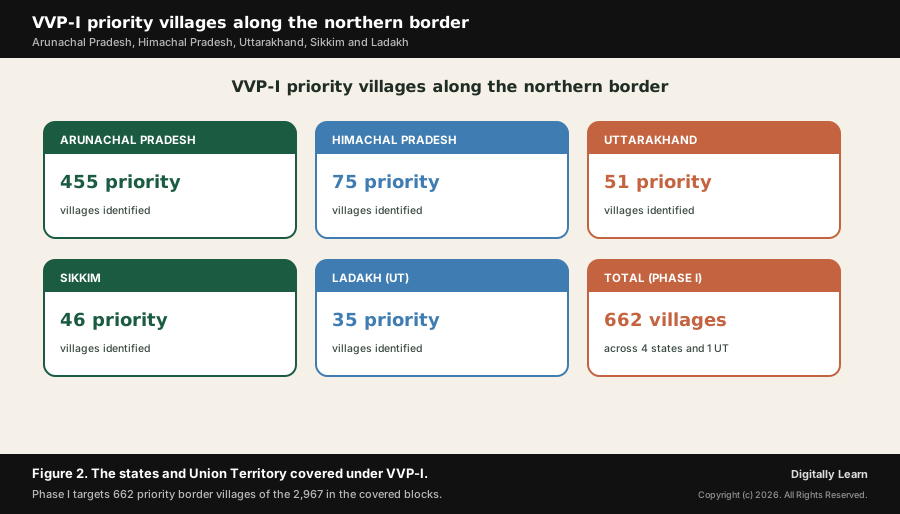
Within those blocks the programme works in concentric fashion. Of the roughly 2,967 villages in the covered blocks, 662 border villages were identified for comprehensive development on priority in the first instance, so that effort and money are concentrated where they matter most rather than spread thin. The state-wise priority count is Arunachal Pradesh 455, Himachal Pradesh 75, Uttarakhand 51, Sikkim 46 and Ladakh 35, with Arunachal Pradesh, the longest and most exposed stretch, carrying by far the largest share.
A significant share of the money is tied to connectivity. Of the Rs 4,800 crore central allocation, a large portion, of the order of Rs 2,500 crore, is earmarked for road connectivity to unconnected villages. In this terrain a road is the precondition for everything else: for services to reach the village, for produce and tourists to reach the market, and for the village to remain viable. The figure below sets out the states and the priority villages.
Phase II (VVP-II): Extending the Model to the Other Land Borders
From the northern border to the wider land frontier, and the saturation goal
If VVP-I tackled the northern border, VVP-II carries the model to the rest of the land frontier. The Union Cabinet approved the second phase as a central sector scheme, funded entirely by the Centre, with a total outlay of Rs 6,839 crore for the financial years 2024-25 to 2028-29. Its purpose is the comprehensive development of select villages in blocks abutting the international land borders other than the northern border already covered under the first phase.
The geographic spread is much wider. VVP-II takes in some 1,954 villages across seventeen States and Union Territories, including Assam, Bihar, Gujarat, Jammu and Kashmir, Manipur, Meghalaya, Mizoram, Nagaland, Punjab, Rajasthan, Tripura, Uttar Pradesh and West Bengal, alongside the border states already covered. In doing so it reaches the borders with Pakistan, Bangladesh, Nepal, Bhutan and Myanmar, so that the first-village idea is applied to every land frontier rather than to the China border alone.
The second phase also sharpens the method into a saturation goal. VVP-II aims to saturate all villages in the covered blocks in four thematic areas, namely all-weather road connectivity, telecom connectivity, television connectivity and electrification, achieved through convergence under the norms of existing schemes. The shift is from selecting a few priority villages to guaranteeing a defined floor of basic services to every village in the border blocks, a more ambitious standard of universal coverage.
The Interventions: Roads, Housing, Water, Energy, Connectivity and Livelihoods
Connectivity, housing, water, health, education and energy
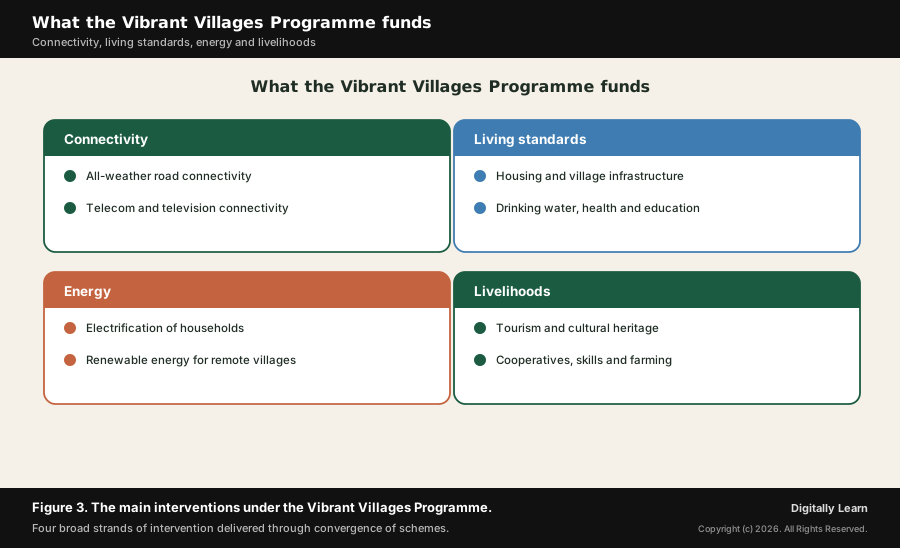
The first cluster of interventions is hard infrastructure. The programme funds road connectivity to unconnected villages, housing, drinking water, and the health and education facilities that make a village liveable. In terrain where a single landslide can cut a settlement off for weeks, an all-weather road and a reliable water supply are the difference between a village that survives and one that empties.
The second cluster is energy and communications. The programme provides for electrification, including renewable energy suited to remote, off-grid locations, and for television and telecom connectivity so that border villages are no longer cut off from information, services and the wider economy. A mobile signal and a power supply allow a young resident to study, bank, sell and stay connected without leaving, removing some of the strongest pressures to migrate out.
The third cluster builds livelihoods, because infrastructure without income still empties a village. The programme promotes tourism and cultural heritage, including border and village tourism, supports skill development and entrepreneurship, and develops cooperative societies in agriculture and horticulture, the cultivation of medicinal plants and herbs, and allied activity. The intent is to give border residents a viable economic reason to remain, turning development spending into durable local prosperity. The figure below groups these strands.
The Institutional Architecture: Who Runs It and How Convergence Works
The Ministry of Home Affairs, states, districts and the convergence model
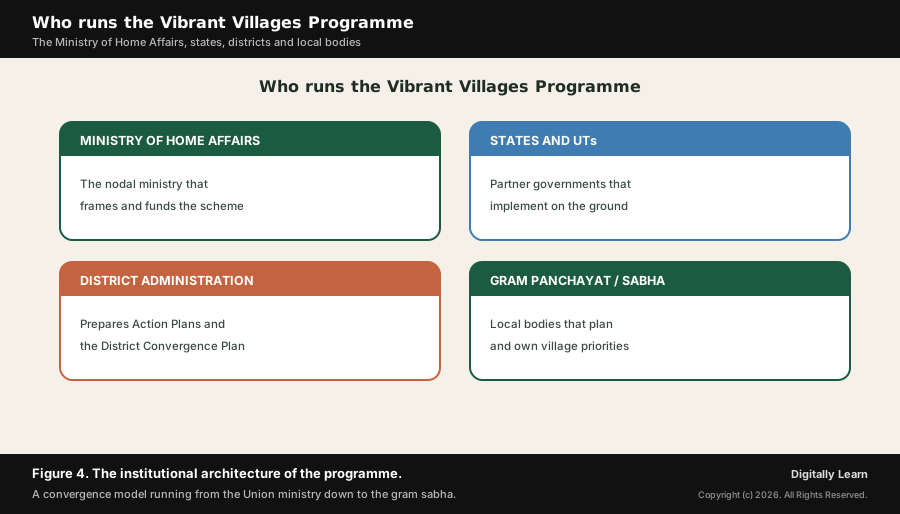
At the top of the structure is the Ministry of Home Affairs, the nodal ministry: it frames the scheme, sets the guidelines, releases the funds and monitors progress. Placing a development programme here, rather than in a line ministry, expresses the idea that on the frontier development and security are one task. The States and Union Territories are the implementing partners that carry the programme out on the ground.
The real delivery work is done at the district level. The District Administration, working with block and panchayat machinery, prepares Action Plans for each identified village and a District Convergence Plan that knits together the relevant central and state schemes. The Gram Panchayat and Gram Sabha are brought into the planning so that priorities are set locally, giving the village a stake in what is built.
The financial engine of the model is convergence, sometimes described as scheme-stacking. Rather than duplicating what other schemes already provide, the programme aims for 100% saturation of existing central and state welfare schemes in the chosen villages, adding its own funds to fill the gaps. A village road may come from one scheme, housing from another and a health sub-centre from a third, bound into one complete package. The figure below sets out the architecture.
How VVP relates to the BADP and the Border Infrastructure and Management scheme
The Vibrant Villages Programme does not stand alone; it sits within an older family of border schemes run by the Ministry of Home Affairs. The longest-standing is the Border Area Development Programme (BADP), implemented by the Department of Border Management through the State Governments and funded entirely by the Centre. It covers border blocks of border districts along the international land border, meeting the special development needs of people in remote border areas through convergence.
The Vibrant Villages Programme is best read as a focused successor to that older effort. Where the BADP spread development thinly across all the border blocks, the Vibrant Villages Programme concentrates intensive, saturation-level investment on a chosen set of frontier villages tied to the first-village idea. The two run alongside each other, the BADP providing the broad base and the newer scheme delivering the deeper, village-by-village push on the most exposed stretches.
Running parallel to both is the security-infrastructure track. The Central Sector Umbrella Scheme for Border Infrastructure and Management (BIM) funds the hardware of the border itself, border roads, fencing, floodlights, Border Out Posts and Company Operating Bases, to secure the land borders with Pakistan, Bangladesh, China, Nepal, Bhutan and Myanmar. These schemes form a layered approach: BIM equips the border line, while the BADP and the Vibrant Villages Programme develop the people and villages behind it.
Challenges and the Implementation Debate, in Measured Terms
Terrain, capacity, ecology, genuine livelihoods and coordination
A balanced reading must weigh the challenges. The first is sheer terrain. The villages the programme serves are by definition remote, high-altitude and hard to reach, with short working seasons, costly construction and supply lines that long winters can sever. Building and maintaining roads, power and water in such country is slow and expensive, and the gap between sanctioned works and completed works on the ground can be wide.
A second challenge is implementation capacity and the quality of spending. Thinly staffed district and block administrations must plan, converge and deliver many schemes at once, and there is a standing risk that spending becomes cosmetic, a viewing gallery or a signboard, rather than the genuine livelihoods that persuade families to stay. The real test is not money sanctioned but whether out-migration slows, which demands durable income and honest, village-by-village assessment.
A third set of concerns is ecological sensitivity and coordination. Much of this terrain is fragile high-mountain and forest country, where roads, tourism and construction must be weighed against environmental harm, so that development does not undermine the landscape that draws people and visitors. Because the model rests on convergence across many ministries and tiers of government, weak coordination can stall delivery. These are reasons to watch implementation closely, not to doubt the programme's purpose.
Understanding the Significance of the Vibrant Villages Programme
Border security, balanced development and a populated frontier
What is the significance of the Vibrant Villages Programme lies first in border security. By keeping the frontier populated and connected, the programme turns the border community into the eyes and ears of the border and gives the security forces the roads and the local awareness they need. A living, developed frontier is harder to encroach upon and easier to defend than an empty one, which is the core security dividend the scheme is designed to deliver.
Its second significance is balanced regional development. The programme directs resources to some of the most remote and long-neglected parts of the country, narrowing the gap between the border belt and the interior and addressing the development asymmetry felt across the line. In doing so it advances the promise of reaching services to every citizen, however remote, and treats the frontier population as full participants in national development rather than an afterthought.
Its third significance is the reframing of the border itself. By insisting that the border village is the first village of India, the programme changes how the state, and in time the citizen, sees the frontier: not as a remote and emptying edge but as a populated and confident face that the nation presents to its neighbours. That shift in perspective, as much as any road, is what the programme is ultimately trying to achieve.
The Way Forward and the Wider Border-Development Landscape
Where the programme sits among India's border and development efforts
The way forward for the programme rests on turning sanctioned works into lasting outcomes. That means completing the all-weather roads and the saturation targets, but above all building durable livelihoods, through tourism, cooperatives and skills, that give border residents a real economic reason to stay. The measure of success is not money spent but out-migration reversed, and that calls for honest, village-level monitoring of whether people are returning and remaining.
The programme also has to be read alongside the rest of India's border effort. It complements the security-infrastructure work under the Border Infrastructure and Management scheme and the broader development of the Border Area Development Programme, and it links to wider connectivity and border-tourism initiatives that bring visitors to the frontier. These efforts are most effective when they converge village by village rather than running in parallel silos.
Held together, the picture is of a state trying to make its frontier liveable and secure at once. The following efforts are worth holding in working memory as the landscape within which the Vibrant Villages Programme sits:
- Vibrant Villages Programme I and II: The focused, saturation-level development of border villages, first on the northern border and then along the other land frontiers.
- Border Area Development Programme (BADP): The older, broad-based development of border blocks through convergence, within which the Vibrant Villages Programme is a sharper, village-level push.
- Border Infrastructure and Management (BIM): The security-infrastructure scheme that funds border roads, fencing, floodlights and outposts along the land borders.
- Convergence of welfare schemes: The saturation of existing central and state schemes in border villages, on which the whole Vibrant Villages model rests.
Taken together, these efforts show that the Vibrant Villages Programme is not a stand-alone scheme but one part of a layered approach in which securing the line and developing the people behind it are pursued as a single, connected task.
How the Programme Took Shape, from the 2022 Budget to VVP-II
The announcement, the Cabinet approvals, the launch and the second phase
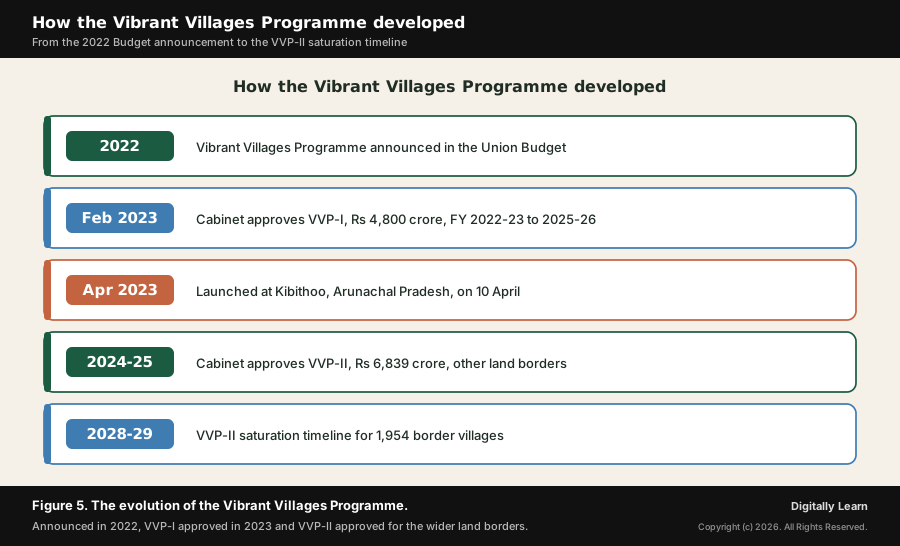
The Vibrant Villages Programme took shape in stages. It was first announced in the Union Budget of 2022 as a plan to develop villages on the northern border, signalling that the government intended to treat the border belt as a development priority in its own right rather than a residual concern. The announcement set the direction; the detail and the money followed in the year that came after.
The Cabinet approval of VVP-I on 15 February 2023, with its Rs 4,800 crore allocation for 2022-23 to 2025-26, turned the idea into a funded scheme, and the launch at Kibithoo on 10 April 2023 carried it to the ground. The later approval of VVP-II, with its Rs 6,839 crore outlay for 2024-25 to 2028-29, then widened the effort to the other land frontiers, completing the arc to a two-phase national programme. The table below traces this sequence.
| Stage | When | What happened |
|---|---|---|
| Budget announcement | 2022 | The Vibrant Villages Programme is announced for the northern border |
| VVP-I approved | Feb 2023 | Cabinet clears VVP-I, Rs 4,800 crore, FY 2022-23 to 2025-26 |
| Launch at Kibithoo | Apr 2023 | Launched in Arunachal Pradesh with the first-village framing |
| VVP-II approved | 2024-25 | Cabinet clears VVP-II, Rs 6,839 crore, other land borders |
| VVP-II saturation | to 2028-29 | Saturation of 1,954 border villages in four thematic areas |
Reading the rows together shows the arc: a single budget announcement grew into a funded northern-border scheme, was carried to the frontier with a clear idea, and was then extended into a wider, saturation-driven programme covering every land border.
UPSC Relevance and Exam Focus
Where the Vibrant Villages Programme fits in the UPSC-CSE syllabus
This topic sits across two papers. It maps to General Studies Paper II: government policies and interventions for development in various sectors and welfare schemes, as a centrally sponsored and central sector scheme with a clear convergence design. It also maps to General Studies Paper III: security challenges and border-area management, because its purpose is inseparable from the security of the land borders. A strong answer holds both dimensions, the welfare scheme and the security instrument, together.
For Prelims, hold the high-yield facts: the programme is run by the Ministry of Home Affairs; VVP-I was approved in February 2023 as a centrally sponsored scheme, Rs 4,800 crore for 2022-23 to 2025-26, covering the northern border in Arunachal Pradesh, Himachal Pradesh, Sikkim, Uttarakhand and the UT of Ladakh, with 662 priority villages; VVP-II is a central sector scheme with Rs 6,839 crore for the other land borders; and it was launched at Kibithoo.
For Mains, the recurring framing is to assess how border development serves border security, and to weigh the schemes that deliver it. A strong answer treats the Vibrant Villages Programme as one layer in a wider effort that includes the Border Area Development Programme and the Border Infrastructure and Management scheme, explains the out-migration and asymmetry rationale, and assesses implementation honestly, the terrain, capacity, ecological and livelihood challenges, in measured terms.
Recurring linked concepts an aspirant should keep in working memory:
- Border-area management: The wider task of securing and developing the frontier, of which the Vibrant Villages Programme is the village-development arm.
- Centrally sponsored versus central sector schemes: VVP-I is centrally sponsored, while VVP-II is a central sector scheme funded entirely by the Centre.
- Convergence and saturation: The model of stacking existing welfare schemes to a 100% floor in chosen villages, the heart of the programme’s design.
- Out-migration and the first-village idea: The demographic and strategic premise that keeping people on the border is itself a security measure.
A common Prelims trap is to confuse the two phases or the nodal ministry; hold that VVP-I is centrally sponsored and covers the northern border, that VVP-II is a central sector scheme for the other land borders, and that both sit with the Ministry of Home Affairs, not a rural-development ministry.
A common Mains trap is to treat the programme as a pure welfare scheme or a pure security measure. Its exam value lies in a balanced judgment: the genuine development gains for a neglected frontier, the indirect but real security dividend of a populated border, its place alongside the BADP and the BIM scheme, and the honest challenges of terrain, capacity, ecology and genuine livelihoods that decide whether it works.
Previous Year UPSC-CSE Questions By the end you will be able to draft model answers for the following UPSC questions. Each question carries a collapsible framework showing how to approach it in the exam.
- UPSC Mains 2024 GS-IIIExamine the security challenges along India's borders with China and Pakistan, and describe the development being undertaken in these areas under the BADP and the BIM scheme.
How to structure the answer in the exam
Body (sub-themes to develop):
- The security challenges along the border: unsettled and contested stretches, the development asymmetry where the neighbouring side has built roads and model villages up to the line, the out-migration that leaves the frontier thinly held, and the difficulty of guarding remote, high-altitude and porous borders.
- Development under the Border Area Development Programme (BADP): a 100% centrally funded programme of the Department of Border Management, MHA, that meets the special development needs of border-area people across the border blocks through convergence of central and state schemes.
- Development under the Border Infrastructure and Management (BIM) scheme: a central sector umbrella scheme funding border roads, border fencing, floodlights, Border Out Posts and Company Operating Bases and technological solutions to secure the land borders.
- The Vibrant Villages Programme as the sharpened layer: focused, saturation-level development of border villages (VVP-I on the northern border, VVP-II on the other land borders) to arrest out-migration and make the population the eyes and ears of the border.
- The balance: development and security reinforcing one another, set against the honest challenges of terrain, implementation capacity, ecological sensitivity and the need for genuine livelihoods rather than cosmetic spending.
Sources and Further Reading
- Press Information Bureau: Cabinet approves the Vibrant Villages Programme for FY 2022-23 to 2025-26 with Rs 4,800 crore
- Prime Minister of India: Cabinet approves the Vibrant Villages Programme (Rs 4,800 crore)
- Press Information Bureau: Union Home Minister launches the Vibrant Villages Programme at Kibithoo, Arunachal Pradesh
- Press Information Bureau: Cabinet approves the Vibrant Villages Programme-II (VVP-II) for FY 2024-25 to 2028-29
- Press Information Bureau: The Border Infrastructure and Management (BIM) umbrella scheme
- Ministry of Home Affairs: Vibrant Villages Programme portal
- Ministry of Home Affairs: Border Area Development Programme (BADP)
- Government of Arunachal Pradesh: Vibrant Village Programme
- NITI Aayog: Aspirational and border-area development
- Wikipedia: Vibrant Village Programme
Editorial Disclaimer
This briefing is for UPSC preparation. Verify the facts and figures against the official Ministry of Home Affairs and PIB sources before relying on them.