

Overview
Composites, smart materials, superconductors and rare earths
The materials behind aircraft, chips, screens and magnets.
Advanced materials are materials designed for particular magnetic, electric, optical or mechanical properties: composites such as carbon-fibre-reinforced polymer, smart materials that respond to heat or pressure, superconductors, semiconductors, display materials, and strategic raw materials such as the rare earth elements.
Advanced Materials: What Makes a Material Advanced
Advanced Materials: Types and Why They Matter
Advanced materials are materials designed for specific magnetic, electric, optical or mechanical properties instead of being taken as nature supplies them. Understanding how the structure of a solid decides its properties is what makes such design possible, and it has produced superconducting ceramics, conducting polymers, optical fibres, biocompatible solids for surgical implants and the large-scale miniaturisation of solid-state devices.
| Class | What sets it apart | Example |
|---|---|---|
| Composites | Two materials combined into one stronger, lighter material | Carbon-fibre-reinforced polymer |
| Smart materials | A property changes under heat, pressure or voltage | Nitinol, quartz |
| Superconductors | Zero electrical resistance below a critical temperature | Niobium-titanium, YBCO |
| Semiconductors | Conductivity between that of conductors and insulators | Silicon, gallium arsenide |
| Display materials | Steer or emit light | Liquid crystals, OLED films, phosphors |
| Advanced ceramics | Very hard and heat-resistant | Silicon carbide in disc brakes |
| Nanomaterials | At least one dimension below 100 nm | Carbon nanotubes, graphene |
Nanomaterials, the last row, have their own treatment under nanotechnology, and graphene under carbon and its compounds, and the sections below take up the other classes.
- Advanced ceramics: Ceramics resist heat, so they serve where metals and polymers fail. Silicon nitride ball bearings wear far less and can last more than three times as long as metal ones, cubic-stabilised zirconia works as the oxygen sensor in exhaust systems, and bio-ceramics such as synthetic hydroxyapatite make dental implants and synthetic bone. Their main limitation is brittleness.
- Aerogels: Made by replacing the liquid in a gel with a gas without collapsing its structure, through supercritical drying or freeze-drying. The result is a solid of extremely low density and extremely low thermal conductivity, a good heat insulator; the first was made by Samuel Kistler in 1931.
Composite Materials and Carbon Fibre
Composite Materials: Matrix, Reinforcement and FRP
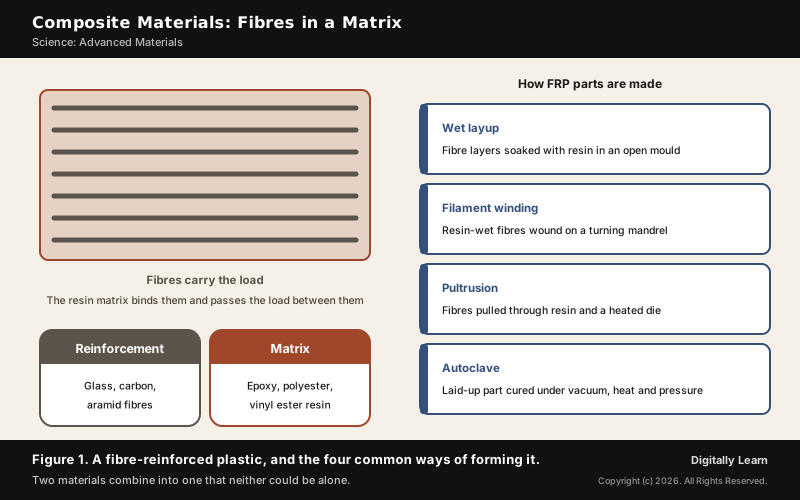
Composite materials are made from two or more constituent materials with notably different properties that together give a material unlike any of them. Inside the finished structure the constituents stay separate and distinct, which sets composites apart from mixtures and solid solutions. Most engineered composites have a matrix, the binding material, and a reinforcement of particles or fibres.
- Everyday examples: Concrete and reinforced concrete, plywood bound with wood glue, and fibreglass.
- Graphite fibres in plastic: These give high-strength, lightweight composites used in tennis rackets, fishing rods, aircraft and canoes.
- Other matrices: Ceramic matrix and metal matrix composites; advanced composites were often developed first for spacecraft and aircraft.
A fibre-reinforced plastic (FRP) is a composite of a polymer matrix reinforced with fibres, usually glass (as in fibreglass), carbon, aramid or basalt, set in an epoxy, vinyl ester or polyester resin. The fibres give strength and stiffness, while the matrix holds them together and passes loads between them. Bakelite was the first fibre-reinforced plastic, and FRP offers a high strength-to-weight ratio, corrosion resistance and design flexibility.
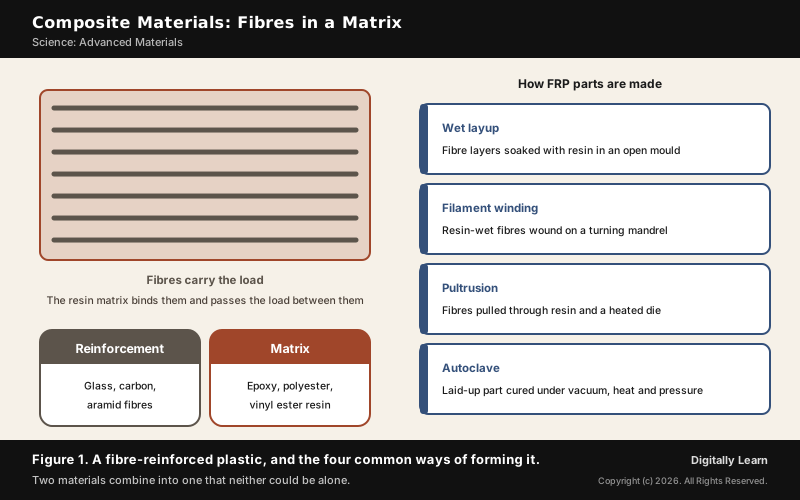
- Wet layup: Fibre layers are placed in an open mould and soaked with resin, which then cures, usually at room temperature.
- Filament winding: Fibre bundles are pulled through a bath of resin and wound over a rotating mandrel.
- Pultrusion: Fibres are pulled through resin and then through a heated die, giving beams, channels, pipes and ladders.
- Autoclave and vacuum bag: The laid-up part is sealed under a vacuum bag and cured in a heated pressure vessel; its long, controlled cure makes it common in aerospace.
| Sector | FRP in use | Gain |
|---|---|---|
| Aviation | Carbon-fibre rudder of the Airbus A310 | 25 per cent lighter, 95 per cent fewer components |
| Aviation | Airbus A350 XWB airframe, 53 per cent CFRP; Boeing 787, 50 per cent | Lighter aircraft, lower fuel use |
| Automobiles | Engine intake manifolds of glass-fibre-reinforced nylon | Up to 60 per cent lighter than cast aluminium |
| Automobiles | Carbon-fibre monocoque racing chassis, first in Formula One in 1981 | Extra rigidity for less weight |
Carbon Fibre: Manufacture, Uses and Recycling
Carbon fibre is a fibre about 5 to 10 micrometres across made mostly of carbon atoms, whose crystals are aligned along the fibre's length. It is made by carbonising fibres of polyacrylonitrile (PAN), pitch or rayon through oxidation and heating to high temperatures; further graphitising or stretching raises its strength or elasticity. The fibres are woven or braided into fabrics and set in resin as carbon-fibre-reinforced polymer (CFRP).
- Properties: High stiffness, high tensile strength, high strength-to-weight ratio, high chemical resistance, tolerance of high temperatures and low thermal expansion.
- Uses: Aircraft and spacecraft parts, racing-car bodies, golf-club shafts, bicycle frames, fishing rods and automobile springs; CFRP also goes into ship superstructures and civil engineering.
- Cost: Carbon fibre is expensive compared with glass, basalt or plastic fibres.
- Recycling: CFRP cannot be melted down in air like many metals, but it can be recycled by mechanical, thermal, chemical and biological methods, and carbon-fibre-reinforced thermoplastics can be reshaped and remoulded.
| Fibre | Strengths | Typical use |
|---|---|---|
| Glass | Much cheaper than carbon and less brittle in composites, though not as rigid | Boats, pipes, fibreglass |
| Carbon | High stiffness and strength for its weight, but expensive | Aircraft, racing cars, sports goods |
| Aramid | Tough synthetic fibres known as Kevlar, Nomex and Technora | With carbon, in aerospace, automotive and sporting goods |
Smart and Functional Materials
Smart Materials: Shape Memory Alloys, Piezoelectrics and Hydrogels
Smart materials, also called intelligent or responsive materials, are designed so that one or more of their properties changes in a controlled way under an external stimulus: stress, moisture, electric or magnetic fields, light, temperature, pH or chemicals. They are the basis of sensors, actuators and artificial muscles.
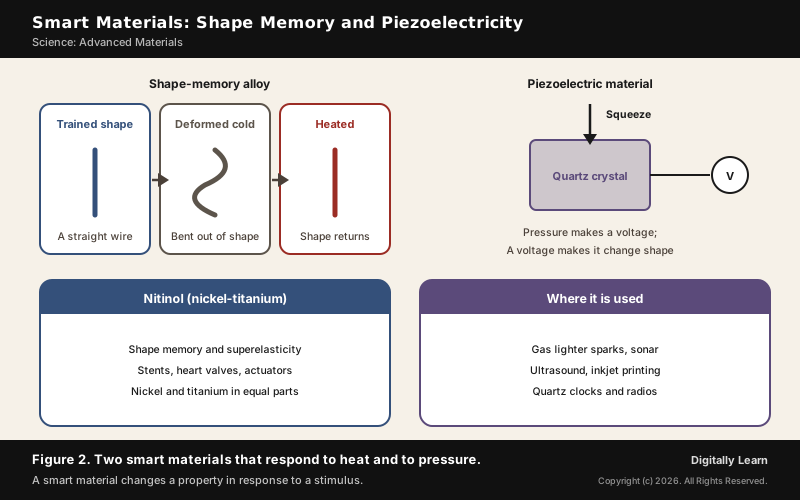
- Shape memory alloy: An alloy that can be deformed when cold but returns to its remembered shape when heated. The two most common are copper-aluminium-nickel and nickel-titanium, and SMA parts can replace hydraulic, pneumatic and motor-driven actuators with light, solid-state ones.
- Nitinol: Nickel and titanium in roughly equal atomic proportions; it shows both the shape memory effect and superelasticity, and is used in peripheral stents, heart valves and actuators.
- Piezoelectric materials: Certain crystals, ceramics and even bone and DNA build up electric charge when squeezed, and change shape when a voltage is applied. Pierre and Jacques Curie discovered the effect in 1880; quartz, a piezoelectric, made accurate clocks, radio and television broadcasting and mobile communication possible.
- Piezoelectric uses: Sparks for gas stoves and lighters, sonar (its first practical use, in the First World War), ultrasound, inkjet printing and clock circuits.
- Hydrogels: A water-insoluble three-dimensional polymer network holding water, at least 10 per cent. As smart materials they respond to pH or temperature; some are liquid at room temperature and set into a gel at body temperature, so they can be injected to deliver drugs. Wound dressings and tissue engineering are other uses.
- Electroactive polymers: Polymers that change their volume when an electrical stimulus is applied.
Superconductors: Zero Resistance, Types and Uses
Superconductors are materials whose electrical resistance drops to exactly zero below a characteristic critical temperature, and which expel magnetic fields from their interior, the Meissner effect. A current in a loop of superconducting wire can persist indefinitely with no power source, and the effect can be explained only by quantum mechanics.
- Discovery: Heike Kamerlingh Onnes found in 1911 that the resistance of mercury vanished abruptly at 4.2 K, using the newly produced liquid helium as a coolant.
- From metals to ceramics: For long only metals and alloys at 0 to 15 K were known to superconduct; now ceramic materials and mixed oxides do so at up to 150 K.
- High-temperature superconductors: In 1986 certain cuprate ceramics were found to superconduct above 35 K, and YBCO, with yttrium, at 92 K; that is above the 77 K boiling point of cheap liquid nitrogen, which can then serve as the coolant.
- Types: Superconductors fall into Type I and Type II, a division for which Abrikosov and Ginzburg shared the 2003 Nobel Prize.
| Use | How superconductors serve it |
|---|---|
| MRI scanners | Most clinical MRI magnets are superconducting and are kept cold with liquid helium |
| Particle accelerators | Niobium-titanium and niobium-tin magnets bend and focus the particle beams |
| SQUIDs | The most sensitive magnetometers known; also used in quantum computing |
| Future uses | Power transmission, transformers, maglev trains, compact fusion devices |
Display Materials: Liquid Crystals, OLED and Phosphors
A liquid-crystal display (LCD) uses the light-modulating properties of liquid crystals together with polarisers. Liquid crystals do not emit light; they steer light from a backlight or a reflector, and LCDs replaced heavy, bulky cathode-ray tubes in nearly all uses by the early 2010s.
An OLED, or organic light-emitting diode, is an LED whose light-emitting layer is a film of an organic compound between two electrodes, at least one of them transparent. Its advantage over the LCD is that each pixel emits its own light, so no backlight is needed; it was invented at Eastman Kodak in 1987 by Ching Wan Tang and Steven Van Slyke, and AMOLED panels switch each pixel through a thin-film transistor.
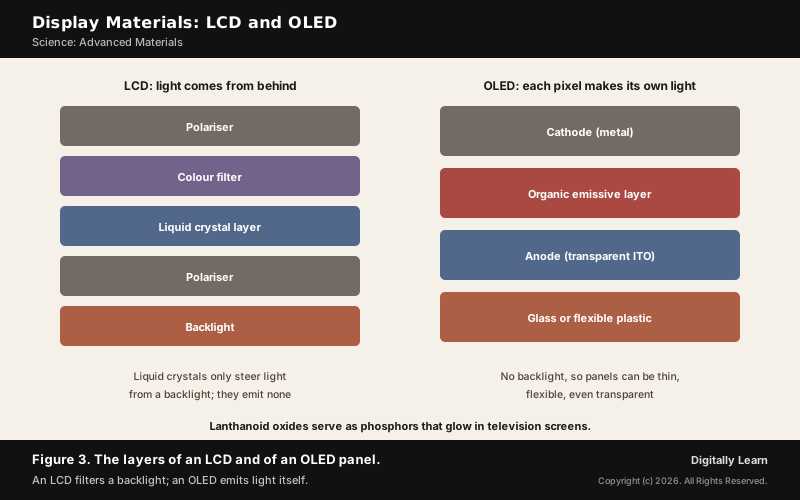
- Flexible: OLED displays can be made on flexible plastic substrates, which opens the way to roll-up displays embedded in fabrics or clothing and to foldable phones; plastic is also shatter-resistant, unlike the glass of LCDs.
- Transparent: With transparent contacts on both sides, OLED panels can be made transparent.
- Limits: Organic displays have a shorter lifespan, and water damage can limit the life of flexible ones.
- Phosphors: Substances that glow when exposed to radiation. Fluorescent ones stop glowing as soon as the radiation stops, while phosphorescent ones keep glowing after a delay. Phosphors are often rare-earth compounds, and lanthanoid oxides are used as phosphors in television screens.
Strategic Materials and Manufacturing in India
Rare Earth Elements: Uses, Monazite and Supply Concerns
Rare earth elements are a set of 17 soft, silvery metals: the 15 lanthanides of the periodic table, together with scandium and yttrium. The name misleads. They are not scarce, and cerium is more abundant than copper, but they occur only in compounds, spread thinly, so getting them pure means processing enormous amounts of ore.
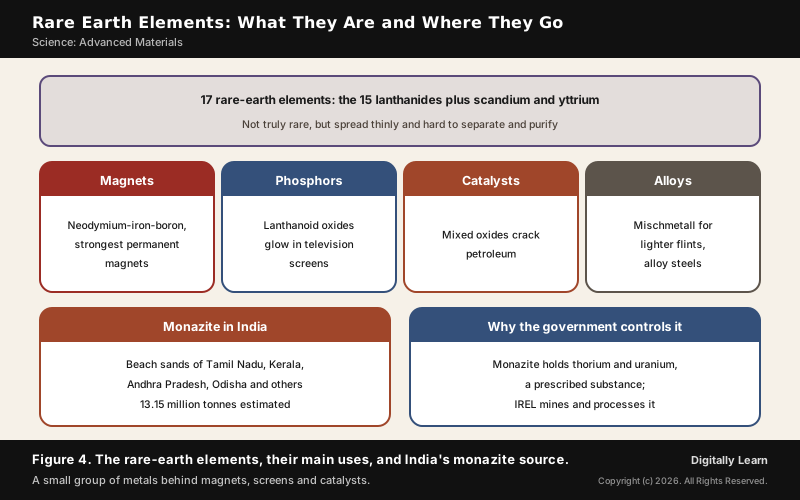
- Magnets: Neodymium-iron-boron magnets, developed in 1984, are the strongest permanent magnets sold; they drive motors in cordless tools and fill hard disk drives. Electric vehicles, wind turbines and smartphones have raised the demand for rare earths.
- Other uses: Catalysts for petroleum cracking; phosphors in television screens; alloy steels, which NCERT names as the lanthanides’ best single use, though other accounts put catalysts and magnets first; and mischmetall, about 95 per cent lanthanoid and 5 per cent iron, used in magnesium alloys for bullets, shells and lighter flints.
- China: In 2019 China supplied around 90 per cent of global demand for the 17 rare-earth powders, and it has restricted their supply since about 2010, with further restrictions in 2025. The US and Australia are the next largest producers.
India's rare earths come from monazite, a phosphate mineral of rare earth elements that also holds uranium and thorium. The Atomic Minerals Directorate counts 136 beach sand deposits with 13.15 million tonnes of monazite in the coastal beach, teri or red sands and inland alluvium of parts of Tamil Nadu, Kerala, Andhra Pradesh, Odisha, Maharashtra, Gujarat, Jharkhand and West Bengal. India's resources are lean in grade and mostly light rare earths.
- Government control: Monazite is a prescribed substance under the Atomic Energy Act, 1962, because of its uranium and thorium, so its mining, processing and refining stay under government control. IREL (India) Limited, under the Department of Atomic Energy, produces high-purity rare earth oxides, and exports of beach sand minerals are channelled through IREL.
- Magnets at home: A scheme for sintered rare earth permanent magnets, approved on 26 November 2025 with ₹7,280 crore, aims at 6,000 tonnes a year of capacity; IREL already runs a samarium-cobalt magnet plant at Visakhapatnam and a magnet-recycling plant at Bhopal.
- Critical minerals: India released its first list of 30 critical minerals, rare earths among them, in June 2023 and joined the Minerals Security Partnership that month. The MMDR Amendment Act, 2023 lets the Centre auction blocks of 24 critical and strategic minerals, and it created a new exploration licence.
- Import dependence: India depends on imports for most of these technology- and energy-critical minerals.
The government's wider plan for these minerals is followed in the current affairs briefing on India's critical minerals strategy.
Semiconductor Materials and the India Semiconductor Mission
Semiconductors are solids whose electrical conductivity, from 10⁻⁶ to 10⁴ ohm⁻¹ m⁻¹, lies between that of conductors and insulators. The gap between their valence band and conduction band is small, so some electrons jump across, and conductivity rises with temperature. Silicon, doped silicon and gallium arsenide are the key semiconductor materials, the basis of every electronic chip.
- Doping: Pure silicon and germanium conduct too little to be useful, so an impurity is added. A group 15 element such as phosphorus or arsenic adds a free electron, giving an n-type semiconductor; a group 13 element such as boron, aluminium or gallium leaves an electron hole, giving a p-type semiconductor.
- Gallium nitride: A wide-bandgap semiconductor, 3.4 eV, used in blue LEDs since the 1990s and in high-power and high-frequency devices.
- Silicon carbide: A hard wide-bandgap semiconductor that is also sintered into very hard ceramics for disc brakes, clutches and bulletproof plates; India’s fabs are now moving from silicon to silicon carbide.
Making chips is hard for any country. Semiconductor manufacturing is a complex, technology-intensive sector that needs huge capital investment, carries high risk and long payback periods, and faces rapid changes in technology; fabs also need land, semiconductor-grade water, high-quality power and logistics.
- The programme: Approved by the Cabinet on 15 December 2021 with ₹76,000 crore to build a semiconductor and display ecosystem, run by a specialised, independent India Semiconductor Mission (ISM).
- Incentives: Up to 50 per cent of project cost for silicon and display fabs; 30 per cent of capital expenditure for compound semiconductor, silicon photonics, sensor and chip assembly and testing (ATMP or OSAT) units; a Design Linked Incentive for chip design; and modernisation of the Semi-conductor Laboratory.
- Progress: By December 2025, 10 projects worth about ₹1.60 lakh crore had been approved in 6 states, among them Micron’s assembly and test unit at Sanand and the Tata-PSMC fab at Dholera for 50,000 wafers a month.
- ISM 2.0: The next phase aims at making semiconductor equipment and materials in India and designing full-stack Indian chip intellectual property, with ₹1,000 crore provided for 2026-27.
The approved fabs and plants are tracked in the current affairs briefing on the India Semiconductor Mission.
3D Printing: Additive Manufacturing and Its Applications
3D printing, also called additive manufacturing, builds a three-dimensional object from a computer-aided design or digital 3D model by depositing, joining or solidifying material under computer control, typically layer by layer. It is the reverse of subtractive manufacturing, such as machining, which removes material; a key gain is that it can make complex shapes, including hollow parts, with less waste.
- History: In the 1980s it was used only for prototypes, then called rapid prototyping; the stereolithography process was patented in France in 1984.
- Methods: Fused deposition modelling, which lays down a continuous filament of thermoplastic, is the most common process; others include stereolithography and machines that fuse powdered metals.
- Industry: Architecture and construction, industrial design, automotive, aerospace, defence, fashion, footwear, jewellery and eyewear.
- Food: Chocolate, candy, crackers, pasta and pizza are candidates for food printing.
- Medicine: Anatomical models for planning bony reconstructive surgery since the mid-1990s, 3D-printed titanium implants, facial reconstruction, patient-specific hearing aids and dental devices; bioprinting builds tissue from layers of living cells, and one bioprinter can make a small piece of ear cartilage in under an hour.
Previous Year UPSC-CSE Questions
Previous Year UPSC-CSE Questions By the end you will be able to draft model answers for the following UPSC questions. Each question carries a collapsible framework showing how to approach it in the exam.
- UPSC Prelims 2023 Prelims-GSConsider the following statements :
- Carbon fibres are used in the manufacture of components used in automobiles and aircrafts.
- Carbon fibres once used cannot be recycled.
Which of the statements given above is/are correct?
How to approach this Prelims question
Approach: Statement 1: carbon-fibre-reinforced materials are used for aircraft and spacecraft parts, racing-car bodies and automobile springs, and the A350 airframe is 53 per cent CFRP, so 1 is correct. Statement 2: CFRP cannot be melted down like metal, but it is recycled by mechanical, thermal, chemical and biological methods, and carbon-fibre thermoplastics can be remoulded, so 2 is incorrect. Only statement 1.
Trap to watch: Hard to recycle is not the same as impossible to recycle.
Key facts to recall:
- (a) 1 only: right. Carbon fibre is used in cars and aircraft, and it can be recycled.
- (b) 2 only: wrong. Statement 2 is false because CFRP is recycled by several methods.
- (c) Both 1 and 2: wrong. Statement 2 is false.
- (d) Neither 1 nor 2: wrong. Statement 1 is true: aircraft and automobile parts use carbon fibre.
Answer signal: Option (a): used in vehicles and aircraft; recyclable, so statement 2 fails.
- UPSC Prelims 2017 Prelims-GSOrganic Light Emitting Diodes (OLEDs) are used to create digital display in many devices. What are the advantages of OLED displays over Liquid Crystal displays?
- OLED displays can be fabricated on flexible plastic substrates.
- Roll-up displays embedded in clothing can be made using OLEDs.
- Transparent displays are possible using OLEDs.
Select the correct answer using the code given below:
How to approach this Prelims question
Approach: Statement 1: OLED displays can be fabricated on flexible plastic substrates, correct. Statement 2: that flexibility makes possible roll-up displays embedded in fabrics or clothing, correct. Statement 3: with transparent contacts on both sides, OLED panels can be transparent, correct. An LCD needs a backlight and glass, so these are advantages over LCDs. All three.
Trap to watch: The reason behind all three is that each OLED pixel makes its own light.
Key facts to recall:
- (a) 1 and 3 only: wrong. Roll-up displays in clothing (statement 2) are also possible.
- (b) 2 only: wrong. Flexible substrates and transparent panels are also advantages.
- (c) 1, 2 and 3: right. Flexible plastic, roll-up displays in clothing and transparency are all possible.
- (d) None of the above statements is correct: wrong. All three statements are correct.
Answer signal: Option (c): all three.
- UPSC Prelims 2025 Prelims-GSConsider the following statements:
- Statement I: Some rare earth elements are used in the manufacture of flat television screens and computer monitors.
- Statement II: Some rare earth elements have phosphorescent properties.
Which one of the following is correct in respect of the above statements?
How to approach this Prelims question
Approach: Statement I: lanthanoid oxides are used as phosphors in television screens and similar fluorescing surfaces, so I is correct. Statement II: phosphors are often rare-earth compounds, and phosphorescent substances keep glowing after the radiation stops, so II is correct. The screens use rare earths precisely for their light-emitting (phosphor) property, so II explains I.
Trap to watch: Both statements are true; check whether II is the reason for I, and here it is.
Key facts to recall:
- (a) Both correct and II explains I: right. Rare earths go into screens because of their phosphor property.
- (b) Both correct but II does not explain I: wrong. The phosphor property is the reason for the use.
- (c) I correct but II not correct: wrong. Some rare earths are phosphorescent, so II is correct.
- (d) I not correct but II correct: wrong. Rare-earth oxides are used as phosphors in television screens.
Answer signal: Option (a).
- UPSC Prelims 2012 Prelims-GSRecently, there has been a concern over the short supply of a group of elements called ‘rare earth metals’. Why?
- China, which is the largest producer of these elements, has imposed some restrictions on their export.
- Other than China, Australia, Canada and Chile, these elements are not found in any country.
- Rare earth metals are essential for the manufacture of various kinds of electronic items and there is a growing demand for these elements.
Which of the statements given above is/are correct?
How to approach this Prelims question
Approach: Statement 1: China supplied around 90 per cent of global demand in 2019 and has restricted supply since about 2010, so 1 is correct. Statement 2: rare earths are not confined to China, Australia, Canada and Chile; India has 13.15 million tonnes of monazite and the US is a leading producer, so 2 is incorrect. Statement 3: electronics, electric vehicles and wind turbines have raised demand, so 3 is correct. Statements 1 and 3.
Trap to watch: Rare earths are not rare in the crust; they are hard to separate.
Key facts to recall:
- (a) 1 only: wrong. Statement 3 is also true: demand from electronics has grown.
- (b) 2 and 3 only: wrong. Statement 2 is false because India and the US also have rare earths.
- (c) 1 and 3 only: right. China's restrictions and rising demand explain the shortage.
- (d) 1, 2 and 3: wrong. Statement 2 is false.
Answer signal: Option (c): statements 1 and 3.
- UPSC Prelims 2022 Prelims-GSWith reference to India, consider the following statements:
- Monazite is a source of rare earths.
- Monazite contains thorium.
- Monazite occurs naturally in the entire Indian coastal sands in India.
- In India, Government bodies only can process or export monazite.
Which of the statements given above are correct?
How to approach this Prelims question
Approach: Statement 1: monazite is a phosphate mineral of rare earth elements, India's source of them, correct. Statement 2: it contains uranium and thorium, correct. Statement 3: it occurs in the beach and inland sands of parts of eight states, not in the entire coastal sands, incorrect. Statement 4: as a prescribed substance its mining, processing and export are kept under government control through IREL, correct. Statements 1, 2 and 4.
Trap to watch: 'Entire' is the word that makes statement 3 false.
Key facts to recall:
- (a) 1, 2 and 3 only: wrong. Statement 3 is false, and statement 4 is true.
- (b) 1, 2 and 4 only: right. Source of rare earths, contains thorium, and under government control.
- (c) 3 and 4 only: wrong. Statement 3 is false, and statements 1 and 2 are true.
- (d) 1, 2, 3 and 4: wrong. Monazite is found in parts of the coast, not the entire coastal sands.
Answer signal: Option (b).
- UPSC Prelims 2025 Prelims-GSConsider the following statements:
- I. India has joined the Minerals Security Partnership as a member.
- II. India is a resource-rich country in all the 30 critical minerals that it has identified.
- III. The Parliament in 2023 has amended the Mines and Minerals (Development and Regulation) Act, 1957 empowering the Central Government to exclusively auction mining lease and composite license for certain critical minerals.
Which of the statements given above are correct?
How to approach this Prelims question
Approach: Statement I: India joined the Minerals Security Partnership in June 2023, correct. Statement II: India depends on imports for most of its critical minerals, so it is not resource-rich in all 30, incorrect. Statement III: the MMDR Amendment Act, 2023 empowers the Centre to auction blocks of 24 critical and strategic minerals, correct. Statements I and III.
Trap to watch: Identifying a mineral as critical signals scarcity or import dependence, not abundance.
Key facts to recall:
- (a) I and II only: wrong. Statement II is false, and statement III is true.
- (b) II and III only: wrong. Statement II is false, and statement I is true.
- (c) I and III only: right. India joined the MSP, and the Centre can auction critical minerals.
- (d) I, II and III: wrong. India is not rich in all 30 critical minerals.
Answer signal: Option (c).
- UPSC Mains 2013 GS-III[Two questions: each with 5 marks, 100 words] 17A. What is an FRP composite material? How are they manufactured? Discuss their applications in aviation and automobile industry
How to structure the answer in the exam
Introduction: A fibre-reinforced plastic is a composite of a polymer matrix reinforced with glass, carbon, aramid or basalt fibres, where the fibres carry the load and the resin binds them.
Body (sub-themes to develop):
- Manufacture: wet layup, filament winding, pultrusion, autoclave curing under vacuum, heat and pressure.
- Aviation: Airbus A310 CFRP rudder 25 per cent lighter with 95 per cent fewer components; A350 XWB 53 per cent and Boeing 787 50 per cent CFRP.
- Automobiles: glass-fibre nylon intake manifolds up to 60 per cent lighter than cast aluminium; carbon-fibre monocoque racing chassis.
- Limits: cost and skilled labour; CFRP cannot be melted down but can be recycled.
Conclusion: Conclude that FRP trades a higher material cost for weight and fuel savings over a vehicle's life.
- UPSC Mains 2025 GS-IIIIndia aims to become a semiconductor manufacturing hub. What are the challenges faced by the semiconductor industry in India? Mention the salient features of the India Semiconductor Mission.
How to structure the answer in the exam
Introduction: Semiconductors such as silicon and gallium arsenide are the base of every chip, and India launched a ₹76,000 crore programme in December 2021 to make them at home.
Body (sub-themes to develop):
- Challenges: huge capital, high risk, long gestation and payback, rapid technology change; need for land, semiconductor-grade water, high-quality power and logistics.
- ISM features: up to 50 per cent of project cost for silicon and display fabs; 30 per cent of capex for compound semiconductor, sensor and ATMP/OSAT units; Design Linked Incentive; SCL modernisation; an independent mission led by industry experts.
- Progress: 10 projects, about ₹1.60 lakh crore, in 6 states by December 2025 (Micron at Sanand, Tata-PSMC at Dholera); a move towards silicon carbide.
- ISM 2.0: equipment, materials and full-stack chip design in India.
Conclusion: Conclude that fabs follow only where water, power, skills and design talent are in place, which is the second phase's focus.
Sources
- NCERT: Chemistry Part I (Class XII), The Solid State; The d- and f-Block Elements
- NCERT: Chemistry (Class XI), Some Basic Concepts; The p-Block Elements
- PIB: Cabinet approves programme for semiconductors and display manufacturing (15 December 2021)
- PIB: India's Semiconductor Revolution (press note)
- PIB: India Semiconductor Mission 2.0
- PIB: Rare earth minerals, Parliament question (29 January 2026)
- PIB: India steps up exploration and mining of rare-earth minerals (3 February 2026)
- PIB: Illegal mining of beach sand minerals (1 August 2022)
- PIB: Thirty critical minerals list released (24 July 2023)
- PIB: List of Critical Minerals for India unveiled (28 June 2023)
- Department of Atomic Energy: Export of monazite from India, facts (19 October 2012)
- Ministry of Mines: Critical Minerals for India, committee report (June 2023)
- Wikipedia: Fibre-reinforced plastic
- Wikipedia: Carbon fibers
- Wikipedia: Shape-memory alloy
- Wikipedia: Superconductivity
- Wikipedia: OLED
- Wikipedia: Rare-earth element
- Wikipedia: 3D printing
- UPSC: Civil Services Examination question papers
Editorial Disclaimer
This article draws on the NCERT chemistry textbooks, the Department of Atomic Energy, the Ministry of Mines, the Ministry of Electronics and Information Technology through the Press Information Bureau, and the other sources listed on this page.


