

Overview
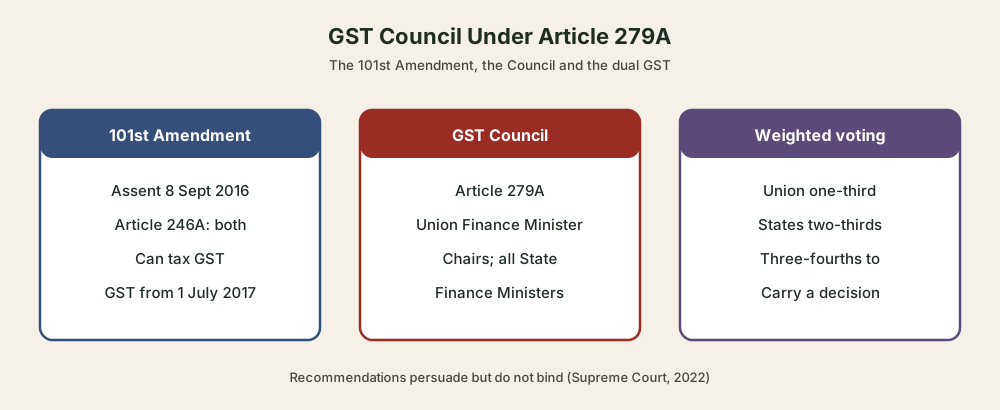
The GST Council is the constitutional body under Article 279A, chaired by the Union Finance Minister with one Minister from each State, that recommends every major feature of the goods and services tax. It was created by the 101st Amendment of 2016, which let Parliament and the States tax goods and services together, and it decides by weighted voting that needs both the Union and the States.
The 101st Amendment and the Making of GST
101st Amendment of Indian Constitution: How GST Was Introduced
Introducing GST needed a change to the Constitution itself, because taxing powers over goods and services were divided between the Union and the States. The 122nd Constitution Amendment Bill, 2014 made that change. The Rajya Sabha passed it on 3 August 2016 and the Lok Sabha on 8 August, more than fifteen States ratified it, and it received the President's assent on 8 September 2016 as the 101st Amendment Act, 2016.
- Article 246A: Gives Parliament and every State Legislature simultaneous power to make laws on GST; inter-State supplies are for Parliament alone.
- Article 269A: GST on inter-State supplies, including imports, is levied and collected by the Union and apportioned between the Union and the States.
- Article 279A: Creates the GST Council, to be constituted by the President within sixty days of the Amendment’s commencement.
- Seventh Schedule: Tax entries such as entry 92C of the Union List and entries 52 and 55 of the State List were omitted.
- Compensation (Section 18): Parliament must provide compensation to States for revenue lost to GST for five years.
GST itself began on 1 July 2017, rolled out at a special midnight session of Parliament. How the Amendment changed the lists is explained in the article on the Seventh Schedule.
Why GST Was Introduced: Cascading Taxes and a Single Market
Before GST, many taxes were levied not on the value added at each stage but on the full value of a good, including taxes already paid on inputs. This produced cascading, a tax on tax. GST taxes only value addition: tax paid at each stage is set off at the next through input tax credit.
| Level | Main taxes subsumed in GST |
|---|---|
| Union | Central excise duty, service tax, central sales tax, cesses such as the Krishi Kalyan Cess and Swachh Bharat Cess |
| States | VAT or sales tax, entry tax, luxury tax, octroi, entertainment tax, taxes on advertisements, taxes on lottery, betting and gambling, State cesses on goods |
| Kept out | Five petroleum products for the time being; alcoholic liquor for human consumption stays under State VAT |
The result was described as "One Nation, One Tax, One Market": standard laws, procedures and rates across the country, free movement of goods and services, and a common market. GST is destination-based, so the tax goes to the State where goods or services are consumed.
The Long Road to GST: Kelkar Task Force to Roll-Out
The idea took fifteen years to reach the statute book. In 2002 a task force under Vijay Kelkar was set up to recommend tax reforms, and in 2005 it recommended rolling out GST, as the Twelfth Finance Commission had suggested. In 2006 the Union Finance Minister proposed a roll-out by 1 April 2010, and a committee under Asim Dasgupta, West Bengal's Finance Minister, worked on the design.
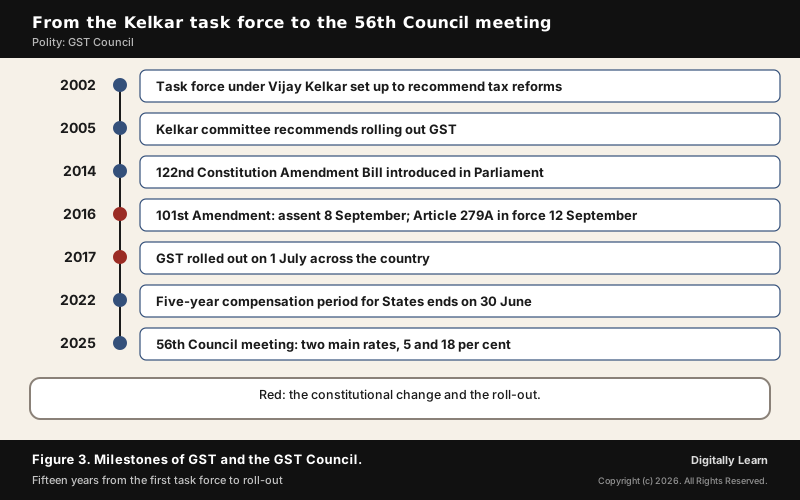
A first attempt stalled. The 115th Constitution Amendment Bill was introduced in the Lok Sabha on 22 March 2011 but ran into opposition and went to a Standing Committee, and the same year Asim Dasgupta resigned as head of the GST committee. The 122nd Amendment Bill of 2014 was passed by the Lok Sabha in May 2015 before the final passage in August 2016.
The delay came from the need to change the Constitution itself and to win over the States, which would give up their own taxes such as VAT, entry tax and octroi. To secure their agreement, the Amendment promised them compensation for five years, later fixed at 14 per cent annual growth in protected revenue.
Dual GST: CGST, SGST and IGST
India adopted a dual GST, administered by both the Union and the States. A supply within a State attracts Central GST, collected by the Union, and State GST, collected by the State. Inter-State supplies and imports attract Integrated GST, levied by the Union under Article 269A and then apportioned.
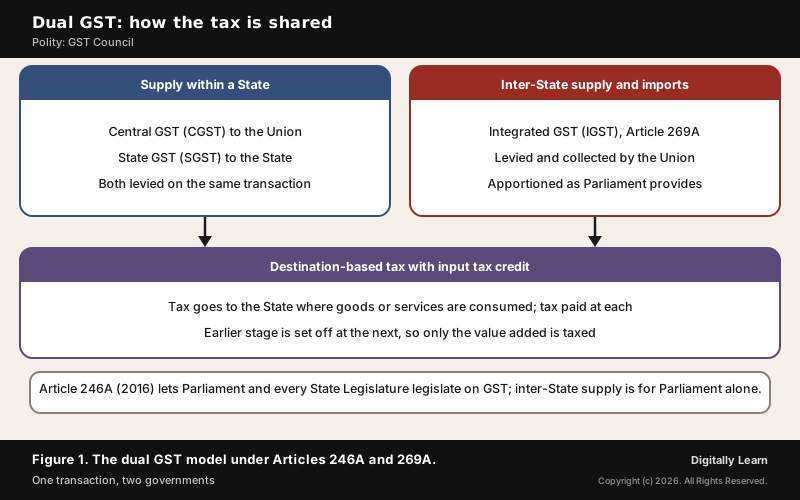
Parliament then passed the CGST Act and the UTGST Act, and each State its own SGST Act. At the start GST had six standard rates, 0, 3, 5, 12, 18 and 28 per cent, applied on supplies across the country, until the Council moved to two main rates in 2025.
The Union's share of GST goes into the divisible pool and is shared with the States on the Finance Commission's advice, like other Union taxes. The wider scheme of tax sharing is explained in the article on the Finance Commission and financial relations.
Goods and Services Tax Council Under Article 279A
GST Council Chairman, Members and Composition
The Goods and Services Tax Council is a constitutional body under Article 279A. Article 279A came into force on 12 September 2016, the Union Cabinet approved setting up the Council the same day, and it first met on 22 and 23 September 2016.
- Chairperson: The Union Finance Minister.
- Union member: The Union Minister of State in charge of Revenue or Finance.
- State members: The Minister in charge of Finance or Taxation, or another Minister nominated by each State Government.
- Vice-Chairperson: Chosen by the State members from among themselves.
- Secretariat: The Revenue Secretary is the Council’s ex officio Secretary, and the Chairperson of the Central Board of Indirect Taxes and Customs a permanent, non-voting invitee.
Weighted Voting, Quorum and Decisions in the GST Council
Every decision is taken at a meeting by a majority of not less than three-fourths of the weighted votes of members present and voting. The Union's vote carries one-third of the total votes cast, and the votes of all the States together two-thirds. One-half of the members form the quorum.
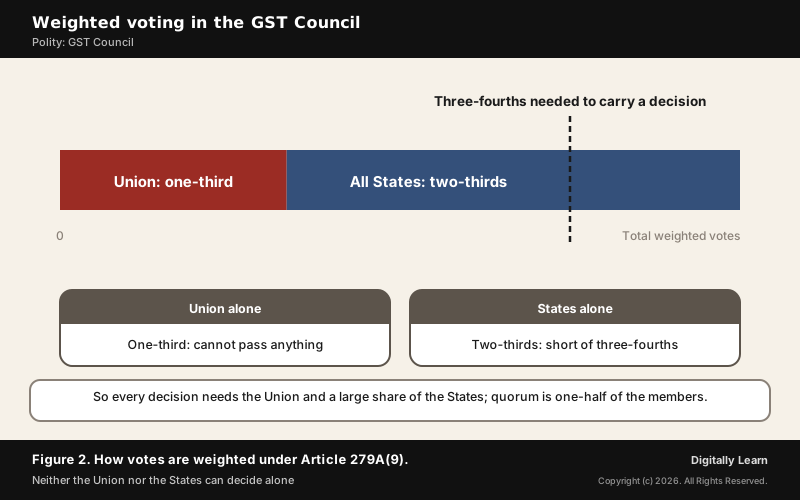
The arithmetic gives each side a veto. The Union alone has only one-third, and the States together have only two-thirds, so neither can reach three-fourths without the other. In practice the Council takes decisions through a consensus-based approach and puts proposals to a vote only when needed. No act of the Council is invalid merely because of a vacancy or a defect in its constitution or procedure.
Functions of the GST Council Under Article 279A(4)
The Council makes recommendations to the Union and the States on every major feature of GST. In doing so it must be guided by the need for a harmonised structure of GST and a harmonised national market for goods and services.
- Scope: Which taxes, cesses and surcharges of the Union, the States and local bodies are subsumed, and which goods and services are taxed or exempted.
- Laws and principles: Model GST laws, principles of levy, apportionment of IGST and the principles of place of supply.
- Rates: Threshold limits, rates including floor rates with bands, and special rates for a specified period to raise resources during a natural calamity or disaster.
- Special States: Special provisions for the north-eastern and Himalayan States named in the Article.
- Petroleum: The date from which GST will apply to petroleum crude, diesel, petrol, natural gas and aviation turbine fuel.
- Disputes: A mechanism to adjudicate disputes between the Union and States, or among States, arising from its recommendations.
Related institutions carry out the system the Council designs. The GST Network is its technology backbone. The GST Appellate Tribunal hears appeals, and in 2025 the Council recommended making it operational. Complaints that tax cuts were not passed on to consumers went first to the National Anti-Profiteering Authority, then from 1 December 2022 to the Competition Commission of India and from 1 October 2024 to the Tribunal; anti-profiteering provisions ended on 1 April 2025.
Are GST Council Recommendations Binding? The Mohit Minerals Ruling
On 19 May 2022, in Union of India v. Mohit Minerals, the Supreme Court held that the recommendations of the GST Council are not binding on the Union and the States. They have persuasive value. The Union had argued that non-binding recommendations would let different laws govern the same field; the Court disagreed.
- Text of Article 279A: It has no non-obstante clause, and Article 246A is not made subject to it, so Parliament and the State Legislatures keep their equal law-making power.
- Drafting history: The deletion of a proposed Article 279B during the amendment showed that Parliament meant the recommendations to persuade rather than bind.
- Federal dialogue: The Court described Indian federalism as a dialogue, ranging from cooperative federalism to contestation, and the Council as a body built to decide by collaboration.
GST Compensation and the Council's Record
GST Compensation Cess and Compensation to States
Section 18 of the 101st Amendment required Parliament to compensate States for revenue lost to GST for five years. The GST (Compensation to States) Act, 2017 does this: under Section 7, States' revenue is protected at a growth of 14 per cent a year over their 2015-16 collection of the subsumed taxes, from 1 July 2017 to 30 June 2022. Any shortfall is paid from a separate compensation cess.
- Early years: Twenty-seven States received compensation in 2017-18, with an aggregate shortfall of 12.85 per cent of protected revenue.
- Pressure on the fund: The Fifteenth Finance Commission noted that the 14 per cent guarantee placed a substantial burden on the system and that cess collections fell substantially short of what was needed.
- The pandemic: Covid-19 cut the tax base; the Commission left out of its fiscal path the borrowing done to manage GST compensation.
- After the transition: Some States asked for compensation beyond five years; in 2024 the Council set up a Group of Ministers to propose a tax to replace the compensation cess after its abolition.
GST Council Meetings and Major Decisions
The Council meets periodically, and its decisions have shaped how GST works. Some examples from its own record show the range of its work.
- 24th meeting: Approved the e-way bill mechanism.
- 33rd and 34th meetings: Cut the effective rate on non-affordable housing under construction from 12 to 5 per cent, and on affordable housing from 8 to 1 per cent.
- 35th meeting: Approved e-invoicing; since 1 August 2023 it is mandatory for firms with turnover of Rs 5 crore or more.
- 36th meeting: Reduced GST on electric vehicles from 12 to 5 per cent.
- 56th meeting, 3 September 2025: Replaced the four-rate structure with two main rates, 5 per cent (merit) and 18 per cent (standard), plus a special 40 per cent rate for a few goods, with effect from 22 September 2025, and exempted individual life and health insurance.
The latest rate changes and their effect are covered in the current affairs article on the GST reform.
GST Council and Cooperative Federalism
The Council is an example of shared taxing power in the Constitution: two sets of governments give up separate taxes and decide together. The voting rule ensures neither can impose its will, and the Mohit Minerals ruling keeps the final power with the legislatures.
- For the States: A share in decisions on the Union’s indirect taxes and a destination-based tax that the Fifteenth Commission noted helped smaller north-eastern and Himalayan States.
- Against: States lost the power to set their own rates on most goods, and the guaranteed 14 per cent growth ended with compensation in 2022.
- Outside GST: Five petroleum products and alcoholic liquor remain outside, and States still tax alcoholic liquor through VAT.
Previous Year UPSC-CSE Questions
Previous Year UPSC-CSE Questions By the end you will be able to draft model answers for the following UPSC questions. Each question carries a collapsible framework showing how to approach it in the exam.
- UPSC Mains 2023 GS-IIExplain the significance of the 101st Constitutional Amendment Act. To what extent does it reflect the accommodative spirit of federalism?
How to structure the answer in the exam
Introduction: The 101st Amendment Act, 2016 gave Parliament and the States simultaneous power to tax goods and services and created the GST Council.
Body (sub-themes to develop):
- Significance: Article 246A concurrent taxing power, Article 269A IGST, the Council under Article 279A, a single national market.
- Accommodation: weighted voting that needs both sides, five years of compensation, special provisions for some States.
- Limits: States gave up separate rate-setting; compensation ended in 2022.
- Mohit Minerals (2022): recommendations persuasive, not binding, preserving legislative autonomy.
Conclusion: Conclude that the Amendment reflects accommodative federalism in design, tested in practice by revenue sharing.
- UPSC Mains 2019 GS-IIIEnumerate the indirect taxes which have been subsumed in the Goods and Services Tax (GST) in India. Also, comment on the revenue implications of the GST introduced in India since July 2017.
How to structure the answer in the exam
Introduction: GST replaced a large number of Union and State indirect taxes from 1 July 2017.
Body (sub-themes to develop):
- Union taxes: central excise, service tax, central sales tax, cesses.
- State taxes: VAT, entry tax, luxury tax, octroi, entertainment tax, taxes on advertisements and lotteries.
- Revenue: compensation guarantee; cess shortfall; petroleum and alcohol outside GST.
Conclusion: Conclude that GST widened the base but shifted revenue risk that compensation temporarily covered.
- UPSC Mains 2013 GS-IIIDiscuss the rationale for introducing the Goods and services tax in India. Bring out critically the reasons for the delay in roll out for its regime.
How to structure the answer in the exam
Introduction: GST was proposed to replace a cascading, fragmented indirect tax system with one tax on value added.
Body (sub-themes to develop):
- Rationale: end cascading through input tax credit; common national market; simpler compliance.
- Delay: need for a constitutional amendment; States' fears of losing taxes; design of compensation.
- Resolution: the 101st Amendment, weighted voting, compensation for five years.
Conclusion: Conclude that the delay was the cost of building consent in a federal system.
- UPSC Prelims 2017 Prelims-GSWhat is/are the most likely advantages of implementing 'Goods and Services Tax (GST)'?
- It will replace multiple taxes collected by multiple authorities and will thus create a single market in India.
- It will drastically reduce the 'Current Account Deficit' of India and will enable it to increase its foreign exchange reserves.
- It will enormously increase the growth and size of economy of India and will enable it to overtake China in the near future.
How to approach this Prelims question
Approach: Keep only what GST is designed to do.
Trap to watch: Big macroeconomic claims sound attractive.
Key facts to recall:
- Replaces multiple taxes and authorities.
- Creates a common market.
Answer signal: 1 only, option (a).
Sources and Further Reading
- Legislative Department, Ministry of Law and Justice: The Constitution of India
- GST Council: The Constitution (One Hundred and First Amendment) Act, 2016
- GST Council: The GST Council
- GST Council Secretariat: Office Memorandum on the Group of Ministers on Compensation Cess, 25 September 2024
- Press Information Bureau: Recommendations of the 56th Meeting of the GST Council, 3 September 2025
- Press Information Bureau: GST compensation to States for five years, 19 July 2022
- Fifteenth Finance Commission: Report for 2021-26, Volume I, Main Report
- Supreme Court of India: Union of India v. Mohit Minerals Pvt. Ltd., judgment of 19 May 2022
- NCERT: Introductory Macroeconomics, Class 12, Chapter 5, Government Budget and the Economy
- Wikipedia: Goods and Services Tax (India)
Editorial Disclaimer
This article explains the GST Council from the Constitution, the Council's own documents, the Supreme Court's judgment and the other sources listed. It is not tax advice.


