

Overview
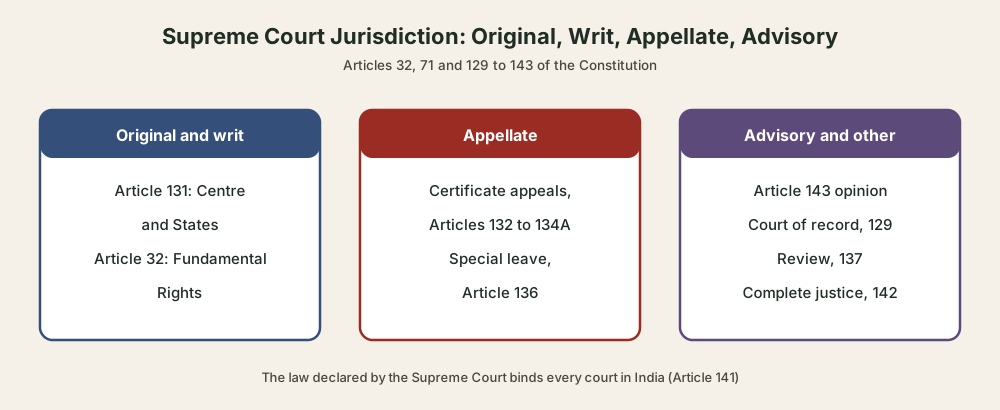
Supreme Court jurisdiction is the set of cases the Court can decide and the powers it uses in them: original jurisdiction over federal disputes under Article 131, writ jurisdiction to enforce Fundamental Rights under Article 32, appellate jurisdiction by certificate and special leave, and advisory jurisdiction on presidential references under Article 143, backed by its status as a court of record.
Jurisdiction of the Supreme Court: An Overview
Kinds of Jurisdiction and Powers at a Glance
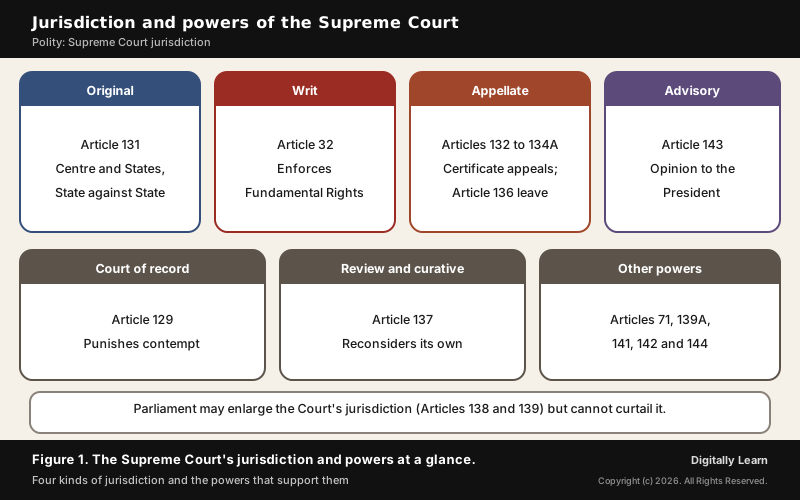
Supreme Court jurisdiction means the range of cases the Court can hear and the powers it can use in them. The Constitution gives it original, appellate and advisory jurisdiction, and adds the power to enforce Fundamental Rights, the status of a court of record and a set of supporting powers. It is at once a federal court like the American Supreme Court and a final court of appeal like the British House of Lords.
That combination led Alladi Krishnaswamy Ayyar, a member of the Drafting Committee, to remark that the Supreme Court of India has more powers than any other Supreme Court in any part of the world. Its decisions bind the Union, the States and every other court, which is why its jurisdiction is a recurring Prelims and Mains theme.
Original Jurisdiction Under Article 131: Federal Disputes
Disputes Between the Centre and the States
Under Article 131 the Supreme Court decides, to the exclusion of every other court, disputes between the units of the federation. "Exclusive" means no other court can hear them; "original" means the Court hears them in the first instance, not on appeal. This is the original jurisdiction of the Supreme Court.
- A dispute between the Government of India and one or more States.
- A dispute between the Government of India and any State or States on one side and one or more States on the other.
- A dispute between two or more States.
The dispute must involve a question of law or fact on which the existence or extent of a legal right depends, so purely political questions are excluded. A private citizen cannot use Article 131 to sue the Centre or a State. The first suit came in 1961, when West Bengal challenged Parliament's Coal Bearing Areas (Acquisition and Development) Act, 1957; the Court dismissed it and upheld the Act.
What Falls Outside Article 131
Several disputes between governments do not reach the Court under Article 131. The article's own proviso excludes disputes arising out of pre-Constitution treaties and instruments, and Article 262(2) lets Parliament bar every court from inter-State river water disputes, which go to tribunals instead.
- Disputes arising out of any pre-Constitution treaty, agreement, covenant, engagement or sanad that continues in operation.
- Disputes under any such instrument that itself excludes the Court’s jurisdiction.
- Inter-State water disputes, where Parliament has barred the courts under Article 262.
- Matters referred to the Finance Commission, and the adjustment of certain expenses and pensions between the Centre and the States.
- Ordinary disputes of a commercial nature between the Centre and the States, and recovery of damages by a State from the Centre.
A dispute over a pre-Constitution instrument can still reach the Court by another door: under Article 143(2) the President may refer it for an opinion, and the Court must then give one. Disputes about the election of the President or Vice-President also go straight to the Court, but under Article 71, not Article 131.
Writ Jurisdiction Under Article 32
Article 32: The Right to Constitutional Remedies
The right to move the Supreme Court for enforcing Fundamental Rights is itself a Fundamental Right under Article 32. Dr B.R. Ambedkar called it the most important article of the Constitution, "the very soul of the Constitution and the very heart of it", and the Court has held Article 32 to be a basic feature that no amendment can abridge.
- Clause (1): The right to move the Supreme Court by appropriate proceedings is guaranteed.
- Clause (2): The Court may issue directions, orders or writs, including habeas corpus, mandamus, prohibition, quo warranto and certiorari.
- Clause (3): Parliament may empower any other court to exercise these powers within its local limits.
- Clause (4): The right cannot be suspended except as the Constitution provides, as during an emergency under Article 359.
Only Fundamental Rights can be enforced under Article 32, not ordinary legal rights. The jurisdiction is original but not exclusive: a person may go straight to the Supreme Court or to a High Court under Article 226. Because the remedy is itself a Fundamental Right, an alternative remedy is no bar, though the Court has said that where a High Court can give relief, the person should normally go there first.
Types of Writs: Habeas Corpus, Mandamus, Prohibition, Certiorari, Quo Warranto
The five writs are borrowed from English law, where they were called prerogative writs. Before 1950 only the High Courts of Calcutta, Bombay and Madras could issue them; today the Supreme Court under Article 32 and every High Court under Article 226 can.
| Writ | What it does | Key limit |
|---|---|---|
| Habeas corpus: 'to have the body of' | Orders a person who has detained another to produce the detainee so the court can test the detention | Lies against public authorities and private persons; not where detention is lawful or by a competent court |
| Mandamus: 'we command' | Commands a public official or body to perform a duty it has failed or refused to perform | Not against a private person or body, a discretionary duty, a contract, or the President or Governors |
| Prohibition: 'to forbid' | Stops a lower court or tribunal from exceeding its jurisdiction | Only against judicial and quasi-judicial bodies |
| Certiorari: 'to be certified' | Transfers a case from a lower court or tribunal, or quashes its order | Preventive and curative; since 1991 also against administrative authorities affecting rights |
| Quo warranto: 'by what authority' | Inquires into a person's legal claim to a public office | Only for a substantive public office created by statute or the Constitution |
Article 32 and Article 226 Compared
The writ powers of the Supreme Court and the High Courts overlap but are not the same. The Supreme Court's is narrower in purpose but wider in territory, and it cannot be refused.
| Point | Article 32 (Supreme Court) | Article 226 (High Courts) |
|---|---|---|
| Purpose | Fundamental Rights only | Fundamental Rights and any other legal right |
| Territory | Anywhere in India | Within the court's territory, or where the cause arises |
| Nature | A Fundamental Right; the Court may not refuse | Discretionary; the court may refuse |
Parliament can widen the Supreme Court's writ power: Article 139 lets it confer power to issue writs for purposes other than enforcing Fundamental Rights. No such law has been made, so the Supreme Court and the High Courts remain the only courts that issue writs, the High Courts with the wider purpose shown in the table.
Public Interest Litigation and the Relaxation of Locus Standi
Public interest litigation (PIL) relaxed the old rule of locus standi, under which only a person directly affected could come to court. A writ petition can now be moved by a public-spirited person or group where the interest of the public at large is involved, even by a letter addressed to the Chief Justice of India. The Court has treated letters, telegrams, postcards and news reports as writ petitions. After the Emergency, the courts reached out to people who could not approach them on their own.
The practice was pioneered by Justices P.N. Bhagwati and V.R. Krishna Iyer. In Hussainara Khatoon v. State of Bihar, filed in December 1979 about prisoners held in Bihar's jails while their cases were pending, the Court ordered free legal aid and speedy hearings, and 40,000 prisoners were released. The S.P. Gupta case later defined public interest litigation for India, and PIL suits the ideal of equal justice and free legal aid in Article 39A.
PIL has limits. The Court has warned that litigation filed for private gain or rival business interests is an abuse, and Chief Justice S.H. Kapadia said substantial costs would be imposed on frivolous petitions. Critics argue that guidelines issued in PILs take the Court into the field of the executive, the concern at the heart of the judicial activism debate.
Appellate Jurisdiction: Constitutional, Civil and Criminal Appeals
Appeals Under Articles 132 to 134A
The Supreme Court is primarily a court of appeal. It succeeded the Federal Court and replaced the British Privy Council as the highest court of appeal, and most appeals reach it from the High Courts on a certificate that the High Court grants under Article 134A.
- Constitutional matters (Article 132): An appeal lies if the High Court certifies that the case involves a substantial question of law as to the interpretation of the Constitution.
- Civil matters (Article 133): The High Court must certify a substantial question of law of general importance that needs decision by the Supreme Court. The 30th Amendment of 1972 removed the old requirement of a sum of Rs 20,000.
- Criminal matters (Article 134): An appeal lies as of right where the High Court reversed an acquittal and sentenced the accused to death, or tried a case itself and passed a death sentence; otherwise it needs a certificate. A 1970 law added cases of life imprisonment or ten years.
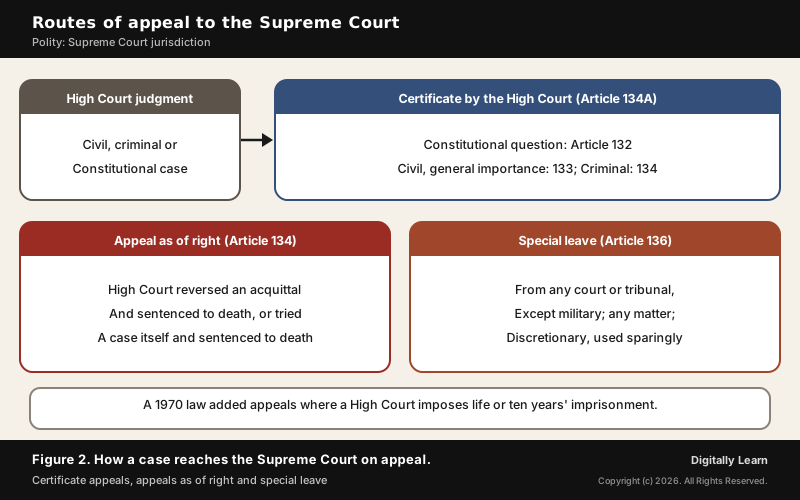
There is no appeal as of right where a High Court reverses a conviction and acquits the accused. The Court's appellate jurisdiction also covers cases in which the Federal Court could hear appeals and which the three articles do not cover, and Parliament may add further criminal appeals by law.
Special Leave Petition Under Article 136
The Court's widest appellate power is special leave to appeal under Article 136. In its discretion it may grant special leave from any judgment, decree, sentence or order of any court or tribunal in India, except a military tribunal or court martial. A petition asking for it is a special leave petition.
- It is discretionary and cannot be claimed as a matter of right.
- It can be granted against a final or an interlocutory order.
- It covers any kind of matter, whether constitutional, civil, criminal, tax, labour or revenue.
- It lies against any court or tribunal, not only a High Court.
Because the power is so wide, the Court has said it is an exceptional and overriding power to be used sparingly and with caution, only in special and extraordinary situations. Beyond that, it has held, the power cannot be fettered by any set formula or rule.
Advisory Jurisdiction Under Article 143
Presidential References and Whether the Court Must Answer
Article 143 lets the President seek the Court's opinion; the Court never advises on its own initiative. There are two kinds of reference, and the difference is whether the Court must answer.
| Clause | What may be referred | Must the Court answer? |
|---|---|---|
| 143(1) | Any question of law or fact of public importance that has arisen or is likely to arise | No; the Court may decline |
| 143(2) | A dispute over a pre-Constitution treaty or instrument, excluded from Article 131 | Yes; it must give its opinion |
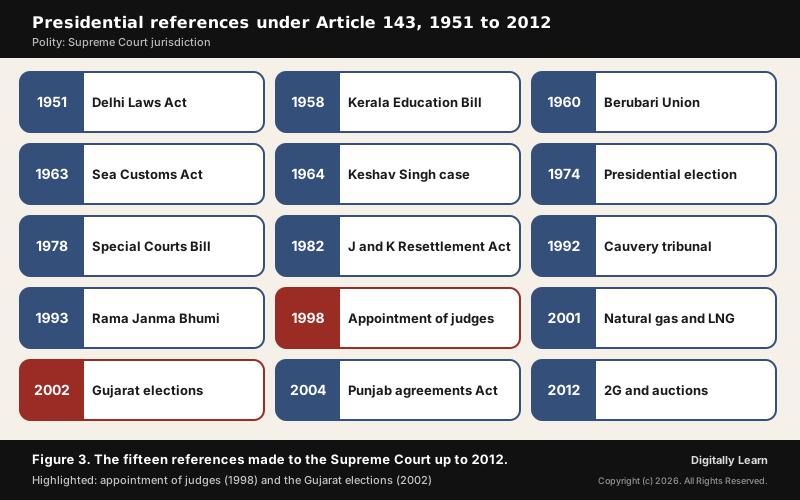
In both cases the opinion is advisory, not a judicial pronouncement, so it does not bind the President, though it gives the government an authoritative legal view. A reference must be heard by a bench of at least five judges under Article 145(3). Fifteen references were made up to 2012, including the 1998 reference on appointing judges and the 2002 reference on deferring the Gujarat Assembly elections.
The most recent reference shows both kinds of answer. On 13 May 2025 the President referred fourteen questions under Article 143(1) on the powers of Governors and the President over Bills under Articles 200 and 201. In its opinion of 20 November 2025, a five-judge bench held that courts cannot prescribe timelines for assent and that Article 142 does not allow "deemed assent", though prolonged, unexplained inaction by a Governor can be met with a limited direction to act. It returned two of the questions unanswered as irrelevant to the reference.
Other Powers: Court of Record, Review, Curative Petition and Complete Justice
Court of Record and the Power to Punish for Contempt (Article 129)
The Supreme Court is a court of record under Article 129, and Article 215 makes the High Courts courts of record too. A court of record has two powers: its judgments and proceedings are recorded for perpetual memory and are accepted as evidence and precedent, and it can punish for contempt of itself. In 1991 the Court held that this power also covers contempt of the High Courts, subordinate courts and tribunals.
- Civil contempt: Wilful disobedience of a judgment, order or writ, or wilful breach of an undertaking given to a court.
- Criminal contempt: Publishing or doing anything that scandalises or lowers the authority of a court, prejudices judicial proceedings, or obstructs the administration of justice.
- Not contempt: Fair and accurate reporting of proceedings and fair criticism of judicial acts.
The Constitution does not define these terms; the Contempt of Courts Act, 1971 does. It followed the recommendations of a committee chaired by H.N. Sanyal, allows up to six months' imprisonment and a fine of up to Rs 2,000, and since 2006 has allowed truth as a defence when it is in the public interest. Parliament's power to legislate comes from the Seventh Schedule: contempt of the Supreme Court is in the Union List, and contempt of other courts in the Concurrent List.
Review Petition (Article 137) and Curative Petition
Under Article 137 the Court may review any judgment or order it has made, subject to laws of Parliament and its own rules. A review petition in a civil case lies only on the grounds in the Code of Civil Procedure, and in a criminal case only for an error apparent on the face of the record.
After a review petition is dismissed, one more remedy remains: the curative petition. The Court devised it in Rupa Ashok Hurra v. Ashok Hurra (2002) to prevent abuse of its process and cure a gross miscarriage of justice, and the Supreme Court Rules, 2013 now provide for it on limited grounds.
- The petitioner must show a genuine violation of natural justice or a real fear of bias.
- The petition must say that the same grounds were raised in the review petition, which was dismissed by circulation.
- A senior advocate must certify that these conditions are met.
- It goes to the three senior-most judges and, if available, the judges who gave the judgment; the Court may impose costs if it lacks merit.
Articles 141, 142 and 144: Binding Law and Complete Justice
Three articles make the Court's word effective across the country. Under Article 141 the law declared by the Supreme Court binds all courts in India. Under Article 142 it may pass any decree or order necessary for doing complete justice in a case before it, enforceable throughout India. Under Article 144 all civil and judicial authorities must act in aid of the Court.
The Court is not bound by its own earlier decisions and can depart from them, which makes it a self-correcting body: in Kesavananda Bharati (1973) it departed from Golak Nath (1967). Under Article 139A it may withdraw cases raising the same substantial question of law from High Courts and decide them itself, and it may transfer a case from one High Court to another. It is also the final interpreter of the Constitution.
Election Disputes of the President and Vice-President (Article 71)
Under Article 71 all doubts and disputes arising out of the election of a President or Vice-President are decided by the Supreme Court, whose decision is final. Election petitions under the Presidential and Vice-Presidential Elections Act, 1952 are filed directly in the Court, so its jurisdiction here is original, exclusive and final.
- If the Court declares an election void, acts done by the President or Vice-President before its decision are not invalidated.
- An election cannot be challenged on the ground that the electoral college was incomplete, that is, that some of its seats were vacant.
- On a reference by the President, the Court also inquires into the conduct of the chairman or members of the Union Public Service Commission, and its advice on removal binds the President.
Enlarging the Court's Jurisdiction: Articles 138 and 139
Parliament's Power to Enlarge the Jurisdiction
Parliament cannot curtail the jurisdiction the Constitution guarantees to the Supreme Court, but it can enlarge it. Article 138(1) lets it confer further jurisdiction on any matter in the Union List, and Article 138(2) lets the Centre and a State confer jurisdiction on other matters by special agreement, if Parliament provides for it by law. Article 139 adds the power to confer writs for other purposes.
Beyond these heads, the Supreme Court exercises judicial review: it can examine laws and executive orders of the Centre and the States and declare them void if they violate the Constitution. The phrase is used nowhere in the Constitution, yet several articles confer the power, and its reach over constitutional amendments rests on the Doctrine of Basic Structure.
Previous Year UPSC-CSE Questions
Previous Year UPSC-CSE Questions By the end you will be able to draft model answers for the following UPSC questions. Each question carries a collapsible framework showing how to approach it in the exam.
- UPSC Mains 2024 GS-IIExplain the reasons for the growth of public interest litigation in India. As a result of it, has the Indian Supreme Court emerged as the world’s most powerful judiciary ?
How to structure the answer in the exam
Introduction: Public interest litigation relaxed the rule that only an aggrieved person may approach the court.
Body (sub-themes to develop):
- Reasons: access for the poor and prisoners; letters treated as petitions; judicial response after the Emergency years; Article 39A.
- Effect: wide original, writ, appellate and advisory powers plus Article 142 complete justice.
- Limits: frivolous and business-motivated petitions; guidelines that enter the executive's field; costs imposed by the Court.
Conclusion: Conclude that PIL made the Court uniquely accessible and powerful, which calls for restraint in its use.
- UPSC Prelims 2014 Prelims-GSThe power of the Supreme Court of India to decide disputes between the Centre and the States falls under its
How to approach this Prelims question
Approach: Link federal disputes to Article 131.
Trap to watch: Writ jurisdiction also starts in the Supreme Court, but it concerns Fundamental Rights.
Key facts to recall:
- Article 131: Centre and States, State against State.
Answer signal: Original jurisdiction, option (c).
- UPSC Prelims 2012 Prelims-GSWhich of the following are included in the original jurisdiction of the Supreme Court?
- A dispute between the Government of India and one or more States
- A dispute regarding elections to either House of the Parliament or that of Legislature of a State
- A dispute between the Government of India and a Union Territory
- A dispute between two or more States
Select the correct answer using the codes given below :
How to approach this Prelims question
Approach: Keep only disputes between the Government of India and States, or between States.
Trap to watch: Elections sound constitutional but are not federal disputes.
Key facts to recall:
- Article 131 names the Government of India and States only.
Answer signal: Items 1 and 4, option (c).
- UPSC Prelims 2010 Prelims-GSConsider the following statements: The Supreme Court of India tenders advice to the President of India on matters of law or fact
- On its own initiative (on any matter of larger public interest).
- If he seeks such an advice.
- Only if the matters relate to the Fundamental Rights of the citizens.
Which of the statements given above is/are correct?
How to approach this Prelims question
Approach: Recall who starts a reference.
Trap to watch: "On its own initiative" sounds plausible for a guardian court.
Key facts to recall:
- Article 143: the President may refer.
- Any question of law or fact of public importance.
Answer signal: Only statement 2, option (b).
- UPSC Prelims 2003 Prelims-GSUnder which Article of the Indian Constitution did the President make a reference to the Supreme Court to seek the Court’s opinion on the constitutional validity of the Election Commission’s decision on deferring the Gujarat Assembly elections (in the year 2002)?
How to approach this Prelims question
Approach: Match a presidential reference to Article 143.
Trap to watch: Article 142 (complete justice) and 145 (rules) sit next to it.
Key facts to recall:
- Article 143: power of the President to consult the Supreme Court.
Answer signal: Article 143, option (b).
- UPSC Prelims 2024 Prelims-GSA Writ of Prohibition is an order issued by the Supreme Court or High Courts to:
How to approach this Prelims question
Approach: Recall against whom prohibition lies.
Trap to watch: Options about officers and governments describe mandamus-like orders.
Key facts to recall:
- Prohibition lies only against judicial and quasi-judicial bodies.
Answer signal: Option (c).
- UPSC Prelims 2022 Prelims-GSConsider the following statements:
- Pursuant to the report of H.N. Sanyal Committee, the Contempt of Courts Act, 1971 was passed.
- The Constitution of India empowers the Supreme Court and the High Courts to punish for contempt of themselves.
- The Constitution of India defines Civil Contempt and Criminal Contempt.
- In India, the Parliament is vested with the powers to make laws on Contempt of Court.
Which of the statements given above is/are correct?
How to approach this Prelims question
Approach: Separate what the Constitution says from what the Act says.
Trap to watch: Statement 3 attributes the Act's definitions to the Constitution.
Key facts to recall:
- Articles 129 and 215.
- Contempt of Courts Act, 1971.
- Union List entry 77; Concurrent List entry 14.
Answer signal: Statements 1, 2 and 4, option (b).
- UPSC Prelims 2023 Prelims-GSConsider the following statements:
- If the election of the President of India is declared void by the Supreme Court of India, all acts done by him/her in the performance of duties of his/her office of President before the date of decision become invalid.
- Election for the post of the President of India can be postponed on the ground that some Legislative Assemblies have been dissolved and elections are yet to take place.
- When a Bill is presented to the President of India, the Constitution prescribes time limits within which he/she has to declare his/her assent.
How many of the above statements are correct?
How to approach this Prelims question
Approach: Test each statement against Article 71 and the veto rules.
Trap to watch: Statement 1 sounds logical if the election itself was void.
Key facts to recall:
- Article 71(2): acts not invalidated.
- Incomplete electoral college is no ground.
- No time limit for assent.
Answer signal: None of the statements is correct, option (d).
Sources and Further Reading
- Legislative Department, Ministry of Law and Justice: The Constitution of India
- Supreme Court of India: Jurisdiction
- Supreme Court of India: History
- NCERT: Indian Constitution at Work, Class 11, Chapter 6, Judiciary
- Wikipedia: Supreme Court of India
- Wikipedia: Writ
- Wikipedia: Public interest litigation in India
- Wikipedia: Curative petition
- Wikipedia: Contempt of court in India
- Supreme Court of India: Opinion in Special Reference No. 1 of 2025, Assent, Withholding or Reservation of Bills (20 November 2025)
- Press Information Bureau: Power of President to consult Supreme Court (21 August 2002)
Editorial Disclaimer
This article explains the jurisdiction of the Supreme Court from the text of the Constitution, the Court's own published account and the other sources listed. It is not legal advice.


