


Overview
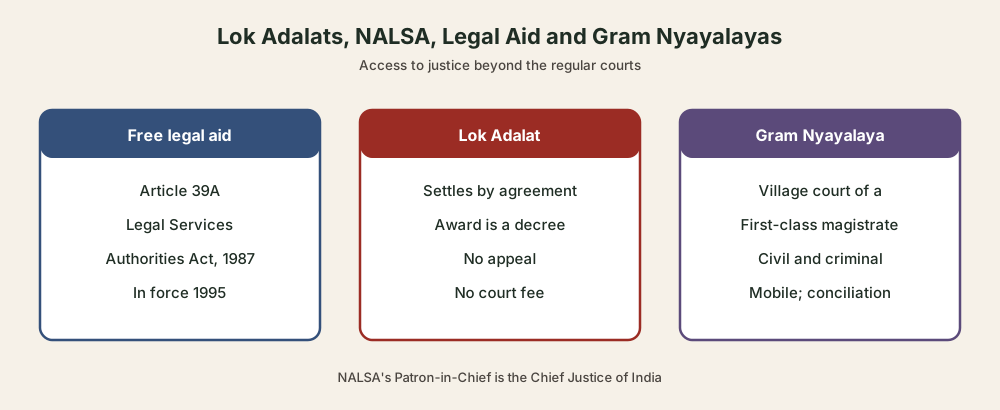
A Lok Adalat is a people's court under the Legal Services Authorities Act, 1987 where disputes pending in court, or not yet filed, are settled by agreement. Its award counts as a civil court decree, is final and carries no court fee. The same Act created NALSA and the network that gives free legal aid under Article 39A, while Gram Nyayalayas take a magistrate's court to the villages.
Free Legal Aid in India: Article 39A and the Legal Services Authorities Act
Article 39A and the Legal Services Authorities Act, 1987
The Constitution's promise of free legal aid sits in Article 39A, a Directive Principle, which asks the State to secure that the legal system promotes justice on a basis of equal opportunity, and in particular to provide free legal aid so that no citizen is denied justice because of economic or other disabilities. Articles 14 and 22(1) add the obligation to ensure equality before law.
The need is practical. Courts are open to every citizen in principle, but for most of the poor, access has always been difficult: legal procedures involve a lot of money and paperwork and take a lot of time, and for a family living on a daily wage going to court often seems remote. Article 39A was added by the 42nd Amendment Act of 1976, and the Supreme Court has since counted the right to free legal aid among the rights protected by Article 21.
To give effect to it, Parliament passed the Legal Services Authorities Act, 1987. It came into force on 9 November 1995, a date now marked as National Legal Services Day, and set up a nationwide network of legal services authorities headed by the National Legal Services Authority. The same Act gives Lok Adalats their statutory status.
Who Gets Free Legal Aid: Section 12 of the Act
The Act lists in Section 12 who is entitled to legal services when filing or defending a case. Eligibility rests on vulnerability, not only on income, so many groups qualify whatever they earn.
- A member of a Scheduled Caste or Scheduled Tribe.
- A victim of trafficking or begar under Article 23.
- A woman or a child.
- A person with disability.
- A victim of a mass disaster, ethnic violence, caste atrocity, flood, drought, earthquake or industrial disaster.
- An industrial workman.
- A person in custody, including in a protective home, a juvenile home or a psychiatric hospital.
- A person whose annual income is below the limit the State Government, or for Supreme Court cases the Central Government, prescribes.
Free legal aid covers representation by an advocate, payment of process fees, witnesses' expenses and other charges in a case, and help in drafting and translating documents. For cases in the Supreme Court, its own legal aid committee helps persons with an annual income below Rs 5,00,000, among others.
NALSA and the Legal Services Institutions
National Legal Services Authority: Composition and Functions
The National Legal Services Authority (NALSA) is the Central Authority constituted under Section 3 of the Act. The Chief Justice of India is its Patron-in-Chief, and a serving or retired judge of the Supreme Court, nominated by the President in consultation with the Chief Justice, is its Executive Chairman; by practice the second senior-most judge holds the post.
- Policy and schemes: Lays down policies and principles and frames effective, economical schemes for legal services.
- Funds: Allocates funds to State and District Authorities and gives grants to voluntary institutions.
- Social justice litigation: Takes up consumer protection, environmental protection and other matters of special concern to the weaker sections.
- Legal aid camps and Lok Adalats: Organises camps in rural areas, slums and labour colonies and encourages settlement through Lok Adalats, negotiation, arbitration and conciliation.
- Legal literacy and clinics: Spreads legal awareness and, with the Bar Council of India, promotes legal services clinics in law colleges.
- Coordination: Monitors the State, District and Taluk bodies and gives general directions for implementing legal services programmes.
State Legal Services Authority, District Legal Services Authority and Taluk Committees
Below NALSA, the Act creates a body at every level of the judiciary. A State Legal Services Authority gives legal services, conducts Lok Adalats, including those for High Court cases, and runs preventive and strategic legal aid programmes. Its duty is to give effect to the policy and directions of the Central Authority.
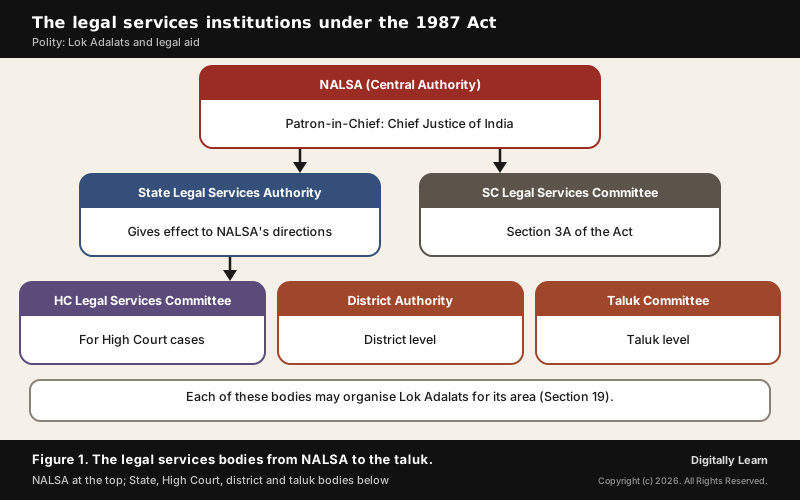
- State Legal Services Authority (Section 6): The Chief Justice of the High Court is Patron-in-Chief, and a serving or retired High Court judge nominated by the Governor is Executive Chairman.
- High Court Legal Services Committee (Section 8A): Chaired by a sitting judge of the High Court.
- District Legal Services Authority (Section 9): The District Judge is Chairman; it coordinates the taluk committees and organises Lok Adalats within the district.
- Taluk Legal Services Committee (Section 11A): The senior-most judicial officer of the taluk or mandal is ex officio Chairman.
- Supreme Court Legal Services Committee (Section 3A): Runs legal services and Lok Adalats for cases in the Supreme Court.
Every one of these bodies may organise Lok Adalats for its area. Because each is headed by a judge of the court at its level, legal aid and Lok Adalats run through the judicial hierarchy itself, from the Supreme Court down to the taluk.
Lok Adalats: People's Courts Under the 1987 Act
What Is Lok Adalat: Meaning and the Cases It Can Settle
A Lok Adalat is an alternative dispute resolution forum where disputes pending in a court, or not yet brought to court, are settled or compromised amicably. The first Lok Adalats were held in Gujarat in 1982, and the 1987 Act gave them statutory status. Under Section 19(5) a Lok Adalat can settle any case pending before a court for which it is organised, and any matter within that court's jurisdiction that has not yet been filed.
- Civil disputes: Recovery of money, cheque dishonour cases under Section 138 of the Negotiable Instruments Act, motor accident claims, labour disputes, bills for electricity, water or telephone services, and claims such as pensions.
- Family disputes: Matrimonial and family matters can be settled, except divorce itself.
- Criminal cases: Only compoundable offences; a Lok Adalat has no jurisdiction over an offence not compoundable under any law.
How a Case Reaches a Lok Adalat: Reference, Procedure and Powers
Section 20 sets out two routes. A case already pending is referred by the court if the parties agree, or if one party applies and the court is prima facie satisfied that a settlement is possible, or if the court itself finds the matter suitable; the parties must first be given a hearing. A dispute not yet in court, a pre-litigation matter, reaches a Lok Adalat when one party applies to the legal services authority, which then issues notice to the other party.
- Speed and principles: The Lok Adalat must act with utmost expedition and be guided by justice, equity, fair play and other legal principles.
- No settlement in a pending case: The record goes back to the court, which resumes from the stage the case had reached.
- No settlement at pre-litigation stage: The Lok Adalat advises the parties to seek a remedy in court.
- Powers (Section 22): The powers of a civil court under the Code of Civil Procedure, 1908 to summon witnesses, order discovery of documents, receive evidence on affidavits and requisition public records, and power to specify its own procedure.
Composition of Lok Adalats and the Role of Members
Section 19(2) says a Lok Adalat consists of serving or retired judicial officers and other persons of the area specified by the organising authority. In practice each bench has a sitting or retired judge or judicial officer, with a member of the legal profession, a social worker working for the weaker sections, or at district and taluk level a person in para-legal work, preferably a woman.
The members are statutory conciliators with no judicial role. They can only persuade the parties towards a settlement and must not pressurise or coerce anyone. A Lok Adalat does not decide a matter on its own view; it records the compromise the parties reach, and assists them independently and impartially.
Award of a Lok Adalat: Decree, Finality and Court Fee Refund
Under Section 21, every award of a Lok Adalat is deemed to be a decree of a civil court, or an order of any other court, and is final and binding on all the parties. No appeal lies to any court against it. If a party is unhappy, the remedy is not an appeal but fresh litigation in the appropriate court, following the normal procedure.
- No court fee: Nothing is payable when a matter is filed in a Lok Adalat.
- Refund: If a case pending in court is referred to a Lok Adalat and settled, the court fee already paid is refunded.
- No settlement: If the parties do not agree, the case goes back to the court from which it came.
Types of Lok Adalat: Regular, National, Mega and Mobile
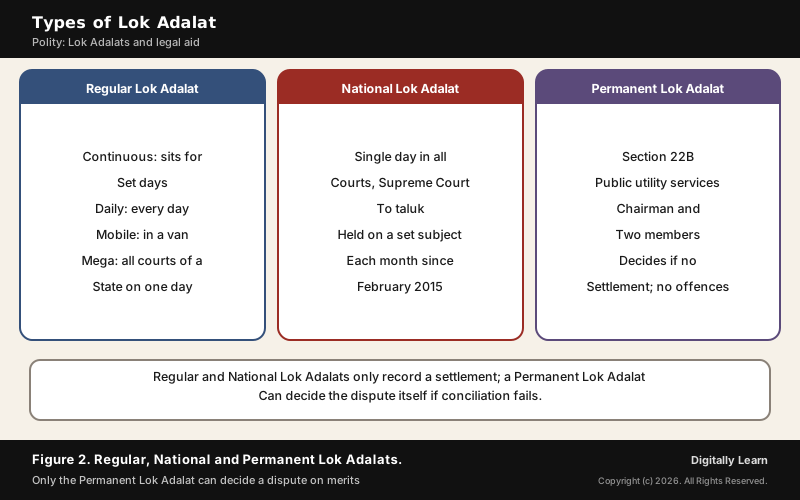
Lok Adalats are held in several forms. Regular Lok Adalats may be continuous, sitting for a set number of days; daily; mobile, travelling in a van to settle petty cases and spread legal awareness; or mega, held in all courts of a State on one day.
National Lok Adalats are held on a single day in every court from the Supreme Court to the taluk, and since February 2015 on a specific subject each month. At the National Lok Adalat of 9 May 2026, with some States sitting in June or July, 39,130,051 of 49,033,256 matters taken up were disposed of, 5,419,072 of them cases already pending in courts.
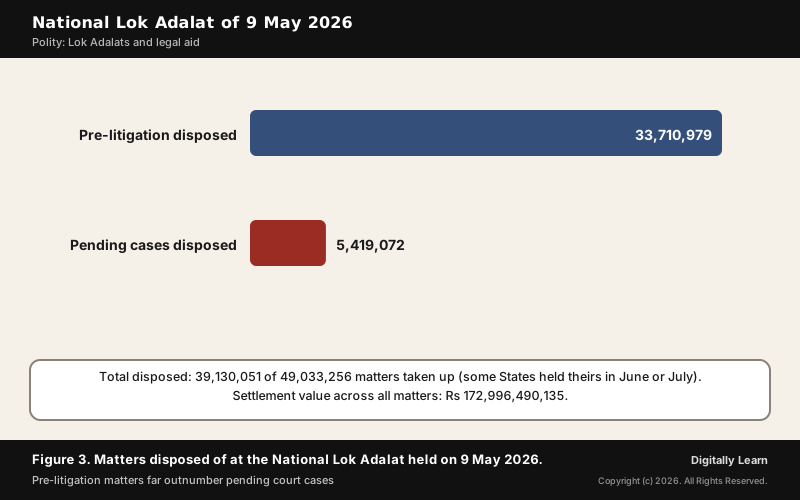
The figures show where Lok Adalats do most of their work. More than six in seven disposals were pre-litigation matters, disputes settled before anyone filed a case, so the institution keeps new cases out of the courts as well as clearing pending cases. The settlement value across all matters came to Rs 172,996,490,135.
Permanent Lok Adalats for Public Utility Services
A 2002 amendment added Permanent Lok Adalats under Section 22B, set up by NALSA or a State Authority for public utility services. Each has a chairman who is or has been a district judge or an officer of higher rank, and two members.
- Public utility services (Section 22A): Transport of passengers or goods by air, road or water; postal, telegraph or telephone service; supply of power, light or water; public conservancy or sanitation; hospitals and dispensaries; insurance; and any other service the government notifies.
- Pre-litigation only: A party applies before going to court, and once it applies, no party may take the same dispute to a court.
- Power to decide: Unlike a regular Lok Adalat, it decides the dispute if conciliation fails, unless the dispute relates to an offence; its award is final and binding.
- Ceiling: The Act set the value limit at ten lakh rupees and lets the Centre raise it by notification; NALSA’s page on Permanent Lok Adalats now gives it as up to one crore rupees.
Advantages and Limits of Lok Adalats
Lok Adalats suit disputes where both sides can give and take. Money claims, partition suits, damages and matrimonial disputes settle easily there, and the award can be executed through the ordinary legal process. Several features make the forum attractive to litigants and to the courts.
- Cost to the parties: No court fee, and a refund of the fee already paid when a pending case settles.
- Speed and informality: The Lok Adalat must act with utmost expedition, and procedural laws and the Evidence Act are not strictly followed.
- Finality: The award is a decree that ends the dispute, with no appeal to prolong it.
- Relief to courts: Pre-litigation settlements keep cases from being filed at all.
The limits follow from the same design. A Lok Adalat works only by consent: if either party refuses, the case returns to court. As the Supreme Court has held, a Lok Adalat exists to bring the parties to a compromise and has no jurisdiction to go into the merits of a complaint, and it cannot touch non-compoundable offences. Where one side is weaker, the duty of members not to pressurise or coerce anyone is the main safeguard.
Lok Adalats, Arbitration and Gram Nyayalayas Compared
Lok Adalats and Arbitration Tribunals: How They Differ
Both are alternative dispute resolution methods, and NALSA is itself required to encourage settlement by negotiation, arbitration and conciliation. But they work in opposite ways: a Lok Adalat helps the parties agree, while an arbitral tribunal decides the dispute for them under an arbitration agreement governed by the Arbitration and Conciliation Act, 1996.
| Point | Lok Adalat | Arbitration |
|---|---|---|
| Law | Legal Services Authorities Act, 1987 | Arbitration and Conciliation Act, 1996 |
| How it ends | Settlement by the parties; members are conciliators | Award by the arbitral tribunal |
| Criminal cases | Compoundable offences only | Built for civil and commercial disputes |
| Role of courts | Award is a decree; no appeal | A court refers parties to arbitration where a valid agreement exists |
Gram Nyayalayas: Village Courts Under the 2008 Act
The Gram Nyayalayas Act, 2008 came into force on 2 October 2009 to bring inexpensive justice to people in rural areas at their doorstep. A Gram Nyayalaya is set up for every intermediate-level Panchayat or group of Panchayats, and it is a court of a Judicial Magistrate of the first class, presided over by a Nyayadhikari appointed by the State Government in consultation with the High Court.
- Jurisdiction: Both criminal and civil cases listed in the First and Second Schedules of the Act.
- Mobile court: It sits at the intermediate Panchayat headquarters but travels to villages to hear cases.
- Conciliation first: It tries to settle disputes by conciliation, using conciliators appointed for the purpose.
- Procedure: Summary trial in criminal cases; not bound by the Indian Evidence Act but guided by natural justice.
- Appeals: Criminal appeals go to the Court of Session and civil appeals to the District Court.
The scheme has been slow to take root: only 208 Gram Nyayalayas were functioning on 3 September 2019 against a target of 5,000, held back by financial constraints and the reluctance of lawyers, police and officials. The regular court structure is described in the article on High Courts and subordinate courts.
Previous Year UPSC-CSE Questions
Previous Year UPSC-CSE Questions By the end you will be able to draft model answers for the following UPSC questions. Each question carries a collapsible framework showing how to approach it in the exam.
- UPSC Mains 2024 GS-IIExplain and distinguish between Lok Adalats and Arbitration Tribunals. Whether they entertain civil as well as criminal cases?
Answer outline: how to structure the answer
What the question asks, the main arguments, relevant examples and the direction of the conclusion. This is not a full model answer.
Introduction: Lok Adalats and arbitration are both alternative dispute resolution methods, but one conciliates and the other adjudicates.
Body (sub-themes to develop):
- Lok Adalat: Legal Services Authorities Act 1987; members as conciliators; award by settlement is a decree; no appeal; no court fee.
- Arbitration: Arbitration and Conciliation Act 1996; tribunal decides under an arbitration agreement; commercial focus.
- Civil and criminal: Lok Adalats take civil and compoundable criminal cases; arbitration is for civil and commercial disputes.
- Permanent Lok Adalats as a hybrid: they decide public utility disputes if conciliation fails.
Conclusion: Conclude that the two complement each other in reducing the load on courts.
- UPSC Prelims 2005 Prelims-GSConsider the following:
- Disputes with mobile cellular companies
- Motor accident cases
- Pension cases
For which of the above are Lok Adalats held?
How to approach this Prelims question
Approach: Ask whether each dispute is one a Lok Adalat can settle. Telephone service is a public utility, so disputes with mobile companies qualify; motor accident claims and pension cases are civil disputes that Lok Adalats settle routinely. All three are covered.
Trap to watch: Pension claims do not sound like a Lok Adalat matter.
Key facts to recall:
- (a) 1 only: wrong. Motor accident and pension cases are also covered.
- (b) 1 and 2 only: wrong. Pension cases are also covered.
- (c) 2 and 3 only: wrong. Disputes with mobile companies, a public utility, are also covered.
- (d) 1, 2 and 3: right. All three kinds of dispute go to Lok Adalats.
Answer signal: Option (d): Lok Adalats are held for all three.
- UPSC Prelims 2009 Prelims-GSWith reference to Lok Adalats, consider the following statements :
- An award made by a Lok Adalat is deemed to be a decree of a civil court and no appeal lies against thereto before any court.
- Matrimonial/Family disputes are not covered under Lok Adalat.
Which of the statements given above is/are correct ?
How to approach this Prelims question
Approach: Check each statement against the 1987 Act. An award is deemed a decree of a civil court and no appeal lies against it, so statement 1 is correct. Matrimonial and family disputes are covered, except divorce, so statement 2 is wrong.
Trap to watch: The divorce exclusion makes statement 2 look right.
Key facts to recall:
- (a) 1 only: right. The award is final, with no appeal.
- (b) 2 only: wrong. Family disputes other than divorce are covered.
- (c) Both 1 and 2: wrong. Statement 2 is wrong.
- (d) Neither 1 nor 2: wrong. Statement 1 is correct.
Answer signal: Option (a): only statement 1 is correct.
- UPSC Prelims 2010 Prelims-GSWith reference to Lok Adalats, which of the following statements is correct ?
How to approach this Prelims question
Approach: Test each claim. Lok Adalats take pending cases as well as pre-litigation matters; they settle compoundable criminal cases as well as civil disputes; and their members include persons other than judicial officers. Every one of the first three statements is wrong.
Trap to watch: Each option states a partial truth.
Key facts to recall:
- (a) Only pre-litigation matters: wrong. Pending cases are also taken.
- (b) Only civil matters: wrong. Compoundable criminal cases are also settled.
- (c) Only judicial officers: wrong. Members include persons other than judicial officers.
- (d) None of the statements is correct: right. All three claims are wrong.
Answer signal: Option (d): none of the three statements is correct.
- UPSC Prelims 2013 Prelims-GSWith reference to National Legal Services Authority, consider the following statements:
- Its objective is to provide free and competent legal services to the weaker sections of the society on the basis of equal opportunity.
- It issues guidelines for the State Legal Services Authorities to implement the legal programmes and schemes throughout the country.
Which of the statements given above is/are correct?
How to approach this Prelims question
Approach: Read the 1987 Act. NALSA's objective is free and competent legal services to the weaker sections on the basis of equal opportunity, and under Section 7 the State Authorities give effect to its policy and directions. Both statements hold.
Trap to watch: "Guidelines" may seem beyond an aid body.
Key facts to recall:
- (a) 1 only: wrong. Statement 2 is also correct.
- (b) 2 only: wrong. Statement 1 is also correct.
- (c) Both 1 and 2: right. NALSA sets the objective and directs the State Authorities.
- (d) Neither 1 nor 2: wrong. Both statements are correct.
Answer signal: Option (c): both statements are correct.
- UPSC Prelims 2016 Prelims-GSWith reference to the 'Gram Nyayalaya Act', which of the following statements is/are correct?
- As per the Act, Gram Nyayalayas can hear only civil cases and not criminal cases.
- The Act allows local social activists as mediators/reconciliators.
Select the correct answer using the code given below:
How to approach this Prelims question
Approach: Check the Gram Nyayalayas Act, 2008. Gram Nyayalayas hear both civil and criminal cases, so statement 1 is wrong. The Act settles disputes through conciliators appointed for the purpose, so statement 2 holds.
Trap to watch: "Village court" suggests civil matters only.
Key facts to recall:
- (a) 1 only: wrong. Gram Nyayalayas also hear criminal cases.
- (b) 2 only: right. The Act provides for conciliators to settle disputes.
- (c) Both 1 and 2: wrong. Statement 1 is wrong.
- (d) Neither 1 nor 2: wrong. Statement 2 is correct.
Answer signal: Option (b): only statement 2 is correct.
Sources and Further Reading
- National Legal Services Authority: The Legal Services Authorities Act, 1987 (English text)
- National Legal Services Authority: Lok Adalats
- National Legal Services Authority: Permanent Lok Adalat
- National Legal Services Authority: Regular Lok Adalat
- National Legal Services Authority: Legal Aid
- National Legal Services Authority: Introduction
- National Legal Services Authority: Disposal of the National Lok Adalat held on 9 May 2026
- Legislative Department, Ministry of Law and Justice: The Constitution of India
- Supreme Court of India: Jurisdiction (legal aid)
- NCERT: Social and Political Life III, Class 8, Chapter 5, Judiciary
- Press Information Bureau: Gram Nyayalayas Act to come into force from 2 October 2009
- Wikipedia: Lok Adalat
- Wikipedia: Gram Nyayalaya
- Wikipedia: Legal Services Authorities Act, 1987
- Wikipedia: Arbitration and Conciliation Act, 1996
Editorial Disclaimer
This article explains Lok Adalats and legal aid from the Legal Services Authorities Act, NALSA's published material and the other sources listed. It is not legal advice.


