


Overview
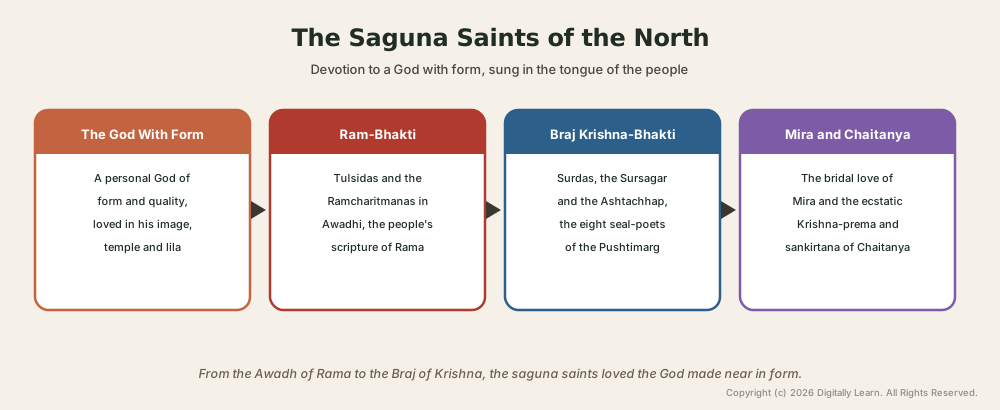
The saguna stream of the medieval Bhakti movement worshipped a personal God who has form and qualities, the very opposite of the formless nirguna Absolute of the Sants. In northern India this devotion ran in two great currents. Ram-bhakti adored Rama, the son of Dasharatha, and found its supreme voice in Tulsidas, whose Awadhi Ramcharitmanas became the people's scripture. Krishna-bhakti of the Braj country was sung by the blind poet Surdas in his Sursagar and by the Ashtachhap, the eight seal-poets of Vallabha's Pushtimarg. The saguna saints loved God in his lila, his image and his temple, through the moods of servant, friend, parent and lover, while Mira and Chaitanya carried the same ecstatic Krishna-prema across the land.
The Saguna Stream of North Indian Bhakti and the God With Form
Saguna Bhakti: Devotion to a Personal God With Form and Qualities
The saguna saints worshipped a God who has a form and qualities, and this is the first thing to grasp about them.
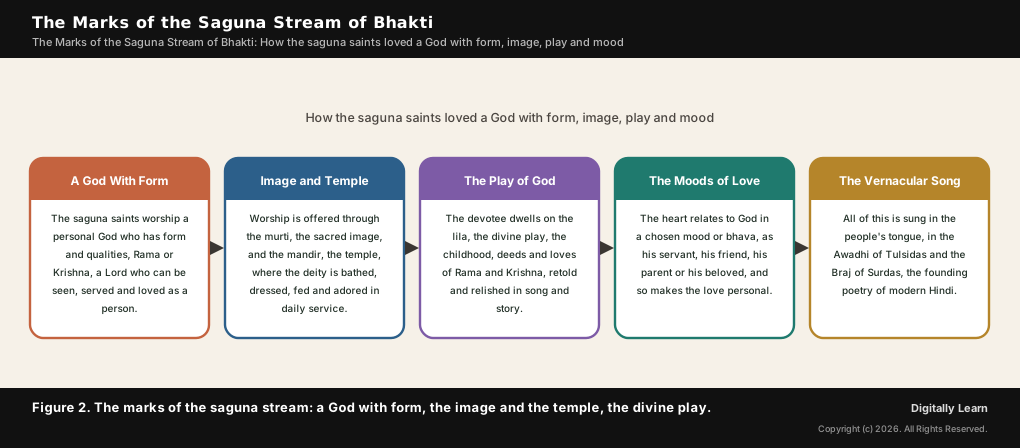
The word saguna means with qualities, from guna, a quality or attribute. Where the nirguna saints of the previous part loved a God beyond all form, the saguna saints loved the Absolute made near, a personal Lord who has a face, a name and a life-story. That Lord is Vishnu in his loving descents, above all Rama and Krishna, worshipped as persons whom the devotee may see, serve and adore. The supreme reality, on this view, is not made smaller by taking a form; rather, in his grace, God takes a form so that the human heart may reach and love him.
From this single conviction the whole character of saguna bhakti follows. Because God has a form, he can be housed in an image and a temple; because he has a life, his deeds can be retold and relished; and because he is a person, the devotee can stand toward him in a chosen relation of love, as servant, friend, parent or beloved. The figure below sets out these marks of the saguna way, which the rest of this part will follow through its great poets.
Nirguna and Saguna Compared: The Formless Absolute and the God With Form
The bhakti of the north flowed in two great streams, the nirguna of the formless and the saguna of the form, and the two must be told apart with care.
The nirguna Sants, treated in the previous part of this series on the nirguna Sants Kabir, Nanak and Ravidas, would have no image at all, holding that the moment God is given a form he is made less than he is; their worship was the inward one, by the divine Name. The saguna saints held the opposite, that the loving form of Rama or Krishna is the supreme and most worthy object of devotion, and that image, temple and song are not barriers to God but the very means of reaching him. The figure below sets the two streams side by side.
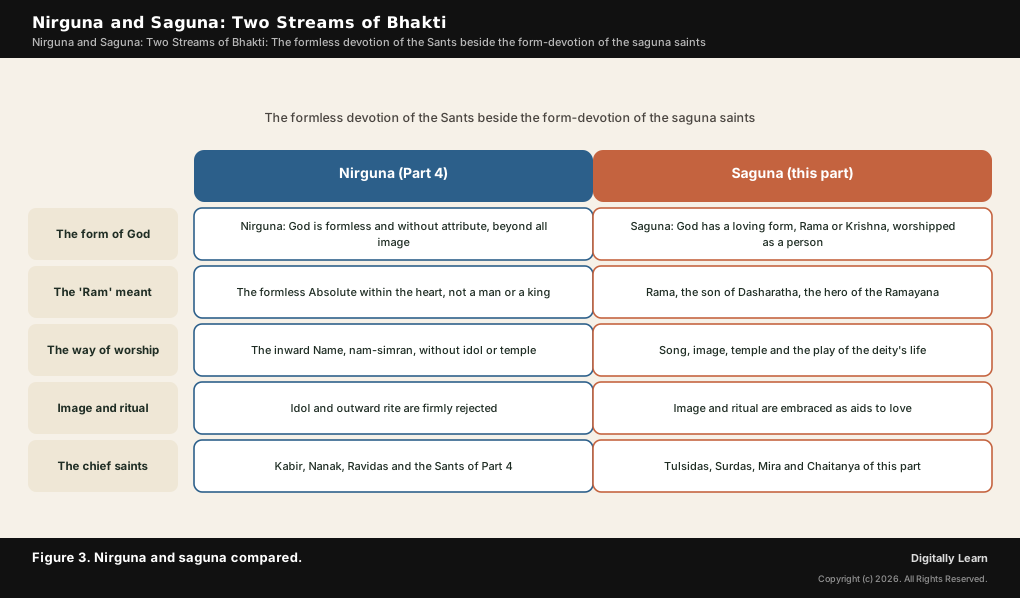
The line between the two was real, yet it was not a wall. A single tradition could hold both, and the same devotee might pass from one to the other; the great point of difference was the image. Where the nirguna way led away from temple and idol toward a stark inward faith, the saguna way led toward the great temples of Ayodhya and Braj, the festivals, and the devotional epics of Tulsidas and Surdas. It is the saguna way, the way of the God with form, that this part now follows.
The Theology of Saguna Devotion: Lila, Image, Temple and the Bhavas
Lila, Murti and Mandir: The Divine Play, the Image and the Temple
Saguna devotion turns upon three great ideas, the play of God, his image and his temple, which together give it its distinctive shape.
The first is lila, the divine play. The saguna saints held that God in his descents acts not from need but from a free and loving play, and that his deeds, the childhood of Krishna in Braj or the exile and victory of Rama, are a lila to be lovingly recalled. The second is the murti, the sacred image, in which the formless takes a form the eye can rest on; for the devotee the image is no mere stone but the chosen dwelling of the living God. The third is the mandir, the temple, the house of the deity where that image is served.
Around the image grew the daily round of seva, loving service, in which the deity is woken, bathed, dressed, fed, fanned and put to rest like a beloved guest or child. This service, raised to a fine art in the temples of Braj and at Nathdwara, is the heart of saguna worship, and it is the exact opposite of the nirguna saints' rejection of all outward rite. Where they found God only within, the saguna saints found him present in the image and the temple, and served him there with the whole apparatus of love.
The Bhavas of Devotion: Dasya, Sakhya, Vatsalya and Madhurya
Because the saguna God is a person, the devotee may love him in a chosen mood, and these moods of love are called the bhavas.
The tradition names several bhavas, the emotional relations in which the soul may stand toward God, and the saguna poets drew on all of them. In dasya, the devotee is the humble servant of the Lord, and the model is Hanuman, the perfect servant of Rama. In sakhya, the devotee is the friend and equal of God, as the cowherd boys of Braj were the playmates of Krishna. In vatsalya, the devotee loves God as a parent loves a child, the love of Yashoda for the infant Krishna that fills the songs of Surdas. The figure below sets out these moods.
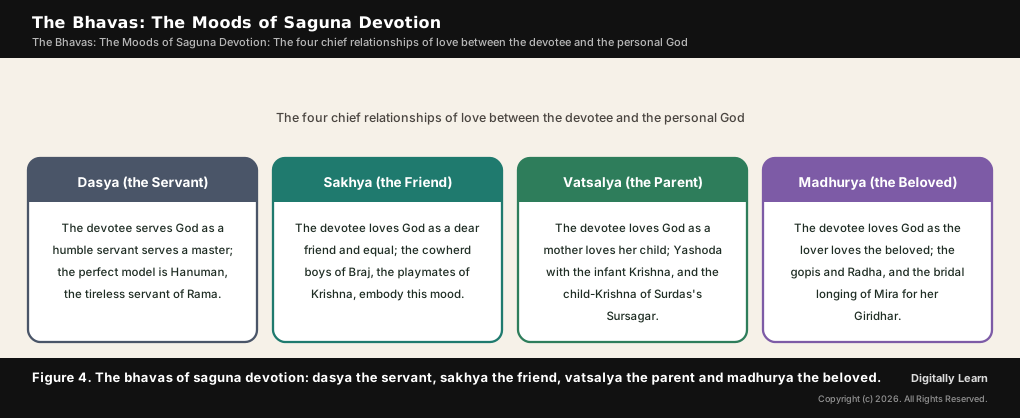
The highest and most intense of the moods is madhurya, the love of the lover for the beloved, in which the gopis of Braj, and Radha above them, long for Krishna as a wife for her husband; this is the bridal love that fills the songs of Mira. A fifth and quieter mood, shanta or peaceful contemplation, is sometimes added to make the standard five. These bhavas are not idle classification: they are the very grammar of saguna love, and each great poet of this part chose the mood that best carried his devotion to the personal God.
Two Streams of Saguna Devotion: Ram-Bhakti and Krishna-Bhakti
The saguna bhakti of the north divided into two great streams of its own, the devotion of Rama and the devotion of Krishna.
The two streams worshipped two different faces of Vishnu and grew two different literatures. Ram-bhakti adored Rama, the son of Dasharatha, the ideal king and the maryada purushottam, the perfect man of righteous conduct; its devotion is reverent and its supreme poet is Tulsidas, who sang in Awadhi. Krishna-bhakti adored Krishna, the cowherd of Braj and the lila purushottam, the playful Lord of love; its devotion is tender and amorous, and its great voices are Surdas and the Ashtachhap, who sang in Braj bhasha. The figure below sets the two streams side by side.
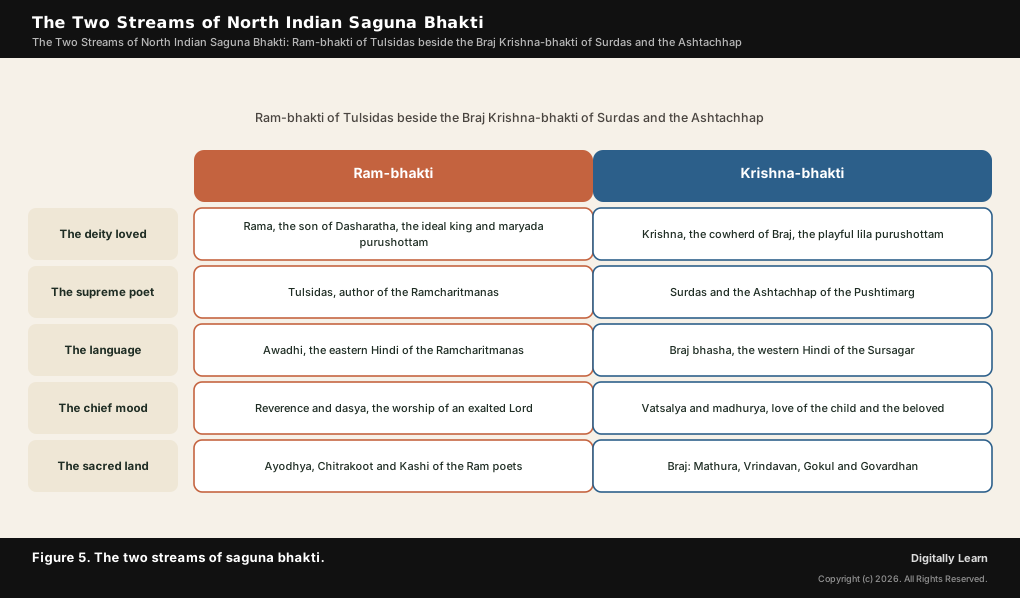
The contrast of mood is striking. The devotee of Rama stands before an exalted and righteous Lord in reverence and service, the mood of dasya; the devotee of Krishna draws near to a child or a lover in the warm moods of vatsalya and madhurya. The two streams have different sacred lands as well, the Awadh of Ayodhya and the Kashi of Tulsidas for Rama, and the Braj of Mathura and Vrindavan for Krishna. This part takes them in turn, beginning with the Ram-bhakti of Tulsidas.
Ramananda, Tulsidas and the Ram-Bhakti Tradition in Awadhi
Ramananda: The Northern Root of Ram Devotion
The northern devotion to Rama is traced back to the teacher Ramananda, the vernacular saint of Banaras.
Ramananda, the Vaishnava saint of the Gangetic plain whose life the previous part described among the nirguna Sants Kabir, Nanak and Ravidas, stands at the head of the northern Ram tradition. Placed between the fourteenth and the mid-fifteenth century, he carried into the north the warm bhakti of the southern acharya Ramanuja, and made devotion to Rama the centre of his teaching. His great innovation, treated more fully in the previous part, was to teach in the vernacular Hindi of the people rather than in Sanskrit, so opening Ram-bhakti to all. From his northern school grew the Ram devotion that Tulsidas would bring to its height; this part recalls him only as the root from which that tradition sprang.
Tulsidas: Life, Contested Dates and the Devotion of Banaras
Tulsidas is the supreme poet of Ram-bhakti, whose retelling of the Rama story became the most loved book of the Hindi world.
The life of Tulsidas is wrapped in legend, and his dates are not certain. He is most often said to have been born in 1511 and to have died in 1623; some popular accounts give the year 1497, but scholars reject it, since it would make his life span an unlikely hundred and twenty-six years. His birthplace too is disputed, claimed for Soron by most scholars and for Chitrakoot by later tradition. What is firm is that he spent his life in the holy cities of Banaras, the Kashi on the Ganga, and Ayodhya, the city of Rama, and that he died at Assi Ghat on the bank of the Ganga at Banaras.
By tradition Tulsidas was a Brahmin who, after an early life of hardship, turned wholly to the devotion of Rama and became the great singer of his praise. He stands apart from the nirguna Sants in a vital way: where Kabir emptied the name of Rama of its story and made it a word for the formless, Tulsidas adored the saguna Rama in his full form, the son of Dasharatha and the hero of the Ramayana, worshipped through image, temple and the retelling of his life. His many works, all in praise of Rama, made him the central figure of north Indian Ram-bhakti.
The Ramcharitmanas: The Story of Rama Retold in Awadhi
The Ramcharitmanas is the masterwork of Tulsidas and the scripture of Ram-bhakti, a retelling of the Rama story in the people's tongue.
The Ramcharitmanas, the 'lake of the deeds of Rama', is a retelling of the ancient Sanskrit Ramayana of Valmiki in Awadhi, the eastern Hindi of the Awadh country. Tulsidas began it at Ayodhya in 1574 and completed it a few years later. By rendering the sacred story in the vernacular rather than in Sanskrit, he placed it in the hands and on the lips of ordinary people, for whom it became at once a poem, a scripture and a guide to life. For four centuries it has been recited in homes and temples across the Hindi-speaking north, and it is fair to call it the most widely read book of that whole region.
The greatness of the work lies as much in its devotion as in its art. Tulsidas reshaped the old epic into a hymn of bhakti, in which Rama is not only a hero but the supreme God in loving human form, and his servant Hanuman the model of perfect devotion in the mood of dasya. The poem teaches that the path to God in the dark present age is the loving repetition of the name of Rama and surrender to his grace. In giving the north a devotional epic of such power and tenderness, the Ramcharitmanas did for Ram-bhakti what no temple or doctrine could.
Vinaya Patrika, Kavitavali and the Hanuman Chalisa
Beyond the Ramcharitmanas, Tulsidas left a body of other works that carry his Ram-bhakti in many forms.
Among them the Vinaya Patrika, the 'petition of humility', is the most personal, a sequence of hymns in which the poet pleads with Rama for grace, and which tradition counts among his last works. The Kavitavali retells the Rama story in the ornate kavitt and savaiya metres of Braj, while the Dohavali gathers his couplets of counsel and the Gitavali his songs. To these the tradition adds the Hanuman Chalisa, the forty-verse hymn to Hanuman that is recited in countless homes; popular belief ascribes it to Tulsidas, though some scholars doubt his authorship, and so the attribution is best given as the long-held tradition rather than as certain fact. The figure below sets out these works.
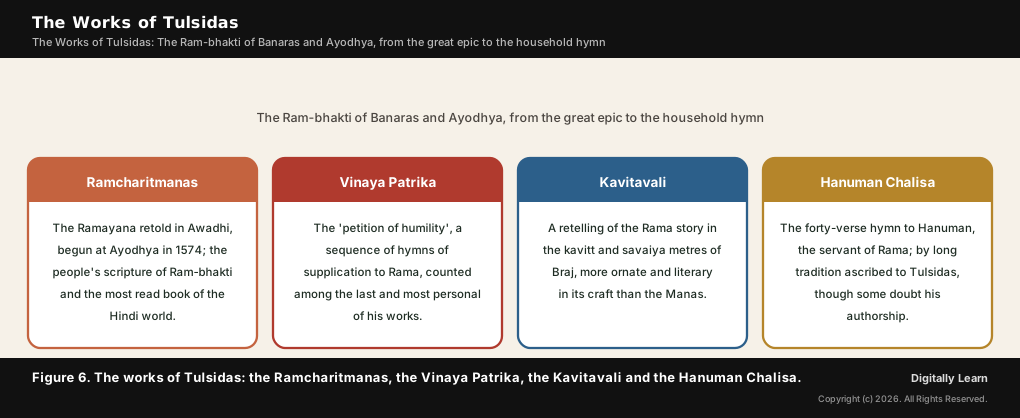
Taken together these works made Tulsidas the voice of Ram-bhakti for the whole north. From the vast canvas of the Ramcharitmanas to the brief and beloved Hanuman Chalisa, his verse reached every level of society and every occasion of devotion, from temple recitation to the daily prayer of the household. No other poet so shaped the religious life of the Hindi-speaking plains, and through him the saguna Rama became the chosen deity of millions.
Ram-Rajya: The Ideal of Righteous Kingship
From the Ramcharitmanas the north drew its enduring ideal of Ram-rajya, the reign of righteousness.
In the closing portion of his epic Tulsidas paints the reign of Rama as a golden age, an ideal of just and compassionate rule in which there is no sorrow, no want and no wrong, where every person keeps his duty and the king rules only for the good of his people. This vision of Ram-rajya, the rule of Rama, became far more than a passage in a poem: it entered the moral imagination of the north as the very picture of good government, the standard against which earthly rulers might be measured. The ideal joined the religious devotion of Ram-bhakti to a clear social vision of order, justice and welfare.
So strong was this ideal that it long outlived its age. In the twentieth century Mahatma Gandhi took Ram-rajya as his word for the just and self-governing India he sought, a society of truth, equality and welfare; in doing so he drew on the very ideal that Tulsidas had planted four centuries before. That a sixteenth-century devotional poem should furnish a modern nation its language of good governance is a measure of how deeply the Ramcharitmanas shaped the culture of northern India, and of the reach of saguna Ram-bhakti beyond the temple into the life of the people.
Surdas and the Braj Krishna-Bhakti Tradition
Surdas: The Blind-Poet Tradition and the Songs of Braj Bhasha
Surdas is the supreme poet of Braj Krishna-bhakti, the blind singer whose songs of Krishna are loved across the north.
The dates of Surdas, like those of so many saints of this age, are uncertain; he is commonly placed across the sixteenth century, from about 1478 to 1583, though the standard reference works also give the narrower span of about 1483 to 1563, and his exact years should be held as contested. He sang in Braj bhasha, the soft western Hindi of the Braj country around Mathura, the very land of Krishna, and it was he above all who made that dialect the great language of Krishna-bhakti. Tradition remembers him as a blind poet, and the figure of the blind singer of Krishna is dear to the devotion of the north, though the firm details of his blindness are not recorded.
Tradition links Surdas to the teacher Vallabhacharya and counts him the foremost of the eight poets of the Pushtimarg, the Ashtachhap, treated in the next section; honesty requires the note that modern scholars regard this connection to the sect as uncertain, even ahistorical, so it is given here as the tradition of the sampradaya rather than as settled fact. What is not in doubt is the man's achievement. In an age that prized Sanskrit learning, a poet held to be blind, singing in the plain speech of Braj, created a body of Krishna devotion that has never lost its hold on the heart of the north.
The Sursagar: Vatsalya and Madhurya in the Ocean of Krishna Songs
The Sursagar is the great work of Surdas, an ocean of songs on the life and love of Krishna.
The Sursagar, the 'ocean of Sur', is the vast collection of devotional songs, or padas, that gathers the verse of Surdas; its name fits its scale, for the tradition speaks of a great multitude of his songs. Its heart is the child Krishna of Gokul and Vraj, and it is famous above all for its tender descriptions of Krishna's childhood, seen often through the eyes of the cowherd women, the gopis. In these songs Surdas perfected the mood of vatsalya, the parental love of Yashoda for the divine child, with a tenderness that has rarely been matched in any literature.
Alongside the love of the child runs the love of the beloved, the mood of madhurya, in the songs of the gopis and their longing for Krishna, and in the famous bhramargit, where they pour out their love and their reproaches. Through the Sursagar the Braj country, the land of Krishna's play, became the very heartland of Krishna-bhakti, and its dialect the chosen tongue of that devotion. The work set the pattern that the other poets of Braj, the Ashtachhap and after, would follow.
The Ashtachhap and the Poets of the Pushtimarg
The Pushtimarg and Braj: The Institutional Home of the Ashtachhap
The Braj poets of Krishna found their institutional home in the Pushtimarg, the path of grace founded by Vallabhacharya.
The Pushtimarg, the path of grace (pushti), was founded by the acharya Vallabhacharya, whose Shuddhadvaita philosophy the previous part of this series described among the Vedanta acharyas and the Lingayat reform; here it concerns us not as a philosophy but as the home of the Braj poets. The sect worships Krishna, above all in the form of Srinathji, Krishna as a seven-year-old child who lifted the hill of Govardhan. The image of Srinathji was first served at Govardhan in the heart of Braj, and in 1672, to shield it from the iconoclasm of Aurangzeb, it was carried away to Mewar in Rajasthan, where it found a home at the shrine that grew into Nathdwara.
It was Vallabha's son, Vitthalnath, also called Gusainji, who gave the sect its rich devotional culture. He raised the simple service of his father's day into an aesthetic worship of music, song, fine dress and ornament, in which the deity is adored through the round of the seasons and the hours. To furnish this worship with song he is said to have gathered the poets whose verse the sect still sings, the Ashtachhap; so the path of grace became the institutional home, in the Braj country, of the greatest body of Krishna devotion in Hindi. The poets themselves are the subject of the next section.
The Ashtachhap: The Eight Seal-Poets of Vallabha and Vitthalnath
The Ashtachhap are the eight seal-poets of the Pushtimarg, the chosen singers of Krishna in the Braj country.
The Ashtachhap, the 'eight seals', are the eight poets whose verse the Pushtimarg honours above all others, the singers of Krishna whose padas are sung in its temples to this day. By the tradition of the sect they fall into two groups of four: the first four, led by Surdas and including Kumbhandas, Parmanandadas and Krishnadas, were the disciples of Vallabhacharya; the second four, among them Nandadas and Govindswami, were the disciples of his son Vitthalnath, who is said to have completed the group. The table below names all eight.
| Poet | Initiated by (tradition) | Remembered for |
|---|---|---|
| Surdas | Vallabhacharya | The Sursagar; foremost of the eight, the blind singer of the child Krishna |
| Kumbhandas | Vallabhacharya | A farmer of Parasoli near Govardhan; famed for shunning Akbar's court |
| Parmanandadas | Vallabhacharya | A poet of Kannauj; tender padas on the child Krishna (the Parmanandasagar) |
| Krishnadas | Vallabhacharya | The manager (adhikari) of the Govardhan temple; a Pushtimarg poet |
| Chaturbhujdas | Vitthalnath | Son of Kumbhandas; a poet of Govardhan in the Pushtimarg manner |
| Nandadas | Vitthalnath | The most literary of the eight; the Rasapanchadhyayi on Krishna and the gopis |
| Govindswami | Vitthalnath | A Brahmin of Bharatpur; a master of the dhrupad music of the padas |
| Chhitswami | Vitthalnath | A Brahmin of Mathura who turned from worldly life to the song of Krishna |
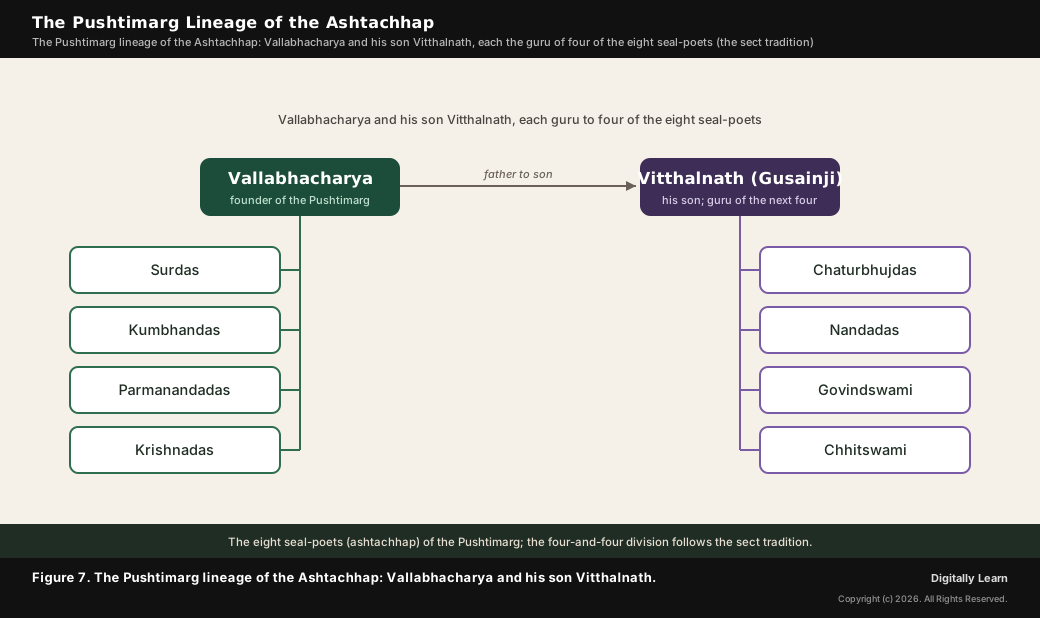
Together the Ashtachhap made the Braj country the singing heart of Krishna-bhakti. Their padas, set to the dhrupad music that Vitthalnath loved, carried the love of Krishna through the temple's daily and seasonal round, and gave Braj bhasha a body of devotional song to stand beside the Sursagar of Surdas. Through them the Pushtimarg became not only a path of grace but a great school of poetry and music, whose influence on the devotional culture of the north was deep and lasting.
Keshavdas, Raskhan and Rahim: Other Voices of Braj Verse
Around the Ashtachhap stood other poets of Braj and Hindi, who added their own voices to the devotion of Krishna and Rama.
Raskhan is the most striking of them, an Indian poet born a Muslim, Sayyid Ibrahim Khan, who became an initiated devotee of Krishna and made his home in Vrindavan in the heart of Braj. He learned the way of devotion, the tradition says, from Vitthalnath, and his verse is wholly given to Krishna and his lila; his works the Prem Vatika, the 'garden of love', and the Sujan Raskhan are celebrated poems on the life of Krishna, and his samadhi stands to this day near Gokul. That a Muslim should become one of the loved poets of Krishna is a clear sign of how saguna devotion, like the nirguna way, could cross the line between the communities.
Keshavdas, who lived from about 1555 to 1617, was a poet of Braj bhasha at the court of Orchha. His Ramchandrika retold the story of Rama, while his Rasikpriya helped found the mannerist riti tradition of Hindi verse. He is remembered more as a master of poetic craft than as a simple devotee, yet his Rama poem belongs to the wider flowering of saguna literature.
Rahim, the noble Abdul Rahim Khan-i-Khanan (1556 to 1627), was one of the nine jewels of Akbar's court and a celebrated composer of Hindi dohas, the rhymed couplets in which, by tradition, he wove the devotion of Krishna and Rama. He was a friend of Tulsidas, with whom he is said to have exchanged couplets. Honesty requires the note that the firmly recorded part of Rahim's work is his Hindi couplets and his link to Tulsidas, while the depth of his Krishna devotion rests more on tradition than on certain record.
Mira and Chaitanya: The Krishna-Prema of Two Great Devotees
Mirabai's Madhurya-Bhava Devotion to Giridhar Gopal
Mirabai is the great voice of bridal love for Krishna, whose songs of longing for her Giridhar belong to the saguna stream.
In her devotion Mirabai loved Krishna as her only true husband, calling him Giridhar, the lifter of the mountain, or Giridhar Gopal, and offering him a total surrender of the self. Hers is the purest example of the madhurya bhava, the mood of the beloved, in which the soul longs for God as a wife for her absent lord; her bhajans and padas pour out her love, her worship and her grief of separation. Her dates are uncertain, placed about 1498 to 1547, and the record is unusually thin, for no manuscript of her verse survives from her own time and the earliest collections are far later, so her songs come to us through a long tradition of singing rather than a fixed text.
Here this part treats only the theology of Mira's devotion, her madhurya-bhava love of the saguna Krishna, which sets her firmly among the Krishna poets beside Surdas and the Ashtachhap. Her wider story, as a Rajput woman who broke the bonds of her age and as one of the great women saints of bhakti, belongs to the sixth part of this series on the regional and women's traditions, and is treated there. What concerns us now is that her ardent Krishna-prema, her love-devotion to the personal Lord of Braj, is one of the supreme expressions of saguna madhurya in the whole tradition.
Chaitanya Mahaprabhu: Ecstatic Krishna-Prema, Sankirtana and Gaudiya Theology
Chaitanya Mahaprabhu was the great ecstatic of Krishna devotion, whose theology of love belongs to the saguna stream of this part.
Chaitanya lived from 1486 to 1534 and was, in the eyes of his followers, devotion itself made flesh, a soul so filled with love of Krishna that he would fall into trances of rapture at the divine name. He taught a path of pure prema, ecstatic loving devotion to Krishna and to Radha-Krishna together, and made its great practice the sankirtana, the congregational chanting and singing of the names of God in the streets, in which all might share. His theology, the heart of the Gaudiya Vaishnava tradition, is summed in the phrase achintya bheda abheda, the inconceivable difference and non-difference of the soul and God, later set in order by his follower Jiva Goswami.
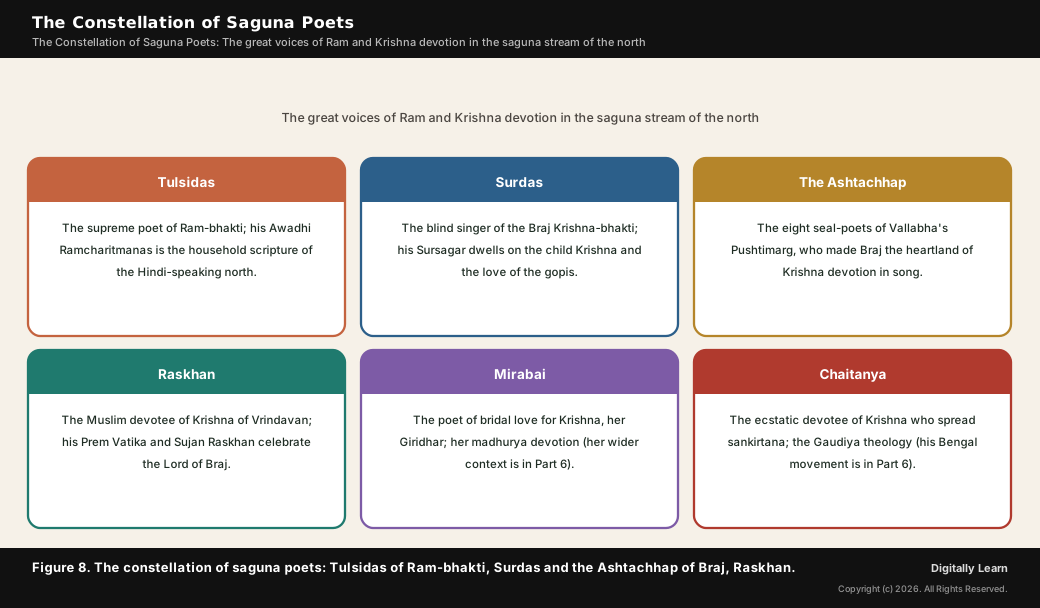
Followers revered Chaitanya as the combined descent of Radha and Krishna in one form, come to taste the love of Radha for her Lord. This part treats only the saguna theology of his devotion, his ecstatic Krishna-prema, his sankirtana and the Gaudiya doctrine of difference-in-non-difference, which place him among the great Krishna devotees beside Mira and the poets of Braj. His role as the founder of the Bengal Vaishnava movement, a regional tradition with its own institutions, belongs to the sixth part of this series and is treated there. The figure below gathers the constellation of saguna poets and devotees this part has followed.
The Sacred Geography of Saguna Bhakti: Ayodhya, Kashi, Braj and Nathdwara
Ayodhya, Chitrakoot, Kashi and the Braj of Krishna
Saguna bhakti is bound to a sacred geography of the northern plain, the holy places of Rama and of Krishna.
The land of Ram-bhakti lies along the Ganga and the Saryu in the eastern part of the plain. Its centre is Ayodhya, the birthplace of Rama on the Saryu, where Tulsidas began the Ramcharitmanas; near it is Chitrakoot, the forest of Rama's exile in the hills of Bundelkhand; and on the Ganga stands Kashi, or Banaras, the ancient city where Tulsidas lived and died. The land of Krishna-bhakti lies to the west, in the Braj country on the Yamuna around Mathura, the birthplace of Krishna, with Vrindavan, Gokul and the hill of Govardhan close by. The map below sets out these places.
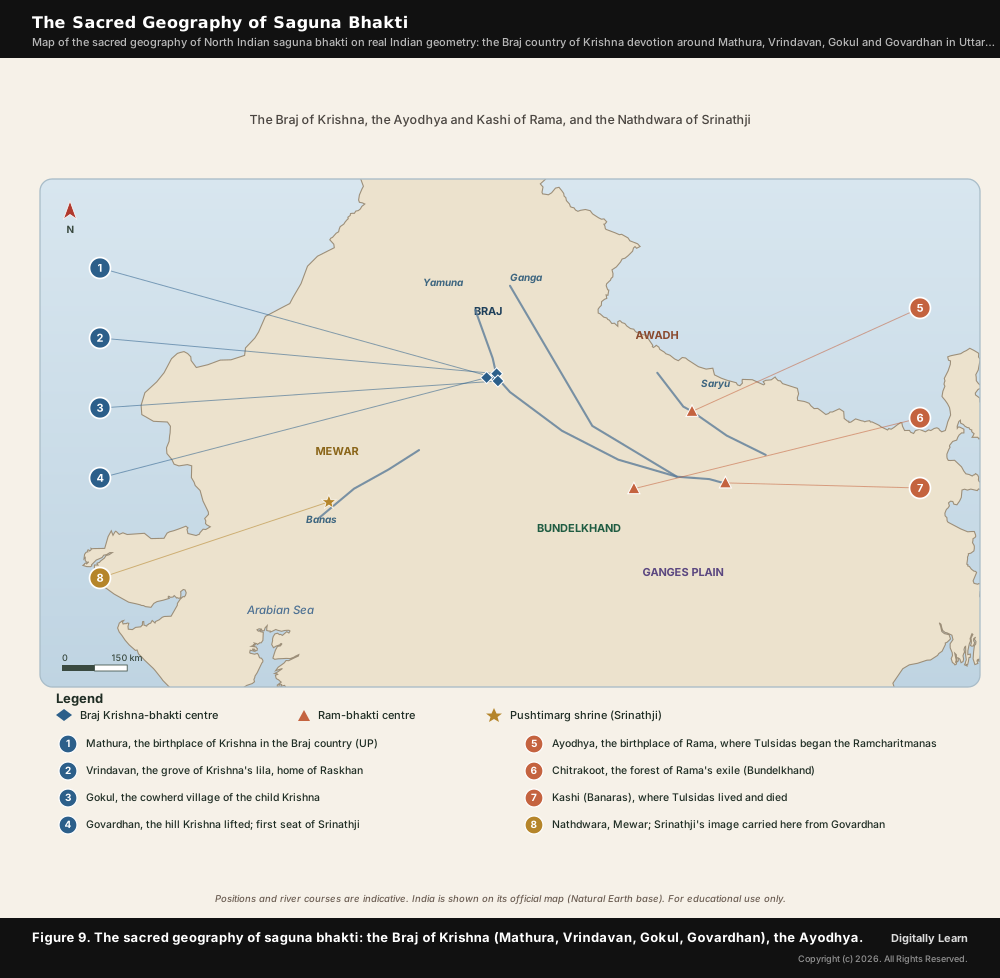
One place lies far from the rest, to the south-west in Rajasthan: Nathdwara in Mewar, the great shrine of Srinathji. Its presence on the map tells a story, for the image of Srinathji was carried there from Govardhan in Braj in 1672 to save it from destruction, and so the devotion of the Pushtimarg took root in a new land. The whole geography, from the Awadh of Rama to the Braj of Krishna and on to the Mewar of Srinathji, shows how the saguna devotion of the north was rooted in particular holy places, the very lands where, the devotees held, God had walked in his lila.
Social and Cultural Significance and the Legacy of Saguna Bhakti
Vernacular Literature and the Flowering of Awadhi and Braj
The saguna saints gave northern India its first great vernacular literature, the founding classics of Hindi.
By choosing to sing in the vernacular, the Awadhi of Tulsidas and the Braj bhasha of Surdas and the Ashtachhap, rather than in Sanskrit, the saguna poets created a devotional literature of the first rank in the living speech of the people. The Ramcharitmanas and the Sursagar are not only scriptures of devotion but the founding classics of Hindi letters, and for four centuries they have shaped the language, the imagery and the imagination of the whole Hindi-speaking north. The table below gathers the chief poets of the saguna stream at a glance.
| Poet | Dates (as given) | Language | Chief work or theme |
|---|---|---|---|
| Tulsidas | About 1511 to 1623 (contested) | Awadhi (also Braj) | Ramcharitmanas; Ram-bhakti |
| Surdas | About 1478 to 1583 (contested) | Braj bhasha | Sursagar; the child Krishna and the gopis |
| Raskhan | About 1548 to 1628 (uncertain) | Braj | Prem Vatika; Krishna devotion of a Muslim poet |
| Keshavdas | About 1555 to 1617 | Braj bhasha | Ramchandrika; Rasikpriya (the riti tradition) |
| Mirabai | About 1498 to 1547 (uncertain) | Rajasthani | Bhajans of madhurya love for Giridhar Krishna |
| Chaitanya | 1486 to 1534 | Bengali (sankirtana) | Ecstatic Krishna-prema; Gaudiya theology |
This was a service to the vernacular whose effects far outlived the saints. By carrying the highest devotion and the noblest poetry out of Sanskrit and into the everyday tongue, the saguna poets gave the people of the north a literature they could call their own. The Awadhi of the Ramcharitmanas and the Braj of the Sursagar became, for centuries, the chief literary languages of Hindi devotion, and the foundation on which the modern literature of the region was later built.
Temple Culture, Devotional Music and the Saguna Legacy
The deepest legacy of saguna bhakti is the living devotion of the temple, the image and the song, the popular Hinduism of the north.
Unlike the nirguna Sants, who turned from temple and idol, the saguna saints built up the whole culture of the murti and the mandir, the loving service of the deity in his image that fills the temples of Braj, Ayodhya and Nathdwara to this day. With it grew a great tradition of devotional music, the kirtan, the bhajan and the pada, in which the love of Rama and Krishna was carried into every home and every festival, and which shaped the classical music of Hindustan, above all the dhrupad of the Pushtimarg. The figure below traces this legacy.
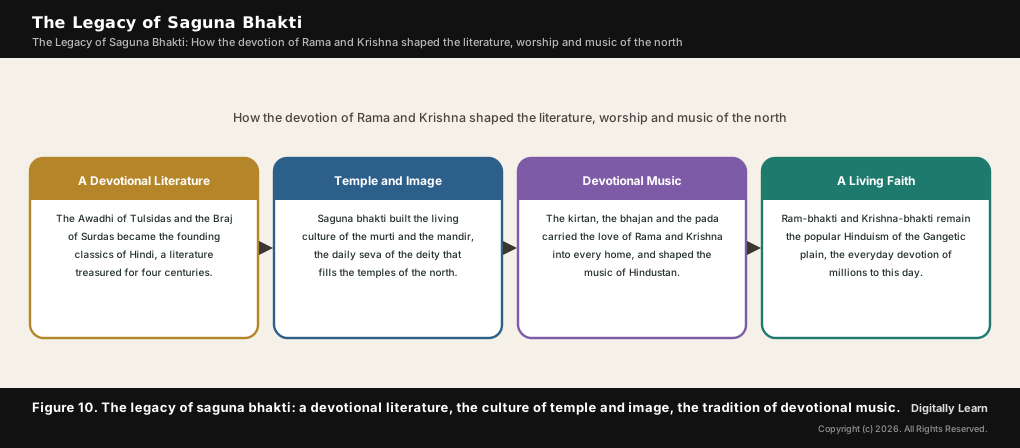
Set in its place, the saguna stream stands beside the other currents of this series: the nirguna devotion of the nirguna Sants Kabir, Nanak and Ravidas, the southern bhakti of the Alvars and the Vedanta acharyas of the earlier parts, and the regional and women's traditions, with Mira and Chaitanya in their fuller setting, that the next part takes up. Within them the saguna saints hold a place of their own, as the makers of the Ramcharitmanas and the Sursagar, the builders of the temple devotion of Rama and Krishna, and the founders of the popular Hinduism of the Gangetic plain.
UPSC Relevance and Previous-Year Questions
Where Saguna Bhakti Fits in the UPSC-CSE Syllabus
This topic belongs to General Studies Paper I: medieval Indian history and culture, and the saguna saints are a recurring theme, tested in Prelims as fine pairings of poet, work and language and in Mains as a subject of religion, literature and society.
The questions most often test the poets and their works, the languages of saguna devotion, and the distinction of the saguna stream from the nirguna. The following points are worth holding in working memory:
- Saguna and nirguna: the saguna saints worship a God with form, Rama or Krishna, through image and temple; the nirguna Sants worship the formless by the Name.
- Tulsidas: the Ramcharitmanas, a retelling of the Ramayana in Awadhi begun at Ayodhya in 1574; also the Vinaya Patrika, Kavitavali and, by tradition, the Hanuman Chalisa.
- Surdas: the Sursagar, songs of the child Krishna and the gopis in Braj bhasha; counted foremost of the Ashtachhap.
- The Ashtachhap: the eight seal-poets of Vallabha’s Pushtimarg, gathered by Vitthalnath, who made Braj the heartland of Krishna-bhakti.
- Raskhan: the Muslim devotee of Krishna who composed the Prem Vatika, poems on the life of Krishna, in the Braj country.
A 1996 Prelims question asked who composed the Prem Vatika, poems on the life of Krishna. This part teaches the answer in the section on the Braj poets: it was Raskhan, the Muslim-born devotee of Krishna of Vrindavan, whose Prem Vatika and Sujan Raskhan are celebrated poems on Krishna's life. The other names offered are distinguishable through this part: Surdas wrote the Sursagar, not the Prem Vatika; Kabir belonged to the nirguna stream of the previous part; and Bihari was a later riti poet. A reader who has followed the section on Raskhan can pick him out at once.
A 1997 Prelims question tested the regions of four Hindi dialects, among them Brajbhasha and Awadhi. This part teaches, in its own words, that these are precisely the two great literary languages of saguna devotion, the Braj bhasha of Surdas and the Krishna poets and the Awadhi of Tulsidas and the Ramcharitmanas; a student who has read this part knows the two dialects and their poets, though the question itself, being a map of where each dialect is spoken, turns on geography that this part does not chart. The fit is therefore an honest partial one: the part supplies the identity of the dialects, not their precise distribution on the map.
A 2014 Prelims question on the Assamese dance-drama Sattriya claimed, in one of its statements, that it is based on devotional songs composed by Tulsidas, Kabir and Mirabai. This part teaches what Tulsidas actually composed, the Awadhi Ramcharitmanas and his other Ram-bhakti works, which helps a student see that the claim is doubtful. The fit is again an honest partial one: the Sattriya form and its true source in the Assamese tradition of Shankaradeva belong to the sixth part of this series, while this part supplies only the knowledge of Tulsidas's real work that flags the statement as suspect.
Previous Year UPSC-CSE Questions
Previous Year UPSC-CSE Questions By the end you will be able to draft model answers for the following UPSC questions. Each question carries a collapsible framework showing how to approach it in the exam.
- UPSC Prelims 1996 GS-IPrem Vatika, poems on the life of Krishna, was composed by
How to approach this Prelims question
Approach: Recall which of the four poets composed the Prem Vatika, a work on the life of Krishna, and test the names against their known works.
Trap to watch: Surdas is the more famous Krishna poet and is an easy wrong pick; but his work is the Sursagar, while the Prem Vatika is distinctively Raskhan's. Kabir is a nirguna saint and out of place here.
Key facts to recall:
- Raskhan, a Muslim-born devotee of Krishna of Vrindavan, composed the Prem Vatika and Sujan Raskhan on the life of Krishna.
- Surdas's chief work is the Sursagar, not the Prem Vatika.
- Kabir belonged to the nirguna stream; Bihari was a later riti poet.
Answer signal: The Prem Vatika, poems on the life of Krishna, was composed by Raskhan.
- UPSC Prelims 1997 GS-IConsider the map given below: The predominant languages spoken in the areas marked A, B, C and D are respectively
How to approach this Prelims question
Approach: Match each lettered area on the map to its predominant dialect, using the known homelands of the four Hindi dialects.
Trap to watch: The four dialects are easy to transpose; fixing Brajbhasha to the Braj country around Mathura and Awadhi to the Awadh region around Ayodhya, the lands of Surdas and Tulsidas, anchors two of the four.
Key facts to recall:
- Brajbhasha is the dialect of the Braj country around Mathura, the language of Surdas and the Krishna poets.
- Awadhi is the dialect of the Awadh region around Ayodhya, the language of Tulsidas's Ramcharitmanas.
- Bhojpuri and Maithili are the eastern dialects of the Hindi belt.
Answer signal: The correct ordering pairs the marked areas with Brajbhasha, Awadhi, Bhojpuri and Maithili respectively.
- UPSC Prelims 2014 GS-IWith reference to Sattriya, consider the following statements:
- It is a combination of music, dance and drama.
- It is a centuries-old living tradition of the Vaishnavites of Assam.
- It is based on classical Ragas and Talas of devotional songs composed by Tulsidas, Kabir and Mirabai.
Which of the statements given above is/are correct?
How to approach this Prelims question
Approach: Test each statement. Statements 1 and 2 (a combination of music, dance and drama; a centuries-old living tradition of the Assam Vaishnavites) are correct; statement 3 wrongly attributes its songs to Tulsidas, Kabir and Mirabai.
Trap to watch: Statement 3 names famous bhakti poets to seem plausible, but Sattriya rests on the Assamese Vaishnava compositions of Shankaradeva, not on Tulsidas, Kabir or Mira.
Key facts to recall:
- Tulsidas was an Awadhi Ram-bhakti poet of Banaras and Ayodhya, author of the Ramcharitmanas.
- Sattriya is the dance-drama tradition of the Assam Vaishnavites, rooted in the work of Shankaradeva.
- Statement 3 is false; only statements 1 and 2 are correct.
Answer signal: Only statements 1 and 2 are correct, so the answer is 1 and 2 only.
Sources and Further Reading
- NCERT, Themes in Indian History and Medieval India (the saguna saints and the Bhakti movement)
- Wikipedia: Tulsidas
- Wikipedia: Ramcharitmanas
- Wikipedia: Surdas
- Wikipedia: Pushtimarg (the Ashtachhap and Vitthalnath)
- Wikipedia: Shrinathji (Govardhan and Nathdwara)
- Wikipedia: Raskhan (the Prem Vatika)
- Wikipedia: Saguna brahman (the God with qualities)
- Wikipedia: Mirabai
- Wikipedia: Chaitanya Mahaprabhu
- Ministry of Culture, Indian Culture portal: the saints of the bhakti tradition
- Sahitya Akademi (the vernacular devotional literature of medieval India)
- Indira Gandhi National Centre for the Arts (IGNCA): the bhakti and sant traditions
- National Portal of India (Know India: culture and heritage)
Editorial Disclaimer
This article is for UPSC preparation. The account of the saguna saints follows the standard scholarship on medieval Indian religion. Many dates of these poets, those of Tulsidas, Surdas, Raskhan and Mirabai above all, are traditional and contested, as are several attributions including the Hanuman Chalisa, and these are flagged in the text.