


Overview
Turning a district's speciality into jobs and exports
A district-level development initiative that selects and brands one signature product, a handloom, handicraft, processed food or farm produce, from every district, then supports value addition, employment, market access and exports, building local value chains as a labour-intensive answer to jobless growth.
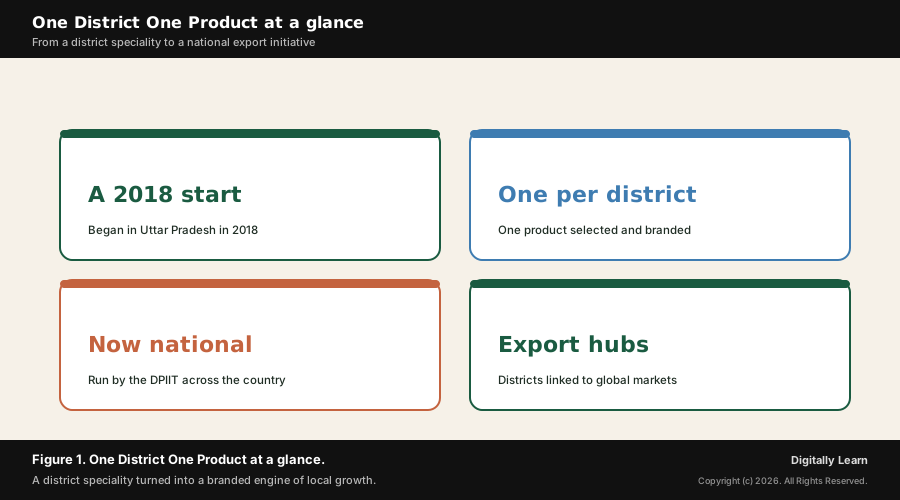
One District One Product, or ODOP, is an initiative that identifies one distinctive signature product in every district, a handloom, handicraft, processed food or farm produce, and then brands, finances and promotes it. It began as a Government of Uttar Pradesh programme in 2018 and is now a national initiative run by the DPIIT, operationally merged with Districts as Export Hubs under the DGFT, with a food-processing pathway through the PM FME scheme. By concentrating support on a district's own labour-intensive product, ODOP aims at value addition, employment, market access and exports, building local value chains as an answer to jobless growth.
What ODOP Is: Origin in Uttar Pradesh (2018) and the National Initiative
The 2018 Uttar Pradesh origin, the district product idea and the national initiative under DPIIT
One District One Product, widely known as ODOP, is a flagship effort to turn each district's signature product into an engine of local growth. The idea is simple and powerful: identify one distinctive product in every district, whether a handloom, a handicraft, a processed food or a farm produce, and then brand, support and promote it so that it reaches wider markets. Rather than spread thin support across everything, the approach concentrates effort on the product a district already does best, building on its existing skills, raw material and tradition to create jobs and income close to home.
ODOP began as a state-led experiment. The Government of Uttar Pradesh launched its One District One Product programme in 2018 to revive the state's traditional handicrafts and to help craft workers earn more through branding and market access. Each district was matched to a known speciality, such as Moradabad brassware, Firozabad glassware or Bhadohi carpets, and given focused support for skills, credit and marketing. Why it matters is that the model showed a district's own heritage product could be turned into a living source of employment, and the early success drew national attention.
What started in one state has grown into a national initiative. The Centre adopted the One District One Product idea and now runs it through the Department for Promotion of Industry and Internal Trade, the DPIIT, within the Ministry of Commerce and Industry. Working with the states, the programme has identified more than 1,100 products across over 760 districts, government figures report, spanning textiles, food, handicrafts and minerals. The national effort keeps the original aim, balanced regional development through each district's own product, while adding the reach of central coordination, digital platforms and an explicit push towards exports.
Objectives of ODOP: Value Addition, Employment, Branding, Market Access and Exports
Value addition, employment, branding, market access, exports and saving traditional crafts
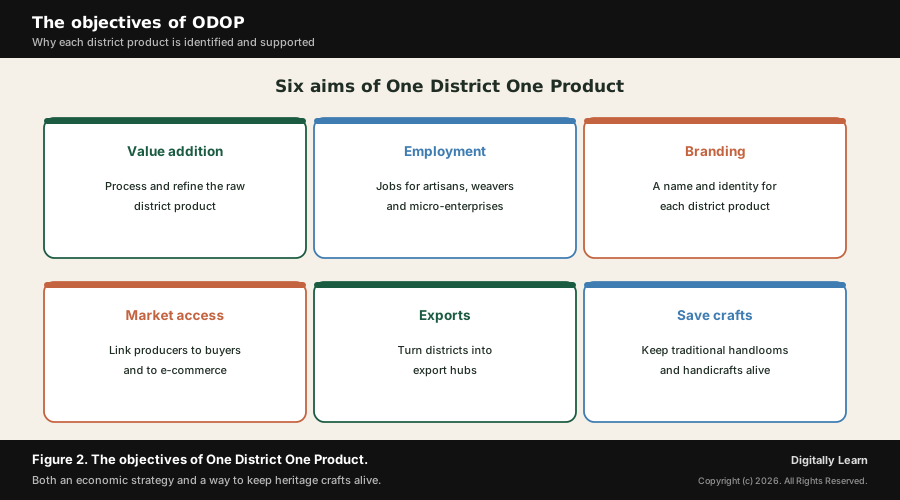
The objectives of ODOP follow from the problem it sets out to solve, that many districts make a fine product but capture little of its value. The first aim is value addition: to help producers process, refine and finish the raw product so that more of the final price stays in the district rather than flowing to distant traders. The second aim is employment. Because the chosen products are labour-intensive crafts, handlooms and food processing, expanding them creates work for artisans, weavers, farmers and small entrepreneurs exactly where they live, without the displacement that migration to far-off cities brings.
A third aim is branding and identity. By giving each district product a recognised name and brand, ODOP turns an anonymous good into one a buyer can trust and seek out, which lifts both price and pride. A fourth aim is market access: linking scattered producers to larger buyers, exhibitions, retail chains and e-commerce so that a maker in a small town can sell far beyond the local bazaar. The programme has tied ODOP products to the Open Network for Digital Commerce, the ONDC, to widen this online reach, government statements note.
A fifth aim is exports. ODOP is closely tied to turning districts into export hubs, identifying products with overseas potential and helping them meet the quality and packaging that foreign markets demand. A sixth aim is to preserve traditional crafts. Many handlooms and handicrafts were fading as younger workers left for other trades; by making a craft pay, ODOP keeps a living heritage alive rather than letting it survive only in a museum. Read together, these aims make ODOP both an economic strategy and a cultural one. The figure below sets out the objectives.
The Institutional Architecture: DPIIT, Districts as Export Hubs, DGFT and State ODOP Cells
DPIIT, the Districts as Export Hubs merger, the DGFT export role and state ODOP cells
ODOP is delivered not by a single office but through a set of bodies that share the work between the Centre, the states and the district. At the national level the DPIIT steers the initiative and maintains the digital portal that lists each district's product. In a key step, the One District One Product effort was operationally merged with the Districts as Export Hubs initiative, so that the two now run as one programme, government notes record. This joins the goal of local development to the goal of exports under a common structure.
The export side is carried by the Directorate General of Foreign Trade, the DGFT, under the Department of Commerce. Through the Districts as Export Hubs framework, products with export potential have been identified in districts across the country, and each district prepares a District Export Action Plan to fix the gaps in supply, quality and logistics. To run this, the government has set up State Export Promotion Committees and District Export Promotion Committees that bring together officials and exporters. Notably, Districts as Export Hubs is an initiative, not a scheme, so it carries no direct cash grant of its own.
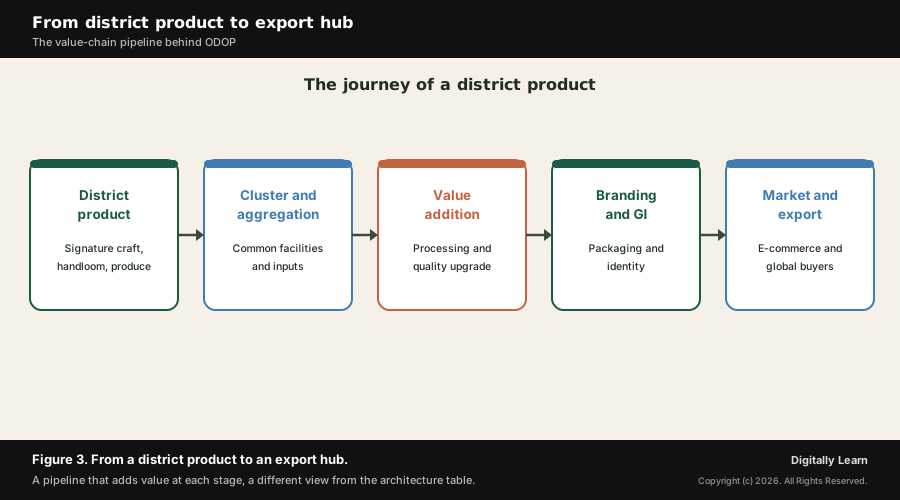
The third layer is the state and district machinery. States choose their district products, run their own ODOP cells and provide support for skills, design and credit, while the district administration drives the plan on the ground. This division of labour matters: the Centre can fund, brand and open markets, but only the local body can organise the artisans, run the common facilities and connect a real producer to a real buyer. The table below sets out the main parts of this architecture, and the figure that follows traces how a district product actually moves towards an export hub.
| Component | Nodal ministry or body | What it does |
|---|---|---|
| One District One Product (national) | DPIIT, Ministry of Commerce and Industry | Steers the initiative and lists each district product on a national portal |
| Districts as Export Hubs | DGFT, Department of Commerce | Identifies export-potential products and drives District Export Action Plans |
| State and District Export Promotion Committees | States and district administration | Run the district plan, tackle bottlenecks and support producers |
| ODOP under PM FME | Ministry of Food Processing Industries | Funds micro food enterprises around one food product per district |
| Branding and e-commerce | DPIIT with ONDC | Brands ODOP products and links them to online and export markets |
How a District Product Is Selected and the Geographical Indication Linkage
Scanning the district economy, weighing export potential and the Geographical Indication linkage
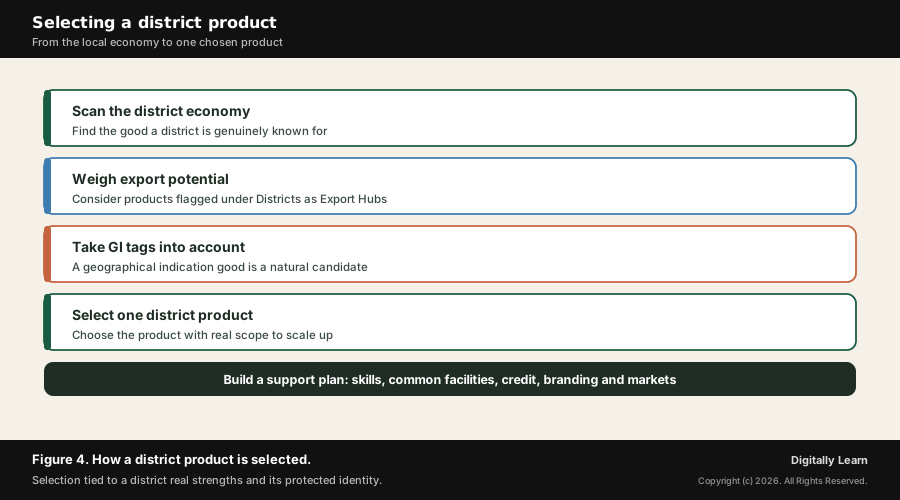
Choosing the one product for a district is a deliberate exercise, not a guess. States and districts scan the local economy to find the good that a district is genuinely known for and that can support many livelihoods: an established craft cluster, a widely grown crop, a traditional textile or a processed food. The choice weighs the existing base of skills and raw material, the number of workers it can employ, and its potential in wider and overseas markets, so that support flows to a product with a real chance of scaling up rather than to a token.
A central input to this choice is the Geographical Indication, the GI tag. A GI marks a product as belonging to a particular place, such as Darjeeling tea, Kullu shawls or Bidriware, and protects that link in law. In selecting district products, the government explicitly takes GI-tagged products into account alongside the local economy and export potential, so that a district's GI good is a natural candidate for its ODOP, official descriptions state. The GI and ODOP labels reinforce each other: the GI proves authenticity and origin, while ODOP adds branding, support and market reach.
Once a product is chosen, the district builds a plan around it. The plan maps the cluster of producers, identifies the gaps in skills, common facilities, credit and quality, and lays out how branding and marketing will lift the product. This turns a single name on a list into a working programme of support, with the GI tag, where it exists, serving as a ready mark of quality and place. By tying selection to a district's real strengths and to its protected geographical identity, ODOP aims to back products that can endure. The figure below sets out the selection path.
ODOP and the PM FME Scheme: A Food-Processing Pathway for Micro Enterprises
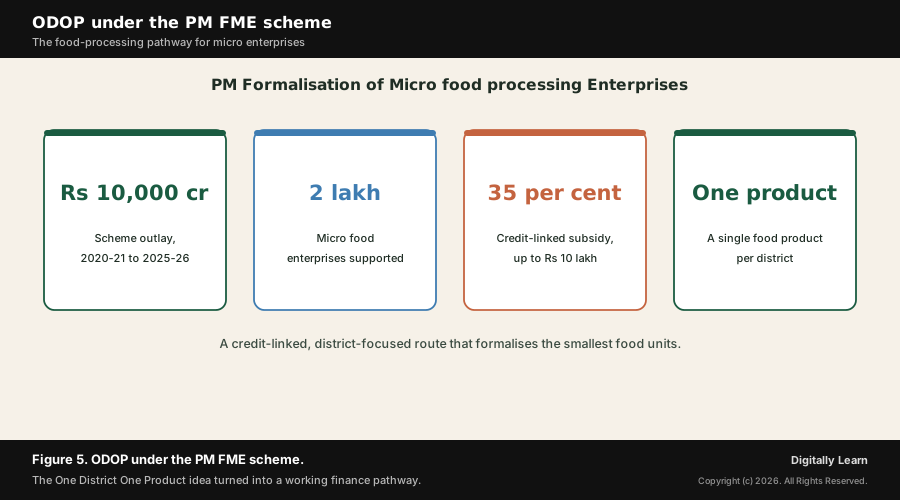
The PM FME outlay, the ODOP approach and the 35 per cent credit-linked subsidy for micro food units
One of the most concrete uses of the One District One Product idea runs through the PM Formalisation of Micro food processing Enterprises scheme, the PM FME scheme of the Ministry of Food Processing Industries. Launched in 2020 under the Atmanirbhar Bharat effort, it is a centrally sponsored scheme that runs over 2020-21 to 2025-26 with an outlay of Rs 10,000 crore, government figures state. Its purpose is to formalise and upgrade the country's vast number of tiny, often unregistered food processing units so that they can grow, meet standards and reach markets.
The scheme adopts the One District One Product approach as its organising principle. For each district a single food product is identified, such as a mango, a millet, a chilli or a fish, and support is concentrated around it so that producers gain from shared procurement, common processing facilities and joint marketing. The aim is to reach about two lakh micro food processing enterprises, government statements report, helping individual units, self-help groups, farmer producer organisations and cooperatives that work on the district's chosen food product.
The heart of the support is a credit-linked subsidy. A micro food enterprise can receive a capital subsidy of 35 per cent of the eligible project cost, up to a ceiling of Rs 10 lakh per unit, with the rest met through a bank loan and the owner's own contribution, the scheme guidelines state. The scheme also funds skills training, branding and common infrastructure. By tying credit and capacity to a single district food product, PM FME turns the ODOP idea into a working finance pathway for the smallest enterprises. The figure below sets out this pathway.
Employment Intensity and the Jobless-Growth Challenge
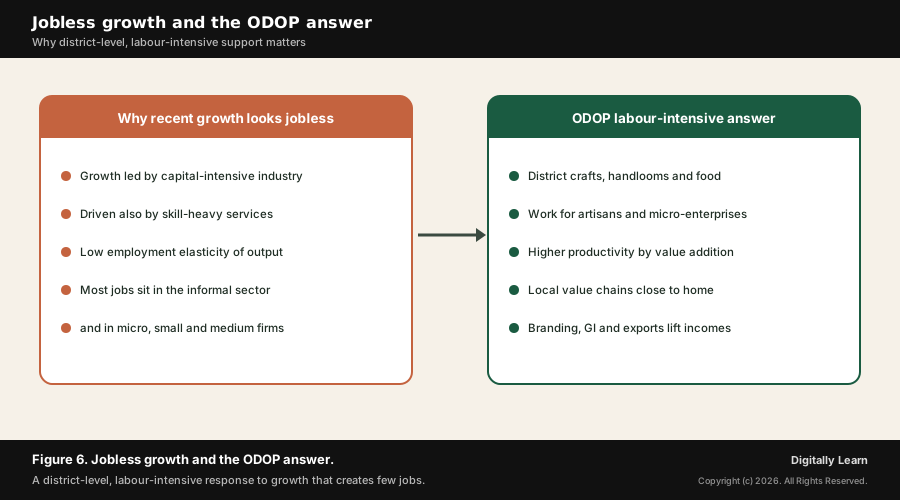
Why recent growth looks jobless and how ODOP's labour-intensive model answers it
To see why ODOP matters beyond a single craft, it helps to understand the wider worry of jobless growth. India's economy has grown quickly in recent decades, yet that growth has often produced fewer jobs than its pace would suggest. Much of the expansion has come from capital-intensive industry that uses machines more than hands, and from skill-heavy services such as software and finance that employ relatively few, and those mostly with high qualifications. When output rises faster than employment, economists say the employment elasticity of growth is low, and the result is the pattern often described as jobless growth.
The weight of employment in India therefore falls not on the large, formal firms but on the informal economy and on micro, small and medium enterprises. Farms, household crafts, small workshops and tiny food units employ the great majority of workers, yet they are often low in productivity, starved of credit and cut off from good markets. The real challenge, then, is not growth alone but growth that creates decent work for ordinary, often less-skilled workers in the places where they already are, rather than only for a narrow, qualified few in a handful of cities.
This is exactly where ODOP offers a response. By backing each district's labour-intensive craft, handloom, handicraft or food product, the programme channels support into the very activities that employ the most hands per rupee invested. It strengthens artisans, weavers, farmers and micro-enterprises in the informal sector, raises their productivity through value addition and common facilities, and connects them to branding, credit and markets so that more of them can earn a living. In doing so, ODOP builds local value chains that create work close to home, a district-level answer to the criticism that India's growth has been jobless.
Linked Schemes and Convergence: GI, MSME, PMEGP and Districts as Export Hubs
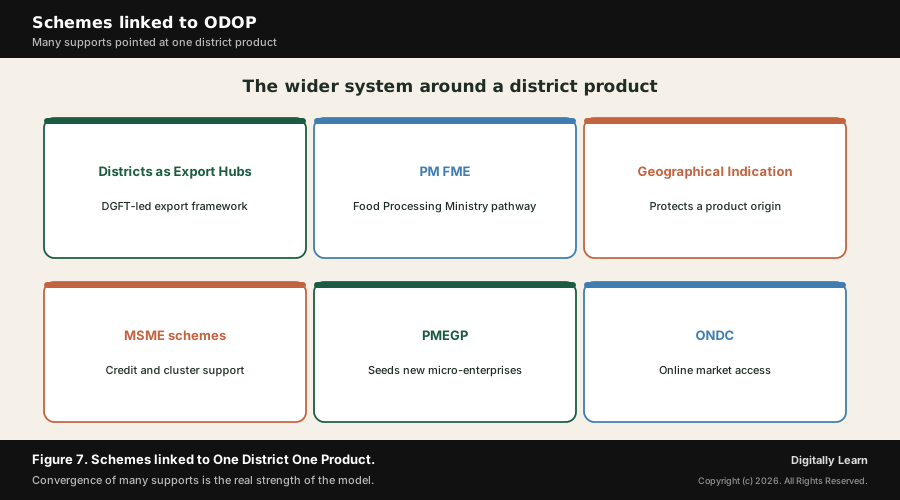
Districts as Export Hubs, Geographical Indication, MSME schemes, PMEGP, PM FME and ONDC
ODOP does not work alone; it sits within a wider system of schemes that share its goal of local enterprise. The closest is Districts as Export Hubs, with which it is operationally merged, carrying district products towards overseas markets through the DGFT framework. Alongside it, the Geographical Indication system protects the origin of place-based products and gives many ODOP goods a ready mark of authenticity. Together these link a district's product to both export markets and legal protection of its identity, multiplying the value of the original choice.
ODOP also draws on the broader architecture for small enterprise. The schemes of the Ministry of Micro, Small and Medium Enterprises offer credit, technology and cluster support that ODOP producers can use, since most are themselves micro or small units. The Prime Minister's Employment Generation Programme, the PMEGP, helps new micro-enterprises start with a margin-money subsidy, which can seed fresh units around a district's product. By plugging into these existing channels, ODOP avoids building everything afresh and instead aligns many supports around one local good.
For food products the link runs through the PM FME scheme and the wider work of the Ministry of Food Processing Industries, which fund processing, cold storage and branding. For markets, the tie to the Open Network for Digital Commerce opens online selling to small producers who could never reach a national platform on their own. This convergence, many schemes pointed at one district product, is the real strength of the model, though it also demands careful coordination so the supports reinforce rather than duplicate. The figure below maps these linked schemes.
Challenges: Quality and Scale, Market Access, Credit, Branding and Uneven Implementation
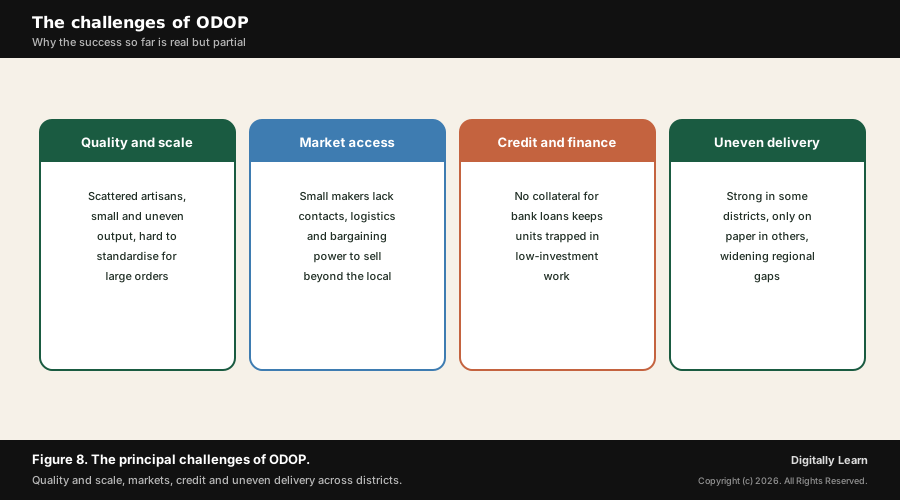
Quality and scale, market access, credit, branding and uneven implementation across districts
For all its promise, ODOP faces real challenges, the first of which is quality and scale. Many district products are made by scattered artisans using traditional methods, so output is small, uneven in quality and hard to standardise for large or export orders. Moving from a handful of skilled makers to a reliable supply chain that can fill a big contract is difficult and slow. A second challenge is market access: even a fine product fails if producers cannot reach buyers, and small makers often lack the contacts, the logistics and the bargaining power to sell beyond the local market.
A third challenge is credit and finance. Micro-enterprises and artisans frequently cannot offer the collateral that banks ask for, so they stay trapped in low-investment work, unable to buy better tools or hold stock, and dependent on costly informal lenders. A fourth challenge is branding and competition. Building a trusted brand takes time and money, and a single district product must compete with mass-produced and imported goods that are cheaper, even where the ODOP product is finer, so without sustained marketing the brand can fade as quickly as it rose.
A fifth challenge is uneven implementation. ODOP depends heavily on the capacity and drive of each state and district, so some districts run vigorous programmes while others list a product on paper and do little, which widens rather than narrows regional gaps. There are also questions of environmental strain where a craft uses scarce resources, and of whether the gains reach the poorest workers or only the larger producers. These obstacles explain why ODOP's success so far is real but partial. The figure below sets out the principal challenges.
Understanding the Significance: Local Value Chains, Employment and Balanced Regional Development
Building local value chains, creating employment against jobless growth and spreading balanced regional development
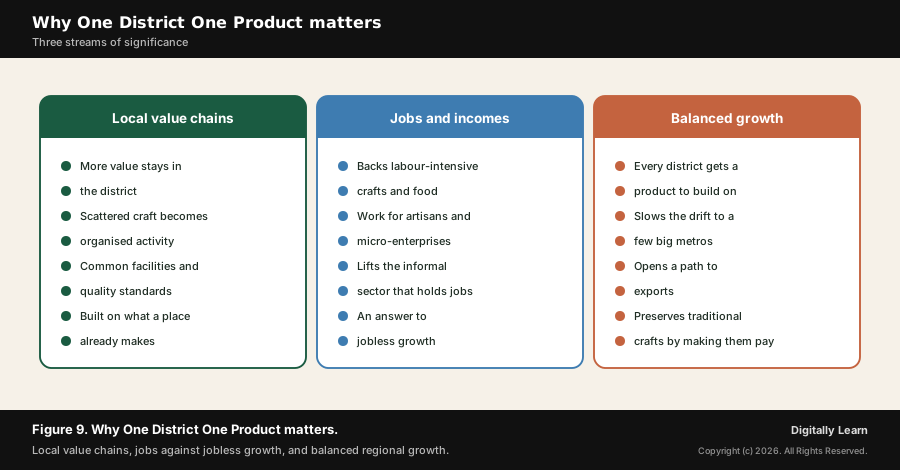
What is the significance of One District One Product lies first in the building of local value chains. By concentrating support on a district's own product and helping producers process, brand and sell it, ODOP lets more of a product's value stay in the district instead of leaking to distant middlemen. This turns a scattered craft into an organised economic activity, with common facilities, quality standards and market links, and it does so by building on what a place already knows how to make rather than importing an alien industry.
Its second significance is employment, and here ODOP speaks directly to the worry of jobless growth. Because it backs labour-intensive crafts, handlooms and food processing, the programme creates work for artisans, weavers, farmers and micro-entrepreneurs in the informal sector that carries most of India's jobs. By raising their productivity and incomes where they live, it offers a model of growth that employs ordinary workers rather than passing them by, which is precisely the kind of measure a jobless-growth critique calls for.
Its third significance is balanced regional development. By giving every district, not only the big cities, a product to build on, ODOP spreads opportunity across the country and slows the drift of work towards a few metros. It also opens a path to exports, letting even small districts earn from global markets, and it preserves traditional crafts by making them pay. Read together, the building of value chains, the creation of jobs and the spread of balanced growth are why ODOP is treated as an important idea in India's development policy. The figure below maps these strands.
The Way Forward: From Product Identification to Durable Local Value Chains
Strengthening clusters, widening markets and credit, and making implementation even and accountable
The way forward follows from the challenges. The first priority is to move beyond merely identifying a district product to building the full chain behind it: investing in skills, common facilities, quality testing and design so that output can grow without losing its character. A product named on a portal achieves little until the cluster that makes it is strengthened to deliver in volume and to a reliable standard, which is the harder and more lasting part of the work.
A second priority is to widen market access and credit. Steady links to buyers, exhibitions, retail and e-commerce through platforms such as ONDC, together with easier and cheaper finance for micro-enterprises, would let producers move from selling locally to selling nationally and abroad. Special care is needed so that the gains reach the artisan and the smallest unit, not only the larger trader, since the programme's promise of employment depends on support flowing to those who actually do the work.
A third priority is to make implementation even and accountable. Sharing the methods of the districts that have done well, measuring ODOP by real outcomes such as jobs created, incomes raised and exports earned rather than by products listed, and protecting the environment and the worker as output grows, would keep the model honest. Pursued together, a strong supply chain, open markets and even delivery would turn ODOP from a promising label into a durable source of local livelihoods and balanced growth.
UPSC Relevance and Exam Focus
Where One District One Product fits in the UPSC-CSE syllabus
This topic maps most directly to General Studies Paper III, to the sections on inclusive growth and employment, on the development of industry, on the micro, small and medium enterprise sector, and on food processing and its supply-chain management, since ODOP is a government intervention aimed at local enterprise and jobs. It also touches agriculture, through farm and food products, and links to questions on government schemes, exports and balanced regional development, giving rich material on how policy tries to make growth more job-creating.
For Prelims, hold the high-yield facts: One District One Product began in Uttar Pradesh in 2018 and is now a national initiative run by the DPIIT under the Ministry of Commerce and Industry; it is operationally merged with the Districts as Export Hubs initiative carried by the DGFT; the PM FME scheme of the Ministry of Food Processing Industries adopts the ODOP approach with a credit-linked subsidy; and ODOP product selection takes GI-tagged products into account. Distinguish ODOP from the schemes it works with.
For Mains, the recurring framing is whether targeted, district-level support can make growth more employment-rich, the very question behind the jobless-growth debate. A strong answer treats ODOP as a case study in labour-intensive, place-based development, weighing its promise of local jobs, value addition and balanced growth against the real challenges of quality, scale, credit and uneven delivery, and locating its success in building durable value chains rather than in announcing products.
Recurring linked concepts and common exam traps
Recurring linked concepts an aspirant should keep in working memory:
- Districts as Export Hubs: The DGFT-led initiative, merged with ODOP, that identifies export-potential products and prepares District Export Action Plans for every district.
- PM FME scheme: The Ministry of Food Processing Industries scheme that uses the ODOP approach and gives a 35 per cent credit-linked subsidy, up to Rs 10 lakh, to micro food enterprises.
- Geographical Indication: A tag that protects a product’s link to its place of origin, taken into account when a district’s ODOP product is chosen.
- Jobless growth: Economic growth that creates relatively few jobs, the concern ODOP’s labour-intensive, district-level model is meant to address.
A common Prelims trap is to confuse the bodies. Hold that the national One District One Product initiative is run by the DPIIT, that its export side runs through the DGFT under the Districts as Export Hubs framework, and that the food-processing pathway is the PM FME scheme of the Ministry of Food Processing Industries. Remember too that Districts as Export Hubs is an initiative, not a scheme, so it carries no cash grant of its own.
A common Mains trap is to praise ODOP as a branding success and stop there. The exam value lies in a balanced judgment: the genuine gain in local jobs, value addition and balanced regional growth, set honestly against the unfinished challenges of quality, scale, credit, branding and uneven implementation, with the durable solution located in strong value chains and steady markets rather than in product lists alone.
Previous Year UPSC-CSE Questions By the end you will be able to draft model answers for the following UPSC questions. Each question carries a collapsible framework showing how to approach it in the exam.
- UPSC Mains 2015 GS-IIIThe nature of economic growth in India in recent times is often described as jobless growth. Do you agree with this view? Give arguments in favour of your answer.
How to structure the answer in the exam
Body (sub-themes to develop):
- Argue why much of India's growth has been relatively jobless: it has been led by capital-intensive industry and by skill-heavy services with low employment elasticity, so output has outrun the creation of decent jobs.
- Show where employment actually sits: in agriculture, the informal economy and the micro, small and medium enterprise sector, which carry most workers but suffer low productivity, weak credit and poor market access.
- Present labour-intensive, district-level support as part of the answer, using One District One Product as a worked example that backs crafts, handlooms and food processing which employ many hands per rupee invested.
- Explain how such support raises employment: value addition, branding, the PM FME credit-linked subsidy, market access through e-commerce and exports, and the building of local value chains that create work close to home.
- Acknowledge the limits: schemes like ODOP face challenges of quality, scale, credit and uneven delivery, and broader job creation also needs labour reforms, skills and investment, so a single programme is necessary but not sufficient.
Relevance to this topic. ODOP backs each district's labour-intensive craft, handloom and food product, supporting artisans and micro-enterprises in the informal sector that carries most jobs. The article uses it as evidence that targeted, place-based support can answer the jobless-growth concern with real local employment.
Sources and Further Reading
- DPIIT: One District One Product initiative
- Press Information Bureau: One District One Product (ODOP)
- DGFT: Districts as Export Hubs initiative
- Department of Commerce: Districts as Export Hubs
- Ministry of Food Processing Industries: PM FME and One District One Product
- Press Information Bureau: PM FME scheme adopts the ODOP approach
- NITI Aayog: balanced regional development
- Ministry of Statistics and Programme Implementation: Periodic Labour Force Survey
- Wikipedia: One District One Product (Uttar Pradesh)
Editorial Disclaimer
This briefing is for UPSC preparation. Verify the figures against the official DPIIT, DGFT and Ministry of Food Processing Industries sources before relying on them.


