


Overview
Credit-linked subsidy, ODOP and self-help group support for the small processor
Launched on 29 June 2020 by the Ministry of Food Processing Industries under Atmanirbhar Bharat, PM-FME is a centrally sponsored scheme to formalise and upgrade India's unorganised micro food processing units, through a credit-linked subsidy, the One District One Product approach and seed capital for self-help groups.
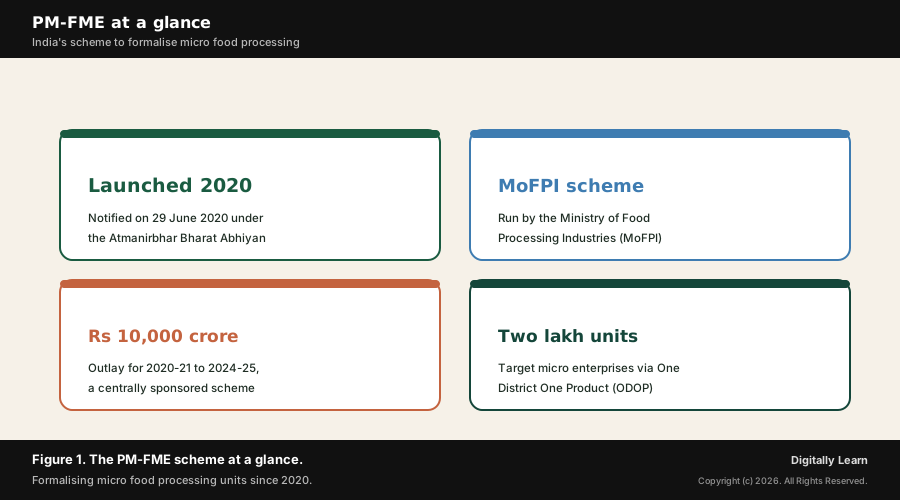
The Pradhan Mantri Formalisation of Micro Food Processing Enterprises scheme, branded PM-FME, is a centrally sponsored scheme of the Ministry of Food Processing Industries, launched on 29 June 2020 under the Atmanirbhar Bharat Abhiyan. With an outlay of about Rs 10,000 crore, it formalises and upgrades India's vast unorganised micro food processing sector through a credit-linked capital subsidy of 35 per cent up to Rs 10 lakh per unit, the One District One Product approach, seed capital for self-help groups, support to Farmer Producer Organisations and cooperatives, common infrastructure, branding, marketing and capacity building.
What PM-FME Is: The 2020 Launch under Atmanirbhar Bharat, MoFPI and the Formalisation Mandate
The 29 June 2020 launch by the Ministry of Food Processing Industries under the Atmanirbhar Bharat Abhiyan, the Rs 10,000 crore outlay and the credit-linked, One District One Product design
The Pradhan Mantri Formalisation of Micro Food Processing Enterprises scheme, known as PM-FME, is a centrally sponsored scheme of the Ministry of Food Processing Industries. It was launched on 29 June 2020 under the Atmanirbhar Bharat Abhiyan to formalise and upgrade India's vast unorganised micro food processing sector. Rather than build large factories, the scheme helps existing tiny units, household processors and self-help groups to modernise, register and reach a wider market, so that more of the value added to farm produce stays close to the farmer.
The scheme runs with an outlay of about Rs 10,000 crore and was framed for the five years from 2020-21 to 2024-25, a period that later official documents carry to 2025-26. Its declared target is to give direct help to about two lakh micro enterprises, organised around the One District One Product approach so that each district can build scale in one chosen produce. The aims are wider access to credit, better technology and food safety, common infrastructure, and stronger branding and marketing for the small processor.
Why it matters is that food processing decides how much of the farm-gate value a grower finally keeps. Most of India's processing is done by countless tiny, informal units that earn little and stay outside the formal economy, so the produce they handle adds modest value and yields small incomes. By placing the Ministry of Food Processing Industries behind a credit-linked, cluster-based push, PM-FME treats the formalisation of these micro units as a route to higher rural incomes and employment. The figure below sets out PM-FME at a glance.
Why India's Micro Food Processing Units Struggle: Informality, No Credit, Weak Technology and No Branding
The unorganised and unregistered base, the lack of formal credit and collateral, weak technology and food-safety compliance, poor common infrastructure, and the absence of branding, marketing and skills that hold back small processing units
India's food processing is dominated by a huge number of micro and unorganised units, home kitchens, tiny mills and small workshops that grade, mill, dry or pack farm produce. Most are unregistered and keep no formal accounts, so they sit outside the tax, credit and quality systems of the formal economy. Because they are informal and scattered, they cannot easily prove their turnover to a bank, meet a buyer's standards, or bargain as a group, and they remain stuck at a small, low-value scale.
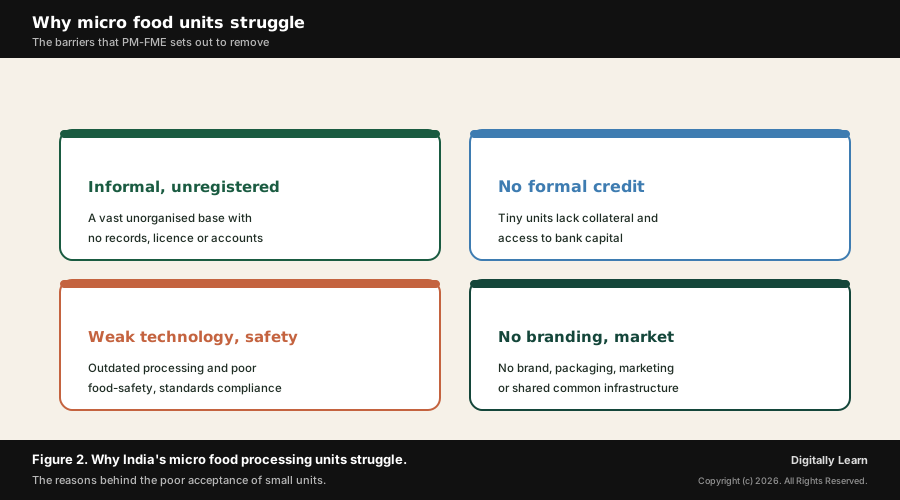
The barriers are concrete. A tiny unit usually lacks the collateral and records that a bank wants, so formal credit for new equipment is hard to get and the unit falls back on costly informal loans. Its technology is often outdated, and meeting food-safety and standards compliance, such as registration with the food regulator, is difficult without help. There is rarely any shared cold storage, testing or packaging facility nearby, and the processor has no brand, no organised marketing and little training, so the product fetches a low price.
What is the significance of this is that it explains the poor acceptance of cost-effective small processing units, the very question the 2017 examination raises. A small unit may be cheap to set up, yet without credit, technology, standards, infrastructure and marketing it cannot run reliably or sell at a fair price, so few entrepreneurs adopt it and many that start do not survive. PM-FME is built precisely to remove these barriers one by one, as the next sections show. The figure below maps why micro units struggle.
The Credit-Linked Capital Subsidy: 35 Per Cent Support up to Rs 10 Lakh per Micro Unit
The credit-linked capital subsidy of 35 per cent of the eligible project cost, the ceiling of Rs 10 lakh per unit, the bank-appraised term loan, and the beneficiary contribution that ties the scheme to formal finance
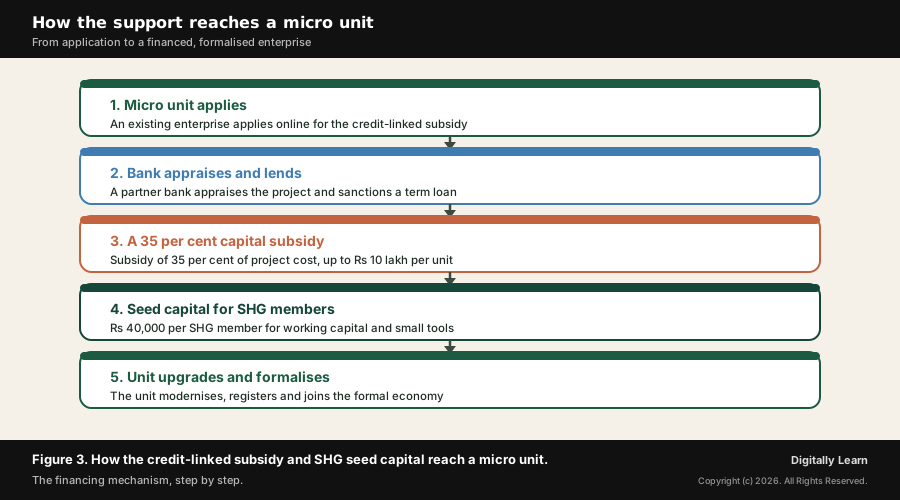
The core instrument of PM-FME for an individual processor is a credit-linked capital subsidy. An existing micro food processing unit applies, a partner bank appraises the project and sanctions a term loan, and the government then provides a capital subsidy of 35 per cent of the eligible project cost, subject to a ceiling of Rs 10 lakh per unit. The beneficiary brings a margin of at least ten per cent, and the balance is the bank loan, so the subsidy is tied to genuine, appraised investment rather than to a simple cash grant.
Tying the subsidy to a bank loan does two things at once. It brings the informal unit into a formal credit relationship, giving it a bank account, a credit record and a path to future finance, which is itself a step towards formalisation. It also makes the public money go further, since each rupee of subsidy pulls in bank lending and the processor's own contribution. The support can be used to buy machinery, upgrade the premises or meet food-safety norms, the very gaps that kept the small unit from being cost-effective before.
What is the significance of this design is that it answers the first barrier behind poor acceptance, the lack of capital. A small processor that could never raise the money for a dryer, a grinder or a cold room can now do so with a subsidised, appraised loan. Because the subsidy is credit-linked, it reaches only viable projects and leaves the unit with a banking relationship it can use again. The figure below traces how the subsidy and the self-help group seed capital reach the micro unit.
The One District One Product (ODOP) Approach and Cluster-Based Development
The One District One Product framework that selects a focus produce for each district, the gains of scale in inputs, common services and marketing, and the link to clusters, branding and shared infrastructure
PM-FME is organised around the One District One Product, or ODOP, approach. Each district identifies a food produce in which it has a natural strength, a fruit, a grain, a spice or a marine product, and the scheme then concentrates its support for micro units, common infrastructure and branding on that chosen produce. Examples range widely, from mango, makhana and millets to honey, turmeric and chillies, so that a district builds depth in a product its farmers already grow and that buyers can come to recognise.
What is the significance of the ODOP design is that it creates scale where individual micro units have none. When many small processors in a district work on the same produce, they can buy inputs together, share common facilities for sorting, storage and testing, and market under a common brand, which lowers cost and raises bargaining power. ODOP also guides where the scheme places incubation centres and infrastructure, so that public support is concentrated rather than thinly spread. It turns scattered units into a recognisable cluster that buyers and lenders can trust.
Support to Self-Help Groups, FPOs and Cooperatives: Seed Capital, Common Infrastructure and Incubation
The seed capital of Rs 40,000 per self-help group member, the support to Farmer Producer Organisations and cooperatives, the grants for common infrastructure, and the incubation centres for product development and training
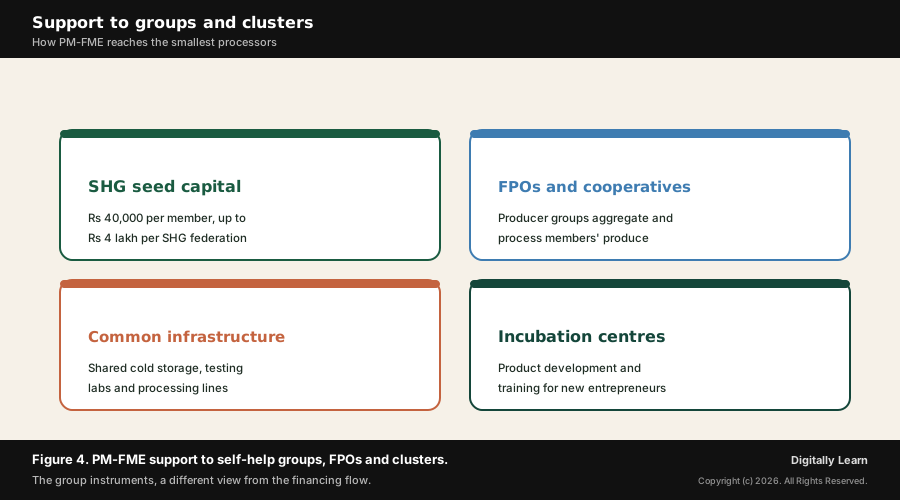
Alongside the individual subsidy, PM-FME supports groups. Self-help groups active in food processing receive seed capital of Rs 40,000 per member for working capital and the purchase of small tools, routed through the self-help group federation up to a ceiling of Rs 4 lakh per federation, and delivered with the National Rural Livelihood Mission and its state missions. This reaches the poorest processors, many of them rural women, who would otherwise have neither collateral nor savings to start, and it draws them into the scheme as a first rung on the ladder.
The scheme also backs larger collectives and shared assets. Farmer Producer Organisations, producer cooperatives and similar groups are supported to process and sell their members' produce, while grants for common infrastructure, such as shared cold storage, warehousing, testing labs and processing lines, give clusters the facilities that no single micro unit could afford. Support for the capital investment of these groups helps build the backbone of an ODOP cluster, so that small producers can move from selling raw produce to making processed, branded products.
To bring new entrepreneurs in, PM-FME funds incubation centres. As on 31 January 2024 the Ministry had approved 76 incubation centres with an outlay of about Rs 205.95 crore across 25 States and Union Territories, where micro entrepreneurs can test recipes, develop and pack products and learn to meet standards before they invest. Together the seed capital, the group support, the common infrastructure and the incubation centres widen the door, so that even the smallest and poorest processor can step onto the formal ladder. The figure below sets out this group support.
Branding, Marketing and Capacity Building: NAFED, TRIFED, Resource Persons and Training
The branding and marketing support through tie-ups with NAFED and TRIFED, the capacity building and skill training for processors, and the District Resource Persons who handhold applicants on the ground
PM-FME recognises that a better product still needs a market. Under its branding and marketing component, the scheme helps groups and clusters develop a brand, packaging and quality control, and the Ministry has tied up with NAFED and TRIFED to take up branding and marketing for selected ODOP products along the value chain. By turning an anonymous local product into a recognised, packaged brand, the scheme lets the processor reach modern retail and earn a higher margin than a loose, unbranded sale allows.
The scheme invests heavily in capacity building. It trains beneficiaries, master trainers, district level trainers and District Resource Persons, who in turn handhold applicants through choosing a project, preparing a bankable proposal, applying online and meeting food-safety norms. This support matters because the typical micro processor has little experience of banks, paperwork or standards, and it is often the absence of such guidance, not the absence of money alone, that kept cost-effective small units from being adopted in the first place.
Cost Sharing and Institutional Architecture: MoFPI, State Nodal Agencies and the Banking Channel
The Centre-State cost-sharing ratios of 60:40, 90:10 for the North Eastern and Himalayan States and full central funding for some Union Territories, and the delivery chain of MoFPI, State Nodal Agencies, district committees and lending banks
As a centrally sponsored scheme, PM-FME shares its cost between the Centre and the States. The general ratio is 60:40 between the Centre and a State, it is 90:10 for the North Eastern and the Himalayan States, 60:40 for Union Territories with a legislature, and the Centre meets the full cost for the other Union Territories. This sharing gives the States a stake in delivery while the Centre carries the larger share, especially in the hill and special-category regions where micro units most need support.
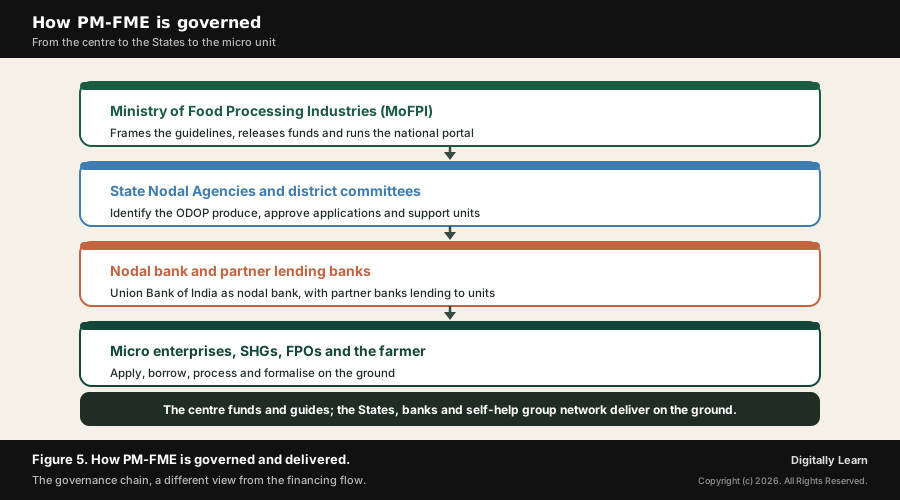
Delivery runs through a clear chain. The Ministry of Food Processing Industries frames the guidelines, releases the funds and runs the national portal, while every State and Union Territory appoints a State Nodal Agency, supported by state and district committees, to identify the ODOP produce, approve applications and handhold units. On the finance side, the Union Bank of India acts as the nodal bank and a network of partner banks appraises projects and lends, so that the subsidy can be released against a genuine loan.
What is the significance of this architecture is that the scheme can reach the smallest unit only by working through the States, the self-help group network and the banks at once. The Centre funds and guides, but it is the State Nodal Agencies, the rural livelihood missions and the lending banks that find the units, approve them and place money in their hands. Where this chain works well the scheme moves quickly; where a State or its banks are slow, deserving units wait. The table below contrasts the micro unit before and with PM-FME.
| Aspect | Micro unit without support | Micro unit under PM-FME |
|---|---|---|
| Status | Informal and unregistered | Formalised, registered and bankable |
| Finance | Costly informal loans, no collateral | Bank term loan with a 35 per cent capital subsidy |
| Technology and safety | Outdated tools, weak standards | Upgraded equipment and food-safety compliance |
| Scale and inputs | Isolated, buys and sells alone | Cluster under One District One Product |
| Group support | No collective backing | SHG seed capital, FPO and common infrastructure |
| Branding and market | Unbranded, local sale at a low price | Brand and marketing via NAFED and TRIFED |
Progress and Scale of PM-FME: Loans Sanctioned, SHG Members Supported and Enterprises Formalised
The loans sanctioned for credit-linked subsidy, the self-help group members given seed capital, the investment mobilised and jobs generated, and the enterprises formalised against the two-lakh target
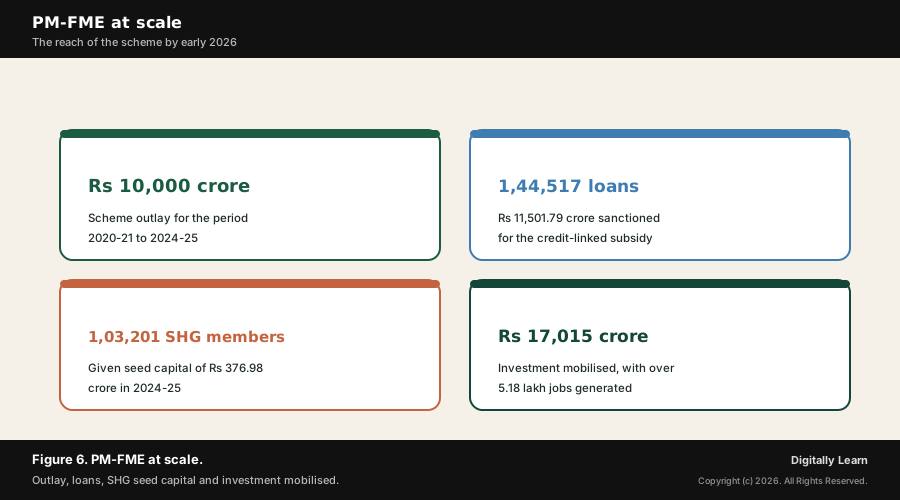
PM-FME has built a sizeable base. Across the country, about 1,44,517 loans worth roughly Rs 11,501.79 crore have been sanctioned to individual micro units and groups for the credit-linked subsidy, drawing thousands of small processors into formal bank finance for the first time. On the group side, seed capital has been approved for about 1,03,201 self-help group members, amounting to about Rs 376.98 crore in 2024-25, reaching the poorest, often women-led, processors whom no bank would have funded alone.
The wider impact shows in investment and jobs. By official accounts the scheme has helped formalise about 59,202 micro food processing enterprises since inception, mobilised about Rs 17,015 crore of investment and supported over 5.18 lakh jobs across the country, as small units modernised and grew. These numbers sit against an ambitious target of two lakh enterprises, so the scheme has made real progress while a large part of the vast informal sector still remains to be reached.
Read together, the figures show steady advance rather than a finished task. The credit-linked subsidy, the seed capital and the incubation support have begun to turn informal units into formal, financed and branded enterprises, and the investment and jobs they generate flow into rural areas. Yet, as the next section sets out, the share of micro processors actually reached remains modest against the scale of the unorganised sector, and the hardest barriers of credit, compliance and market access have not vanished. The figure below sets out PM-FME at scale.
Challenges Before PM-FME: A Vast Informal Base, Credit Access, FSSAI Compliance and Market Linkage
The slow pace of formalising a vast informal base, the continuing difficulty of credit and collateral for micro units, the burden of food-safety and standards compliance, and the gaps in branding, market linkage and awareness
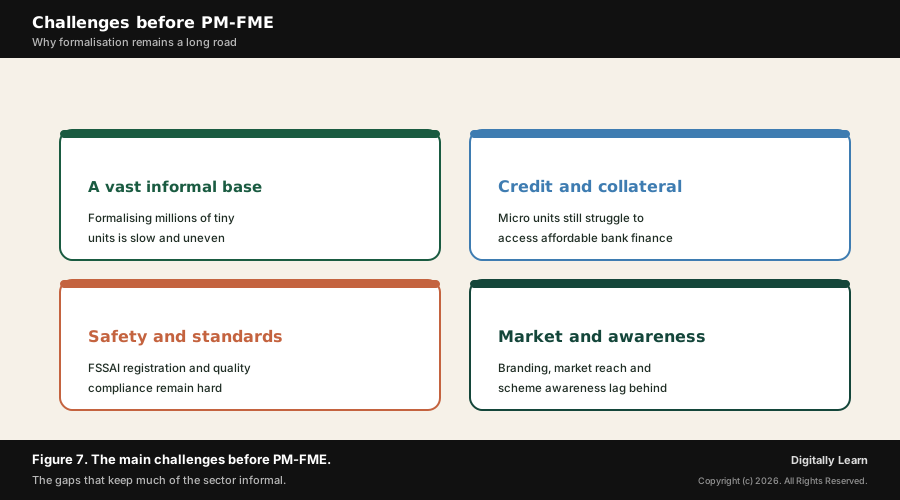
Judged honestly, PM-FME has done much but faces real limits. The informal food processing base is vast, running into many millions of tiny units, so even strong yearly numbers reach only a fraction, and formalising such a scattered, mostly unregistered sector is inherently slow. Awareness of the scheme among the smallest processors is uneven, and many never apply, so the very units that most need support can be the hardest to find and to bring in.
The old barriers also persist in new forms. Despite the subsidy, credit access remains hard, since banks are cautious about tiny borrowers with little collateral, and loan appraisal can be slow. Meeting food-safety and FSSAI registration and quality standards is still a hurdle for an unlettered processor, and branding, packaging and market linkage, though supported, take time to build, so many assisted units still sell locally at modest margins. Logistics and steady demand for the new branded products are not guaranteed.
These are reasons to deepen the scheme, not to doubt its direction. Because food processing touches credit, technology, standards, infrastructure and markets at once, no single instrument can formalise the sector quickly, and progress depends on banks, State agencies and the self-help group network all working together. The honest reading is that PM-FME has built a real but partial answer to a deep structural problem, and that the unfinished agenda is large. The figure below sets out the main challenges.
Significance for Poor Farmers and the Food Processing Sector: Value Addition, Incomes, Rural Jobs and Women's Empowerment
How micro food processing units uplift the socio-economic status of poor farmers through value addition, reduced post-harvest losses, better farm-gate prices, rural non-farm employment and the empowerment of women and self-help groups
The deeper purpose of PM-FME is to lift the socio-economic status of poor farmers, the second half of the 2017 examination question. A food processing unit adds value to raw produce by cleaning, milling, drying, packing or making a finished product, so that more of the final price is captured near the farm rather than far down the chain. It also reduces post-harvest losses, because perishable fruit, vegetables and milk that would otherwise rot can instead be dried, preserved or processed and sold over a longer period.
These gains translate into income and work. By processing locally, farmers and their groups earn a better farm-gate price and a share of the processing margin, instead of selling raw produce cheaply at the peak of harvest. Processing units create rural non-farm employment for landless and marginal households, so that incomes no longer depend on the crop alone. Where self-help groups run the units, the seed capital and training give rural women an independent livelihood and a stronger voice, which is empowerment in the fullest sense.
What is the significance of this for the poor farmer is that PM-FME's instruments map directly onto the reasons small units were not adopted before. The credit-linked subsidy supplies the missing capital, the seed capital reaches self-help groups, ODOP and common infrastructure give scale, and branding with NAFED and TRIFED opens markets. Together they turn a cheap but unviable small unit into a working, financed and branded enterprise, so that processing becomes a real path out of low farm incomes for the poorest producers.
The Way Forward: Deepening the Formalisation of India's Micro Food Processing Sector
Widening credit access, simplifying food-safety compliance, strengthening ODOP clusters and FPOs, expanding branding and market linkage, raising awareness and building the digital and skill capacity of micro processors
The path ahead is to convert a strong start into a deep and lasting formalisation. That means reaching far more of the informal units, making credit and compliance easier, and ensuring that the processed products find a steady market. The measures below set out a balanced way to strengthen PM-FME and the wider micro food processing sector.
- Widen and speed up credit access for micro units by simplifying loan appraisal, strengthening credit guarantees and building the bankability of the smallest processors.
- Make food-safety and FSSAI registration and quality compliance easier through handholding, shared testing labs and simpler procedures, so that standards stop being a barrier to formalisation.
- Strengthen One District One Product clusters, Farmer Producer Organisations and self-help groups, so that small processors gain scale in inputs, common facilities and bargaining power.
- Expand branding, packaging and market linkage beyond NAFED and TRIFED to modern retail, exports and e-commerce, so that formalised units can sell at a fair margin.
- Raise awareness of the scheme among the poorest and most remote processors, and build their digital and entrepreneurial skills, so that those who most need support actually apply.
- Invest in common infrastructure, cold chains and logistics around clusters, so that perishable produce can be processed, stored and moved without heavy post-harvest loss.
- Track outcomes such as incomes, the survival of assisted units and women’s participation, and use the findings to refine the scheme, so that formalisation is genuine and not merely on paper.
UPSC Relevance: GS-III Economy, the Prelims Pointers and the Food Processing Mains Framing
The GS-III economy and agriculture fit, the Prelims facts on launch, ministry, subsidy and ODOP, and the food-processing-and-poor-farmer Mains framing of the 2017 PYQ on small processing units
For the examination, PM-FME sits in GS-III, under the economy, agriculture, food processing and inclusive growth. The facts worth fixing for Prelims are the launch on 29 June 2020 by the Ministry of Food Processing Industries under the Atmanirbhar Bharat Abhiyan, the Rs 10,000 crore outlay, the credit-linked subsidy of 35 per cent up to Rs 10 lakh per unit, the One District One Product approach, and the Rs 40,000 seed capital per self-help group member. Candidates should not confuse PM-FME, a micro-enterprise scheme, with the larger food processing infrastructure schemes.
For Mains, PM-FME is the standard example for any answer on food processing and rural livelihoods. It lets a student first explain the reasons for poor acceptance of cost-effective small processing units, informality, no credit, weak technology and standards, poor infrastructure and no branding, and then show how processing units uplift the socio-economic status of poor farmers through value addition, lower post-harvest losses, better prices, rural jobs and women's empowerment. The 2017 question on small processing units maps directly onto this need-and-response structure.
Contemporary linkages place PM-FME within a wider push to raise farm incomes and build the food economy. It works alongside the One District One Product branding effort, the Farmer Producer Organisation movement, the food regulator's safety regime and the larger food processing infrastructure schemes, and it speaks to debates on doubling farmers' income, on women-led self-help groups and on formalising the informal economy. Read this way, PM-FME is a central instrument of India's attempt to add value to its farm produce close to the farmer.
Previous Year UPSC-CSE Questions By the end you will be able to draft model answers for the following UPSC questions. Each question carries a collapsible framework showing how to approach it in the exam.
- UPSC Mains 2017 GS-IIIWhat are the reasons for poor acceptance of cost-effective small processing unit? How the food processing unit will be helpful to uplift the socio-economic status of poor farmers?
How to structure the answer in the exam
Body (sub-themes to develop):
- Reasons for poor acceptance, part one: the units are informal and unregistered, with no books or licence, so they cannot prove turnover, access formal credit or meet a buyer's standards, and they lack the collateral a bank requires.
- Reasons for poor acceptance, part two: weak and outdated technology, the difficulty of meeting food-safety and standards compliance, the absence of nearby common infrastructure such as cold storage and testing, and the lack of branding, organised marketing, skills and training that leave the product fetching a low price.
- How a food processing unit uplifts poor farmers, part one: value addition lets more of the final price be captured near the farm, reduced post-harvest losses save perishable produce, and processing yields a better farm-gate price and a share of the processing margin instead of a cheap raw sale at harvest.
- How a food processing unit uplifts poor farmers, part two: processing creates rural non-farm employment for landless and marginal households, and self-help group units give rural women an independent livelihood and a stronger voice, raising household incomes and social status.
- The PM-FME response that maps onto each barrier: a 35 per cent credit-linked subsidy up to Rs 10 lakh supplies capital, Rs 40,000 seed capital reaches self-help group members, the One District One Product approach and common infrastructure give scale, capacity building and District Resource Persons handhold applicants, and branding through NAFED and TRIFED opens markets.
Relevance to this topic. The body first explains the reasons for poor acceptance of small processing units, informality, no credit, weak technology, poor infrastructure and no branding, then shows how processing units uplift poor farmers through value addition, reduced post-harvest losses, better prices, rural jobs and women's empowerment, with PM-FME's instruments attacking each barrier.
Sources and Further Reading
- Ministry of Food Processing Industries: PM-FME scheme guidelines on the credit-linked subsidy, cost sharing, ODOP and seed capital
- Ministry of Food Processing Industries: seed capital of Rs 40,000 per self-help group member under PM-FME
- Press Information Bureau: PM-FME launched under Atmanirbhar Bharat with an outlay of Rs 10,000 crore for two lakh micro enterprises through ODOP
- Press Information Bureau: progress and performance of the PM-FME scheme, loans sanctioned and SHG seed capital
- Press Information Bureau: PM-FME formalises micro food processing enterprises, mobilises investment and generates jobs
- NITI Aayog: enhancing the competitiveness of micro, small and medium enterprises in India
- World Bank: agribusiness and helping smallholder farmers reach markets and reduce post-harvest losses
- FAO: on-farm post-harvest handling and value addition to reduce losses and raise farm income
- Wikipedia: Ministry of Food Processing Industries
Editorial Disclaimer
This briefing is for UPSC preparation. Verify the scheme components and the progress figures against the official PM-FME portal, the Ministry of Food Processing Industries and Press Information Bureau sources before relying on them.


