


Overview
The flagship push to make India a nation of job creators
Startup India, launched on 16 January 2016 and run by the Department for Promotion of Industry and Internal Trade, recognises innovative startups, grants them tax and compliance relief, and channels risk capital through the Fund of Funds for Startups, the Seed Fund Scheme and a credit guarantee, to build one of the world's largest startup ecosystems.
Startup India is the flagship initiative of the Government of India, launched on 16 January 2016 and run by the Department for Promotion of Industry and Internal Trade (DPIIT) in the Ministry of Commerce and Industry, to build a strong ecosystem for nurturing innovation and entrepreneurship. Its founding charter was a 19-point Action Plan across three themes: simplification and handholding, funding support and incentives, and industry-academia partnership and incubation. The scheme works through a single recognition: once DPIIT recognises an entity as a startup, it unlocks tax incentives, eased compliance and access to dedicated financing such as the Fund of Funds for Startups. The stated goal is to turn India into a country of job creators rather than job seekers.
What Startup India Is: A DPIIT Initiative to Grow Innovation and Enterprise
The 2016 launch, the 19-point Action Plan and the role of DPIIT
Startup India is the Union Government's flagship programme for the country's startup and entrepreneurship ecosystem, launched on 16 January 2016 with the stated ambition of turning India into a nation of job creators rather than job seekers. The scheme is run by the Department for Promotion of Industry and Internal Trade, which sits in the Ministry of Commerce and Industry, frames the rules, recognises startups and manages the funding schemes.
The programme was launched with a structured 19-point Action Plan that still shapes its design. The plan grouped its measures under three themes: simplification and handholding, to ease the regulatory burden on a young firm; funding support and incentives, to put risk capital and tax relief within reach; and industry-academia partnership and incubation, to link new ventures to research, mentors and infrastructure. Together, the three themes were meant to lower the cost and the risk of starting up.
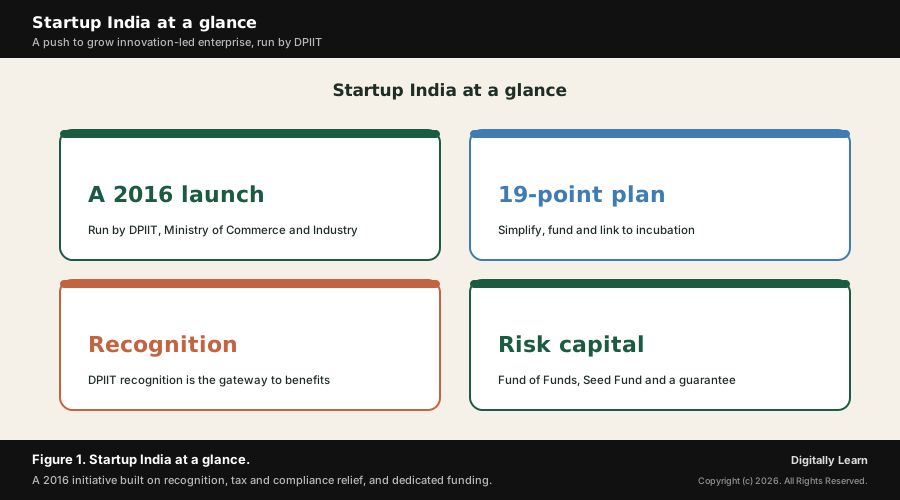
Why it matters is that the scheme rests on a deliberate idea of the modern firm. Startup India targets not every small business but the innovative, scalable venture that can create wealth and jobs at speed, and it works through a single gateway: a startup that obtains DPIIT recognition becomes eligible for the tax, compliance and funding benefits that follow. The figure below sets out the scheme's headline features, the facts an aspirant should hold before the detail that follows.
Why a startup push: jobs, innovation and the demographic dividend
The case for a dedicated startup policy begins with India's demographic dividend. With one of the world's youngest populations and many graduates entering the workforce each year, the country must create jobs faster than the established corporate sector alone can. The Government's wager is that young firms, which grow quickly and hire as they scale, can absorb talent in a way salaried employment cannot, which is why the founding aim was to turn job seekers into job creators.
A second part of the case is innovation and self-reliance. A vibrant startup base lets India build home-grown technology in fields such as financial technology, software, electric mobility and deep technology, rather than importing it. The third part is the market failure the scheme corrects: a new, unproven venture struggles to raise early capital, faces a thicket of compliances and cannot easily reach buyers, so the state lowers these barriers and crowds in private capital it could not raise alone.
DPIIT Startup Recognition: The Definition and the Benefits It Unlocks
The DPIIT startup definition: age, turnover and the innovation test
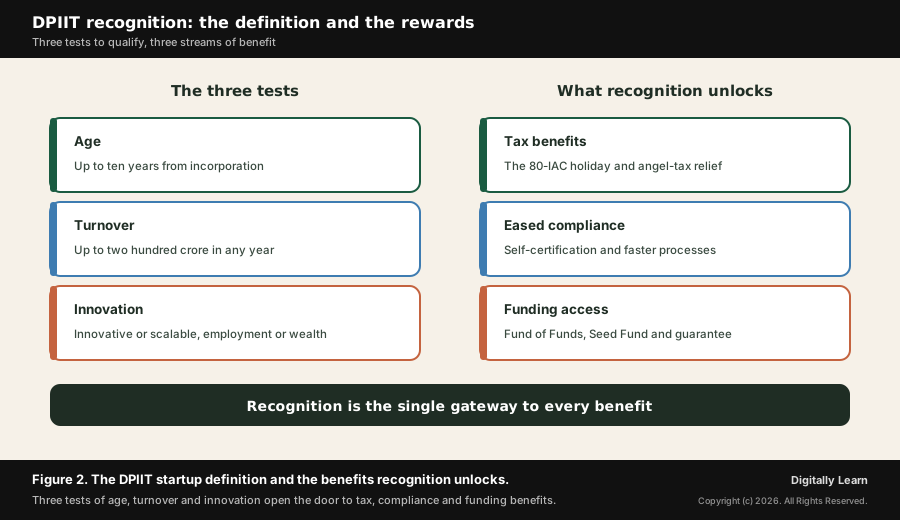
Every benefit under the scheme flows from a single act: DPIIT recognition. To be recognised as a startup, an entity must meet a precise definition rather than simply call itself one. It must be incorporated as a private limited company, a registered partnership firm or a limited liability partnership, and it must apply online through the Startup India portal, where recognition is granted after the application is examined.
The definition turns on three tests. The first is age: an entity is treated as a startup for up to ten years from the date of its incorporation. The second is size: its annual turnover must not have exceeded two hundred crore rupees in any financial year since incorporation. The third, and the heart of the definition, is innovation and scalability, which the next paragraph explains.
On the third test, the entity must be working towards innovation, development or improvement of products, processes or services, or have a scalable business model with a high potential for employment generation or wealth creation. An entity formed by splitting up or reconstructing an existing business is expressly excluded, which keeps the recognition for genuinely new ventures rather than rebadged old ones.
Recognition is the gateway, not the destination. Once an entity holds the certificate, it may apply for the tax exemptions, the eased compliances and the funding schemes that this article describes, and it carries a verifiable startup badge that public buyers and investors trust. The recognition confers a status; the substantive reliefs each have their own, often stricter, eligibility, so a recognised startup must still qualify separately for the tax holiday.
The Tax Incentives: The Section 80-IAC Holiday and the Angel-Tax Story
Section 80-IAC: the three-year income-tax holiday for eligible startups
The headline tax relief is the income-tax holiday under Section 80-IAC of the Income-tax Act. An eligible startup may claim a hundred per cent deduction of its profits for any three consecutive financial years chosen out of its first ten years since incorporation, which lets a young firm shelter its early profits and reinvest them in growth. The relief is targeted, not automatic: a recognised startup applies separately for the 80-IAC certificate and is cleared by an inter-ministerial board.
The eligibility for the holiday is tighter than for recognition alone. The startup must be a private limited company or a limited liability partnership, incorporated within the qualifying window, and its turnover in the year of the deduction must not exceed one hundred crore rupees, below the two-hundred-crore threshold for recognition. The logic is to defer the tax burden until the venture is on its feet, so early cash builds the business.
The angel-tax issue under Section 56(2)(viib) and its abolition
No tax question troubled the ecosystem more than the so-called angel tax. It arose from Section 56(2)(viib) of the Income-tax Act, under which an unlisted company that issued shares above their fair market value was taxed on the excess as income. Because a young startup is valued on its promise, an angel investor often paid more than the book value, and the tax authority could treat that premium as taxable income, hitting the early-stage funding the scheme wanted.
The Government first narrowed the problem and then removed it. Recognised startups were granted an exemption, so a startup that filed the prescribed declaration was kept outside the provision, and the valuation rules were eased. The decisive step came in the Union Budget 2024-25, when the Finance Minister announced the abolition of the angel tax for all classes of investors, ending the uncertainty that had clouded fundraising and making it simpler for domestic and foreign angels to back Indian startups.
The episode is instructive for an exam answer because it shows policy learning. A provision meant to curb the laundering of unaccounted money through inflated share premiums had the unintended effect of penalising genuine startup investment, and the response evolved from a carve-out to outright abolition. For the ecosystem, the practical gain is certainty: an angel investor need no longer fear that a tax officer will second-guess the valuation at which an unproven venture raised its first capital.
The Financing Pillars: Fund of Funds, the Seed Fund Scheme and the Credit Guarantee
The Fund of Funds for Startups: SIDBI and the Alternative Investment Fund route
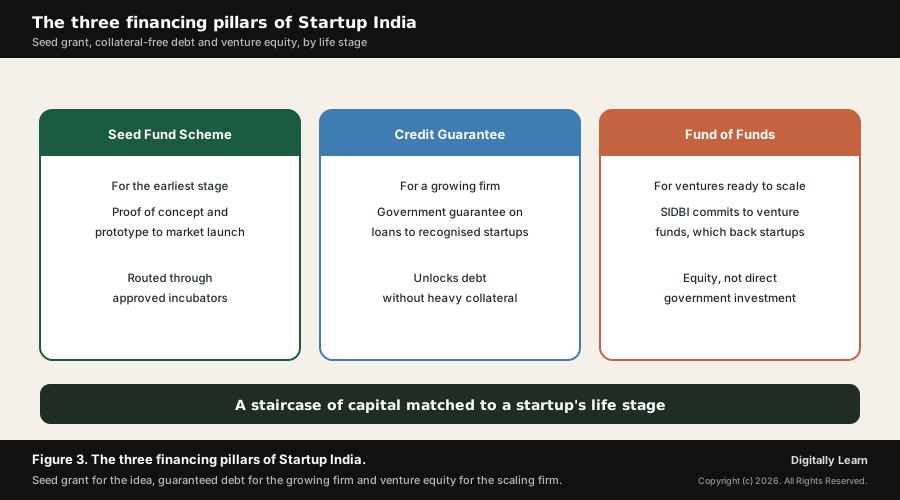
The largest financing instrument is the Fund of Funds for Startups, established in 2016 with a corpus of ten thousand crore rupees. Its structure is the feature an aspirant must remember: the fund does not invest directly in startups. Instead, DPIIT is the monitoring agency while the Small Industries Development Bank of India, the SIDBI, is the operating agency that commits capital to Alternative Investment Funds, the daughter funds, which in turn invest in startups.
What these funds supply is venture capital, that is, long-term, high-risk equity capital provided to young, high-growth startups by investors who take a stake in the firm in exchange for the funding, rather than a short-term loan repaid with interest. This is the precise meaning the term carries in the exam: forward-looking start-up capital for new entrepreneurs, not a rescue line for loss-making firms or money for replacing old plant.
This indirect design is deliberate. By placing the investment decision with professional, regulated venture funds rather than a government desk, the scheme avoids the state picking winners and lets market expertise allocate the capital. Crucially, the public money is meant to crowd in private capital: a daughter fund must invest a multiple of its committed amount into startups, so each rupee of government commitment mobilises several more of private investment. The scheme thus deepens India's domestic venture-capital base.
The Seed Fund Scheme and the Credit Guarantee Scheme for Startups
The Fund of Funds reaches startups that are already investable, so two further schemes fill the gaps at the earliest and the credit ends of the cycle. The Startup India Seed Fund Scheme assists very early startups with proof of concept, prototype, product trials, market launch and commercialisation, when a venture is too young for venture capital or a bank loan. The seed money is routed through approved incubators, which select the startups and disburse it.
The Credit Guarantee Scheme for Startups addresses a different barrier: an asset-light, unproven startup cannot easily offer the collateral a lender wants. Under it the Government provides a guarantee, up to a ceiling, against loans that member institutions extend to recognised startups, so the lender's risk on a default is shared. By covering part of the loss, the guarantee makes lenders willing to lend without heavy collateral, opening a debt channel alongside the equity and grants of the other schemes.
Taken together, the three schemes form a staircase of capital matched to a startup's life stage. The Seed Fund Scheme supports the idea and the prototype; the Credit Guarantee Scheme unlocks debt for a growing firm that lacks collateral; and the Fund of Funds channels equity, through professional venture funds, into ventures ready to scale. The figure below maps this financing ladder, the most testable part of the scheme.
| Scheme | Stage and form of support | Who operates it |
|---|---|---|
| Startup India Seed Fund Scheme | Earliest stage; grant and convertible support for proof of concept to commercialisation | Disbursed through approved incubators |
| Credit Guarantee Scheme for Startups | Growing firm; government guarantee on collateral-free credit | Guarantee on loans by member lending institutions |
| Fund of Funds for Startups | Ready to scale; equity through Alternative Investment Funds, not direct investment | SIDBI operates it; DPIIT monitors it |
Ease of Compliance: Self-Certification, Public Procurement and Faster Exit
Self-certification under labour and environment laws and the single-window portal
Alongside money, the scheme attacks the regulatory burden that can crush a small team. Recognised startups may self-certify compliance with a set of labour laws and environment laws through a simple online declaration, sparing them the inspections that the same laws impose on established firms. For the notified labour laws, no inspection is ordinarily carried out for a period of years, and for environment laws a startup in the least-polluting white category may self-certify, with only random checks thereafter.
The interface for all this is a single digital portal. The Startup India platform brings recognition, the tax and funding applications, learning resources and networking onto one online window, so a founder need not navigate many offices to claim benefits. The intellectual-property side is eased too: recognised startups get help with patent and trademark filing through facilitators whose fees the Government bears, with a rebate on official fees, because protecting an idea early is part of building an innovation.
Public procurement relaxations on GeM and faster exit under the insolvency code
Getting the first customer is often the hardest task for a young firm, and the Government, as the largest buyer, opens its own door. DPIIT-recognised startups on the Government e-Marketplace, the GeM portal, are exempted from the usual conditions of prior turnover, prior experience and the earnest-money deposit that shut a new venture out of public tenders. Central ministries relax these conditions, letting a startup compete on its product's merit rather than a track record it cannot yet have.
The scheme also makes failure less costly, which matters because most startups do not survive. Under the Insolvency and Bankruptcy Code, a startup that cannot continue can wind up through a time-bound process rather than being trapped for years in litigation, releasing the founder and the capital to try again. Treating a faster, cleaner exit as part of the policy signals that the state accepts risk-taking, since an ecosystem that punishes honest failure too harshly discourages the experimentation it wants.
The Institutional Architecture: DPIIT, the Startup India Hub, Incubators and States
DPIIT, the Startup India Hub, the incubators and the States' Startup Ranking
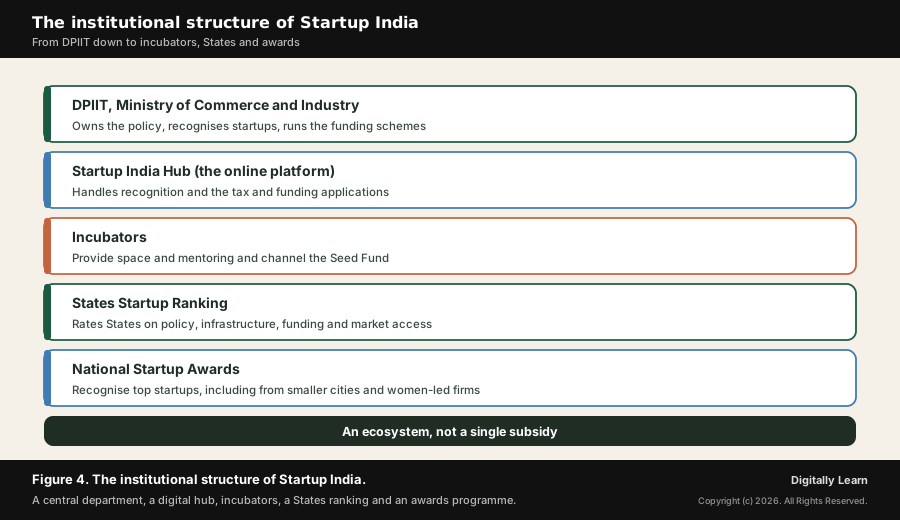
The scheme is delivered through a small set of institutions an aspirant should be able to name and explain. At the centre sits DPIIT, which owns the policy, recognises startups, runs the funding schemes and reports to the Ministry of Commerce and Industry. The day-to-day work runs through the Startup India Hub, the online platform and team that handles recognition, hosts the applications for tax and funding benefits, and connects founders to mentors and investors.
Below the platform sit the incubators, which give a startup physical space, mentoring and laboratory access, and act as the channel through which the Seed Fund Scheme reaches the youngest ventures. The scheme also works hard to engage the States: the States Startup Ranking evaluates States and Union Territories across reform areas such as institutional support, infrastructure, access to funding and market access, turning policy into a measured, competitive exercise that nudges every State to improve its own startup climate.
Recognition and reward complete the structure. The National Startup Awards identify and celebrate outstanding startups across many categories, including ventures from smaller cities, deep-technology innovators and women-led firms, giving winners visibility and credibility with investors and buyers. By combining a central department, a digital hub, incubators, a States ranking and an awards programme, the scheme builds an ecosystem rather than running a single subsidy, which makes Startup India a study in institution-building. The figure below maps this structure.
Outcomes and the Unicorn Ecosystem: Recognised Startups, Reach and Diversity
Recognised startups, the unicorn count and the spread to smaller cities and women
On the visible results, the picture is best stated with care, since the headline counts move quickly. India is widely described as one of the world's largest startup ecosystems, and DPIIT-recognised startups have grown from a few hundred at launch to well over a hundred thousand, across nearly every State. India also has a sizeable cohort of unicorns, privately held startups valued above a billion dollars, though the exact tally moves with valuations.
Two features of the spread matter for an answer. The first is geographic reach: recognition and the schemes increasingly pull in founders from tier-two and tier-three cities, not only the metropolitan hubs. The second is diversity: a large and rising share of recognised startups report at least one woman director, and the awards single out women-led ventures. These counts are dynamic, so this article keeps them qualitative rather than fixing a number that would date quickly.
The Critiques and Debates: Funding Cycles, Profitability and Concentration
The funding winter, profitability versus valuation, concentration and jobs quality
A balanced reading sets the achievements against persistent critiques, presented here as they are argued by independent analysts and observers. The first is dependence on the funding cycle. Much of the ecosystem's growth rode a wave of cheap global capital, and when financing conditions tightened in the so-called funding winter, investment slowed, valuations were cut and layoffs followed, exposing how reliant many startups were on a steady supply of outside money rather than their own earnings.
A second debate concerns profitability against valuation. Critics note that several high-profile startups grew their users and headline valuations while still posting large losses, raising the question of whether the model rewards growth at any cost over a profitable business. A third concern is concentration: investment, unicorns and talent cluster in a handful of cities and a few consumer-facing sectors, so the gains are unevenly shared across regions and across the kinds of innovation the country needs, including deep technology.
Two further issues round out a fair account. The angel-tax history is cited as a lesson in policy uncertainty: a well-meant anti-evasion rule chilled early investment for years before it was abolished, a reminder that tax stability matters as much as incentives. On employment, observers question the quality of jobs, since some large startup-driven sectors rely on gig and platform work whose security is debated. On whether the push can build a deep, self-sustaining ecosystem, a careful answer stays open.
Understanding the Significance: Jobs, Home-Grown Innovation and the Ease of Doing Business
A jobs engine, an innovation base and a reform of the business climate
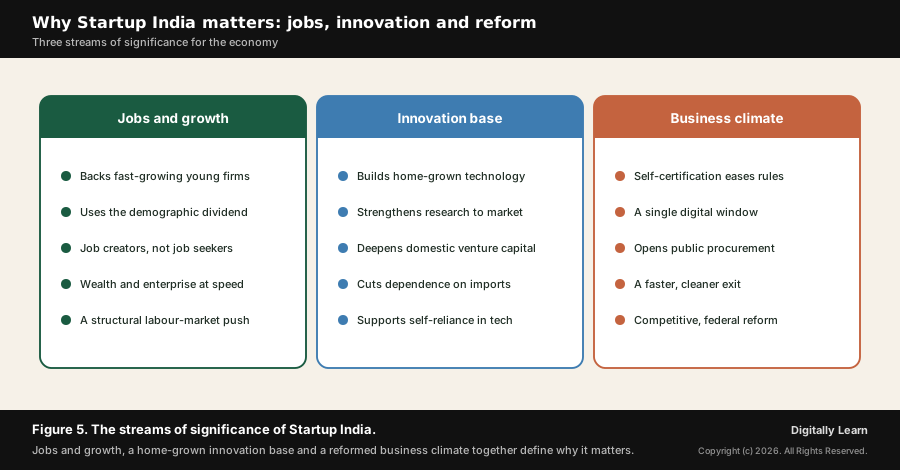
What is the significance of Startup India lies first in its character as a jobs and growth engine. By backing young, fast-growing firms rather than only the corporate sector, the scheme aims to convert the demographic dividend into employment and wealth, turning graduates into founders and the people they hire. This shift from a job-seeking to a job-creating economy is its deepest claim, and the reason it is read as a structural labour-market intervention rather than a subsidy.
Its second significance is technological. A deep startup base lets India build and own home-grown technology in fields from financial technology and software to electric mobility and deep technology, cutting dependence on imports and strengthening the path from research to market. The funding schemes, by crowding in private venture capital and seeding early ideas, deepen a domestic risk-capital industry that barely existed a decade ago, a lasting gain for the economy's capacity to finance innovation.
Its third significance is for the business climate. The self-certification, the single portal, the procurement relaxations and the faster exit together push the wider ease of doing business agenda, and the lessons in easing a startup's compliance feed into reform for small firms. Because the scheme engages every State through a ranking and reaches into smaller cities, it drives competitive, federal reform of the enterprise environment. The figure below maps these strands.
The Way Forward: Deep Tech, Domestic Capital and Broader Regional Spread
Building deep tech, mobilising domestic capital and widening the geographic base
The way forward follows from the critiques. The first priority is to shift the ecosystem's centre of gravity towards deep technology and manufacturing, the patient, research-heavy ventures in semiconductors, biotechnology, climate and artificial intelligence that take longer to mature, so that growth is not concentrated in quick-return consumer apps. This is why later additions to the funding schemes deliberately steer capital towards deep-tech and early-stage funds rather than only the segments that the market already favours.
The second priority is to deepen domestic capital and durable business models. Mobilising more home-grown long-term money, from domestic institutions and the Fund of Funds, would cushion startups against swings in foreign sentiment, while an emphasis on a path to profitability rather than valuation alone would build firms that survive a funding winter. Keeping the tax regime stable, now that the angel tax is gone, is part of the same task, since predictability is what early investors prize most.
The third priority is to widen the ecosystem's base. Strengthening incubators and access to capital in tier-two and tier-three cities, supporting more women-led and first-generation founders, and using the States ranking to lift the laggard States would spread the gains beyond a few metropolitan hubs. Pursued together, these measures would move Startup India closer to its founding promise: a deep, broad-based and self-sustaining engine of innovation, enterprise and jobs across the whole country.
UPSC Relevance and Exam Focus
Where Startup India fits in the UPSC-CSE syllabus
This topic maps most directly to General Studies Paper III: Indian economy and issues relating to planning, mobilization of resources, growth, development and employment, since Startup India spurs innovation-led growth, mobilises risk capital and creates jobs. It also links to General Studies Paper II, government policies and interventions for development, because the scheme is a design-and-implementation case study, and it supplies material on science and technology and the digital economy for both growth and governance answers.
For Prelims, hold the high-yield facts: Startup India was launched in 2016 and is run by DPIIT in the Ministry of Commerce and Industry; a DPIIT-recognised startup is an entity up to ten years old with turnover up to two hundred crore rupees, working on innovation or a scalable model; and the income-tax holiday is under Section 80-IAC.
Two further Prelims facts complete the set: the angel tax arose from Section 56(2)(viib) and was abolished for all investors in the 2024-25 Budget; and the three funding schemes are the Fund of Funds for Startups operated by SIDBI, the Startup India Seed Fund Scheme and the Credit Guarantee Scheme for Startups, each pitched at a different stage of a startup's life.
Recurring linked concepts an aspirant should keep in working memory:
- DPIIT recognition: The single gateway, an entity up to ten years old with turnover up to two hundred crore rupees, working on innovation or a scalable model, that unlocks every benefit.
- Fund of Funds for Startups: The ten-thousand-crore corpus, monitored by DPIIT and operated by SIDBI, that invests through Alternative Investment Funds rather than directly in startups.
- Section 80-IAC and the angel tax: The three-year income-tax holiday for eligible startups, and the Section 56(2)(viib) angel tax that was abolished for all investors in the 2024-25 Budget.
- Ease of compliance: Self-certification under labour and environment laws, public-procurement relaxations on the Government e-Marketplace and a faster exit under the insolvency code.
For Mains, the recurring framing is to assess the scheme's design against its delivery: how recognition, tax relief and dedicated capital try to correct the market failures facing a young firm, and how far the funding cycle, profitability and regional concentration have limited the results. A strong answer treats Startup India as a case study in innovation-led growth and ease of doing business, weighing its genuine gains against the unresolved questions of depth, breadth and quality.
A common Prelims trap is to confuse the financing routes and the thresholds; hold that the Fund of Funds invests through Alternative Investment Funds and not directly in startups, that SIDBI is its operating agency while DPIIT monitors it, and that the turnover ceiling is two hundred crore for recognition but one hundred crore for the 80-IAC holiday.
A common Mains trap is to celebrate the unicorn count and stop there. The exam value lies in a balanced judgment: the real gains in recognition, capital and ease of doing business, set honestly against the open problems of funding-cycle dependence, profitability against valuation, regional and sectoral concentration, and the quality of the jobs created.
Previous Year UPSC-CSE Questions By the end you will be able to draft model answers for the following UPSC questions. Each question carries a collapsible framework showing how to approach it in the exam.
- UPSC Prelims 2014 GS-IIdentify the correct meaning of venture capital from four definitions, the right one being long-term start-up capital provided to new entrepreneurs.
How to approach this Prelims question
Approach: Recall the defining features of venture capital: it is long-term, high-risk equity capital provided to new, high-growth ventures, not a short-term loan, a loss-rescue fund or a renovation fund. Match these features to the options; only one describes long-term start-up capital for new entrepreneurs.
Trap to watch: Do not confuse venture capital with short-term industrial finance, with funds given to firms that are already making losses, or with money for replacing and renovating plant. Venture capital is forward-looking equity for new, scalable ventures, not a rescue or a maintenance line.
Key facts to recall:
- Venture capital is long-term, high-risk equity capital provided to young, high-growth startups by investors who take a stake in exchange for funding.
- It is equity, not debt, so the investor shares in the venture's upside and its risk rather than earning fixed interest.
- Startup India's Fund of Funds for Startups is the public mechanism that channels venture capital into startups, with SIDBI committing capital to SEBI-registered Alternative Investment Funds.
- The Fund of Funds does not invest directly in startups; it backs venture funds, the Alternative Investment Funds, which in turn make the equity investments.
- Venture capital suits the scaling stage, while the Seed Fund Scheme and the Credit Guarantee Scheme cover the earliest and the collateral-free debt stages of a startup's life.
Answer signal: The only option that describes long-term start-up capital provided to new entrepreneurs is the correct one, namely option (b).
Relevance to this topic. Venture capital maps onto the Fund of Funds for Startups, the public mechanism that channels venture capital into startups; SIDBI commits money to SEBI-registered Alternative Investment Funds, the venture funds, which make long-term equity investments in new entrepreneurs.
Sources and Further Reading
- Startup India: About the Startup India Initiative
- Startup India: DPIIT Startup Recognition and Tax Exemption
- DPIIT: Startup India Initiative
- Press Information Bureau: Action Plan for Startups unveiled to create a vibrant startup ecosystem
- Press Information Bureau: Angel tax abolished for all classes of investors
- Press Information Bureau: Government strengthens startup ecosystem through Fund of Funds, Seed Fund and Credit Guarantee
- Startup India: Credit Guarantee Scheme for Startups
- Startup India: Public Procurement benefits for startups
- Union Budget portal (the 2024-25 Budget abolished angel tax for all classes of investors)
- NITI Aayog: India's startup and innovation ecosystem
- Wikipedia: Startup India
Editorial Disclaimer
This briefing is for UPSC preparation. Verify the facts and provisions against the official Startup India, DPIIT and PIB sources before relying on them.


