


Overview
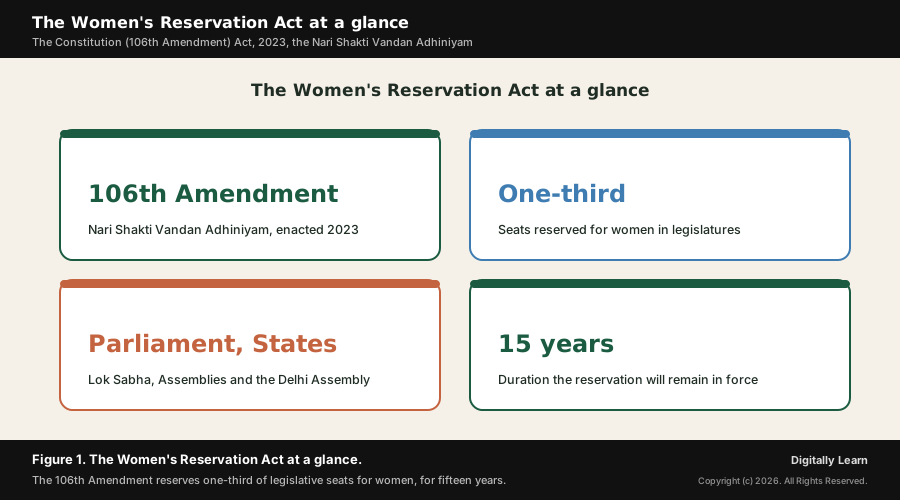
The Women's Reservation Act, 2023, formally the Constitution (One Hundred and Sixth Amendment) Act, 2023 and named the Nari Shakti Vandan Adhiniyam, reserves one-third, about 33 per cent, of all seats for women in the Lok Sabha, in every State Legislative Assembly, and in the Delhi Assembly. The same one-third applies within the seats already reserved for the Scheduled Castes and Scheduled Tribes. Passed in the September 2023 special session and notified on 28 September 2023, it caps nearly three decades of failed attempts. Its commencement is deferred: the reservation takes effect only after a delimitation based on the first census held after the Act comes into force, and reserved seats rotate after each delimitation. Once in effect, it remains in force for fifteen years, extendable by Parliament.
What the Women's Reservation Act Does: The 106th Amendment and the One-Third Reserve
One-third of legislative seats reserved for women
India has placed on its statute book a law to reserve seats for women in its highest law-making bodies. The Women's Reservation Act, 2023, formally the Constitution (One Hundred and Sixth Amendment) Act, 2023 and named the Nari Shakti Vandan Adhiniyam, reserves one-third, about 33 per cent, of all seats for women in the Lok Sabha, every State Legislative Assembly and the Delhi Assembly. It was passed in the September 2023 special session and notified on 28 September 2023.
A point worth fixing at the outset, because it is a common source of confusion, concerns the amendment number. The measure was introduced as the Constitution (One Hundred and Twenty-Eighth Amendment) Bill, 2023, the 128th being the bill number as introduced. On enactment it became the 106th Amendment Act, the correct way to cite the law now in force. The bill number and the act number are not the same thing.
The reservation does not stop at the general seats. The same one-third share applies within the seats already reserved for the Scheduled Castes and the Scheduled Tribes, so one-third of SC seats and one-third of ST seats are set aside for women of those communities. This nests the gender reservation inside the existing caste reservation rather than placing the two side by side. The figure below sets out the core design of the Act.
Why the Women's Reservation Act Is in the News
A thirty-year demand finally on the statute book
Why it matters is that a demand pending for almost thirty years has at last become law. Earlier attempts to reserve seats for women in the legislatures, from the mid-1990s onward, had repeatedly failed to clear both Houses of Parliament. The passage of the 106th Amendment in the September 2023 special session, by 454 votes to 2 in the Lok Sabha and unanimously in the Rajya Sabha, closed that long gap and put the reservation into the Constitution itself.
It is also in the news because attention has now turned to when it will actually operate. The Act ties its commencement to a future delimitation, which in turn waits on the next census, so the reservation, though enacted, is not yet in force. The question of how soon women will see one-third of seats in practice keeps the law in active public and parliamentary discussion.
Understanding the Significance of the Women's Reservation Act for India
Correcting the under-representation of women in law-making
What is the significance of the Women's Reservation Act lies first in the gap it is meant to close. Women make up about half of India's population and of its electorate, yet they have long held only a small share of seats in the Lok Sabha and the State Assemblies. A guaranteed one-third reserve is a structural attempt to correct that persistent under-representation in the bodies that make the country's laws.
Its second significance is what reserved seats can change. Greater numbers of women in the legislatures are expected to bring different priorities and perspectives to law-making, on questions from health and education to safety and the household economy, and to make elected office a more realistic ambition for women across the country.
Backed by a constitutional guarantee rather than a party's goodwill, the reservation turns women's representation from an aspiration into a binding rule. It also places India alongside the global effort, pursued through reserved seats and quotas in many countries, to raise the share of women in elected office and to move from women's development towards women-led development.
How the Reservation Works: Within SC and ST Seats, Rotation, the Delimitation Trigger and the Fifteen-Year Term
The one-third reserve and its share within SC and ST seats
The mechanism of the Act is best taken in steps. The base rule is that one-third of the total seats in each covered house, the Lok Sabha, the State Legislative Assemblies and the Delhi Assembly, are to be reserved for women. This is a reservation of seats, not of candidates, so the seats themselves are set aside and only women may contest them.
The reservation is then layered onto the existing caste reservations. Within the seats reserved for the Scheduled Castes and the Scheduled Tribes, one-third are further reserved for women of those communities. The effect is that an SC or ST woman benefits from the gender reservation inside the caste reservation, rather than the two operating in separate silos.
| Where the reservation applies | What is reserved for women |
|---|---|
| Lok Sabha | One-third of the total seats |
| Every State Legislative Assembly | One-third of the total seats |
| Legislative Assembly of NCT of Delhi | One-third of the total seats |
| Seats reserved for Scheduled Castes | One-third within those seats |
| Seats reserved for Scheduled Tribes | One-third within those seats |
Reading the rows together shows the scope: the reservation reaches the directly elected lower house at the Centre and the directly elected assemblies in the States and Delhi, and it carves a women's share out of the caste-reserved seats as well, so it is layered rather than flat.
Rotation of seats and the census-and-delimitation trigger
Two design choices decide which seats are reserved and when the law starts. The first is rotation. The particular seats reserved for women are not fixed for ever; they will rotate after each delimitation, as determined by Parliament, so that over time different constituencies take their turn as reserved seats rather than the same ones always being set aside.
The second, and the more consequential for timing, is the commencement trigger. The reservation does not begin with the Act. It will take effect only after a delimitation exercise is undertaken on the basis of the first census taken after the Act's commencement. Delimitation is the redrawing of constituency boundaries, and it is during that exercise that the reserved seats will be identified.
Because both a census and a fresh delimitation must come first, the reservation is, in effect, deferred: it is enacted now but will operate only at a later date. This deferral is the single feature that most shapes how the Act is read, and it is the root of much of the debate examined further below.
The fifteen-year duration of the reservation
The Act also sets a time limit on the reservation. Once it comes into effect, the reservation of seats for women is to remain in force for a period of fifteen years. It is therefore framed as a measure with a defined life rather than a permanent fixture of the Constitution.
The fifteen-year term is not the last word, however. Parliament retains the power to extend the reservation by law, so the period can be continued if a future Parliament so decides. The structure mirrors the way other temporary special provisions in the Constitution have been periodically reviewed and renewed.
The Long Road: From the 73rd and 74th Amendments to the 2023 Act
Women's reservation in local self-government under the 73rd and 74th Amendments
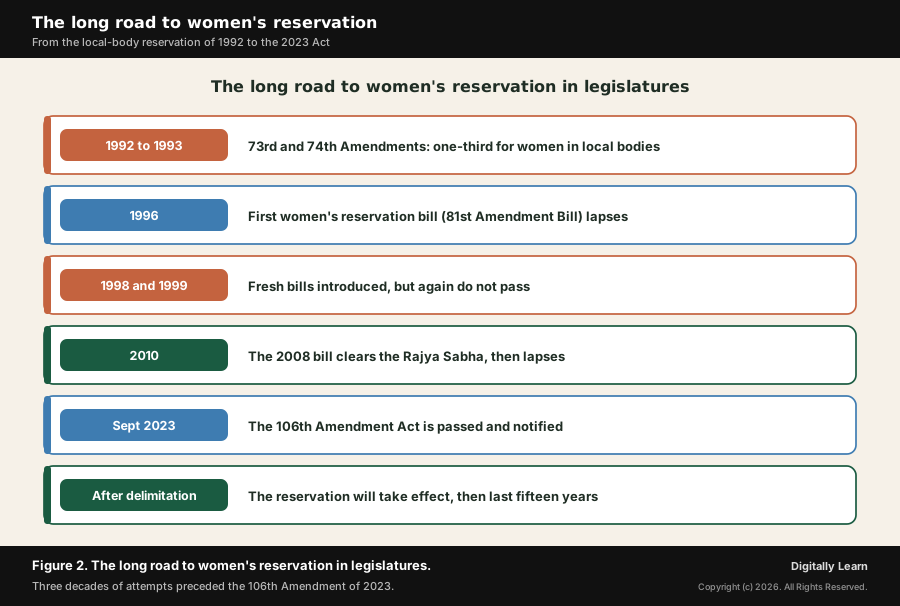
The 2023 Act did not appear from nowhere; the idea of reserving seats for women was first put into practice at the local level. The 73rd and 74th Constitutional Amendments of 1992 gave constitutional status to rural and urban local bodies and, crucially, reserved not less than one-third, about 33.3 per cent, of seats for women in the panchayats and the municipalities. The 73rd Amendment Act came into force on 24 April 1993.
That reservation in local self-government brought very large numbers of women into elected office, more than a million across the country's panchayats and urban bodies, and it became the template that the demand for legislative reservation drew upon. It showed that a constitutional quota could change the composition of elected bodies quickly and at scale.
It also, importantly for the exam, became the testing ground for the harder question of whether reserved seats translate into real power for women. The experience of the panchayats, examined later in this article, is what informs much of the debate over the 2023 legislative reservation, and it is the basis on which the reform is judged.
Three decades of failed bills, from 1996 to 2010
The attempt to extend reservation to Parliament and the State Assemblies has a long and halting history. The first women's reservation bill, the Constitution (81st Amendment) Bill, was introduced in 1996, on 12 September of that year, but it lapsed with the dissolution of the eleventh Lok Sabha without being passed.
Fresh bills were brought in 1998 and 1999, and again they failed to clear Parliament amid sharp disagreement, particularly over demands for a separate quota for women of the Other Backward Classes and the minorities. The reform repeatedly foundered on the floor of the House.
The closest earlier attempt came with the 2008 bill, which the Rajya Sabha passed in 2010, on 9 March of that year. But the Lok Sabha never voted on it, and the bill eventually lapsed. It was only with the 106th Amendment of 2023 that a women's reservation measure finally cleared both Houses and entered the Constitution. The timeline below traces this long road.
Criticisms and Debates: Deferral, the OBC Sub-Quota, Upper Houses and Rotation
The deferral that postpones the reform
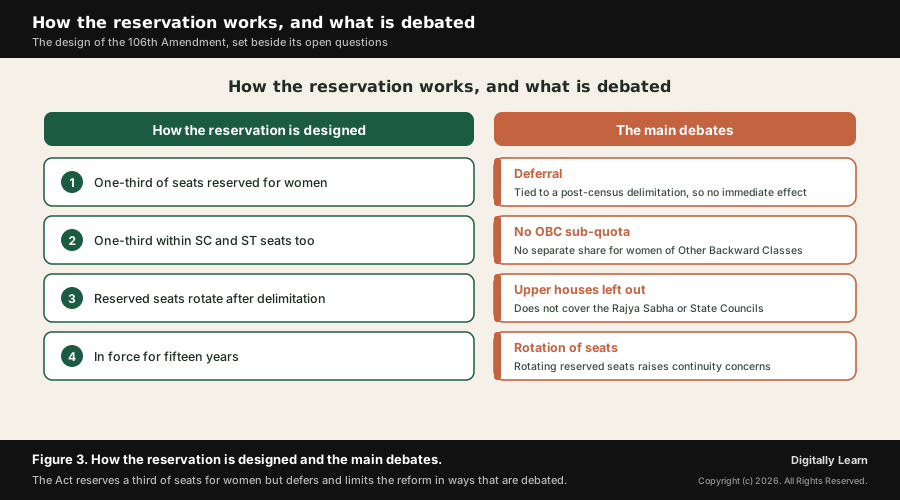
A balanced reading must weigh the criticisms the Act has drawn, since UPSC questions reward this balance. The most prominent concern is the deferral. By tying the reservation to a delimitation that itself waits on the next census, the Act, though passed in 2023, does not take effect immediately, and critics argue that a reform so long awaited should not have been postponed once more to an uncertain future date.
The worry is not only the delay but the uncertainty around it. Because the start depends on the completion of a census and then a delimitation, the precise date on which women will actually occupy one-third of the seats cannot be stated with confidence, which critics say weakens the immediate force of an otherwise historic measure.
The OBC sub-quota, the upper houses and rotation of seats
A second, long-standing debate concerns the absence of an OBC sub-quota. The Act reserves seats within the SC and ST categories but provides no separate sub-reservation for women of the Other Backward Classes. Critics argue this leaves out a large group of women and repeats one of the very fault lines on which the earlier bills had collapsed.
A third concern is the law's reach. The reservation applies to the directly elected lower house and assemblies, but not to the Rajya Sabha or the State Legislative Councils, the indirectly elected upper houses. Women's representation in those bodies is therefore left untouched by the Act, which critics see as an incomplete coverage of the legislature.
A fourth debate is over the rotation of reserved seats after each delimitation. Because the reserved constituencies will change from one delimitation to the next, a sitting member may find a seat reserved away from them, which some argue can weaken a representative's incentive to nurture a constituency over the long term and unsettle continuity of representation.
- Deferral and no immediate effect: The reservation waits on a post-census delimitation, so it does not operate as soon as it is enacted.
- Absence of an OBC sub-quota: There is a women’s share within SC and ST seats but none for women of the Other Backward Classes.
- Upper houses excluded: The Act does not cover the Rajya Sabha or the State Legislative Councils.
- Rotation of seats: Rotating reserved constituencies after each delimitation raises concerns about continuity of representation.
The lesson of local bodies: reservation and the patriarchal character of politics
Beyond the design of the 2023 Act lies a deeper debate that the experience of local self-government has already exposed: whether reserving seats for women, by itself, changes the patriarchal character of the political process. The reservation of one-third of seats in the panchayats and municipalities since the 1990s brought women into office in very large numbers, but it did not automatically transfer real decision-making power to them.
The clearest illustration is the phenomenon the Government itself has named and campaigned against: the Sarpanch Pati, or pradhan pati, where a male relative, usually the husband, exercises the powers of an elected woman representative on her behalf. The Ministry of Panchayati Raj has run awareness campaigns, such as one asking who the real sarpanch is, and brought out work on eliminating such proxy participation, an open acknowledgement that numbers alone have not ended male control.
The lesson, and the one an exam answer should draw, is that reservation has had a limited but real impact. It has visibly expanded women's presence in elected bodies and produced many effective women leaders, yet entrenched social attitudes, dependence on male relatives and patriarchal party structures have blunted its effect on the underlying character of politics.
The same caution attends the legislative reservation. A one-third reserve is a necessary structural step, but on its own it is unlikely to dissolve patriarchy without parallel changes in party tickets, campaign finance and political culture. The reform creates the opportunity for change; whether it delivers substantive empowerment depends on what surrounds it.
Women-Led Development, Local Governance and Global Quotas: The Wider Context and Exam Relevance
Women-led development, local governance and global comparison
Contemporary linkages place the Women's Reservation Act within a wider shift in how India frames the role of women. The official language has moved from women's development to women-led development, the idea that women should be leaders of the country's progress rather than only its beneficiaries, and a guaranteed share of legislative seats is presented as part of that shift.
The Act connects directly to the longer story of local governance. The reservation for women in the panchayats and municipalities under the 73rd and 74th Amendments is both the precedent and the cautionary tale for the new legislative reservation: it proves the reform can expand representation quickly, and it warns that representation does not by itself mean power.
It also belongs to a global movement. Many countries use reserved seats or candidate quotas to raise the share of women in their legislatures, and India's measure is read against that international experience, in which quotas have generally increased women's presence while their effect on substantive policy has varied with the surrounding political culture.
- The 73rd and 74th Amendments: The 1992 reservation of one-third of seats for women in panchayats and municipalities, the precedent for the legislative reservation.
- Women-led development: The policy shift from treating women as beneficiaries to placing them in leadership, of which the reservation is a part.
- Delimitation and the census: The exercises on which the reservation’s commencement depends, linking it to wider debates on redrawing constituencies.
- Global quotas for women: Reserved seats and candidate quotas used worldwide to raise women’s share in elected office.
It sits, too, within India's evolving constitutional architecture for representation. The Act adds a gender reservation in the legislatures to the existing reservations for the Scheduled Castes and Scheduled Tribes, and to the reservation for women already in place in local bodies, building a layered structure of guaranteed representation across the tiers of government.
Where This Fits in the UPSC-CSE Syllabus and Exam
This topic maps most directly to General Studies Paper II: the Indian Constitution, significant provisions and basic structure, the functioning of the legislature, and government policies for vulnerable sections, and to the social justice strand on the empowerment of women. It carries a strong link to women's political participation as a recurring theme across the paper.
For Prelims, hold the high-yield facts: the Women's Reservation Act, 2023 is the Constitution (106th Amendment) Act, the Nari Shakti Vandan Adhiniyam; it reserves one-third of seats for women in the Lok Sabha, the State Assemblies and the Delhi Assembly, including within SC and ST seats; reserved seats rotate after delimitation; its commencement is deferred until a delimitation after the next census; and it is to last fifteen years.
For Mains, the recurring framing is to assess whether reserving seats for women translates into real empowerment, and to weigh the Act's promise against its deferral, the missing OBC sub-quota and the lesson of local bodies. A strong answer treats women's reservation as a necessary structural step whose effect depends on accompanying changes in political culture.
Recurring linked concepts an aspirant should keep in working memory:
- 106th Amendment (Nari Shakti Vandan Adhiniyam): The 2023 Act reserving one-third of legislative seats for women, with effect after the next delimitation.
- 73rd and 74th Amendments (1992): The earlier reservation of one-third of seats for women in panchayats and municipalities.
- Delimitation: The redrawing of constituency boundaries, on which the Act’s commencement and the rotation of reserved seats depend.
- Women-led development: The policy frame of placing women in leadership, within which the reservation is presented.
A common Prelims trap is the amendment number: the law was introduced as the 128th Amendment Bill but enacted as the 106th Amendment Act, and the enacted law is the 106th. A further trap is to confuse this 2023 Act with the separate, later Constitution (131st Amendment) Bill and Delimitation Bill of 2026, which are different measures; the 2023 Act only links to delimitation as its commencement trigger.
A common Mains trap is to praise the reservation without testing it. Its exam value lies in a balanced judgment: a genuine and overdue advance in women's representation, set honestly against the deferral, the gaps in coverage and the hard evidence from local bodies that reserved seats do not on their own dissolve patriarchy.
Previous Year UPSC-CSE Questions By the end you will be able to draft model answers for the following UPSC questions. Each question carries a collapsible framework showing how to approach it in the exam.
- UPSC Mains 2019 GS-IIComment on the statement that reserving seats for women in local self-government has had a limited impact on the patriarchal character of the Indian political process.
How to structure the answer in the exam
Body (sub-themes to develop):
- The scale of the reform: the one-third reservation in local bodies brought more than a million women into elected office across panchayats and municipalities, with many states raising the share to one-half.
- The limited impact on patriarchy: the Sarpanch Pati or pradhan pati phenomenon, where male relatives exercise the powers of elected women, shows that numerical reservation did not automatically transfer real decision-making power.
- Why the impact has been limited: entrenched social attitudes, women's dependence on male relatives, patriarchal party structures and the control of party tickets and campaign finance by men.
- The real gains, fairly stated: a visible expansion of women's presence, many effective women leaders, and a shift in aspiration, so the impact is limited but not negligible.
- Extending the lesson: the 2023 legislative reservation (the 106th Amendment) is a necessary structural step, but like local-body reservation it is unlikely to dissolve patriarchy without parallel changes in political culture, party tickets and finance.
Sources and Further Reading
- Press Information Bureau: Discussion on Nari Shakti Vandan Adhiniyam in the Lok Sabha
- Press Information Bureau: Year End Review 2023, Ministry of Parliamentary Affairs
- Press Information Bureau: Passage of the Constitution (128th Amendment) Bill, 2023 in the Lok Sabha
- Press Information Bureau: Women Reservation in Panchayats
- Press Information Bureau: Sarpanch Pati Culture Under Spotlight in New Digital Campaign
- National Portal of India: Acts and Rules
- Election Commission of India
- Legislative Department, Ministry of Law and Justice: Constitution Amendment Acts
- Legislative Department, Ministry of Law and Justice: The Constitution (One Hundred and Sixth Amendment) Act, 2023 (enacted text)
- Office of the Registrar General and Census Commissioner, India: Census of India
- Wikipedia: One Hundred and Sixth Amendment of the Constitution of India
- Wikipedia: Women's Reservation Bill, 2010
- Wikipedia: Panchayati raj in India
Editorial Disclaimer
This briefing is for UPSC preparation. Verify the figures and provisions against the official PIB sources and the bare text of the Constitution (106th Amendment) Act before relying on them.


