


Overview
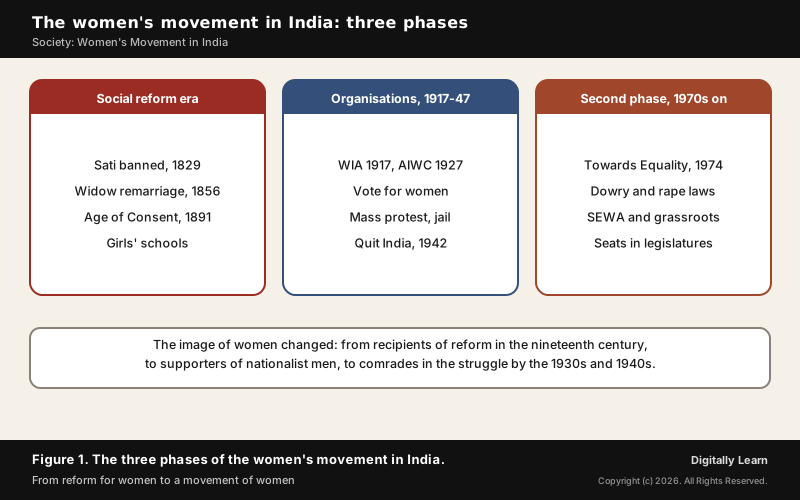
The women's movement in India is the long struggle for women's equality and rights. It began with the nineteenth-century social reform movements, which took up sati, widow remarriage and child marriage; grew through women's organisations and mass participation in the freedom struggle; and was renewed in the mid-1970s in a second phase that fought dowry, violence and unequal laws.
Women's Movement in India: Meaning and Phases
What Is the Women's Movement? Meaning and Three Phases in India
The women's question arose in modern India as part of the nineteenth-century middle class social reform movements. Reformers from the new western-educated middle class drew both on modern democratic ideals and on India's own sacred texts to fight for women's rights. Over the next century the movement passed through three broad phases:
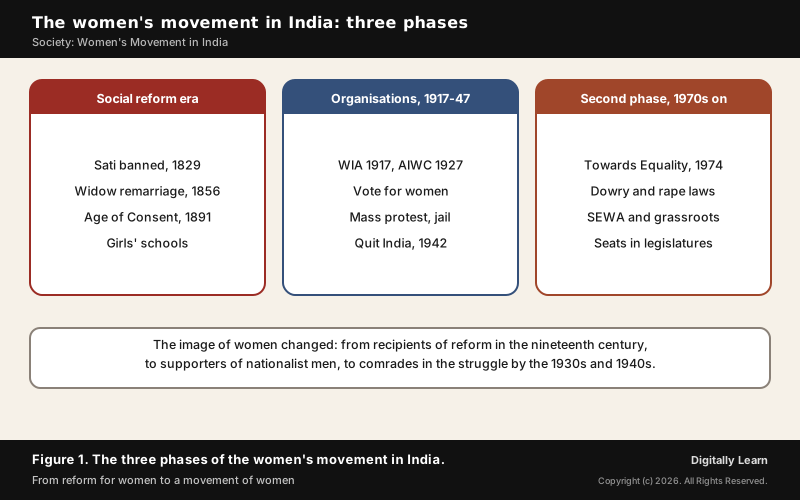
- Social reform era: Campaigns against sati, child marriage and the ill-treatment of widows, and for girls’ education, mostly led by male reformers.
- Organisations and the national movement: From 1917, women’s organisations at national and local level, and mass participation in the freedom struggle from the 1920s.
- Second phase: A renewal in the mid-1970s, with new issues such as violence against women and new organisational strategies.
The image of the woman changed across these phases: from a recipient of justice in the nineteenth century, to a supporter of nationalist men in the early twentieth, to a comrade by the 1930s and 1940s.
The Women's Question in the Nineteenth-Century Social Reform Movement
Sati, Widow Remarriage and Child Marriage: Reform Campaigns and Laws
Reformers attacked the customs that confined women, and learned to argue from the sacred texts: whenever they wished to challenge a harmful practice, they found a verse in the ancient texts that supported them and argued that the present practice was against early tradition.
- Sati: Raja Rammohun Roy campaigned against sati a decade before founding the Brahmo Samaj in 1828, appealing both to natural rights and to the shastras; the regulation of 1829 made it punishable as culpable homicide in Bengal, and was extended to Madras and Bombay in 1830.
- Widow remarriage: Ishwar Chandra Vidyasagar cited the texts to show that widows could remarry, and the Hindu Widows’ Remarriage Act, 1856 legalised it; Ranade in the Bombay Presidency and Veerasalingam Pantulu in Madras carried the cause further, though few widows actually remarried.
- Child marriage: The Age of Consent Act, 1891 forbade the marriage of girls below 12, after a campaign by B.M. Malabari; the Child Marriage Restraint Act, 1929 fixed the minimum age at 14 for girls and 18 for boys.
- Female infanticide: Bengal regulations of 1795 and 1804 declared it murder, and an Act of 1870 made the registration of all births compulsory.
Women's Education and Early Women Reformers: Phule, Ramabai, Tarabai Shinde
Many reformers felt that education for girls was the way to improve women's condition. Vidyasagar was associated with no less than 35 girls' schools in Bengal; Jyotiba Phule, who attacked caste and gender oppression together, opened schools in Maharashtra; and the Arya Samaj set up girls' schools in Punjab.
- Resistance: The first girls’ schools of the mid-nineteenth century were feared as a corrupting influence, so most educated women were taught at home by liberal fathers or husbands.
- Limited aims: Sir Syed Ahmed Khan wanted girls educated within their homes, and like Dayanand Saraswati sought a curriculum of religion, housekeeping, handicrafts and child rearing; yet once education was accepted, women could not be confined to only some kinds of it.
- Women’s own voices: Tarabai Shinde’s Stree Purush Tulana (1882) protested the double standards of a male-dominated society; Begum Rokeya Sakhawat Hossain wrote Sultana’s Dream (1905) and started schools for Muslim girls in Patna and Calcutta.
- Institutions: Pandita Ramabai founded a widows’ home at Poona where women were trained to support themselves; D.K. Karve set up an Indian Women’s University at Bombay in 1916.
Women's Organisations in India Before Independence
Women's Organisations in India: WIA, NCWI and the All India Women's Conference
The early twentieth century saw the growth of women's organisations at the national and local level. By the end of the nineteenth century women themselves were writing books, editing magazines, founding schools and setting up associations; from the early twentieth they formed political pressure groups.
| Body | Founded | Key facts |
|---|---|---|
| Women's Indian Association (WIA) | 1917, Adyar, Madras | Founded by Margaret Cousins; Annie Besant first president; founding members included Kamaladevi Chattopadhyay and Begam Hasrat Mohani |
| National Council for Women in India (NCWI) | 1925 | One of the early national women's bodies |
| All India Women's Conference (AIWC) | 1927, Pune | Began with the education and welfare of women and children; about 2,000 attended its first meeting |
| National Federation of Indian Women (NFIW) | 1954 | Formed when Communist women left the AIWC |
| Self Employed Women's Association (SEWA) | 1972, Ahmedabad | Founded by Ela Bhatt to unionise women in informal work |
The AIWC began by treating women's welfare and politics as separate, but a later presidential address asked whether Indian men or women could be free if India was a slave. In December 1917 Sarojini Naidu led a WIA deputation of 14 women to demand the vote.
These bodies had organisations, an ideology, leadership and shared aims; whether or not they formed a social movement, they created an atmosphere in which the women's question could no longer be ignored.
Women's Suffrage in India: From the 1919 Act to Universal Adult Franchise
The campaign for the vote was a central political demand of the women's organisations. Women's petitions were ignored in the Montagu-Chelmsford Reforms, and the Government of India Act 1919 left it to the provincial councils to decide whether women could vote, subject to property, income or education conditions.
- First wins: The city of Madras in 1919, Travancore and Jhalawar in 1920, and the Madras and Bombay Presidencies in 1921; reforms in 1926 let women stand for election.
- Government of India Act 1935: Provided special quotas for women in the provincial legislatures, though only 2.5 per cent of women could vote.
- Nationalist commitment: The Karachi session of the Congress in 1931 resolved that women shall have the right to vote, to represent and to hold public office.
- After Independence: The Constitution gave women the vote along with men, without any qualification of education, property or income.
Women in the Indian Freedom Struggle: From Swadeshi to Quit India
Women in the Freedom Struggle: Swadeshi, Home Rule and the Gandhian Phase
The role of women in the Indian freedom struggle grew with each phase. Participation in the Swadeshi, anti-partition and Home Rule movements was a major liberating experience for home-centred women. After 1918 women faced lathis and bullets and were jailed during processions and picketing, and they voted in, stood for and were elected to legislatures and local bodies.
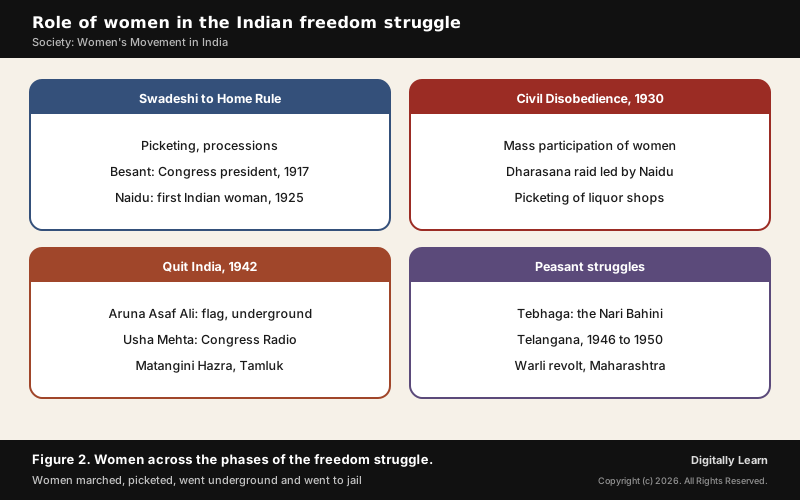
- Leadership: Annie Besant, an English theosophist and Home Rule leader, was elected president of the Congress in late 1917, and Sarojini Naidu became its first Indian woman president in 1925.
- Civil Disobedience: The movement saw mass participation of women; on 21 May 1930 Sarojini Naidu led the raid on the Dharasana salt works, where a peaceful crowd was met with a brutal lathi charge.
- Liquor boycott: Gandhiji made the boycott of liquor part of the nationalist programme and entrusted it to women.
- A lasting change: In the mid-1930s Gandhiji told Mridula Sarabhai that he had brought Indian women out of the kitchen, and it was for women activists to see they did not go back.
The national movement treated women as political beings. If women could march in processions, defy laws and go to jail unescorted by male relatives, they could also claim jobs, the vote and a share of parental property; mass struggle opened possibilities that a century of reform had not.
Women in the Quit India Movement and Peasant Struggles
In the Quit India Movement of 1942, women, especially school and college girls, actively participated, and several became leaders of its underground phase.
- Aruna Asaf Ali: Hoisted the national flag at the Gowalia Tank Maidan in Bombay, then went underground to evade arrest and organised underground activity.
- Usha Mehta: An important member of the small group that ran the underground Congress Radio.
- Sucheta Kripalani: Among the leaders of the underground movement.
- Matangini Hazra: A 73-year-old peasant widow of Tamluk, killed on 29 September 1942 when the Sutahata police station was captured; she kept the national flag aloft even after being shot.
Women also took part in peasant and tribal revolts, a history that was long forgotten because only middle class women were assumed to join movements. In the Tebhaga movement of 1946-47 in Bengal, women organised their own platform, the Nari Bahini; they took part in the Telangana struggle of 1946 to 1950 and the Warli revolt against bondage in Maharashtra.
Women's Movement After Independence
Constitutional Rights for Women and the Hindu Code Bill
After Independence, attention turned to securing legal and constitutional rights. The Constitution guarantees equality before law and forbids discrimination on grounds of sex, and it adds specific provisions for women:
- Article 15(3): Allows the State to make special provisions for women and children.
- Article 39: Directs the State to secure for men and women equally the right to an adequate means of livelihood, and equal pay for equal work.
- Article 42: Directs just and humane conditions of work and maternity relief.
- Article 51A(e): Makes it a fundamental duty to renounce practices derogatory to the dignity of women.
Nehru took up the Hindu Code Bill, a demand of women since the 1930s. Ambedkar's bill raised the age of marriage, upheld monogamy and gave women rights to divorce, maintenance and inheritance; after conservative opposition it passed as four separate Acts, including the Hindu Marriage Act, 1955 and the Hindu Succession Act, 1956. Many rights stayed on paper: women commonly forgo their share of parental property.
The Second Phase of the Women's Movement: Towards Equality and the 1970s
In the mid-1970s the women's movement was renewed, a revival some call its second phase. The concerns were partly the same, but organisational strategy, ideology and issues changed: the emphasis moved from the backward aspects of tradition to 'modern' issues such as the representation of women in the media and the gendered consequences of unequal development.
- Towards Equality (1974): The report of the Committee on the Status of Women in India, said to lay the foundation of the women’s movement in independent India.
- SEWA (1972): Founded by Ela Bhatt from the women’s wing of the Textile Labour Association, it organised self-employed women such as vendors and home-based workers into a union.
- Grassroots struggles: Bhil women of Shahada in Maharashtra led an anti-liquor campaign from 1972; women in Uttarakhand hugged trees in the Chipko movement from 1974.
- Autonomous groups: Urban women’s groups grew from the mid-1970s, helped by the UN’s International Women’s Year of 1975; the journal Manushi began in Delhi after 1977.
Campaigns Against Dowry and Custodial Rape: Changing the Law
The movement's most visible campaigns targeted dowry deaths and rape, and they changed the law. The law became a major site for reform in the 1980s, when it was found that many laws of concern to women had not changed since the nineteenth century.
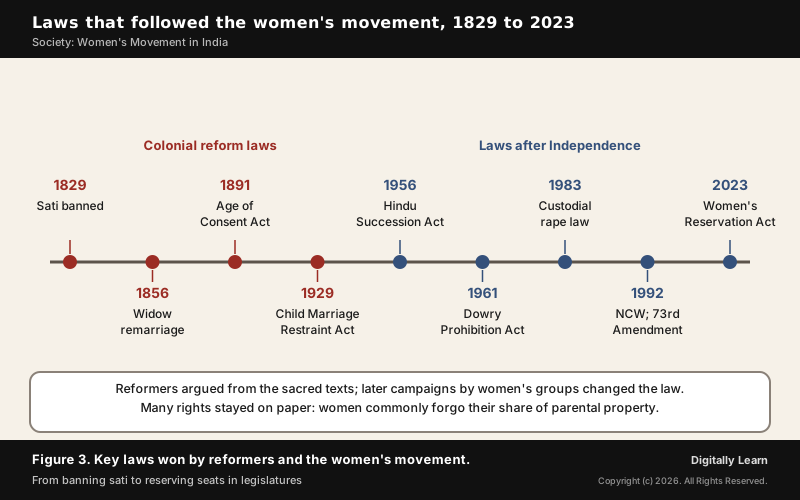
- Dowry: From 1979 dowry harassment and deaths were taken up through street rallies, plays and demonstrations; amendments strengthening the Dowry Prohibition Act, 1961 were passed in 1984.
- Mathura case: A tribal girl was raped by two policemen in 1972; the Supreme Court acquitted them in 1979, and the public outcry led to the Criminal Law Amendment Act, 1983.
- What changed: Custodial rape was treated as a graver crime, and the burden of proof shifted from the victim to the accused.
- Divisions: Later issues, the Shah Bano case of 1985 and the death of Roop Kanwar at Deorala, were entangled with communal politics, and the movement was less united.
Criticism of the Women's Movement: Class, Caste and Women of Lower Strata
The movement has come to recognise that while all women are disadvantaged in some way, all women do not suffer the same discrimination. The concerns of the educated middle class woman differ from those of the peasant woman, and the concerns of the Dalit woman from those of the 'upper caste' woman.
- The criticism: A gap remained between urban educated women’s groups and the concerns of rural or poor urban women; the movement also suffered from sectarianism, a lack of unity on goals, and reaction to crises rather than an agreed agenda.
- The counter-evidence: SEWA organised poor informal workers; Bhil women led the Shahada campaign; women in Chhattisgarh formed the Mahila Mukti Morcha against job losses from mechanisation.
- Land and livelihood: In Bodh Gaya in 1979 women demanded that land be registered in women’s names, and some States later gave title deeds only to women.
- Poor women’s own campaigns: Poor rural women in Andhra Pradesh led an anti-liquor wave in the mid-1990s that produced a policy of prohibition.
Women's Representation and a Gender-Just Society
Women's Reservation in India: Panchayats and the Women's Reservation Act, 2023
Women's groups long pressed for political representation. The 73rd and 74th Amendments of 1992 reserved one-third of seats in panchayats and municipalities for women. A bill to reserve seats in legislatures, first introduced in 1996, lapsed repeatedly until 2023, though it had considerable support from women politicians and women's groups.
- The 2023 Act: The Constitution (One Hundred and Sixth Amendment) Act, 2023, the Nari Shakti Vandan Adhiniyam, received assent on 28 September 2023.
- Articles 330A and 332A: As nearly as may be, one-third of seats in the Lok Sabha and the State Legislative Assemblies, including the Delhi Assembly, are reserved for women, including one-third of the seats reserved for SCs and STs.
- Conditions: The reservation begins after a delimitation based on the first census published after the Act, lasts 15 years, and does not apply to the Rajya Sabha or Legislative Councils.
- Grassroots pressure: In 1986 the Samagra Mahila Aghadi, women’s wing of the Shetkari Sangathana farmers’ movement in Maharashtra, decided to field all-women panels for panchayat and zilla parishad elections.
- Institutions: The National Commission for Women, a statutory body, was set up on 31 January 1992 under the National Commission for Women Act, 1990.
Men, Gender Identities and a Gender-Just Society
It is often assumed that social reform for women was fought entirely by male reformers; in fact women such as Tarabai Shinde and Rokeya wrote against discrimination, while men such as Rammohun Roy, Vidyasagar, Ranade and Phule led many campaigns. Leaders such as Nehru and Subhas Chandra Bose also backed greater equality.
- Men are constrained too: In patriarchal societies men feel they must be strong and successful and that it is not manly to express emotion; a gender-just society would free both men and women.
- Two foundations: A gender-just society rests on educated women with multiple roles and an improved sex ratio; the Beti Bachao, Beti Padhao Yojana is one effort towards it.
- Interventions beyond schemes: Legal reform, media watch groups that scan advertisements and films derogatory to women, land titles in women’s names, credit for women’s groups, and seats in elected bodies.
- New challenges: The sharp fall in the child sex ratio and the bias against the girl child are among the newest forms of gender inequality.
Previous Year UPSC-CSE Questions
Previous Year UPSC-CSE Questions By the end you will be able to draft model answers for the following UPSC questions. Each question carries a collapsible framework showing how to approach it in the exam.
- UPSC Mains 2017 GS-IThe women’s questions arose in modern India as a part of the 19th century social reform movement. What were the major issues and debates concerning women in that period?
How to structure the answer in the exam
Introduction: The women's question arose as part of the nineteenth-century middle class reform movements.
Body (sub-themes to develop):
- Issues: sati (1829), widow remarriage (1856), child marriage (1891, 1929), female infanticide, girls' education.
- Debates: reformers used both natural rights and the shastras; orthodox groups resisted girls' schools.
- Limits: education at home, stereotyped curricula; women's own voices such as Tarabai Shinde and Rokeya.
Conclusion: Conclude that reform began a process that made it impossible to confine women's rights.
- UPSC Mains 2016 GS-IDiscuss the role of women in the freedom struggle especially during the Gandhian phase.
How to structure the answer in the exam
Introduction: Women moved from supporters to comrades in the national movement by the 1930s.
Body (sub-themes to develop):
- Early: Swadeshi, Home Rule; Besant president 1917; Naidu 1925.
- Gandhian: mass participation in Civil Disobedience; Dharasana 1930; liquor boycott entrusted to women.
- Quit India: Aruna Asaf Ali, Usha Mehta's Congress Radio, Matangini Hazra.
Conclusion: Conclude that participation made women political beings and opened public life to them.
- UPSC Mains 2013 GS-IDefying the barriers of age, gender and religion, the Indian women became the torch-bearer during the struggle for freedom in India. Discuss.
How to structure the answer in the exam
Introduction: Women defied social barriers to march, picket, go underground and go to jail.
Body (sub-themes to develop):
- Age: Matangini Hazra at 73; school and college girls in 1942. Religion and origin: Annie Besant, an English theosophist; Begam Hasrat Mohani among the WIA founders.
- Class and region: Tebhaga's Nari Bahini, Telangana, the Warli revolt.
- Leadership: Besant, Naidu, Aruna Asaf Ali, Usha Mehta, Sucheta Kripalani.
Conclusion: Conclude that the struggle changed how society saw women.
- UPSC Mains 2018 GS-I‘Women’s movement in India has not addressed the issues of women of lower social strata.’ Substantiate your view.
How to structure the answer in the exam
Introduction: All women are disadvantaged, but not all suffer the same discrimination.
Body (sub-themes to develop):
- For: urban, educated leadership; gap with rural and poor women; caste blind spots.
- Against: SEWA, Shahada Bhil women, Chhattisgarh Mahila Mukti Morcha, Andhra anti-liquor wave, land in women's names.
- Recognition: Dalit and peasant women's concerns now seen as distinct.
Conclusion: Conclude that the charge is partly true but grassroots strands have narrowed the gap.
- UPSC Mains 2013 GS-I“Male membership needs to be encouraged in order to make women’s organizations free from gender bias.” Comment.
How to structure the answer in the exam
Introduction: Gender identities bind both men and women in a patriarchal society.
Body (sub-themes to develop):
- History: Rammohun Roy, Vidyasagar, Ranade, Phule, Nehru and Bose backed reform.
- Reason: men too are constrained by norms of strength and success.
- Caution: women's own leadership and voice, as with Tarabai Shinde and Rokeya, must stay central.
Conclusion: Conclude that men as partners help free organisations from gender bias.
- UPSC Mains 2021 GS-II“Though women in post-Independent India have excelled in various fields, the social attitude towards women and feminist movement has been patriarchal.” Apart from women education and women empowerment schemes, what interventions can help change this milieu?
How to structure the answer in the exam
Introduction: Women's achievements have not ended patriarchal attitudes to women and to feminism.
Body (sub-themes to develop):
- Law: campaigns that changed dowry and rape law; enforcement and convictions.
- Society: media watch against derogatory portrayals; men as partners; attention to the child sex ratio.
- Power: land titles in women's names, credit for women's groups, reserved seats in local bodies and legislatures.
Conclusion: Conclude that attitudes change when women hold property, voice and office.
- UPSC Mains 2023 GS-IIDiscuss the contribution of civil society groups for women’s effective and meaningful participation and representation in state legislatures in India.
How to structure the answer in the exam
Introduction: Women's organisations have pressed for women's political voice for over a century.
Body (sub-themes to develop):
- Franchise: WIA deputation of 1917; AIWC; the vote for women.
- Representation: support from women's groups for the reservation bill from 1996 to 2023.
- Local: one-third seats since 1992; all-women panels; training of women representatives.
Conclusion: Conclude that the 2023 Act rests on this long civil society campaign.
- UPSC Prelims 2021 Prelims-GSConsider the following statements :
- The Montagu-Chelmsford Reforms of 1919 recommended granting voting rights to all the women above the age of 21.
- The Government of India Act of 1935 gave women reserved seats in legislature.
Which of the statements given above is/are correct?
How to approach this Prelims question
Approach: Check what each Act did for women's franchise.
Trap to watch: The 1919 reforms did not give all women above 21 the vote.
Key facts to recall:
- 1919: left to provincial councils
- Madras 1921 among the first
- 1935: quotas for women
Answer signal: Statement 2 only: option (b).
- UPSC Prelims 2015 Prelims-GSConsider the following statements :
- The first woman President of the Indian National Congress was Sarojini Naidu.
- The first Muslim President of the Indian National Congress was Badruddin Tyabji.
Which of the statements given above is/are correct?
How to approach this Prelims question
Approach: Separate the first woman president from the first Indian woman president.
Trap to watch: Annie Besant (1917) preceded Sarojini Naidu (1925); Badruddin Tyabji was the first Muslim president.
Key facts to recall:
- Annie Besant 1917
- Sarojini Naidu 1925, first Indian woman
- Badruddin Tyabji, first Muslim president
Answer signal: Statement 2 only: option (b).
- UPSC Prelims 2009 Prelims-GSDuring the freedom struggle, Aruna Asaf Ali was a major woman organizer of underground activity in
How to approach this Prelims question
Approach: Link the underground phase to 1942.
Trap to watch: Underground activity marked the Quit India Movement, not the Civil Disobedience Movement.
Key facts to recall:
- Gowalia Tank Maidan, Bombay
- Usha Mehta's Congress Radio
- Quit India, 1942
Answer signal: Quit India Movement: option (c).
Sources and Further Reading
- NCERT: Social Change and Development in India (Class XII), Chapter 8, Social Movements
- NCERT: Indian Society (Class XII), Chapter 5, Patterns of Social Inequality and Exclusion
- Gazette of India: The Constitution (One Hundred and Sixth Amendment) Act, 2023
- Legislative Department: The Constitution of India
- PIB: Strategy for women's political participation and local governance (2025)
- Wikipedia: Women's suffrage in India
- Wikipedia: Women's Indian Association
- Wikipedia: All India Women's Conference
- Wikipedia: Self Employed Women's Association
- Wikipedia: Mathura rape case
- Wikipedia: Towards Equality
- Wikipedia: Women's Reservation Bill
- Wikipedia: National Commission for Women
- UPSC: Previous year question papers
Editorial Disclaimer
This article explains the women's movement in India from the NCERT sociology and history textbooks, the constitutional text and the other sources listed below.


