


Overview
The Constitution (131st Amendment) Bill, 2026 was a proposed amendment to the Constitution of India, introduced in the Lok Sabha in April 2026. It sought to enable a fresh delimitation of Lok Sabha seats on an updated census and to operationalise the one-third reservation for women in the Lok Sabha and state assemblies. On 17 April 2026, the Bill was negatived, that is, voted down, because it did not secure the special majority that Article 368 requires for a constitutional amendment. It was the first time a government-moved constitutional amendment failed to pass.
Why the defeated amendment is in focus
A constitutional amendment voted down
The Lok Sabha negatived the Constitution (131st Amendment) Bill, 2026 on 17 April 2026. The Bill had been introduced and discussed alongside a related Delimitation Bill and a Union Territories laws Bill.
To negative a Bill is to vote it down, so it does not become law. A constitutional amendment can only pass if it secures the special majority that the Constitution requires.
The Bill sought to enable a fresh delimitation of seats and to operationalise the reservation for women. Its defeat was the first time a government-moved constitutional amendment failed to pass in Parliament.
The key elements of the development are:
- Outcome: the Lok Sabha negatived the Bill on 17 April 2026.
- Reason: it did not reach the special majority Article 368 requires.
- Aim: to enable delimitation and operationalise women’s reservation.
- First of its kind: the first government constitutional amendment to be defeated.
Why the defeat matters
The high bar for amending the Constitution
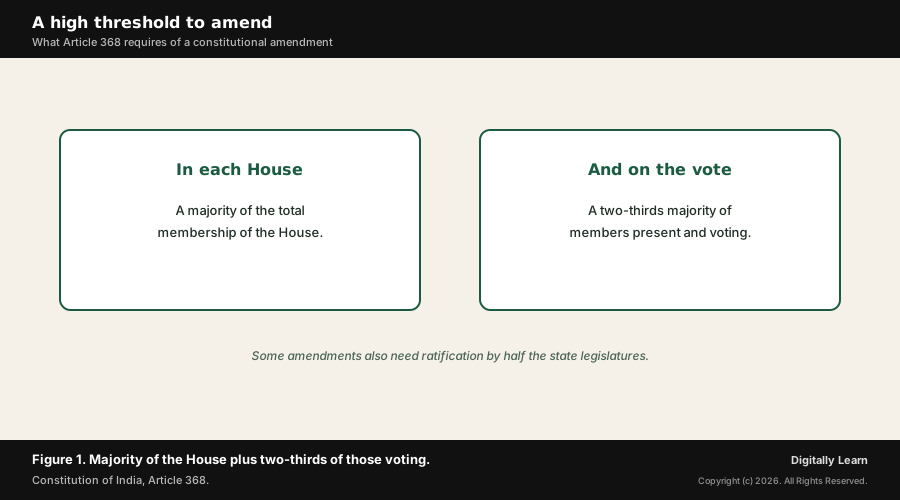
The Constitution deliberately makes amendment hard. Article 368 sets a special majority so that the basic law is not changed by a simple, fleeting majority, which protects its stability.
Even a government that commands a majority for ordinary laws can fall short of the higher threshold an amendment needs, especially when the opposition does not support it.
It also matters as a parliamentary first. A government-moved constitutional amendment being voted down is rare, and it underlines that the amending power rests with Parliament as a whole, not the executive alone.
What the development signifies
Delimitation, women's reservation, and federal balance
Three threads carry the weight: the delimitation question, the link to women's reservation, and the federal balance between states.
First, delimitation. The number of Lok Sabha seats has long been frozen pending a future census, and the Bill sought to enable a fresh exercise on an updated population count.
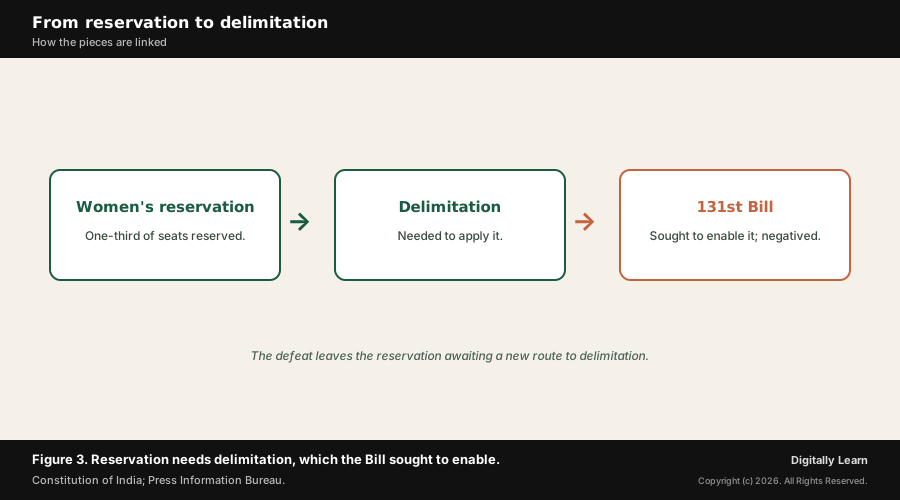
Second, the women's reservation link. The one-third reservation for women, enacted earlier, is to take effect after a delimitation, so the Bill was tied to bringing that reservation into force.
Third, the federal balance. Several states raised concern that redrawing seats on updated population could shift the balance of representation between regions, a sensitive federal question.
Distinguishing features of the Bill
The Bill at a glance
The table sets out the key facts, so the nature, aim and outcome of the Bill are visible at a glance.
| Feature | Detail |
|---|---|
| Bill | Constitution (131st Amendment) Bill, 2026 |
| House | Lok Sabha |
| Outcome | Negatived on 17 April 2026 |
| Reason | Fell short of the special majority under Article 368 |
| Aim | Delimitation and women's reservation |
Three features that defined the Bill
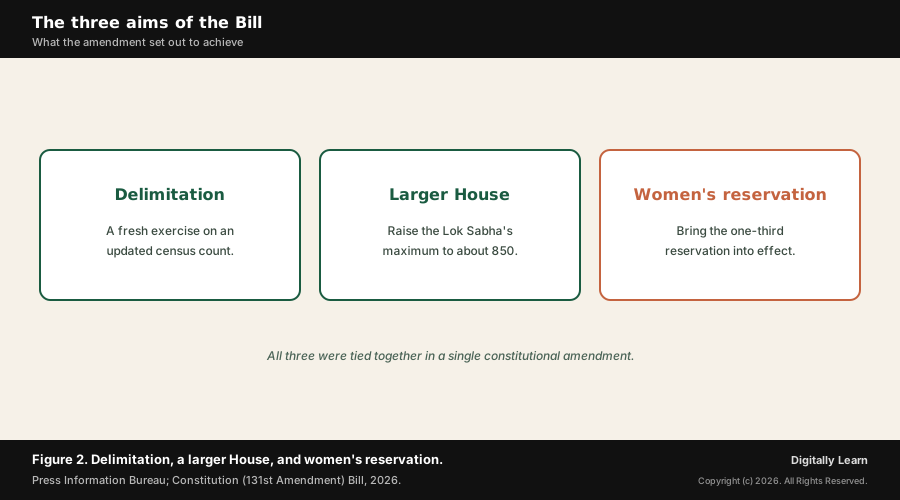
Three aims set the Bill apart from an ordinary piece of legislation:
- (i) Enabling delimitation. It sought to allow a fresh delimitation of seats on an updated census count.
- (ii) Expanding the House. It proposed raising the maximum strength of the Lok Sabha to about 850 seats.
- (iii) Operationalising reservation. It aimed to bring the one-third reservation for women into effect.
Observable outcomes
Three trackable outcomes
The defeat translates into three developments to watch in the months ahead.
- (a) Linked Bills stall. With the amendment defeated, the related delimitation and territory Bills could not proceed.
- (b) Women’s reservation delayed. The one-third reservation, tied to delimitation, awaits a fresh path to implementation.
- (c) Renewed debate. Delimitation and the north-south balance of seats return to the centre of political discussion.
A defeated Bill can be reworked and brought again. How the government rebuilds support, and whether the design changes, will shape what comes next.
Article 368, women's reservation and delimitation
The amendment process, the 106th Amendment and the seat freeze
The episode turns on Article 368, which lays down how the Constitution is amended and sets the special majority that a Bill of this kind must clear.
It connects to the women's reservation law, enacted earlier as a constitutional amendment, which reserves one-third of seats for women but is to take effect only after a delimitation.
It also links to the long freeze on Lok Sabha seats, held steady for decades pending a future census, which is the backdrop to the whole delimitation question.
UPSC relevance and exam focus
Where this fits in the UPSC-CSE syllabus
This topic maps to General Studies Paper II: Indian Constitution, Parliament, and the amendment process, with links to representation and federalism.
For Prelims, hold the high-yield facts: that a constitution amendment Bill needs a special majority, the role of Article 368, and the basics of delimitation.
For Mains, two framings recur: the limits on Parliament's amending power, and the federal questions raised by delimitation.
Recurring linked concepts an aspirant should keep in working memory:
- Article 368: the procedure to amend the Constitution.
- Special majority: the higher threshold an amendment must clear.
- Delimitation: redrawing constituency boundaries and seat numbers.
- Women’s reservation: the one-third reservation in legislatures.
A constitution amendment Bill needs a special majority, not a simple majority. Treating it like an ordinary Bill is a frequent error.
Do not read the defeat only as politics. It also illustrates the constitutional design that makes amendment deliberately demanding.
Previous Year UPSC-CSE Questions By the end you will be able to draft model answers for the following UPSC questions. Each question carries a collapsible framework showing how to approach it in the exam.
- UPSC Mains 2019 GS-IIParliament’s power to amend the Constitution is a limited power and it cannot be enlarged into absolute power.” In the light of this statement explain whether Parliament under Article 368 of the Constitution can destroy the Basic Structure of the Constitution by expanding its amending power?
How to structure the answer in the exam
Introduction: Open with Article 368 as the source of, and limit on, the amending power.
Body (sub-themes to develop):
- Article 368: the procedure and the special majority.
- Kesavananda Bharati and the basic-structure doctrine.
- Why amending power is limited, not absolute.
- Judicial review as a check on amendments.
- The 131st Amendment Bill as a recent example of the process.
Conclusion: Conclude that the amending power is wide but bounded by the basic structure.
- UPSC Prelims 2003Which one of the following Bills must be passed by each House of the Indian Parliament separately, by special majority?
How to approach this Prelims question
Approach: Recall which category of Bill needs a special majority in each House.
Trap to watch: Ordinary, money and finance Bills pass by simple majority; only a Constitution Amendment Bill needs a special majority in each House.
Key facts to recall:
- A Constitution Amendment Bill needs a special majority under Article 368.
- Ordinary, money and finance Bills require only a simple majority.
- Some amendments also need ratification by half the states.
Answer signal: Only a Constitution Amendment Bill needs a special majority. Correct answer: Constitution Amendment Bill.
Sources and Further Reading
- Press Information Bureau: Amit Shah replies in Lok Sabha on the Delimitation Bill, the Constitution (131st Amendment) Bill and the UT Laws (Amendment) Bill, 2026
- Press Information Bureau: Amit Shah intervenes in the Lok Sabha discussion on the Delimitation Bill, the Constitution (131st Amendment) Bill and the UT Laws (Amendment) Bill, 2026
- Constitution of India: Article 368 (amendment procedure)
- Wikipedia: Constitution (131st Amendment) Bill, 2026
- Wikipedia: One Hundred and Sixth Amendment of the Constitution of India (women's reservation)
- Wikipedia: Delimitation Commission of India
Editorial Disclaimer
This article is compiled from the reference materials listed in the Sources section. It is an explainer for UPSC preparation and is not a substitute for primary documents (NCERTs, GoI ministry releases, IMD bulletins, RBI / CEA / MoEFCC publications, and Standing-Committee reports).


