

Overview
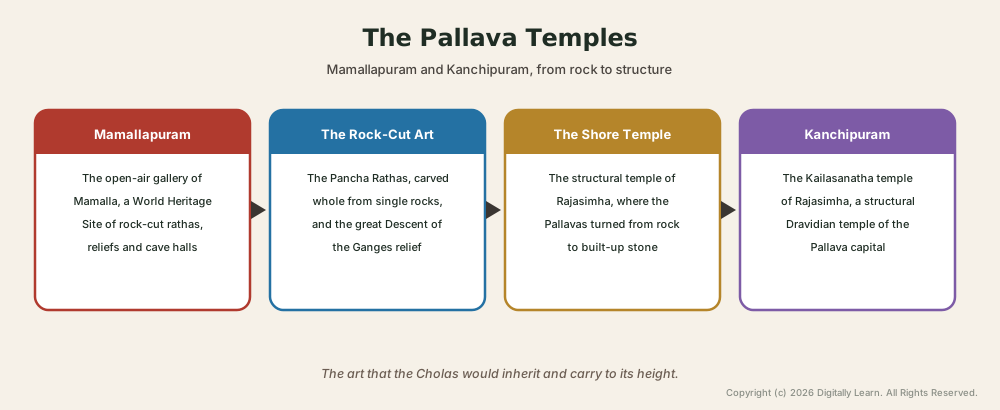
The temples of the Pallavas, at Mamallapuram on the sea and at their capital Kanchipuram, are a glory of South-Indian art. At Mamallapuram, a World Heritage Site named for Narasimhavarman I Mamalla, the Pallavas carved the monolithic Pancha Rathas and the vast Descent of the Ganges relief from the living rock; later, under Rajasimha, they built the structural Shore Temple and the Kailasanatha of Kanchipuram from cut stone. In these monuments the Indian temple of the south passed from the rock-cut cave to the soaring structure. This part covers Mamallapuram, its monuments, the Shore Temple, Kanchipuram and the exam focus.
Mamallapuram, the City of Pallava Art
The Open-Air Gallery of Narasimhavarman
What is the significance of Mamallapuram: it is the great open-air gallery of Pallava art, a World Heritage Site where the temple of the south is seen growing from the living rock.
Mamallapuram, also called Mahabalipuram, the port on the Tamil shore, takes its name from Mamalla, the title of Narasimhavarman I, who made it a city of art. Today it is a UNESCO World Heritage Site, famous above all for its monuments cut from the granite of the shore.
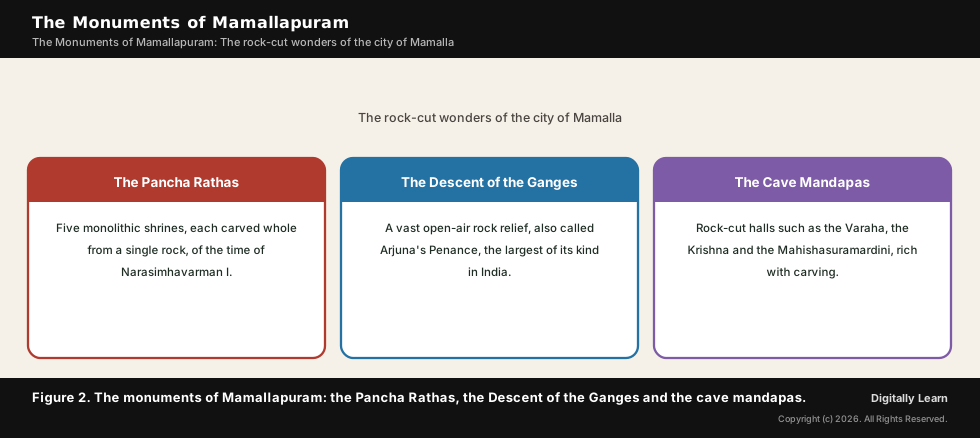
Most of its wonders are rock-cut: the monolithic rathas, the great open-air reliefs, and the cave halls. Only the Shore Temple, of a later reign, is built up from cut stone. The figure sets out the chief monuments of the city.
The Rock-Cut Wonders and the Shore Temple
The Pancha Rathas and the Descent of the Ganges
What is the significance of the rock-cut monuments: in the rathas and the great relief, the Pallava sculptor carved whole temples and whole scenes from the living rock, a feat unmatched in its age.
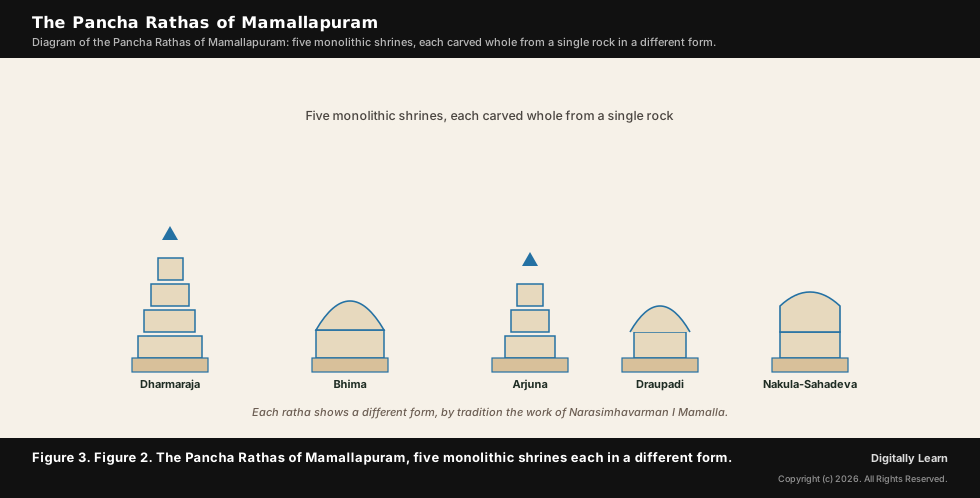
The Pancha Rathas, the five rathas, are monolithic shrines, each carved whole from a single outcrop of granite, and each in a different form, so that they are a gallery of temple shapes in stone; they are by tradition the work of Narasimhavarman I. Near them lies the vast Descent of the Ganges, also called Arjuna's Penance, a great open-air rock relief that celebrates the Pallava king's victory over the Chalukyas.
Around these stand the cave mandapas, the rock-cut halls such as the Varaha, the Krishna and the Mahishasuramardini, their walls alive with carved gods and scenes. Together they make Mamallapuram one of the great galleries of Indian rock-cut art.
The Shore Temple and the Turn to Structure
Distinguishing the structural temple: the last and greatest of the Mamallapuram monuments is not cut from the rock at all, but built up from blocks of stone, the work of a later king.
The Shore Temple, standing on the very edge of the sea, is a structural temple, raised from cut blocks of granite, and it is the work not of Mamalla but of his successor Narasimhavarman II Rajasimha. In it the Pallavas turned from carving temples out of the rock to building them up from stone, a change that would shape all the later temples of the south.
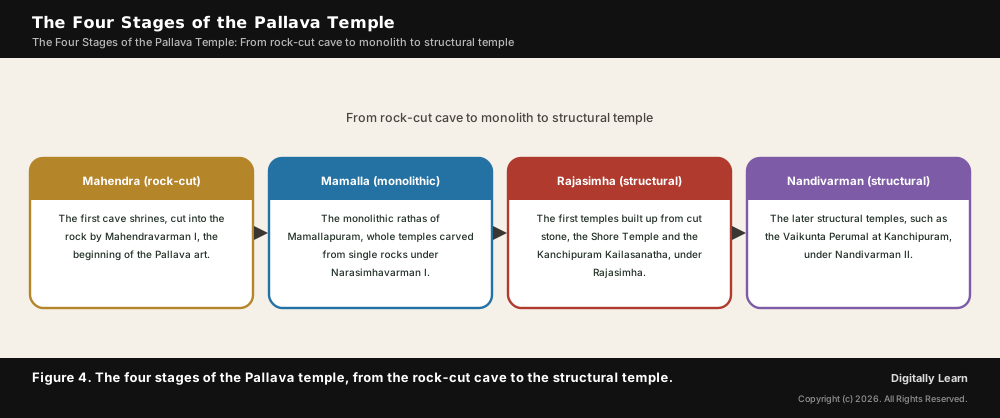
This is a point to hold firm: the rock-cut rathas and reliefs belong to Mamalla, while the structural Shore Temple belongs to Rajasimha. The figure that follows sets out the four stages by which the Pallava temple grew.
Kanchipuram and the Two Kailasa Temples
The Kailasanatha of Kanchipuram
What is the significance of the Kanchipuram Kailasanatha: it is the great structural temple of the Pallava capital, and an aspirant must not confuse it with another temple of the same name far to the north.
The Kailasanatha temple at Kanchipuram, the Pallava capital, was built by Rajasimha about 700; it is a structural temple of cut stone, in the Dravidian style, and one of the finest of the Pallava buildings. It was here that the Chalukya Vikramaditya II, when he took Kanchipuram, set up the inscription recording that he had spared the city and its temples.
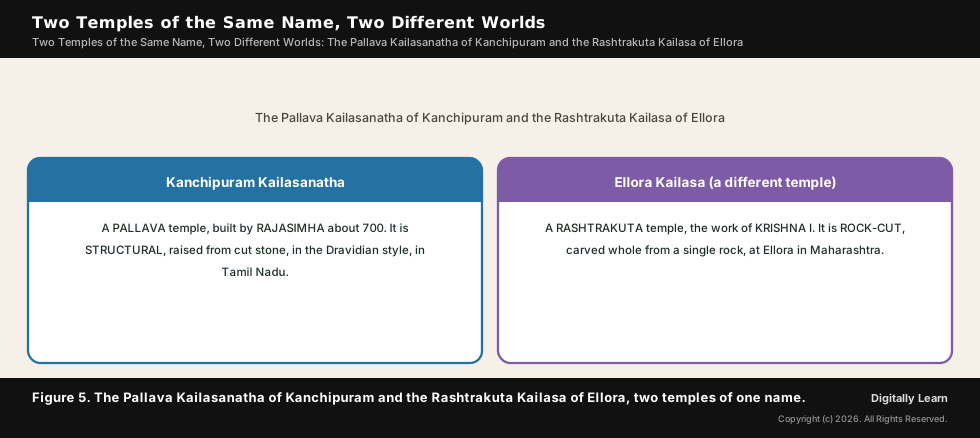
Here a famous confusion must be cleared. The Kanchipuram Kailasanatha is a Pallava, structural temple in Tamil Nadu; it is not the same as the Kailasa temple at Ellora, which is a Rashtrakuta monument, rock-cut from a single rock, far away in Maharashtra. The two share a name and nothing more.
The Growth of the Pallava Temple in Four Stages
Distinguishing the stages: the Pallava temple did not spring up at once, but grew through four stages, from the cave cut into the rock to the temple built up from stone.
Scholars divide the Pallava art into four stages, named for the kings who led them, from the rock-cut caves of Mahendravarman to the structural temples of Rajasimha and Nandivarman. The table below sets them out.
| Stage | King | Form |
|---|---|---|
| First | Mahendravarman I | Rock-cut cave temples. |
| Second | Narasimhavarman I (Mamalla) | Monolithic rathas and reliefs. |
| Third | Narasimhavarman II (Rajasimha) | Structural temples (Shore Temple, Kailasanatha). |
| Fourth | Nandivarman II | Later structural temples (Vaikunta Perumal). |
UPSC Relevance and Exam Focus
Where the Pallava Temples Fit in the UPSC-CSE Syllabus
This topic belongs to General Studies Paper I: Indian art and culture, and the Pallava temples, above all Mamallapuram, are a favourite ground for Prelims questions.
The questions most often test the monuments and their builders: the Pancha Rathas and the Descent of the Ganges at Mamallapuram, the structural Shore Temple, and the Kanchipuram Kailasanatha.
Several linked points recur and are worth holding in working memory:
- Mamallapuram: A World Heritage Site, named for Narasimhavarman I Mamalla.
- The Pancha Rathas: Five monolithic, rock-cut shrines.
- The Descent of the Ganges: A vast open-air rock relief.
- The Shore Temple: A structural temple, the work of Rajasimha.
- The four stages: Mahendra, Mamalla, Rajasimha, Nandivarman.
A 2016 question asked what Ajanta and Mamallapuram have in common; the answer is that both have rock-cut monuments, but not that they are of the same period or the same religion. A 2005 question listed Mamallapuram among the UNESCO World Heritage Sites of India.
A common trap credits the structural Shore Temple to Mamalla; the rock-cut rathas are Mamalla's, the structural Shore Temple is Rajasimha's. Another confuses the Kanchipuram Kailasanatha, a Pallava temple, with the Ellora Kailasa, which is the work of the Rashtrakutas.
Previous Year UPSC-CSE Questions By the end you will be able to draft model answers for the following UPSC questions. Each question carries a collapsible framework showing how to approach it in the exam.
- UPSC Prelims 2016 GS-IWhat is/are common to the two historical places known as Ajanta and Mahabalipuram?
- Both were built in the same period.
- Both belong to the same religious denomination.
- Both have rock-cut monuments.
Select the correct answer using the code given below.
How to approach this Prelims question
Approach: Compare Ajanta and Mahabalipuram: both have rock-cut monuments (3 correct); but Ajanta is older (1 wrong) and Buddhist while Mamallapuram is Hindu (2 wrong).
Trap to watch: The shared feature is only the rock-cut monuments; the period and the religion differ.
Key facts to recall:
- Mamallapuram has rock-cut monuments (the Pancha Rathas, the reliefs).
- Ajanta is older than Mamallapuram, and is Buddhist; Mamallapuram is Hindu.
- Only the rock-cut feature is common.
Answer signal: 3 only.
- UPSC Prelims 2005 GS-IWhich of the following are included in the World Heritage List of UNESCO?
- Champaner-Pavagadh Archaeological Park
- Chhatrapati Shivaji Railway Station, Mumbai
- Mamallapuram
- Sun Temple (Konark)
Select the correct answer using the code given below.
How to approach this Prelims question
Approach: Check each: Mamallapuram (1984), Champaner-Pavagadh, CST Mumbai and the Konark Sun Temple are all on the World Heritage List, so all four are included.
Trap to watch: All four are genuine World Heritage Sites; do not drop Mamallapuram, which has been inscribed since 1984.
Key facts to recall:
- Mamallapuram is a UNESCO World Heritage Site (1984).
- Champaner-Pavagadh and CST Mumbai are also World Heritage Sites.
- The Konark Sun Temple is a World Heritage Site.
Answer signal: 1, 2, 3 and 4.
Prelims MCQ practice
Each question below tests one specific concept on the topic. Click to reveal the answer and a full option-wise explanation.
Q1. The Pancha Rathas at Mamallapuram are best described as which one of the following?
- Structural temples built of cut stone
- Monolithic shrines carved from single rocks
- Painted cave temples
- Brick temples of a later age
Show answer and explanation
Answer: Monolithic shrines carved from single rocks
Explanation.
Option (b) is correct. The Pancha Rathas are monolithic shrines, each carved whole from a single rock, of the time of Narasimhavarman I. Hence option (b).
Q2. Mamallapuram (Mahabalipuram) takes its name from which one of the following?
- A title of Narasimhavarman I
- A title of Mahendravarman I
- The Chalukya Pulakeshin II
- A Chola king
Show answer and explanation
Answer: A title of Narasimhavarman I
Explanation.
Option (a) is correct. Mamallapuram, the city of Mamalla, is named after the title Mamalla of Narasimhavarman I. Hence option (a).
Q3. With reference to the builders of the Pallava temples, consider the following statements:
- The monolithic rathas of Mamallapuram are associated with Narasimhavarman I Mamalla.
- The structural Shore Temple at Mamallapuram is the work of Narasimhavarman II Rajasimha.
Which of the statements given above is/are correct?
- 1 only
- 2 only
- Both 1 and 2
- Neither 1 nor 2
Show answer and explanation
Answer: Both 1 and 2
Explanation.
Both statements are correct. The rock-cut rathas belong to Mamalla, and the structural Shore Temple to Rajasimha; the two must not be swapped. Hence option (c).
Q4. The great open-air rock relief at Mamallapuram, which celebrates a Pallava victory, is known as which one of the following?
- The Gommateshwara colossus
- The Descent of the Ganges (Arjuna's Penance)
- The Dashavatara relief
- The Trimurti of Elephanta
Show answer and explanation
Answer: The Descent of the Ganges (Arjuna's Penance)
Explanation.
Option (b) is correct. The Descent of the Ganges, also called Arjuna's Penance, is the great open-air rock relief at Mamallapuram. Hence option (b).
Q5. The Kailasanatha temple at Kanchipuram is best distinguished from the Kailasa temple at Ellora in which one of the following ways?
- Both are Rashtrakuta rock-cut temples
- The Kanchipuram temple is a Pallava structural temple, the Ellora a Rashtrakuta rock-cut one
- Both are Pallava structural temples
- The Kanchipuram temple is older than the Ellora by four centuries
Show answer and explanation
Answer: The Kanchipuram temple is a Pallava structural temple, the Ellora a Rashtrakuta rock-cut one
Explanation.
Option (b) is correct. The Kanchipuram Kailasanatha is a Pallava structural temple (Rajasimha), while the Ellora Kailasa is a Rashtrakuta rock-cut monolith (Krishna I). Hence option (b).
Q6. With reference to the stages of Pallava temple architecture, consider the following statements:
- The first stage, of rock-cut caves, is associated with Mahendravarman I.
- The structural temples belong to the stages of Rajasimha and Nandivarman.
Which of the statements given above is/are correct?
- 1 only
- 2 only
- Both 1 and 2
- Neither 1 nor 2
Show answer and explanation
Answer: Both 1 and 2
Explanation.
Both statements are correct. The rock-cut cave stage belongs to Mahendravarman I, and the structural temples to the Rajasimha and Nandivarman stages. Hence option (c).
Sources and Further Reading
- NCERT, Indian Art and Culture (NCERT-inspired grounding)
- Wikipedia: Group of Monuments at Mahabalipuram
- Wikipedia: Pancha Rathas
- Wikipedia: Descent of the Ganges (Mahabalipuram)
- Wikipedia: Shore Temple
- Wikipedia: Kailasanathar Temple, Kanchipuram
- Wikipedia: Pallava art and architecture
- Wikipedia: Mamallapuram
Editorial Disclaimer
This article is for UPSC preparation. The account of the Pallava temples follows the standard scholarship, and some attributions, such as that of the Pancha Rathas, are debated among historians.


