

Overview
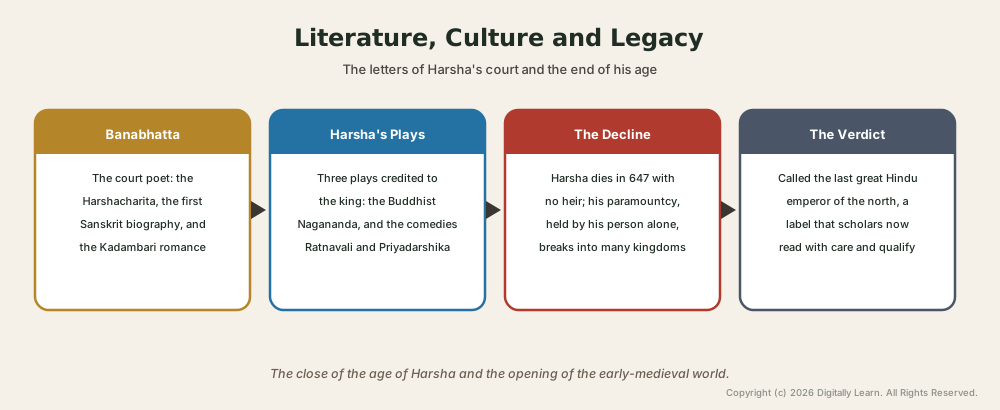
The Harsha literature and legacy close the age of the great king of Kannauj. His court shone with letters: Banabhatta wrote the Harshacharita, the first true biography in Sanskrit, and the romance of the Kadambari, while three plays, among them the Buddhist Nagananda, are credited to Harsha himself. Yet the empire he built rested on his own person, and at his death in 647, with no heir, it dissolved into the kingdoms of the early-medieval age. This part covers the literature, the decline, the legacy and the exam focus, and so closes the story of Harsha.
The Literature of Harsha's Court
Banabhatta: The Harshacharita and the Kadambari
What is the significance of Banabhatta: he was the great poet of Harsha's court, the writer who gave the age both its history and its romance, and one of the masters of Sanskrit prose.
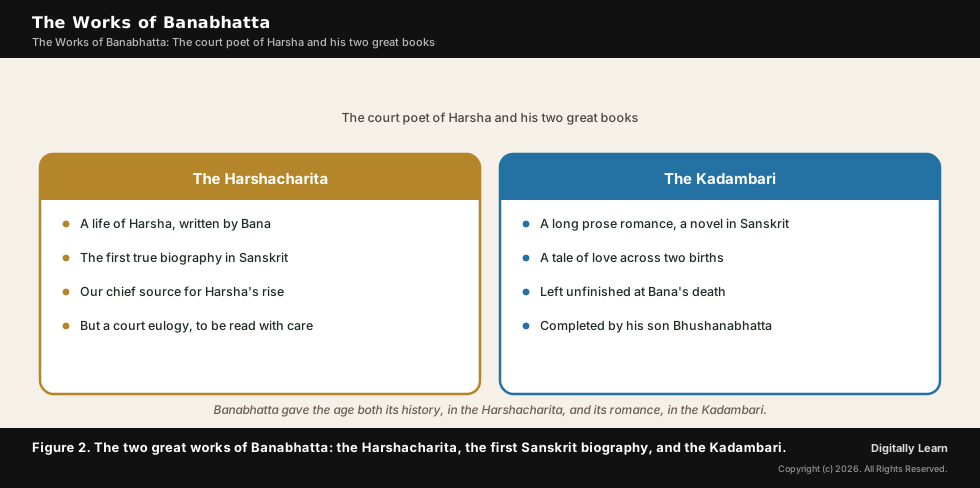
His Harshacharita, the deeds of Harsha, is a life of the king, and is counted the first true historical biography in Sanskrit; it is our chief source for Harsha's rise, though, as a court eulogy, it is to be read as praise as much as record. In it Bana set down the tale of the double murder and the young king's rescue of his sister.
His Kadambari is of another kind, a long prose romance, a novel in Sanskrit, telling a tale of love that runs across two births. Bana did not live to finish it; the work was completed by his son, Bhushanabhatta, and it remains one of the great romances of the language.
Harsha the Playwright: Nagananda, Ratnavali and Priyadarshika
What is the significance of Harsha's plays: the king was himself remembered as a poet, and three Sanskrit plays are credited to his hand, a rare thing for a ruler.
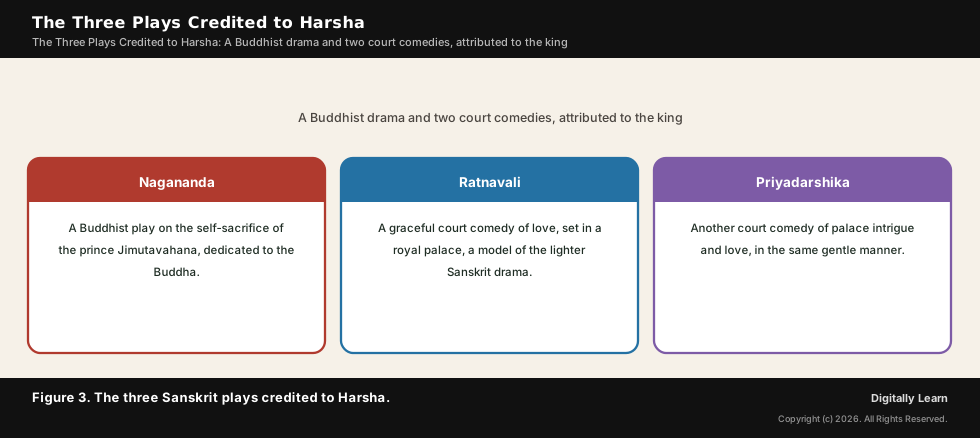
Three plays are attributed to Harsha, though some hold that he commissioned rather than wrote them. The Nagananda is a Buddhist play, on the self-sacrifice of the Bodhisattva Jimutavahana, dedicated to the Buddha; the Ratnavali and the Priyadarshika are graceful court comedies of love and palace intrigue, in the lighter manner of the Sanskrit stage.
Together with Banabhatta's prose, these plays make the court of Harsha one of the bright moments of Sanskrit letters. The university of Nalanda, treated in the part on religion, flourished in the same years, so that the age was rich in learning as well as in poetry.
The Decline and the End of the Empire
The Death of Harsha and the Dissolution of the Empire
What is the significance of Harsha's death: it brought the sudden end of his empire, and so showed how wholly that empire had rested on the one man who built it.
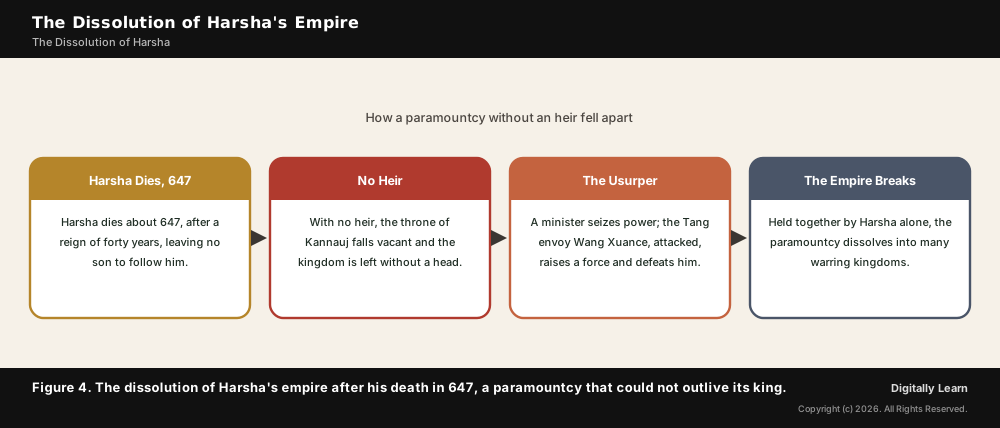
Harsha died about 647, after a reign of some forty years, leaving no heir to follow him. With his death the Pushyabhuti dynasty came to an end, and the throne of Kannauj fell vacant. Because his power had been a paramountcy held together by his own strength, and not a settled state, it could not outlive him.
The empire dissolved almost at once into the many kingdoms from which he had raised it. The feudatory lords, the samantas, who had bowed to Harsha, now stood up as independent kings, and the unity of the north was lost again, as the part on the empire foretold.
Wang Xuance and the End of the Pushyabhutis
Distinguishing the strange epilogue: the very end of the dynasty is marked by a curious episode, the visit of a Chinese envoy who found the king dead and the throne seized.
In 648 a Tang envoy, Wang Xuance, reached India to find that Harsha had died and that a minister had usurped his throne. The usurper, whose name the Chinese render as Aluonashun, attacked the envoy; Wang escaped, raised a force from Tibet and Nepal, and returned to defeat and capture him, a last, odd note on the fall of the house of Thanesar.
| Step in the end | What happened |
|---|---|
| The death of Harsha | About 647, after a forty-year reign, leaving no heir. |
| The end of the dynasty | The Pushyabhuti line ends; the throne of Kannauj falls vacant. |
| The usurper | A minister seizes power; the Chinese name him Aluonashun (Arunashva). |
| The Wang Xuance episode | The Tang envoy, attacked, raises a force and defeats the usurper, 648. |
The Legacy and the Verdict on Harsha
The Way to the Tripartite Struggle
What is the significance of Harsha's legacy: his fall did not bring a new unity but opened the long early-medieval contest for the north, the age of the tripartite struggle.
With the north broken again into kingdoms, the prize of Kannauj, the seat Harsha had made the centre of power, became the object of a long, three-cornered war. In the centuries after him, three great powers, the Pratiharas of the west, the Palas of the east and the Rashtrakutas of the Deccan, would fight for Kannauj.
This tripartite struggle, the next great theme of Indian history, grows directly out of the world Harsha left, a north without an overlord and a city that all desired. The age of Harsha thus stands as the threshold between the ancient and the early-medieval orders.
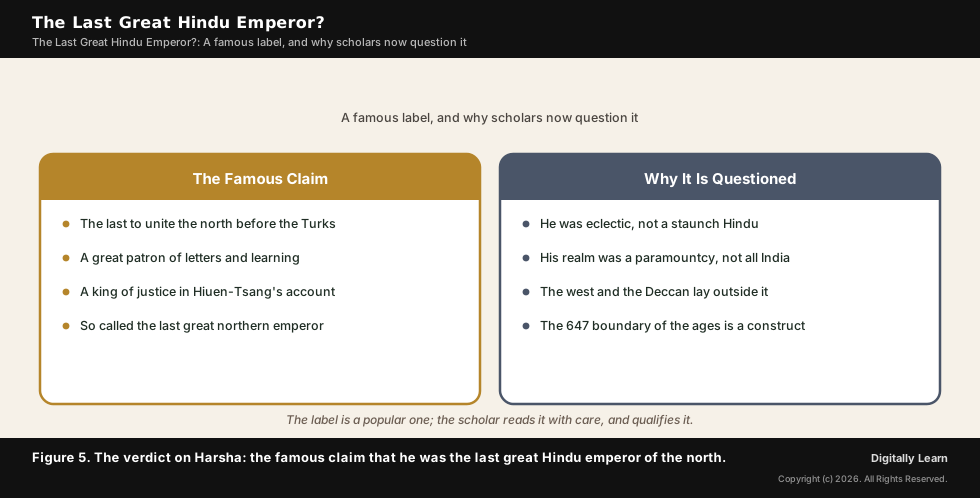
The Last Great Hindu Emperor? A Contested Verdict
Distinguishing the famous label: Harsha is often called the last great Hindu emperor of northern India, a phrase that an aspirant should know, and know how to question.
The claim rests on his uniting of the north and his patronage of letters; but scholars now read it with care. Harsha was eclectic, not a staunch Hindu; his realm was a paramountcy, not the whole of north India; and the very idea that the ancient age ends and the medieval begins with his death is a later construct, not a fact of his time.
| The famous claim | Why scholars qualify it |
|---|---|
| The last great Hindu emperor of the north. | Harsha was eclectic, not a staunch Hindu. |
| He united all of northern India. | His realm was a paramountcy; the west and Deccan lay outside. |
| His death ends the ancient age. | The ancient-to-medieval boundary at 647 is a later construct. |
UPSC Relevance and Exam Focus
Where Harsha's Literature and Legacy Fit in the UPSC-CSE Syllabus
This topic belongs to General Studies Paper I: ancient Indian history and culture, and the literature of Harsha's court and the assessment of his reign are a regular ground for both Prelims and Mains.
For Prelims, hold the firm pairings: the Harshacharita and the Kadambari with Banabhatta, and the three plays Nagananda, Ratnavali and Priyadarshika with Harsha. The classic matching question pairs the Harshacharita with Banabhatta, beside the Mrichchhakatika of Shudraka and the Mudrarakshasa of Vishakhadatta of the Gupta age, and the Buddhacharita of Ashvaghosha, not Vasubandhu, of the Kushana age.
For Mains, the assessment of Harsha, the contested label of the last great Hindu emperor, and the value of Bana's biography as a source, make strong analytical questions.
Recurring linked concepts an aspirant should keep in working memory:
- The Harshacharita: Banabhatta’s biography of Harsha.
- The Kadambari: Bana’s romance, finished by his son.
- Harsha’s plays: Nagananda, Ratnavali and Priyadarshika.
- 647: The death of Harsha and the end of his dynasty.
- The tripartite struggle: Pratiharas, Palas and Rashtrakutas for Kannauj.
A common Prelims trap attributes the Buddhacharita to Vasubandhu; it is the work of Ashvaghosha, while the Harshacharita is Banabhatta's. Another treats the title last great Hindu emperor as settled fact; it is a contested label, for Harsha was eclectic and his realm was a paramountcy, not all of the north.
Previous Year UPSC-CSE Questions By the end you will be able to draft model answers for the following UPSC questions. Each question carries a collapsible framework showing how to approach it in the exam.
- UPSC Prelims 1998 GS-IWhich of the following pairs of a classical Sanskrit work and its author are correctly matched?
- Mrichchhakatikam: Shudraka
- Buddhacharita: Vasuvandhu
- Mudrarakshasha: Vishakhadatta
- Harshacharita: Banabhatta
Select the correct answer using the codes given below:
How to approach this Prelims question
Approach: Fix the Harsha-age pair, the Harshacharita with Banabhatta (pair four, correct); recall that the Buddhacharita is by Ashvaghosha, not Vasubandhu (pair two, wrong), while Mrichchhakatika-Shudraka and Mudrarakshasa-Vishakhadatta are correct. The answer is I, III and IV.
Trap to watch: Pair two is the wrong one: the Buddhacharita is by Ashvaghosha, not Vasubandhu.
Key facts to recall:
- The Harshacharita is by Banabhatta.
- The Buddhacharita is by Ashvaghosha, not Vasubandhu.
- Mrichchhakatika is by Shudraka and Mudrarakshasa by Vishakhadatta.
Answer signal: I, III and IV.
Prelims MCQ practice
Each question below tests one specific concept on the topic. Click to reveal the answer and a full option-wise explanation.
Q1. With reference to Banabhatta, consider the following statements:
- He wrote the Harshacharita, a biography of Harsha.
- His Kadambari was left unfinished and completed by his son.
Which of the statements given above is/are correct?
- 1 only
- 2 only
- Both 1 and 2
- Neither 1 nor 2
Show answer and explanation
Answer: Both 1 and 2
Explanation.
Both statements are correct. Banabhatta wrote the Harshacharita, the first Sanskrit biography, and his prose romance Kadambari was left unfinished and completed by his son Bhushanabhatta. Hence option (c).
Q2. The Buddhist play Nagananda, on the Bodhisattva Jimutavahana, is attributed to which of the following?
- Banabhatta
- Harshavardhana
- Kalidasa
- Shudraka
Show answer and explanation
Answer: Harshavardhana
Explanation.
Option (b) is correct. The Nagananda is one of the three plays credited to Harsha himself; Banabhatta wrote the Harshacharita and the Kadambari. Hence option (b).
Q3. Which one of the following plays is NOT among those attributed to Harshavardhana?
- Ratnavali
- Priyadarshika
- Nagananda
- Mrichchhakatika
Show answer and explanation
Answer: Mrichchhakatika
Explanation.
Option (d) is correct. The Mrichchhakatika is by Shudraka; the Ratnavali, Priyadarshika and Nagananda are the three plays credited to Harsha. Hence option (d).
Q4. Harshavardhana died in about which year, after which his empire dissolved for want of an heir?
- 606 CE
- 618 CE
- 647 CE
- 712 CE
Show answer and explanation
Answer: 647 CE
Explanation.
Option (c) is correct. Harsha died about 647 CE, leaving no heir, and his paramountcy dissolved into the many kingdoms of the early-medieval age. Hence option (c).
Q5. With reference to the verdict on Harsha, consider the following statements:
- Harsha is popularly called the last great Hindu emperor of northern India.
- His realm was a centralized empire that covered the whole of India.
Which of the statements given above is/are correct?
- 1 only
- 2 only
- Both 1 and 2
- Neither 1 nor 2
Show answer and explanation
Answer: 1 only
Explanation.
Only the first statement is correct. Harsha is popularly called the last great Hindu emperor of the north, but his realm was a paramountcy, not a centralized all-India empire, the west and the Deccan lying outside it. Hence option (a).
Q6. The contest for Kannauj after Harsha, the tripartite struggle, was fought among which of the following?
- The Cholas, Pandyas and Cheras
- The Pratiharas, Palas and Rashtrakutas
- The Mauryas, Shungas and Kanvas
- The Chalukyas, Pallavas and Cholas
Show answer and explanation
Answer: The Pratiharas, Palas and Rashtrakutas
Explanation.
Option (b) is correct. After Harsha, the Pratiharas of the west, the Palas of the east and the Rashtrakutas of the Deccan fought the tripartite struggle for Kannauj. Hence option (b).
Sources and Further Reading
Editorial Disclaimer
This article is for UPSC preparation. The authorship of Harsha's plays is by tradition, and the assessment of his reign follows the standard scholarship, in which the label of the last great Hindu emperor is debated.


