

Overview
The India-Republic of Korea Special Strategic Partnership is the top tier of the diplomatic relationship between India and South Korea, first declared in 2015. In April 2026, Prime Minister Narendra Modi and President Lee Jae Myung adopted a Joint Strategic Vision to expand this partnership for the years 2026 to 2030, setting out cooperation across trade, critical minerals, defence, space and maritime affairs. It is a flagship of India's Act East Policy and its engagement in the Indo-Pacific.
What the two countries agreed
A Joint Strategic Vision for 2026 to 2030
Prime Minister Narendra Modi and the President of the Republic of Korea, Lee Jae Myung, adopted a Joint Strategic Vision to expand the India-Republic of Korea Special Strategic Partnership over the five years from 2026 to 2030. The partnership was first raised to a Special Strategic Partnership in 2015.
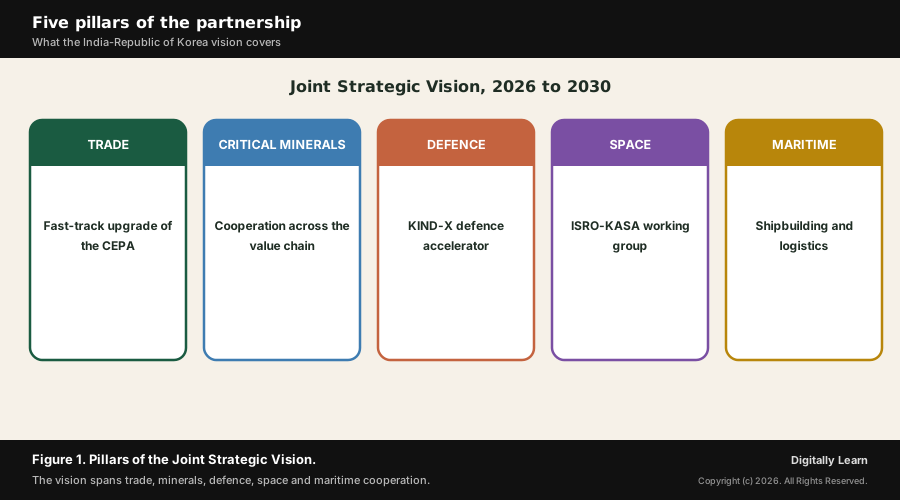
The vision sets out cooperation across five broad areas: trade, critical minerals, defence, space and maritime affairs. It turns a long-standing relationship into a fuller agenda with concrete steps in each area.
Why a Deeper India-Korea Partnership Matters
A like-minded partner in a contested region
Why it matters is that South Korea is one of Asia's most advanced economies, a leader in semiconductors, shipbuilding and electronics, and a fellow democracy in a region increasingly shaped by China's economic and strategic weight. A closer partnership therefore serves both countries at once.
For India, it means more resilient supply chains, fresh investment and technology, and a partner that shares its interest in a free and open Indo-Pacific. For South Korea, it means access to a large and growing market and a trusted base for manufacturing beyond a single country.
From Trade Partners Towards Strategic Allies
What the vision signifies for India's foreign policy
What is the significance of this partnership lies in its breadth. Earlier ties were driven mainly by trade and investment; the new vision adds defence, space, critical minerals and maritime cooperation, moving the relationship from a commercial one towards a strategic one.
It also fits a wider pattern in which India deepens ties with advanced democracies to diversify its supply chains and reduce over-dependence on any single source. In this sense the partnership is part of India's broader balancing in the Indo-Pacific.
Distinguishing features of the 2026 vision
The main outcomes at a glance
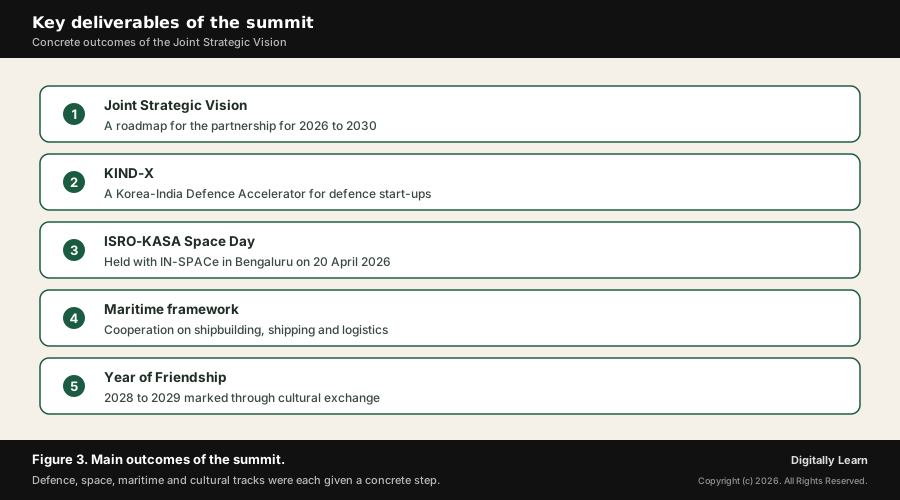
The table sets out the principal outcomes of the summit and what each one does. Together they show a partnership that is being built across several tracks at once, rather than in trade alone.
Read together, the rows show concrete steps in defence, space, trade and maritime cooperation, each with a named mechanism.
| Track | Outcome |
|---|---|
| Trade | A fast-track, mission-mode upgrade of the Comprehensive Economic Partnership Agreement |
| Critical minerals | Cooperation across the value chain, including AI-based mapping and recovery from e-waste |
| Defence | A Korea-India Defence Accelerator, called KIND-X, for defence start-ups |
| Space | An ISRO-KASA working group and an India-Republic of Korea Space Day in Bengaluru |
| Maritime | A framework for cooperation on shipbuilding, shipping and maritime logistics |
Upgraded trade, shared minerals and a Korean enclave
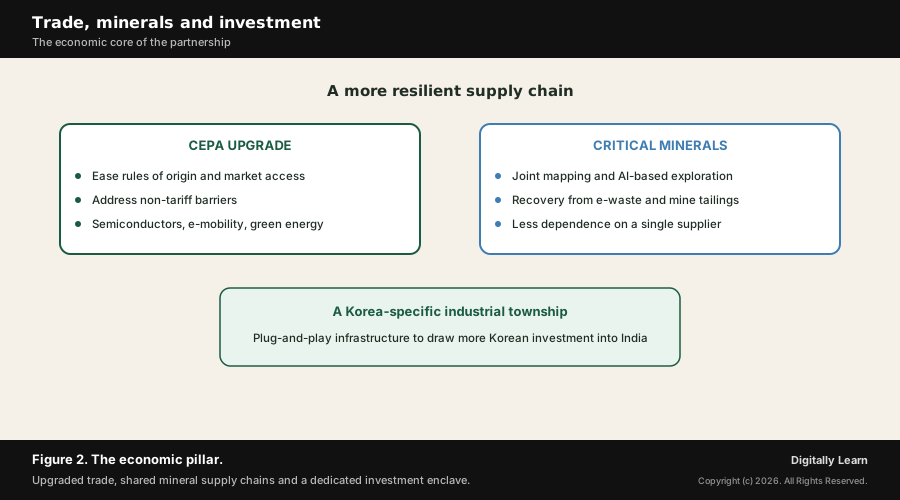
The economic core of the vision is an upgrade of the Comprehensive Economic Partnership Agreement, the trade pact in force since 2010. The two sides agreed to a fast-track approach to ease rules of origin, address non-tariff barriers and widen market access for a more balanced trade relationship.
They also agreed to work together across the critical minerals value chain, including joint mapping and exploration using artificial intelligence and the recovery of minerals from unconventional sources such as e-waste and mine tailings. To draw more Korean investment, the leaders discussed a Korea-specific industrial township in India with plug-and-play infrastructure.
What to Watch as the Partnership Develops
Three things to track from 2026 onwards
The vision translates into three developments worth tracking, since a strategic vision is judged by whether its named mechanisms turn into working projects.
- (a) The CEPA upgrade. Whether the fast-track talks actually lower barriers and rebalance the trade relationship.
- (b) Critical minerals delivery. Whether joint exploration and recovery projects begin to reduce supply-chain risk.
- (c) Defence and space tracks. Whether KIND-X and the ISRO-KASA working group produce concrete projects.
The real test is whether the five tracks move together, so that the partnership grows in depth and not only on paper.
Act East, the Indo-Pacific and Supply-Chain Resilience
How the partnership fits India's wider strategy
Contemporary linkages tie the partnership to India's Act East Policy, the drive to deepen ties with East and Southeast Asia, of which South Korea is a key part. It also fits India's engagement in the Indo-Pacific, where it works with advanced democracies to support a stable, rules-based order.
The push on critical minerals and the CEPA upgrade reflects a wider Indian effort to build supply-chain resilience and reduce over-dependence on any single source, an effort visible across India's recent trade and technology partnerships.
The partnership sits alongside India's other major East Asian relationships, including with Japan, and forms part of the web of bilateral ties through which India pursues its strategic and economic interests in the region.
UPSC relevance and exam focus
Where this fits in the UPSC-CSE syllabus
This topic maps to General Studies Paper II: bilateral relations and groupings involving India, and agreements affecting India's interests, with links to the economy and to science and technology.
For Prelims, hold the high-yield facts: the Special Strategic Partnership and its 2015 origin, the Comprehensive Economic Partnership Agreement, the KIND-X defence accelerator, the ISRO-KASA space cooperation, and India's Act East Policy.
For Mains, two framings recur: India deepening ties with advanced democracies to diversify supply chains away from China, and the economic and strategic dimensions of India's Act East engagement.
Recurring linked concepts an aspirant should keep in working memory:
- Act East Policy: deepening India’s ties with East and Southeast Asia.
- Indo-Pacific: the maritime strategic space from the east coast of Africa to the Pacific.
- Comprehensive Economic Partnership Agreement: the India-Korea trade pact in force since 2010.
- Critical minerals: minerals essential for high-technology and clean-energy supply chains.
A common Prelims trap is to confuse a Comprehensive Economic Partnership Agreement with a free trade agreement; the partnership agreement is broader, covering services and investment alongside goods.
A common Mains trap is to treat a strategic vision as an achievement in itself. The harder question is delivery: whether the named mechanisms become working projects within the five-year window.
Previous Year UPSC-CSE Questions By the end you will be able to draft model answers for the following UPSC questions. Each question carries a collapsible framework showing how to approach it in the exam.
- UPSC Mains 2024 GS-IIThe West is fostering India as an alternative to reduce dependence on China's supply chain and as a strategic ally to counter China's political and economic dominance. Explain this statement with examples.
How to structure the answer in the exam
Introduction: Open with the global drive to diversify supply chains away from China and India's appeal as a partner.
Body (sub-themes to develop):
- Supply chains: critical minerals cooperation and recovery from e-waste reduce single-source dependence.
- Trade: upgraded agreements such as the India-Korea CEPA widen market access.
- Strategy: defence and maritime tracks support a stable Indo-Pacific.
- Limits: delivery and balanced trade still have to be worked out.
Conclusion: Conclude that partnerships like the one with South Korea show India being courted as both an economic alternative and a strategic ally.
- UPSC Mains 2016 GS-IIEvaluate the economic and strategic dimensions of India's Look East Policy in the context of the post-Cold War international scenario.
How to structure the answer in the exam
Introduction: Open with the shift from the Look East Policy to the Act East Policy and its rationale.
Body (sub-themes to develop):
- Economic dimension: trade pacts such as the CEPA, investment and supply-chain links.
- Strategic dimension: defence, space and maritime cooperation in the Indo-Pacific.
- Korea as a case: a Special Strategic Partnership spanning both dimensions.
- Assessment: gains in breadth, but delivery and balanced trade remain tasks.
Conclusion: Conclude that India's eastward engagement now joins economic and strategic dimensions, as the Korea partnership shows.
Sources and Further Reading
- Press Information Bureau: Joint Strategic Vision for India-ROK Special Strategic Partnership
- Press Information Bureau: India-Republic of Korea Joint Statement on Energy Resource Security
- Press Information Bureau: 12th Round of India-Korea CEPA Upgrade Negotiations
- Ministry of External Affairs: India-Republic of Korea Bilateral Relations
- Department of Commerce: India-Korea Comprehensive Economic Partnership Agreement
- Indian Space Research Organisation
- Ministry of Mines: National Critical Mineral Mission
Editorial Disclaimer
This briefing is for UPSC preparation. Verify details against the official joint statements of the Ministry of External Affairs before relying on them.


