


Overview
Unincorporated Sector
NSO survey puts India's unincorporated sector at 7.92 crore establishments, growing 7.97 per cent year-on-year.
The unincorporated sector in Indian statistical vocabulary refers to non-agricultural enterprises that are not registered as companies under the Companies Act, covering proprietary, partnership, and other unincorporated forms. The Annual Survey of Unincorporated Sector Enterprises (ASUSE) is the largest enterprise-count survey in India, conducted by the National Statistical Office (NSO) under the Ministry of Statistics and Programme Implementation (MoSPI), covering manufacturing, trade, and other services (excluding construction).
Why this is in the news on 22 May 2026
The ASUSE 2025 press note and the headline data
On 22 May 2026, the National Statistical Office (NSO) under the Ministry of Statistics and Programme Implementation (MoSPI) released the Annual Survey of Unincorporated Sector Enterprises (ASUSE) 2025. The release covers the reference period January to December 2025.
Definition: The unincorporated sector covers non-agricultural enterprises that are not registered as companies under the Companies Act, 2013. ASUSE is the largest enterprise-count survey in India and is conducted on a stratified-sample basis across the three target sectors of manufacturing, trade, and other services (excluding construction).
Three data points define the ASUSE 2025 release:
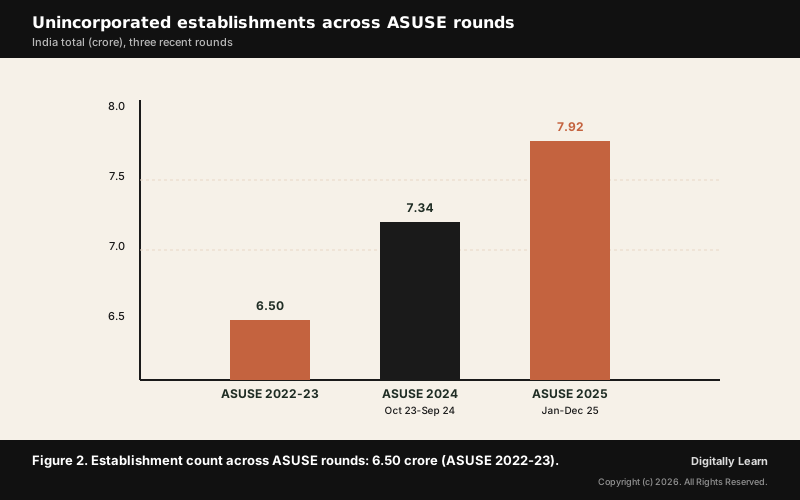
- (i) Establishment count. Total establishments rose to 7.92 crore in ASUSE 2025 (Jan-Dec 2025), from 7.34 crore in ASUSE 2024 (Oct 2023-Sep 2024). Year-on-year establishment growth is 7.97 per cent.
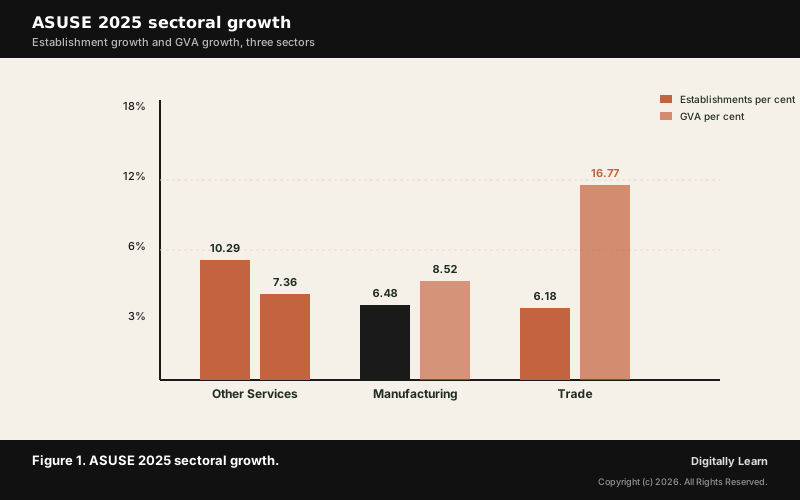
- (ii) Sectoral growth. Other Services grew fastest at 10.29 per cent establishment growth, followed by Manufacturing at 6.48 per cent and Trade at 6.18 per cent.
- (iii) Gross Value Added (GVA) growth. Overall GVA rose 10.87 per cent; led by Trade at 16.77 per cent, Manufacturing at 8.52 per cent, and Other Services at 7.36 per cent.
Why the ASUSE release matters for the Indian-economy data base
Size, share, and the formalisation question
Why it matters: ASUSE 2025 matters because it is the most comprehensive enumeration of the informal-economy footprint in India. The 7.92 crore establishments cover the bulk of non-agricultural enterprise activity outside the formal corporate sector, employing 12.81 crore workers across the three target sectors, with about 74.52 lakh jobs added over the previous round.
The release also matters because the 7.97 per cent establishment growth is the steepest annual gain in the post-2020 ASUSE series. The 7.97 per cent pace signals a recovery from the pandemic-era contraction of the informal economy, but it does not yet close the gap to the pre-pandemic baseline on every sub-indicator. Within the sector, Other Services holds the largest GVA share at about 42 per cent, ahead of Trade at 37 per cent and Manufacturing at 21 per cent.
Significance for India's economic and employment policy
What the ASUSE 2025 release means for India's GDP and employment policy
What is the significance of this issue: The ASUSE 2025 release carries three significances for India's economic and employment policy:
- (i) GDP-share signal. The unincorporated sector contributes approximately 30 per cent of GVA from non-agricultural activity, and the 10.87 per cent GVA growth in ASUSE 2025 feeds the overall GDP-growth estimate. The release improves the precision of the NSO’s quarterly GVA estimates for the segment outside the registered-factory ASI series and the corporate-sector MCA-21 database.
- (ii) Employment-policy signal. The unincorporated sector employs 12.81 crore workers across the three target sectors, far exceeding formal-sector employment, and added about 74.52 lakh jobs over the previous round. The 7.97 per cent establishment growth signals informal-employment-creation absorption capacity, particularly for the self-employed and casual-labour categories.
- (iii) Formalisation-debate signal. The persistent dominance of unincorporated enterprises in the non-agricultural economy is the structural backdrop for the formalisation push under GST, Udyam registration, the e-Shram portal, and the MSME Development Act credit-and-procurement linkages.
Distinguishing features of the ASUSE methodology
How the ASUSE survey is designed and conducted
Distinguishing features: Three methodological pillars define the ASUSE survey design:
- (i) Coverage scope. The survey covers non-agricultural unincorporated enterprises in manufacturing (NIC division 10-33), trade (NIC division 45-47), and other services (NIC division 49-96 excluding construction at 41-43). Crop production, public administration, and registered companies are out of scope.
- (ii) Stratified sample design. The survey uses a two-stage stratified sample design. The first stage selects census enumeration blocks (urban) and villages (rural) within each state and union territory; the second stage selects establishments within the chosen blocks. The Sixth Economic Census frame and the National Statistical Office sample registers seed the first stage.
- (iii) Continuous-survey cycle. ASUSE shifted from a periodic (every few years) cycle to an annual continuous-survey design from ASUSE 2022-23. Each round runs for 12 months across multiple visit-rounds; ASUSE 2025 covered January to December 2025. The continuous cycle aligns the unincorporated-sector data series with the Annual Survey of Industries (ASI) data flow for the registered-factory segment.
The ASUSE 2025 release in numbers
| ASUSE 2025 attribute | Detail | Significance |
|---|---|---|
| Release | ASUSE 2025 press note, 22 May 2026 | Largest enterprise survey in India by establishments covered |
| Reference period | January to December 2025 | Annual continuous-survey cycle |
| Total establishments | 7.92 crore (up from 7.34 crore) | 7.97 per cent year-on-year growth |
| Gross Value Added | 10.87 per cent GVA growth | Led by Trade 16.77 per cent, Manufacturing 8.52 per cent, Other Services 7.36 per cent |
| Sector establishments | Other Services +10.29 per cent; Manufacturing +6.48 per cent; Trade +6.18 per cent | Other Services leads on count |
| Survey authority | National Statistical Office (NSO), MoSPI | Conducts the survey under MoSPI |
| Coverage | Manufacturing, Trade, Other Services (excluding construction) | Non-agricultural unincorporated enterprises |
| Sample frame | Sixth Economic Census plus NSO sample registers | First-stage frame for blocks and villages |
| Cycle | Annual continuous from ASUSE 2022-23 | Earlier rounds were periodic (2010-11, 2015-16, 2018-19) |
Observable outcomes to track from the data release
What to watch on the unincorporated-sector trajectory through 2026
Observable outcomes: Five outcomes frame the post-release tracking of the unincorporated-sector data series:
- (a) Establishment-growth durability. Whether the 7.97 per cent annual growth in ASUSE 2026 sustains above the post-pandemic-recovery threshold or normalises toward the trend rate of 3-4 per cent.
- (b) Sectoral mix shift. Whether Other Services continues to lead establishment growth or Trade reclaims the lead under post-pandemic consumption normalisation.
- (c) Worker-density progression. Workers per establishment ratio across the three sectors; the post-pandemic shift toward smaller establishments versus a reversion to larger units.
- (d) Formalisation-channel transitions. The flow of unincorporated establishments graduating to Udyam-registered MSME, GST-registered, or Companies-Act-registered status year-on-year.
- (e) Goods-versus-services GVA balance. Whether Trade continues to outpace Manufacturing and Other Services on GVA growth or the goods-side recovery catches up.
Threads connecting ASUSE to wider employment and informalisation policy
How the ASUSE release connects to formalisation, e-Shram, and the statistical-architecture
Contemporary linkages: Three threads connect the ASUSE 2025 release to wider Indian employment and informalisation policy.
The first is the formalisation-and-MSME thread. The Udyam registration portal (launched 1 July 2020), the MSME Development Act, 2006, and the revised MSME classification thresholds (effective 1 April 2025) all attempt to draw unincorporated enterprises into the formal registry without raising compliance cost beyond the firm's elasticity. The ASUSE 2025 7.92 crore base sets the universe size for this formalisation effort.
The second is the unorganised-worker-welfare thread. The e-Shram portal (launched August 2021) maintains a database of unorganised workers for benefits delivery. The Code on Social Security, 2020 extends social-security benefits to gig and platform workers. The unincorporated sector is the primary employer pool for these worker categories.
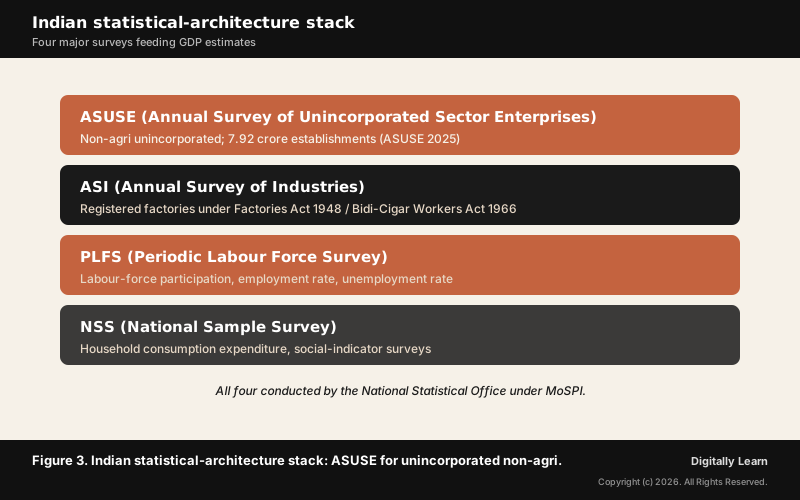
The third is the statistical-architecture thread. ASUSE complements the Periodic Labour Force Survey (PLFS) for employment estimates, the Annual Survey of Industries (ASI) for registered factories, and the National Sample Survey (NSS) household-side surveys. Together they form the basis for the quarterly GDP estimates released by NSO.
UPSC Relevance
Where the ASUSE release sits in the UPSC syllabus
UPSC context: The ASUSE 2025 release falls within General Studies Paper III under Indian Economy and issues relating to planning, mobilization of resources, growth, development and employment and effects of liberalization on the economy, changes in industrial policy and their effects on industrial growth. The employment dimension also touches inclusive growth and issues arising from it.
Prelims relevance: The Prelims surface includes the Annual Survey of Unincorporated Sector Enterprises (ASUSE), the National Statistical Office (NSO) under the Ministry of Statistics and Programme Implementation (MoSPI), the Periodic Labour Force Survey (PLFS), the Annual Survey of Industries (ASI), the National Sample Survey (NSS), the e-Shram portal, the Udyam registration portal, the MSME Development Act, 2006, the Code on Social Security, 2020, and the four Labour Codes of 2019-2020.
Mains relevance: Two framings dominate the Mains-paper surface:
- (i) Informalisation-and-development framing. Whether globalisation reduced formal-sector employment and whether increased informalisation is detrimental to development. The ASUSE 2025 release supplies the universe size and growth rates for the empirical answer.
- (ii) Unemployment-methodology framing. Whether Indian unemployment is structural and how the measurement methodology can improve. ASUSE complements PLFS by measuring the establishment-side count where PLFS measures the worker-side.
Mains practice question: A focused fifteen-mark question would read: The ASUSE 2025 release shows 7.92 crore unincorporated establishments and 10.87 per cent GVA growth. Examine the structural significance of the unincorporated sector for India's economy and discuss the formalisation-and-welfare policy stack that it is the universe for.
- Past Mains linkage. 2016 GS-III: How globalization has led to the reduction of employment in the formal sector of the Indian economy? Is increased informalization detrimental to the development of the country? The ASUSE 2025 universe size of 7.92 crore is the most-current evidence for the informalisation discussion.
- Past Mains linkage. 2023 GS-III: Most of the unemployment in India is structural in nature. Examine the methodology adopted to compute unemployment in the country and suggest improvements. ASUSE complements PLFS on the methodology-improvement question by providing establishment-side enumeration.
- Institutional linkage. Prelims questions on PLFS, e-Shram, Udyam, and MSME architecture test the institutional surface.
Previous Year UPSC-CSE Questions By the end you will be able to draft model answers for the following UPSC questions. Each question carries a collapsible framework showing how to approach it in the exam.
- UPSC Mains 2016 GS-IIIHow globalization has led to the reduction of employment in the formal sector of the Indian economy? Is increased informalization detrimental to the development of the country?
How to structure the answer in the exam
Introduction: Open with the 1991 liberalisation and post-2000 globalisation, name the 7.92 crore ASUSE 2025 unincorporated-sector base as the empirical reference point, and frame the answer through formal-sector reduction channels and informalisation impact lenses.
Body (sub-themes to develop):
- Channel 1 (formal reduction): Import competition under WTO commitments squeezed labour-intensive sectors (textiles, garments, leather) in the early 2000s; small-scale-industry reservation withdrawal in 2010 exposed formal MSMEs to scale-disadvantage; jobless-growth pattern in capital-intensive manufacturing.
- Channel 2 (formal reduction): Technology displacement; automation in formal-sector services and manufacturing; software-services sector grew skill-intensive employment but not absolute volume.
- Channel 3 (formal reduction): Footloose capital and contractualisation; rise of contract workers in the organised sector under the Contract Labour Regulation Act framework; informalisation within the formal sector.
- Informalisation lens 1 (universe size): ASUSE 2025 records 7.92 crore unincorporated establishments employing 12.81 crore workers; the universe is large, persistent, and growing at 7.97 per cent.
- Informalisation lens 2 (welfare exposure): unorganised workers lack EPF, ESI, and gratuity coverage; e-Shram portal (August 2021) and Code on Social Security 2020 are the welfare-extension instruments.
- Informalisation lens 3 (productivity drag): unincorporated establishments have lower output per worker, lower technology adoption, and limited credit access; the productivity gap caps aggregate growth.
- Formalisation stack: Udyam registration (July 2020); GST registration; e-Shram (August 2021); MSME thresholds revised 2025; Production-Linked Incentive sector-specific schemes.
Conclusion: Conclude that globalisation reduced formal-sector employment through import-competition, technology-displacement, and contractualisation channels, that informalisation is partially detrimental on welfare and productivity grounds, and that the ASUSE 2025 release at 7.92 crore establishments is the most-current empirical pillar the formalisation-policy stack must address.
The ASUSE 2025 release at 7.92 crore unincorporated establishments is the most-current empirical reference point for the 2016 GS-III question on informalisation. The body sub-theme on informalisation lens 1 supplies the leading universe-size pillar.
- UPSC Mains 2023 GS-IIIMost of the unemployment in India is structural in nature. Examine the methodology adopted to compute unemployment in the country and suggest improvements.
How to structure the answer in the exam
Introduction: Open with the structural-unemployment claim and PLFS as the official unemployment-measurement instrument, frame the answer through current methodology, measurement gaps, and improvement levers.
Body (sub-themes to develop):
- Current methodology: PLFS conducted by NSO under MoSPI since 2017-18 (replacing the older NSS-EUS); three reference periods: Usual Principal Status (UPS, 365 days), Usual Principal and Subsidiary Status (UPSS), Current Weekly Status (CWS, 7 days), Current Daily Status (CDS); rural and urban estimates separately.
- Measurement gap 1: informal-employment under-count; the establishment-side ASUSE 7.92 crore establishments employ 12.81 crore workers, but PLFS worker-side captures self-employed and casual labour partially; reconciliation gap.
- Measurement gap 2: disguised unemployment in agriculture and family enterprises; the PLFS asks worker-side participation but does not measure productivity per worker.
- Measurement gap 3: women workforce; the female labour-force participation rate is sensitive to definitions of unpaid domestic and household-enterprise work; under-counting persists.
- Improvement 1: ASUSE-PLFS integration; cross-walk the establishment-side ASUSE 7.92 crore base with the PLFS worker-side estimates to triangulate informal-employment.
- Improvement 2: Time-use surveys; the Time Use Survey 2019 by NSO captured time spent on paid and unpaid work; periodic repetition improves the female workforce estimate.
- Improvement 3: Gig and platform worker tracking; the e-Shram database (35 crore registrations by 2024) and the Code on Social Security 2020 explicit category create a tracking channel.
Conclusion: Conclude that Indian unemployment is structural across formal-informal, agriculture-non-agriculture, and gender lines, that the PLFS methodology has known gaps in informal-employment, disguised unemployment, and women workforce capture, and that ASUSE-PLFS integration plus time-use surveys plus gig-worker tracking are the three improvement levers.
The ASUSE 2025 release supplies the establishment-side enumeration that the PLFS worker-side methodology needs for triangulation. The body sub-theme on Improvement-1 ASUSE-PLFS integration is the direct response to the 2023 GS-III methodology-improvement question.
Sources
- MoSPI Press Note on ASUSE 2025 Release
- MoSPI Microdata Portal: ASUSE 2023-24 catalog
- PIB Press Release: ASUSE 2023-24 Results
- Ministry of MSME: Udyam registration portal
- Ministry of Labour and Employment: e-Shram portal
- NSO Periodic Labour Force Survey (PLFS) reports
- MSME Development Act, 2006 (consolidated text)
- Wikipedia: Informal sector in India
Editorial Disclaimer
This article is compiled from the reference materials listed in the Sources section. It is an explainer for UPSC preparation and is not a substitute for primary documents (NCERTs, GoI ministry releases, IMD bulletins, RBI / CEA / MoEFCC publications, and Standing-Committee reports).


