


Overview
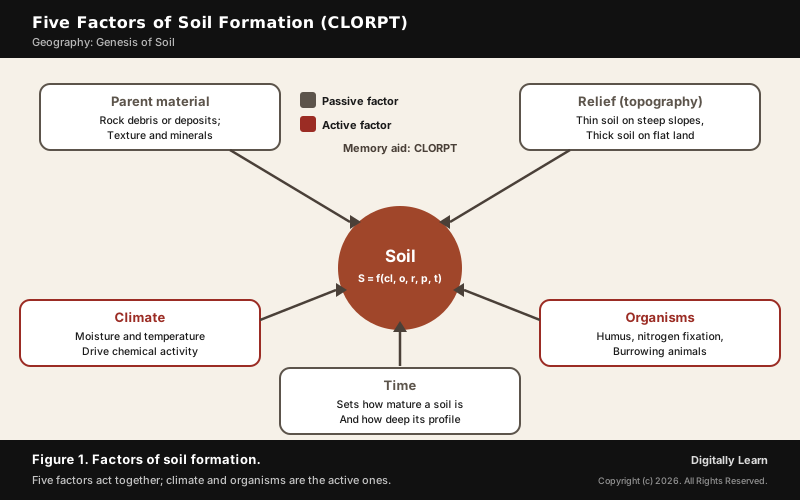
Soil formation, or pedogenesis, is the process by which weathered rock and deposits become soil, a mixture of rock debris and organic matter that supports plants. It depends first on weathering and is controlled by five factors: parent material, topography, climate, biological activity and time.
Genesis of Soil: What Soil Is and How Soil Formation Begins
What Is Soil? Definition, Components and Composition
A soil scientist, or pedologist, defines soil as a collection of natural bodies on the earth's surface containing living matter and supporting or capable of supporting plants. Put simply, soil is the mixture of rock debris and organic materials that develops on the earth's surface.
Soil is not dead dust. It is a dynamic medium in which chemical, physical and biological activities go on constantly; it is a result of decay and also the medium for growth. Its temperature, moisture, organic matter and life change with the seasons, and it adjusts to climate, landform and vegetation, changing internally when these change.
- Components: Mineral particles, humus, water and air, in amounts that vary from one soil to another.
- A typical soil: About 50 per cent solids (45 per cent mineral and 5 per cent organic matter) and 50 per cent pore space, half filled with water and half with gas.
- Pedology: The branch of soil science that studies how soils form and are characterised; its partner, edaphology, studies soil as a medium for plants.
Soil Formation Process: How Soil Is Formed from Weathered Rock
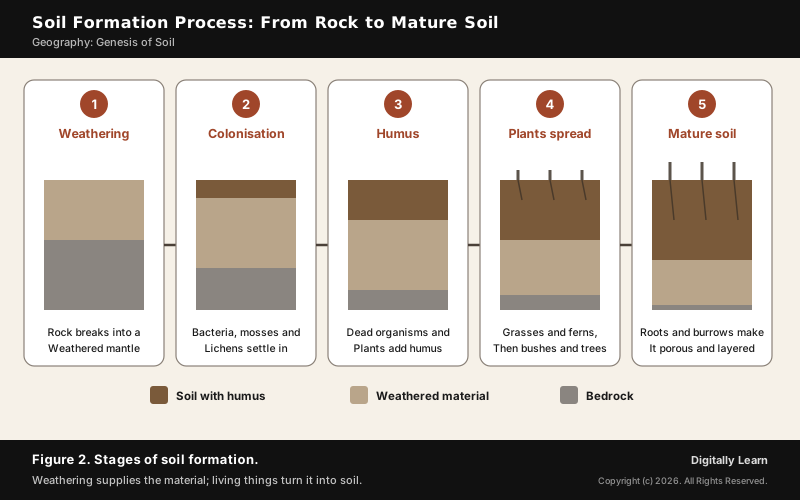
The origin of soil lies in rock: soil formation depends first on weathering. The weathering mantle, the depth of weathered material, is the basic input from which soil forms, and life then turns that material into soil. The soil formation stages run in this order.
- Weathering: Rock breaks down in place into a mantle of weathered material, or transported deposits are laid down.
- Colonisation: Bacteria and simple plants such as mosses and lichens settle on the material, and small organisms take shelter in it.
- Humus builds up: The dead remains of organisms and plants accumulate as humus.
- Plants spread: Grasses and ferns grow, then bushes and trees from seeds brought by birds and wind.
- Mature soil: Roots push down and burrowing animals bring particles up; the material becomes porous and sponge-like, holds water and lets air pass, and a mature soil, a complex mixture of mineral and organic products, forms.
Weathering and Soil Formation: Chemical, Physical and Biological
Rocks are broken down by weathering: the mechanical disintegration and chemical decomposition of rocks by the elements of weather and climate. Little or no movement of material takes place, so it is an in-situ, on-site process, and its three groups rarely act alone.
| Type | How it works |
|---|---|
| Solution | Minerals dissolve in water or weak acids and are carried away |
| Carbonation | Carbon dioxide in water forms carbonic acid, which dissolves carbonates |
| Hydration | Minerals take up water and expand, which fatigues the rock |
| Oxidation | Iron and other minerals combine with oxygen; red iron turns brown or yellow |
| Reduction | Without oxygen, below the water table, red iron turns greenish or bluish grey |
| Unloading | Erosion removes overlying rock; the rock expands and cracks into sheets |
| Temperature change | Daily heating and cooling fatigue rock, most in dry climates |
| Frost and salt | Ice and salt crystals grow in cracks and split the rock |
| Biological | Roots, burrowing animals and organic acids break and decay rock |
Chemical weathering needs water and air: water, oxygen and carbon dioxide, with heat, speed up all its reactions, and decaying plants and animals add carbon dioxide underground. Hydration, carbonation and oxidation go hand in hand. That is why rain is a weathering agent: it carries dissolved carbon dioxide, which drives carbonation, and oxygen, which drives oxidation.
Factors of Soil Formation: The Five Soil-Forming Factors
Five Factors of Soil Formation and the CLORPT Model
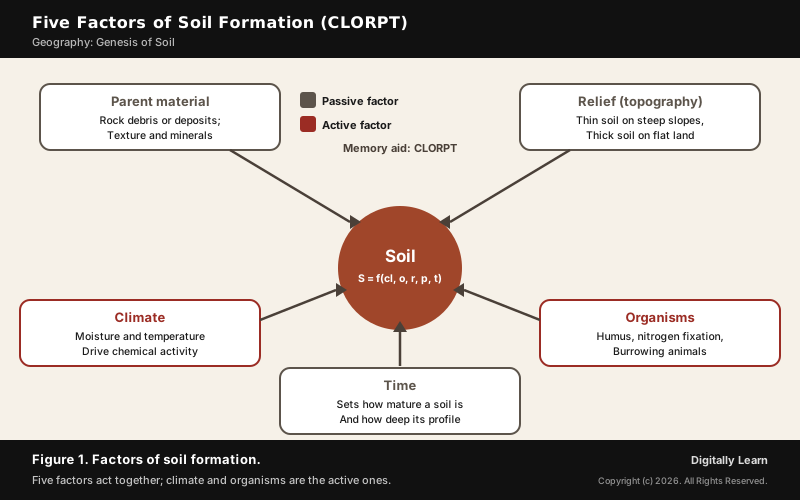
Five basic factors control the formation of soils: parent material, topography, climate, biological activity and time. These factors affecting soil formation act in union and affect the action of one another, so no factor explains a soil on its own. Human activities also influence soil formation to a large extent.
- Dokuchaev, 1883: Vasily Dokuchaev, regarded as the father of soil science, concluded from field studies of Russian soils that soil forms over time under climate, vegetation, topography and parent material. His best-known work is Russian Chernozem (1883).
- Jenny, 1941: The American soil scientist Hans Jenny wrote soil formation as a state equation, S = f(cl, o, r, p, t, …), for climate, organisms, relief, parent material and time, leaving room for more factors.
- CLORPT: The initials of Jenny’s factors give the memory aid CLORPT.
Parent Material: The Passive Base of Soil
Every soil starts from a parent material, the rock debris or deposit from which it forms, and this is a passive control factor. It may be weathered rock debris in place, giving residual soils, or deposits brought from elsewhere, giving transported soils.
- What matters: The texture (sizes of debris), the structure (how the grains are arranged) and the mineral and chemical composition of the debris, along with the rate and depth of weathering.
- Not a fixed rule: Similar bedrock can carry different soils, and different bedrocks can carry similar soils.
- Young soils: Soils that have not matured show strong links with the parent rock, as do soils in some limestone areas where the weathering is peculiar.
India offers a clear case. The black soil of the Deccan is typical of the Deccan trap, the basalt region made up of lava flows, and climate together with this parent rock is taken to be the main factor in its formation. That is why black soil covers most of the Deccan Plateau.
Topography (Relief) and Soil Formation
The second passive factor is topography, or relief. It works through how much sunlight a surface receives and how much water drains over and through its parent material.
- Steep slopes: Soils are thin, and erosion by running water is more significant.
- Gentle slopes: Soil formation is most favourable, since erosion is slow and water percolates well.
- Flat land: Soils are thick and may develop a thick clay layer with much organic matter, which gives a dark colour.
- Aspect: In middle latitudes, sunny south-facing slopes carry different vegetation and soils from cool, moist north-facing slopes.
India's mountain soils show the rule on a single hillside. Forest soils are loamy and silty on valley sides and coarse-grained on the upper slopes; in the snow-bound Himalaya they are denuded, acidic and low in humus, while the soils of the lower valleys are fertile.
Relief also decides drainage. Where water collects and stays, the soil is saturated long enough for its iron to be reduced and the soil to turn grey, the gleisation described below; where water drains freely, air reaches the soil and its iron stays oxidised.
Climate: The Active Factor in Soil Formation
Climate is an important active factor, working through moisture (how much, how often and how long it rains, against evaporation and humidity) and temperature (seasonal and daily variation). Precipitation gives the soil the moisture that makes chemical and biological activity possible.
- Eluviation and illuviation: Excess water carries soil components down through the soil (eluviation) and deposits them lower down (illuviation).
- Desilication: In wet equatorial areas with high rainfall, not only calcium, sodium, magnesium and potassium but also most of the silica is removed from the soil.
- Hardpans: In dry climates evaporation exceeds precipitation; ground water rises by capillary action, evaporates, and leaves salts that form a crust.
- Kankar: In tropical climates and where precipitation is intermediate, calcium carbonate nodules form.
Temperature acts in two ways. Chemical activity increases with higher temperature, slows in cool conditions (carbonation is the exception) and stops in freezing conditions. That is why tropical soils have deeper profiles, while soils of the frozen tundra are largely mechanically broken material. How water moves minerals down the profile is explained in leaching of soil.
Biological Activity: Humus, Nitrogen Fixation and Soil Organisms
The second active factor, biological activity, begins with the first organisms on the parent material and continues at every later stage. Vegetation and organisms add organic matter, hold moisture and add nitrogen.
- Humus: Dead plants provide humus, the finely divided organic matter of the soil; organic acids formed during humification help decompose the minerals of the parent material.
- Cold against warm: In cold climates bacteria grow slowly, so humus accumulates, and layers of peat develop in sub-arctic and tundra climates; in humid tropical climates bacteria act fast, dead vegetation is quickly oxidised, and humus stays low.
- Nitrogen fixation: Bacteria and other organisms take gaseous nitrogen from the air and turn it into a form plants can use; Rhizobium lives in the root nodules of leguminous plants and fixes nitrogen for its host.
- Animals: Ants, termites, earthworms and rodents rework the soil up and down, and the soil that passes through an earthworm comes out changed in texture and chemistry.
Time and Soil Maturity: How Long Soil Takes to Form
Time decides how far the other factors can go. The length of time the soil-forming processes operate determines how mature a soil is and how well its profile develops.
- Mature soil: A soil becomes mature when all the soil-forming processes have acted long enough to develop a profile.
- Young soil: Soils on recently deposited alluvium or glacial till show no horizons, or only poorly developed ones.
- No fixed clock: No specific length of time in absolute terms can be fixed for soils to develop and mature.
- Very slow: It takes over 1,000 years to make 1 cm of soil, so soil is a non-renewable resource on the scale of a human life.
Old soils can outlive their climate. Paleosols are ancient soils that formed in the past: buried soils covered by younger sediment or rock, exhumed soils exposed again by erosion, and relict soils that sit at the surface but formed in a very different climate or biome.
Human Activity as a Soil-Forming Factor
Soil scientists now list organisms, including humans, among the main factors, alongside parent material, climate, topography and time. These processes operate in the critical zone, the thin veneer of the planet where rock meets life.
- Anthrosols: The FAO’s soil classification has a group for soils formed or profoundly modified by human activity, such as adding organic matter or household waste, irrigation or cultivation; paddy soils are among them.
- Mixing and exposure: By disturbing vegetation, ploughing and cultivating, people mix soil and create new contacts between air, water and minerals.
- Degradation: Overgrazing, deforestation for mining and over-irrigation, which raises salinity and alkalinity, are among the main human causes of land degradation in India.
India now tests the soil of every farmer's field. The Soil Health Card scheme, launched on 19 February 2015 at Suratgarh in Rajasthan, gives farmers the status of their soil on 12 parameters: nitrogen, phosphorus, potassium and sulphur; zinc, iron, copper, manganese and boron; and pH, electrical conductivity and organic carbon.
Soil-Forming Processes: How Climate Produces Different Soils
Laterisation and Podzolisation: Soil Formation by Leaching
The same five factors, weighted differently, produce distinct soil-forming processes. Two of them are driven by heavy leaching, where water moving down the profile removes some minerals and leaves others.
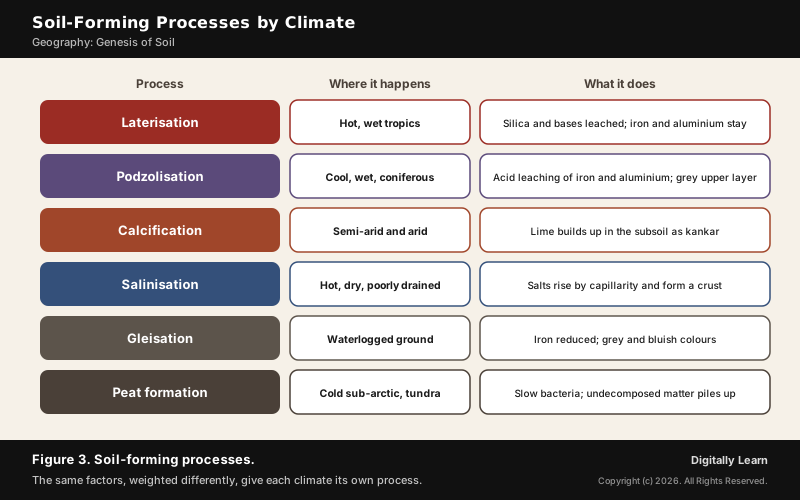
- Laterisation: Intensive and prolonged weathering under high temperature and heavy rainfall alternating with dry periods. In India’s laterite soils, rain leaches away lime and silica and leaves soils rich in iron oxide and aluminium compounds; bacteria remove humus fast in the heat.
- Podzolisation: An extreme form of leaching where precipitation exceeds evapotranspiration. Organic acids from the litter of coniferous forests carry iron and aluminium down, leaving an acidic soil with an ash-grey leached layer near the top.
Laterite soils are poor in organic matter, nitrogen, phosphate and calcium, so they need manure and fertiliser to be farmed. The red laterite soils of Tamil Nadu, Andhra Pradesh and Kerala suit tree crops like cashew, and tapioca, the Indian name for cassava, grows productively on poor soil. Laterite soils in India are treated in Soils Part 4.
Calcification, Salinisation and Gleisation
Where water is scarce or stagnant, soil formation takes other paths. What collects in the soil, or what the lack of oxygen does to its iron, gives each process its name.
- Calcification: A substantial secondary accumulation of lime, widespread in arid and semi-arid lands on calcareous parent material; the soils are called Calcisols, and in India the same process gives kankar nodules.
- Salinisation: In dry climates, salts brought up by capillary action are left behind as the water evaporates and form hardpans; arid soils show it.
- Gleisation: Soils saturated with ground water long enough develop a grey or bluish colour pattern; without oxygen, iron is reduced and red turns greenish or bluish grey. These are Gleysols.
- Peat formation: In cold sub-arctic and tundra climates, slow bacteria leave organic matter undecomposed, and it piles up as peat.
Soil Profile and Soil Structure: What Soil Formation Produces
Soil Horizons: How a Soil Profile Develops
A pit dug into mature soil shows layers called horizons, and their arrangement is the soil profile. The profile is the record of soil formation: young soils show no horizons or only poorly developed ones, and mature soils show a full profile.
| Horizon | What it holds |
|---|---|
| A | Topmost zone; organic matter mixed with minerals, nutrients and water |
| B | Transition zone; matter from above and below, weathered minerals |
| C | Loose parent material, the first stage of soil formation |
| Bedrock | Parent rock beneath the three horizons |
Soil scientists use more letters than these three. Hard bedrock is mostly labelled R, and many soils carry an organic surface layer, labelled O. Horizon C is where formation begins, and it eventually forms the two layers above it. Material eluviated from horizon A is illuviated into horizon B, which is why B collects clay, iron and aluminium. Each horizon is explained in soil profile and horizons, and the soils of India are introduced in Soils Part 1.
Genesis of Soil Structure: Granular, Blocky, Prismatic and Platy
The way the solid parts of a soil and the pore spaces between them are arranged is its structure. It forms as individual grains clump, bind and aggregate into units called peds, and it governs how water and air move, how roots grow and how seedlings emerge.
| Structure | Shape of the units |
|---|---|
| Granular | Roughly spherical, with curved or irregular faces |
| Blocky | Block-like, nearly equal in all directions; angular or subangular |
| Prismatic | Longer vertically, with flat to rounded vertical faces |
| Columnar | Like prisms but with distinct rounded tops |
| Platy | Flat and plate-like, usually lying horizontally |
Structure is part of the genesis of soil. In granular, or crumb, structure, the products of decaying organic matter, root and microbial exudates and animal excreta bridge the mineral grains into crumbs, while repeated wetting and drying makes clays swell and contract and opens cracks. India's black soils show the extreme case: they swell and turn sticky when wet and shrink and crack when dry, a kind of self-ploughing.
Previous Year UPSC-CSE Questions
Previous Year UPSC-CSE Questions By the end you will be able to draft model answers for the following UPSC questions. Each question carries a collapsible framework showing how to approach it in the exam.
- UPSC Prelims 2024 Prelims-GSConsider the following statements :
- Statement-I : Rainfall is one of the reasons for weathering of rocks.
- Statement-II : Rain water contains carbon dioxide in solution.
- Statement-III : Rain water contains atmospheric oxygen.
Which one of the following is correct in respect of the above statements ?
How to approach this Prelims question
Approach: Check each statement, then ask whether each explains weathering by rain.
Trap to watch: Both dissolved gases matter: carbon dioxide for carbonation, oxygen for oxidation.
Key facts to recall:
- Carbonic acid dissolves carbonates
- Oxidation turns iron red to brown or yellow
Answer signal: Both correct and both explain Statement-I, option (a).
- UPSC Prelims 2021 Prelims-GSThe black cotton soil of India has been formed due to the weathering of
How to approach this Prelims question
Approach: Link black soil to its parent rock.
Trap to watch: Granite and schist give red soils; black soil comes from basalt lava.
Key facts to recall:
- Deccan trap basalt
- Climate and parent rock form black soil
Answer signal: Fissure volcanic rock, option (b).
- UPSC Prelims 2013 Prelims-GSWhich of the following statements regarding laterite soils of India are correct?
- They are generally red in colour.
- They are rich in nitrogen and potash.
- They are well-developed in Rajasthan and UP.
- Tapioca and cashew nuts grow well on these soils.
Select the correct answer using the codes given below.
How to approach this Prelims question
Approach: Keep the colour and the crops; test nitrogen and the dry states.
Trap to watch: Laterites are poor in nitrogen and form under heavy rain, not in Rajasthan.
Key facts to recall:
- Lime and silica leached, iron and aluminium left
- Cashew on red laterite
Answer signal: 1 and 4, option (c).
- UPSC Prelims 2011 Prelims-GSBiodiversity forms the basis for human existence in the following ways:
- Soil formation
- Prevention of soil erosion
- Recycling of waste
- Pollination of crops
Select the correct answer using the codes given below:
How to approach this Prelims question
Approach: Check each service against what living things do for soil and crops.
Trap to watch: Soil formation is itself a biological service, not only a physical one.
Key facts to recall:
- Humus, nitrogen fixation, earthworms
Answer signal: 1, 2, 3 and 4, option (d).
Sources
- NCERT: Fundamentals of Physical Geography (Class XI), Geomorphic Processes
- NCERT: India Physical Environment (Class XI), Soils
- NCERT: Contemporary India II (Class X), Resources and Development
- FAO: Cherishing the ground we walk on
- FAO: Lecture Notes on the Major Soils of the World, Anthrosols
- USGS: Soil formation (Goldhaber and Banwart)
- USGS: Soils and paleosols (Muhs)
- PIB (Agriculture): Soil Health Card Scheme
- Wikipedia: Pedogenesis
- Wikipedia: Soil
- Wikipedia: Soil horizon
- Wikipedia: Vasily Dokuchaev
- Wikipedia: Pedology
- Wikipedia: Laterite
- Wikipedia: Podzolization
- Wikipedia: Calcisol
- Wikipedia: Gleysol
- Wikipedia: Soil structure
- Wikipedia: Cassava
- UPSC: Civil Services Examination question papers
Editorial Disclaimer
This article draws on the NCERT geography textbooks, the FAO, the US Geological Survey, the Press Information Bureau and the other sources listed on this page. The figures are schematic.


