


Overview

Leaching is the removal of soluble materials from the soil by water that percolates down through it. Rain or irrigation water dissolves minerals and plant nutrients, such as calcium, potassium and nitrate, and carries them to lower layers or out into groundwater. In geography, leaching of soil explains why heavily rained-on tropical soils such as laterite lose their lime and silica and are left rich in iron and aluminium.
Leaching Meaning: What Leaching of Soil Is
What Is Leaching in Geography?
In geography and soil science, leaching is the removal of soluble materials from one zone of the soil to another by water moving through the profile. Rain soaks into the ground, dissolves salts and nutrients, and carries them down. What is lost from the topsoil is either deposited lower in the subsoil or washed out of the soil altogether into groundwater.
Leaching starts with weathering. Rock-forming minerals such as nitrates, sulphates and potassium dissolve easily, so they are leached out without leaving any residue in rainy climates, while in dry regions they accumulate. Limestone minerals dissolve in water made weakly acidic by carbon dioxide, which decaying organic matter adds to soil water.
- Leached soil: A soil that has lost its soluble nutrients and bases to percolating water, becoming poorer and often more acidic; laterite is the classic leached soil of India.
- Leaching in agriculture: The loss of water-soluble plant nutrients from the soil because of rain and irrigation.
- Leaching in decomposition: One of the steps by which dead matter breaks down: water-soluble inorganic nutrients go down into the soil horizon and are precipitated as unavailable salts.
Eluviation and Illuviation: Where Leached Material Goes
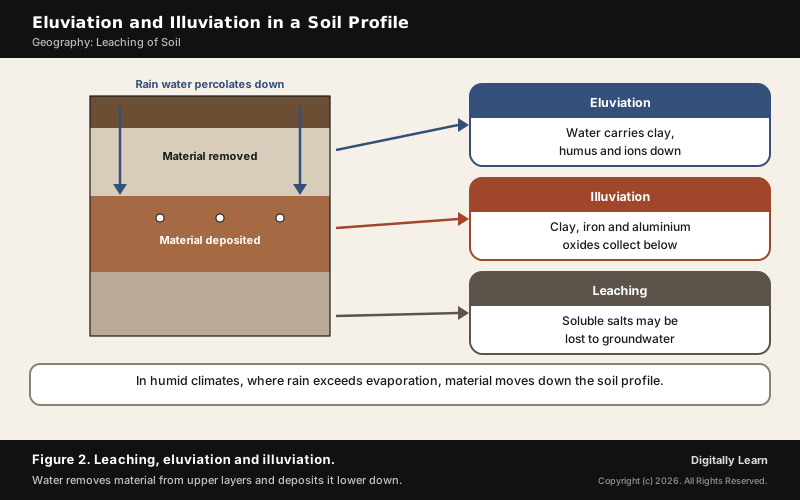
Water does not only remove material; it also puts it down again lower in the soil. Excess water carries soil components down through the soil, a process called eluviation, and deposits them further down, a process called illuviation. Eluviation happens where precipitation exceeds evaporation, and the leaching diagram in Figure 2 shows both processes in one soil.
| Point | Eluviation | Illuviation |
|---|---|---|
| What happens | Material is removed | Material is deposited |
| Where | Upper layers, the E horizon | Lower layers, the B horizon |
| What moves | Clay, humus and dissolved ions | Clay, organic matter, iron and aluminium oxides |
| Look of the layer | Light grey, clay-depleted | Enriched with clay and oxides |
Soil scientists draw one further line. Strictly, leaching moves dissolved materials, while eluviation moves fine particles of clay and organic matter as well. The E horizon, the zone of eluviation, is typically light grey, low in organic matter and rich in quartz silt and sand; the zone that collects leached and eluviated material is the zone of illuviation. The layers themselves are covered in soil profile and horizons.
Leaching Process in Soil: How It Works and What Controls It
Leaching Process Step by Step
The leaching process in soil follows the path of water from the surface down to the water table:
- Water enters: Rain or irrigation water soaks into the soil.
- Minerals dissolve: Soluble minerals and nutrients dissolve; carbonic acid from carbon dioxide in soil water dissolves calcium and magnesium carbonates.
- Water percolates: The solution moves down through pores in the soil, carrying the dissolved ions.
- Material is deposited or lost: Some of it is deposited in lower layers by illuviation; the rest drains out into groundwater, streams and eventually the sea.
The same washing out also concentrates what is left. When rocks weather, some materials are removed by chemical or physical leaching by groundwater, and the concentration of the valuable materials that remain increases. This enrichment is how weathering produces workable ores of iron, manganese, aluminium and copper.
Factors Controlling Leaching: Rainfall, Temperature, Soil Texture and Vegetation
Climate is the main control. In wet equatorial areas with high rainfall, not only calcium, sodium, magnesium and potassium but also a major part of the silica is removed from the soil, a process called desilication. In dry climates evaporation exceeds precipitation, groundwater is drawn up by capillary action and salts are left behind as crusts called hardpans.
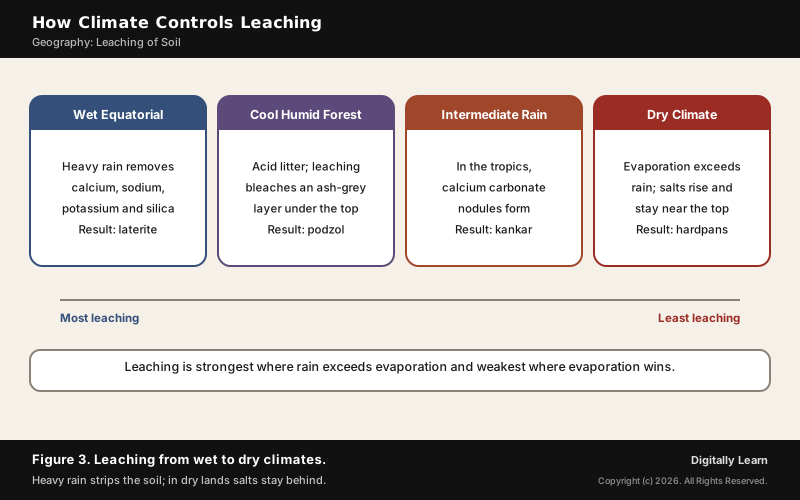
- Rainfall: The more water percolates through the soil, the more is leached; leaching is strongest where rainfall exceeds evaporation.
- Temperature: Chemical activity rises in higher temperatures, so tropical soils have deeper profiles; bacteria also destroy humus fast in hot, wet climates.
- Soil texture: Sandy soil holds little water, so water and nutrients pass through quickly; clay soils retain much more water.
- Vegetation: Litter from conifers such as pine, spruce and fir returns fewer base cations to the soil than deciduous litter, so soils under conifers acidify more.
- Slope: On gentle slopes, where erosion is slow, water percolates well; on steep slopes it runs off instead.
Between the two extremes lies the intermediate case. In tropical climates and areas with intermediate precipitation, calcium carbonate nodules, called kankar, form in the soil.
Soils Formed by Leaching: Laterite, Podzol and Leached Soil Orders
Laterite: The Soil Formed by Intense Leaching
The soil formed by intense leaching is laterite. Laterite soils develop in areas of high temperature and high rainfall and are the result of intense leaching by tropical rains. The rain washes away lime and silica, leaving soils rich in iron oxide and aluminium compounds, while bacteria that thrive in the heat remove humus fast. The name comes from the Latin later, a brick.

- What it lacks: Organic matter, nitrogen, phosphate and calcium; iron oxide and potash are in excess, so laterite needs manures and fertilisers before it can be farmed.
- Where it is found: Mainly on the higher areas of the Peninsular plateau, in Karnataka, Kerala, Tamil Nadu, Madhya Pradesh and the hilly areas of Odisha and Assam. In Madhya Pradesh the laterite capping the plateau is 30 m thick.
- Crops on laterite: Red laterite soils in Tamil Nadu, Andhra Pradesh and Kerala suit tree crops such as cashew.
- Uses of laterite: Laterite is widely cut into bricks for houses, and laterites are a source of aluminium ore, like bauxite, which is associated with laterite on the Peninsular plateau and hills.
- First named in India: Francis Buchanan-Hamilton described and named a laterite formation in southern India in 1807.
The leaching works in a seasonal rhythm. Rocks are leached by percolating rain in the wet season, and the solution of leached ions is drawn back to the surface by capillary action in the dry season, so the zone in contact with water is progressively stripped of sodium, potassium, calcium and magnesium. The full soil is described in red soil and laterite soil of India.
Red Soil and Black Soil: Why Leaching Does Not Form Them
Is red soil formed by the process of leaching? No. Red soil develops on crystalline igneous rocks in areas of low rainfall in the eastern and southern Deccan Plateau. Its colour comes from the wide diffusion of iron in crystalline and metamorphic rocks, and it looks yellow when the iron is hydrated. The red soil that is formed by leaching is laterite, which is why the two are often confused.
Black soil, or regur, is the opposite of a leached soil. It is clayey, deep and impermeable, swells when wet and cracks when dry, and holds moisture for a long time. It stays rich in lime and magnesia, bases that heavy leaching removes, as well as iron and alumina, and it contains potash, though it lacks phosphorus, nitrogen and organic matter. More on it in black soil of India.
| Soil | How it forms and its colour |
|---|---|
| Laterite | Intense leaching under high temperature and heavy rain; iron oxide gives a red colour |
| Red soil | Crystalline igneous rocks in low rainfall; red from diffused iron, yellow when hydrated |
| Black soil | Clayey and impermeable; keeps its lime, iron, magnesia and alumina |
Podzols and Other Heavily Leached Soils
Cool, humid forests produce a different leached soil, the podzol. Podzols are the typical soils of coniferous or boreal forests. The name, given by Vasily Dokuchaev in 1875, means under-ash in Russian: peasants ploughing virgin podzol turned up what looked like a layer of ash, which was the leached E horizon.
- Why they are poor: Podzols are mostly sandy, low in moisture and nutrients, with a low pH, phosphate deficiency and aluminium toxicity; their best agricultural use is grazing.
- Ultisols: The ultimate product of continuous weathering in humid climates, with no calcium carbonate anywhere in the soil; they make up 2.51 per cent of India’s soils by the USDA classification.
- Alfisols: Soils with a clay-enriched subsoil, a product of illuviation, and relatively high native fertility; 13.55 per cent of India’s soils.
- Oxisols: Soils of tropical rainforest within 25 degrees of the equator, some once classed as laterite soils.
| Soil order (USDA) | Share of India's soils |
|---|---|
| Inceptisols | 39.74 per cent |
| Entisols | 28.08 per cent |
| Alfisols (clay-enriched subsoil) | 13.55 per cent |
| Vertisols | 8.52 per cent |
| Aridisols | 4.28 per cent |
| Ultisols (heavily weathered) | 2.51 per cent |
| Mollisols | 0.40 per cent |
| Others | 2.92 per cent |
Effects of Leaching: Soil Fertility, Acidity and Water Pollution
Loss of Nutrients and Soil Acidification
The first effect of leaching is on soil fertility. Water carries away the nutrients plants need, and overwatering fields speeds it up: excessive irrigation leads to leaching of nutrients, lower product quality and reduced yields.
The second effect is acidity. Soil acidification occurs when base cations such as calcium, magnesium, potassium and sodium are leached from the soil, leaving hydrogen and aluminium behind. Acid rain speeds this up: as acidic rainfall flows through the soil, calcium is leached and aluminium and hydrogen levels rise.
Acid soils, with a pH below 5.5 for most of the year, lie in two main belts: the humid northern temperate zone under coniferous forest, where podzols form, and the humid tropics under savannah and rainforest, where laterites form. They suffer from aluminium toxicity and molybdenum deficiency, yet crops such as rice, cassava (tapioca), mango and cashew grow on them.
- Remedy for acid soils: Liming, the application of calcium- and magnesium-rich materials such as limestone, chalk or burnt lime, neutralises soil acidity and often improves plant growth; soil tests every two to three years show how much lime a field needs.
- Remedy for laterite: Manures and fertilisers are needed to make laterite fertile for cultivation.
- Nitrogen fertiliser: Leaching of nitrate from acidic sources can increase the loss of calcium and other soil nutrients, reducing an ecosystem’s productivity.
Nitrate Leaching, Groundwater Pollution and Blue Baby Syndrome
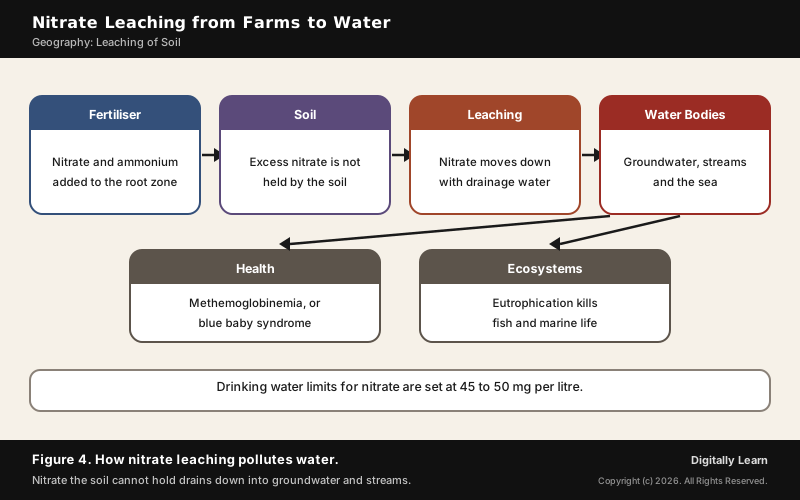
Nitrate is the nutrient most easily leached. Fertilisers add nitrate and ammonium to the root zone, but soils do not hold the excess nitrate ions, which move down freely with drainage water and are leached into groundwater, streams and oceans. How much leaches depends on the soil type, the water crops use and the nitrate already in the soil.
India measures the problem every year. The Central Ground Water Board samples groundwater once a year before the monsoon and analyses it in 16 regional chemical laboratories. Its Annual Groundwater Quality Report, described in Parliament in March 2025, found nitrate beyond the permissible limit in 19.8 per cent of the samples tested.
- Health effects: High nitrate in water causes methemoglobinemia, known as blue baby syndrome, so drinking water limits are set at 45 to 50 mg of nitrate per litre. Bottle-fed infants are most at risk: above 50 mg per litre, drinking water becomes their main source of nitrate, and infants under six months are especially susceptible.
- Ecosystems: Nitrate and phosphorus reaching water bodies cause eutrophication, which can kill fish and other marine life.
- Phosphorus: Phosphorus is held more tightly by soil, but decades of heavy fertiliser use fill the soil’s holding sites, so legacy phosphorus leaches too.
- Leachate: Water draining through landfills and industrial waste carries harmful substances into the environment. At Daurala near Meerut, untreated industrial wastewater leaching into the groundwater table polluted the village’s water.
Using and Controlling Leaching: Salinity, Liming and Metallurgy
Leaching to Control Soil Salinity
Leaching is not always harmful. On irrigated land the danger is the opposite one: salts build up when irrigation water evaporates. Farmers then apply a little more irrigation water than the crop needs, the leaching fraction, to wash the added salts below the root zone, and drainage must carry the excess water away.
Nature does the same over long periods: as soil minerals weather and release salts, drainage water flushes them out of the soil wherever precipitation is sufficient, while in droughts the salts rise by capillarity and gather near the surface.
The balance is delicate. Where drainage is disrupted, the salts that should be leached accumulate instead, and in dry climates groundwater drawn up by capillary action leaves salts behind as hardpans. How India reclaims such land is covered in saline and alkaline soils of India.
Leaching Process in Chemistry and Metallurgy
In chemistry, leaching means extracting a substance from a solid by dissolving it in a solvent. Metallurgy uses it when an ore is soluble in a suitable solvent: the metal is dissolved out and the impurities are left behind.
- Aluminium: Bauxite is digested with concentrated sodium hydroxide, which leaches out alumina as sodium aluminate and leaves impurities such as iron oxides behind.
- Gold and silver: The metal is leached with a dilute solution of sodium or potassium cyanide in the presence of air, then recovered by replacement.
- Copper from low-grade ores: Copper is leached out using acid or bacteria, and the solution is treated with scrap iron or hydrogen.
- Heap leaching: Ore is piled on a liner and chemicals are dripped through it to extract precious metals, copper and uranium at lower cost than conventional processing.
The same process can harm the environment. Acid rain corrodes water pipes, leaching heavy metals such as iron, lead and copper into drinking water, and waste heaps can release metals into soil and water in the same way.
Previous Year UPSC-CSE Questions
Previous Year UPSC-CSE Questions By the end you will be able to draft model answers for the following UPSC questions. Each question carries a collapsible framework showing how to approach it in the exam.
- UPSC Prelims 2013 Prelims-GSWhich of the following statements regarding laterite soils of India are correct?
- They are generally red in colour.
- They are rich in nitrogen and potash.
- They are well-developed in Rajasthan and UP.
- Tapioca and cashew nuts grow well on these soils.
Select the correct answer using the codes given below.
How to approach this Prelims question
Approach: Recall what intense leaching removes and where laterite is found.
Trap to watch: Laterite is poor in nitrogen, and it is not developed in Rajasthan and Uttar Pradesh.
Key facts to recall:
- (a) 1, 2 and 3: wrong. Laterite is poor in nitrogen and potash, and it is not well developed in Rajasthan and Uttar Pradesh.
- (b) 2, 3 and 4: wrong. Statements 2 and 3 are wrong.
- (c) 1 and 4: right. Laterite is generally red, from the iron oxide that leaching leaves behind, and cashew and tapioca grow well on it.
- (d) 2 and 3 only: wrong. Both of these statements are wrong.
Answer signal: Only statements 1 and 4 are correct, so the answer is option (c).
- UPSC Prelims 2010 Prelims-GSWhen you travel in certain parts of India, you will notice red soil. What is the main reason for this colour?
How to approach this Prelims question
Approach: Link the red colour to iron.
Trap to watch: Humus makes soil dark, not red.
Key facts to recall:
- (a) Abundance of magnesium: wrong. Magnesium does not give soil its red colour.
- (b) Accumulated humus: wrong. Humus darkens soil; it does not make it red.
- (c) Presence of ferric oxides: right. Red soil is red from the diffusion of iron, as ferric oxide.
- (d) Abundance of phosphates: wrong. Phosphates do not colour soil red.
Answer signal: Ferric oxides make red soil red, so the answer is option (c).
- UPSC Prelims 2015 Prelims-GSWhat can be the impact of excessive/inappropriate use of nitrogenous fertilizers in agriculture?
- Proliferation of nitrogen-fixing microorganisms in soil can occur.
- Increase in the acidity of soil can take place.
- Leaching of nitrate to the groundwater can occur.
Select the correct answer using the code given below.
How to approach this Prelims question
Approach: Keep the effects that come from excess nitrogen in the soil and water.
Trap to watch: Adding fertiliser nitrogen does not make nitrogen-fixing microbes multiply.
Key facts to recall:
- (a) 1 and 3 only: wrong. Excess nitrogen does not make nitrogen-fixing microorganisms multiply.
- (b) 2 only: wrong. It leaves out nitrate leaching to groundwater.
- (c) 2 and 3 only: right. Excess nitrogen raises soil acidity, and the nitrate the soil cannot hold leaches to groundwater.
- (d) 1, 2 and 3: wrong. Statement 1 is wrong.
Answer signal: Statements 2 and 3 are correct, so the answer is option (c).
Sources
- NCERT: Fundamentals of Physical Geography (Class XI), Geomorphic Processes and soil formation
- NCERT: India Physical Environment (Class XI), Soils
- NCERT: Biology (Class XII), Ecosystem, decomposition
- NCERT: Chemistry Part I (Class XII), General Principles and Processes of Isolation of Elements
- NCERT: India People and Economy (Class XII), Daurala case study
- PIB (Ministry of Jal Shakti): Annual Groundwater Quality Report, March 2025
- Central Ground Water Board: Ground Water Quality
- WHO: Nitrate and nitrite in drinking-water, background document
- FAO Soils Portal: Acid soils
- Wikipedia: Leaching (pedology)
- Wikipedia: Leaching (agriculture)
- Wikipedia: Eluviation
- Wikipedia: Illuviation
- Wikipedia: Podzol
- Wikipedia: Laterite
- Wikipedia: Soil acidification
- Wikipedia: Liming (soil)
- Wikipedia: Leaching (chemistry)
- Wikipedia: Heap leaching
- Wikipedia: Ultisol
- Wikipedia: Alfisol
- Wikipedia: Oxisol
- Wikipedia: Soil salinity
- Wikipedia: Leachate
- Wikipedia: Methemoglobinemia
- UPSC: Civil Services Examination question papers
Editorial Disclaimer
This article draws on the NCERT geography, biology and chemistry textbooks and the other sources listed on this page. Leaching varies with rainfall, soil and land use, so figures for any one place differ.


