Skip to content

UPSC previous year questions · Prelims 2017

UPSC Prelims 2017 Question Paper with Answer Key: Every Option Explained

The UPSC Prelims 2017 question paper for GS Paper 1 with UPSC's final answer key for Sets A, B, C and D, and every option of all 100 questions explained. Practise the paper against a timer, check your score against the 2017 cut-off, or save it as a PDF.

100questions, 200 marksGS Paper I, two hours
100questions scoredNo question was dropped
18 Junexam held, 2017UPSC final key, Sets A to D
105.34General cut-off, out of 200Counted on GS Paper I only
Updated 11 October 2026Answers: UPSC official final keyExplanations: Digitally Learn

Paper analysis

UPSC Prelims 2017 Paper Analysis: Subjects and Question Types

Questions by subject

SubjectQuestions
Economy26
Polity and Governance22
Environment and Ecology16
History14
Science and Technology10
Geography6
Current Affairs5
International Relations1

Questions by format

FormatQuestions
Statements or items with an answer code ("1 and 3 only")56
Direct single-answer questions42
Matching pairs2
Why this mattersEconomy (26) and Polity and Governance (22) made up nearly half of the paper. 56 questions gave statements or items to judge with an answer code, 42 asked for a single direct answer, and only 2 asked to match pairs.

Practise and check

All 100 UPSC Prelims 2017 Questions with Answers, Every Option Explained

Read each question with its answer, practise one by one, or take a timed drill. The timed modes use UPSC's marking and show your score by subject at the end. Choose your booklet series to see the questions in your own order.

Economy 26Polity and Governance 22Environment and Ecology 16History 14Science and Technology 10Geography 6Current Affairs 5International Relations 1

Q1Polity and Governance

With reference to the Parliament of India, consider the following statements :

  • 1. A private member's bill is a bill presented by a Member of Parliament who is not elected but only nominated by the President of India.
  • 2. Recently, a private member's bill has been passed in the Parliament of India for the first time in its history.

Which of the statements given above is/are correct ?

  1. a1 only
  2. b2 only
  3. cBoth 1 and 2
  4. dNeither 1 nor 2
See the answer and explanationWith how to crack it

Answer: (d) Neither 1 nor 2

Statement 1 is wrong. A private member's bill is one introduced by any member of Parliament other than a minister. Whether the member was elected or nominated has nothing to do with it; an elected member of the Opposition or of the ruling party who is not a minister can bring one.

Statement 2 is wrong. Parliament has passed private members' bills before. The last one to become law was the Supreme Court (Enlargement of Criminal Appellate Jurisdiction) Bill, 1968, which became an Act on 9 August 1970. In 2015 the Rajya Sabha passed the Rights of Transgender Persons Bill, 2014, a private member's bill, but that was one House, not Parliament. Answer (d), Neither 1 nor 2.

How to crack it

The test is 'minister or not', never 'elected or nominated'. And 'for the first time in its history' is a strong claim; one earlier example is enough to sink it.

Remember

Government bill: introduced by a minister. Private member's bill: introduced by any other member, elected or nominated.
Sources: Private member's bill (Wikipedia, India section)

Q2History

With reference to the difference between the culture of Rigvedic Aryans and Indus Valley people, which of the following statements is/are correct ?

  • 1. Rigvedic Aryans used the coat of mail and helmet in warfare whereas the people of Indus Valley Civilization did not leave any evidence of using them.
  • 2. Rigvedic Aryans knew gold, silver and copper whereas Indus Valley people knew only copper and iron.
  • 3. Rigvedic Aryans had domesticated the horse whereas there is no evidence of Indus Valley people having been aware of this animal.

Select the correct answer using the code given below :

  1. a1 only
  2. b2 and 3 only
  3. c1 and 3 only
  4. d1, 2 and 3
See the answer and explanationWith how to crack it

Answer: (c) 1 and 3 only

Statement 1 is correct. The Rigveda describes armour: the varman, sewn armour or a coat of mail covering the body, and its hymn on weapons of war speaks of warriors armed with mail. UPSC's key accepts the contrast with the Harappans as stated.

Statement 2 is wrong. The Harappans did use gold (a touchstone with gold streaks was found at Banawali, and gold jewellery has been excavated), and they did not know iron. Iron tools came only after the Harappan period, along with the horse.

Statement 3 is correct. Horses were central to Vedic life: possession of horses was an important priority of Vedic leaders, needed for cavalry and for sacrifice. In the Harappan story the horse appears only in the later, post-urban phase. Answer (c), 1 and 3 only.

How to crack it

Statement 2 has two errors at once: it denies gold and silver to the Harappans and gives them iron. One wrong half is enough to drop it, which leaves (c).

Remember

Two quick markers separate the two cultures: the horse and iron. Both are linked with the Vedic and later period, not with the Harappan cities.

Sources: Indian armour (Wikipedia); Indus Valley Civilisation (Wikipedia); Vedic period (Wikipedia)

Q3Economy

'Recognition of Prior Learning Scheme' is sometimes mentioned in the news with reference to

  1. aCertifying the skills acquired by construction workers through traditional channels.
  2. bEnrolling the persons in Universities for distance learning programmes.
  3. cReserving some skilled jobs to rural and urban poor in some public sector undertakings.
  4. dCertifying the skills acquired by trainees under the National Skill Development Programme.
See the answer and explanationWith how to crack it

Answer: (a) Certifying the skills acquired by construction workers through traditional channels.

Recognition of Prior Learning (RPL) is the part of the Pradhan Mantri Kaushal Vikas Yojana that assesses and certifies skills a worker already has, learnt on the job or through informal channels, rather than in a training centre. The construction sector was a large user: most of its workers belong to the informal economy, and RPL gave their existing skills formal recognition.

Option (a) matches this: certifying skills that construction workers acquired through traditional channels. Option (b) is wrong; RPL has nothing to do with university admission for distance learning. Option (c) is wrong; it certifies skills and does not reserve jobs. Option (d) is wrong because certifying trainees of a training programme is ordinary certification, while RPL is about learning that happened before and outside such training. Answer (a).

How to crack it

Read the name: recognition (certification) of prior (already acquired) learning. Only (a) speaks of certifying skills picked up outside formal training.

Remember

'Prior learning' means learning already done, usually informally. That alone rules out (b) and (d).

Sources: NSDC, Impact Assessment of RPL under PMKVY 2.0 for the Construction Sector

Q4Environment and Ecology

From the ecological point of view, which one of the following assumes importance in being a good link between the Eastern Ghats and the Western Ghats?

  1. aSathyamangalam Tiger Reserve
  2. bNallamala Forest
  3. cNagarhole National Park
  4. dSeshachalam Biosphere Reserve
See the answer and explanationWith how to crack it

Answer: (a) Sathyamangalam Tiger Reserve

Sathyamangalam Tiger Reserve in Erode district of Tamil Nadu straddles both the Western Ghats and the Eastern Ghats. It is a wildlife corridor in the Nilgiri Biosphere Reserve between the two ranges, and a genetic link with Mudumalai, Bandipur and the other protected areas it adjoins. That makes (a) the answer.

Option (b) is wrong: the Nallamala hills are a section of the Eastern Ghats in Andhra Pradesh and Telangana, far from the Western Ghats. Option (c) is wrong: Nagarhole in Kodagu and Mysore districts lies in the Western Ghats Nilgiri sub-cluster, on one side only. Option (d) is wrong: the Seshachalam hills are part of the Eastern Ghats in Tirupati district. Answer (a).

How to crack it

Ask which reserve sits where the two ranges meet. Nallamala and Seshachalam are wholly Eastern Ghats and Nagarhole wholly Western Ghats; only Sathyamangalam touches both.

Remember

Sathyamangalam adjoins the Sigur Plateau, Mudumalai and Bandipur National Parks, and the Billigiriranga Swamy Temple and Cauvery sanctuaries.

Sources: Sathyamangalam Tiger Reserve (Wikipedia); Nallamala Hills (Wikipedia); Nagarhole National Park (Wikipedia); Seshachalam Hills (Wikipedia)

Q5Polity and Governance

One of the implications of equality in society is the absence of

  1. aPrivileges
  2. bRestraints
  3. cCompetition
  4. dIdeology
See the answer and explanationWith how to crack it

Answer: (a) Privileges

Equality in political theory begins by ending a formal system of inequality and privileges: some people enjoying rights, opportunities and rewards that the law or custom denies to others. A society with equality has no such special privileges for a few.

Option (b), restraints, is wrong; laws and rules restrain everyone, and equal laws apply the same restraints to all. Option (c), competition, is wrong; equality of opportunity is meant to let people compete on equal terms, not to remove competition. Option (d), ideology, is wrong; equality is itself an ideal people hold. Answer (a), Privileges.

How to crack it

Pair each concept with what it removes: liberty removes constraints, equality removes privileges.

Remember

Freedom is linked with the absence of constraints; equality with the absence of privileges.

Sources: NCERT Class 11, Political Theory, Equality

Q6Environment and Ecology

Consider the following statements in respect of Trade Related Analysis of Fauna and Flora in Commerce (TRAFFIC) :

  • 1. TRAFFIC is a bureau under United Nations Environment Programme (UNEP).
  • 2. The mission of TRAFFIC is to ensure that trade in wild plants and animals is not a threat to the conservation of nature.

Which of the above statements is/are correct ?

  1. a1 only
  2. b2 only
  3. cBoth 1 and 2
  4. dNeither 1 nor 2
See the answer and explanationWith how to crack it

Answer: (b) 2 only

Statement 1 is wrong. TRAFFIC is a non-governmental organisation working on the trade in wild species. It works with WWF and IUCN (with whom it has run joint campaigns and standards), but it is not a bureau of the United Nations Environment Programme.

Statement 2 is correct. Its mission is to ensure that trade in wild species is legal and sustainable, so that the trade does not become a threat to species and ecosystems. Answer (b), 2 only.

How to crack it

Ask whether TRAFFIC is an intergovernmental body. It is a non-governmental network, so 'a bureau under UNEP' fails; the mission statement is plainly its own.

Remember

Do not confuse TRAFFIC (an NGO watching wildlife trade) with CITES (the treaty that regulates that trade).

Sources: TRAFFIC (official site); TRAFFIC (Wikipedia)

Q7Polity and Governance

Which principle among the following was added to the Directive Principles of State Policy by the 42nd Amendment to the Constitution?

  1. aEqual pay for equal work for both men and women
  2. bParticipation of workers in the management of industries
  3. cRight to work, education and public assistance
  4. dSecuring living wage and human conditions of work to workers
See the answer and explanationWith how to crack it

Answer: (b) Participation of workers in the management of industries

The 42nd Amendment Act of 1976 added three new Directive Principles: equal justice and free legal aid (Article 39A), participation of workers in the management of industries (Article 43A), and protection of the environment, forests and wild life (Article 48A). So (b) is the answer.

Option (a), equal pay for equal work for men and women, is in Article 39 of the original Constitution. Option (c), the right to work, to education and to public assistance, is Article 41, also original. Option (d), a living wage and humane conditions of work, is Articles 42 and 43, also original. Answer (b).

How to crack it

The amendment added articles with letters. Of the four options, only 'participation of workers in management' carries a lettered article, 43A.

Remember

The 42nd Amendment added three lettered articles to Part IV: 39A, 43A and 48A.

Q8History

Which one of the following statements is correct?

  1. aRights are claims of the State against the citizens.
  2. bRights are privileges which are incorporated in the Constitution of a State.
  3. cRights are claims of the citizens against the State.
  4. dRights are privileges of a few citizens against the many.
See the answer and explanationWith how to crack it

Answer: (c) Rights are claims of the citizens against the State.

A right is a justified claim, and rights place an obligation upon the state to act in certain ways: each right says what the state must do and what it must not do. Rights are therefore claims of citizens against the State, which is option (c).

Option (a) reverses the direction; the State does not hold rights against citizens. Option (b) is wrong because rights are not privileges; a right is due to everyone, and rights are claimed as conditions of a life of respect and dignity, not as favours written into a document. Option (d) is wrong for the same reason: privileges of a few against the many is the opposite of a right held equally by all. Answer (c).

How to crack it

Two options call rights privileges; a right is not a privilege. Between the two 'claims' options, rights bind the State, not the citizen.

Remember

Rights also limit the authority of the state; that is why they are described as claims against it.

Sources: NCERT Class 11, Political Theory, Rights

Q9Economy

Of the following, which gives 'Global Gender Gap Index' ranking to the countries of the world?

  1. aWorld Economic Forum
  2. bUN Human Rights Council
  3. cUN Women
  4. dWorld Health Organization
See the answer and explanationWith how to crack it

Answer: (a) World Economic Forum

The Global Gender Gap Report, with its index ranking countries on the gap between women and men, was first published in 2006 by the World Economic Forum. It assesses how well countries divide resources and opportunities between their male and female populations.

The UN Human Rights Council (b) reviews human rights records; it does not publish this index. UN Women (c) works on gender equality but the Gender Gap Index is not its report. The World Health Organization (d) deals with health. Answer (a), World Economic Forum.

How to crack it

Link each index to its publisher: the Global Gender Gap Report has come from the World Economic Forum since 2006.

Remember

The report assesses how well countries divide their resources and opportunities between their male and female populations.

Sources: Global Gender Gap Report (Wikipedia)

Q10Environment and Ecology

Which of the following statements is/are correct regarding Smart India Hackathon 2017?

  • 1. It is a centrally sponsored scheme for developing every city of our country into Smart Cities in a decade.
  • 2. It is an initiative to identify new digital technology innovations for solving the many problems faced by our country.
  • 3. It is a programme aimed at making all the financial transactions in our country completely digital in a decade.

Select the correct answer using the code given below:

  1. a1 and 3 only
  2. b2 only
  3. c3 only
  4. d2 and 3 only
See the answer and explanationWith how to crack it

Answer: (b) 2 only

Smart India Hackathon 2017 was a 36-hour non-stop competition for engineering college students, introduced through the All India Council for Technical Education, in which teams built technology solutions for real problems faced by the country.

Statement 1 is wrong; it was not a centrally sponsored scheme for building smart cities (that is the Smart Cities Mission). Statement 2 is correct; it was an initiative to find new technology innovations for the country's problems. Statement 3 is wrong; it was not a programme to make all financial transactions digital. Answer (b), 2 only.

How to crack it

A hackathon is a competition to solve problems in a short time. It cannot be a ten-year scheme, so 1 and 3 fall away.

Remember

Smart Cities Mission (urban development), Digital India (digital services) and Smart India Hackathon (student problem-solving) are different programmes with similar names.

Sources: AICTE, Smart India Hackathon 2017; Smart India Hackathon (official site)

Q11Economy

Which of the following statements is/are correct regarding the Monetary Policy Committee (MPC)?

  • 1. It decides the RBI's benchmark interest rates.
  • 2. It is a 12-member body including the Governor of RBI and is reconstituted every year.
  • 3. It functions under the chairmanship of the Union Finance Minister.

Select the correct answer using the code given below:

  1. a1 only
  2. b1 and 2 only
  3. c3 only
  4. d2 and 3 only
See the answer and explanationWith how to crack it

Answer: (a) 1 only

Statement 1 is correct. The Monetary Policy Committee fixes the benchmark interest rate in India, the policy repo rate, and publishes its decision after each meeting.

Statement 2 is wrong on both counts. The committee has six members, three officials of the Reserve Bank and three external members nominated by the Government of India, and the external members hold a four-year term; it is not a 12-member body reconstituted every year.

Statement 3 is wrong. The Governor of the Reserve Bank is the ex officio chairperson. The Finance Minister is not a member at all; keeping the government's influence limited was the point of the design. Answer (a), 1 only.

How to crack it

Remember 'six, Governor, four years'. That alone removes statements 2 and 3.

Remember

MPC: six members, the Governor as chair, meetings at least four times a year.

Sources: Monetary Policy Committee (India) (Wikipedia)

Q12Environment and Ecology

With reference to Manipuri Sankirtana, consider the following statements:

  • 1. It is a song and dance performance.
  • 2. Cymbals are the only musical instruments used in the performance.
  • 3. It is performed to narrate the life and deeds of Lord Krishna.

Which of the statements given above is/are correct?

  1. a1, 2 and 3
  2. b1 and 3 only
  3. c2 and 3 only
  4. d1 only
See the answer and explanationWith how to crack it

Answer: (b) 1 and 3 only

Sankirtana of Manipur is ritual singing, drumming and dancing, performed in temples and homes, through which the performers narrate the many stories of Krishna. UNESCO inscribed it on the Representative List of the Intangible Cultural Heritage of Humanity in 2013.

Statement 1 is correct: it is a song and dance performance. Statement 2 is wrong: the drum is central to it, so cymbals are not the only instruments. Statement 3 is correct: the life and deeds of Krishna are its theme. Answer (b), 1 and 3 only.

How to crack it

'Only' is the warning word. A devotional performance with drumming cannot have cymbals as its only instrument.

Remember

UNESCO's own title for it names the three elements: 'Sankirtana: ritual singing, drumming and dancing of Manipur'.

Sources: Meitei Sankirtan (Wikipedia)

Q13Polity and Governance

Who among the following was/were associated with the introduction of Ryotwari Settlement in India during the British rule ?

  • 1. Lord Cornwallis
  • 2. Alexander Read
  • 3. Thomas Munro

Select the correct answer using the code given below :

  1. a1 only
  2. b1 and 3 only
  3. c2 and 3 only
  4. d1, 2 and 3
See the answer and explanationWith how to crack it

Answer: (c) 2 and 3 only

The ryotwari system was first tried on a small scale by Captain Alexander Read in areas taken over after the wars with Tipu Sultan, and then developed by Thomas Munro, who extended it across south India. Read and Munro held that the south had no traditional zamindars, so the settlement had to be made directly with the cultivators (ryots).

Lord Cornwallis is linked with the Permanent Settlement of 1793 in Bengal, a settlement with zamindars, which is the opposite approach. So 2 and 3 are correct and 1 is not. Answer (c), 2 and 3 only.

How to crack it

Cornwallis belongs to the Permanent Settlement, so any option with 1 is out. Only (c) is left.

Remember

Permanent Settlement: Cornwallis, zamindars, Bengal. Ryotwari: Read and Munro, ryots, south India.

Sources: NCERT Class 8, Our Pasts III, The Munro system; Permanent Settlement (Wikipedia)

Q14Polity and Governance

In the context of solving pollution problems, what is/are the advantage/advantages of bioremediation technique?

  • 1. It is a technique for cleaning up pollution by enhancing the same biodegradation process that occurs in nature.
  • 2. Any contaminant with heavy metals such as cadmium and lead can be readily and completely treated by bioremediation using microorganisms.
  • 3. Genetic engineering can be used to create microorganisms specifically designed for bioremediation.

Select the correct answer using the code given below:

  1. a1 only
  2. b2 and 3 only
  3. c1 and 3 only
  4. d1, 2 and 3
See the answer and explanationWith how to crack it

Answer: (c) 1 and 3 only

Statement 1 is correct. Bioremediation uses the natural ability of organisms to break down pollutants, and much of it involves native organisms; research focuses on stimulating that process by adding organisms or nutrients.

Statement 2 is wrong. Heavy metals such as cadmium and lead cannot be degraded; they can only be oxidised, reduced or immobilised. So contaminants with heavy metals cannot be 'readily and completely' treated by microbes.

Statement 3 is correct. Genetic engineering is used to create organisms designed for bioremediation, by inserting genes that degrade pollutants or genes that report pollution levels. Answer (c), 1 and 3 only.

How to crack it

'Any contaminant', 'readily and completely' are absolute words. Metals are elements and cannot be broken down, so statement 2 must go.

Remember

Organic pollutants biodegrade; heavy metals and radionuclides do not, though metals can sometimes be immobilised.

Sources: Bioremediation (Wikipedia)

Q15Economy

The Trade Disputes Act of 1929 provided for

  1. athe participation of workers in the management of industries.
  2. barbitrary powers to the management to quell industrial disputes.
  3. can intervention by the British Court in the event of a trade dispute.
  4. da system of tribunals and a ban on strikes.
See the answer and explanationWith how to crack it

Answer: (d) a system of tribunals and a ban on strikes.

The Trade Disputes Act of 1929 was passed when the government, alarmed at the growing strength of the trade union movement, turned to legislative restrictions. It made compulsory the appointment of Courts of Inquiry and Consultation Boards to settle industrial disputes, and it made strikes in public utility services such as posts, railways, water and electricity illegal unless each worker gave a month's notice.

That is a system of tribunals with a ban on strikes, option (d). Option (a) is wrong; it did not give workers a share in management. Option (b) is wrong; the powers went to state-appointed bodies, not to the management. Option (c) is wrong; there was no British court in the scheme. Answer (d).

How to crack it

Place the Act in 1929, a year of repression of the labour movement. Of the options, only (d) curbs labour.

Remember

The same year (1929) the government also passed the Public Safety Ordinance against the growing labour movement.

Q16Polity and Governance

Local self-government can be best explained as an exercise in

  1. aFederalism
  2. bDemocratic decentralisation
  3. cAdministrative delegation
  4. dDirect democracy
See the answer and explanationWith how to crack it

Answer: (b) Democratic decentralisation

Local government is government at the village and district level, the government closest to ordinary people, run by their elected representatives. The Balwant Rai Mehta Committee (1957) called its scheme for this 'democratic decentralisation', which came to be known as Panchayati Raj. Power and decision-making move down from the State to elected local bodies.

Option (a), federalism, is a division of power between the Union and the States, set by the Constitution. Option (c), administrative delegation, only passes work to officials who stay answerable to their superiors, with no elected body. Option (d), direct democracy, means citizens decide laws themselves; panchayats and municipalities are representative bodies. Answer (b), Democratic decentralisation.

How to crack it

Local bodies are elected and have their own powers. That is decentralisation (power moves down) and democratic (to elected people).

Remember

Decentralisation that hands power to elected local bodies is democratic decentralisation; handing tasks to field officers is deconcentration or delegation.

Sources: NCERT Class 11, Indian Constitution at Work, Local Governments

Q17Economy

Consider the following statements : With reference to the Constitution of India, the Directive Principles of State Policy constitute limitations upon

  • 1. legislative function.
  • 2. executive function.

Which of the above statements is/are correct?

  1. a1 only
  2. b2 only
  3. cBoth 1 and 2
  4. dNeither 1 nor 2
See the answer and explanationWith how to crack it

Answer: (d) Neither 1 nor 2

The Directive Principles are positive directions: they require the State to do certain things. Limitations on what the State may do are the Fundamental Rights, which are negative and prohibit the State from doing certain things.

The directives are also non-justiciable; no court enforces them, so they cannot work as a legal limit on the legislature (statement 1) or on the executive (statement 2). They are fundamental in the governance of the country and the State has a duty to apply them in making laws, but that is guidance, not limitation. Answer (d), Neither 1 nor 2.

How to crack it

Ask whether a court can strike down an act for breaching a directive. It cannot, so the directives limit nobody.

Remember

Fundamental Rights limit the State; Directive Principles direct it. Ambedkar compared the directives to the Instrument of Instructions under the 1935 Act.

Q18History

The term 'Digital Single Market Strategy' seen in the news refers to

  1. aASEAN
  2. bBRICS
  3. cEU
  4. dG20
See the answer and explanationWith how to crack it

Answer: (c) EU

The Digital Single Market is a European Commission policy: it aims to remove national and other barriers to online transactions so that the European Union works as one market for digital goods and services. It is an EU strategy. Answer (c).

ASEAN (a), BRICS (b) and the G20 (d) are not single markets with a common commission making market rules, and the strategy belongs to none of them. Answer (c), EU.

How to crack it

Only one of the four groups is a single market with a supranational commission: the European Union.

Remember

The Digital Single Market is a European Commission policy for the EU's online economy.

Sources: Digital Single Market (Wikipedia)

Q19History

At one of the places in India, if you stand on the seashore and watch the sea, you will find that the sea water recedes from the shore line a few kilometres and comes back to the shore, twice a day, and you can actually walk on the sea floor when the water recedes. This unique phenomenon is seen at

  1. aBhavnagar
  2. bBheemunipatnam
  3. cChandipur
  4. dNagapattinam
See the answer and explanationWith how to crack it

Answer: (c) Chandipur

Chandipur, in Balasore district of Odisha on the Bay of Bengal, has a beach where the water recedes up to 5 kilometres at low tide. Visitors can walk out on the exposed sea floor, and the sea returns with the next tide. Answer (c).

Bhavnagar (a) is a port city in Gujarat, Bheemunipatnam (b) a coastal town near Visakhapatnam and Nagapattinam (d) a port in Tamil Nadu; none of them is the beach where the sea withdraws kilometres from the shore. Answer (c), Chandipur.

How to crack it

The question describes a very flat beach where the sea goes out kilometres at low tide. That is Chandipur in Odisha.

Remember

Chandipur is on the Odisha coast at the head of the Bay of Bengal, in Balasore district.

Sources: Chandipur (Wikipedia)

Q20Economy

With reference to the ‘Prohibition of Benami Property Transactions Act, 1988 (PBPT Act)’, consider the following statements :

  • 1. A property transaction is not treated as a benami transaction if the owner of the property is not aware of the transaction.
  • 2. Properties held benami are liable for confiscation by the Government.
  • 3. The Act provides for three authorities for investigations but does not provide for any appellate mechanism.

Which of the statements given above is/are correct ?

  1. a1 only
  2. b2 only
  3. c1 and 3 only
  4. d2 and 3 only
See the answer and explanationWith how to crack it

Answer: (b) 2 only

Statement 1 is wrong. The Act, as amended in 2016, expressly includes in 'benami transaction' a transaction in respect of a property where the owner of the property is not aware of, or denies knowledge of, such ownership.

Statement 2 is correct. Section 5 says any property which is the subject matter of a benami transaction shall be liable to be confiscated by the Central Government.

Statement 3 is wrong. The Act names four authorities (the Initiating Officer, the Approving Authority, the Administrator and the Adjudicating Authority), not three, and it does provide an appeal: an Appellate Tribunal, and from it an appeal to the High Court on a question of law. Answer (b), 2 only.

How to crack it

Statement 3 says 'does not provide for any appellate mechanism'; a law that takes away property without an appeal would be unusual. With 3 gone and 1 wrong, (b) remains.

Remember

Benami means 'without name': the property stands in one person's name while another paid for it. The 2016 amendment renamed the law the Prohibition of Benami Property Transactions Act, 1988.

Sources: Benami Transactions (Prohibition) Amendment Act, 2016, Gazette of India; Benami Transactions (Prohibition) Act, 1988 (Wikipedia)

Q21Environment and Ecology

Due to some reasons, if there is a huge fall in the population of species of butterflies, what could be its likely consequence/consequences?

  • 1. Pollination of some plants could be adversely affected.
  • 2. There could be a drastic increase in the fungal infections of some cultivated plants.
  • 3. It could lead to a fall in the population of some species of wasps, spiders and birds.

Select the correct answer using the code given below:

  1. a1 only
  2. b2 and 3 only
  3. c1 and 3 only
  4. d1, 2 and 3
See the answer and explanationWith how to crack it

Answer: (c) 1 and 3 only

Statement 1 is correct. Some butterflies are agents of pollination of some plants, so a crash in their numbers could hurt the pollination of those plants.

Statement 2 is wrong. Butterflies do not keep fungal diseases of crops in check; if anything, their own caterpillars suffer from bacterial, viral and fungal diseases. Losing butterflies gives no reason for crop fungal infections to rise sharply.

Statement 3 is correct. Predators of butterflies include ants, spiders, wasps and birds, and parasitoid wasps develop inside caterpillars. A fall in the prey can bring down the populations of species that depend on it. Answer (c), 1 and 3 only.

How to crack it

Think of the butterfly's two roles: pollinator and prey. Statements 1 and 3 follow from those roles; nothing links butterflies to fungal disease.

Remember

For any 'what if this species declines' question, trace the food web both ways: what it does for plants (pollination, herbivory) and who eats it.

Sources: Butterfly (Wikipedia)

Q22Science and Technology

It is possible to produce algae based biofuels, but what is/are the likely limitation(s) of developing countries in promoting this industry?

  • 1. Production of algae based biofuels is possible in seas only and not on continents.
  • 2. Setting up and engineering the algae based biofuel production requires high level of expertise/technology until the construction is completed.
  • 3. Economically viable production necessitates the setting up of large scale facilities which may raise ecological and social concerns.

Select the correct answer using the code given below:

  1. a1 and 2 only
  2. b2 and 3 only
  3. c3 only
  4. d1, 2 and 3
See the answer and explanationWith how to crack it

Answer: (b) 2 and 3 only

Statement 1 is wrong. Algae for fuel are grown in open ponds and in closed photobioreactors on land, and can even use land unsuitable for crops, such as arid land and land with saline soil. They are not limited to the sea.

Statement 2 is correct. Algae fuel needs costly engineering: photobioreactors are expensive, and studies found the capital, labour and operating costs too high to compete with conventional fuel. For a developing country, that technology and expertise is a real barrier.

Statement 3 is correct. Production pays only at large scale, and large facilities raise concerns of their own: algae cultivation is highly water-intensive (life-cycle studies put it at 607 to 1,944 litres of water for one litre of biodiesel) and needs large areas. Answer (b), 2 and 3 only.

How to crack it

'Possible in seas only' is the false absolute. Ponds and reactors are on land. Drop 1 and the answer is (b).

Remember

Algae can use land unfit for crops and even saline water, which is their appeal; cost and water use are what hold them back.

Sources: Algae fuel (Wikipedia)

Q23Current Affairs

Which of the following are the objectives of ‘National Nutrition Mission’?

  • 1. To create awareness relating to malnutrition among pregnant women and lactating mothers.
  • 2. To reduce the incidence of anaemia among young children, adolescent girls and women.
  • 3. To promote the consumption of millets, coarse cereals and unpolished rice.
  • 4. To promote the consumption of poultry eggs.

Select the correct answer using the code given below:

  1. a1 and 2 only
  2. b1, 2 and 3 only
  3. c1, 2 and 4 only
  4. d3 and 4 only
See the answer and explanationWith how to crack it

Answer: (a) 1 and 2 only

The National Nutrition Mission, later run as POSHAN Abhiyaan, aims to reduce stunting, under-nutrition, low birth weight and anaemia among young children, women and adolescent girls, and to create awareness about nutrition among the masses.

Statement 1 is correct: creating awareness of malnutrition among pregnant women and lactating mothers is part of its awareness aim. Statement 2 is correct: reducing anaemia among young children, adolescent girls and women is one of its targets. Statements 3 and 4 are wrong: promoting millets and unpolished rice, or poultry eggs, are not among its stated objectives. Answer (a), 1 and 2 only.

How to crack it

A national mission states outcomes (less anaemia, more awareness), not the promotion of particular foods. Keep 1 and 2.

Remember

The Mission's targets are stated as reductions: stunting, under-nutrition, anaemia and low birth weight. Promoting particular foods is not among them.

Sources: New India Samachar (PIB), POSHAN Abhiyaan; India Science and Technology portal, POSHAN Abhiyaan (National Nutrition Mission)

Q24History

Consider the following statements:

  • 1. The Factories Act, 1881 was passed with a view to fix the wages of industrial workers and to allow the workers to form trade unions.
  • 2. N.M. Lokhande was a pioneer in organizing the labour movement in British India.

Which of the above statements is/are correct?

  1. a1 only
  2. b2 only
  3. cBoth 1 and 2
  4. dNeither 1 nor 2
See the answer and explanationWith how to crack it

Answer: (b) 2 only

Statement 1 is wrong. The Indian Factory Act, 1881 dealt mainly with child labour: it banned the employment of children under seven, limited children's working hours to nine a day and gave them four holidays a month. It neither fixed wages nor allowed workers to form trade unions.

Statement 2 is correct. Narayan Meghaji Lokhande started the newspaper Deenbandhu in 1880 and set up the Bombay Mill Hands Association, the first labour association in India, and won rights such as a weekly holiday on Sunday for mill workers. Answer (b), 2 only.

How to crack it

An 1881 colonial Act allowing trade unions should sound wrong; the first Factory Act was about children in factories.

Remember

Trade unions got legal recognition only with the Trade Union Act, 1926.

Sources: Narayan Meghaji Lokhande (Wikipedia)

Q25Environment and Ecology

In the context of mitigating the impending global warming due to anthropogenic emissions of carbon dioxide, which of the following can be the potential sites for carbon sequestration?

  • 1. Abandoned and uneconomic coal seams
  • 2. Depleted oil and gas reservoirs
  • 3. Subterranean deep saline formations

Select the correct answer using the code given below:

  1. a1 and 2 only
  2. b3 only
  3. c1 and 3 only
  4. d1, 2 and 3
See the answer and explanationWith how to crack it

Answer: (d) 1, 2 and 3

Geological sequestration stores carbon dioxide underground in depleted oil and gas reservoirs, in saline formations, or in deep coal beds unsuitable for mining.

So all three listed sites qualify: abandoned and uneconomic coal seams (1), depleted oil and gas reservoirs (2) and subterranean deep saline formations (3). Saline formations have a larger potential storage capacity than depleted oil wells. Answer (d), 1, 2 and 3.

How to crack it

Each site is porous rock or coal sealed deep underground. Nothing in the list is implausible, so pick the option with all three.

Remember

Most captured CO2 today is used for enhanced oil recovery, injected into partly depleted oil reservoirs to push out more oil, and largely left underground.

Sources: Carbon sequestration (Wikipedia); Carbon capture and storage (Wikipedia)

Q26History

The object of the Butler Committee of 1927 was to

  1. aDefine the jurisdiction of the Central and Provincial Governments.
  2. bDefine the powers of the Secretary of State for India.
  3. cImpose censorship on national press.
  4. dImprove the relationship between the Government of India and the Indian States.
See the answer and explanationWith how to crack it

Answer: (d) Improve the relationship between the Government of India and the Indian States.

The Butler Committee of 1927 was set up to examine the nature of the relationship between the Indian (princely) States and the Government of India. It recommended that paramountcy must remain supreme. That is option (d).

Option (a) is wrong; the jurisdiction of the Central and Provincial Governments was not its subject. Option (b) is wrong; the Secretary of State's powers were not its subject. Option (c) is wrong; it had nothing to do with the press. Answer (d).

How to crack it

The committee is remembered for one word, paramountcy, which concerns the princely States.

Remember

Butler Committee (1927): princely States and paramountcy.

Q27Economy

The term ‘Domestic Content Requirement’ is sometimes seen in the news with reference to

  1. aDeveloping solar power production in our country
  2. bGranting licences to foreign T.V. channels in our country
  3. cExporting our food products to other countries
  4. dPermitting foreign educational institutions to set up their campuses in our country
See the answer and explanationWith how to crack it

Answer: (a) Developing solar power production in our country

The Jawaharlal Nehru National Solar Mission's guidelines required solar cells and modules for crystalline-silicon photovoltaic projects to be manufactured in India. This domestic content requirement in Phase II was challenged by the United States at the World Trade Organization as discrimination against its exports. The term belongs to solar power. Answer (a).

Options (b), (c) and (d) are wrong: licences for foreign television channels, food exports and foreign university campuses were not the subject of the domestic content requirement in the news. Answer (a), Developing solar power production in our country.

How to crack it

'Domestic content' means part of a product must be made locally. That fits manufacturing, and among the options only solar equipment is a manufactured good.

Remember

India defended the requirement as a way to build local manufacturing and reduce dependence on imports.

Sources: National Solar Mission (Wikipedia)

Q28Science and Technology

Consider the following statements:

  • 1. The Nuclear Security Summits are periodically held under the aegis of the United Nations.
  • 2. The International Panel on Fissile Materials is an organ of International Atomic Energy Agency.

Which of the statements given above is/are correct?

  1. a1 only
  2. b2 only
  3. cBoth 1 and 2
  4. dNeither 1 nor 2
See the answer and explanationWith how to crack it

Answer: (d) Neither 1 nor 2

Statement 1 is wrong. The Nuclear Security Summits were a series of four summits started by US President Obama, who hosted the first in Washington in 2010; the others were in Seoul (2012), The Hague (2014) and Washington (2016). They were not held under the aegis of the United Nations.

Statement 2 is wrong. The International Panel on Fissile Materials, set up in 2006, is a group of independent nuclear experts from 17 countries, including India. It is not an organ of the International Atomic Energy Agency. Answer (d), Neither 1 nor 2.

How to crack it

'Panel' made of independent experts and 'summits' hosted by heads of government are not UN or IAEA organs. Both statements tie them to the UN system wrongly.

Remember

The four Nuclear Security Summits ran from 2010 to 2016, two of them in Washington.

Sources: Nuclear Security Summit (Wikipedia); International Panel on Fissile Materials (Wikipedia)

Q29Economy

Who among the following can join the National Pension System (NPS)?

  1. aResident Indian citizens only
  2. bPersons of age from 21 to 55 only
  3. cAll State Government employees joining the services after the date of notification by the respective State Governments
  4. dAll Central Government employees including those of Armed Forces joining the services on or after 1st April, 2004
See the answer and explanationWith how to crack it

Answer: (c) All State Government employees joining the services after the date of notification by the respective State Governments

Almost all State Governments have adopted the National Pension System and made it mandatory, through Gazette notifications, for their employees joining on or after their own cut-off dates. Option (c) states exactly this.

Option (a) is wrong; a non-resident Indian can also open an NPS account. Option (b) is wrong; the scheme was opened to citizens between 18 and 65, not 21 to 55. Option (d) is wrong; NPS is mandatory for Central Government employees joining on or after 1 January 2004 except the Armed Forces, and the option wrongly includes them (and gives the wrong date). Answer (c).

How to crack it

Option (d) has two traps (the Armed Forces and the date). Options (a) and (b) use 'only', which a scheme open to all citizens and NRIs cannot carry.

Remember

NPS is regulated by the Pension Fund Regulatory and Development Authority (PFRDA), created by an Act of Parliament.

Sources: PFRDA, Subscriber Information Brochure for Government Subscribers; National Pension System (Wikipedia)

Q30Geography

With reference to river Teesta, consider the following statements:

  • 1. The source of river Teesta is the same as that of Brahmaputra but it flows through Sikkim.
  • 2. River Rangeet originates in Sikkim and it is a tributary of river Teesta.
  • 3. River Teesta flows into Bay of Bengal on the border of India and Bangladesh.

Which of the statements given above is/are correct?

  1. a1 and 3 only
  2. b2 only
  3. c2 and 3 only
  4. d1, 2 and 3
See the answer and explanationWith how to crack it

Answer: (b) 2 only

Statement 1 is wrong. The Teesta rises from the Teesta Khangtse glacier in the Sikkim Himalaya, while the Brahmaputra (Yarlung Tsangpo) rises on the Angsi glacier near Mount Kailash in Tibet. They do not share a source.

Statement 2 is correct. The Rangeet originates in the Himalayas of West Sikkim district and is a tributary of the Teesta.

Statement 3 is wrong. The Teesta enters Bangladesh and joins the Brahmaputra (Jamuna) there; the combined waters reach the Bay of Bengal much further south. Answer (b), 2 only.

How to crack it

Recall that the Teesta is a tributary of the Brahmaputra. A tributary cannot share its parent's source in Tibet, and it ends in the parent, not in the sea.

Remember

The Teesta is the largest river of Sikkim; it then crosses West Bengal into Bangladesh.

Sources: Teesta River (Wikipedia); Rangeet (Wikipedia); Brahmaputra River (Wikipedia)

Q31Science and Technology

Consider the following statements:

  • 1. In tropical regions, Zika virus disease is transmitted by the same mosquito that transmits dengue.
  • 2. Sexual transmission of Zika virus disease is possible.

Which of the statements given above is/are correct?

  1. a1 only
  2. b2 only
  3. cBoth 1 and 2
  4. dNeither 1 nor 2
See the answer and explanationWith how to crack it

Answer: (c) Both 1 and 2

Statement 1 is correct. Zika is spread mainly by Aedes mosquitoes, chiefly Aedes aegypti, the same mosquito that carries dengue; Zika and dengue viruses even belong to the same genus.

Statement 2 is correct. Besides mosquito bites, Zika can be transmitted through sexual contact and through blood transfusion. Answer (c), Both 1 and 2.

How to crack it

Zika is an Aedes-borne virus like dengue, and unlike most mosquito-borne viruses it can also pass through sexual contact. Both statements hold.

Remember

The virus takes its name from the Ziika Forest of Uganda, where it was first isolated in 1947.

Sources: Zika virus (Wikipedia)

Q32Economy

Consider the following statements:

  • 1. The Standard Mark of Bureau of Indian Standards (BIS) is mandatory for automotive tyres and tubes.
  • 2. AGMARK is a quality Certification Mark issued by the Food and Agriculture Organization (FAO).

Which of the statements given above is/are correct?

  1. a1 only
  2. b2 only
  3. cBoth 1 and 2
  4. dNeither 1 nor 2
See the answer and explanationWith how to crack it

Answer: (a) 1 only

Statement 1 is correct. Pneumatic tyres and tubes for automotive vehicles are under BIS compulsory certification through the Pneumatic Tyres and Tubes for Automotive Vehicles (Quality Control) Order, 2009, so they must carry the BIS Standard Mark.

Statement 2 is wrong. AGMARK is a certification mark for agricultural products issued by the Directorate of Marketing and Inspection of the Government of India, not by the Food and Agriculture Organization. Answer (a), 1 only.

How to crack it

AGMARK is an Indian mark (AGriculture MARKeting), so it cannot come from a UN body. That leaves 1 only.

Remember

BIS Standard Mark: compulsory for the products listed in quality control orders. AGMARK: Directorate of Marketing and Inspection, farm produce.

Sources: BIS, Products under compulsory certification (Scheme I); Agmark (Wikipedia)

Q33Economy

What is/are the advantage/advantages of implementing the 'National Agriculture Market' scheme?

  • 1. It is a pan-India electronic trading portal for agricultural commodities.
  • 2. It provides the farmers access to nationwide market, with prices commensurate with the quality of their produce.

Select the correct answer using the code given below:

  1. a1 only
  2. b2 only
  3. cBoth 1 and 2
  4. dNeither 1 nor 2
See the answer and explanationWith how to crack it

Answer: (c) Both 1 and 2

Statement 1 is correct. The National Agriculture Market (eNAM) is a pan-India electronic trading portal that networks the existing APMC mandis to create a unified national market for agricultural commodities.

Statement 2 is correct. It gives the farmer access to a nationwide market, with prices commensurate with the quality of the produce, and supports this with common quality standards and assaying (quality testing) in every market. Answer (c), Both 1 and 2.

How to crack it

Both statements are lifted from eNAM's own description; neither has an absolute or a wrong agency. Pick (c).

Remember

eNAM was launched on 14 April 2016 and is implemented by the Small Farmers Agribusiness Consortium (SFAC) under the Ministry of Agriculture.

Sources: eNAM, About National Agriculture Market (archived official page); National Agriculture Market (Wikipedia)

Q34Economy

With reference to the 'National Intellectual Property Rights Policy', consider the following statements:

  • 1. It reiterates India's commitment to the Doha Development Agenda and the TRIPS Agreement.
  • 2. Department of Industrial Policy and Promotion is the nodal agency for regulating intellectual property rights in India.

Which of the above statements is/are correct?

  1. a1 only
  2. b2 only
  3. cBoth 1 and 2
  4. dNeither 1 nor 2
See the answer and explanationWith how to crack it

Answer: (c) Both 1 and 2

Statement 1 is correct. The National Intellectual Property Rights Policy approved in May 2016 reiterates India's commitment to the Doha Development Agenda and the TRIPS agreement, while using the flexibilities of the international regime for its development concerns.

Statement 2 is correct. The policy makes the Department of Industrial Policy and Promotion (DIPP) the nodal department to coordinate, guide and oversee the implementation and future development of IPRs in India. Answer (c), Both 1 and 2.

How to crack it

India stays inside TRIPS while defending its flexibilities, and a single department coordinating all IPRs was the policy's main administrative change. Both hold.

Remember

Its slogan is 'Creative India; Innovative India'. DIPP is now called the Department for Promotion of Industry and Internal Trade (DPIIT).

Sources: PIB, National Intellectual Property Rights Policy (12 May 2016); Quality Council of India (Wikipedia)

Q35Environment and Ecology

According to the Wildlife (Protection) Act, 1972, which of the following animals cannot be hunted by any person except under some provisions provided by law?

  • 1. Gharial
  • 2. Indian wild ass
  • 3. Wild buffalo

Select the correct answer using the code given below:

  1. a1 only
  2. b2 and 3 only
  3. c1 and 3 only
  4. d1, 2 and 3
See the answer and explanationWith how to crack it

Answer: (d) 1, 2 and 3

Section 9 of the Wild Life (Protection) Act, 1972 says no person shall hunt any wild animal specified in Schedules I, II, III and IV, except as provided under sections 11 and 12, which deal with special cases.

All three animals are listed in Schedule I: the Indian wild ass (Equus hemionus khur) and the wild buffalo (Bubalus bubalis) among the mammals, and the gharial (Gavialis gangeticus) among the reptiles. So none of them may be hunted except under those provisions. Answer (d), 1, 2 and 3.

How to crack it

Gharial, Indian wild ass and wild buffalo are all rare Indian species, and all three sit in Schedule I. Pick the option with all three.

Remember

Schedule I and Part II of Schedule II give absolute protection and carry the highest penalties.

Sources: Wild Life (Protection) Act, 1972 (Legislative Department); Wildlife Protection Act, 1972 (Wikipedia)

Q36Polity and Governance

Which of the following statements is/are true of the Fundamental Duties of an Indian citizen?

  • 1. A legislative process has been provided to enforce these duties.
  • 2. They are correlative to legal duties.

Select the correct answer using the code given below:

  1. a1 only
  2. b2 only
  3. cBoth 1 and 2
  4. dNeither 1 nor 2
See the answer and explanationWith how to crack it

Answer: (d) Neither 1 nor 2

Statement 1 is wrong. The Fundamental Duties are non-justiciable: the Constitution does not provide for their direct enforcement by the courts and there is no legal sanction against their violation. Parliament is free to enforce them by suitable legislation, but the Constitution itself provides no legislative process for enforcing them.

Statement 2 is wrong. Legal duties are enforceable and carry penalties; the Fundamental Duties are moral and civic obligations without legal sanction. They are not correlative to legal duties. Answer (d), Neither 1 nor 2.

How to crack it

Both statements give the duties a legal character. The one fact to remember is 'no legal sanction', which rules out both.

Remember

The Fundamental Duties (Article 51A, Part IVA) were added by the 42nd Amendment, 1976 on the recommendation of the Swaran Singh Committee.

Q37History

Consider the following pairs:

  • 1. Radhakanta Deb: First President of the British Indian Association
  • 2. Gazulu Lakshminarasu Chetty: Founder of the Madras Mahajana Sabha
  • 3. Surendranath Banerjee: Founder of the Indian Association

Which of the above pairs is/are correctly matched?

  1. a1 only
  2. b1 and 3 only
  3. c2 and 3 only
  4. d1, 2 and 3
See the answer and explanationWith how to crack it

Answer: (b) 1 and 3 only

Pair 1 is correct. The British Indian Association was established in Calcutta on 29 October 1851 with Radhakanta Deb as its first President.

Pair 2 is wrong. Gazulu Lakshminarasu Chetty founded the Madras Native Association in 1852 and died in 1868. The Madras Mahajana Sabha was founded in 1884 by M. Viraraghavachari, B. Subramaniya Aiyer and P. Anandacharlu.

Pair 3 is correct. The Indian Association of Calcutta was founded in 1876 by younger nationalists of Bengal led by Surendranath Banerjee and Ananda Mohan Bose. Answer (b), 1 and 3 only.

How to crack it

Pair 2 mixes up the two Madras associations, 32 years apart. Pairs 1 and 3 are the standard textbook pairings.

Remember

Two Madras bodies, two generations: Madras Native Association (1852, Lakshminarasu Chetty) and Madras Mahajana Sabha (1884, Viraraghavachari, Subramaniya Aiyer, Anandacharlu).

Sources: British Indian Association (Wikipedia); Gazulu Lakshminarasu Chetty (Wikipedia)

Q38Polity and Governance

Which one of the following objectives is not embodied in the Preamble to the Constitution of India?

  1. aLiberty of thought
  2. bEconomic liberty
  3. cLiberty of expression
  4. dLiberty of belief
See the answer and explanationWith how to crack it

Answer: (b) Economic liberty

The Preamble secures to all citizens LIBERTY of thought, expression, belief, faith and worship. Liberty of thought (a), of expression (c) and of belief (d) are all named there.

Economic liberty is not among them. The Preamble does speak of economic justice (JUSTICE, social, economic and political), which is a different idea from economic liberty. Answer (b), Economic liberty.

How to crack it

Recite the liberty clause: thought, expression, belief, faith, worship. 'Economic' belongs to the justice clause, not the liberty clause.

Remember

Preamble triads: justice (social, economic, political); liberty (thought, expression, belief, faith, worship); equality (of status and of opportunity).

Q39Economy

With reference to ‘Quality Council of India (QCI)’, consider the following statements:

  • 1. QCI was set up jointly by the Government of India and the Indian Industry.
  • 2. Chairman of QCI is appointed by the Prime Minister on the recommendations of the industry to the Government.

Which of the above statements is/are correct?

  1. a1 only
  2. b2 only
  3. cBoth 1 and 2
  4. dNeither 1 nor 2
See the answer and explanationWith how to crack it

Answer: (c) Both 1 and 2

Statement 1 is correct. The Quality Council of India was set up in 1997 as a public-private partnership: the Government of India together with the apex industry associations ASSOCHAM, CII and FICCI, registered as an autonomous society. Its Governing Body has equal representation of government and industry.

Statement 2 is correct. The Chairman of QCI is nominated by the Prime Minister, and the post is non-executive; UPSC's key accepts the statement that this is done on the industry's recommendation. Answer (c), Both 1 and 2.

How to crack it

QCI is the textbook example of a government-industry partnership in quality, and the Prime Minister names its chairman. Nothing in either statement is false.

Remember

QCI's boards include NABL (laboratories), NABH (hospitals), NABCB (certification bodies), NABET (education and training) and NBQP (quality promotion).

Sources: Quality Council of India (Wikipedia); Quality Council of India, About QCI

Q40Economy

What is the purpose of setting up of Small Finance Banks (SFBs) in India?

  • 1. To supply credit to small business units
  • 2. To supply credit to small and marginal farmers
  • 3. To encourage young entrepreneurs to set up business particularly in rural areas.

Select the correct answer using the code given below:

  1. a1 and 2 only
  2. b2 and 3 only
  3. c1 and 3 only
  4. d1, 2 and 3
See the answer and explanationWith how to crack it

Answer: (a) 1 and 2 only

The Reserve Bank's guidelines say small finance banks are set up to further financial inclusion by providing savings vehicles to the unserved and underserved, and by supplying credit to small business units, small and marginal farmers, micro and small industries and other unorganised sector entities.

So 1 (credit to small business units) and 2 (credit to small and marginal farmers) are among the stated purposes. Statement 3 is not: encouraging young entrepreneurs to set up business in rural areas is not an objective in the guidelines. Answer (a), 1 and 2 only.

How to crack it

Small finance banks are about financial inclusion through deposits and credit to small borrowers. Statement 3 is a start-up promotion goal, not a banking one.

Remember

In the RBI's words, small finance banks are to work through high technology-low cost operations.

Sources: RBI, Guidelines for Licensing of Small Finance Banks in the Private Sector

Q41Economy

With reference to ‘Asia Pacific Ministerial Conference on Housing and Urban Development (APMCHUD)’, consider the following statements:

  • 1. The first APMCHUD was held in India in 2006 on the theme ‘Emerging Urban Forms – Policy Responses and Governance Structure’.
  • 2. India hosts all the Annual Ministerial Conferences in partnership with ADB, APEC and ASEAN.

Which of the statements given above is/are correct?

  1. a1 only
  2. b2 only
  3. cBoth 1 and 2
  4. dNeither 1 nor 2
See the answer and explanationWith how to crack it

Answer: (d) Neither 1 nor 2

Statement 1 is wrong. The first Asia Pacific Ministerial Conference on Housing and Urban Development was indeed held in New Delhi, from 13 to 16 December 2006, but its theme was 'A vision for sustainable urbanization in the Asia-Pacific by 2020', not 'Emerging Urban Forms'.

Statement 2 is wrong. The conference is biennial, not annual, and it moves between member countries: after New Delhi it met in Tehran (2008), Solo in Indonesia (2010) and Amman in Jordan (2012). India does not host all of them, and it is promoted by UN-Habitat, not run with ADB, APEC and ASEAN. Answer (d), Neither 1 nor 2.

How to crack it

'India hosts all the Annual' conferences carries two red flags: 'all' and 'annual'. Statement 1 fails on the theme, a detail UPSC changed on purpose.

Remember

APMCHUD is an inter-governmental body of housing ministers of the Asia-Pacific, set up in 2006 through UN-Habitat's Governing Council resolutions.

Sources: UN-Habitat, The 4th APMCHUD (2013 report)

Q42Polity and Governance

Democracy’s superior virtue lies in the fact that it calls into activity

  1. athe intelligence and character of ordinary men and women.
  2. bthe methods for strengthening executive leadership.
  3. ca superior individual with dynamism and vision.
  4. da band of dedicated party workers.
See the answer and explanationWith how to crack it

Answer: (a) the intelligence and character of ordinary men and women.

Democracy rests on political equality and enhances the dignity of citizens: ordinary people, as rulers themselves, take part in decisions through discussion and voting. Its special virtue is that it draws in the intelligence and character of ordinary men and women. Answer (a).

Option (b) is wrong; strengthening executive leadership is not democracy's distinctive claim. Option (c) is wrong; reliance on one superior individual is the opposite of rule by ordinary citizens. Option (d) is wrong; a band of party workers is a narrow group, while democracy's case is about all citizens. Answer (a).

How to crack it

Three options praise a leader or a small group; only (a) speaks of ordinary citizens, which is what sets democracy apart.

Remember

NCERT's arguments for democracy: it promotes equality among citizens, enhances the dignity of the individual, improves the quality of decision-making, resolves conflicts, and allows room to correct mistakes.

Sources: NCERT Class 9, Democratic Politics, Why democracy; NCERT Class 10, Democratic Politics, Outcomes of democracy

Q43Economy

Which of the following is a most likely consequence of implementing the ‘Unified Payments Interface (UPI)’?

  1. aMobile wallets will not be necessary for online payments.
  2. bDigital currency will totally replace the physical currency in about two decades.
  3. cFDI inflows will drastically increase.
  4. dDirect transfer of subsidies to poor people will become very effective.
See the answer and explanationWith how to crack it

Answer: (a) Mobile wallets will not be necessary for online payments.

The Unified Payments Interface, launched in April 2016, lets a user transfer money instantly between two bank accounts from a mobile phone using only a UPI ID. Money moves straight from bank account to bank account, so a separate pre-loaded mobile wallet is no longer needed for online payments. Answer (a).

Option (b) is wrong: UPI is a payment channel for bank money and says nothing about replacing cash within two decades. Option (c) is wrong: a domestic payment system has no direct link with foreign direct investment. Option (d) is wrong: UPI is a way for users to pay each other; it does not decide how the government transfers subsidies. Answer (a).

How to crack it

Look for the immediate, mechanical effect. UPI links bank accounts directly, so the middleman wallet becomes unnecessary; the other options are sweeping predictions.

Remember

UPI runs on top of the Immediate Payment Service (IMPS).

Sources: Unified Payments Interface (Wikipedia)

Q44Science and Technology

The terms 'Event Horizon', 'Singularity', 'String Theory' and 'Standard Model' are sometimes seen in the news in the context of

  1. aObservation and understanding of the Universe
  2. bStudy of the solar and the lunar eclipses
  3. cPlacing satellites in the orbit of the Earth
  4. dOrigin and evolution of living organisms on the Earth
See the answer and explanationWith how to crack it

Answer: (a) Observation and understanding of the Universe

All four terms belong to physics and cosmology. An event horizon is the boundary of a black hole, and the singularity is the point at its centre. String theory is a candidate theory of quantum gravity applied to black holes and early-universe cosmology. The Standard Model of particle physics describes three of the four fundamental forces in the universe and classifies the known elementary particles. Together they are about observing and understanding the Universe. Answer (a).

Eclipses (b), satellite orbits (c) and the origin of life on Earth (d) do not use these terms. Answer (a).

How to crack it

Black holes (event horizon, singularity) and particle physics (Standard Model, string theory) point to one field: the study of the Universe.

Remember

Event horizon and singularity: black holes. Standard Model: particle physics. String theory: an attempt to unify gravity with the other forces.

Sources: Event horizon (Wikipedia); String theory (Wikipedia); Standard Model (Wikipedia)

Q45Science and Technology

With reference to agriculture in India, how can the technique of 'genome sequencing', often seen in the news, be used in the immediate future?

  • 1. Genome sequencing can be used to identify genetic markers for disease resistance and drought tolerance in various crop plants.
  • 2. This technique helps in reducing the time required to develop new varieties of crop plants.
  • 3. It can be used to decipher the host-pathogen relationships in crops.

Select the correct answer using the code given below:

  1. a1 only
  2. b2 and 3 only
  3. c1 and 3 only
  4. d1, 2 and 3
See the answer and explanationWith how to crack it

Answer: (d) 1, 2 and 3

Statement 1 is correct. Knowing a crop's genome sequence lets breeders find DNA markers linked to traits such as disease resistance and abiotic stress tolerance (drought is one such stress), and select plants by the marker instead of waiting for the trait to show.

Statement 2 is correct. Selecting seedlings by DNA analysis is more precise and faster than conventional breeding, so it shortens the time needed to develop a new variety.

Statement 3 is correct. Sequencing data from infected host cells is used to analyse host-pathogen interactions, which is how the relationship between a crop and its pathogen is deciphered. Answer (d), 1, 2 and 3.

How to crack it

All three uses follow from reading DNA: find markers (1), select early and faster (2), study pathogen and host together (3). Nothing is overstated.

Remember

Marker-assisted selection is the practical bridge between genome sequencing and new crop varieties.

Sources: Marker-assisted selection (Wikipedia); Host–pathogen interaction (Wikipedia)

Q46Polity and Governance

The main advantage of the parliamentary form of government is that

  1. athe executive and legislature work independently.
  2. bit provides continuity of policy and is more efficient.
  3. cthe executive remains responsible to the legislature.
  4. dthe head of the government cannot be changed without election.
See the answer and explanationWith how to crack it

Answer: (c) the executive remains responsible to the legislature.

The parliamentary system establishes a responsible government: ministers are responsible to Parliament for all their acts of omission and commission, and Parliament controls them through question hour, discussions, adjournment motions and no-confidence motions. That is option (c).

Option (a) is wrong; in a parliamentary system the executive is part of the legislature and the two work together, while independence of the two is the presidential model. Option (b) is wrong; continuity of policy is a demerit of the parliamentary system, which can bring unstable government and policy changes with each new ruling party. Option (d) is wrong; the head of government can be changed by a no-confidence motion without an election. Answer (c).

How to crack it

Responsibility of the executive to the legislature is the defining feature; options (b) and (d) actually describe the presidential system's advantages.

Remember

Parliamentary merits: harmony between legislature and executive, responsible government, prevents despotism, wide representation. Demerits: unstable government, no continuity of policies, against separation of powers.

Q47Polity and Governance

In the context of India, which one of the following is the correct relationship between Rights and Duties?

  1. aRights are correlative with Duties.
  2. bRights are personal and hence independent of society and Duties.
  3. cRights, not Duties, are important for the advancement of the personality of the citizen.
  4. dDuties, not Rights, are important for the stability of the State.
See the answer and explanationWith how to crack it

Answer: (a) Rights are correlative with Duties.

Rights and duties go together. A right I claim for myself requires that I respect the same right of others, and the rights and duties of citizens are described as correlative and inseparable. Option (a) is the answer.

Option (b) is wrong; rights exist only in society and are recognised by others, so they are not independent of society or of duties. Options (c) and (d) are wrong because each keeps one side and drops the other, when both are needed for the citizen and the State alike. Answer (a).

How to crack it

Three options say 'one, not the other'. Only (a) keeps both together, which is the standard view.

Remember

The original Constitution contained only the Fundamental Rights; the Fundamental Duties were added later, in 1976.

Sources: NCERT Class 11, Political Theory, Rights

Q48Polity and Governance

The mind of the makers of the Constitution of India is reflected in which of the following?

  1. aThe Preamble
  2. bThe Fundamental Rights
  3. cThe Directive Principles of State Policy
  4. dThe Fundamental Duties
See the answer and explanationWith how to crack it

Answer: (a) The Preamble

In the Berubari Union case (1960), the Supreme Court said the Preamble shows the general purposes behind the provisions of the Constitution and is therefore a key to the minds of the makers of the Constitution. Alladi Krishnaswami Iyer said the Preamble expresses what the framers had thought or dreamt so long. Answer (a).

The Fundamental Rights (b), Directive Principles (c) and Fundamental Duties (d) are specific provisions; each carries out part of the Preamble's purposes. The Fundamental Duties were not even in the original Constitution, being added in 1976. Answer (a), The Preamble.

How to crack it

'Mind of the makers' is a phrase from the Berubari case about the Preamble.

Remember

Preamble descriptions to remember: 'key to the minds of the makers' (Berubari), 'horoscope of our sovereign democratic republic' (K M Munshi).

Q49Geography

If you travel by road from Kohima to Kottayam, what is the minimum number of States within India through which you can travel, including the origin and the destination?

  1. a6
  2. b7
  3. c8
  4. d9
See the answer and explanationWith how to crack it

Answer: (b) 7

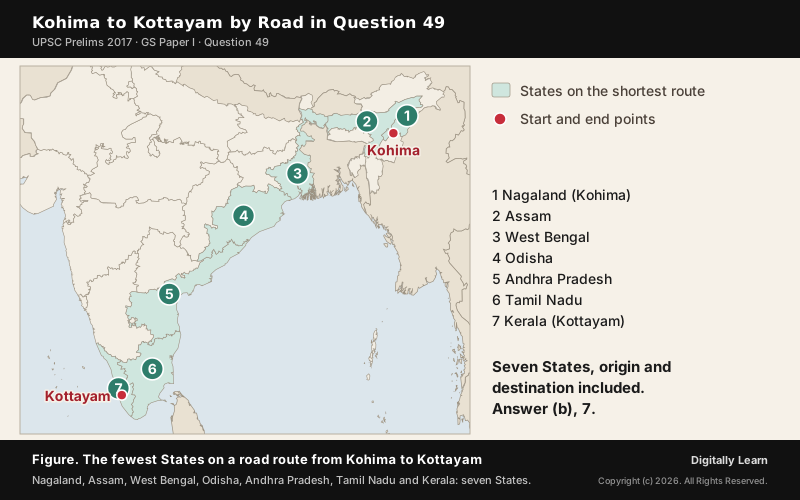
Kohima is the capital of Nagaland and Kottayam is in Kerala. Count the shortest chain of neighbouring States. Nagaland borders Assam; Assam borders West Bengal; West Bengal borders Odisha; Odisha borders Andhra Pradesh; Andhra Pradesh borders Tamil Nadu; and Tamil Nadu borders Kerala.

That is Nagaland, Assam, West Bengal, Odisha, Andhra Pradesh, Tamil Nadu and Kerala: 7 States, including the origin and the destination. A shorter chain is not possible, because the road must leave the North-East through Assam and West Bengal and then run down the east coast. Answer (b), 7.

Map of India on State boundaries with the seven States on the shortest road route from Kohima in Nagaland to Kottayam in Kerala shaded and numbered 1 to 7
Tap the figure to open it full size.
How to crack it

Draw the route mentally along the east coast: NE exit via Assam and West Bengal, then Odisha, Andhra Pradesh, Tamil Nadu, Kerala. Count seven.

Remember

West Bengal touches Odisha directly, so the route need not pass through Jharkhand or Bihar; Andhra Pradesh touches Tamil Nadu, so it need not pass through Telangana or Karnataka.

Sources: Nagaland (Wikipedia); Kohima (Wikipedia); Assam (Wikipedia); West Bengal (Wikipedia); Andhra Pradesh (Wikipedia); Tamil Nadu (Wikipedia); Kottayam (Wikipedia)

Q50Polity and Governance

The Parliament of India exercises control over the functions of the Council of Ministers through

  • 1. Adjournment motion
  • 2. Question hour
  • 3. Supplementary questions

Select the correct answer using the code given below:

  1. a1 only
  2. b2 and 3 only
  3. c1 and 3 only
  4. d1, 2 and 3
See the answer and explanationWith how to crack it

Answer: (d) 1, 2 and 3

Parliament controls the Council of Ministers through devices such as question hour, discussions, the adjournment motion and the no-confidence motion. The adjournment motion (1) draws the attention of the House to a definite matter of urgent public importance and involves an element of censure against the government. Question hour (2) makes ministers answer for their departments.

Supplementary questions (3) follow a starred question, which needs an oral answer, and let members press the minister further. All three are tools of parliamentary control. Answer (d), 1, 2 and 3.

How to crack it

Each listed item makes a minister answer to the House. With no wrong item, pick (d).

Remember

Starred question: oral answer, supplementaries allowed. Unstarred: written answer, no supplementaries. Short notice: less than ten days' notice.

Q51History

Which one of the following was a very important seaport in the Kakatiya kingdom?

  1. aKakinada
  2. bMotupalli
  3. cMachilipatnam (Masulipatnam)
  4. dNelluru
See the answer and explanationWith how to crack it

Answer: (b) Motupalli

Motupalli, a village on the coast of present-day Andhra Pradesh, was the primary port of the Kakatiya realm. Marco Polo referred to the Kakatiya state as the Kingdom of Motupalli, and the Kakatiya king Ganapati Deva is said to have imported Arabian horses through this port. Answer (b).

Kakinada (a), Machilipatnam (c) and Nellore (d) are coastal towns of the same region, but none of them was the great Kakatiya seaport that the travellers wrote about. Answer (b), Motupalli.

How to crack it

Remember Marco Polo's name for the Kakatiya kingdom, 'the Kingdom of Motupalli'. The port gave its name to the kingdom in his account.

Remember

Motupalli is also mentioned as a port in the writings of Ptolemy and Pliny, and was later ruled by the Reddys, Vijayanagara and the Qutb Shahis.

Sources: Motupalli (Wikipedia)

Q52Environment and Ecology

With reference to 'Global Climate Change Alliance', which of the following statements is/are correct?

  • 1. It is an initiative of the European Union.
  • 2. It provides technical and financial support to targeted developing countries to integrate climate change into their development policies and budgets.
  • 3. It is coordinated by World Resources Institute (WRI) and World Business Council for Sustainable Development (WBCSD).

Select the correct answer using the code given below:

  1. a1 and 2 only
  2. b3 only
  3. c2 and 3 only
  4. d1, 2 and 3
See the answer and explanationWith how to crack it

Answer: (a) 1 and 2 only

Statement 1 is correct. The Global Climate Change Alliance was established by the European Union in 2007 to strengthen dialogue and cooperation on climate change with developing countries, especially least developed countries and small island developing States.

Statement 2 is correct. It acts as a source of technical and financial support for the most climate-vulnerable countries, and one of its priority areas is mainstreaming climate change, so that climate becomes an integral consideration in national development plans, policies and budgets.

Statement 3 is wrong. It is an EU programme funded by the European Union, not coordinated by the World Resources Institute and the World Business Council for Sustainable Development. Answer (a), 1 and 2 only.

How to crack it

If statement 1 says it is an EU initiative, statement 3 naming two other organisations as coordinators is unlikely to be true too. Keep 1 and 2.

Remember

In 2014 the GCCA became GCCA+ (Global Climate Change Alliance Plus), an EU flagship initiative.

Sources: GCCA, What is the GCCA/GCCA+? (archived official page)

Q53History

With reference to the religious history of India, consider the following statements:

  • 1. Sautrantika and Sammitiya were the sects of Jainism.
  • 2. Sarvastivadin held that the constituents of phenomena were not wholly momentary, but existed forever in a latent form.

Which of the statements given above is/are correct?

  1. a1 only
  2. b2 only
  3. cBoth 1 and 2
  4. dNeither 1 nor 2
See the answer and explanationWith how to crack it

Answer: (b) 2 only

Statement 1 is wrong. The Sautrantika was an early Buddhist school, and the Sammitiya was a sub-school of the Pudgalavada, also Buddhist. Neither was a sect of Jainism.

Statement 2 is correct. Sarvastivada means 'the theory of all that exists': it held that all dharmas (the constituents of phenomena) exist in the past, present and future, the 'three times'. So they were not wholly momentary but existed always. Answer (b), 2 only.

How to crack it

Sautrantika and Sammitiya are schools of early Buddhism, not Jainism, and the doctrine in statement 2 is exactly what Sarvastivada ('all exists') means.

Remember

Sarvastivada was particularly strong in Kashmir and North India; its Abhidharma tradition had seven canonical texts.

Sources: Sautrantika (Wikipedia); Pudgalavada (Wikipedia); Sarvastivada (Wikipedia)

Q54Geography

Mediterranean Sea is a border of which of the following countries?

  • 1. Jordan
  • 2. Iraq
  • 3. Lebanon
  • 4. Syria

Select the correct answer using the code given below:

  1. a1, 2 and 3 only
  2. b2 and 3 only
  3. c3 and 4 only
  4. d1, 3 and 4 only
See the answer and explanationWith how to crack it

Answer: (c) 3 and 4 only

The countries with a Mediterranean coast in West Asia are Turkey, Syria, Lebanon, Israel and Palestine (Gaza Strip). So Lebanon (3) and Syria (4) border the Mediterranean.

Jordan (1) does not; apart from a 26 km shoreline on the Gulf of Aqaba in the Red Sea it is landlocked. Iraq (2) does not; its only coast is a 58 km stretch on the northern Persian Gulf. Answer (c), 3 and 4 only.

Map of the eastern Mediterranean showing Lebanon and Syria on the coast and Jordan and Iraq inland, with the Gulf of Aqaba and the Persian Gulf marked
Tap the figure to open it full size.
How to crack it

Picture the eastern shore of the Mediterranean from north to south: Turkey, Syria, Lebanon, Israel, Gaza. Jordan and Iraq lie inland behind them.

Remember

Jordan touches the Red Sea (Aqaba) and the Dead Sea, Iraq the Persian Gulf; neither reaches the Mediterranean.

Sources: Mediterranean Sea (Wikipedia); Jordan (Wikipedia); Iraq (Wikipedia)

Q55Economy

With reference to 'National Investment and Infrastructure Fund', which of the following statements is/are correct?

  • 1. It is an organ of NITI Aayog.
  • 2. It has a corpus of ₹ 4,00,000 crore at present.

Select the correct answer using the code given below:

  1. a1 only
  2. b2 only
  3. cBoth 1 and 2
  4. dNeither 1 nor 2
See the answer and explanationWith how to crack it

Answer: (d) Neither 1 nor 2

Statement 1 is wrong. The National Investment and Infrastructure Fund was announced in the Union Budget, approved in August 2015 by the Department of Economic Affairs (Ministry of Finance) and registered with SEBI as a Category II Alternative Investment Fund. It is not an organ of NITI Aayog.

Statement 2 is wrong. It was planned with ₹20,000 crore from the Government of India, the government's commitment being 49 per cent of the total corpus. That makes a corpus of about ₹40,000 crore, not ₹4,00,000 crore. Answer (d), Neither 1 nor 2.

How to crack it

Statement 2 has one zero too many: if ₹20,000 crore is 49 per cent, the whole is about ₹40,000 crore.

Remember

NIIF is registered with SEBI as an Alternative Investment Fund; the government's share is 49 per cent.

Sources: National Investment and Infrastructure Fund (Wikipedia)

Q56Economy

The Global Infrastructure Facility is a/an

  1. aASEAN initiative to upgrade infrastructure in Asia and financed by credit from the Asian Development Bank.
  2. bWorld Bank collaboration that facilitates the preparation and structuring of complex infrastructure Public-Private Partnerships (PPPs) to enable mobilization of private sector and institutional investor capital.
  3. cCollaboration among the major banks of the world working with the OECD and focused on expanding the set of infrastructure projects that have the potential to mobilize private investment.
  4. dUNCTAD funded initiative that seeks to finance and facilitate infrastructure development in the world.
See the answer and explanationWith how to crack it

Answer: (b) World Bank collaboration that facilitates the preparation and structuring of complex infrastructure Public-Private Partnerships (PPPs) to enable mobilization of private sector and institutional investor capital.

The Global Infrastructure Facility is a global, open platform that facilitates the preparation and structuring of complex infrastructure PPPs, to enable mobilisation of private sector and institutional investor capital. It was designed as a partnership of the World Bank Group, other multilateral development banks, governments and private investors, and its first partners signed on at the World Bank and IMF Annual Meetings in October 2014. That is option (b).

Option (a) is wrong; it is not an ASEAN initiative financed by Asian Development Bank credit (the ADB joined as one partner). Option (c) is wrong; it is not a collaboration of major banks with the OECD. Option (d) is wrong; it is not funded by UNCTAD. Answer (b).

How to crack it

Option (b) is long, specific and technical, the World Bank's own wording about PPPs and institutional investors; the others pair the facility with the wrong institution.

Remember

The first multilateral bank partners alongside the World Bank Group were the Asian Development Bank, the EBRD, the European Investment Bank and the Islamic Development Bank.

Sources: Global Infrastructure Facility: Update for G20, September 2014; GIF update for G20 leaders, November 2014

Q57Polity and Governance

For election to the Lok Sabha, a nomination paper can be filed by

  1. aanyone residing in India.
  2. ba resident of the constituency from which the election is to be contested.
  3. cany citizen of India whose name appears in the electoral roll of a constituency.
  4. dany citizen of India.
See the answer and explanationWith how to crack it

Answer: (c) any citizen of India whose name appears in the electoral roll of a constituency.

Under the Representation of the People Act, 1951, a candidate for Parliament must be registered as an elector for a parliamentary constituency, besides being a citizen of India of at least 25 years of age (for the Lok Sabha). The roll can be of any constituency in India. That is option (c).

Option (a) is wrong; residence alone is not enough, and a non-citizen cannot contest. Option (b) is wrong; the candidate need not live in, or be a voter of, the constituency being contested. Option (d) is wrong; citizenship alone is not enough without being on an electoral roll. Answer (c).

How to crack it

Two filters apply together: citizen and registered voter somewhere in India. Only (c) states both.

Remember

The same rule (registered as an elector for a parliamentary constituency) applies to both the Lok Sabha and the Rajya Sabha.

Q58Geography

Consider the following statements:

  • 1. In India, the Himalayas are spread over five States only.
  • 2. Western Ghats are spread over five States only.
  • 3. Pulicat Lake is spread over two States only.

Which of the statements given above is/are correct?

  1. a1 and 2 only
  2. b3 only
  3. c2 and 3 only
  4. d1 and 3 only
See the answer and explanationWith how to crack it

Answer: (b) 3 only

Statement 1 is wrong. The Indian Himalayan Region spans thirteen States and Union Territories: Ladakh, Jammu and Kashmir, Himachal Pradesh, Uttarakhand, Sikkim, West Bengal, Arunachal Pradesh, Nagaland, Manipur, Mizoram, Tripura, Meghalaya and Assam. Even counting only the main ranges, they cover more than five States.

Statement 2 is wrong. The Western Ghats run through six States: Gujarat, Maharashtra, Goa, Karnataka, Kerala and Tamil Nadu.

Statement 3 is correct. Pulicat Lake lies on the Andhra Pradesh and Tamil Nadu border, on the Coromandel Coast, so it is spread over these two States only. Answer (b), 3 only.

How to crack it

Count the Western Ghats States (six) and statement 2 falls; with 2 out, only (b) remains.

Remember

Western Ghats States from north to south: Gujarat, Maharashtra, Goa, Karnataka, Kerala, Tamil Nadu.

Sources: Indian Himalayan Region (Wikipedia); Western Ghats (Wikipedia); Pulicat Lake (Wikipedia)

Q59Environment and Ecology

Biological Oxygen Demand (BOD) is a standard criterion for

  1. aMeasuring oxygen levels in blood
  2. bComputing oxygen levels in forest ecosystems
  3. cPollution assay in aquatic ecosystems
  4. dAssessing oxygen levels in high altitude regions
See the answer and explanationWith how to crack it

Answer: (c) Pollution assay in aquatic ecosystems

Biochemical (biological) oxygen demand is the amount of dissolved oxygen that micro-organisms need to break down the organic matter in a water sample, usually measured over 5 days at 20 °C. It is used as a surrogate of the degree of organic water pollution, and to judge how well wastewater treatment plants work. So it is a standard for pollution assay in aquatic ecosystems. Answer (c).

Option (a) is wrong; BOD is a test on water samples, not on blood. Options (b) and (d) are wrong; BOD is measured on water samples, not on forests or the air at high altitude. Answer (c).

How to crack it

'Demand' for oxygen by microbes decomposing organic waste in water: the term itself points to water pollution.

Remember

The standard test is BOD5: oxygen consumed per litre over 5 days at 20 °C.

Sources: Biochemical oxygen demand (Wikipedia)

Q60Environment and Ecology

With reference to the role of UN-Habitat in the United Nations programme working towards a better urban future, which of the statements is/are correct?

  • 1. UN-Habitat has been mandated by the United Nations General Assembly to promote socially and environmentally sustainable towns and cities to provide adequate shelter for all.
  • 2. Its partners are either governments or local urban authorities only.
  • 3. UN-Habitat contributes to the overall objective of the United Nations system to reduce poverty and to promote access to safe drinking water and basic sanitation.

Select the correct answer using the code given below:

  1. a1, 2 and 3
  2. b1 and 3 only
  3. c2 and 3 only
  4. d1 only
See the answer and explanationWith how to crack it

Answer: (b) 1 and 3 only

Statement 1 is correct. UN-Habitat is mandated by the UN General Assembly to promote socially and environmentally sustainable towns and cities.

Statement 2 is wrong. Its partners are not only governments and local authorities: it collaborates with governments, intergovernmental bodies, UN agencies, civil society organisations, foundations, academic institutions and the private sector.

Statement 3 is correct. Its work serves the UN system's goals of reducing poverty and of access to safe drinking water and sanitation; it works for reduced inequality and poverty and for urban systems that ensure safe drinking water and sanitation. Answer (b), 1 and 3 only.

How to crack it

'Either governments or local urban authorities only' is the false restriction; a UN programme works with NGOs, academia and business too.

Remember

UN-Habitat is the focal point for all urbanisation and human settlement matters within the UN system.

Sources: UN-Habitat, About us

Q61Economy

With reference to 'National Skills Qualification Framework (NSQF)', which of the statements given below is/are correct?

  • 1. Under NSQF, a learner can acquire the certification for competency only through formal learning.
  • 2. An outcome expected from the implementation of NSQF is the mobility between vocational and general education.

Select the correct answer using the code given below :

  1. a1 only
  2. b2 only
  3. cBoth 1 and 2
  4. dNeither 1 nor 2
See the answer and explanationWith how to crack it

Answer: (b) 2 only

Statement 1 is wrong. The NSQF arranges qualifications by levels defined in terms of learning outcomes, which the learner must possess regardless of whether they were acquired through formal, non-formal or informal learning. Certification is therefore not limited to formal learning; recognition of prior learning is one of the framework's expected gains.

Statement 2 is correct. General education and vocational training had worked as separate verticals in India, and the NSQF was meant to facilitate mobility from vocational to general education and back, through pathways among vocational education, vocational training, general education and technical education. Answer (b), 2 only.

How to crack it

'Only through formal learning' contradicts the whole idea of a skills framework that recognises prior learning. Drop 1.

Remember

The NSQF was notified on 27 December 2013 and organises qualifications into ten levels.

Sources: NSQF Notification (Ministry of Finance, 2013; AICTE copy)

Q62History

In the context of Indian history, the principle of ‘Dyarchy (diarchy)’ refers to

  1. aDivision of the central legislature into two houses
  2. bIntroduction of double government i.e., Central and State governments
  3. cHaving two sets of rulers; one in London and another in Delhi
  4. dDivision of the subjects delegated to the provinces into two categories
See the answer and explanationWith how to crack it

Answer: (d) Division of the subjects delegated to the provinces into two categories

The Government of India Act, 1919 divided the provincial subjects into two parts, transferred and reserved. Transferred subjects were run by the Governor with ministers responsible to the legislative council; reserved subjects by the Governor and his executive council, who were not responsible to it. This dual scheme was called dyarchy, from the Greek di-arche, 'double rule'. That is option (d).

Option (a) describes bicameralism, which the same Act introduced at the Centre but which is a different principle. Option (b), Central and State governments, describes federalism. Option (c), rulers in London and Delhi, is not what the term meant. Answer (d).

How to crack it

Dyarchy was a provincial arrangement: the provincial subjects split into reserved and transferred. Only (d) speaks of provincial subjects.

Remember

The 1935 Act abolished dyarchy in the provinces, introducing provincial autonomy, and provided for dyarchy at the Centre, which never came into operation.

Q63Economy

Consider the following in respect of ‘National Career Service’:

  • 1. National Career Service is an initiative of the Department of Personnel and Training, Government of India.
  • 2. National Career Service has been launched in a Mission Mode to improve the employment opportunities to uneducated youth of the country.

Which of the above statements is/are correct?

  1. a1 only
  2. b2 only
  3. cBoth 1 and 2
  4. dNeither 1 nor 2
See the answer and explanationWith how to crack it

Answer: (d) Neither 1 nor 2

Statement 1 is wrong. The National Career Service is an initiative of the Ministry of Labour and Employment, not of the Department of Personnel and Training.

Statement 2 is wrong. It is a one-stop portal of employment and career services (job search and matching, career counselling, job fairs) open to all job seekers, employers, skill providers and others. It is not limited to uneducated youth. Answer (d), Neither 1 nor 2.

How to crack it

Employment services belong to the Labour Ministry, and a career portal serves all job seekers. Both statements narrow or misplace the scheme.

Remember

The NCS portal is free to use and lists job seekers, employers, skill providers and career counsellors among its users.

Sources: National Career Service, About us

Q64Economy

Which of the following statements best describes the term ‘Scheme for Sustainable Structuring of Stressed Assets (S4A)’, recently seen in the news?

  1. aIt is a procedure for considering ecological costs of developmental schemes formulated by the Government.
  2. bIt is a scheme of RBI for reworking the financial structure of big corporate entities facing genuine difficulties.
  3. cIt is a disinvestment plan of the Government regarding Central Public Sector Undertakings.
  4. dIt is an important provision in ‘The Insolvency and Bankruptcy Code’ recently implemented by the Government.
See the answer and explanationWith how to crack it

Answer: (b) It is a scheme of RBI for reworking the financial structure of big corporate entities facing genuine difficulties.

The Scheme for Sustainable Structuring of Stressed Assets was issued by the Reserve Bank of India in June 2016. Large borrower accounts in severe financial difficulty may need coordinated deep financial restructuring, often with a substantial write-down of debt. The scheme lets lenders work out how much of the debt is sustainable and restructure the rest. Eligible accounts are projects already in commercial operation with total institutional lending above ₹500 crore. That matches (b).

Option (a) is wrong; it is about bank loans, not ecological costs. Option (c) is wrong; it is not a disinvestment plan for public sector undertakings. Option (d) is wrong; it is an RBI scheme for banks, separate from the Insolvency and Bankruptcy Code. Answer (b).

How to crack it

'Stressed assets' are bad loans; 'structuring' them is the RBI's and banks' business. Only (b) names the RBI and big corporate borrowers.

Remember

S4A came after the Strategic Debt Restructuring (SDR) mechanism, another RBI tool for stressed assets.

Sources: RBI notification, Scheme for Sustainable Structuring of Stressed Assets (13 June 2016)

Q65Environment and Ecology

Consider the following statements:

  • 1. Climate and Clean Air Coalition (CCAC) to Reduce Short Lived Climate Pollutants is a unique initiative of G20 group of countries.
  • 2. The CCAC focuses on methane, black carbon and hydrofluorocarbons.

Which of the statements given above is/are correct?

  1. a1 only
  2. b2 only
  3. cBoth 1 and 2
  4. dNeither 1 nor 2
See the answer and explanationWith how to crack it

Answer: (b) 2 only

Statement 1 is wrong. The Climate and Clean Air Coalition was launched on 16 February 2012 by the United Nations Environment Programme and six countries (Bangladesh, Canada, Ghana, Mexico, Sweden and the United States). It is a voluntary partnership of governments, organisations and businesses, not an initiative of the G20.

Statement 2 is correct. It works to reduce short-lived climate pollutants: methane, black carbon, tropospheric ozone and hydrofluorocarbons (HFCs). Answer (b), 2 only.

How to crack it

The founders included Bangladesh and Ghana, which are not in the G20. The pollutant list in statement 2 is the coalition's own focus.

Remember

Short-lived climate pollutants stay in the air from a few days to a few decades but have a powerful warming effect, and many are also dangerous air pollutants.

Sources: Climate and Clean Air Coalition (Wikipedia)

Q66Geography

With reference to ‘Indian Ocean Dipole (IOD)’, sometimes mentioned in the news while forecasting Indian monsoon, which of the following statements is/are correct?

  • 1. IOD phenomenon is characterised by a difference in sea surface temperature between tropical Western Indian Ocean and tropical Eastern Pacific Ocean.
  • 2. An IOD phenomenon can influence an El Niño’s impact on the monsoon.

Select the correct answer using the code given below:

  1. a1 only
  2. b2 only
  3. cBoth 1 and 2
  4. dNeither 1 nor 2
See the answer and explanationWith how to crack it

Answer: (b) 2 only

Statement 1 is wrong. The Indian Ocean Dipole is an oscillation of sea surface temperatures between the western and the eastern parts of the Indian Ocean (near Indonesia), not between the western Indian Ocean and the eastern Pacific.

Statement 2 is correct. The IOD affects the strength of the Indian monsoon and interacts with El Niño in the Pacific; research has shown that it changes the relationship between El Niño and Indian monsoon rainfall. Answer (b), 2 only.

How to crack it

A 'dipole' within one ocean: the 'Pacific' in statement 1 gives it away.

Remember

Positive IOD: warmer water and more rain in the western Indian Ocean, cooler water in the east. The IOD was first identified by Indian researchers in 1999.

Sources: Indian Ocean Dipole (Wikipedia)

Q67Environment and Ecology

If you want to see gharials in their natural habitat, which one of the following is the best place to visit?

  1. aBhitarkanika Mangroves
  2. bChambal River
  3. cPulicat Lake
  4. dDeepor Beel
See the answer and explanationWith how to crack it

Answer: (b) Chambal River

The gharial is a river crocodile that lives in rivers in the plains of the north of the subcontinent and is the most thoroughly aquatic crocodilian. The Chambal River, protected as the National Chambal Sanctuary across three States, is one of its strongholds: 107 gharials were recorded there in 1974, and captive-bred gharials have been released into it since 1979. Answer (b).

Bhitarkanika (a) is a mangrove wetland known for saltwater crocodiles, not gharials. Pulicat Lake (c) is a coastal lagoon. Deepor Beel (d) is a freshwater lake (a Ramsar wetland) near Guwahati in Assam. None of them is gharial habitat. Answer (b), Chambal River.

How to crack it

Gharials need clean, flowing rivers with sandbanks. Of the four, only Chambal is a river.

Remember

The gharial has been listed as Critically Endangered on the IUCN Red List since 2007.

Sources: Gharial (Wikipedia); Bhitarkanika Mangroves (Wikipedia); Pulicat Lake (Wikipedia); Deepor Beel (Wikipedia)

Q68Current Affairs

Consider the following in respect of Indian Ocean Naval Symposium (IONS):

  • 1. Inaugural IONS was held in India in 2015 under the chairmanship of the Indian Navy.
  • 2. IONS is a voluntary initiative that seeks to increase maritime co-operation among navies of the littoral states of the Indian Ocean Region.

Which of the above statements is/are correct?

  1. a1 only
  2. b2 only
  3. cBoth 1 and 2
  4. dNeither 1 nor 2
See the answer and explanationWith how to crack it

Answer: (b) 2 only

Statement 1 is wrong. The first Indian Ocean Naval Symposium was held in 2008, with India as host, not in 2015. Its chair then rotates among member States, each term lasting two years.

Statement 2 is correct. IONS is a voluntary initiative among the navies and maritime security agencies of the littoral States of the Indian Ocean region, meant to increase maritime security cooperation. Answer (b), 2 only.

How to crack it

Remember the start year, 2008, with India as host. That alone removes statement 1.

Remember

IONS is often compared to the Western Pacific Naval Symposium; it groups its members into four sub-regions.

Sources: Indian Ocean Naval Symposium (Wikipedia)

Q69History

The painting of Bodhisattva Padmapani is one of the most famous and oft-illustrated paintings at

  1. aAjanta
  2. bBadami
  3. cBagh
  4. dEllora
See the answer and explanationWith how to crack it

Answer: (a) Ajanta

The two most famous individual painted images at Ajanta are the over-lifesize figures of the protective bodhisattvas Padmapani and Vajrapani on either side of the entrance to the Buddha shrine in Cave 1. Padmapani is the bodhisattva of compassion, shown holding a lotus. Answer (a).

Badami (b), Bagh (c) and Ellora (d) are other cave sites; the Padmapani painting is not at any of them. Answer (a), Ajanta.

How to crack it

Padmapani ('lotus in hand') is the signature painting of Ajanta Cave 1.

Remember

Ajanta Cave 1 holds both Padmapani and Vajrapani, flanking the shrine doorway.

Sources: Ajanta Caves (Wikipedia)

Q70History

Consider the following pairs :

TraditionsCommunities
1.Chaliha Sahib FestivalSindhis
2.Nanda Raj Jaat YatraGonds
3.Wari-WarkariSanthals

Which of the pairs given above is/are correctly matched?

  1. a1 only
  2. b2 and 3 only
  3. c1 and 3 only
  4. dNone of the above
See the answer and explanationWith how to crack it

Answer: (a) 1 only

Pair 1 is correct. Chaliho or Chaliha Sahib is a forty-day festival of the Sindhi Hindu community, linked with the worship of Jhulelal.

Pair 2 is wrong. The Nanda Devi Raj Jat is a long pilgrimage in Chamoli, Uttarakhand, observed by the Hindus of Garhwal and Kumaon, not by the Gonds.

Pair 3 is wrong. The Wari is the annual pilgrimage on foot to Pandharpur in Maharashtra in honour of Vithoba; a Varkari is one who performs the Wari. It has nothing to do with the Santhals. Answer (a), 1 only.

How to crack it

Place each tradition on the map: Sindhi (Chaliho), Uttarakhand (Nanda Raj Jat), Maharashtra (Wari). Gonds and Santhals live elsewhere.

Remember

Pandharpur Wari carries the padukas of the saints Dnyaneshwar and Tukaram in palkhis to Pandharpur.

Sources: Chaliho (Wikipedia); Nanda Devi Raj Jat (Wikipedia); Pandharpur Wari (Wikipedia)

Q71Environment and Ecology

Which of the following practices can help in water conservation in agriculture?

  • 1. Reduced or zero tillage of the land
  • 2. Applying gypsum before irrigating the field
  • 3. Allowing crop residue to remain in the field

Select the correct answer using the code given below:

  1. a1 and 2 only
  2. b3 only
  3. c1 and 3 only
  4. d1, 2 and 3
See the answer and explanationWith how to crack it

Answer: (c) 1 and 3 only

Statement 1 is correct. Reduced or zero tillage leaves the soil undisturbed, which increases the amount of water that infiltrates the soil.

Statement 3 is correct. Crop residue left on the field reduces evaporation, improves water infiltration and helps the soil retain moisture for the next crop.

Statement 2 is wrong. Gypsum is applied to reclaim sodic and saline soils (it lowers the exchangeable sodium) and to supply calcium and sulphur. That is a soil-chemistry treatment, not a water-conservation practice. Answer (c), 1 and 3 only.

How to crack it

Tillage and residue both act on soil moisture; gypsum acts on soil chemistry. Keep 1 and 3.

Remember

No-till farming also reduces soil erosion and the number of machinery passes.

Sources: No-till farming (Wikipedia); Gypsum (Wikipedia)

Q72Economy

Consider the following statements: The nation-wide ‘Soil Health Card Scheme’ aims at

  • 1. expanding the cultivable area under irrigation.
  • 2. enabling the banks to assess the quantum of loans to be granted to farmers on the basis of soil quality.
  • 3. checking the overuse of fertilizers in farmlands.

Which of the above statements is/are correct?

  1. a1 and 2 only
  2. b3 only
  3. c2 and 3 only
  4. d1, 2 and 3
See the answer and explanationWith how to crack it

Answer: (b) 3 only

The Soil Health Card Scheme, launched on 19 February 2015, gives farmers cards carrying crop-wise recommendations of nutrients and fertilisers for their own farms, based on tests of soil samples. It aims at soil-test-based, balanced use of fertilisers so that farmers get higher yields at lower cost.

Statement 3 is correct: checking the overuse of fertilisers is the point of balanced, test-based use. Statement 1 is wrong: the scheme does not expand irrigated area. Statement 2 is wrong: the card advises the farmer on inputs; it is not a tool for banks to decide loan amounts. Answer (b), 3 only.

How to crack it

A soil card is about what the soil needs, that is, fertiliser. Irrigation and bank loans are outside its scope.

Remember

The card reports the soil's nutrient status, including micronutrient deficiencies, and suggests the dose of fertiliser for each crop.

Sources: Soil Health Card Scheme (Wikipedia)

Q73Science and Technology

Consider the following pairs :

Commonly used / consumed materialsUnwanted or controversial chemicals likely to be found in them
1.LipstickLead
2.Soft drinksBrominated vegetable oils
3.Chinese fast foodMonosodium glutamate

Which of the pairs given above is/are correctly matched?

  1. a1 only
  2. b2 and 3 only
  3. c1 and 3 only
  4. d1, 2 and 3
See the answer and explanationWith how to crack it

Answer: (d) 1, 2 and 3

Pair 1 is correct. Lipsticks have been found to carry traces of lead; a US FDA study in 2009 found lead in all 20 samples it tested.

Pair 2 is correct. Brominated vegetable oil has been used since 1931 to emulsify citrus-flavoured soft drinks so that the flavouring does not separate.

Pair 3 is correct. Monosodium glutamate (MSG), a flavour enhancer, has long been controversial; the so-called 'Chinese restaurant syndrome' was blamed on it, though blinded studies have not shown such effects at normal amounts. Answer (d), 1, 2 and 3.

How to crack it

Each pair is a well-known consumer-safety story (lead in lipstick, BVO in soft drinks, MSG in Chinese food). All three match.

Remember

'Unwanted or controversial' is broad: MSG is controversial even though food regulators treat it as safe.

Sources: Lipstick (Wikipedia); Brominated vegetable oil (Wikipedia); Monosodium glutamate (Wikipedia)

Q74Science and Technology

Organic Light Emitting Diodes (OLEDs) are used to create digital display in many devices. What are the advantages of OLED displays over Liquid Crystal displays?

  • 1. OLED displays can be fabricated on flexible plastic substrates.
  • 2. Roll-up displays embedded in clothing can be made using OLEDs.
  • 3. Transparent displays are possible using OLEDs.

Select the correct answer using the code given below:

  1. a1 and 3 only
  2. b2 only
  3. c1, 2 and 3
  4. dNone of the above statements is correct
See the answer and explanationWith how to crack it

Answer: (c) 1, 2 and 3

OLED displays can be fabricated on flexible plastic substrates (statement 1). That opens the way to flexible OLEDs for new uses such as roll-up displays embedded in fabrics or clothing (statement 2). OLEDs can also be made transparent, and transparent OLED displays are already used, for example in phones with optical fingerprint scanners (statement 3).

Plastic substrates are also shatter-resistant, unlike glass. All three statements hold. Answer (c), 1, 2 and 3.

How to crack it

Flexible substrates make roll-up and wearable displays possible, so 1 and 2 go together; transparency is a separate known OLED feature.

Remember

In an OLED, an organic film emits light when an electric current passes through it.

Sources: OLED (Wikipedia)

Q75History

Which of the following is/are famous for Sun temples?

  • 1. Arasavalli
  • 2. Amarakantak
  • 3. Omkareshwar

Select the correct answer using the code given below:

  1. a1 only
  2. b2 and 3 only
  3. c1 and 3 only
  4. d1, 2 and 3
See the answer and explanationWith how to crack it

Answer: (a) 1 only

Arasavalli, 1 km east of Srikakulam in Andhra Pradesh, has a temple to Surya, the Sun god, believed to have been built in the 7th century by King Devendra Varma of the Eastern Ganga dynasty. So 1 is a Sun temple site.

Amarkantak (2) in Madhya Pradesh is a pilgrimage centre known as the source of the Narmada and the Son, with the Narmada Kund temples. Omkareshwar (3), also in Madhya Pradesh, is famous for its Shiva temple, one of the twelve Jyotirlingas. Neither is known for a Sun temple. Answer (a), 1 only.

How to crack it

Amarkantak and Omkareshwar are both pilgrimages on the Narmada (its source and a Jyotirlinga). Only Arasavalli is a Surya temple.

Remember

The Arasavalli temple's main festival is Ratha Saptami.

Sources: Arasavalli Sun Temple (Wikipedia); Amarkantak (Wikipedia); Omkareshwar Temple (Wikipedia)

Q76Polity and Governance

Consider the following statements:

  • 1. In the election for Lok Sabha or State Assembly, the winning candidate must get at least 50 percent of the votes polled, to be declared elected.
  • 2. According to the provisions laid down in the Constitution of India, in Lok Sabha, the Speaker’s post goes to the majority party and the Deputy Speaker’s to the Opposition.

Which of the statements given above is/are correct?

  1. a1 only
  2. b2 only
  3. cBoth 1 and 2
  4. dNeither 1 nor 2
See the answer and explanationWith how to crack it

Answer: (d) Neither 1 nor 2

Statement 1 is wrong. Lok Sabha and Assembly elections use the first-past-the-post system: the candidate with the largest number of votes wins, even without 50 per cent of the votes polled. A 50 per cent plus one rule has been suggested for examination, but it is not the law.

Statement 2 is wrong. The Constitution only says the Lok Sabha shall elect a Speaker and a Deputy Speaker from among its members. Giving the Deputy Speaker's post to the main opposition party is a consensus followed since the 11th Lok Sabha, a convention and not a constitutional provision. Answer (d), Neither 1 nor 2.

How to crack it

Both statements turn a practice or a proposal into a rule. FPTP needs only the most votes; the Deputy Speaker arrangement is convention.

Remember

Up to the 10th Lok Sabha, both the Speaker and the Deputy Speaker usually came from the ruling party.

Q77Economy

Which of the following has/have occurred in India after its liberalization of economic policies in 1991?

  • 1. Share of agriculture in GDP increased enormously.
  • 2. Share of India’s exports in world trade increased.
  • 3. FDI inflows increased.
  • 4. India’s foreign exchange reserves increased enormously.

Select the correct answer using the codes given below:

  1. a1 and 4 only
  2. b2, 3 and 4 only
  3. c2 and 3 only
  4. d1, 2, 3 and 4
See the answer and explanationWith how to crack it

Answer: (b) 2, 3 and 4 only

Statement 1 is wrong. The share of agriculture in GDP has kept falling (from 55.4 per cent in 1950-51 to about 14 per cent), while industry and services gained; it did not rise after 1991.

Statements 2, 3 and 4 are correct. India's share in global exports improved from 0.8 per cent in 2004 to 1.7 per cent in 2013. Foreign investment (FDI and portfolio) rose from about US$100 million in 1990-91 to US$150 billion in 2003-04. Foreign exchange reserves, enough for barely two weeks of imports in 1991, rose from about US$6 billion to US$125 billion by 2004-05. Answer (b), 2, 3 and 4 only.

How to crack it

Growth in a developing economy shifts output away from farming. Any option with statement 1 is out, leaving (b) or (c); FDI and reserves both clearly rose, so (b).

Remember

1991 began with a balance-of-payments crisis; the reserve position is the clearest before-and-after contrast of the reforms.

Sources: NCERT Class 11, Indian Economic Development, Liberalisation, Privatisation and Globalisation

Q78Science and Technology

What is the application of Somatic Cell Nuclear Transfer Technology?

  1. aProduction of biolarvicides
  2. bManufacture of biodegradable plastics
  3. cReproductive cloning of animals
  4. dProduction of organisms free of diseases
See the answer and explanationWith how to crack it

Answer: (c) Reproductive cloning of animals

Somatic cell nuclear transfer takes an egg cell with its nucleus removed and implants the nucleus of a body (somatic) cell into it, creating a viable embryo. It is used in therapeutic and reproductive cloning; Dolly the sheep (1996) was the first mammal cloned this way from an adult cell. So its application is reproductive cloning of animals. Answer (c).

Biolarvicides (a), biodegradable plastics (b) and disease-free organisms (d) do not involve moving a body-cell nucleus into an egg to grow an embryo. Answer (c).

How to crack it

'Nuclear transfer' into an egg to make an embryo is cloning; Dolly is the case to recall.

Remember

'Somatic' means a body cell; the technique moves the nucleus of such a cell into an egg cell whose own nucleus has been removed.

Sources: Somatic cell nuclear transfer (Wikipedia)

Q79Economy

Consider the following statements:

  • 1. The National Payments Corporation of India (NPCI) helps in promoting financial inclusion in the country.
  • 2. NPCI has launched RuPay, a card payment scheme.

Which of the statements given above is/are correct ?

  1. a1 only
  2. b2 only
  3. cBoth 1 and 2
  4. dNeither 1 nor 2
See the answer and explanationWith how to crack it

Answer: (c) Both 1 and 2

Statement 1 is correct. The National Payments Corporation of India runs retail payment systems such as IMPS, UPI and the *99# USSD service, which works on basic phones and was built for areas with poor internet connectivity; such services serve financial inclusion.

Statement 2 is correct. RuPay, the domestic card scheme of India, is one of NPCI's products, accepted at ATMs, point-of-sale terminals and online merchants across the country. Answer (c), Both 1 and 2.

How to crack it

NPCI's whole portfolio (RuPay, *99#, UPI) is aimed at cheap, wide payments. Both statements are standard facts.

Remember

NPCI's products include RuPay, IMPS, UPI, BHIM, *99# and National Electronic Toll Collection.

Sources: National Payments Corporation of India (Wikipedia)

Q80Environment and Ecology

The term 'M-STrIPES' is sometimes seen in the news in the context of

  1. aCaptive breeding of Wild Fauna
  2. bMaintenance of Tiger Reserves
  3. cIndigenous Satellite Navigation System
  4. dSecurity of National Highways
See the answer and explanationWith how to crack it

Answer: (b) Maintenance of Tiger Reserves

M-STrIPES (Monitoring System for Tigers: Intensive Protection and Ecological Status) is a software-based monitoring system launched across Indian tiger reserves by the National Tiger Conservation Authority in 2010. Forest guards carry handheld devices with GPS to record tiger sightings, deaths, wildlife crime and ecological observations while patrolling, and the software maps their patrol routes. Answer (b).

It has nothing to do with captive breeding (a), satellite navigation (c) or highway security (d). Answer (b), Maintenance of Tiger Reserves.

How to crack it

Read the acronym: 'Tiger' and 'stripes'. It is a tiger reserve management tool.

Remember

The name spells it out: Monitoring System for TIgers, with 'STrIPES' as the giveaway.

Sources: M-STrIPES (Wikipedia)

Q81Economy

What is/are the most likely advantages of implementing 'Goods and Services Tax (GST)'?

  • 1. It will replace multiple taxes collected by multiple authorities and will thus create a single market in India.
  • 2. It will drastically reduce the 'Current Account Deficit' of India and will enable it to increase its foreign exchange reserves.
  • 3. It will enormously increase the growth and size of economy of India and will enable it to overtake China in the near future.

Select the correct answer using the code given below :

  1. a1 only
  2. b2 and 3 only
  3. c1 and 3 only
  4. d1, 2 and 3
See the answer and explanationWith how to crack it

Answer: (a) 1 only

Statement 1 is correct. GST, introduced on 1 July 2017, replaced a range of earlier taxes (VAT, service tax, central excise, entertainment tax, octroi and others) levied by the Centre and the States. One tax across the country removes the barriers those different taxes created and moves India towards a single market.

Statement 2 is wrong. The current account deficit depends on the balance of trade, remittances and income flows with the rest of the world; a domestic indirect tax does not 'drastically' cut it or build up reserves.

Statement 3 is wrong. A tax reform may help growth, but claiming it will 'enormously' enlarge the economy so that India overtakes China in the near future is an exaggeration no tax change can promise. Answer (a), 1 only.

How to crack it

Statements 2 and 3 use extreme words ('drastically', 'enormously', 'overtake China'). Statement 1 is the textbook purpose of GST.

Remember

GST is destination-based: the tax goes to the State where goods or services are consumed, not where they are made.

Sources: Goods and Services Tax (India) (Wikipedia)

Q82Current Affairs

'Broad-based Trade and Investment Agreement (BTIA)' is sometimes seen in the news in the context of negotiations held between India and

  1. aEuropean Union
  2. bGulf Cooperation Council
  3. cOrganization for Economic Cooperation and Development
  4. dShanghai Cooperation Organization
See the answer and explanationWith how to crack it

Answer: (a) European Union

India and the European Union have been negotiating a Broad-based Trade and Investment Agreement (BTIA) since 2007; it is the name for the long-running India-EU free trade agreement talks. Answer (a).

The Gulf Cooperation Council (b), the OECD (c) and the Shanghai Cooperation Organisation (d) are not India's partners in the BTIA. Answer (a), European Union.

How to crack it

BTIA is the EU's long-pending trade deal with India; recall 'India-EU BTIA, since 2007'.

Remember

Several rounds of BTIA negotiations passed without an agreement; the talks were later carried on as the India-EU Free Trade Agreement.

Sources: India–European Union relations (Wikipedia)

Q83Economy

Consider the following statements:

  • 1. India has ratified the Trade Facilitation Agreement (TFA) of WTO.
  • 2. TFA is a part of WTO's Bali Ministerial Package of 2013.
  • 3. TFA came into force in January 2016.

Which of the statements given above is/are correct?

  1. a1 and 2 only
  2. b1 and 3 only
  3. c2 and 3 only
  4. d1, 2 and 3
See the answer and explanationWith how to crack it

Answer: (a) 1 and 2 only

Statement 1 is correct. India ratified the WTO Trade Facilitation Agreement on 22 April 2016.

Statement 2 is correct. The TFA was concluded at the WTO's Ninth Ministerial Conference in Bali, Indonesia, in December 2013, as part of the Bali package.

Statement 3 is wrong. The TFA entered into force on 22 February 2017, once two-thirds of WTO members had ratified it, not in January 2016. Answer (a), 1 and 2 only.

How to crack it

A WTO agreement needs two-thirds of members to ratify; India itself ratified only in April 2016, so January 2016 is too early for entry into force.

Remember

The TFA aims to expedite the movement, release and clearance of goods, including goods in transit.

Sources: Trade Facilitation Agreement (Wikipedia); WTO, Trade facilitation

Q84International Relations

What is the importance of developing Chabahar Port by India?

  1. aIndia's trade with African countries will enormously increase.
  2. bIndia's relations with oil-producing Arab countries will be strengthened.
  3. cIndia will not depend on Pakistan for access to Afghanistan and Central Asia.
  4. dPakistan will facilitate and protect the installation of a gas pipeline between Iraq and India.
See the answer and explanationWith how to crack it

Answer: (c) India will not depend on Pakistan for access to Afghanistan and Central Asia.

Chabahar is Iran's only oceanic port, on the Gulf of Oman. Being close to Afghanistan and the Central Asian countries, it has been called the 'Golden Gate' to these landlocked countries. India, Iran and Afghanistan signed a trilateral transit agreement in 2016, and the port gives India a sea-and-land route to Afghanistan that bypasses Pakistan. Answer (c).

Option (a) is wrong; the port faces Afghanistan and Central Asia, not Africa. Option (b) is wrong; it is not about relations with Arab oil producers. Option (d) is wrong; no Iraq-India pipeline through Pakistan is involved. Answer (c).

How to crack it

Look at the map: Chabahar lets goods from India reach Afghanistan through Iran instead of through Pakistan.

Remember

Chabahar is about 170 km west of Pakistan's Gwadar port.

Sources: Chabahar Port (Wikipedia)

Q85Science and Technology

In India, it is legally mandatory for which of the following to report on cyber security incidents?

  • 1. Service providers
  • 2. Data centres
  • 3. Body corporate

Select the correct answer using the code given below:

  1. a1 only
  2. b1 and 2 only
  3. c3 only
  4. d1, 2 and 3
See the answer and explanationWith how to crack it

Answer: (d) 1, 2 and 3

Section 70B(6) of the Information Technology Act, 2000 empowers CERT-In (the Indian Computer Emergency Response Team) to call for information and give directions to service providers, intermediaries, data centres and body corporate. Its functions, which include response to and reporting of cyber incidents, are set out in the CERT-In Rules of 2013, notified on 16 January 2014.

So service providers (1), data centres (2) and body corporate (3) are all legally obliged to report. The obligation was later tightened: since 2022, any service provider, intermediary, data centre, body corporate or Government organisation must report listed cyber incidents to CERT-In within 6 hours. Answer (d), 1, 2 and 3.

How to crack it

The IT Act names all three categories together in the same breath as the bodies CERT-In can direct. Pick (d).

Remember

CERT-In's directions cover security practices, prevention, response and reporting of cyber incidents.

Sources: CERT-In Directions under Section 70B(6) of the IT Act (28 April 2022)

Q86Polity and Governance

Right to vote and to be elected in India is a

  1. aFundamental Right
  2. bNatural Right
  3. cConstitutional Right
  4. dLegal Right
See the answer and explanationWith how to crack it

Answer: (c) Constitutional Right Equally defensible: (d) Legal Right

Answer in doubt

UPSC's final key gives (c), Constitutional Right, but (d), Legal Right, is equally defensible. The right to vote comes from Article 326 (adult suffrage), which lies outside Part III, and rights of this kind are described in the standard polity texts as 'constitutional rights or legal rights or non-fundamental rights': the two labels name the same category. The right to be elected also depends on the qualifications Parliament laid down in the Representation of the People Act, 1951, which is an ordinary law. A candidate who chose (d) had a sound reason. We count both (c) and (d) as correct.

The right to vote in Lok Sabha and Assembly elections rests on Article 326, which says these elections shall be on the basis of adult suffrage, so every citizen of 18 or more has a right to vote. Such rights, found in the Constitution but outside Part III, are called constitutional (non-fundamental) rights. The right to be elected rests on the qualifications in the Constitution together with those laid down by Parliament in the Representation of the People Act, 1951. UPSC's key treats the right to vote and to be elected as a Constitutional Right. Answer (c).

It is not a Fundamental Right (a), since it is not in Part III and cannot be enforced directly under Article 32. It is not a natural right (b), since it exists only because the Constitution and the law create it. Option (d), Legal Right, is the one that remains arguable (see the note).

How to crack it

Ask where the right is written. Adult suffrage is in Article 326, outside Part III: that makes it a constitutional right, not a fundamental one.

Remember

Rights outside Part III in the Constitution: Article 265 (no tax without law), Article 300A (property), Article 301 (trade and commerce) and Article 326 (adult suffrage).

Q87Science and Technology

What is the purpose of ‘evolved Laser Interferometer Space Antenna (eLISA)’ project?

  1. aTo detect neutrinos
  2. bTo detect gravitational waves
  3. cTo detect the effectiveness of missile defence system
  4. dTo study the effect of solar flares on our communication systems
See the answer and explanationWith how to crack it

Answer: (b) To detect gravitational waves

eLISA (evolved Laser Interferometer Space Antenna) was the scaled-down 2013 version of the European Space Agency's LISA mission, a space-based observatory to detect and measure gravitational waves, with laser arms a million kilometres long between spacecraft. Answer (b).

Neutrinos (a), missile defence (c) and solar flares (d) are not its purpose. Answer (b), to detect gravitational waves.

How to crack it

A laser interferometer measures tiny changes in distance, which is how a passing gravitational wave shows itself; the 'space antenna' is such an instrument in space.

Remember

ESA chose the 'Gravitational Universe' theme for its L3 mission slot, with launch expected in 2034.

Sources: Laser Interferometer Space Antenna (Wikipedia)

Q88Current Affairs

What is the purpose of ‘Vidyanjali Yojana’?

  • 1. To enable the famous foreign educational institutions to open their campuses in India.
  • 2. To increase the quality of education provided in government schools by taking help from the private sector and the community.
  • 3. To encourage voluntary monetary contributions from private individuals and organizations so as to improve the infrastructure facilities for primary and secondary schools.

Select the correct answer using the code given below:

  1. a2 only
  2. b3 only
  3. c1 and 2 only
  4. d2 and 3 only
See the answer and explanationWith how to crack it

Answer: (a) 2 only

Vidyanjali, launched by the Ministry of Human Resource Development in June 2016, is a school volunteer programme to boost community and private sector participation in government schools. Volunteers such as NRIs, retired teachers, government officials, defence personnel and professionals help improve the quality of education. So statement 2 is correct.

Statement 1 is wrong; it has nothing to do with foreign universities opening campuses. Statement 3 is wrong for the programme as it stood in 2017: it sought volunteers' time and skills in schools, not monetary contributions for infrastructure. Answer (a), 2 only.

How to crack it

'Anjali' is an offering; here people offer their time and skills to government schools. Statement 2 is the volunteer idea; 1 and 3 are different schemes.

Remember

Vidyanjali's volunteers include NRIs, retired teachers, government officials and defence personnel.

Sources: Vidyanjali (Wikipedia)

Q89Current Affairs

What is the aim of the programme ‘Unnat Bharat Abhiyan’?

  1. aAchieving 100% literacy by promoting collaboration between voluntary organizations and government’s education system and local communities.
  2. bConnecting institutions of higher education with local communities to address development challenges through appropriate technologies.
  3. cStrengthening India’s scientific research institutions in order to make India a scientific and technological power.
  4. dDeveloping human capital by allocating special funds for health care and education of rural and urban poor, and organizing skill development programmes and vocational training for them.
See the answer and explanationWith how to crack it

Answer: (b) Connecting institutions of higher education with local communities to address development challenges through appropriate technologies.

Unnat Bharat Abhiyan, inaugurated on 11 November 2014 by the then Ministry of Human Resource Development, grew out of a group at IIT Delhi with expertise in rural development and appropriate technology. It aims at transformational change in rural development by leveraging knowledge institutions: higher education institutions work with local communities on their development challenges. That is option (b).

Option (a) is wrong; it is not a literacy mission. Option (c) is wrong; it is not about strengthening national research institutions. Option (d) is wrong; it is not a fund for health, education and skilling of the poor. Answer (b).

How to crack it

The scheme sits with higher education ('knowledge institutions') and aims at rural development. Only (b) links colleges with communities.

Remember

UBA brings together educational institutions, government bodies, NGOs and local communities.

Sources: Unnat Bharat Abhiyan, Introduction (official site)

Q90Polity and Governance

Consider the following statements:

  • 1. The Election Commission of India is a five-member body.
  • 2. Union Ministry of Home Affairs decides the election schedule for the conduct of both general elections and bye-elections.
  • 3. Election Commission resolves the disputes relating to splits/mergers of recognised political parties.

Which of the statements given above is/are correct?

  1. a1 and 2 only
  2. b2 only
  3. c2 and 3 only
  4. d3 only
See the answer and explanationWith how to crack it

Answer: (d) 3 only

Statement 1 is wrong. Since October 1993 the Election Commission has been a multi-member body of three: the Chief Election Commissioner and two Election Commissioners.

Statement 2 is wrong. Notifying the dates and schedules of elections is a function of the Election Commission itself, not of the Union Ministry of Home Affairs.

Statement 3 is correct. The Commission acts as a court for settling disputes about the recognition of political parties and the allotment of election symbols; when a recognised party splits, the rival groups' claim to the party's name and symbol is decided by the Commission. Answer (d), 3 only.

How to crack it

Remember 'three members' and 'the Commission fixes its own schedule'. That removes 1 and 2.

Remember

The Election Commission's functions are administrative, advisory and quasi-judicial; settling party and symbol disputes is quasi-judicial.

Q91Environment and Ecology

In India, if a species of tortoise is declared protected under Schedule I of the Wildlife (Protection) Act, 1972, what does it imply?

  1. aIt enjoys the same level of protection as the tiger.
  2. bIt no longer exists in the wild, a few individuals are under captive protection; and now it is impossible to prevent its extinction.
  3. cIt is endemic to a particular region of India.
  4. dBoth (b) and (c) stated above are correct in this context.
See the answer and explanationWith how to crack it

Answer: (a) It enjoys the same level of protection as the tiger.

Schedule I of the Wild Life (Protection) Act, 1972 is the list of the most protected animals; the tiger (Panthera tigris) is itself in Schedule I, Part I. Schedule I and Part II of Schedule II give absolute protection, and offences against them carry the highest penalties. A tortoise placed in Schedule I therefore enjoys the same level of protection as the tiger. Answer (a).

Option (b) is wrong; listing in Schedule I is about legal protection, not a finding that the species survives only in captivity or cannot be saved. Option (c) is wrong; the schedules do not say where a species is endemic. Option (d) falls with (b) and (c). Answer (a).

How to crack it

A schedule is a list for legal protection. Being on the same list as the tiger means the same protection; nothing about extinction or endemism follows.

Remember

Section 9 bans hunting of any animal in Schedules I to IV except as the Act provides; the schedules differ in the penalty for breaking that ban.

Sources: Wild Life (Protection) Act, 1972 (Legislative Department); Wildlife Protection Act, 1972 (Wikipedia)

Q92Polity and Governance

In India, Judicial Review implies

  1. athe power of the Judiciary to pronounce upon the constitutionality of laws and executive orders.
  2. bthe power of the Judiciary to question the wisdom of the laws enacted by the Legislatures.
  3. cthe power of the Judiciary to review all the legislative enactments before they are assented to by the President.
  4. dthe power of the Judiciary to review its own judgements given earlier in similar or different cases.
See the answer and explanationWith how to crack it

Answer: (a) the power of the Judiciary to pronounce upon the constitutionality of laws and executive orders.

Judicial review is the power of the courts to examine the constitutionality of legislative enactments and executive orders of the Central and State governments; if they violate the Constitution (ultra vires), the court declares them illegal, unconstitutional and void. That is option (a).

Option (b) is wrong; courts judge whether a law is constitutional, not whether it is wise. Option (c) is wrong; courts review laws after they are made, not before the President's assent. Option (d) is wrong; reviewing its own earlier judgements is a different power (review jurisdiction). Answer (a).

How to crack it

Review means testing against the Constitution. Only (a) mentions constitutionality.

Remember

The Supreme Court has held judicial review to be a 'basic feature' of the Constitution, so even laws in the Ninth Schedule can be challenged.

Q93History

With reference to Indian freedom struggle, consider the following events:

  • 1. Mutiny in Royal Indian Navy
  • 2. Quit India Movement launched
  • 3. Second Round Table Conference

What is the correct chronological sequence of the above events?

  1. a1-2-3
  2. b2-1-3
  3. c3-2-1
  4. d3-1-2
See the answer and explanationWith how to crack it

Answer: (c) 3-2-1

The Second Round Table Conference was held in London in late 1931, after the Gandhi-Irwin Pact. The Quit India Resolution was ratified by the AICC at Gowalia Tank, Bombay, on 8 August 1942, and the leaders were arrested the next day. The Royal Indian Navy ratings went on strike in Bombay on 18 February 1946.

So the order is 3 (1931), 2 (1942), 1 (1946). Answer (c), 3-2-1.

How to crack it

Anchor the middle event: Quit India, 1942. The RTCs were before it (1930 to 1932) and the naval mutiny after the war (1946).

Remember

The RIN revolt was one of three post-war upsurges, after the Calcutta protests of November 1945 and February 1946 over the INA trials.

Q94Economy

Consider the following statements:

  • 1. Tax revenue as a percent of GDP of India has steadily increased in the last decade.
  • 2. Fiscal deficit as a percent of GDP of India has steadily increased in the last decade.

Which of the statements given above is/are correct?

  1. a1 only
  2. b2 only
  3. cBoth 1 and 2
  4. dNeither 1 nor 2
See the answer and explanationWith how to crack it

Answer: (d) Neither 1 nor 2

Statement 1 is wrong. Tax revenue did not rise steadily as a share of GDP. The Centre's gross tax to GDP ratio fell to 11.6 per cent in 2008-09 (revised estimates) and was set to decline further to 10.9 per cent in 2009-10, because of tax cuts and the economic slowdown.

Statement 2 is wrong. The fiscal deficit did not rise steadily either. It was 2.5 per cent of GDP in 2007-08, jumped to 6.0 per cent in 2008-09 and 6.4 per cent in 2009-10, and then came down to 5.1 per cent in 2010-11 and 4.6 per cent (budgeted) in 2011-12. Answer (d), Neither 1 nor 2.

How to crack it

The 2008-09 global crisis pushed the deficit up and tax revenue down for a while, after which the deficit was brought down. Neither series moved steadily one way.

Remember

'Steadily increased in the last decade' is a strong claim; one fall in the series is enough to make it wrong.

Sources: Union Budget 2009-10, Medium Term Fiscal Policy Statement

Q95Environment and Ecology

Recently there was a proposal to translocate some of the lions from their natural habitat in Gujarat to which one of the following sites?

  1. aCorbett National Park
  2. bKuno Palpur Wildlife Sanctuary
  3. cMudumalai Wildlife Sanctuary
  4. dSariska National Park
See the answer and explanationWith how to crack it

Answer: (b) Kuno Palpur Wildlife Sanctuary

Kuno Palpur in Madhya Pradesh was selected in the 1990s for the Asiatic Lion Reintroduction Project, to establish a second lion population outside Gujarat's Gir. Villagers were resettled from it between 1998 and 2003, and in April 2013 the Supreme Court ordered Gujarat to send some Gir lions to Madhya Pradesh. Answer (b).

Corbett (a), Mudumalai (c) and Sariska (d) were not the sites chosen for the lion translocation. Answer (b), Kuno Palpur Wildlife Sanctuary.

How to crack it

Recall the long Gujarat versus Madhya Pradesh lion dispute: the Madhya Pradesh site was Kuno.

Remember

Gujarat resisted because Gir would lose its status as the world's only home of the Asiatic lion. Kuno later became the first site of Project Cheetah.

Sources: Kuno National Park (Wikipedia)

Q96Polity and Governance

Which of the following are not necessarily the consequences of the proclamation of the President’s rule in a State?

  • 1. Dissolution of the State Legislative Assembly
  • 2. Removal of the Council of Ministers in the State
  • 3. Dissolution of the local bodies

Select the correct answer using the code given below:

  1. a1 and 2 only
  2. b1 and 3 only
  3. c2 and 3 only
  4. d1, 2 and 3
See the answer and explanationWith how to crack it

Answer: (b) 1 and 3 only

When President's Rule is imposed, the President dismisses the State Council of Ministers headed by the Chief Minister, and the Governor runs the State on the President's behalf. Removal of the Council of Ministers (2) is therefore a necessary consequence.

The State Legislative Assembly (1) is either suspended or dissolved; dissolution is not automatic, so it is not necessarily a consequence. Local bodies (3) are not part of the State government or legislature that the proclamation takes over, so their dissolution does not follow from it. So 1 and 3 are 'not necessarily' consequences. Answer (b), 1 and 3 only.

How to crack it

Note the word 'not'. The ministry always goes; the Assembly may only be suspended; local bodies are untouched.

Remember

Under President's Rule, Parliament passes the State's bills and budget, or delegates that power to the President.

Q97Polity and Governance

Which of the following are envisaged by the Right against Exploitation in the Constitution of India?

  • 1. Prohibition of traffic in human beings and forced labour
  • 2. Abolition of untouchability
  • 3. Protection of the interests of minorities
  • 4. Prohibition of employment of children in factories and mines

Select the correct answer using the code given below:

  1. a1, 2 and 4 only
  2. b2, 3 and 4 only
  3. c1 and 4 only
  4. d1, 2, 3 and 4
See the answer and explanationWith how to crack it

Answer: (c) 1 and 4 only

The Right against Exploitation (Articles 23 and 24) prohibits traffic in human beings and forced labour (Article 23) and the employment of children in factories and similar places (Article 24). So 1 and 4 are correct.

Abolition of untouchability (2) is Article 17, under the Right to Equality. Protection of the interests of minorities (3) is Article 29, under Cultural and Educational Rights. Answer (c), 1 and 4 only.

How to crack it

Exploitation means forced labour, trafficking and child labour. Untouchability belongs to equality, minorities to cultural rights.

Remember

The six Fundamental Rights: equality (14 to 18), freedom (19 to 22), against exploitation (23, 24), religion (25 to 28), cultural and educational (29, 30), constitutional remedies (32).

Q98Geography

Which of the following is geographically closest to Great Nicobar?

  1. aSumatra
  2. bBorneo
  3. cJava
  4. dSri Lanka
See the answer and explanationWith how to crack it

Answer: (a) Sumatra

Great Nicobar is the southernmost and largest of the Nicobar Islands, lying north of Sumatra. Indira Point, India's southernmost point on Great Nicobar, is only 145 km (80 nautical miles) from Rondo Island, the northernmost island of Sumatra's Aceh province. Answer (a).

Borneo (b) and Java (c) lie much further to the south-east, beyond Sumatra. Sri Lanka (d) lies far to the north-west, across the Bay of Bengal. Answer (a), Sumatra.

Map of the eastern Indian Ocean showing Great Nicobar just north of Sumatra, with Java, Borneo and Sri Lanka much farther away
Tap the figure to open it full size.
How to crack it

Picture the Andaman and Nicobar chain running south: it ends just above the northern tip of Sumatra.

Remember

India and Indonesia are upgrading the deep-sea port of Sabang, just across the channel from Great Nicobar.

Sources: Great Nicobar Island (Wikipedia); Indira Point (Wikipedia)

Q99Polity and Governance

Out of the following statements, choose the one that brings out the principle underlying the Cabinet form of Government:

  1. aAn arrangement for minimizing the criticism against the Government whose responsibilities are complex and hard to carry out to the satisfaction of all.
  2. bA mechanism for speeding up the activities of the Government whose responsibilities are increasing day by day.
  3. cA mechanism of parliamentary democracy for ensuring collective responsibility of the Government to the people.
  4. dA device for strengthening the hands of the head of the Government whose hold over the people is in a state of decline.
See the answer and explanationWith how to crack it

Answer: (c) A mechanism of parliamentary democracy for ensuring collective responsibility of the Government to the people.

The Cabinet form of government is the parliamentary system: the ministers are responsible to Parliament for all their acts, and the Council of Ministers is collectively responsible to the Lok Sabha, which answers to the people. Collective responsibility of the executive to the legislature is the principle underneath it. That is option (c).

Option (a) is wrong; the system invites criticism (question hour, motions) instead of minimising it. Option (b) is wrong; speed of action is not its principle, and in fact the system is criticised for instability. Option (d) is wrong; it does not exist to strengthen a declining leader's hold. Answer (c).

How to crack it

The cabinet system is defined by responsibility to the legislature; look for 'collective responsibility'.

Remember

Collective responsibility means the ministers swim or sink together: when the Lok Sabha passes a no-confidence motion, all of them must resign.

Q100Polity and Governance

Which one of the following is not a feature of Indian federalism?

  1. aThere is an independent judiciary in India.
  2. bPowers have been clearly divided between the Centre and the States.
  3. cThe federating units have been given unequal representation in the Rajya Sabha.
  4. dIt is the result of an agreement among the federating units.
See the answer and explanationWith how to crack it

Answer: (d) It is the result of an agreement among the federating units.

Article 1 describes India as a 'Union of States', which implies that the Indian federation is not the result of an agreement by the States, and that no State has the right to secede. So (d) is not a feature of Indian federalism and is the answer.

The other three are features of Indian federalism. An independent judiciary (a) settles disputes between the Centre and the States. Powers are divided between the Centre and the States through the Union, State and Concurrent Lists (b). And the States have unequal representation in the Rajya Sabha (c), seats being allotted by population, unlike the equal representation of states in the US Senate. Answer (d).

How to crack it

Note 'not'. The US federation came from an agreement of States; India's did not, which is why Article 1 says 'Union of States'.

Remember

The Constitution never uses the word 'federation'; it is described as 'federal in form but unitary in spirit' and 'quasi-federal' (K C Wheare).

Cut-off

UPSC Prelims 2017 Cut-off Marks by Category

These are UPSC's official Prelims 2017 cut-offs, counted on GS Paper I alone. CSAT (GS Paper II) only had to be cleared at 33 per cent. Compare them with the score the full-paper drill gives you.

CategoryPrelims 2017 cut-off (out of 200)
General105.34
OBC102.66
SC88.66
ST88.66
PH-185.34
PH-261.34
PH-340.00

Source: UPSC, Civil Services Examination 2017, minimum qualifying marks.

Coming next

Coming Next: UPSC Prelims 2027 and Mains 2027 Answer Keys

EVERY YEAR, ONE PLACE

Practise all UPSC PYQs

Prelims GS from 2016, CSAT from 2018 and Mains from 2014 in one practice section: full papers, subject-wise and topic-wise sets, in English and Hindi.

PRELIMS 2027 · 23 MAY 2027

Answer key on exam day

Our answer key with an explanation for all 100 questions goes live as soon as the paper is out, and switches to UPSC's provisional key when it is published.

MAINS 2027 · FROM 20 AUGUST 2027

Mains 2027 papers

The Mains 2027 papers follow the same pattern, question by question, within days of each paper.

Dates: UPSC Annual Calendar 2027 and the Mains 2026 time table.

Questions students ask

UPSC Prelims 2017 Question Paper and Answer Key: Common Questions

Is this the official UPSC Prelims 2017 answer key?

Yes. The answers are UPSC's final answer key for GS Paper I, for all four booklet series (Sets A, B, C and D).

Was any question dropped in UPSC Prelims 2017?

No. UPSC's final key shows no question dropped, so all 100 questions were scored.

Is any answer in UPSC's 2017 key open to doubt?

Question 86, on the right to vote and to be elected, is. UPSC's key gives (c), Constitutional Right, but (d), Legal Right, is equally defensible, and the explanation sets out why. The score calculator counts both.

What was the UPSC Prelims 2017 cut-off?

The official cut-off, counted on GS Paper I only, was 105.34 for General, 102.66 for OBC, and 88.66 each for SC and ST candidates.

How do I calculate my UPSC Prelims 2017 score?

Give yourself 2 marks for every right answer and take away 0.66 marks (one-third of 2) for every wrong answer. A question you left blank scores zero. The score calculator does this for you: choose your booklet set, mark your answers, and it adds up the marks.

I had Set B, C or D. Can I use this page?

Yes. Choose your set in the booklet menu and every question is shown under the number it had in your booklet. Set B starts with Set A's question 26, Set C with question 76 and Set D with question 51, and the answer key tables also give each set separately.

When was UPSC Prelims 2017 held?

The Civil Services (Preliminary) Examination 2017 was held on 18 June 2017, and the qualified candidates sat the Main examination from 28 October 2017.

Answer key at a glance

UPSC Prelims 2017 Answer Key for Sets A, B, C and D

No question dropped

UPSC's final answer key for Prelims 2017 drops no question, so all 100 questions were scored in every set.

Pick the set printed on your booklet. Each box shows the question number and UPSC's final answer.

Set A answer key All 100 scored
  1. 1d
  2. 2c
  3. 3a
  4. 4a
  5. 5a
  6. 6b
  7. 7b
  8. 8c
  9. 9a
  10. 10b
  11. 11a
  12. 12b
  13. 13c
  14. 14c
  15. 15d
  16. 16b
  17. 17d
  18. 18c
  19. 19c
  20. 20b
  21. 21c
  22. 22b
  23. 23a
  24. 24b
  25. 25d
  26. 26d
  27. 27a
  28. 28d
  29. 29c
  30. 30b
  31. 31c
  32. 32a
  33. 33c
  34. 34c
  35. 35d
  36. 36d
  37. 37b
  38. 38b
  39. 39c
  40. 40a
  41. 41d
  42. 42a
  43. 43a
  44. 44a
  45. 45d
  46. 46c
  47. 47a
  48. 48a
  49. 49b
  50. 50d
  51. 51b
  52. 52a
  53. 53b
  54. 54c
  55. 55d
  56. 56b
  57. 57c
  58. 58b
  59. 59c
  60. 60b
  61. 61b
  62. 62d
  63. 63d
  64. 64b
  65. 65b
  66. 66b
  67. 67b
  68. 68b
  69. 69a
  70. 70a
  71. 71c
  72. 72b
  73. 73d
  74. 74c
  75. 75a
  76. 76d
  77. 77b
  78. 78c
  79. 79c
  80. 80b
  81. 81a
  82. 82a
  83. 83a
  84. 84c
  85. 85d
  86. 86c
  87. 87b
  88. 88a
  89. 89b
  90. 90d
  91. 91a
  92. 92a
  93. 93c
  94. 94d
  95. 95b
  96. 96b
  97. 97c
  98. 98a
  99. 99c
  100. 100d
Set B answer key All 100 scored
  1. 1d
  2. 2a
  3. 3d
  4. 4c
  5. 5b
  6. 6c
  7. 7a
  8. 8c
  9. 9c
  10. 10d
  11. 11d
  12. 12b
  13. 13b
  14. 14c
  15. 15a
  16. 16d
  17. 17a
  18. 18a
  19. 19a
  20. 20d
  21. 21c
  22. 22a
  23. 23a
  24. 24b
  25. 25d
  26. 26d
  27. 27c
  28. 28a
  29. 29a
  30. 30a
  31. 31b
  32. 32b
  33. 33c
  34. 34a
  35. 35b
  36. 36a
  37. 37b
  38. 38c
  39. 39c
  40. 40d
  41. 41b
  42. 42d
  43. 43c
  44. 44c
  45. 45b
  46. 46c
  47. 47b
  48. 48a
  49. 49b
  50. 50d
  51. 51d
  52. 52b
  53. 53c
  54. 54c
  55. 55b
  56. 56a
  57. 57a
  58. 58a
  59. 59c
  60. 60d
  61. 61c
  62. 62b
  63. 63a
  64. 64b
  65. 65d
  66. 66a
  67. 67a
  68. 68c
  69. 69d
  70. 70b
  71. 71b
  72. 72c
  73. 73a
  74. 74c
  75. 75d
  76. 76b
  77. 77a
  78. 78b
  79. 79c
  80. 80d
  81. 81b
  82. 82c
  83. 83b
  84. 84c
  85. 85b
  86. 86b
  87. 87d
  88. 88d
  89. 89b
  90. 90b
  91. 91b
  92. 92b
  93. 93b
  94. 94a
  95. 95a
  96. 96c
  97. 97b
  98. 98d
  99. 99c
  100. 100a
Set C answer key All 100 scored
  1. 1d
  2. 2b
  3. 3c
  4. 4c
  5. 5b
  6. 6a
  7. 7a
  8. 8a
  9. 9c
  10. 10d
  11. 11c
  12. 12b
  13. 13a
  14. 14b
  15. 15d
  16. 16a
  17. 17a
  18. 18c
  19. 19d
  20. 20b
  21. 21b
  22. 22c
  23. 23a
  24. 24c
  25. 25d
  26. 26b
  27. 27a
  28. 28b
  29. 29c
  30. 30d
  31. 31b
  32. 32c
  33. 33b
  34. 34c
  35. 35b
  36. 36b
  37. 37d
  38. 38d
  39. 39b
  40. 40b
  41. 41b
  42. 42b
  43. 43b
  44. 44a
  45. 45a
  46. 46c
  47. 47b
  48. 48d
  49. 49c
  50. 50a
  51. 51d
  52. 52c
  53. 53a
  54. 54a
  55. 55a
  56. 56b
  57. 57b
  58. 58c
  59. 59a
  60. 60b
  61. 61a
  62. 62b
  63. 63c
  64. 64c
  65. 65d
  66. 66b
  67. 67d
  68. 68c
  69. 69c
  70. 70b
  71. 71c
  72. 72b
  73. 73a
  74. 74b
  75. 75d
  76. 76d
  77. 77a
  78. 78d
  79. 79c
  80. 80b
  81. 81c
  82. 82a
  83. 83c
  84. 84c
  85. 85d
  86. 86d
  87. 87b
  88. 88b
  89. 89c
  90. 90a
  91. 91d
  92. 92a
  93. 93a
  94. 94a
  95. 95d
  96. 96c
  97. 97a
  98. 98a
  99. 99b
  100. 100d
Set D answer key All 100 scored
  1. 1b
  2. 2a
  3. 3b
  4. 4c
  5. 5d
  6. 6b
  7. 7c
  8. 8b
  9. 9c
  10. 10b
  11. 11b
  12. 12d
  13. 13d
  14. 14b
  15. 15b
  16. 16b
  17. 17b
  18. 18b
  19. 19a
  20. 20a
  21. 21c
  22. 22b
  23. 23d
  24. 24c
  25. 25a
  26. 26d
  27. 27b
  28. 28c
  29. 29c
  30. 30b
  31. 31a
  32. 32a
  33. 33a
  34. 34c
  35. 35d
  36. 36c
  37. 37b
  38. 38a
  39. 39b
  40. 40d
  41. 41a
  42. 42a
  43. 43c
  44. 44d
  45. 45b
  46. 46b
  47. 47c
  48. 48a
  49. 49c
  50. 50d
  51. 51d
  52. 52a
  53. 53d
  54. 54c
  55. 55b
  56. 56c
  57. 57a
  58. 58c
  59. 59c
  60. 60d
  61. 61d
  62. 62b
  63. 63b
  64. 64c
  65. 65a
  66. 66d
  67. 67a
  68. 68a
  69. 69a
  70. 70d
  71. 71c
  72. 72a
  73. 73a
  74. 74b
  75. 75d
  76. 76d
  77. 77c
  78. 78a
  79. 79a
  80. 80a
  81. 81b
  82. 82b
  83. 83c
  84. 84a
  85. 85b
  86. 86a
  87. 87b
  88. 88c
  89. 89c
  90. 90d
  91. 91b
  92. 92d
  93. 93c
  94. 94c
  95. 95b
  96. 96c
  97. 97b
  98. 98a
  99. 99b
  100. 100d

Every UPSC previous year question, explained

Prelims GS from 2016, CSAT from 2018 and Mains from 2014 can already be practised here, and explanations are being added year by year. Leave your email and we will send each new year as it goes live, with a PDF of the explanations.

Questions are reproduced from the official question paper published by the Union Public Service Commission. Answers follow UPSC's final answer key. Explanations are written by Digitally Learn and are its copyright. upsc.gov.in