


Overview
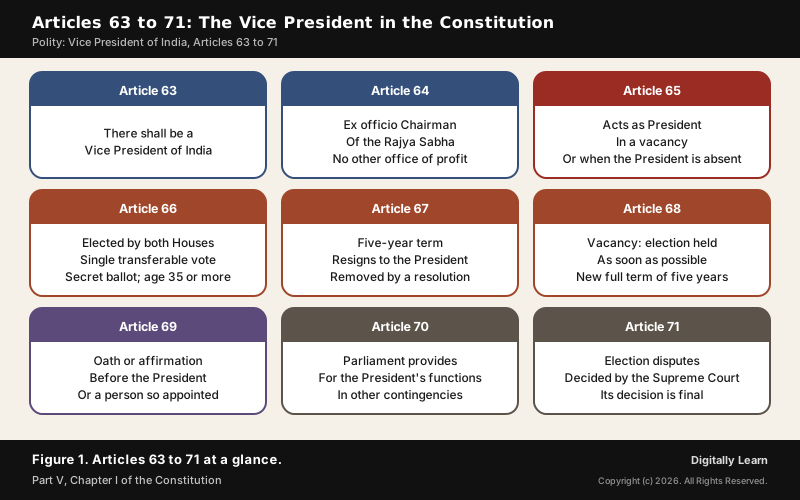
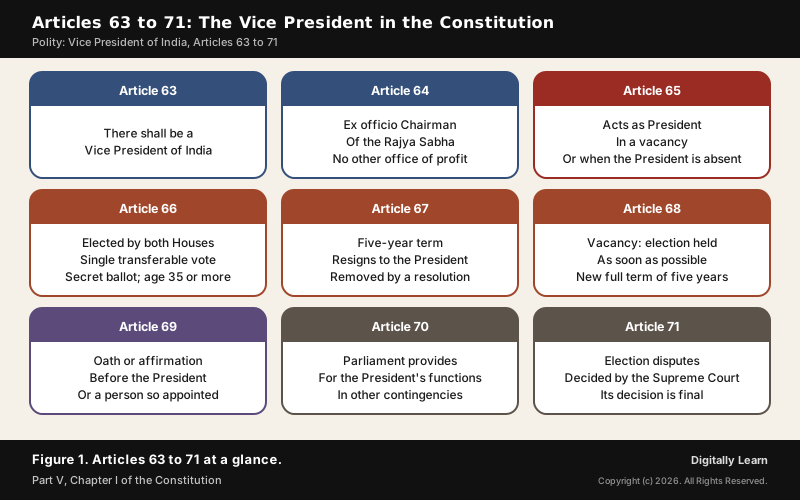
The Vice President articles of the Constitution are Articles 63 to 71, in Part V, Chapter I (The Executive). Article 63 creates the office, Article 64 makes the Vice President ex officio Chairman of the Rajya Sabha, Article 65 covers acting as President, Article 66 the election and qualifications, Articles 67 and 68 the term, removal and vacancies, Article 69 the oath, Article 70 other contingencies and Article 71 election disputes before the Supreme Court.
Articles Related to the Vice President of India: Overview
Which Articles Deal with the Vice President?
The Vice President is dealt with in Articles 63 to 71, in Part V, Chapter I of the Constitution, the chapter on the Union executive. The office sits between the executive and Parliament: it is the second-highest constitutional office after the President, and its holder is also the ex officio Chairman of the Rajya Sabha.
This page takes the articles one at a time. For the full treatment of the office, including the Chairman's powers in the House and the 2025 election, read the complete guide to the Vice-President of India: election, Rajya Sabha chairmanship and removal.
Articles 63 and 64: The Office and the Rajya Sabha Chairmanship
Article 63 and Article 64: Office and Ex Officio Chairman
The office itself comes from Article 63, which is one line long: "There shall be a Vice-President of India." Article 64 then gives the office its main job. The Vice President is ex officio Chairman of the Council of States, the Rajya Sabha, and may not hold any other office of profit. "Ex officio" means by virtue of the office: whoever is Vice President is automatically the Chairman.
A proviso to Article 64 separates the two roles. While the Vice President is acting as President under Article 65, he does not perform the duties of Chairman and is not paid the Chairman's salary under Article 97. The office has no salary of its own: the Vice President does not draw any salary as Vice President, and is paid as Chairman under the Salaries and Allowances of Officers of Parliament Act, 1953.
Rajya Sabha Chairman: Related Articles 89, 91, 92 and 100
The Chairman's role is spelt out in the chapter on Parliament, not in Articles 63 to 71. A student asked for "articles related to the Vice President" should add these:
| Article | What it says |
|---|---|
| Article 89 | The Vice President is ex officio Chairman; the House chooses a Deputy Chairman from its members |
| Article 91 | The Deputy Chairman acts when the Chairman's office is vacant or the Vice President is acting as President |
| Article 92 | The Chairman may not preside while a resolution for his removal is under consideration |
| Article 97 | Salaries of the Chairman and Deputy Chairman are fixed by Parliament by law |
| Article 100 | The Chairman does not vote in the first instance but has a casting vote in a tie |
| Tenth Schedule | The Chairman decides whether a Rajya Sabha member is disqualified for defection |
Powers of the Vice President as Rajya Sabha Chairman
As Chairman, the Vice President is the presiding officer and the guardian of the dignity of the House. In practice he presides during Question Hour, the first hour of the sitting, and is in the Chair for important debates such as those on Constitution Amendment Bills. His powers fall into five groups:
- Conducting the House: He maintains order, may adjourn the House or suspend a sitting for want of quorum, and his rulings are binding precedents that cannot be questioned in the House.
- Voting: He has no vote except a casting vote when the votes are tied (Article 100).
- Quasi-judicial work: He decides whether a member is disqualified for defection under the Tenth Schedule, and may refuse a member’s resignation that is not voluntary or genuine.
- Privilege and committees: His consent is needed to raise a breach of privilege; he appoints committee chairmen, nominates members to standing committees, and himself chairs the Business Advisory, Rules and General Purposes Committees.
- Spokesman of the House: Messages from the President come to the House through him, and he conveys the Motion of Thanks on the President’s Address.
He is helped by the Deputy Chairman, a member elected by the House, and by a panel of six Vice-Chairmen constituted every year. Neutrality is the office's working rule. On 20 April 1987, Vice President R. Venkataraman left the Chair before a debate on defence deals, saying that he had been Defence Minister from 1982 to 1984 and it would not be proper for him to preside.
Article 65: Vice President as Acting President
Article 65: Acting as President in a Vacancy or Absence
The acting-President rule in Article 65 covers two different situations, and the difference is often tested:
- Vacancy, Article 65(1): If the President dies, resigns or is removed, the Vice President acts as President until a newly elected President takes office.
- Absence, Article 65(2): If the President is unable to work because of absence, illness or any other cause, the Vice President discharges the President’s functions until the President resumes.
- Powers, Article 65(3): While acting, the Vice President has all the powers and immunities of the President and the emoluments Parliament fixes.
A vacancy cannot last long, because Article 62 requires a new President to be elected within six months. Both situations have arisen several times, as the table shows.
| Vice President and period | Situation |
|---|---|
| S. Radhakrishnan, 20 June to 5 July 1960 | Absence: President's State visit to the Soviet Union |
| S. Radhakrishnan, 25 July to 19 December 1961 | Absence: illness of President Rajendra Prasad |
| Zakir Husain, February 1964 and March 1965 | Absence: President's eye operation |
| V. V. Giri, until 19 July 1969 | Vacancy: death of President Zakir Husain, 3 May 1969 |
| B. D. Jatti, until 24 July 1977 | Vacancy: death of President Fakhruddin Ali Ahmed, 11 February 1977 |
| M. Hidayatullah, 6 to 31 October 1982 | Absence: President Zail Singh's treatment abroad |
Article 66: Election and Qualifications of the Vice President
Who Elects the Vice President: Article 66(1)
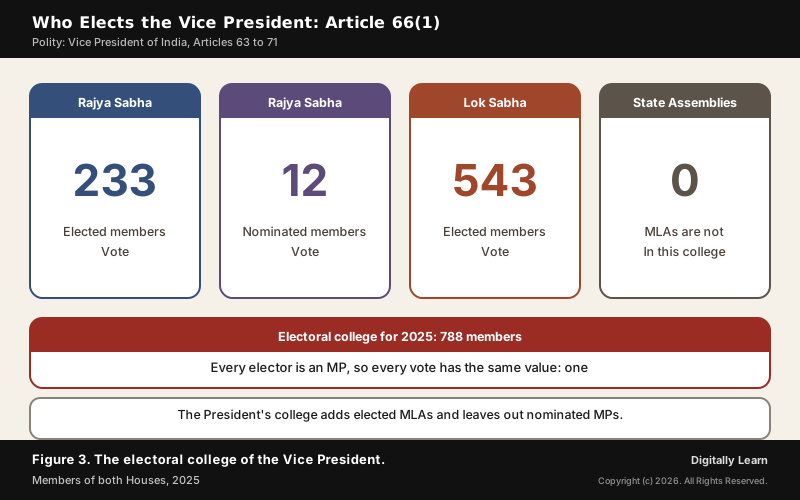
Under Article 66(1), the Vice President is elected by an electoral college of the members of both Houses of Parliament, using proportional representation by means of the single transferable vote, and the voting is by secret ballot. The college includes nominated members. It leaves out the members of the state legislatures, which is the main difference from the President's election.
The original text required a joint meeting of both Houses. The Eleventh Amendment, 1961, replaced that with an electoral college, so members vote without assembling in one sitting. For the 2025 election the college had 788 members: 233 elected and 12 nominated members of the Rajya Sabha, and 543 elected members of the Lok Sabha. Because every elector is an MP, each vote has the same value, one.
| Point | Vice President | President |
|---|---|---|
| Electoral college | All MPs, nominated included | Elected MPs and elected MLAs |
| Qualified for | Rajya Sabha | Lok Sabha |
| Nomination | 20 proposers, 20 seconders | 50 proposers, 50 seconders |
| Oath before | The President | The Chief Justice of India |
Qualifications for Vice President: Article 66(2) to 66(4)
To be elected Vice President, a person must meet three conditions under Article 66(3):
- Citizenship: Be a citizen of India.
- Age: Have completed the age of 35 years.
- Rajya Sabha: Be qualified for election as a member of the Council of States.
Two more rules complete the picture. Under Article 66(4), no one holding an office of profit under the Union, a state or a local authority can stand, though the President, the Vice President, a Governor and ministers are not treated as holding an office of profit for this purpose. Under Article 66(2), the Vice President cannot be a member of Parliament or of a state legislature; a member who is elected vacates the seat on taking office. The nomination paper needs at least 20 electors as proposers and 20 as seconders, and a security deposit of Rs 15,000.
Vice-Presidential Election of 2025: Articles 66 and 68 in Action
The 2025 election shows these articles at work. Jagdeep Dhankhar resigned on 21 July 2025, citing health, the third Vice President to resign before completing his term. Because the vacancy was caused by resignation, Article 68(2) required an election as soon as possible, the first early election for the office since 1987.
The poll was held on 9 September 2025 in Parliament House. Of 781 eligible electors, 767 voted and 15 ballot papers were invalid. The Returning Officer, the Secretary General of the Rajya Sabha, declared C. P. Radhakrishnan elected, by a margin of 152 votes, and he has been the 15th Vice President since 12 September 2025.
- 7 August 2025: The Election Commission issued the notification calling the election.
- 21 August 2025: Last date for nominations; scrutiny followed on 22 August.
- 25 August 2025: Last date for withdrawing candidatures.
- 9 September 2025: Poll from 10 am to 5 pm, with counting the same day.
Articles 67 to 69: Term, Removal, Vacancy and Oath
Article 67: Term, Resignation and Removal of the Vice President
The term of office under Article 67 is five years from the day the Vice President takes office, and the holder can be re-elected any number of times. Three provisos follow: the Vice President may resign by writing to the President; may be removed by the Rajya Sabha; and continues in office after the term ends until a successor takes over.
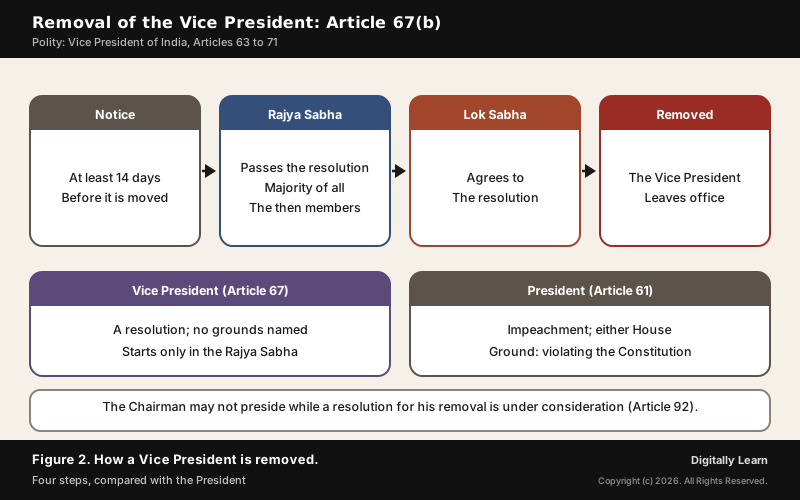
Removal is simpler than the President's impeachment. The resolution is passed by the Rajya Sabha by a majority of all its then members and agreed to by the Lok Sabha, after at least 14 days' notice. No grounds are named, while the President can be impeached only for violation of the Constitution. No Vice President has been removed. The only removal notice, given against Jagdeep Dhankhar on 10 December 2024, was never tabled because the session ended within the 14-day notice period.
Article 68 and Article 69: Filling a Vacancy and the Oath
Vacancies are handled by Article 68. When a term is ending, the election must be completed before it expires. When the office falls vacant through death, resignation or removal, the election is held as soon as possible, and the person elected serves a full five-year term, not the rest of the old one. Unlike Article 62 for the President, Article 68 sets no six-month limit, and the Constitution names no successor to the office in the meantime.
The oath, under Article 69, is taken before the President or a person the President appoints. The Vice President swears to bear true faith and allegiance to the Constitution and to faithfully discharge the duty of the office. The President's oath under Article 60 is different: it is taken before the Chief Justice of India and promises to preserve, protect and defend the Constitution.
Articles 70 and 71: Other Contingencies and Election Disputes
Article 70 and Article 71: Contingencies and the Supreme Court
A safety valve comes in Article 70. Parliament may make any provision it thinks fit for the discharge of the President's functions in a contingency the chapter does not cover, such as the offices of both the President and the Vice President falling vacant together. That happened in 1969. After V. V. Giri resigned as Vice President and acting President to contest the presidential election, Chief Justice Mohammad Hidayatullah acted as President from 20 July to 24 August 1969.
Disputes over the election of a President or a Vice President fall under Article 71:
- Article 71(1): All doubts and disputes are inquired into and decided by the Supreme Court, whose decision is final.
- Article 71(2): If an election is declared void, acts done in office before the decision remain valid.
- Article 71(3): Parliament may regulate such elections by law.
- Article 71(4): An election cannot be challenged because there were vacancies in the electoral college.
Article 71 in its present form was substituted by the Forty-fourth Amendment, with effect from 20 June 1979. Under the Presidential and Vice-Presidential Elections Act, 1952, a petition can be filed in the Supreme Court by any candidate or by ten or more electors together, within thirty days of the result.
List of Vice Presidents of India, 1952 to 2025
All Vice Presidents of India and Their Terms
India has had 15 Vice Presidents. Sarvepalli Radhakrishnan and Mohammad Hamid Ansari each served two terms, six Vice Presidents later became President, and Krishan Kant is the only one to have died in office.
| Vice President | Term |
|---|---|
| 1. Sarvepalli Radhakrishnan | 13 May 1952 to 13 May 1962 |
| 2. Zakir Husain | 13 May 1962 to 13 May 1967 |
| 3. V. V. Giri | 13 May 1967 to 3 May 1969 |
| 4. Gopal Swarup Pathak | 31 August 1969 to 31 August 1974 |
| 5. B. D. Jatti | 31 August 1974 to 31 August 1979 |
| 6. Mohammad Hidayatullah | 31 August 1979 to 31 August 1984 |
| 7. Ramaswamy Venkataraman | 31 August 1984 to 24 July 1987 |
| 8. Shankar Dayal Sharma | 3 September 1987 to 24 July 1992 |
| 9. K. R. Narayanan | 21 August 1992 to 24 July 1997 |
| 10. Krishan Kant | 21 August 1997 to 27 July 2002 |
| 11. Bhairon Singh Shekhawat | 19 August 2002 to 21 July 2007 |
| 12. Mohammad Hamid Ansari | 11 August 2007 to 11 August 2017 |
| 13. Venkaiah Naidu | 11 August 2017 to 11 August 2022 |
| 14. Jagdeep Dhankhar | 11 August 2022 to 21 July 2025 |
| 15. C. P. Radhakrishnan | 12 September 2025 to Incumbent |
Previous Year UPSC-CSE Questions
Previous Year UPSC-CSE Questions By the end you will be able to draft model answers for the following UPSC questions. Each question carries a collapsible framework showing how to approach it in the exam.
- UPSC Mains 2022 GS-IIDiscuss the role of the Vice-President of India as the Chairman of Rajya Sabha.
How to structure the answer in the exam
Introduction: Articles 64 and 89 make the Vice President ex officio Chairman of the Rajya Sabha.
Body (sub-themes to develop):
- Presiding: conducts the House; not a member, so votes only to break a tie (Article 100).
- Quasi-judicial: decides defection cases under the Tenth Schedule.
- Removal safeguard: may not preside while his own removal resolution is considered (Article 92).
- Link to the executive: stops chairing while acting as President (Article 64 proviso, Article 91).
Conclusion: Conclude that the office depends on neutrality in the Chair, as the 2024 removal notice showed.
- UPSC Prelims 2004 Prelims-GSThe resolution for removing the Vice-President of India can be moved in the
How to approach this Prelims question
Approach: Recall where Article 67(b) places the resolution.
Trap to watch: The Lok Sabha only agrees to a resolution the Rajya Sabha has passed.
Key facts to recall:
- Rajya Sabha: majority of all the then members
- 14 days' notice
Answer signal: Rajya Sabha alone, option (d).
- UPSC Prelims 2013 Prelims-GSConsider the following statements:
- The Chairman and the Deputy Chairman of the Rajya Sabha are not the members of that House.
- While the nominated members of the two Houses of the Parliament have no voting right in the presidential election, they have the right to vote in the election of the Vice President.
Which of the statements given above is/are correct?
How to approach this Prelims question
Approach: Test the Chairman and the Deputy Chairman separately, then the voting rule.
Trap to watch: The Deputy Chairman is a member of the Rajya Sabha (Article 89(2)); only the Chairman is not.
Key facts to recall:
- Vice President not a member of either House
- Nominated members vote for the Vice President
Answer signal: 2 only, option (b).
- UPSC Prelims 2008 Prelims-GSWho among the following have held the office of the Vice-President of India?
- Mohammad Hidayatullah
- Fakhruddin Ali Ahmed
- Neelam Sanjiva Reddy
- Shankar Dayal Sharma Select the correct answer using the code given below:
How to approach this Prelims question
Approach: Check each name against the list of 15.
Trap to watch: Fakhruddin Ali Ahmed and Neelam Sanjiva Reddy were Presidents only.
Key facts to recall:
- Hidayatullah: 1979 to 1984
- Shankar Dayal Sharma: 1987 to 1992
Answer signal: 1 and 4 only, option (b).
Sources and Further Reading
- Constitution of India (Legislative Department, 2024 edition): Articles 60 to 71, 89 to 100
- Rajya Sabha Secretariat: Rajya Sabha at Work, Chapter 4 (Presiding Officers)
- Rajya Sabha: Powers and Functions of the Chairman
- NCERT: Indian Constitution at Work (Class XI), Chapter 4, Executive
- PIB: Election Commission, schedule for the Vice-Presidential Election 2025
- PIB: Result of the Vice-Presidential Election 2025
- Wikipedia: Vice President of India
- Wikipedia: List of vice presidents of India
- Wikipedia: 2025 Indian vice presidential election
- Wikipedia: Jagdeep Dhankhar
- Wikipedia: C. P. Radhakrishnan
- Wikipedia: Eleventh Amendment of the Constitution of India
- UPSC: Previous year question papers
Editorial Disclaimer
This article explains the office of the Vice President of India for UPSC preparation. The facts are drawn from the Constitution of India and the Rajya Sabha Secretariat. It is an explainer, not a substitute for the bare text of the Constitution.


