


Overview
Narco-terrorism is the use of the illegal drug trade to fund, arm or shelter terrorist and insurgent groups, and the use of violence by drug networks to keep the law from being enforced. The term was first used in 1983 by Fernando Belaúnde Terry, then President of Peru, and it still has no universally accepted legal definition. India meets the problem because it lies between Asia's two principal areas of illicit opium production, the Golden Crescent of Afghanistan, Pakistan and eastern Iran to the west and the Golden Triangle of north-eastern Myanmar, northern Thailand and northern Laos to the east. Drug money from both can pay for weapons and cadres, which turns a crime against public health into a threat to internal security.
India Between the Golden Crescent and the Golden Triangle
Afghanistan, Iran and Pakistan: Heroin Routes to Punjab and Gujarat
The Golden Crescent lies at the meeting point of Central, South and West Asia, across the mountainous borderlands of Afghanistan and Pakistan and into eastern Iran. It has a longer history of opium production than the Golden Triangle. It became a major producer in the 1950s, and Afghanistan became the world's primary opium producer in 1991. At its peak in 2007 the region produced more than 8,000 of the world's almost 9,000 tons of opium, and opium money helped fund the Taliban's military activities and insurgency.
Heroin made from Afghan opium reaches India by two main routes:
- The land route: Drugs move through Pakistan to the international border in Punjab. Smugglers now use drones to drop packets of heroin, often with pistols and ammunition, in Punjab's border fields.
- The sea route: Consignments are hidden in cargo or carried by boat across the Arabian Sea towards the coasts of Gujarat and Kerala. In September 2021 the Directorate of Revenue Intelligence seized 2,988 kg of heroin at Mundra Port in Gujarat from two containers that had come from Kandahar, Afghanistan, via Bandar Abbas in Iran, declared as semi-processed talc stones.
The Taliban banned opium production again on 3 April 2022. In 2025 Afghanistan had an estimated 10,200 hectares under opium poppy, against about 2,32,000 hectares in 2022, and production fell to an estimated 296 tons. The ban has not ended trafficking along these routes, because stocks of Afghan opium remain and the same networks have turned to methamphetamine.
Myanmar, Laos and Thailand: Routes Into the North-East
The Golden Triangle is a mountainous region of about 2,00,000 square kilometres in north-eastern Myanmar, northern Thailand and northern Laos, centred on the confluence of the Ruak and Mekong rivers. A United States official, Marshall Green, gave it the name in 1971.
Myanmar is now the largest global producer of illicit opium. Its output rose from about 420 tons in 2021 to over 1,000 tons in 2025, and its area under poppy rose from 45,200 hectares in 2024 to 53,100 hectares in 2025. South Shan holds 44 per cent of the country's opium fields, but the sharpest rise in 2025 was in East Shan and in Chin State, which borders Mizoram and Manipur. Sagaing Region, also in Myanmar's western border areas, appeared in the survey for the first time, with 552 hectares under poppy.
The Golden Triangle is also a major source of methamphetamine. Seizures of methamphetamine in East and South-East Asia reached a record 236 tons in 2024, as production rose in Shan State. A common form is yaba, tablets of methamphetamine mixed with caffeine.
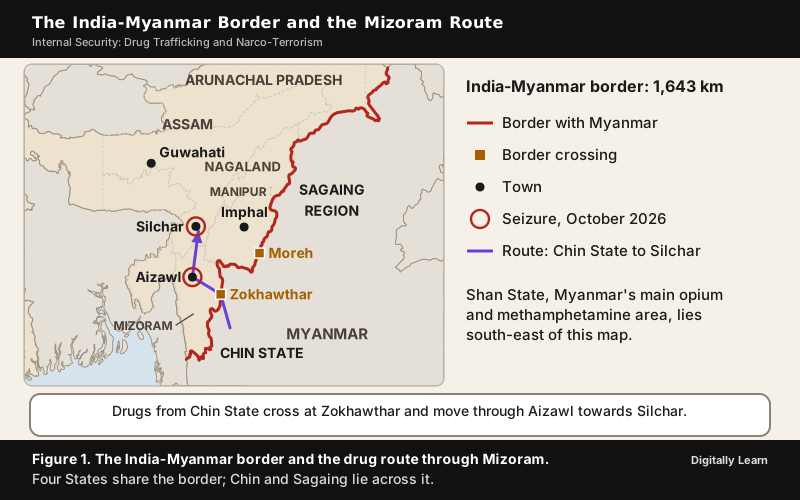
India shares a 1,643 km border with Myanmar along Arunachal Pradesh, Nagaland, Manipur and Mizoram. Communities such as the Kuki, Naga, Mizo and Chin live on both sides of it, which makes cross-border movement part of daily life. In October 2026 the Directorate of Revenue Intelligence seized 50 kg of methamphetamine tablets and crystal methamphetamine in Mizoram and Assam that had been smuggled from Myanmar through Zokhawthar towards Aizawl and Silchar. The Free Movement Regime had let border residents travel up to 16 km across the boundary without a visa; in February 2024 the Ministry of Home Affairs decided to scrap it, citing internal security, and the Centre decided to fence the entire border.
| Feature | Golden Crescent | Golden Triangle |
|---|---|---|
| Countries | Afghanistan, Pakistan and eastern Iran | Myanmar, Thailand and Laos |
| Position relative to India | North-west and west | East |
| Main drug reaching India | Heroin, now also methamphetamine | Heroin and methamphetamine (yaba tablets) |
| Entry into India | Punjab border; Gujarat and Kerala coasts by sea | Manipur and Mizoram border; Andaman Sea |
| Opium trend in 2025 | Afghanistan's cultivation down to 10,200 hectares after the 2022 ban | Myanmar's cultivation up to 53,100 hectares, a ten-year peak |
From Heroin to Methamphetamine: The Shift to Synthetic Drugs
Synthetic drugs are replacing heroin as the main threat on both of India's flanks. Afghanistan supplied some 80 per cent of the world's illegal opium before its ban, and from 2023, after the ban, its production collapsed by 95 per cent against earlier annual outputs. Methamphetamine needs no poppy fields, is easier to make, harder to detect and less exposed to drought, so synthetic drugs have become the new business model for organised crime groups in the region. Seizures of synthetic drugs in and around Afghanistan were about 50 per cent more frequent by the end of 2024 than in the third quarter of 2023.
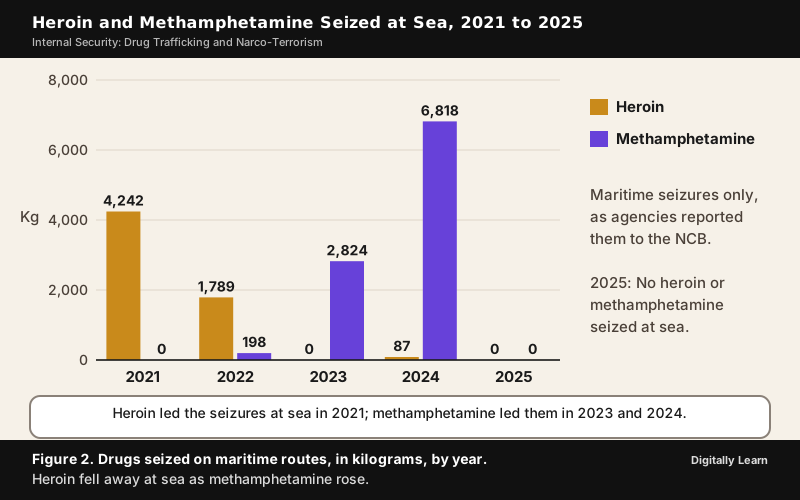
Indian seizures show the same change. Seizures of amphetamine-type stimulants such as methamphetamine in India more than doubled from about 3,400 kg (34 quintals) in 2023 to about 8,000 kg (80 quintals) in 2024, and cocaine seized rose from 292 kg to 1,426 kg. At sea the change is sharper. Heroin made up most maritime seizures in 2021, while methamphetamine made up most of them in 2023 and 2024. In 2024 Indian agencies seized drugs worth about ₹25,330 crore, more than 55 per cent above the ₹16,100 crore seized in 2023.
Narco-Terrorism: How Drugs Fund Terror
Drug Profits and Terror Funding: The Mechanism
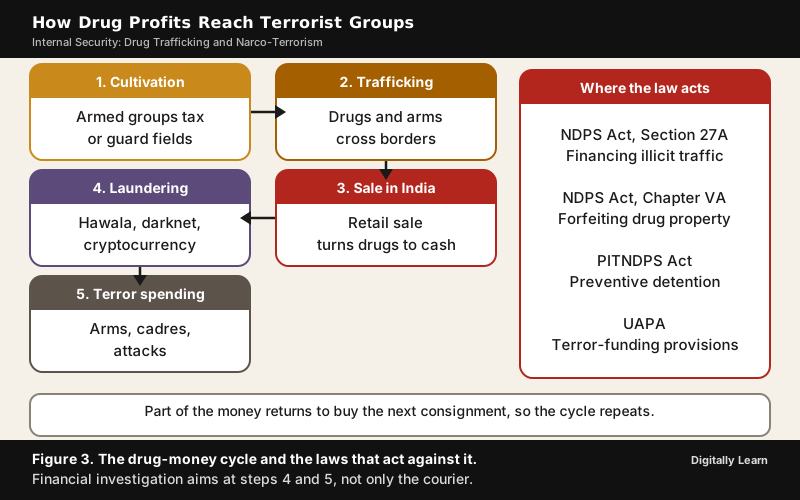
Drug money suits terrorist and insurgent groups because the trade is large and is paid in cash that is hard to trace. The link works in a cycle:
- Cultivation and protection: Armed groups tax farmers or guard fields and laboratories in areas the state does not control.
- Trafficking: The same groups, or criminal networks working with them, move the drugs across borders, often with weapons in the same consignment.
- Sale in India: Retail sale turns the drugs into cash and builds a market of users at the same time.
- Laundering and transfer: The cash moves back through hawala, front businesses, couriers, the darknet or cryptocurrency.
- Terror spending: The money buys arms, pays cadres and funds attacks, and part of it is reinvested in the next consignment.
The NDPS Act does not use the term narco-terrorism. Such cases are pursued by combining the NDPS Act, which punishes anyone who finances illicit traffic, with the terror-funding provisions of the Unlawful Activities (Prevention) Act, 1967 (UAPA). A Joint Coordination Committee chaired by the Director General of the Narcotics Control Bureau monitors the investigation of major drug cases, including cases of narco-terrorism.
Linkages With Gunrunning, Money Laundering and Human Trafficking
Drug trafficking rarely travels alone, because the routes, couriers and cash systems built for drugs serve other crimes as well.
- Gunrunning: Drones that cross the Punjab border carry drugs and weapons together. In the three years to 28 February 2023, 28 drones used for smuggling were recovered, carrying 125.174 kg of heroin along with pistols, magazines, ammunition, detonators and 4.750 kg of other explosives. In the North-East, insurgent groups obtain small arms from armed groups in Myanmar and from black markets in South-East Asia.
- Money laundering: Drug profits must be cleaned before they can be used. The NDPS Act forbids converting, transferring, concealing or knowingly using property derived from a drug offence, and its Chapter VA lets the government freeze and forfeit such property. Traffickers increasingly use the darknet and cryptocurrency. From 2020 to April 2024 the Narcotics Control Bureau booked 92 cases involving the darknet and cryptocurrencies, and enforcement agencies reported 1,025 cases involving parcels and couriers. The Prevention of Money-laundering Act, 2002, and the hawala channels used for terror funding are part of the same chain.
- Human trafficking: In the Golden Triangle and the wider Mekong region, casinos, Special Economic Zones and business parks have become strongholds from which criminal groups run drug production and trafficking, illegal gambling, trafficking in persons for forced criminality and money laundering. In India, the prohibition of traffic in human beings and forced labour is part of the Right against Exploitation, a Fundamental Right in Article 23 of the Constitution.
Drone Drops and Maritime Seizures
Drones and the sea let smugglers avoid the fenced land border. In Punjab, small drones flown from across the frontier drop their loads in nearby fields. Over one year to January 2024, field formations of the Border Security Force (BSF) under its Western Command seized 126 drones and 595 kg of heroin.
The response to drones has several layers:
- Detection and interception: Anti-drone systems have been deployed in Punjab's border areas, and a laser-equipped anti-drone gun mount system has been developed with the Ministry of Defence and the Defence Research and Development Organisation. By December 2024, 55 per cent of drone intrusions along the Punjab border were being intercepted and neutralised, against about 3 per cent earlier.
- Rules and testing: An anti-rogue drone standard operating procedure guides field units, and the Ministry of Home Affairs set up an Anti Rogue Drone Technology Committee under the Director General of the Border Security Force to evaluate and certify counter-drone technology.
- Ground follow-up: Depth nakas are laid in likely dropping zones, local police are alerted as soon as a drone is seen, and border villagers are encouraged to report drone activity.
At sea, the Navy, the Coast Guard, the Narcotics Control Bureau and Gujarat's Anti-Terrorism Squad now act together. The Narcotics Control Bureau's Operation Samudragupt, begun in January 2022, made the first interception of a "mothership" by an Indian agency in May 2023, seizing about 2,500 kg of methamphetamine valued at about ₹15,000 crore. In November 2024 the Coast Guard seized about 5,500 kg of methamphetamine from a Myanmar fishing boat off Barren Island in the Andaman Sea, its biggest haul at the time, and in September 2026 it intercepted an Iranian dhow west of Lakshadweep carrying about 526 kg of heroin and methamphetamine.
Law and Institutions Against Drug Trafficking
NDPS Act, 1985: Offences, Punishments and Amendments
The Narcotic Drugs and Psychotropic Substances Act, 1985, known as the NDPS Act, is India's main law against drug trafficking and drug abuse. It came into force on 14 November 1985 and gives effect to India's obligations under the three United Nations drug conventions. The Act bans the cultivation of coca, opium poppy and cannabis, and the production, possession, sale, purchase, transport, use and consumption of narcotic drugs and psychotropic substances, except for medical or scientific purposes and under licence.
Punishment depends on the quantity involved. The Central Government notifies two thresholds for each drug. An offence involving less than the small quantity draws the lightest punishment, and one involving more than the commercial quantity draws the heaviest.
| Quantity involved | Imprisonment | Fine |
|---|---|---|
| Small quantity | Rigorous imprisonment up to one year, or fine, or both | Up to ₹10,000 |
| More than small but less than commercial | Rigorous imprisonment up to 10 years | Up to ₹1 lakh |
| Commercial quantity | Rigorous imprisonment of 10 to 20 years | ₹1 lakh to ₹2 lakh, or more for reasons recorded |
| Drug | Small quantity | Commercial quantity |
|---|---|---|
| Heroin | 5 grams | 250 grams |
| Morphine | 5 grams | 250 grams |
| Cocaine | 2 grams | 100 grams |
| Methamphetamine | 2 grams | 50 grams |
| Ganja | 1 kg | 20 kg |
| Poppy straw | 1 kg | 50 kg |
Other provisions make the penalties stiff and the procedure strict:
- Financing and harbouring (Section 27A): Financing illicit traffic, directly or indirectly, or harbouring anyone engaged in it is punishable with rigorous imprisonment of 10 to 20 years and a fine of ₹1 lakh to ₹2 lakh. This is the provision that reaches the people who pay for trafficking.
- Consumption (Section 27): Consuming cocaine, morphine, heroin or another notified drug is punishable with rigorous imprisonment up to one year, a fine up to ₹20,000, or both; for other drugs the limit is six months, ₹10,000, or both.
- Repeat offences (Sections 31 and 31A): A second conviction carries up to one and a half times the punishment. For certain repeat offences involving large quantities, the court may impose the death penalty.
- Bail (Section 37): Every offence is cognizable. A person accused of financing, of an offence involving commercial quantity, or of certain other grave offences gets bail only if the court finds reasonable grounds to believe the person is not guilty and is not likely to offend on bail.
- Treatment instead of prosecution (Sections 39 and 64A): An addict who voluntarily seeks de-addiction treatment at a government-run or recognised hospital is immune from prosecution for consumption or for offences involving small quantity, an immunity that can be withdrawn if the treatment is not completed. A court may also release an addict found guilty of such offences for treatment instead of sentencing at once.
- Special Courts (Section 36): The government may set up Special Courts for speedy trial, each with a single judge appointed with the concurrence of the Chief Justice of the High Court.
The Act has been amended in 1988, 2001, 2014 and 2021. The 2001 amendment introduced the graded punishments by small and commercial quantity.
The 2014 amendment made the death penalty for repeat offences discretionary instead of mandatory, created the category of essential narcotic drugs (narcotic drugs notified for medical and scientific use, such as morphine, fentanyl and methadone) to ease their supply for pain relief, raised the punishment for small quantity from six months to one year, and widened the forfeiture of property. The 2021 amendment corrected a drafting error in Section 27A, which still referred to a clause of Section 2 that the 2014 amendment had relettered; the 2021 Act set the right reference with effect from 1 May 2014.
PITNDPS Act, 1988: Preventive Detention and Forfeiture
The Prevention of Illicit Traffic in Narcotic Drugs and Psychotropic Substances Act, 1988 (PITNDPS Act) allows preventive detention of traffickers. The Central or a State Government, or a specially empowered senior officer, may order the detention of any person, including a foreigner, to prevent that person from engaging in illicit traffic. A confirmed detention order may ordinarily run for up to one year from the date of detention. The aim is to stop a person from trafficking before the next offence, instead of punishing a past one.
Chapter VA of the NDPS Act attacks the money directly. It applies to persons convicted of offences carrying 10 years or more, persons detained under the PITNDPS Act, and persons arrested for such offences, and it makes it unlawful for them to hold illegally acquired property, which can be seized, frozen and forfeited to the Central Government.
The sale proceeds of forfeited property go to the National Fund for Control of Drug Abuse, created under Section 7A, which pays for combating illicit traffic, preventing drug abuse, educating the public and treating and rehabilitating addicts. Financial investigation and detention under the PITNDPS Act are reviewed at the NCORD and Joint Coordination Committee meetings, so that a case reaches past the courier to the money behind the network.
Narcotics Control Bureau, NCORD and the Anti-Narcotics Task Forces
The Narcotics Control Bureau (NCB), set up on 17 March 1986 under Section 4(3) of the NDPS Act, is the national agency that coordinates drug law enforcement. It works under the Ministry of Home Affairs, coordinates the Centre and the States, carries out India's obligations under the drug conventions and assists foreign drug enforcement agencies. By June 2025 its Regional Offices had risen from three to seven and its zonal offices from 13 to 30.
Coordination runs through the Narco-Coordination Centre (NCORD) mechanism, set up on 22 November 2016 and restructured into four tiers on 29 July 2019:
- Apex Committee: Chaired by the Union Home Secretary, with secretaries of the ministries concerned, Chief Secretaries and Directors General of Police of the States, and the heads of central agencies.
- Executive Committee: Chaired by the Special Secretary (Internal Security) in the Ministry of Home Affairs.
- State Level Committee: Chaired by the Chief Secretary of the State.
- District Level Committee: Chaired by the District Magistrate, with the Superintendent of Police as convener.
Below this structure, every State and Union Territory has a dedicated Anti-Narcotics Task Force (ANTF), headed by a police officer of the rank of Additional Director General or Inspector General, which also serves as the NCORD secretariat for local enforcement.
| Body or tool | Level | Role |
|---|---|---|
| Narcotics Control Bureau | Central, under the Ministry of Home Affairs | Coordinates enforcement, investigates major networks, handles international cooperation |
| NCORD mechanism | Four tiers, from the Centre to the district | Coordinates central and State agencies and departments |
| Anti-Narcotics Task Force | Every State and Union Territory | Enforcement and NCORD secretariat in the State |
| Joint Coordination Committee | Centre and States, chaired by the NCB's Director General | Monitors major cases, including narco-terrorism |
| Border Security Force, Sashastra Seema Bal, Assam Rifles, Coast Guard, Railway Protection Force | Borders, coasts and railways | Empowered under the NDPS Act to search, seize and arrest |
The NCORD portal gives all agencies one source of drug-enforcement information. The MANAS helpline (Madak-Padarth Nished Asoochna Kendra), toll-free number 1933, was launched in July 2024 for citizens to report drug-related issues by call, SMS, chatbot, email or web. The National Integrated Database on Arrested Narco-Offenders (NIDAAN) portal holds the data of arrested drug offenders, and a Special Task Force on Darknet and Crypto Currency tracks drug sales on the darknet.
Demand Reduction and Drug Abuse
Drug Use in India: The 2019 National Survey
The Magnitude of Substance Use in India survey is the most recent national estimate of drug use. The Ministry of Social Justice and Empowerment had it carried out in 2018 by the National Drug Dependence Treatment Centre of the All India Institute of Medical Sciences (AIIMS), New Delhi, and the report was released in February 2019. It covered people aged 10 to 75 in all 36 States and Union Territories, combining a household survey of 4,73,569 people with a separate survey of 70,293 people dependent on illicit drugs.
The main findings for people aged 10 to 75 were:
- Alcohol: About 14.6 per cent, or about 16 crore people, were current users.
- Cannabis: About 2.8 per cent, or 3.1 crore people, had used a cannabis product in the past year.
- Opioids: Current use stood at 2.06 per cent; heroin was the most common opioid, at 1.14 per cent, followed by pharmaceutical opioids and opium. About 60 lakh people had opioid use disorders.
- Regional spread: By share of population, the States most affected by opioid use were in the North-East (Mizoram, Nagaland, Arunachal Pradesh, Sikkim and Manipur), together with Punjab, Haryana and Delhi.
- Children: Inhalants were the only substances used more by children and adolescents (1.17 per cent) than by adults (0.58 per cent).
The pattern follows the trafficking routes, with Punjab and the North-Eastern States among the worst affected. A second national survey, with estimates down to the district level, has been entrusted to the same centre at AIIMS.
Nasha Mukt Bharat Abhiyaan and De-Addiction Services
Demand reduction rests on a constitutional direction. Article 47, a Directive Principle of State Policy, directs the State to raise the level of nutrition and the standard of living, to improve public health, and to prohibit intoxicating drinks and drugs injurious to health except for medicinal purposes.
The Ministry of Social Justice and Empowerment runs the National Action Plan for Drug Demand Reduction (NAPDDR), a centrally sponsored scheme for prevention, treatment and rehabilitation. Under it, the government supports:
- Integrated Rehabilitation Centres for Addicts: There are 349 of them, giving in-patient treatment, counselling, detoxification and after-care.
- Addiction Treatment Facilities: There are 154, in government hospitals.
- District De-Addiction Centres: There are 145, each offering all these services under one roof in a district.
- Outreach and peer-led centres: There are 76 Outreach and Drop-in Centres for screening, counselling and referral, and 45 peer-led programmes for early prevention among adolescents.
- Helpline 14446: A toll-free number gives counselling and referral.
The Nasha Mukt Bharat Abhiyaan (NMBA), launched on 15 August 2020, carries awareness to schools, colleges and communities in all districts. By September 2026 it had reached 25 crore citizens, and about 5.7 lakh people had been made drug-free through treatment and rehabilitation. The Ministry of Health and Family Welfare separately runs a Drug De-addiction Programme through government hospitals.
Measures to Counter Narco-Terrorism
Border Control, Maritime Security and Intelligence Sharing
Counter-measures follow the route of the drugs, from the border and the port to the money and the market.
- Land borders: The Pakistan border has fencing and an integrated surveillance system of cameras, infrared sensors and alarms linked to a command and control system; the whole Myanmar border is to be fenced; and anti-drone systems guard Punjab.
- Empowered forces: The Border Security Force, Sashastra Seema Bal, Assam Rifles and Indian Coast Guard can search, seize and arrest under the NDPS Act on land and sea borders, and the Railway Protection Force on the rail network.
- Ports and the sea: A Multi Agency Maritime Security Group in the National Security Council Secretariat, set up in November 2022, analyses trafficking by sea, and the Navy, Coast Guard and NCB run joint operations such as Sagar Manthan.
- Intelligence and data: The NCORD portal, the NIDAAN database, the Crime and Criminal Tracking Network System and a national canine pool (Nar-K9) at 10 locations support detection and investigation.
- Following the money: Financial investigation, forfeiture under Chapter VA and detention under the PITNDPS Act aim at the kingpins and financiers instead of the couriers.
- Reducing demand: Treatment, awareness and the NMBA shrink the market that pays for the whole chain.
Two limits stand out. The Myanmar border runs through hills where the same communities live on both sides, and the threat from drones is expected to grow. Cooperation between agencies and with the public therefore matters as much as fencing and equipment.
International Cooperation and UN Drug Conventions
Drug trafficking crosses borders, so no country can control it alone. India is a party to the three United Nations drug control conventions, which together form the global framework.
| Convention | Signed | In force | What it controls |
|---|---|---|---|
| Single Convention on Narcotic Drugs | 30 March 1961, New York | 13 December 1964 | Plant-based narcotics such as opium, coca and cannabis, and their products |
| Convention on Psychotropic Substances | 21 February 1971, Vienna | 16 August 1976 | Synthetic psychoactive drugs such as amphetamine-type stimulants and sedatives |
| Convention against Illicit Traffic in Narcotic Drugs and Psychotropic Substances | 20 December 1988, Vienna | 11 November 1990 | Trafficking, precursor chemicals and the confiscation of drug proceeds |
The Commission on Narcotic Drugs (CND) is the United Nations' central drug policy-making body; 53 member States sit on it for four-year terms, and it decides, on the advice of the World Health Organization and the International Narcotics Control Board, which substances are placed under international control. The United Nations Office on Drugs and Crime (UNODC) supports countries in carrying out the conventions and publishes the World Drug Report and the opium surveys of Afghanistan and Myanmar. Its 2026 report estimates that 331 million people used a drug in 2024.
India works with other countries through:
- Bilateral ties: The NCB has bilateral agreements with 27 countries and memoranda of understanding with 19 countries, and holds Director General level talks with neighbours such as Myanmar, Iran, Bangladesh and Sri Lanka.
- Shared intelligence: Inputs from India's maritime operations have led to seizures by Sri Lanka and the Maldives, and a 2024 arrest in Delhi followed information from Australian and New Zealand authorities.
- Training: The NCB trains officers on clandestine laboratories and precursor diversion with the United States Drug Enforcement Administration.
The United Nations General Assembly decided on 7 December 1987 to observe 26 June as the International Day against Drug Abuse and Illicit Trafficking, and India marks it each year.
Previous Year UPSC‑CSE Questions
Each Prelims question is explained option by option, and each Mains question comes with an answer outline.
- UPSC Prelims 2008Which of the following is/are included in the Directive Principles of State Policy?
- Prohibition of traffic in human beings and forced labour
- Prohibition of consumption except for medicinal purposes of intoxicating drinks and of other drugs which are injurious to health
Which of the statements given above is/are correct?
How to approach this Prelims question
Approach: Test each statement against the part of the Constitution where the provision sits.
- Statement 1: The prohibition of traffic in human beings and forced labour is in Article 23, which is a Fundamental Right in Part III, so it is not a Directive Principle.
- Statement 2: The prohibition of intoxicating drinks and harmful drugs except for medicinal purposes is in Article 47, a Directive Principle in Part IV.
Only statement 2 is a Directive Principle, which gives option (b).
Trap to watch: Students who remember that the Directive Principles speak of health and welfare pick option (c), because ending human trafficking also sounds like a welfare goal; but Article 23 is an enforceable Fundamental Right, not a Directive Principle.
Why each option is right or wrong:
- (a) 1 only: Wrong. Article 23 on traffic in human beings and forced labour is a Fundamental Right, not a Directive Principle.
- (b) 2 only: Correct. Article 47 directs the State to prohibit intoxicating drinks and drugs injurious to health except for medicinal purposes.
- (c) Both 1 and 2: Wrong. Statement 1 belongs to the Fundamental Rights under Article 23.
- (d) Neither 1 nor 2: Wrong. Statement 2 is the Directive Principle in Article 47.
Answer: (b) 2 only. Article 47 places the prohibition of intoxicating drinks and harmful drugs among the Directive Principles, while Article 23 makes the ban on human trafficking a Fundamental Right.
- UPSC Mains 2024 GS‑IIIExplain how narco-terrorism has emerged as a serious threat across the country. Suggest suitable measures to counter narco-terrorism.
Answer outline
The outline sets out what the question asks, the main arguments, relevant examples and the direction of the conclusion; it is not a full model answer.
Introduction: Narco-terrorism is the use of drug profits and drug routes to fund and arm terror and insurgent groups; India lies between the Golden Crescent and the Golden Triangle.
Body (sub-themes to develop):
- Spread across the country: Land routes into Punjab and the North-East, sea routes to Gujarat, Kerala and the Andaman Sea, drone drops, and darknet and courier sales.
- Shift to synthetic drugs: Seizures of amphetamine-type stimulants in India rose from about 3,400 kg in 2023 to about 8,000 kg in 2024 as Afghan opium declined and Myanmar's output rose.
- Threat: Drug cash funds weapons and cadres, arms travel with drugs, and addiction spreads, most heavily in the border States.
- Measures: The NDPS Act (Section 27A, Chapter VA), the PITNDPS Act, NCORD, the ANTFs and the Joint Coordination Committee; anti-drone systems and joint maritime operations; international cooperation; and demand reduction through the NMBA and de-addiction centres.
Conclusion: Narco-terrorism is fought best by striking the money, the routes and the market together.
- UPSC Mains 2023 GS‑IIIThe use of unmanned aerial vehicles (UAVs) by our adversaries across the borders to ferry arms/ammunitions, drugs, etc., is a serious threat to the internal security. Comment on the measures being taken to tackle this threat.
Answer outline
Introduction: Small drones from across the Punjab border drop heroin and weapons in fields; 28 such drones were recovered in the three years to February 2023, carrying 125.174 kg of heroin with pistols and explosives.
Body (sub-themes to develop):
- Detection and interception: Anti-drone systems are deployed in Punjab, and a laser-equipped anti-drone gun mount system raised interceptions to 55 per cent of intrusions by December 2024.
- Rules and testing: An anti-rogue drone standard operating procedure, and an Anti Rogue Drone Technology Committee under the Director General of the BSF to certify counter-drone technology.
- Ground follow-up: Depth nakas in dropping zones, immediate alerts to local police and reporting by border villagers.
- Limits: The threat from drones is expected to grow, so detection must be paired with investigation of the receivers and financiers.
Conclusion: The measures have raised interception sharply, and dedicated anti-drone units with financial investigation of the networks are the next step.
- UPSC Mains 2018 GS‑IIIIndia's proximity to two of the world's biggest illicit opium-growing states has enhanced her internal security concerns. Explain the linkages between drug trafficking and other illicit activities such as gunrunning, money laundering and human trafficking. What counter-measures should be taken to prevent the same?
Answer outline
Introduction: India lies between Afghanistan in the Golden Crescent and Myanmar in the Golden Triangle, Asia's two main areas of illicit opium production, so heroin and methamphetamine enter through Punjab, Gujarat's coast and the Myanmar border.
Body (sub-themes to develop):
- Gunrunning: Drones on the Punjab border carry heroin with pistols and explosives, and arms from Myanmar reach insurgent groups in the North-East.
- Money laundering: Drug cash moves through hawala, couriers, the darknet and cryptocurrency, and the NDPS Act makes dealing in drug-derived property an offence.
- Human trafficking: Criminal enclaves in the Golden Triangle combine drug production with trafficking in persons for forced criminality and money laundering.
- Counter-measures: Border fencing and anti-drone systems, joint maritime operations, NCORD and the ANTFs, Section 27A and Chapter VA of the NDPS Act, detention under the PITNDPS Act, and cooperation with neighbours and UNODC.
Conclusion: Cutting the money and the market together, through financial investigation and demand reduction, weakens all the linked crimes at once.
Sources
- NCERT: Indian Constitution at Work (Class XI, revised edition, reprint 2026‑27), Chapter 2, Rights in the Indian Constitution
- India Code (Department of Revenue copy): The Narcotic Drugs and Psychotropic Substances Act, 1985 (last updated 3 January 2022)
- Department of Revenue: Punishment for Offences under the NDPS Act
- Department of Revenue: Special Provision for Addicts
- Department of Revenue: The Prevention of Illicit Traffic in Narcotic Drugs and Psychotropic Substances Act, 1988
- PIB: Prevention of Smuggling of Narcotic Substances (Rajya Sabha reply, 5 August 2026)
- PIB: Union Home Minister addresses a press conference on narcotics control in Panaji (6 September 2026)
- PIB: More than ₹25,000 crore worth of drugs seized in 2024
- PIB: NCORD mechanism (Rajya Sabha reply, 23 July 2025)
- PIB: Measures to combat drug trafficking (Lok Sabha reply, 2 December 2025)
- PIB: Drug trafficking, darknet and steps taken (Rajya Sabha reply, 24 July 2024)
- PIB: Seventh Apex Level Meeting of NCORD and launch of MANAS (15 July 2024)
- PIB: International Day against Drug Abuse and Illicit Trafficking 2025
- PIB: DRI seizure of heroin at Mundra Port (22 September 2021)
- PIB: Seizure of about 2,500 kg of methamphetamine under Operation Samudragupt (13 May 2023)
- PIB: Biggest-ever drug haul by ICG in the Andaman Sea (25 November 2024)
- PIB: ICG interdicts transnational syndicate west of Lakshadweep (30 September 2026)
- PIB: DRI seizes 50 kg of methamphetamine in the North-East (30 October 2026)
- PIB: Smuggling of Arms and Narcotics by drones (Lok Sabha reply, 28 March 2023)
- PIB: DG BSF reviews the Western Command (22 January 2024)
- PIB: Union Home Minister at the 60th Raising Day of the BSF (8 December 2024)
- PIB: MHA decides to scrap the Free Movement Regime between India and Myanmar (8 February 2024)
- PIB: Fence along the entire Indo-Myanmar border (6 February 2024)
- PIB: NDDTC, AIIMS submits report Magnitude of Substance Use in India (18 February 2019)
- PIB: Steps taken to prevent substance addiction among youth (Rajya Sabha reply, 24 March 2026)
- PIB: Nasha Mukt Bharat Abhiyaan and the second national survey (Lok Sabha reply, 10 March 2026)
- UNODC: Afghanistan opium cultivation falls in 2025 (6 November 2025)
- UNODC: Myanmar's opium cultivation reaches ten-year peak (December 2025)
- UNODC: World Drug Report 2026, Highlights
- UNODC: Rise in production and trafficking of synthetic drugs from the Golden Triangle (May 2025)
- UNODC: Transnational Organized Crime and the Convergence of Cyber-Enabled Fraud, Underground Banking and Technological Innovation in Southeast Asia (October 2024)
- UNODC: What is the Commission on Narcotic Drugs? (March 2026)
- Wikipedia: Golden Crescent
- Wikipedia: Golden Triangle (Southeast Asia)
- Wikipedia: Narcoterrorism
- Wikipedia: Opium production in Afghanistan
- Wikipedia: Narcotic Drugs and Psychotropic Substances Act, 1985
- Wikipedia: Narcotics Control Bureau
- Wikipedia: Illegal drug trade in India
- Wikipedia: India-Myanmar border
- Wikipedia: Single Convention on Narcotic Drugs
- Wikipedia: Convention on Psychotropic Substances
- Wikipedia: United Nations Convention Against Illicit Traffic in Narcotic Drugs and Psychotropic Substances
- Wikipedia: Directive Principles
- Wikipedia: Fundamental rights in India
- UPSC: Civil Services Examination question papers
Editorial Disclaimer
Seizure figures, scheme numbers and the status of border arrangements change; where this article and the official text differ, the Act on India Code and the latest release of the ministry prevail.
See more of our UPSC articles in Google Search
Add to Preferred Sources

